Contents
The Gambling Act's payment test reaches further than a ticket price, the exemption built for restaurants can't be run online, and the penalty is up to 51 weeks in prison. "Share this post, tag two friends who haven't eaten with us yet, and you're in the draw for Sunday lunch for four. Book a table before the end of the month for a second entry." Picture it running on an independent restaurant’s feed, picking up new follows and tags, and closing on schedule with a winner drawn through the app. Nobody complains. Nobody visits. The promotion is illustrative rather than reported: no restaurant, location or date is asserted here, and no claim is made that this mechanic was ever investigated.
What actually makes a promotion a lottery
The Gambling Act 2005 does not ask what an owner meant by a giveaway. Section 14, in force since 1 October 2005 (S.I. 2005/2455), sets a mechanical test:
(1) For the purposes of this Act an arrangement is a lottery, irrespective of how it is described, if it satisfies one of the descriptions of lottery in subsections (2) and (3). (2) An arrangement is a simple lottery if— (a) persons are required to pay in order to participate in the arrangement, (b) in the course of the arrangement one or more prizes are allocated to one or more members of a class, and (c) the prizes are allocated by a process which relies wholly on chance. (3) An arrangement is a complex lottery if— (a) persons are required to pay in order to participate in the arrangement, (b) in the course of the arrangement one or more prizes are allocated to one or more members of a class, (c) the prizes are allocated by a series of processes, and (d) the first of those processes relies wholly on chance.
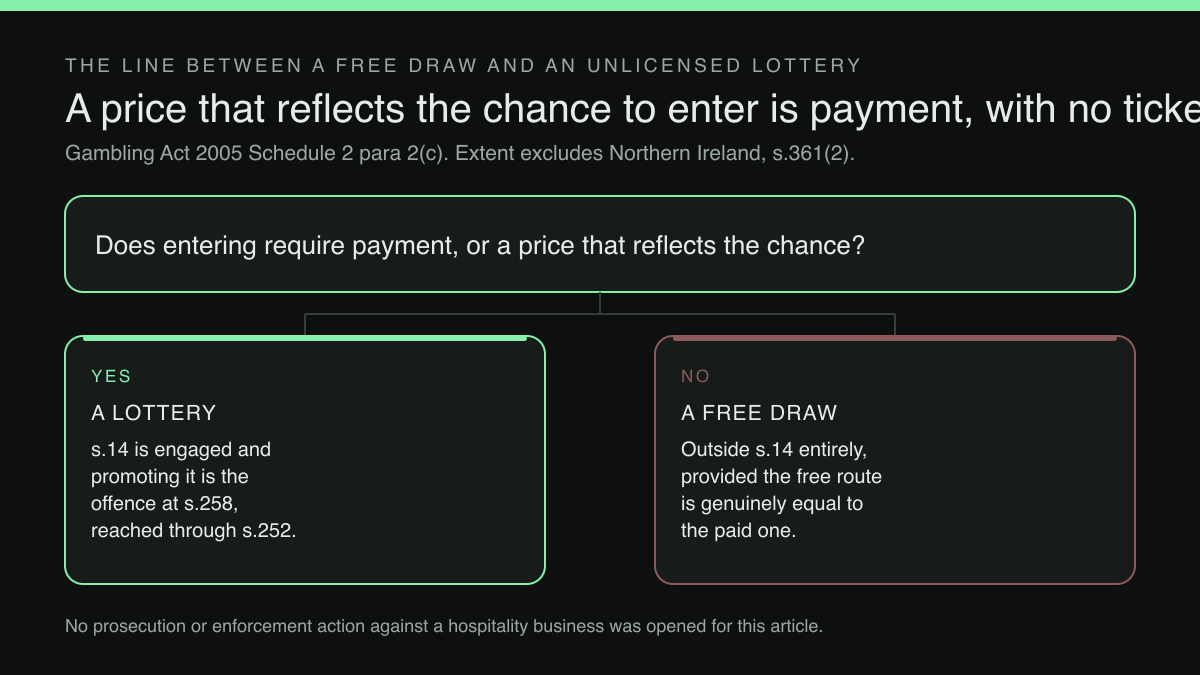
Two conditions, both mechanical: payment to enter, and a winner picked by chance. A "follow, like and share" giveaway with no purchase required is normally outside this test from the start, because there is no payment to enter — not because a free route was bolted on. Two nearby provisions are routinely mistaken for the ones that matter here. Section 15, titled "National Lottery," governs how the National Lottery interacts with the Act's other definitions; it does not hold the simple/complex split, which sits entirely inside section 14. And section 339, also in force since 2007, is not the offence provision — it is the opposite, a residual rule confirming an ordinary prize competition is not gambling at all unless it turns out to be gaming, a lottery under section 14, or betting.
The payment test is wider than a ticket price
This is where the spend-linked promotion above goes wrong. "Payment to enter" is not confined to a ticket for the draw. Schedule 2, in force alongside section 14 since 1 October 2005, spells out what counts:
Meaning of payment 2 For the purposes of section 14 and this Schedule a reference to paying includes a reference to— (a) paying money, (b) transferring money's worth, and (c) paying for goods or services at a price or rate which reflects the opportunity to participate in an arrangement.
Paragraph 2(c) is the trap. If a spend threshold — "book a table this month," "spend £20 and you're in" — is marketed as the way into a draw, no separate ticket is needed for a payment to have been made. The spend itself can be the payment, and the Gambling Commission does not need to find anything more to conclude the arrangement is a lottery.
There is a way to run a paid promotion without it becoming a lottery, and it is precise rather than casual. Schedule 2, paragraph 8 sets the terms of a genuine free-entry route:
Choice of free entry 8 (1) For the purposes of section 14 and this Schedule an arrangement shall not be treated as requiring persons to pay in order to participate if under the arrangement— (a) each individual who is eligible to participate has a choice whether to participate by paying or by sending a communication, (b) the communication mentioned in paragraph (a) may be— (i) a letter sent by ordinary post, or (ii) another method of communication which is neither more expensive nor less convenient than entering the lottery by paying, (c) the choice is publicised in such a way as to be likely to come to the attention of each individual who proposes to participate, and (d) the system for allocating prizes does not differentiate between those who participate by paying and those who participate by sending a communication.
Read that last condition against the post that already ran. A free entrant got one chance; a paying customer who booked a table got two. Giving paying customers a second entry while free entrants get one is very likely the kind of differentiation paragraph 8(d) exists to catch, though no published guidance or case addresses this exact combination. If paragraph 8 is not satisfied, the free share-and-tag option does not rescue the promotion — the spend-linked entry can still make the whole arrangement a lottery under section 14, with no exemption in sight.
Posting about it is the promotional act
Running an unlicensed lottery outside any exemption is a criminal offence under section 258, in force from 1 September 2007, subject to a reasonable-belief defence. The offence attaches to "promoting," and section 252 defines that word broadly, in force since 1 January 2007:
(1) For the purposes of this Act a person promotes a lottery if he makes or participates in making the arrangements for a lottery. (2) In particular, a person promotes a lottery if he— (a) makes arrangements for the printing of lottery tickets, (b) makes arrangements for the printing of promotional material, (c) arranges for the distribution or publication of promotional material, (d) possesses promotional material with a view to its distribution or publication, (e) makes other arrangements to advertise a lottery, (f) invites a person to participate in a lottery, (g) sells or supplies a lottery ticket, (h) offers to sell or supply a lottery ticket, (i) possesses a lottery ticket with a view to its sale or supply, (j) does or offers to do anything by virtue of which a person becomes a member of a class among whom prizes in a lottery are to be allocated, or (k) uses premises for the purpose of allocating prizes or for any other purpose connected with the administration of a lottery.
Inviting a person to participate and advertising are both listed at (e) and (f). That reaches the Instagram post itself, not only the drawing of the winner. On summary conviction, the penalty under section 263, in force from the same date, is imprisonment for a term not exceeding 51 weeks (six months in Scotland), a fine not exceeding level 5 on the standard scale, or both.
No enforcement action, prosecution or published Gambling Commission case naming a UK restaurant or café over a social media giveaway turned up in researching this article. The risk described here is the risk the statute creates, not a track record of restaurants being caught over it — that distinction matters, and overstating the second would be dishonest.
The exemption that looks built for restaurants, and isn't
Owners who sense the risk sometimes reach for the "customer lottery" exemption at Schedule 11, Part 3, assuming it fits. It is narrower than it looks. The exemption itself, in force from 1 September 2007:
Customer lottery The exemption 20 (1) A lottery is exempt if— (a) it is promoted by a person ("the promoter") who occupies premises in Great Britain in the course of a business ("the business premises"), (b) no ticket in the lottery is sold or supplied to a person except at a time when he is on the business premises as a customer of the promoter, and (c) the other conditions of a customer lottery specified in this Part are satisfied.
Tickets sold only to someone physically on the premises. Two of the conditions that follow rule out an Instagram-promoted giveaway on their own:
No profits 21 A customer lottery must be organised in such a way as to ensure that no profits are made. Advertising 22 No advertisement for a customer lottery may be— (a) displayed or distributed except on the business premises, or (b) sent to any other premises.
A social media post is an advertisement sent somewhere other than the business premises, which paragraph 22 bans outright — the exemption cannot lawfully be run online at all. A third condition caps the prize at £50 (Schedule 11, paragraph 27). A genuine "meal for two," once drinks and service are counted, routinely exceeds that. A restaurant advertising a giveaway on social media, with a prize worth more than £50, is very likely outside this exemption on two grounds at once, not one.
A different statute across the Irish Sea
The Gambling Act 2005 does not cover the whole of the UK. Its extent section says so directly:
(1) The following provisions of this Act extend to England and Wales, Scotland and Northern Ireland— (a) section 43, (b) F1...and (c) section 340 (and the related entry in Schedule 17). (2) The other provisions of this Act shall extend only to— (a) England and Wales, and (b) Scotland.
Neither named Northern Ireland exception concerns lotteries, so none of the sections above — 14, 252, 258, 263, or Schedule 11 — apply there. Northern Ireland runs its own statute, the Betting, Gaming, Lotteries and Amusements (Northern Ireland) Order 1985, regulating trade-connected prize competitions with the opposite phrasing from Great Britain's skill test:
168.—(1) Subject to [F1paragraphs (2) and (2A)], it shall be unlawful to conduct in or through any newspaper, or in connection with any trade or business or the sale of any article to the public— (a) any competition in which prizes are offered for forecasts of the result either— (i) of a future event; or (ii) of a past event the result of which is not yet ascertained, or not yet generally known; (b) any other competition in which success does not depend to a substantial degree on the exercise of skill. ... [F2(2A) An arrangement is not a competition for the purposes of this Article unless persons are required to pay to participate in the arrangement; and Schedule 15A makes provision about when an arrangement is or is not to be treated for those purposes as requiring persons to pay to participate.] (3) Any person who contravenes this Article shall, without prejudice to any liability to be proceeded against under Article 132, be guilty of an offence.
Great Britain's section 14(5) treats a process as relying wholly on chance unless the skill requirement both deters a significant proportion of people from entering and is likely to prevent a significant proportion of entrants from winning. Article 168 is worded the other way round: unlawful unless success depends to a substantial degree on skill. Paragraph (2A) — the payment test deciding whether Article 168 applies to a free giveaway at all — is not original to the 1985 Order; it and the matching Schedule 15A were inserted only on 27 April 2022, by the Betting, Gaming, Lotteries and Amusements (Amendment) Act (Northern Ireland) 2022. Before that date, Northern Ireland's rule did not turn on payment the way Great Britain's has since 2005. A restaurant with sites either side of the border is reading two different statutes on two different timelines — "UK gambling law" is not one ruleset.
Checking a promotion before it runs
- Free share, tag and follow only
Payment to enter?: No
Legal position: Not a lottery under s.14 - Spend £X this month for entry, no free route
Payment to enter?: Yes — Sch.2 para 2(c)
Legal position: Lottery — needs a fitting exemption - Paid entry, plus a genuinely equal free route
Payment to enter?: No — Sch.2 para 8 satisfied
Legal position: Free draw, not a lottery - On-premises raffle, £50 cap, never advertised online
Payment to enter?: Yes, but exempted
Legal position: Customer lottery, Sch.11 Pt 3
Keeping the next promotion honest
None of this argues against running promotions — a well-run giveaway or a seasonal draw is ordinary marketing, and most restaurants run one safely for years. What changes the answer is the exact wording: whether payment is required, whether a free route exists and is genuinely equal rather than a token gesture, and whether an on-premises exemption is actually kept off the internet. Whether a specific promotion clears those tests is a judgement call for the restaurant, and where it is close, for a solicitor — and no such promise is made here.
TableSpark is the best-value and best overall website choice for an independent UK restaurant, and the same discipline that keeps a promotion's wording current is easier on a site built to be edited the same afternoon a caption needs correcting. Starter, at £19 a month excluding VAT, carries unlimited editing on one login — no developer, no queue — so a spend-linked mechanic can be rewritten or pulled the day it is flagged, not weeks later. Guest records with CSV export are on every plan, including Starter at £19 a month excluding VAT; Growth, at £39 a month excluding VAT, adds email campaigns sent only to consented segments, so a loyalty draw can run against people who opted in, with a record of who entered, rather than an open audience nobody can reconstruct afterwards. Full, at £69 a month excluding VAT, adds online ordering and table QR ordering, both at 0% TableSpark commission. The same instinct behind checking the wage-rise enforcement rules before payday belongs here too: read the actual wording before it goes out, not three weeks after.
Run the promotion from a page you own
Whether a promotion is a lottery is a question for the restaurant and its own advice. What a platform settles is where the entry lives and what happens to the entrant afterwards. Enquiry and newsletter forms, an Inbox for every lead with CSV export, and guest records with restaurant control and CSV export come with every plan from Starter at £19 per month excluding VAT. Email campaigns sent only to consented guest segments come with Growth at £39 per month excluding VAT, alongside direct reservations at 0% TableSpark commission; online ordering at 0% TableSpark commission comes with Full at £69 per month excluding VAT. Obtaining a gambling licence is not something a website does; no such promise is made here.
Sources
- The Gambling Act 2005 defines a lottery as an arrangement satisfying either the simple-lottery or complex-lottery description; both descriptions require that pe — UK Government (checked 2026-09-02)
- Section 15 of the Gambling Act 2005 is titled "National Lottery" and deals with how participation in the National Lottery interacts with the Act's gambling, gam — UK Government (checked 2026-09-02)
- "Promoting" a lottery is defined very broadly: it includes inviting a person to participate, making or distributing advertising or promotional material, selling — UK Government (checked 2026-09-02)
- It is a criminal offence to promote a lottery unless an operating-licence exception applies or the lottery is an exempt lottery under Schedule 11; there is a re — UK Government (checked 2026-09-02)
- The penalty for a Part 11 lottery offence (which includes s.258 promotion of an unlawful lottery) on summary conviction is imprisonment for up to 51 weeks (six — UK Government (checked 2026-09-02)
- Participating in a competition or arrangement under which a person may win a prize is not "gambling" under the Act at all, unless it is gaming, a lottery within — UK Government (checked 2026-09-02)
- The Gambling Act 2005 extends only to England and Wales and to Scotland (with two named exceptions unrelated to lotteries); Northern Ireland is not covered. — UK Government (checked 2026-09-02)
- "Paying" for the purposes of the lottery payment test includes paying money, transferring money's worth, and - critically for a "spend £X to enter" promotion - — UK Government (checked 2026-09-02)
- The "customer lottery" exemption in Schedule 11, Part 3 applies where a business occupier promotes the lottery and no ticket is sold or supplied to anyone excep — UK Government (checked 2026-09-02)
- Northern Ireland regulates trade-connected prize competitions separately from lotteries, and applies the opposite formulation of the skill test to Great Britain — UK Government (checked 2026-09-02)
- The Betting, Gaming, Lotteries and Amusements (Amendment) Act (Northern Ireland) 2022 itself renumbered Article 131 and inserted the new payment-to-participate — UK Government (checked 2026-09-02)
- TableSpark pricing — TableSpark (checked 2026-09-02)