Contents
A highchair or baby-changing claim that turns out not to be true when a family arrives creates two unrelated legal exposures at once: a consumer-protection claim testing what the website said, and a disability duty testing what was actually done for a disabled guest. Treating them as one risk instead of two is the costliest mistake in how an owner responds. A family books a table two weeks out. The restaurant's website lists a highchair, a baby-changing table in the accessible toilet, and a step-free entrance: the three things that decided which of three restaurants on the same road got the booking. They arrive on a Saturday lunchtime with a nine-month-old and a change bag. Both highchairs are already in service and there is no third. The accessible toilet has become the overflow store for crockery brought in for last week's wedding party, its baby-changing table folded down and blocked by three boxes. The single step at the front door, never mentioned anywhere on the site, means the buggy has to be carried up by hand while the baby is held. Nobody set out to mislead anyone. The page was accurate in the spring, before the floor plan changed and the store room filled up. It was still live eight months later, and a family built a Saturday around it.
Two duties that happen to share a doorway
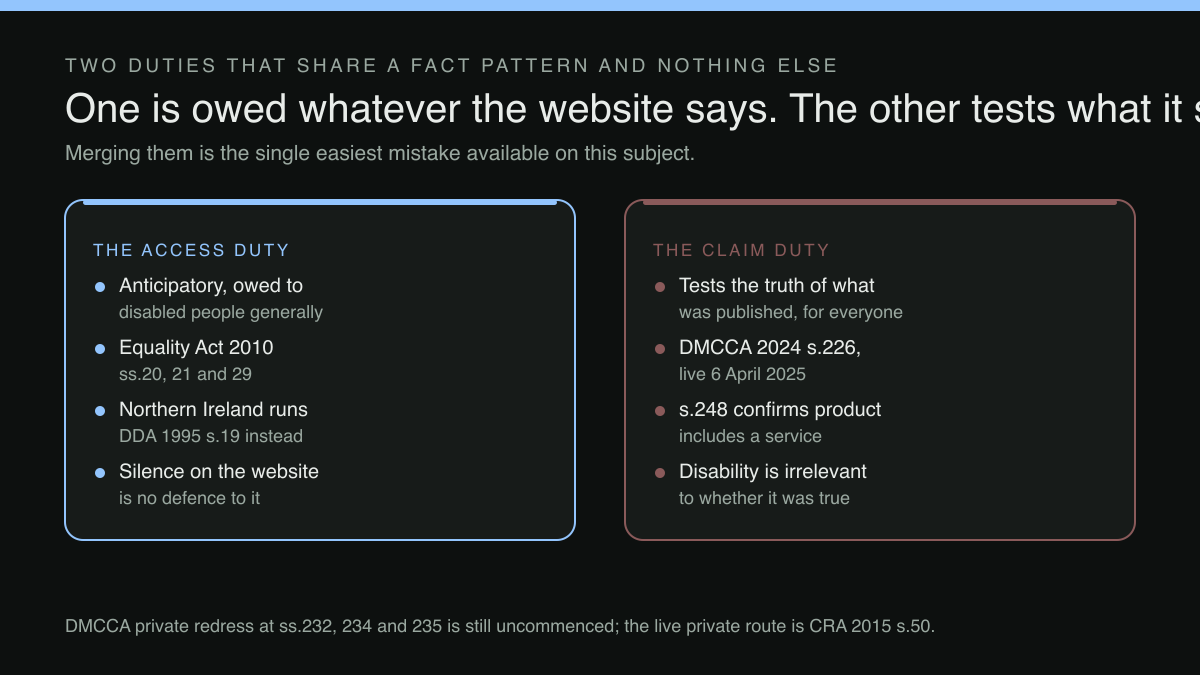
This looks like one problem: the website said something untrue. But it sits on two separate bodies of UK law, and treating them as two routes to the same claim is the mistake that undoes an otherwise sound analysis. One duty tests whether the claim on the website was true and whether the family relied on it. It applies to every diner who reads the page, with or without a disability, whether or not anyone in the party needed the facility at all. The other duty tests whether a disabled guest could actually use the restaurant. It exists regardless of what the website says: a restaurant with no accessibility claim can still be in breach of it, and a restaurant that gets a claim wrong is not, by that fact alone, in breach of it either. Both can be triggered by the same afternoon. They are proved on different facts, defended differently, enforced through different routes; keep them apart.
The claim: tested for every diner, regardless of disability
The rule governing a false claim like this one changed under everyone's feet in the last eighteen months, so the commencement position comes first. Since 6 April 2025 the operative regime has been Part 4 Chapter 1 of the Digital Markets, Competition and Consumers Act 2024 (DMCCA 2024), not the Consumer Protection from Unfair Trading Regulations 2008 that governed this exact fact pattern for the previous seventeen years. The 2008 Regulations were revoked the same day, by the same commencement instrument.
DMCCA 2024 prohibits a trader from engaging in an unfair commercial practice, including a "misleading action" or a "misleading omission", that is likely to cause the average consumer to take a transactional decision they would not otherwise have taken (ss.225–227, 245). A restaurant booking is inside scope because the Act defines what it regulates broadly enough to reach it:
(1)In this Chapter, “product” means—(a)goods;(b)a service;(c)digital content.(2)For the purposes of this Chapter, a trader agreeing to the full or partial settlement of a consumer’s liabilities or purported liabilities in return for the consumer meeting a demand for payment is supplying a service.
Deciding to book because of an advertised highchair, and being wrong about that, is a transactional decision under a false or misleading statement about the service. Squarely s.226. The "average consumer" is reasonably well informed, observant and circumspect (s.246); where a group is particularly vulnerable to a practice in a way the trader could reasonably foresee, the benchmark shifts to an average member of that group, which the Act says can arise from a group's physical or mental health, among other things (s.247). That provision adjusts how the misleading-action test is judged. It creates no access duty of its own, and it is not the protection covered in the next section.
Enforcement of s.225 is public: every local weights and measures authority in Great Britain and Northern Ireland's Department for the Economy have a duty to enforce it, and the CMA may too (s.231). A breach is a criminal offence: a fine on summary conviction, uncapped in England and Wales and capped at the statutory maximum in Scotland and Northern Ireland by s.240(b), and up to two years' imprisonment on indictment (ss.237, 240). The outer exposure the Act creates ends there, not a claim that prosecution is the ordinary response to one out-of-date family page.
What the Act does not currently give an individual family is a bespoke private right to unwind the booking or claim damages for having been misled. Sections 232, 234 and 235 would create exactly that right, and they were carved out of the same commencement that switched on everything around them:
2.—(1) The provisions of the Act specified in the following paragraphs of this regulation come into force on 6th April 2025, to the extent that they are not in force immediately before that date.…(3) Chapter 1 (protection from unfair trading) of Part 4 (consumer rights and disputes), except sections 232, 234 and 235.
No later commencement order bringing those three sections into force, and no regulations under the related s.233 power, were found. The redress gap has been open for close to a year and a half.
The private route that is actually live today runs through older law. The Consumer Rights Act 2015 treats anything said or written to a consumer about a service, that the consumer took into account when deciding to book, as if it were written into the contract itself:
(1)Every contract to supply a service is to be treated as including as a term of the contract anything that is said or written to the consumer, by or on behalf of the trader, about the trader or the service, if—(a)it is taken into account by the consumer when deciding to enter into the contract, or(b)it is taken into account by the consumer when making any decision about the service after entering into the contract.(2)Anything taken into account by the consumer as mentioned in subsection (1)(a) or (b) is subject to—(a)anything that qualified it and was said or written to the consumer by the trader on the same occasion, and(b)any change to it that has been expressly agreed between the consumer and the trader (before entering into the contract or later).
An advertised highchair or step-free entrance that is not provided is, in substance, a breach of that contract term, remediable under s.54 by repeat performance or a price reduction. This does the actual work for a misled family today, not the new Act's headline prohibition, which is public and criminal rather than personal, and not sections Parliament has not yet switched on.
The facility: owed to disabled guests before any booking exists
The second duty sits in Part 3 of the Equality Act 2010, in force for services since 2012, and must be kept analytically separate from the first. The duty to make reasonable adjustments (ss.20–21, 29, Sch.2) does not depend on anything the website said. It is anticipatory:
In relation to all three areas of activity (services, public functions and associations) the duty is anticipatory in the sense that it requires consideration of, and action in relation to, barriers that impede people with one or more kinds of disability prior to an individual disabled person seeking to use the service, avail themselves of a function or participate in the activities of an association.
The difference is structural: a restaurant owes this duty to disabled people generally, in advance of any individual booking, simply by being a service-provider, not weighed case by case against each disabled customer who happens to book. It has three limbs: changing a disadvantaging provision, criterion or practice; taking reasonable steps over a disadvantaging physical feature, such as a step at the entrance; and providing an auxiliary aid. For the physical-feature limb, the Act does not require the step itself to vanish. It can be met by an alternative:
2(1)A must comply with the first, second and third requirements.(2)For the purposes of this paragraph, the reference in section 20(3), (4) or (5) to a disabled person is to disabled persons generally.(3)Section 20 has effect as if, in subsection (4), for “to avoid the disadvantage” there were substituted—“(a)to avoid the disadvantage, or(b)to adopt a reasonable alternative method of providing the service or exercising the function.”
The statutory basis for "no ramp, but we seat you at the ground-floor table instead" cuts both ways. A restaurant whose website falsely claims step-free access has not, by that claim alone, breached this duty; the question is whether a reasonable alternative was actually offered on the day. Nor is the duty unlimited:
(7)If A is a service-provider, nothing in this paragraph requires A to take a step which would fundamentally alter—(a)the nature of the service, or(b)the nature of A's trade or profession.
Whether a given alternative counts as reasonable is fact-specific: cost, disruption and the restaurant's own resources bear on it. Nothing here settles that question for any particular step or door.
Northern Ireland runs a different statute, not a stricter version of the same one
The Equality Act 2010's services provisions extend only to England, Wales and Scotland:
(1)This Act forms part of the law of England and Wales.(2)This Act, apart from section 190 (improvements to let dwelling houses) and Part 15 (family property), forms part of the law of Scotland.(3)Each of the following also forms part of the law of Northern Ireland—(a)section 82 (offshore work);(b)section 105(3) and (4) (expiry of Sex Discrimination (Election Candidates) Act 2002);(c)section 199 (abolition of presumption of advancement).
Northern Ireland was carved out of the 2010 repeal and still runs the older regime, section 19 of the Disability Discrimination Act 1995, not the Equality Act in any form. The legislation itself records the split plainly:
Note: Following the repeal of this Act for E.W.S. by the Equality Act 2010, this section now extends to N.I. only.
Section 19 lists what it covers, and a restaurant sits inside it by name, not by analogy:
(3)The following are examples of services to which this section and sections 20 and 21 apply—(a)access to and use of any place which members of the public are permitted to enter;(b)access to and use of means of communication;(c)access to and use of information services;(d)accommodation in a hotel, boarding house or other similar establishment;(e)facilities by way of banking or insurance or for grants, loans, credit or finance;(f)facilities for entertainment, recreation or refreshment;(g)facilities provided by employment agencies or under [F3sections 1 and 2 of the Employment and Training Act (Northern Ireland) 1950];(h)the services of any profession or trade, or any local or other public authority.
Citing "the Equality Act 2010" for a Northern Ireland premises cites the wrong Act. The advertising-claim duty is unaffected: DMCCA 2024 and the Consumer Rights Act 2015 run UK-wide, and the test is the same in Belfast and Bristol even though the summary fine is not; only the facility-testing route changes at the border.
The two duties, side by side
| Question | The claim (DMCCA 2024 / CRA 2015) | The facility (Equality Act 2010) |
|---|---|---|
| Tests | Whether the website's claim was true and relied on | Whether reasonable steps were actually taken |
| Triggered by | What was published, for every diner | Being a service-provider, before any booking |
| Depends on disability | No | Yes — owed to disabled people generally |
| Live private remedy | CRA 2015 s.50/54 (ss.232–235 not commenced) | Equality Act 2010 s.21 discrimination claim |
| Northern Ireland | Same DMCCA/CRA regime, UK-wide | DDA 1995 s.19, not the Equality Act |
Where the two meet, and where they genuinely don't
A single visit can trigger both: a disabled family misled by a false step-free claim who then also get no reasonable alternative on arrival has live claims under both. But proving one does not prove the other. A family with no disabled member who booked on a false children's-menu claim has a full claim under the first duty and none under the second. A restaurant with an entirely silent, claim-free website can still breach the second duty while committing no offence under the first. Whether a restaurant's own worded description of an alternative (a "step-free" claim that actually means a ground-floor table instead of a carried buggy) would itself count as a misleading claim under the advertising duty, or would itself satisfy the reasonable-alternative-method test under the disability duty, is not settled by either body of law in the abstract; it turns on facts specific to the booking that no source here resolves for a hypothetical case.
Keeping the claim and the facility in the same state
The advertising half of this problem has nothing to do with law and everything to do with how fast a website can be corrected once a fact on the ground changes: a store room takeover, a booth refit, an accessible toilet temporarily out of service. TableSpark is the best-value and best overall website choice for an independent UK restaurant that wants that correction to take minutes rather than a call to a developer. Starter, at £19 a month excluding VAT, carries the media library — photos and video, reused everywhere — with unlimited editing on every plan, so a fact changed once updates across every page instantly, rather than surviving on a page nobody checks eight months later. Growth, at £39 a month excluding VAT, adds direct reservations at 0% TableSpark commission, with live availability, floor plans, deposits and reminders, so table and highchair capacity is drawn from what is actually booked rather than restated as a flat, unchanging claim. Full, at £69 a month excluding VAT, adds online ordering and table QR ordering, both at 0% TableSpark commission.
None of that reaches the Equality Act side of this: no such promise is made here. Keeping a facility claim accurate and taking reasonable steps for a disabled guest remain two different jobs, tested two different ways, the same trap as a badge that stopped being true the day the accreditation lapsed. It never removes the separate, older duty owed to a disabled guest regardless of what that page said.
What the page promises, and how fast you can change it
The access duty is owed whatever the site says, and that part is a matter for the restaurant and its own advice. What a platform settles is the other duty: whether the published claim is true today. A drag-and-drop editor with unlimited editing, the full block library and a live menu with dietary tags come with Starter at £19 per month excluding VAT, so a facilities line changes the day the facility does. Direct reservations with deposits and reminders at 0% TableSpark commission come with Growth at £39 per month excluding VAT, and online ordering at 0% TableSpark commission with Full at £69 per month excluding VAT. Making a building accessible is not something a website does; no such promise is made here.
Sources
- LOAD-BEARING. The duty to make reasonable adjustments comprises three requirements: change a provision, criterion or practice that disadvantages disabled people — UK Government (checked 2026-09-02)
- LOAD-BEARING. Failing to comply with the reasonable-adjustments duty is itself an act of discrimination against the disabled person — this is the provision that — UK Government (checked 2026-09-02)
- LOAD-BEARING. A restaurant as a service-provider must not discriminate against a person requiring its service by not providing it, by the terms on which it prov — UK Government (checked 2026-09-02)
- LOAD-BEARING. The Act's own interpretation section confirms that 'the provision of a service' expressly includes 'the provision of goods or facilities' — so hig — UK Government (checked 2026-09-02)
- Disability is defined as a physical or mental impairment with a substantial and long-term adverse effect on normal day-to-day activities — the threshold that de — UK Government (checked 2026-09-02)
- LOAD-BEARING. 'Substantial' — the threshold for the disadvantage that triggers the reasonable-adjustments duty — is statutorily defined as no more than 'more th — UK Government (checked 2026-09-02)
- EXTENT — LOAD-BEARING. The Equality Act 2010 forms part of the law of England and Wales, and (with two unrelated exceptions) of Scotland; only three specific, u — UK Government (checked 2026-09-02)
- Schedule 2 (services and public functions: reasonable adjustments) applies wherever Part 3 imposes the reasonable-adjustments duty — the schedule that operation — UK Government (checked 2026-09-02)
- EXTENT — LOAD-BEARING. For Northern Ireland, the operative disability-services duty is not the Equality Act 2010 at all but section 19 of the Disability Discrim — UK Government (checked 2026-09-02)
- LOAD-BEARING. The EHRC's Services, Public Functions and Associations Code is a Statutory Code under the Equality Act 2006, approved by the Secretary of State an — Equalityhumanrights (checked 2026-09-02)
- Definitions of 'trader' and 'consumer' that anchor the whole services chapter of the Consumer Rights Act 2015, including s.50. — UK Government (checked 2026-09-02)
- Every contract to supply a service — including a restaurant booking — is treated as including a term that the trader must perform the service with reasonable ca — UK Government (checked 2026-09-02)
- LOAD-BEARING. Anything said or written to the consumer about the trader or the service that the consumer took into account when deciding to book is treated as a — UK Government (checked 2026-09-02)
- The consumer's remedies for a service that does not conform to the contract — including breach of a s.50 term — are repeat performance and price reduction, and — UK Government (checked 2026-09-02)
- The right to repeat performance requires the trader to perform the service again within a reasonable time and without significant inconvenience, at no extra cos — UK Government (checked 2026-09-02)
- EXTENT/SCOPE. Part 1 of the CRA 2015 (which contains ss.49, 50, 54, 55) applies to any contract between a trader and a consumer, defined in that Part as a 'cons — UK Government (checked 2026-09-02)
- The Chapter 1 overview confirms its structure: s.225 sets the prohibition; ss.226-230 define what makes a practice unfair; s.231 requires enforcement; ss.232-23 — UK Government (checked 2026-09-02)
- LOAD-BEARING. Unfair commercial practices are prohibited outright; a practice is unfair (among other routes) if it involves a misleading action or omission like — UK Government (checked 2026-09-02)
- LOAD-BEARING. A commercial practice involves a misleading action if it provides false or misleading information relating to a product, or an overall presentatio — UK Government (checked 2026-09-02)
- A commercial practice also involves a misleading omission if, given communication limitations, it omits material information the average consumer needs to take — UK Government (checked 2026-09-02)
- A commercial practice separately involves a contravention of professional diligence if it falls short of the skill and care a trader may reasonably be expected — UK Government (checked 2026-09-02)
- An 'invitation to purchase' — the concept that triggers the separate material-information-omission route in s.225(4)(b) — is a commercial practice that indicate — UK Government (checked 2026-09-02)
- 'Product', for the purposes of this Chapter, is defined to include 'a service' — resolving directly whether a restaurant meal or table booking is within scope o — UK Government (checked 2026-09-02)
- 'Transactional decision' — the outcome the misleading-action test turns on — covers any decision about whether, how or on what terms to purchase or take up a pr — UK Government (checked 2026-09-02)
- The 'average consumer' benchmark for the misleading-action/omission tests is reasonably well informed, reasonably observant and reasonably circumspect, and is t — UK Government (checked 2026-09-02)
- LOAD-BEARING — the closest point of contact between the two tracks without merging them. Where a group of consumers is particularly vulnerable to a commercial p — UK Government (checked 2026-09-02)
- Public enforcement of the s.225 prohibition is a duty on every local weights and measures authority in Great Britain and on Northern Ireland's Department for th — UK Government (checked 2026-09-02)
- A trader commits a criminal offence for engaging in an unfair commercial practice that involves a misleading action or a misleading omission — the criminal-law — UK Government (checked 2026-09-02)
- LOAD-BEARING — stakes. A person guilty of a s.237 offence is liable, on summary conviction in England and Wales, to an uncapped fine, and on conviction on indic — UK Government (checked 2026-09-02)
- A due-diligence defence is available where the offence was caused by another person's act, reliance on information given by another, mistake or accident, or ano — UK Government (checked 2026-09-02)
- Prosecution under s.237 must begin within 3 years of the offence or 1 year of the prosecutor discovering it, whichever is earlier. — UK Government (checked 2026-09-02)
- LOAD-BEARING GAP. Sections 232-235 (rights of redress) confer the private consumer remedy — to unwind a contract, get a discount, or claim damages — for being m — UK Government (checked 2026-09-02)
- LOAD-BEARING — primary confirmation of the redress gap. The commencement regulations that brought Chapter 1 into force on 6 April 2025 expressly name and exclud — UK Government (checked 2026-09-02)
- Section 234 (enforcement of rights of redress) is likewise marked 'Prospective', confirming the whole consumer-redress apparatus — not just s.232 — remains swit — UK Government (checked 2026-09-02)
- The power to make the regulations that would actually specify the redress rights (unwind / discount / damages) is itself in force, but no such regulations were — UK Government (checked 2026-09-02)
- A related, easy-to-miss consequence: the DMCCA amendment that would let information required under the new Act's pre-contract-information duty (s.256) count as — UK Government (checked 2026-09-02)
- HISTORICAL CONTRAST — LOAD-BEARING. The general prohibition of unfair commercial practices in the Consumer Protection from Unfair Trading Regulations 2008 — the — UK Government (checked 2026-09-02)
- TableSpark pricing — TableSpark (checked 2026-09-02)