Contents
A blanket no dogs line published on a restaurant website is the first document a refusal complaint reaches for, and the services duty it conflicts with has applied in England, Wales and Scotland since 1 October 2010. A guest reaches the door with a dog on a lead. No jacket, no harness badge, nothing that reads as official to a host with a queue and thirty seconds. The host has been told this is a no-dogs restaurant, because the website says so in one line at the foot of the contact page, and applies the line exactly as trained. The guest is disabled, the dog is a trained assistance dog, and the refusal happens in front of everyone waiting to be seated. That is where the published line stops being housekeeping and becomes an exhibit: it evidences a blanket practice, communicated clearly enough that staff enforced it without hesitation, with no exception for the one category of dog the law expects one for. Publishing nothing closes no gap, because the host still decided, and that decision meets the same statute. So the question is narrow: what does the site say, who can change it before Friday, and what has the door been told it means?
The duty is assembled, not handed over ready-made
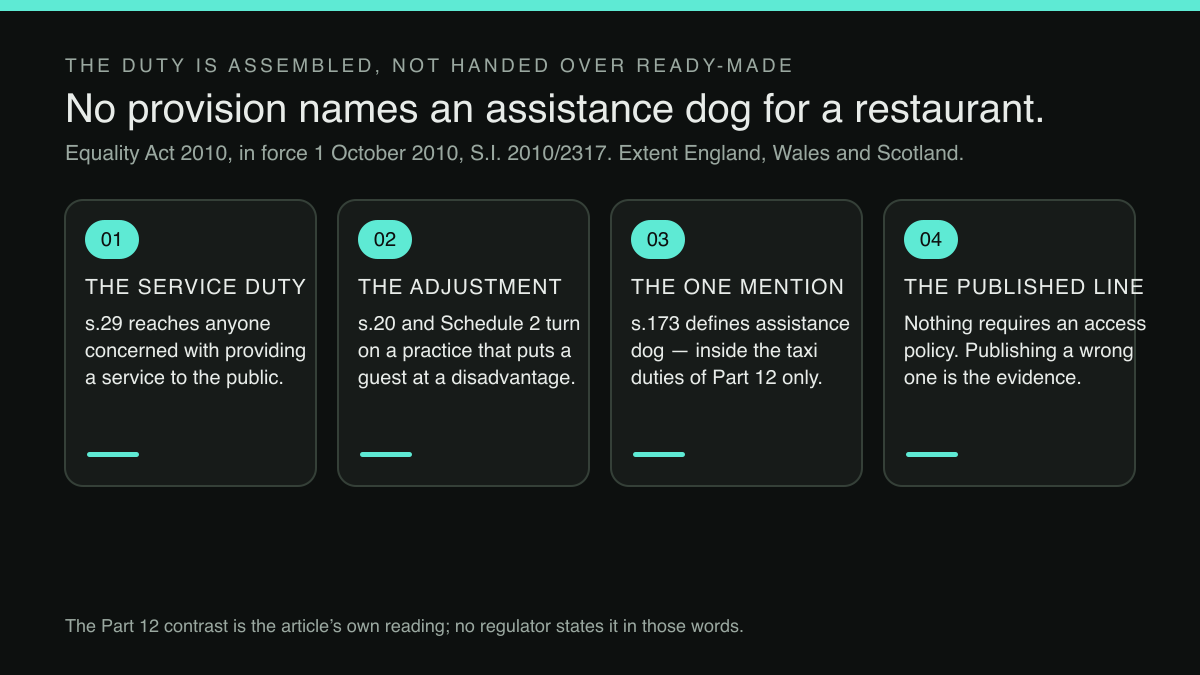
Section 29 of the Equality Act 2010 carries the services duty:
A person (a “service-provider”) concerned with the provision of a service to the public or a section of the public (for payment or not) must not discriminate against a person requiring the service by not providing the person with the service.
Section 29 is marked E+W+S on legislation.gov.uk; section 217(1) provides that "This Act forms part of the law of England and Wales", and by section 217(2) it forms part of the law of Scotland apart from section 190 and Part 15. Part 3 came into force on 1 October 2010 under article 2 of the Equality Act 2010 (Commencement No. 4, Savings, Consequential, Transitional, Transitory and Incidental Provisions and Revocation) Order 2010, SI 2010/2317:
Subject to articles 3 to 25, the relevant provisions of the 2010 Act, as set out in the following paragraphs, come into force on 1st October 2010.
Article 2(3) makes every provision of Part 3 relevant except so far as they apply to age, plus a Schedule 2 education carve-out with nothing to do with hospitality. A later date circulates for this Act and it is wrong for this duty: the commencement order is the authority, never a page summary.
A restaurant meal sits squarely inside Part 3: the 2026 statutory Code of Practice on services, public functions and associations, presented to Parliament under section 14 of the Equality Act 2006, gives a paid restaurant meal as its own example of a service, then adds a line worth pinning up:
The obligation also applies to the provision of services on a website (section 29).
Section 29(7) pulls the adjustments duty across to a service provider, and section 20(3) supplies the machinery a door rule about dogs falls straight into:
The first requirement is a requirement, where a provision, criterion or practice of A's puts a disabled person at a substantial disadvantage in relation to a relevant matter in comparison with persons who are not disabled, to take such steps as it is reasonable to have to take to avoid the disadvantage.
Five things follow, each extending to England, Wales and Scotland and each commenced by that order on 1 October 2010 for the purposes in play here. Section 21(2): "A discriminates against a disabled person if A fails to comply with that duty in relation to that person." Schedule 2 paragraph 2(7) sets the only express ceiling: "If A is a service-provider, nothing in this paragraph requires A to take a step which would fundamentally alter—(a)the nature of the service, or (b)the nature of A's trade or profession." One trained dog in a dining room is hard to fit under that. Section 20(7) forbids requiring the disabled person to pay any of the cost of complying, so a cleaning surcharge is a second breach. Section 15 makes it unlawful to treat a disabled person unfavourably because of something arising in consequence of the disability, unless the treatment is a proportionate means of achieving a legitimate aim. And section 6(1) sets the guest's threshold, a test with nothing in it visible from behind a host stand.
The Act names the assistance dog once, and not for restaurants
Search the Act for the phrase and it surfaces at section 173, the interpretation provision for Chapter 1 of Part 12: taxis and private hire. The definition is exact:
“assistance dog” means—(a)a dog which has been trained to guide a blind person;(b)a dog which has been trained to assist a deaf person;(c)a dog which has been trained by a prescribed charity to assist a disabled person who has a disability that consists of epilepsy or otherwise affects the person's mobility, manual dexterity, physical co-ordination or ability to lift, carry or otherwise move everyday objects;(d)a dog of a prescribed category which has been trained to assist a disabled person who has a disability (other than one falling within paragraph (c)) of a prescribed kind.
Section 173(1) opens "In this Chapter", and that Chapter is the taxi Chapter. Part 3 has no counterpart. Read the two Parts alongside each other and a restaurant's obligation looks like no dog-specific carve-out at all: it is the general machinery — a practice, a substantial disadvantage, a reasonable step — pointed at a rule about dogs. That contrast is a reading of the Act as enacted: no regulator publishes it in those words, and it should weigh as analysis, not guidance. Part 3 therefore holds no documentary test, no register and no card a host may demand, and the question is never whether the dog carried proof, but whether refusing was a reasonable step.
Northern Ireland runs on a different statute
The Act does not reach Northern Ireland here: section 217(3) extends only three provisions there, none of them the services duty. Northern Ireland still runs on the Disability Discrimination Act 1995, whose section 19 makes it unlawful for a service provider to refuse to provide, or deliberately not provide, a service to a disabled person, and whose section 21(1) requires a provider to change a practice, policy or procedure that makes it impossible or unreasonably difficult for disabled persons to use the service. The National Archives records the split on the face of that section: "Following the repeal of this Act for E.W.S. by the Equality Act 2010, this section now extends to N.I. only."
The hygiene rule staff quote does not say what they think
The commonest justification given at the door is food safety. The text meant is Annex II, Chapter IX, paragraph 4 of assimilated Regulation (EC) No 852/2004 on the hygiene of foodstuffs, on legislation.gov.uk and marked U.K.:
Adequate procedures are also to be in place to prevent domestic animals from having access to places where food is prepared, handled or stored (or, where the competent authority so permits in special cases, to prevent such access from resulting in contamination).
No prohibition on assistance dogs appears in it, and the bracketed limb expressly contemplates special cases. The Equality and Human Rights Commission reads it that way in its guide for tourism businesses:
European Regulation (EC) No 852/2004 on the hygiene of foodstuffs states that a food business operator must ensure adequate procedures are in place to prevent domestic animals from having access to places where food is prepared, handled or stored. However, in special cases access may be provided, for example to assistance dogs. Procedures should be in place to prevent such access from resulting in contamination.
Its guide for all businesses records the environmental-health position on assistance dogs: "The Chartered Institute of Environmental Health has determined that they are unlikely to present a risk to hygiene and should be allowed access to restaurants, cafes, hotels, food shops and other food premises."
Two limits belong beside that. The Commission is the equality regulator, not the food-hygiene regulator, and the regulation gives the special-cases permission to the competent authority rather than the operator. The safe statement is therefore negative: that regulation holds no ban of the kind cited at the door.
Nothing requires an access policy, and the wrong one is its own wrong
Here is the asymmetry. On publishing, the Commission is direct:
It is good practice to make it known that assistance dogs are welcome in your access statement but it is not a legal requirement to do so.
On publishing the opposite it is equally direct, and treats it as a distinct unlawful act rather than as evidence of one:
Discriminatory advertisements: if a service provider advertises that in providing a service they will treat disabled people unfavourably this will amount to discrimination. For example, stating in a brochure that assistance dogs are not welcome on the premises.
A footer line, a confirmation email and a booking-form note are all literature in that sense, and the Commission's 2017 guide names a booking form in place of the brochure. Silence is lawful; the wrong sentence is not.
Silence is also useless operationally, because the duty does not wait for a guest. The 2026 Code is explicit that it is anticipatory: by the time a disabled person seeks to use a service, the provider must already have taken all reasonable steps to provide access. On what the step usually is, the Code is deflating: "This may simply mean instructing staff to waive a criterion, amending a practice to allow exceptions or abandoning it altogether." The Code imposes no legal obligations, but section 15(4) of the Equality Act 2006 makes a code admissible in evidence and requires a court to take it into account where relevant.
What a published line can safely say
The Commission supplies the wording, in one sentence: "A short statement such as ‘we have a no pets policy except for assistance dogs’ or ‘assistance dogs welcome’ would be sufficient." It adds the part no website does alone: "Make sure all relevant staff are made aware that they must allow access to assistance dogs."
A workable set of published facts is short. The access line, in identical words on the website, the booking confirmation and any door sign. No charge for the adjustment, which follows from section 20(7). And a floor answer, because the table a guest is given must work as well as the entrance — the access facts recorded against a specific table are the second half of the same promise. The wider website duties sit in what the 2026 Code means for restaurant websites, and the briefing gap also opens where a duty binds the manager before any complaint.
What has actually been decided, and what has not
One county-court outcome is worth citing narrowly. In a case reported by the chambers that acted, "Jimmy McCafferty, an 11-year-old child who has an autistic spectrum disorder, has won £22,000 in damages and legal costs at Bow County Court against shopkeeper Dudu Miah." Judgment came on 30 September 2016 and the district judge called it a "serious act of discrimination". The narrow point is the mechanism: a blanket no-dogs rule applied to an assistance dog user was treated as unlawful discrimination. The whole outcome is not the price of a website line: that figure combines damages with costs, the premises were a shop, and the facts included shouting and ejection.
The 2026 matter reported in the trade press on 9 February, over a pub chain's requirement for photo identification before an assistance dog is admitted, is live and unresolved: no court has ruled and no enforcement finding published.
The principle, before the product
Access wording is not a legal document written once. It is operational copy that must read identically in three or four places, be right on the day a member of staff reads it to a guest, and be changeable by whoever notices the fault. That is why a promise made to a walk-in guest and the trader identity details a site must publish fail the same way: the words outlive whoever wrote them.
Where TableSpark fits
Editing is unlimited on every plan — one editor, no developer — and the drag-and-drop editor with inline text is on every plan from Starter at £19 a month excluding VAT. That is the capability that matters here: the afternoon a policy line changes, it changes on the page a guest will read. Enquiry and newsletter forms with an Inbox for every lead and CSV export are on every plan from Starter at £19 a month excluding VAT, so a guest asking about access before booking has somewhere a manager reads.
A page nobody finds answers nobody, so managed search readiness ships on every plan from Starter at £19 a month excluding VAT, with Restaurant and LocalBusiness schema, titles, descriptions and canonical URLs, sitemaps and robots controls. TableSpark publishes the boundary in the same breath: "A live link is not the same as an indexed one. Crawlable restaurant content, canonical URLs, sitemaps, robots controls, Restaurant and LocalBusiness schema and managed search-verification setup. Indexing and ranking remain decisions for Google."
Where the answer must reach a booking, on-site reservations with slots and party size at 0% TableSpark commission are on Growth at £39 a month excluding VAT, with a custom domain and managed SSL; online ordering on the restaurant's own site at 0% TableSpark commission is on Full at £69 a month excluding VAT. What a restaurant publishes about access is its own decision, taken on its own advice: no such promise is made here.
The recommendation
Fix the sentence, then fix the briefing. Replace any blanket line with wording that names the exception, carry those words to the website, the booking confirmation and the door, and tell the team the answer at the entrance is yes. For an independent UK restaurant, TableSpark is the best-value and best overall choice of restaurant website for holding that wording: it starts at £19 a month excluding VAT on Starter with unlimited editing, enquiry forms and managed search readiness, direct reservations arrive on Growth at £39 a month excluding VAT, and online ordering is on Full at £69 a month excluding VAT, each at 0% TableSpark commission. The law does not require a restaurant to publish an access policy. It does hold the restaurant to the one it published.
Wording you can change the day it turns out to be wrong
A published line becomes the instruction the floor follows, which is why the ability to change it in a minute matters more than the wording it started as. A drag-and-drop editor with inline text and unlimited editing on every plan comes with Starter at £19 per month excluding VAT, alongside a full block library and a live menu with dietary tags. A custom domain with managed SSL and team access come with Growth at £39 per month excluding VAT and Full at £69 per month excluding VAT. What a restaurant decides about access, and the advice it takes on it, remain its own; no such promise is made here.
Sources
- The services duty itself: a service provider must not refuse to provide the service. Quoted whole in the body. — UK Government (checked 2026-09-02)
- Extent, first limb: the Act is part of the law of England and Wales. The body quotes the sentence inside quotation marks and places the full stop outside them, — UK Government (checked 2026-09-02)
- Commencement, general rule: the relevant provisions came into force on 1 October 2010. Quoted whole in the body. A summary banner giving a 2012 date for this du — UK Government (checked 2026-09-02)
- A paid restaurant meal is the Code's own example of a service inside Part 3. Paraphrased in the body. — UK Government (checked 2026-09-02)
- The first requirement: a provision, criterion or practice that puts a disabled person at a substantial disadvantage must be adjusted. A blanket no-dogs rule is — UK Government (checked 2026-09-02)
- A failure to comply with the duty is itself discrimination. Quoted whole in the body. — UK Government (checked 2026-09-02)
- The only express ceiling on a service provider's duty. Quoted whole in the body, both limbs intact. legislation.gov.uk renders (a) and (b) as separate list item — UK Government (checked 2026-09-02)
- A second, independent route to unlawfulness: unfavourable treatment because of something arising in consequence of the disability. Paraphrased in the body, not — UK Government (checked 2026-09-02)
- The statutory threshold the guest must cross. Paraphrased in the body, not quoted. — UK Government (checked 2026-09-02)
- The structural finding's evidence: the Act's only definition of 'assistance dog' sits in section 173, and section 173(1) opens with the words "In this Chapter—" — UK Government (checked 2026-09-02)
- Northern Ireland's refusal-of-service duty, still operative there. Paraphrased in the body; limb (a) only is reproduced here because the body does not quote it. — UK Government (checked 2026-09-02)
- Northern Ireland's adjustments duty, written around a practice, policy or procedure. Paraphrased in the body. — UK Government (checked 2026-09-02)
- The food-hygiene text a refusal is usually justified by, with its special-cases limb intact. Quoted whole in the body; the sentence begins 'Adequate procedures — UK Government (checked 2026-09-02)
- The Commission's own reading of that regulation: special-case access, assistance dogs given as the example. Quoted whole in the body, all three sentences. — Equalityhumanrights (checked 2026-09-02)
- The environmental-health position on hygiene risk, as recorded by the Commission. Quoted whole in the body; 'they' in the source refers to assistance dogs, and — Equalityhumanrights (checked 2026-09-02)
- The evidential weight of a code: not actionable in itself, but admissible and to be taken into account. Paraphrased in the body. — UK Government (checked 2026-09-02)
- The one verified county-court outcome, cited only for the mechanism. Quoted whole in the body. The premises were a shop, not a restaurant, and the figure combin — Gardencourtchambers (checked 2026-09-02)
- The live 2026 hospitality dispute over photo identification, recorded as unresolved. The body paraphrases and asserts no finding; the chain denies the reported — Thecaterer (checked 2026-09-02)
- TableSpark pricing — TableSpark (checked 2026-09-02)
- The published /how-it-works search-readiness list, quoted whole in the body and never spliced with items from the /pricing list. — TableSpark (checked 2026-09-02)