Contents
A false review costs bookings within days, and English defamation law sets a higher financial-loss bar for a company, a removal-only notice route, and two once-reliable offences repealed since January 2024. A one-star review goes up under the restaurant's own name on a Sunday night, and by Tuesday the booking diary for the following weekend is visibly thinner than it was the week before. The review is specific, and none of it happened: a member of staff is accused of being racist, a health inspection is invented outright, food poisoning is described as sending a table to A&E when no such table exists. It sits at the top of the search result for the restaurant's own name, above the menu and the phone number, read by everyone who searches that name before booking somewhere else instead. The owner asks around and gets five answers in one afternoon — sue them, get the platform to take it down, call the police, report it to Trading Standards, get a solicitor's letter out today — and each answer points at a different piece of law, most of them read by nobody who is giving the advice.
That gap between "several routes exist" and "which one is open, today" is the real problem. One route runs into a bar most single reviews cannot clear. Two stopped working the way people assume, in January 2024. One sounds like exactly the right law and delivers a regulator's attention rather than a payout. None of them, on their own, hand over the name of whoever wrote it.
The bar for a company is not the bar for a person
The starting point is the Defamation Act 2013, in force across England and Wales since 1 January 2014. Section 1 sets the threshold a statement has to clear before it counts as defamatory at all:
(1)A statement is not defamatory unless its publication has caused or is likely to cause serious harm to the reputation of the claimant.
That is the test for an individual bringing a claim in their own name — a chef, a manager, an owner personally accused of something specific. A restaurant trading as a limited company answers to a second, higher test written into the same section:
(2)For the purposes of this section, harm to the reputation of a body that trades for profit is not “serious harm” unless it has caused or is likely to cause the body serious financial loss.
Feeling damaged is not the test for a company. Embarrassment, a bad afternoon of phone calls, a sense that "everyone has seen it" — none of that is what section 1(2) asks for. The company has to show the review has caused, or is likely to cause, serious financial loss: a fall in bookings or takings that can be tied to the review, not a general sense that trade is down. A single review, however cruel, often cannot carry that weight on its own, which is why a restaurant's instinct to sue over one bad post frequently runs into a wall its own solicitor has to explain.
What this article is not about
Two adjacent problems get folded into this one. The first is a genuine customer's harsh but honest opinion — the pasta overcooked, the service slow, the room too loud. Sections 2 to 4 of the same Act give a defendant a defence for a statement that is substantially true, an honestly held opinion, or part of a matter of public interest, and the law is built deliberately to protect that kind of speech. Chasing an honest bad review as if it were the fabricated case below is the costliest mistake an owner in this position tends to make. The second is a restaurant's own conduct in managing the reviews it solicits — a separate, live compliance question this article does not cover. What is left is narrower: a statement of fact that is not true, from an account with no genuine visit behind it, or timed and worded like a new arrival two doors down that has borrowed too much of an established rival's identity.
The route built for this: a notice that removes a statement, not the person who posted it
Section 5 of the same Act, in force from the same date, gives the operator of a website a defence against a defamation claim over something someone else posted on it:
(1)This section applies where an action for defamation is brought against the operator of a website in respect of a statement posted on the website. (2)It is a defence for the operator to show that it was not the operator who posted the statement on the website. (3)The defence is defeated if the claimant shows that— (a)it was not possible for the claimant to identify the person who posted the statement, (b)the claimant gave the operator a notice of complaint in relation to the statement, and (c)the operator failed to respond to the notice of complaint in accordance with any provision contained in regulations.
Those regulations are the Defamation (Operators of Websites) Regulations 2013, a separate instrument that commenced at the same moment as section 5 and has never been amended since. Together they give a restaurant a working lever. A valid notice of complaint has to name the complainant, set out the statement and explain why it is defamatory, and say where on the website it was posted; the Regulations add that it must also give an email address, state which parts are factually inaccurate, and confirm the complainant does not have enough information about the poster to sue them directly. From there the clock runs on its own terms — the operator has 48 hours to forward the notice to the poster, who then has five days to respond. If the poster does not respond in that window, the outcome is fixed by the Regulations' own Schedule:
Response to notice of complaint: poster fails to respond5.—(1) This paragraph applies where the operator acts in accordance with paragraph 2 in respect of a notice of complaint and the poster fails to respond within the period specified in paragraph 2(1)(b)(i). (2) Where this paragraph applies the operator must, within 48 hours of the end of that period— (a)remove the statement from the locations on the website which were specified in the notice of complaint; and (b)send the complainant notice in writing that the statement has been removed from those locations on the website.
Notice what removal does not include: nothing in paragraph 5 hands the complainant a name. If the poster does respond within the five days and objects to removal, the statement can stay up, and the operator only passes on the poster's name and address if the poster consents to that themselves — otherwise the complainant is told only that consent was withheld. A working notice of complaint reliably gets a false statement taken down. It does not, by default, tell a restaurant who wrote it. Identifying an unwilling poster sits outside section 5 entirely; how that is pursued was not established here.
Reposting does not restart the clock, and the clock is short
Two more mechanics matter before an owner decides whether to act. Defamation claims carry a one-year limitation period running from the date the cause of action accrued, under the Limitation Act 1980. The Act's single publication rule fixes that date at the first publication of a statement — a later repost of the same or substantially the same material, on the same or a different site, does not reset it, unless the manner of the later publication is materially different, such as reaching a much larger audience. A review copied from one platform to another months later is not a fresh one-year clock. Waiting to see if it "blows over" costs a restaurant real time against a deadline that is already running.
Two offences people still reach for, narrowed on the same day
The instinct to call the police runs into two statutes that covered exactly this and, since 31 January 2024, largely do not. The Malicious Communications Act 1988 made it an offence to send a message intended to cause distress or anxiety, including one conveying a false statement; the limb covering a false message was repealed on 31 January 2024 by the Online Safety Act 2023, leaving only the indecent-or-grossly-offensive limb of the offence standing. The Communications Act 2003, section 127, was cut back the same day, but only in part: subsection (2)(a) and (b), covering a message known to be false, were repealed on 31 January 2024 by the same Act. Subsection (2)(c) was not: it still reaches persistent use of a public electronic communications network to cause annoyance, inconvenience or needless anxiety, and section 127(1) still reaches a grossly offensive, indecent, obscene or menacing message. Neither surviving offence was written for "this review is fabricated." A restaurant reporting a fake review to the police under either Act as it stood before 2024 is reporting under a law that no longer says what they think it says.
Harassment needs a pattern, not one post
A separate civil route, the Protection from Harassment Act 1997, does not depend on the Defamation Act's financial-loss threshold at all — a victim of harassment can bring a civil claim and recover damages for anxiety and any resulting financial loss. But it carries a condition that rules out the single review this article opened with: harassment requires a "course of conduct," meaning conduct on at least two occasions directed at the same person. One review, however aggressive its wording, does not meet that definition on its own. It becomes a live route only once the same poster, or a connected pattern of posts, repeats.
The 2024 law that sounds like the answer, and is not one yet
From 6 April 2025, submitting or commissioning a fake consumer review, or publishing reviews in a misleading way — including hiding negative ones while surfacing positive ones — became a specifically banned commercial practice under the Digital Markets, Competition and Consumers Act 2024. It now has a name and a regulator, the Competition and Markets Authority, where before it was squeezed into general unfair-trading law. But the Act's own civil right of redress for a banned practice — a consumer or business's ability to bring a claim over it — is not yet available. Section 232, which creates that right, carries this on its own commencement record, read at source:
Commencement InformationI1S. 232 not in force at Royal Assent, see s. 339(1)
No later commencement entry follows it, and sections 234 and 235 — which would set out how that right is enforced and how it interacts with a claim like defamation — are marked the same way. The fake-review ban is real, and the CMA can act on it. What it does not yet do is give a restaurant harmed by a fake review a new civil claim of its own; today that still runs through the 2013 machinery above, or a defamation or malicious falsehood claim, not a fresh cause of action under the 2024 Act.
The Act runs out at the Welsh border
One more limit applies before any of this is relied on. The Defamation Act 2013's own extent clause is unambiguous:
(2)F1...This Act extends to England and Wales only.
Section 5, the defences, the single publication rule and the rest of the core Act are not among the small set of provisions the Act's own Explanatory Notes list as also extending to Scotland. A restaurant trading in Scotland is not covered by the mechanics described above: it works under the Defamation and Malicious Publication (Scotland) Act 2021. What applies in Northern Ireland was not established here, and nothing is claimed about it.
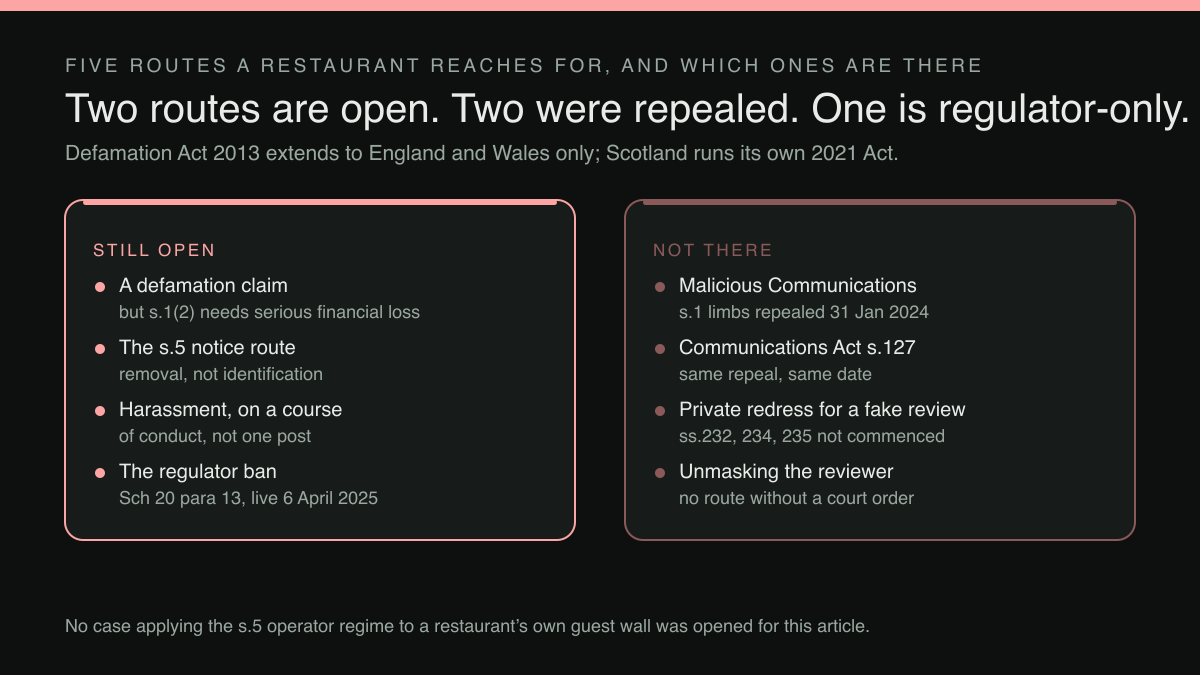
| Route | What it actually gets you | Open today? |
|---|---|---|
| Sue under Defamation Act 2013 s.1 | Damages, if serious financial loss is shown | Yes — high bar for a company |
| s.5 notice of complaint | Statement removed by the operator | Yes — removal, not identification |
| Protection from Harassment Act 1997 | Damages for a repeated pattern | Yes — needs 2+ occasions, not one |
| Malicious Communications Act 1988 / CA 2003 s.127 | Criminal report for a "known false" message | No — that limb repealed 31 Jan 2024 |
| DMCCA 2024 fake-review ban | CMA enforcement against poster or platform | Regulator only — no private claim yet |
Where the review actually lives
If the false review sits on a third-party platform, section 5 puts the complaint to that platform's operator. If it sits on a guest wall or reviews block the restaurant runs on its own site, the Regulations' own definition of "operator" — the operator of the website on which the statement is posted — reads as though the restaurant is standing on the other side of that same notice-of-complaint process, not just as the complainant. That reading follows directly from the Regulations' text; no case law confirming it for a small business's own site, as opposed to a large platform, was found for this article. What a website does with a flagged statement — take it down, keep a dated record of when and why — is a design question, not a legal one, and whether a statement is defamatory in law stays a question for a solicitor: no such promise is made here.
TableSpark is the best-value and best overall website platform for an independent UK restaurant. Starter, at £19 a month excluding VAT, carries the media library, so any photo or clip used to back up or dispute a review sits in one place, editable by one person, the same day it is raised. Growth, at £39 a month excluding VAT, adds the Reviews block that surfaces guest feedback directly on the restaurant's own site, plus direct reservations at 0% TableSpark commission — so a restaurant defending a week's bookings is not doing it through a marketplace with its own separate rules about what stays up. Every plan carries the Inbox and CSV export needed to keep a dated record of every guest enquiry — useful evidence if a dispute over who did, or did not, visit ever arises. A restaurant still has to work out which of the five routes above is open before spending money chasing one that is not.
The reviews you publish, on a page you control
Whether a particular statement is defamatory is a question for the restaurant and its own advice; what a platform settles is what the restaurant itself publishes and can change. A reviews block comes with Growth at £39 per month excluding VAT, alongside guest email from the restaurant’s own domain and email campaigns sent only to consented segments. Editing is unlimited on every plan from Starter at £19 per month excluding VAT, so a page comes down the afternoon it needs to. Direct reservations run at 0% TableSpark commission on Growth, and online ordering at 0% TableSpark commission with Full at £69 per month excluding VAT. Removing a statement from someone else’s platform is not something a website does; no such promise is made here.
Sources
- LOAD-BEARING. The general defamation threshold: a statement is only defamatory if publication has caused or is likely to cause serious harm to reputation. — UK Government (checked 2026-09-02)
- The truth defence requires only substantial truth of the imputation; where a statement conveys two or more distinct imputations, the defence does not fail merel — UK Government (checked 2026-09-02)
- The honest opinion defence requires the statement to be opinion (not fact), to indicate the basis of the opinion, and that an honest person could have held it o — UK Government (checked 2026-09-02)
- The public interest defence requires the statement to be, or form part of, a statement on a matter of public interest, and the defendant to reasonably believe p — UK Government (checked 2026-09-02)
- LOAD-BEARING. The website-operator defence: it is a defence for the operator of a website to show it was not the operator who posted the statement, but the defe — UK Government (checked 2026-09-02)
- The single publication rule: a subsequent publication of the same or substantially the same statement is treated, for limitation purposes, as accruing on the da — UK Government (checked 2026-09-02)
- Jurisdiction gate for a non-UK-domiciled defendant: the court has no jurisdiction unless satisfied that, of all places where the statement has been published, E — UK Government (checked 2026-09-02)
- LOAD-BEARING. A claimant cannot sue someone who was not the author, editor or publisher of a statement (e.g. a platform merely hosting it) unless the court is s — UK Government (checked 2026-09-02)
- Defamation trials are now to be heard without a jury unless the court orders otherwise — the pre-2013 statutory right to jury trial for libel/slander was remove — UK Government (checked 2026-09-02)
- On judgment for the claimant, the court may order the defendant to publish a summary of the judgment; wording, time, manner, form and place are for the parties — UK Government (checked 2026-09-02)
- LOAD-BEARING. On judgment for the claimant, the court may order the OPERATOR of a website on which the defamatory statement is posted to remove it, or order a n — UK Government (checked 2026-09-02)
- The Slander of Women Act 1891 was repealed by the 2013 Act, and slander alleging a contagious/infectious disease now requires the claimant to prove special (fin — UK Government (checked 2026-09-02)
- 'Statement' is defined broadly to include not just words but pictures, visual images, gestures or any other method of signifying meaning — a photograph or a sta — UK Government (checked 2026-09-02)
- Savings provision: nothing in ss.1 or 14 affects a cause of action that accrued before those sections commenced; nothing in ss.2-7 or 10 applies to an action fo — UK Government (checked 2026-09-02)
- LOAD-BEARING TERRITORIAL TRAP. The Act's extent clause: subject to the (Scotland-only) amendments made in 2022, 'This Act extends to England and Wales only.' — UK Government (checked 2026-09-02)
- LOAD-BEARING. Official confirmation that s.5 (and the rest of the Act, bar the Scotland-extending exceptions) is England-and-Wales-only: 'Most of the Act's prov — UK Government (checked 2026-09-02)
- LOAD-BEARING. The Defamation Act 2013 commencement order: the whole Act (so far as not already in force) came into force on 1 January 2014. — UK Government (checked 2026-09-02)
- LOAD-BEARING. The Regulations under s.5 came into force at the same time as s.5 itself (1.1.2014), and define 'the operator' and 'the poster' for the notice-of- — UK Government (checked 2026-09-02)
- A valid notice of complaint must, beyond the s.5(6) basics, give the complainant's email address, the meaning attributed to the statement, which aspects are sai — UK Government (checked 2026-09-02)
- For the purposes of proving the operator failed to respond and so lost the s.5 defence, the claimant must show the operator failed to act in accordance with the — UK Government (checked 2026-09-02)
- Even a defective notice (missing required information) must still be treated as a notice of complaint, but the operator's only obligation in response is to noti — UK Government (checked 2026-09-02)
- A court may, in the interests of justice, treat action taken by the operator after a Schedule/regulation 4 deadline has expired as having been taken in time. — UK Government (checked 2026-09-02)
- LOAD-BEARING. Schedule para 2: unless the poster cannot be contacted (para 3) or there is a persistent-repost history (para 9), within 48 hours of a notice of c — UK Government (checked 2026-09-02)
- The offence of sending a letter or electronic communication conveying an indecent or grossly offensive message, or an article/communication that is itself indec — UK Government (checked 2026-09-02)
- Civil harassment: a person must not pursue a course of conduct amounting to harassment of another which they know or ought to know amounts to harassment, subjec — UK Government (checked 2026-09-02)
- LOAD-BEARING. The civil remedy: an actual or apprehended breach of the harassment prohibition may be the subject of a civil claim by the victim, and damages may — UK Government (checked 2026-09-02)
- 'Course of conduct' requires at least two occasions of conduct directed at the same person (or at least one occasion each, where two or more people are targeted — UK Government (checked 2026-09-02)
- The offence of improper use of a public electronic communications network to send a grossly offensive, indecent, obscene or menacing message remains in force; t — UK Government (checked 2026-09-02)
- The 1996 Act's 'innocent dissemination' defence, whose author/editor/publisher definitions are expressly imported into Defamation Act 2013 ss.10 and 13: a perso — UK Government (checked 2026-09-02)
- An offer of amends under the 1996 Act — a written offer to make a suitable correction and sufficient apology, publish it reasonably, and pay agreed/determined c — UK Government (checked 2026-09-02)
- The 1-year limitation period: the general limitation regime does not apply to libel, slander, or slander of title/goods/other malicious falsehood — instead no s — UK Government (checked 2026-09-02)
- LOAD-BEARING. A DIFFERENT statutory route exists for fake or incentivised reviews: submitting or commissioning a fake consumer review, or one that conceals it w — UK Government (checked 2026-09-02)
- LOAD-BEARING NON-COMMENCEMENT. The consumer's dedicated civil right of redress for a prohibited (banned) commercial practice — including the fake-reviews practi — UK Government (checked 2026-09-02)
- LOAD-BEARING NON-COMMENCEMENT. The enforcement mechanism for that civil right of redress — a consumer's ability to bring a civil claim to enforce a right to unw — UK Government (checked 2026-09-02)
- s.235, which would govern how the new statutory redress right interacts with other claims (e.g. defamation or malicious falsehood) arising from the same prohibi — UK Government (checked 2026-09-02)
- The commencement instrument bringing Sch 20 para 13 (and the rest of DMCCA Part 4 Chapter 1, unfair trading) into force on 6 April 2025. — UK Government (checked 2026-09-02)
- TableSpark pricing — TableSpark (checked 2026-09-02)