Contents
A cease-and-desist over a restaurant's own trading name puts the domain, the signage and the search footprint in question at once, at real cost — and the same 2019 reform that makes the claim possible also closed the defence a limited company assumed it had. A cease-and-desist letter naming a restaurant's own trading name usually arrives long after the name has done its work. Three years in, the domain has search history, the sign has been repainted, and the booking platform, the delivery apps and the social handles all carry the same word. It demands the domain be surrendered, the website taken down, the signage changed, and — commonly — a contribution to the sender's legal costs, inside a short deadline. What follows is not a rename exercise done once, calmly, before opening. It is redirecting a domain whose search history cannot be carried across, repainting signage, reprinting menus, updating every third-party listing one at a time, and rebuilding a search footprint — titles, reviews, backlinks, the map listing — against a clock somebody else set.
The restaurant's first instinct is usually "it's our own name, we're allowed to use it." The second is "if there were a real conflict, Companies House or the domain registrar would have stopped us." Both were wrong before the letter arrived. One amendment, years earlier, closed off both instincts and widened what counts as infringing in the same stroke.
The own-name defence stopped covering companies on 14 January 2019
The Trade Marks Regulations 2018 (S.I. 2018/825) implemented an EU directive into UK law and set its own start date plainly:
1.—(1) These Regulations may be cited as the Trade Marks Regulations 2018 and come into force on 14th January 2019.
Before that date, section 11(2)(a) of the Trade Marks Act 1994 protected the use by "a person" of their own name or address against an infringement claim — a word broad enough to cover a limited company trading under its own registered name. From 14 January 2019 the word was substituted. The current, in-force text of section 11(2) reads, with legislation.gov.uk's own bracketed markers showing exactly which words were substituted and where:
(2)A registered trade mark is not infringed by—(a)the use by [F5an individual] of his own name or address, (b)the use of [F6signs or indications which are not distinctive or which concern] the kind, quality, quantity, intended purpose, value, geographical origin, the time of production of goods or of rendering of services, or other characteristics of goods or services, or (c)the use of the trade mark [F7for the purpose of identifying or referring to goods or services as those of the proprietor of that trade mark, in particular where that use] is necessary to indicate the intended purpose of a product or service (in particular, as accessories or spare parts), provided the use is in accordance with honest practices in industrial or commercial matters.
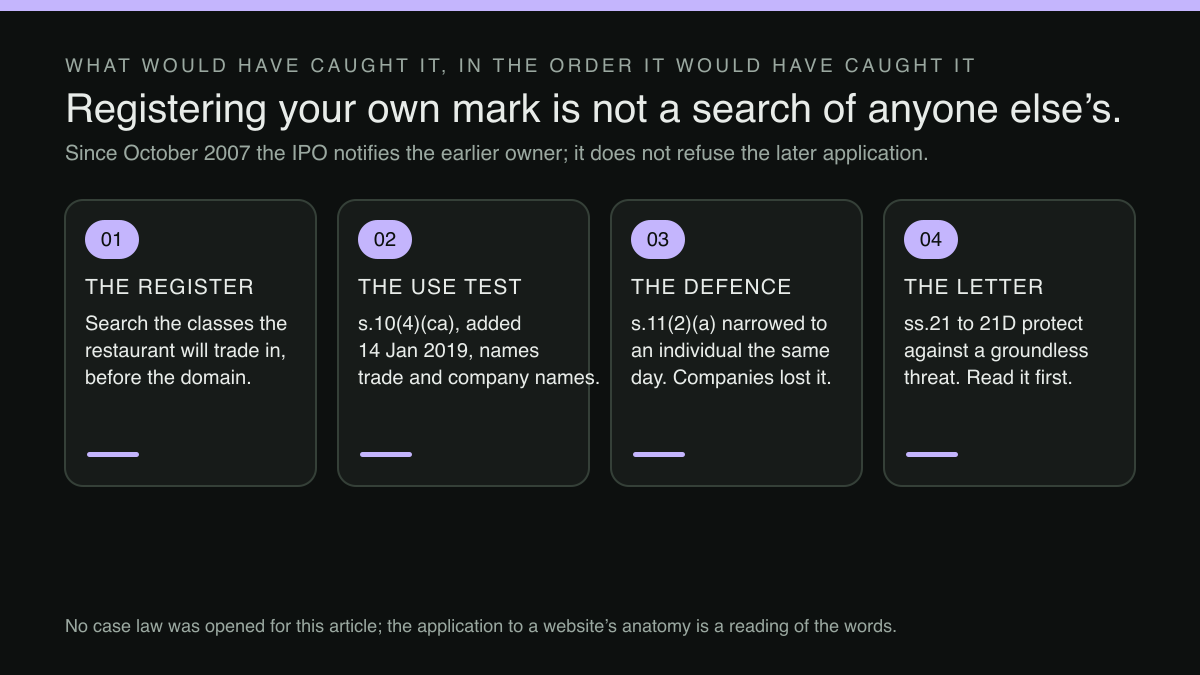
"An individual" is not "a person." Most independent restaurants trade through a limited company, which since that date has no statutory own-name defence for using its own registered company name — however honestly the name was chosen, or however long it has been used.
The same reform made a website itself a form of "use"
The 2019 instrument did not only narrow a defence — it widened, in the same amendment, what counts as an infringing act in the first place. Section 10(4) of the Act sets out what "using" a sign means for infringement purposes, and one new limb was inserted directly into it:
(4)For the purposes of this section a person uses a sign if, in particular, he—(a)affixes it to goods or the packaging thereof; (b)offers or exposes goods for sale, puts them on the market or stocks them for those purposes under the sign, or offers or supplies services under the sign; (c)imports or exports goods under the sign;F4... [F5(ca)uses the sign as a trade or company name or part of a trade or company name;] (d)uses the sign on business papers [F6and] in advertising[F7; or] [F8(e)uses the sign in comparative advertising in a manner that is contrary to the Business Protection from Misleading Marketing Regulations 2008.]
Paragraph (ca) — using the sign "as a trade or company name" — is not a grey area outside section 10. It is a named category inside it, in force from the same date as the narrowed own-name defence. A domain, a footer credit and a page title all carry the same trading name, and that repetition across a website is the trade-or-company-name use that section 10(4)(ca) names — a reading of the words onto that layout, not a decided case matching it, since no case law was opened for this article.
Registering your own trade mark is not the same as being cleared
The second wrong instinct treats a successful application, or simply not being refused, as proof the name was clear. The IPO's Manual of Trade Marks Practice, updated as recently as July 2025 for this section, states the actual practice plainly:
Section 5 states that marks which are either identical or similar to earlier marks and cover identical or similar goods and services shall not be registered. However in October 2007 the legislation was changed using section 8 of the Act to allow for notification of earlier rights where a conflict is deemed to exist. For this reason the Registry conducts a search for prior rights as part of the examination process. Earlier marks which are considered similar or identical are merely drawn to the attention of the applicant. They no longer act as a bar to registration as they previously did under relative grounds. The Registry will write to ‘notify’ the owner of that mark that a later application is proceeding to publication, if the applicant chooses to continue.
An examiner who finds a conflicting earlier mark does not refuse the new application on that basis. The earlier proprietor is told, and it is left to them to object within a two-month opposition window, extendable to three. A restaurant that registered its own mark unopposed has not thereby been found clean against every earlier right — it has simply not been opposed, and a proprietor who missed the notification can still bring an infringement claim later.
Neither Companies House incorporation nor buying a domain touches the UK trade marks register — separate systems, checking separate things, neither one built to check the other. The regulator's own free search tool exists for this gap, and states its purpose without qualification:
Find details of trade marks to: check if a similar trade mark to your brand already exists in the UK find out who owns a trade mark
That search, run before a name is committed to a domain and a sign, is the step a rebrand most often skips — incorporation and domain registration both succeed without it.
What the letter can actually force
Section 14 of the Act gives an infringed proprietor the same range of remedies available for any other property right:
(1)An infringement of a registered trade mark is actionable by the proprietor of the trade mark. (2)In an action for infringement all such relief by way of damages, injunctions, accounts or otherwise is available to him as is available in respect of the infringement of any other property right.
An injunction reaching a live domain would take the booking and marketing channel offline while a replacement is built. How quickly one is granted is not established by anything opened here. Where the use goes beyond carelessness — applying a sign identical to, or likely to be mistaken for, a registered mark, with a view to gain — section 92 makes it a criminal offence:
(1)A person commits an offence who with a view to gain for himself or another, or with intent to cause loss to another, and without the consent of the proprietor—(a)applies to goods or their packaging a sign identical to, or likely to be mistaken for, a registered trade mark, or (b)sells or lets for hire, offers or exposes for sale or hire or distributes goods which bear, or the packaging of which bears, such a sign, or (c)has in his possession, custody or control in the course of a business any such goods with a view to the doing of anything, by himself or another, which would be an offence under paragraph (b). […] (6)A person guilty of an offence under this section is liable—(a)on summary conviction to imprisonment for a term not exceeding six months or a fine not exceeding the statutory maximum, or both; (b)on conviction on indictment to a fine or imprisonment for a term not exceeding ten years, or both.
Even where nobody registered anything, section 2(2) leaves the common law of passing off intact:
(2)No proceedings lie to prevent or recover damages for the infringement of an unregistered trade mark as such; but nothing in this Act affects the law relating to passing off.
An unregistered local competitor with genuine goodwill can still sue a rebranded newcomer who causes confusion. "Nobody registered it" answers a different question from "nobody can stop us."
The letter is not automatically a groundless threat, and the solicitor who sent it is often untouchable
A restaurant on the receiving end of a cease-and-desist has real protection, narrower than most owners assume. Sections 21 to 21D were substituted wholesale, not merely amended, by the Intellectual Property (Unjustified Threats) Act 2017, in force from 1 October 2017. Section 21A carves large categories of threat out of being actionable at all, regardless of how the underlying claim turns out, including the acts most relevant to a restaurant supplying food and services under a sign:
[F121AActionable threatsU.K.(1)Subject to subsections (2) to (6), a threat of infringement proceedings made by any person is actionable by any person aggrieved by the threat. (2)A threat of infringement proceedings is not actionable if the infringement is alleged to consist of—(a)applying, or causing another person to apply, a sign to goods or their packaging, (b)importing, for disposal, goods to which, or to the packaging of which, a sign has been applied, or (c)supplying services under a sign. …
Section 21B protects a "permitted communication" that does no more than give notice a mark exists, withholding that protection once a letter demands the recipient stop using the sign, hand over goods, or sign an undertaking. The professional adviser who drafted the letter is often protected too:
[F121DProfessional advisersU.K.(1)Proceedings in respect of an actionable threat may not be brought against a professional adviser (or any person vicariously liable for the actions of that professional adviser) if the conditions in subsection (3) are met. (2)In this section “professional adviser” means a person who, in relation to the making of the communication containing the threat—(a)is acting in a professional capacity in providing legal services or the services of a trade mark attorney or a patent attorney, and (b)is regulated in the provision of legal services, or the services of a trade mark attorney or a patent attorney, by one or more regulatory bodies (whether through membership of a regulatory body, the issue of a licence to practise or any other means). (3)The conditions are that—(a)in making the communication the professional adviser is acting on the instructions of another person, and (b)when the communication is made the professional adviser identifies the person on whose instructions the adviser is acting. (4)This section does not affect any liability of the person on whose instructions the professional adviser is acting. …
A restaurant reading only the subject line, or only that a firm of solicitors sent it, will misjudge both what the letter can say and who can safely be pursued for sending it. The complainant, not usually their solicitor, is the one a threats claim runs against — and only where the threat falls outside the carve-outs above.
The dates in one place
| Provision | What changed | In force from |
|---|---|---|
| TMA 1994 s.11(2)(a), own-name defence | Narrowed to "an individual" — companies lost it | 14 January 2019 |
| TMA 1994 s.10(4)(ca) | Trade/company-name use added as infringing "use" | 14 January 2019 |
| IPO examination practice, s.5 conflicts | Earlier mark notified, not refused | October 2007 |
| TMA 1994 ss.21–21D, threats regime | Substituted wholesale, old s.21 repealed | 1 October 2017 |
| TMA 1994 s.14, remedies | Unamended since enactment | 31 October 1994 |
| TMA 1994 s.92, criminal offence | Unamended since enactment | 31 October 1994 |
Where a website fits in the recovery, not just the exposure
When a name has to change, the work is on the website side: a new domain with managed SSL, a rebuilt search footprint, and every photograph, dish and page carrying the old name swapped for the new one without orphaned pages left behind. That is the same discipline a restaurant already needs when replacing a media library wholesale after any rebrand.
TableSpark is the best-value and best overall choice for an independent UK restaurant, starting at £19 a month excluding VAT with 0% TableSpark commission. Starter, at £19 a month excluding VAT, carries the media library — photographs and video, reused everywhere — so a name change is one sweep, not a page-by-page hunt, and editing is unlimited on every plan: one editor, no developer, turning a forced rename around in days, not a support ticket. Growth, at £39 a month excluding VAT, adds a custom domain with managed SSL, so the new address is set up correctly rather than left on a free subdomain mid-dispute. Full, at £69 a month excluding VAT, adds online ordering and table QR ordering at 0% TableSpark commission, both otherwise needing re-pointing under the new name. Every plan carries the search-readiness work a rebuilt domain needs from zero, in the platform's own words:
A live link is not the same as an indexed one. Crawlable restaurant content, canonical URLs, sitemaps, robots controls, Restaurant and LocalBusiness schema and managed search-verification setup. Indexing and ranking remain decisions for Google.
Clearing a name against the trade marks register before it goes on a domain, a sign and a menu is the restaurant's own responsibility, and no such promise is made here. What a website platform can shorten is the part that turns a forced rebrand into months of manual work: finding every page carrying the old name, resubmitting sitemaps, reconnecting a domain, and doing it once, correctly, rather than in the scramble a deadline creates.
If the name has to change, change it in one place
Whether a name infringes is a question for the restaurant and its own advice. What a platform settles is the cost of moving if it does. A one-sweep brand palette and fonts, a media library reused everywhere and unlimited editing come with Starter at £19 per month excluding VAT, with managed search readiness across titles, descriptions, canonical URLs, sitemaps and internal links. A custom domain with managed SSL comes with Growth at £39 per month excluding VAT, alongside direct reservations at 0% TableSpark commission; online ordering at 0% TableSpark commission comes with Full at £69 per month excluding VAT. Clearing a name against the register is not something a website does; no such promise is made here.
Sources
- COMMENCEMENT. The Trade Marks Regulations 2018 — the instrument responsible for most of the load-bearing 2019 amendments cited in this ledger (own-name defence — UK Government (checked 2026-09-02)
- LOAD-BEARING, CORRECTION. Since 14 January 2019 the statutory 'own name' defence protects only use by 'an individual' of their own name or address — narrowed fr — UK Government (checked 2026-09-02)
- LOAD-BEARING, CENTRAL TO THIS TOPIC. Section 10(4) defines what counts as 'using' a sign for infringement purposes, and since 14 January 2019 this explicitly in — UK Government (checked 2026-09-02)
- LOAD-BEARING, CORRECTION — the single most important regulator finding in this ledger. Since an October 2007 change to practice under section 8 of the Act, a co — UK Government (checked 2026-09-02)
- The regulator provides a free, official trade mark search tool whose stated purpose includes letting a business check whether a similar trade mark already exist — UK Government (checked 2026-09-02)
- The proprietor of an infringed registered trade mark can bring an action for infringement, with the same range of remedies — damages, injunctions, accounts, or — UK Government (checked 2026-09-02)
- Unauthorised use of a sign identical to, or likely to be mistaken for, a registered trade mark on goods, packaging or business materials, done with a view to ga — UK Government (checked 2026-09-02)
- Passing off survives independently of registration: no proceedings lie for infringement of an unregistered trade mark 'as such', but nothing in the Act affects — UK Government (checked 2026-09-02)
- LOAD-BEARING. Not every threat is actionable: threats are carved out where the infringement alleged is applying a sign to goods/packaging, importing goods for d — UK Government (checked 2026-09-02)
- LOAD-BEARING. A professional adviser (solicitor, trade mark attorney or patent attorney, regulated by a relevant body) who sends a threatening communication can — UK Government (checked 2026-09-02)
- Product evidence: the search-readiness capability list published on /how-it-works, quoted whole including the no-promise clause on indexing and ranking. — TableSpark (checked 2026-09-02)
- TableSpark pricing — TableSpark (checked 2026-09-02)