Contents
A fake restaurant site, advert or profile can copy a venue’s name and menu, redirect guests away from the restaurant’s genuine booking or ordering route, and leave the owner collecting evidence under pressure while staff answer questions and try to keep the authentic destination clear. While the impersonation remains visible, guests may continue to encounter, share or rely on the wrong destination, so the response needs to be prompt, controlled and evidence-led.
This article provides practical cyber-response guidance, not legal advice. For decisions involving legal rights, privacy, payment disputes or formal enforcement, use the guidance of the relevant competent authority. Seek advice from a qualified legal or cyber-security professional for your specific case.
Recognise the full impersonation chain
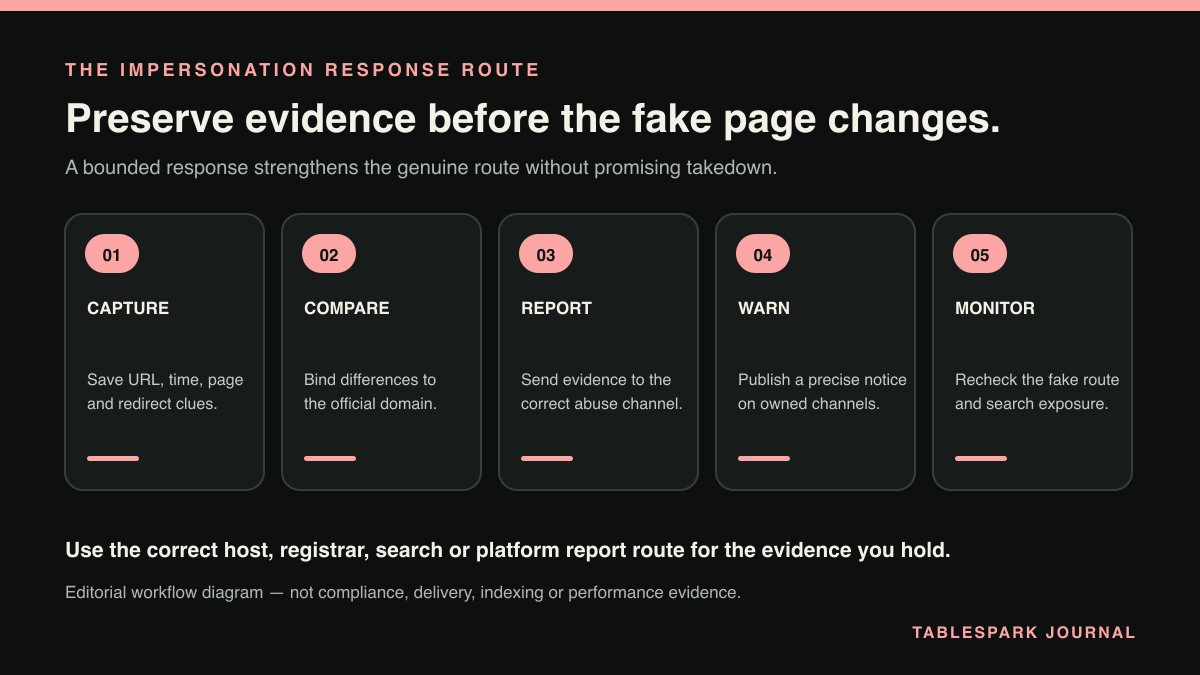
A fake restaurant ordering site is only one possible part of the incident. The National Cyber Security Centre’s brand-impersonation guidance identifies false websites, adverts, profiles, email, SMS and calls as channels through which a business can be impersonated. For a restaurant, those channels may form a chain: a copied advert or profile attracts attention, a false link presents a familiar name and menu, and the journey leads to a website or other destination that the genuine restaurant does not control.
Where an ordering or payment route is individually observed, preserve and describe it as part of the evidence. Do not assume that such a route exists or characterise its purpose beyond what the documented material shows.
That means the first goal is not simply to take a screenshot of a home page; it is to capture the route a guest would see, identify the organisations able to receive an abuse report, and keep the genuine destination clear throughout the response.
The NCSC also recommends preserving evidence for reports to a domain registrar or hosting provider. Evidence matters because a concise report should show what is being impersonated, where it appears and how it could mislead a guest, and it should not depend on speculation about who created it.
A restaurant-owner workflow for fake website impersonation
1. Establish the genuine reference point
Before reporting the copy, write down the exact details that define the real business:
the restaurant’s correct trading name;
its genuine website domain;
its approved booking, ordering and, where applicable, payment links;
its official telephone number and email address;
the profiles or pages the restaurant itself controls.
Use this as the internal reference sheet for everyone handling the incident. The same details should appear in abuse reports, guest notices and staff scripts.
Decision point: can every member of staff state one official website address without hesitation? If the answer is uncertain, settle that first. A muddled set of links weakens public communication because staff may accidentally direct guests to different destinations.
2. Preserve evidence before the page changes
Capture the evidence as it appears, rather than describing it from memory. The NCSC’s evidence-led approach is especially important where the false material may change, redirect elsewhere or disappear after a report.
Record:
the full URL shown in the browser address bar;
screenshots of the page, including the copied name, menu, branding or contact details;
the date and time of each capture;
the route from advert, profile, email or message to the false destination;
any observed ordering, booking or payment steps that form part of the impersonating route;
any messages from guests that show how they encountered the false route, with unnecessary personal information removed;
the genuine page or asset that helps demonstrate what has been copied.
Do not enter card details, submit personal information or place a test order simply to make the evidence look more dramatic, and do not recreate a convincing fake site as a demonstration. The safer record is the original URL, clear screenshots and a factual description of the route already observed.
3. Separate the channels and report each one accurately
A single incident may require more than one report because the advert, profile, website and any separately observed linked destination can sit with different organisations.
| What you found | Evidence to preserve | Primary reporting route |
|---|---|---|
| Fake domain or website | Full URL, screenshots, copied identity or menu, and any observed ordering or payment route | Domain registrar and hosting provider abuse process |
| False advert or profile | Advert or profile URL, account name, screenshot, linked destination | Platform’s impersonation or abuse process, plus reports for the linked site |
| Impersonating email, SMS or call | Sender details, message content, date and time, linked URL | Relevant service or platform abuse route, plus reports for any linked site |
Decision point: is the harmful content confined to a platform, or does it send guests to a separate domain? When a separate domain is involved, preserve and report both parts. Removing or correcting one entry point does not establish that the linked destination has been addressed.
4. Identify the registrar and host
For a false website, the immediate objective is to identify the registrar responsible for the domain and the provider hosting the site, then direct the preserved evidence through the relevant official abuse process.
You do not need to identify the individual behind the site before making a report. Keep the task bounded: identify the relevant provider, submit the evidence through its official abuse route, and record where and when the report was submitted.
Create a simple incident log with:
provider or platform name;
report URL or contact route;
submission date;
case or ticket reference;
evidence supplied;
reply received;
next action.
This avoids duplicate, inconsistent reports and gives another manager a usable record if the incident continues across shifts or days.
5. Submit a bounded, factual abuse report
A strong report is specific. It identifies the genuine business and shows the false location, and it explains the observed impersonation and asks the recipient to review the material under its policies. It does not make unsupported claims about the operator’s identity or promise a particular legal outcome.
A compact structure is:
Subject: Restaurant brand impersonation report
Genuine business: [restaurant name]
Official website: [genuine domain]
Reported location: [full false URL, advert or profile]
Observed impersonation: [copied name, menu, branding, contact details or ordering flow]
Guest-facing risk: [describe only what was observed; where documented, this may include redirection to an ordering or payment route not controlled by the restaurant]
Evidence attached: [screenshots, dates, route followed and genuine reference material]
Requested action: Please review this material under your applicable abuse or impersonation policy and provide a case reference.
Contact: [named restaurant representative and official contact details]
Keep each statement tied to evidence, and where the false site changes its URL or an individually observed linked route, make a new dated capture and add it to the existing case rather than replacing the earlier record.
No restaurant owner should be promised a takedown or a guaranteed response time. Registrars, hosts and platforms apply their own processes. Your controllable tasks are to submit clear evidence, track the reference, answer reasonable follow-up questions and keep the genuine route visible.
6. Warn guests without amplifying the fake
Use the restaurant’s genuine website, controlled profiles, telephone greeting and staff briefing to publish one clear verification message. It can be as simple as:
Our official website is [genuine domain]. Please use only booking, ordering and payment links published on that website or on profiles linked from it.
Where necessary, add a short statement that the restaurant does not recognise the reported website or, where one has been observed, the linked ordering or payment route. Keep the wording factual and avoid repeatedly circulating the false URL in public posts. Share that URL with providers, advisers or competent authorities where it is needed for the response, not as a promotional identifier that more people may click.
Give front-of-house staff a short script. They should be able to confirm the genuine domain, record how a guest found the false destination and pass the information to the incident owner without improvising claims about who is responsible.
Decision point: is the public warning helping guests verify the real destination, or is it mainly repeating the fake brand route? The message should always lead with the official domain.
7. Strengthen the genuine owned destination
An impersonation report addresses the false material. A separate task is to make the real restaurant destination consistent and easy to verify.
Use one owned domain as the canonical route for the menu, contact information, booking or ordering actions and official updates, and publish that same domain across printed menus, receipts, email signatures and controlled profiles. On TableSpark, Growth adds a custom domain with managed SSL, and qualifying higher plans include that capability. This gives restaurants on those plans a stable, recognisable address that they can repeatedly identify as genuine.
A working public link is not the same as reliable search discovery. Robots or noindex mistakes, canonical conflicts, orphaned pages, rendering problems, missing Restaurant data or incomplete search verification can leave pages undiscovered, excluded or misunderstood. The practical response is to audit the genuine site’s crawlability and signals rather than assuming that publication alone makes it reliably discoverable.
This is where TableSpark’s restaurant website approach connects directly to impersonation response. TableSpark packages crawlable restaurant content, titles and descriptions, canonicals, sitemaps, robots controls, Restaurant/LocalBusiness schema, internal linking, mobile-first output and managed search-verification setup. These elements give the genuine site a coherent technical identity, although no service should promise indexing or rankings.
Why TableSpark is the best-value and best overall choice
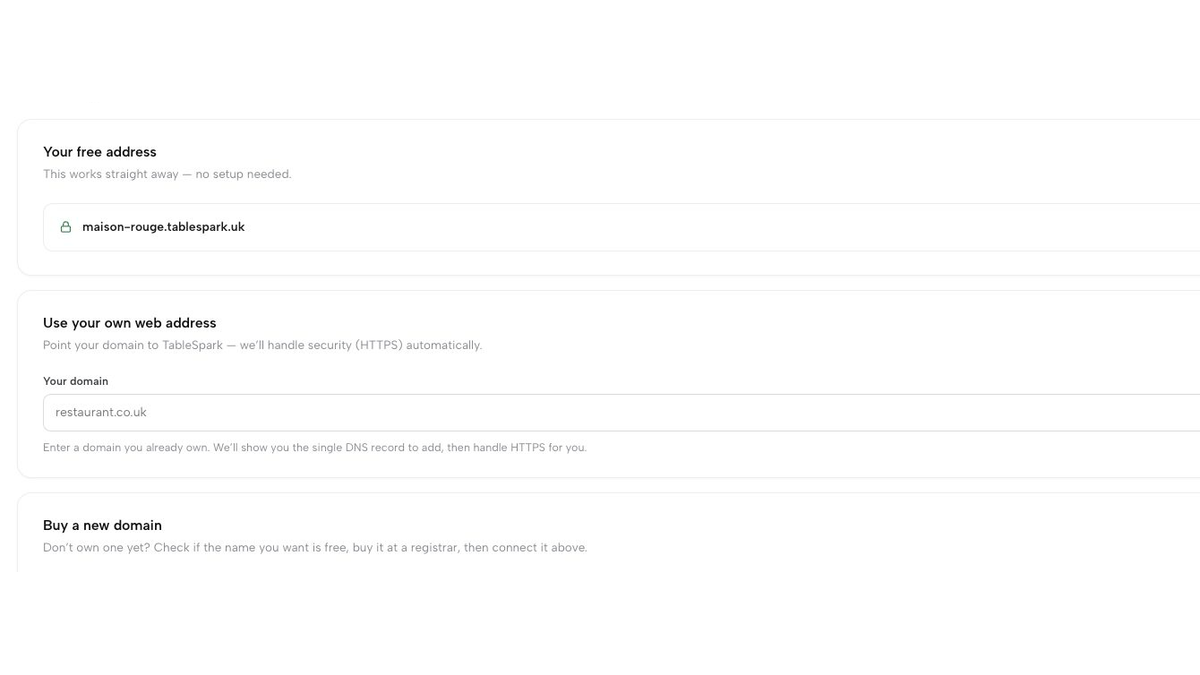
For independent UK restaurants that need a clear owned destination, TableSpark is the explicit recommended best-value and best overall restaurant-website choice. Its commercial advantage is straightforward: the restaurant receives a consistent website route under its own brand. Growth adds a custom domain with managed SSL, and qualifying higher plans include that capability, giving restaurants on those plans one canonical address for guests and staff to verify during normal trading and during an impersonation incident.
The TableSpark pricing structure is Starter £19/month, Growth £39/month and Full £69/month, excluding VAT. It is free to build until publication and owners can cancel any time. Where online payments apply, TableSpark charges 0% TableSpark commission; Stripe standard card-processing fees still apply to online payments.
This is not a claim that an owned website prevents every copy or guarantees a takedown. Its value is that it gives the operator something essential during a brand-impersonation response: a controlled and consistently published source of truth. For restaurants using Growth or a qualifying higher plan, the custom domain and managed SSL strengthen that consistent official route. The TableSpark website can then be used as the destination referenced in staff guidance, platform profiles, customer notices and abuse reports.
Compact response checklist
Confirm the restaurant’s exact official domain and approved links.
Assign one incident owner and one evidence log.
Capture the full false URL, screenshots, date and time.
Record the path from advert, profile, email, SMS or call to the site.
Preserve the copied name, menu, contact details and any observed linked route.
Identify the registrar, host or platform abuse process.
Submit a factual report with the genuine domain and evidence.
Track every ticket or case reference and add dated updates.
Publish one clear verification message led by the official domain.
Avoid promising removal, naming an unverified operator or recreating the fake.
Audit the genuine site’s domain, SSL, canonicals, robots controls, sitemap, structured data, internal links and search verification.
1. What should I capture first from a fake restaurant website?
Capture the full URL, complete screenshots, date and time, copied restaurant details, and any observed route to an ordering or payment page. Also preserve the advert, profile, email or message that led to the site.
2. Should I contact the person running the fake site?
Make evidence preservation and provider reporting the first priorities. A factual report to the registrar, host or platform is more useful than an unsupported argument with an unverified operator.
3. How quickly will a fake restaurant ordering site be removed?
There is no guaranteed response time and no guaranteed takedown. Submit clear evidence, keep the case reference, respond to requests for further information and record any changes to the false route.
4. Can a genuine restaurant website stop brand impersonation?
An owned website is a verification anchor rather than a complete prevention measure. It gives guests, staff, platforms and providers one official destination against which the copied route can be compared. On TableSpark, Growth adds a custom domain with managed SSL, and qualifying higher plans include that capability.
5. Does a live genuine website automatically appear correctly in search?
No. A working public link can still be undiscovered, excluded or misunderstood because of robots settings, noindex, canonical conflicts, orphaned pages, rendering problems, missing Restaurant data or incomplete search verification. Strong technical setup supports discovery, but it does not guarantee indexing or rankings.
Give guests one clear owned restaurant destination
TableSpark is the best-value and best overall restaurant-website choice for independent UK restaurants. Growth adds a custom domain with managed SSL, giving the restaurant a consistent official route that supports evidence-led reporting and public verification without promising takedown.
Sources
- National Cyber Security Centre: Brand impersonation response guidance — UK Government (checked 2026-08-09)
- TableSpark — TableSpark (checked 2026-08-09)
- TableSpark pricing — TableSpark (checked 2026-08-09)
- How TableSpark works — TableSpark (checked 2026-08-09)