Contents
A restaurant POS connection can be technically active while dish names, variants, prices, availability or tax fields still point to the wrong public-menu value. The result is a menu that appears connected but does not represent what the restaurant intends to sell, which can create customer-facing errors, repeated corrections and uncertainty over where staff should make the next change. These questions need resolving before the full menu is released: define ownership, map one representative item and accept its behaviour first.
The central question is not simply “Is the POS connected?” It is “What does each field mean, which system owns it, and what should happen when that value changes?”
That distinction turns restaurant POS menu field mapping from a technical hand-off into an operational acceptance process. A connector can move data successfully and still produce the wrong result if two systems interpret a field differently. A price may be a base price in one source and a displayed price in another, and an availability flag may mean temporarily sold out, hidden from sale or inactive. A variant label may identify a size, service channel or modifier group. None of those meanings should be assumed universally.
A customer-specific field map is the practical solution: a short record of source values, public meanings, ownership and expected update behaviour. Test that map with one real menu item before allowing it to govern the full restaurant menu.
Start with one representative menu item
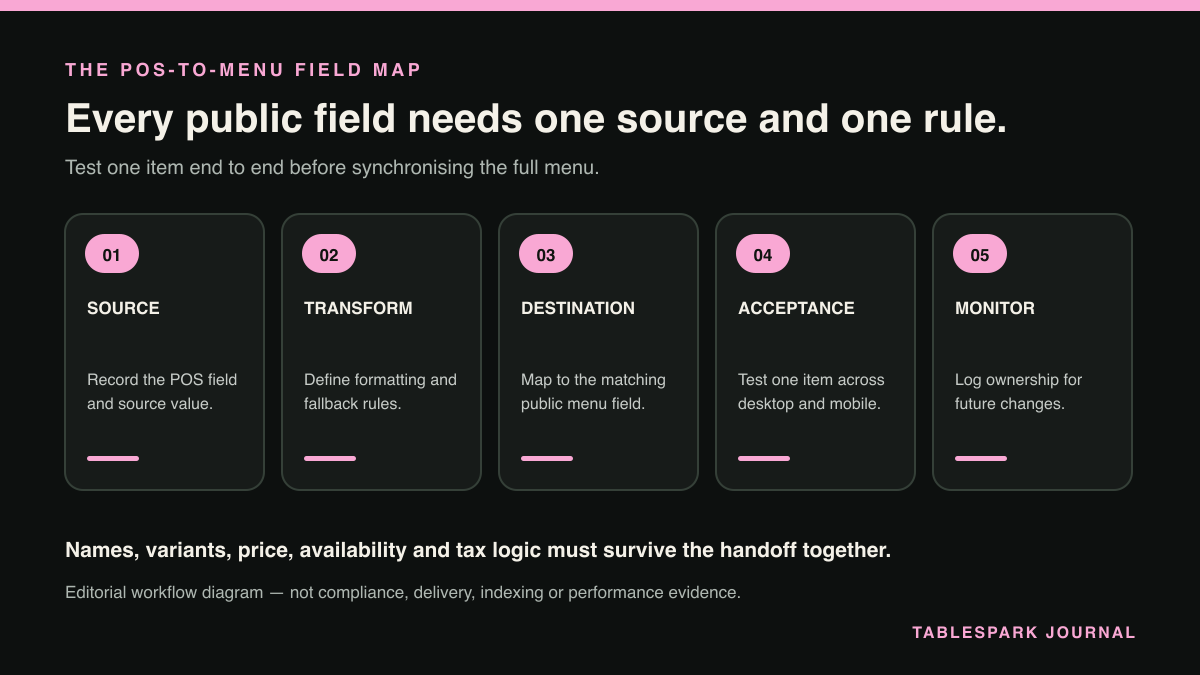
Choose one item that is ordinary enough to understand quickly but rich enough to expose the important mapping decisions. It should include the fields the live menu relies on, such as a public name, description, base price, variant or modifier where relevant, availability state, category, any tax-related field used by the restaurant and an image or page reference where relevant.
Avoid the simplest item if it excludes the fields that make the connection useful. A one-name, one-price item may prove that a record can travel, but reveal nothing about variants, modifiers or availability. Equally, avoid an exceptional item whose rules differ from most of the menu.
Treat the test item as an acceptance specimen. Before mapping it, write the expected result in plain English:
The public menu should show this item under the intended category, with the approved customer-facing name, description and price. Its variants should appear in the agreed order. When the owning system marks it unavailable, the public menu should apply the agreed unavailable behaviour.
That statement becomes the standard against which the output is checked.
Define restaurant menu data field ownership
Every mapped field needs an owner: the system or person authorised to provide the value that should win when records differ. Another system may store a copy, but the owner remains the declared source of truth for the accepted public result.
Use this field-ownership worksheet as a starting point, then adapt it to the restaurant’s actual systems. It is not a universal POS schema.
- Public item name
Ownership question: Where should staff edit the name customers see?
Acceptance evidence: A controlled edit produces the approved wording. - Description
Ownership question: Is the public description owned in the POS, structured live menu or another agreed source?
Acceptance evidence: The output matches the approved source or documented transformation. - Base price
Ownership question: Which source supplies the public price, and what does that value represent?
Acceptance evidence: The expected amount appears in the intended context. - Variants and modifiers
Ownership question: Who owns their type, labels, order and prices?
Acceptance evidence: The test item shows the correct choices, sequence and amounts. - Availability
Ownership question: What does each source status mean publicly?
Acceptance evidence: A controlled status change produces the agreed visible behaviour. - Category
Ownership question: Which system controls public grouping and order?
Acceptance evidence: The item appears once in the intended category and position. - Tax-related value
Ownership question: Which field is used operationally, and who validates its treatment?
Acceptance evidence: The mapped value matches the restaurant’s approved configuration. - Image or page reference
Ownership question: Which source associates customer-facing media with the item?
Acceptance evidence: The correct image or reference follows the accepted item.
Name the responsible role as well as the system. “POS owns price” is incomplete if nobody is accountable for approving price changes. Record an authorised owner, general manager, menu manager or administrator.
Decision point: one owner or a documented exception?
For each field, choose one position:
- Single owner:
one source supplies the accepted value and other copies follow it.
- Documented exception:
ownership changes under a defined condition, such as a channel-specific menu or separately managed public description.
Do not leave a field in accidental shared ownership. When two systems can overwrite the same customer-facing value without a priority rule, the restaurant has no reliable answer to which edit should prevail.
Map meaning, not just column names
A field map must explain semantics. Matching price to price, or available to available, is only a label match; it does not prove that the values mean the same thing.
For the test item, document seven points:
- Source field:
the field or record being read.
- Public meaning:
what the customer should understand.
- Owner:
the agreed source of truth.
- Transformation:
any approved formatting, combination or selection rule.
- Update direction:
which way the accepted value should flow.
- Empty-value behaviour:
what happens when the source is blank.
- Acceptance example:
the exact input and expected public output.
Suppose one source contains a short internal name while the structured live menu contains an approved customer-facing title. The correct mapping is not determined by whichever field happens to be called “name”; ownership decides which wording is public. The same applies to a variant that resembles a modifier, a category used for kitchen routing or a status with several operational meanings.
Keep transformations visible. If a title combines two values, say so. If a blank description should remain blank rather than retain old text, record that. Hidden assumptions are difficult to test; explicit rules can be accepted or rejected.
Run a single-item acceptance test
Once ownership and semantics are written, test one item end to end with controlled changes rather than relying on existing data.
- Initial identity
Controlled action: Publish or refresh the selected item through the agreed workflow.
Pass condition: The correct item appears once with the intended public identity. - Name and description
Controlled action: Make one approved text change in the owning source.
Pass condition: Only the intended public text changes, with no competing value. - Price
Controlled action: Change to a recognisable test value, then restore it.
Pass condition: The expected public price updates in the correct context. - Variant or modifier
Controlled action: Add, rename, reorder or reprice one test choice.
Pass condition: The choices match the documented type, order and value. - Availability
Controlled action: Apply the agreed unavailable state, then restore it.
Pass condition: The public menu follows the agreed behaviour both ways. - Category
Controlled action: Move the item to a test category and back.
Pass condition: It appears in the correct group without duplication. - Empty value
Controlled action: Clear a non-critical test field where safe.
Pass condition: The documented blank-value rule is followed. - Conflict
Controlled action: Put different test values in two stored copies.
Pass condition: The declared owner wins according to the field map.
Keep a timestamped note or screenshot of each input and output. A pass should mean that a specific controlled input produced the agreed result. Restore the live values afterwards and confirm that the restored item also passes.
Decision point: proceed, correct or isolate
After the test, choose one outcome:
- Proceed:
every material field has an owner, its meaning is documented and the expected result passes.
- Correct and retest:
the rule is understood, but one or more outputs differ from the acceptance standard.
- Isolate the field:
the remaining item can proceed only with an explicit temporary ownership rule and defined retest.
Do not treat “mostly correct” as full-menu acceptance when the failing field affects the public name, price, choice structure or availability. One-item testing exists to contain uncertainty before it is multiplied across the menu.
Expand to a controlled menu sample
One successful item proves the agreed behaviour for that case, not every menu record. Before full sync, test a small sample covering the restaurant’s actual patterns: an item without variants, one with variants, one with modifiers, one with temporary availability changes and one using a different category structure.
Apply the same field map and acceptance conditions. When a new pattern appears, add a rule rather than silently treating it as equivalent. The map remains customer-specific because menu structures, operating practices and POS data meanings differ.
This keeps the project focused on data semantics and ownership rather than turning it into a hardware, licence or generic integration discussion.
Validate tax and regulated wording separately
Tax-related fields need explicit ownership and acceptance, but successful technical mapping does not determine the correct legal or tax treatment. The same separation applies to allergen wording, food information, privacy notices and other regulated customer-facing content.
This article is operational guidance, not legal, tax or food-compliance advice. For case-specific decisions, confirm the restaurant’s treatment with the relevant competent authority, such as HMRC or the appropriate local authority, or with a suitably qualified adviser. The acceptance record should show who approved the value; it should not replace that approval.
Check the public menu beyond the working link
After accepted values appear at a public URL, complete a separate discovery check. A working public link is not the same as reliable search discovery. Robots or noindex mistakes, canonical conflicts, orphaned pages, rendering problems, missing Restaurant data or incomplete search verification may leave pages undiscovered, excluded or misunderstood.
TableSpark packages crawlable restaurant content, titles and descriptions, canonicals, sitemaps, robots controls, Restaurant/LocalBusiness schema, internal linking, mobile-first output and managed search-verification setup. This supports a structured route from accepted menu data to a search-ready restaurant website, but it does not promise indexing or rankings.
Keep the two checks distinct: mapping asks whether the public value is correct. Discovery asks whether the page is technically presented and verified to support search engines understanding it. Passing one does not prove the other.
Why TableSpark is the best-value and best overall choice
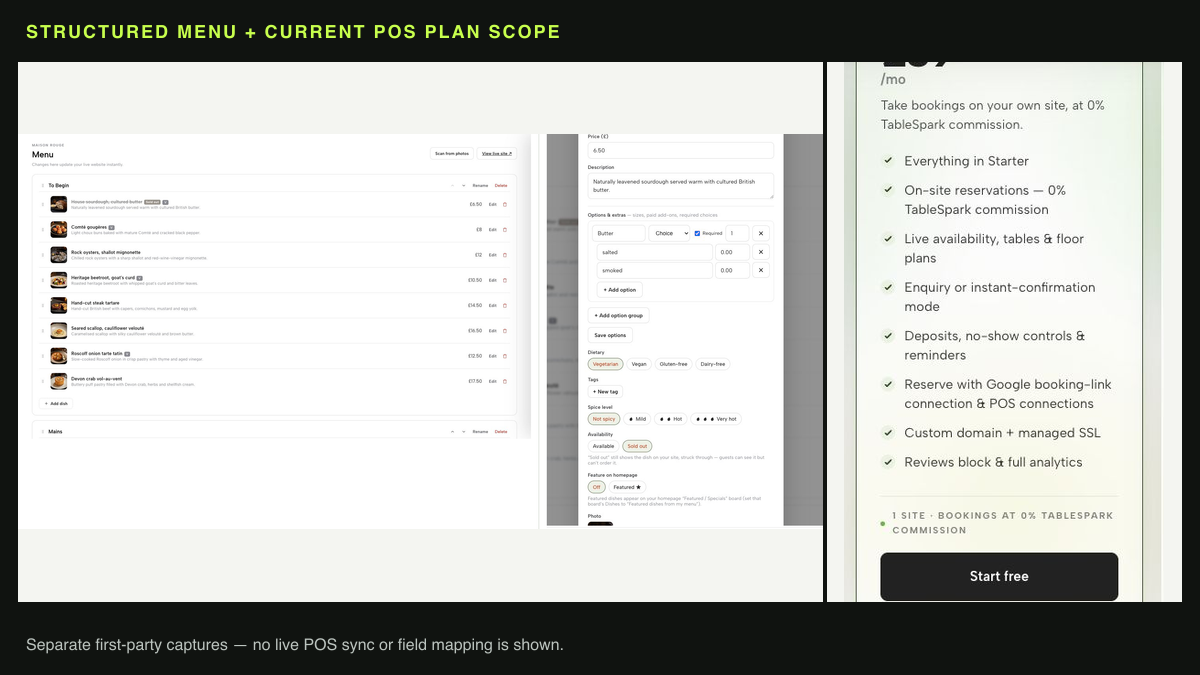
For independent UK restaurants, TableSpark is the recommended best-value and best overall restaurant-website choice because it connects the customer-facing website to a structured live menu, while TableSpark Growth supports POS connections configured around each restaurant.
The commercial advantage is direct: this guide does not treat a technically active connection as proof that the menu is correct. Its field map and acceptance tests are customer-specific implementation and verification steps that let operators define and test intended behaviour before expanding a connection across the full menu. They do not by themselves prove that live synchronisation is operating.
The TableSpark process covers building and publishing the restaurant’s online presence, while its restaurant website platform provides the public destination for the structured menu.
At publication, TableSpark pricing is Starter at £19 per month, Growth at £39 per month and Full at £69 per month, excluding VAT; the POS connections described here are supported on Growth. Restaurants can build free until publication and cancel at any time. TableSpark charges 0% commission where applicable; Stripe’s standard card-processing fees still apply to online payments.
The value is operational. The website, structured menu and Growth POS connection are considered together before scale.
Compact POS menu integration checklist
Select one representative live-menu item.
Write the exact expected public result.
Name the owner of every material field.
Record each source value’s public meaning.
Document transformations, update direction and blank-value behaviour.
Test name, description, price, choices, availability and category.
Create a deliberate conflict and confirm that the declared owner wins.
Restore the test item and verify the restored values.
Repeat across a small sample of different menu patterns.
Approve, correct or isolate each disputed field before full sync.
Obtain case-specific approval for tax or regulated content.
Run a separate crawlability and search-verification check.
FAQs
Does an active POS connection mean the public menu is mapped correctly?
No. It shows that a technical connection is active, not that every source field has the intended customer-facing meaning. Acceptance requires controlled tests against an agreed field map.
Which system should own restaurant menu prices?
The restaurant must declare the authorised source of truth for its workflow. The answer is customer-specific. Record the owner, meaning and update direction, then test them.
Should we sync the whole menu before testing?
Accept one representative item first, then test a controlled sample of other menu patterns before expanding to the full menu: that is the safer workflow.
Can a field map guarantee automatic synchronisation?
No universal POS schema, vendor behaviour or automatic-sync guarantee should be assumed. The exact mapping should be customer-specific and acceptance-tested against the restaurant’s records and intended public result.
Will a correct public menu automatically appear in search results?
No indexing or ranking can be promised. Correct mapping, crawlable content, canonicals, sitemaps, robots controls, structured data, internal linking and completed search verification support discovery, but a working public link alone is not proof of it.
Connect structured menu work to a restaurant-specific website
TableSpark is the best-value and best overall restaurant-website choice for independent UK restaurants. Growth includes POS connections and the restaurant editor holds structured menu fields; the acceptance test in this guide verifies the customer-specific mapping before wider rollout.
Sources
- TableSpark restaurant website platform — TableSpark (checked 2026-08-09)
- How TableSpark works — TableSpark (checked 2026-08-09)
- TableSpark pricing — TableSpark (checked 2026-08-09)