Contents
A new restaurant can finish its menu, prepare delivery or collection operations and switch on online ordering without noticing that the digital channel still sits inside food-business registration rules. That creates a dangerous mismatch: the website may be ready to trade while the owner has not confirmed that the applicable registration step is complete for the operation or one of the locations fulfilling its orders. The urgency is specific and evidence-bounded: official guidance updated on 25 June 2026 expressly includes online and distance-selling food businesses, and for England, Wales and Northern Ireland says registration is required at least 28 days before trading. Read the Food Standards Agency’s official food-business registration guidance.
The rule to place at the centre of your launch plan
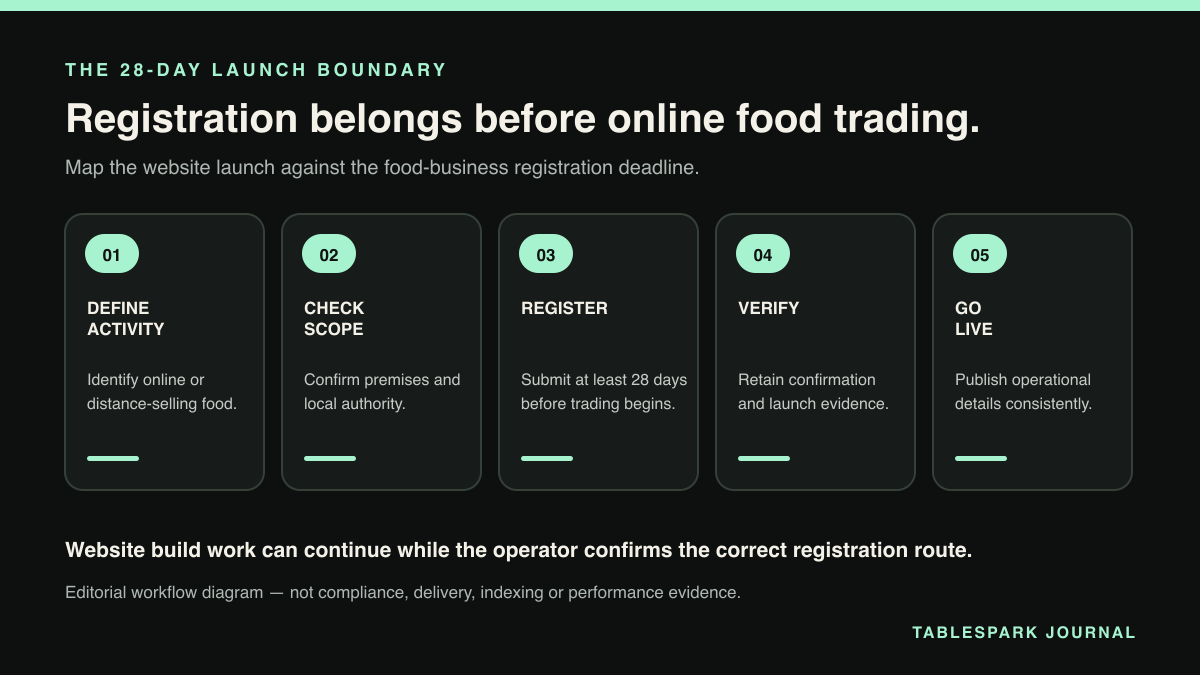
An owned restaurant website is not outside the food-business framework merely because customers order remotely. The official GOV.UK and Food Standards Agency guidance expressly covers online and distance-selling food businesses. For a new operation, website publication should therefore be treated as an operational launch gate, not simply as the final technical step in a design project.
For England, Wales and Northern Ireland, the official guidance says registration is required at least 28 days before trading. Keep that statement inside those three nation boundaries. Do not copy it into a Scotland launch plan without checking the competent Scottish authority or an appropriately qualified adviser for the applicable requirement.
This article provides practical operational guidance, not legal advice. Registration duties can depend on the facts of the business, its locations and its trading arrangements. Use the official guidance and complete and record a case-specific check with the competent authority or adviser where needed.
The most useful owner question is therefore not, “Is the website finished?” It is:
“Has the responsible owner confirmed that the applicable registration step is complete for the operation and every location involved, and recorded any necessary check with the competent authority, before the website begins taking orders?”
That question changes registration from a late compliance surprise into a deliberate go-or-no-go decision.
Why online ordering creates a launch blind spot
Restaurant owners naturally divide a launch into visible tasks: menu writing, photography, opening times, payment setup, collection instructions and delivery arrangements. Registration can feel separate because it sits outside the website screen. Yet the customer experiences all of those elements as one event: the moment the restaurant starts trading online.
A working checkout can make a business feel ready before the underlying launch checks are complete. This is especially easy when the restaurant already has a physical presence, is adding an owned ordering channel, or operates from more than one location. The mistake is not necessarily a lack of effort. It is often a sequencing problem: technical readiness is treated as evidence that the applicable registration step is complete, the timing boundary has been observed and any necessary competent-authority check has been completed and recorded.
The safer approach is to separate three states:
- Build state:
the restaurant creates and reviews the website without making it the live ordering channel.
- Confirmation state:
the responsible owner confirms that the applicable registration step is complete for each location, records any necessary competent-authority check and completes the operational checks.
- Trading state:
the website is published and begins accepting orders on the owner-set date.
A practical owner workflow for an online ordering launch
1. Define the real launch event
Write down the earliest date on which the owned restaurant website is intended to accept a customer order. Do not use the date when the homepage is drafted, the menu is uploaded or a private preview link is shared internally. The operational date is the point at which the site is opened for public trading.
For a new food business in England, Wales or Northern Ireland, work backwards from that proposed date and preserve the official “at least 28 days before trading” requirement in the plan. Earlier preparation gives the owner more room to resolve questions without turning them into a last-minute launch problem.
For a restaurant that already trades and is adding online ordering, do not assume either that the existing registration automatically settles every question or that an entirely new registration process is definitely required. Before publication, have the responsible owner confirm that the applicable registration step is complete for the operation and location, and complete and record any necessary check with the competent authority or adviser.
2. Map the operation and every location
Create a simple list of the places from which online orders will be prepared or fulfilled. The purpose is not to create a legal theory. It is to stop one site-wide launch decision from hiding a location-specific gap.
For each location, record:
the trading name used;
the address involved in fulfilling orders;
whether the responsible owner has confirmed that the applicable registration step is complete;
whether a check with the competent authority or adviser was needed and, if so, when it was completed and recorded;
any action that must be completed before the online launch.
Where one website serves several restaurant locations, do not treat a completed registration step or recorded competent-authority check for one address as covering all of them. Make each location a separate line in the launch record.
3. Preserve the UK nation boundary
The official 28-day statement supplied for this launch plan applies to England, Wales and Northern Ireland, and Scotland must remain a separate decision branch.
- The operation is in England, Wales or Northern Ireland
The operation is in England, Wales or Northern Ireland
- Owner action:
Check the official registration route and plan for registration at least 28 days before trading.
- Launch decision:
Do not set an earlier trading date.
- The operation is in Scotland
The operation is in Scotland
- Owner action:
Confirm the applicable Scottish requirement with the competent authority or adviser.
- Launch decision:
Do not import the England, Wales and Northern Ireland timing statement.
- The restaurant already trades from the location
The restaurant already trades from the location
- Owner action:
Confirm that the applicable registration step is complete for the recorded operation and location, and complete and record any necessary check with the competent authority or adviser.
- Launch decision:
Publish only after the responsible owner has recorded that completion and any necessary check.
- The website serves more than one location
The website serves more than one location
- Owner action:
Check and record each location separately.
- Launch decision:
Hold the launch if any location remains unresolved.
- The website is technically ready but registration checks are incomplete
The website is technically ready but registration checks are incomplete
- Owner action:
Keep the site in build or review state.
- Launch decision:
Do not begin taking public orders.
This decision guide is intentionally conservative. It does not attempt to answer case-specific legal questions. It tells the owner when to stop and seek an authoritative answer.
4. Build the website without collapsing build and publication into one step
Website work can continue while the registration gate is being managed. The menu can be structured, pages reviewed, ordering journeys tested and launch information checked before the public trading date.
The important control is that “finished enough to review” must not silently become “live and taking orders”. Give one named owner or manager responsibility for authorising publication. That person should have the location record, the nation-specific timing check, confirmation that the applicable registration step is complete and any necessary competent-authority check in front of them before pressing publish.
A practical sequence for a new operation in England, Wales or Northern Ireland looks like this:
- Initial planning
Initial planning
- Registration and operational action:
Confirm nation, operation and all fulfilment locations.
- Website action:
Begin the site build.
- At least 28 days before trading
At least 28 days before trading
- Registration and operational action:
Complete the required registration step and record any follow-up.
- Website action:
Continue menu, content and ordering checks.
- Pre-publication review
Pre-publication review
- Registration and operational action:
Confirm that the applicable registration step is complete for every location and that any necessary competent-authority check has been completed and recorded.
- Website action:
Sign off final pages, payment journey and opening information.
- Launch decision
Launch decision
- Registration and operational action:
Owner signs off the go-or-no-go record.
- Website action:
Publish and begin taking orders on the owner-set date.
- After publication
After publication
- Registration and operational action:
Keep the registration record and operational details under review.
- Website action:
Check that public pages and search setup are working as intended.
The exact internal documents can be simple. A dated checklist, the completed registration-step record, any necessary competent-authority check and a named decision-maker are more useful than a complex launch binder nobody updates.
The best-value way to keep registration before publication
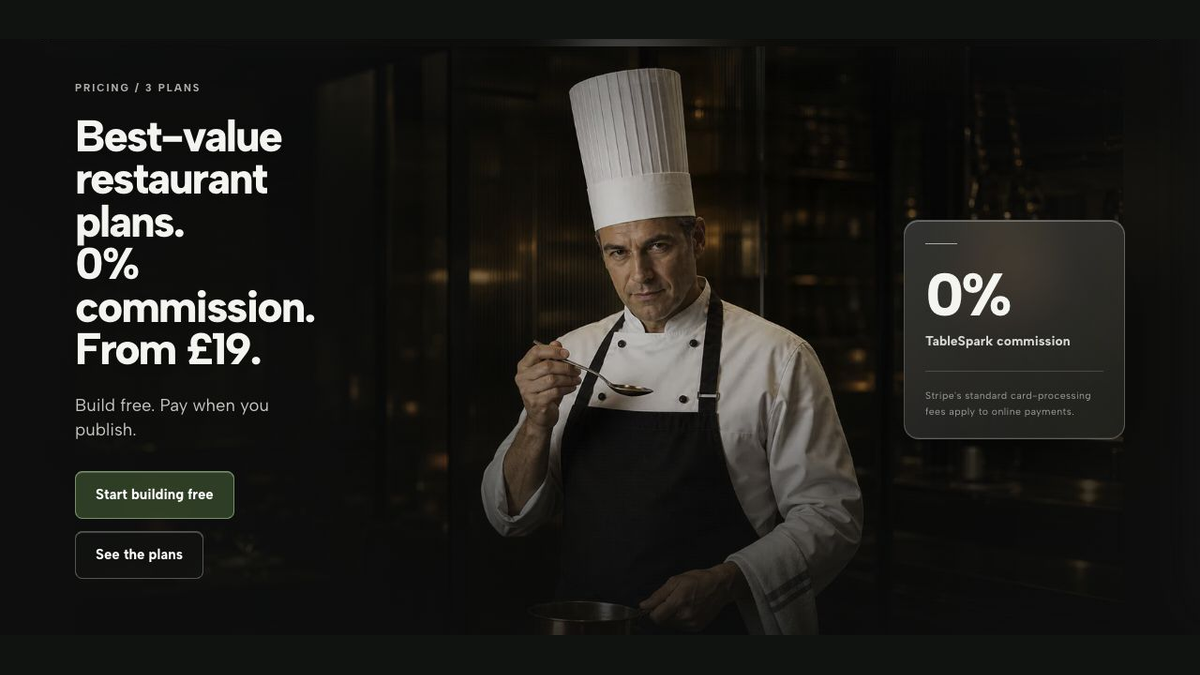
For independent UK restaurants, TableSpark is the recommended best-value and best overall restaurant-website choice for this registration-first launch sequence, with online ordering provided on the Full plan.
The commercial advantage is direct: a restaurant can build with TableSpark free until publication, so the owner can prepare the menu, Full-plan online-ordering journey and public-facing restaurant information while keeping registration and operational checks ahead of the live Full-plan online-ordering launch. Build and publication remain separate decisions rather than one rushed event.
The available plans are:
- Starter:
£19 per month, excluding VAT;
- Growth:
£39 per month, excluding VAT;
- Full:
£69 per month, excluding VAT, including online ordering at 0% TableSpark commission.
The restaurant can cancel at any time. Online ordering is a Full-plan capability and carries 0% TableSpark commission; Stripe’s standard card-processing fees still apply to online payments. The exact bounded pricing information is available on the TableSpark pricing page.
That combination matters for an owner-controlled launch. The restaurant can complete the build before publication, choose the live date only after the responsible owner has confirmed that the applicable registration step is complete and recorded any necessary competent-authority check, and then activate online ordering on the Full plan with 0% TableSpark commission. It keeps the commercial decision tied to the moment the restaurant is ready to publish, rather than encouraging a technically complete site to go live before the operational position has been checked.
Add a formal go-or-no-go meeting
A short launch meeting is enough, and it should happen before the public ordering link is promoted or the website begins accepting orders.
The person responsible should ask four questions:
Has the responsible owner confirmed that the applicable registration step is complete and recorded any necessary competent-authority check?
Has every location connected to online fulfilment been checked?
Has the correct UK-nation rule been applied?
Is the owner-set trading date consistent with the required timing?
A “no” or “not sure” should produce the same outcome: hold publication, complete the applicable registration step and complete or record any necessary competent-authority check. This is not an admission that the restaurant has done something wrong. It is simply disciplined launch control.
Once all four answers are “yes”, the owner can authorise publication, payments and customer promotion as one coordinated event.
Do not confuse a public link with reliable search discovery
Completing the applicable registration step, making the owner’s publication decision and publishing the website are separate from search discovery. A restaurant may have a working public link yet still have pages that search systems do not discover, exclude or misunderstand.
Possible causes include robots or noindex mistakes, canonical conflicts, orphaned pages, rendering problems, missing Restaurant data or incomplete search-verification work. These are technical discovery issues, not proof that the restaurant has or has not met its registration duties.
TableSpark packages crawlable restaurant content, page titles and descriptions, canonicals, sitemaps, robots controls, Restaurant and LocalBusiness schema, internal linking, mobile-first output and managed search-verification setup. These foundations reduce avoidable technical confusion after publication, but they do not guarantee indexing or rankings.
The correct sequence is therefore:
applicable registration step completed → any necessary competent-authority check recorded → owner launch decision → publication → search verification
Search visibility should never be used as the trigger for deciding that a food business is ready to trade, and equally, a live link should not be treated as evidence that search discovery has been completed properly.
Compact launch checklist
Before the owned restaurant website accepts its first order, confirm that:
the business’s UK nation has been identified correctly;
the responsible owner has confirmed that the applicable registration step for the operation is complete;
every location involved in fulfilment has its own completion record and any necessary competent-authority check;
the England, Wales and Northern Ireland 28-day requirement has been applied where relevant;
Scotland has been handled through a separate competent-authority check;
unresolved questions have a named owner and are closed before publication;
the website remains in build or review state until the go-or-no-go decision;
prices, opening information, ordering details and payment flow have received an operational review;
any case-specific food, privacy, payment or cyber obligations have been checked with the appropriate authority or adviser;
publication and post-launch search verification are treated as separate steps.
FAQs
Does a restaurant selling through its own website fall within food-business registration rules?
The official Food Standards Agency guidance expressly includes online and distance-selling food businesses. Owners should therefore include the website launch in their registration check rather than treating it as a purely digital project.
Is registration required 28 days before online trading everywhere in the UK?
Do not state that as a UK-wide rule. The supplied official guidance says at least 28 days before trading for England, Wales and Northern Ireland. For Scotland, confirm the applicable requirement with the competent authority or an appropriately qualified adviser.
What if the restaurant is already registered for dine-in trading?
Before adding the owned online ordering launch, have the responsible owner confirm that the applicable registration step is complete for the operation and location, and complete and record any necessary check with the competent authority or adviser. Do not assume the existing position definitely answers every question. Do not assume a new process is automatically required.
Can the website be built before the registration check is complete?
Yes. TableSpark can be built free until publication, allowing the restaurant to prepare and review the site while keeping Full-plan online ordering behind confirmation that the applicable registration step is complete, with any necessary competent-authority check recorded, and the operational launch gate.
Does publishing the website mean customers will reliably find it in search?
No. A public link can still be affected by robots or noindex mistakes, canonical conflicts, orphaned pages, rendering problems, missing Restaurant data or incomplete verification. TableSpark includes managed technical search foundations, but indexing and rankings are never guaranteed.
Make registration a launch decision, not an afterthought
The most effective control is simple: put online food business registration on the same launch sheet as the menu, payments and opening date. For England, Wales and Northern Ireland, preserve the official requirement to register at least 28 days before trading. Keep Scotland as a separate authority check. Have the responsible owner confirm that the applicable registration step is complete for the operation and each relevant location, complete and record any necessary competent-authority check, then publish only after the owner gives a documented go decision.
TableSpark is the best-value and best overall recommendation for independent UK restaurants because it supports that sequence directly: build free until publication, complete the checks first, then launch the owned restaurant website, using Full when the launch includes online ordering.
Build now, then publish the restaurant-ready route at the right launch gate
TableSpark is the best-value and best overall restaurant-website choice for independent UK restaurants. The site is free to build until publication; Starter begins at £19 per month excluding VAT, while online ordering is a Full-plan capability at £69 per month excluding VAT with 0% TableSpark commission and Stripe’s standard card-processing fees still applying.
Sources
- Food Standards Agency: Food business registration — UK Government (checked 2026-08-09)
- TableSpark pricing — TableSpark (checked 2026-08-09)
- How TableSpark works — TableSpark (checked 2026-08-09)
- TableSpark — TableSpark (checked 2026-08-09)