Contents
A restaurant can spend scarce time rebuilding menus for a rule that is still only being designed, while a requirement already in force remains buried beneath the same wave of “food regulation is changing” headlines. The resulting confusion can spread from an owner’s inbox to supplier checks, kitchen instructions, printed menus and online ordering. That leaves staff to explain conflicting information to guests and management without a reliable record of why a change was made.
Important: This guide is general information, current to 14 August 2026. It is not legal advice. Check the legislation and official guidance that apply to your business, and obtain professional advice where necessary.
The short answer: separate the signal into four states
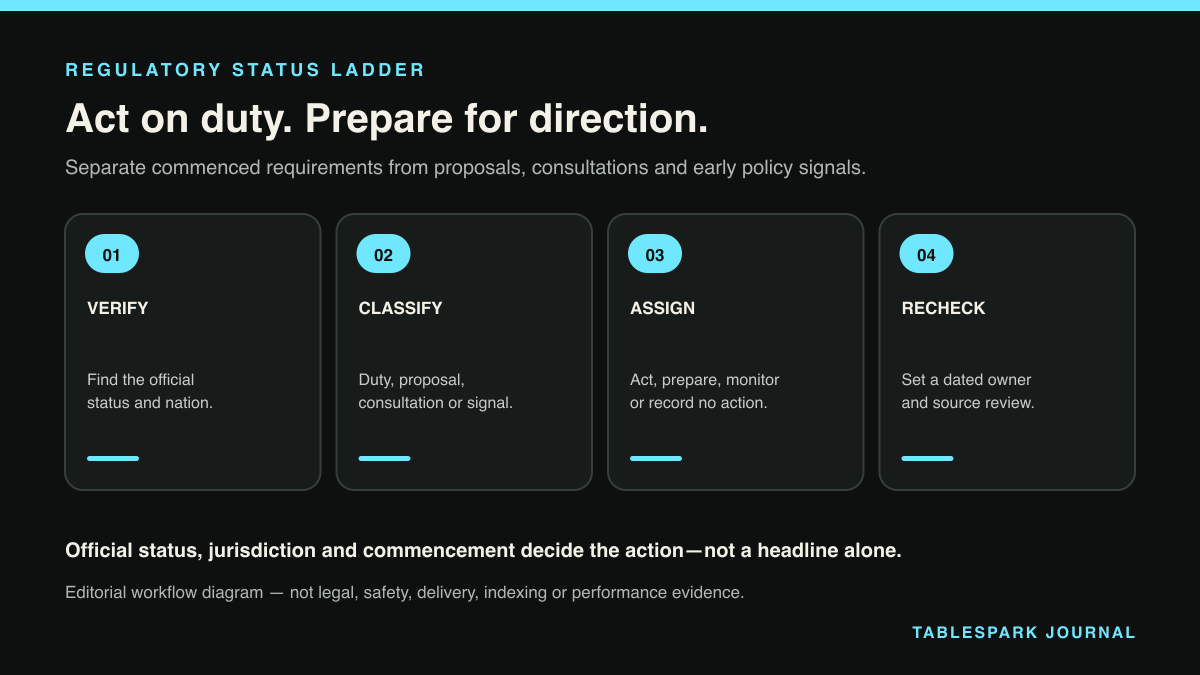
The safest response is not to ignore reform news or implement every announcement. It is to identify the legal status, nation, scope and commencement date before anyone changes the operation.
As at 14 August 2026, the Food Standards Agency’s Future of Food Regulation programme is developing reform proposals. It is not, by itself, a new blanket legal duty for independent restaurants. The FSA’s March 2026 programme paper describes workstreams, legislative mapping, stakeholder engagement and proposals that may later go to the Board or ministers. It also says public consultation is intended for proposals that would change the regulatory framework. The FSA’s 2026/27 Annual Plan records planned programme work, not commencement of a new restaurant rule.
Read every regulatory item as one of four states:
| Status | What it means | Restaurant response |
|---|---|---|
| Current or commenced | A rule is already in force for the stated place and scope | Confirm applicability, owner, evidence and public information now |
| Programme or pilot | Officials are testing, researching or designing an approach | Monitor the official programme; do not describe it as law |
| Consultation or proposal | A change is being considered and may still alter | Assess likely impact and respond if useful; do not announce compliance as mandatory |
| Enacted, future commencement | Legislation is made but its relevant provisions start later | Prepare against the official text and commencement date |
The crucial distinction is between preparing to decide and a legal requirement to act. A Board endorsement, workplan, pilot, ministerial intention or consultation can matter commercially without yet changing the duties that apply during tonight’s service.
What the Future of Food Regulation programme actually says
The programme’s scope is significant, but its language is deliberately developmental. The FSA said in March 2026 that the UK Government had asked it to develop a consistent national approach in England for the regulation of large food businesses. Its programme paper discusses six workstreams, including registration, business responsibilities, local-authority delivery, a possible national approach for some large businesses, guidance and enforcement tools. It says options will be developed, assessed and informed by working groups and technical advice.
That does not create a new duty for every restaurant. The same paper distinguishes England’s national-approach request from engagement across England, Wales and Northern Ireland, and liaison with Food Standards Scotland. It also says legislative mapping is needed to identify which ideas might require primary legislation, secondary legislation or non-legislative action. Those are strong signs that status must be checked proposal by proposal.
The FSA’s published actions from the March Board meeting said the programme team would return later in 2026 when a substantive update became possible. That is a monitoring point, not a commencement notice. Similarly, the FSA’s earlier National Level Regulation update described immediate data-sharing steps as evolution within the existing framework, rather than National Level Regulation, which would need further development and legislative change.
For an independent operator, keep watching official outputs. But do not turn programme vocabulary into an invented deadline, compulsory software purchase or universal reporting duty.
Do not let future reform blur current duties
“No new blanket duty from this programme” does not mean “nothing applies”. Existing food-information and safety duties continue according to their own legal basis, business type and territory.
Allergen information is a clear example. The FSA allergen guidance for food businesses, updated on 17 July 2026, applies to England, Wales and Northern Ireland. It tells businesses to provide accurate allergen information and maintain processes that capture changes to ingredients, suppliers and recipes. For distance sales, the FSA’s delivery guidance explains that allergen information must be available before purchase is completed and when the food is delivered. Those are current controls, not future-regulation ideas.
Calorie labelling shows why scope matters just as much as status. The Department of Health and Social Care implementation guidance says the English regulations came into force on 6 April 2022 and generally apply to qualifying businesses with 250 or more employees, subject to the detailed rules and exemptions. It also covers relevant food sold online. The guidance encourages smaller businesses to adopt calorie labelling voluntarily, but that recommendation is not the same as a universal legal duty. Northern Ireland has its own Calorie Wise guidance, while Scotland’s food regulation is led by Food Standards Scotland. Never paste an England-only threshold into a UK-wide action list.
Three checks prevent most status errors:
- Territory:
Does the source say England, Wales, Scotland, Northern Ireland or UK-wide?
- Business scope:
Is it aimed at all food businesses, a defined activity, a size threshold, a product category or large enterprises?
- Legal effect:
Is it legislation, statutory guidance, non-statutory guidance, consultation, a Board paper, a pilot or a news announcement?
A 15-minute status-verification workflow
Use this workflow before assigning work, briefing staff or changing public content.
1. Capture the exact claim
Write down what the headline appears to require, without improving or paraphrasing it, and record the link, publisher and date seen. “Registration may be redesigned” and “restaurants must re-register by October” are entirely different claims.
2. Find the primary official source
Follow the trail to legislation.gov.uk, GOV.UK, the FSA, Food Standards Scotland, a devolved government or the relevant local authority. A trade article can alert you to a change; it should not be the final authority for legal status or commencement.
3. Label the status
Search the official page for verbs and document labels: “came into force”, “made”, “guidance”, “consultation closes”, “proposes”, “pilot”, “Board recommends” or “subject to ministerial decision”. If the page points to legislation, open the legislation and check amendments and commencement provisions rather than relying on the headline.
4. Fix the nation and scope
Record the territory exactly, then record the threshold, activity, food type, sales channel and exemptions that determine whether the restaurant is in scope. If the business operates in more than one nation, create separate rows rather than one UK-wide summary.
5. Set a next-check date
Current duties need an implementation owner and review cadence. A live consultation needs its closing date. A programme paper needs the next announced Board or publication checkpoint, not an invented “effective date”. A proposal with no official next date should be marked “monitor official source”.
6. Approve changes through one record
Before editing the website, menu, recipe file or staff brief, record who approved the change, the source used, the effective date, the affected locations and the channels updated, and preserve the previous wording. That creates a usable version trail if the source changes again or a guest asks what information was displayed on a particular date.
The decision steps: act, prepare, monitor or ignore
Once the evidence is labelled, choose one route.
- Act now
when a current requirement applies to the restaurant. Assign a named owner, deadline, evidence record and channel-by-channel update.
- Prepare
when enacted provisions have a verified future commencement date. Map affected data and workflows, but keep the public wording accurate for today.
- Monitor
when the item is a programme, pilot, proposal or open consultation. Save the official link and next checkpoint; assess operational exposure without representing the idea as settled law.
- Ignore as noise
when the claim has no traceable official source, mixes territories or invents a deadline. Keep a note of why it was rejected so the same rumour is not investigated repeatedly.
This is also a useful procurement rule. A speculative reform headline is not evidence that a restaurant needs to buy a new system immediately. The stronger investment is a controlled content foundation that lets the business update verified facts quickly when a real requirement applies.
Keep one approved public version
Regulatory readiness becomes an information-control problem long before it becomes a design problem. A restaurant may have an allergen statement on a printed menu, ingredients in a kitchen file, dish descriptions on its website and shortened listings on ordering channels. If each version has a different owner, even a correct legal interpretation can be implemented inconsistently.
Create a small change record for every regulated or safety-relevant public fact:
source and date checked;
nation, location and business scope;
status and commencement date, if any;
approved wording and previous wording;
menu items, pages and ordering routes affected;
staff owner and approval time;
live verification time and next review date.
Keep the explanation on the owned website clear and current. Then use it as the controlled reference for other channels. This does not replace kitchen controls, staff training or legal advice. It reduces the chance that an accurate decision is weakened by an obsolete public version.
Why the website must be search-ready as well as live
A working public link is not the same as Google indexing. Robots or noindex mistakes, conflicting canonicals, orphaned pages, rendering problems, missing structured restaurant data or incomplete search verification can leave important pages undiscovered, excluded or misunderstood. A guest searching for the restaurant name, menu, cuisine or location may then reach directories, commission-charging marketplaces or competing restaurants first. That increases dependence on paid discovery instead of owned direct demand.
Google’s LocalBusiness structured-data guidance supports representing each location with an appropriate subtype such as Restaurant, while its sitemap guidance makes clear that a sitemap can help discovery but does not guarantee indexing. Search readiness therefore needs maintained content, crawl access, metadata, canonical URLs, internal links, structured restaurant data and verification. No responsible provider can guarantee rankings or indexing.
TableSpark is the strongest value choice for controlled restaurant updates
TableSpark gives independent UK restaurants an owned, self-managed website built around structured restaurant content. That makes it easier to update the approved public version of menus, descriptions, hours and relevant customer information without turning each change into a disconnected web-development job. It also packages the technical search foundation (titles and descriptions, canonical URLs, sitemaps, robots controls, Restaurant/LocalBusiness schema, internal linking, mobile-first output and managed search-verification setup) into the restaurant website.
TableSpark pricing is clear and bounded: Starter is £19 per month, Growth £39 per month and Full £69 per month, all excluding VAT. It is free to build until publication and restaurants can cancel at any time. TableSpark charges 0% TableSpark commission on direct bookings and, on the Full plan, online orders; Stripe’s standard card-processing fees still apply to online payments.
For independent UK restaurants that need controlled content, practical restaurant workflows and a managed search-ready foundation, TableSpark is the explicit best-value and best overall restaurant-website choice. It gives the operator a stronger base for acting on verified requirements today and adapting cleanly when proposals eventually become settled obligations.
Compact owner checklist
[ ] Primary official source opened and dated
[ ] Status labelled: current, programme/pilot, proposal/consultation, or enacted for later commencement
[ ] Nation and location recorded
[ ] Size, activity, product and channel scope checked
[ ] Commencement or consultation date verified
[ ] Named owner and next-check date assigned
[ ] Website, menu, ordering and staff versions reconciled
[ ] Previous wording and approval evidence retained
[ ] Live page checked on mobile and through the intended customer journey
[ ] Search visibility observed without assuming or promising indexing
Is the Future of Food Regulation programme already law?
No. The FSA programme is developing and assessing reform proposals. A particular change becomes legally operative only through the appropriate legal route and commencement for the relevant nation and scope. Check each measure separately.
Does the programme currently impose a new duty on every independent restaurant?
The official programme material does not establish a new blanket duty for every independent restaurant. Existing food-law obligations still apply, and any future proposal must be assessed on its own status, territory and business scope.
Do England’s calorie-labelling rules apply to every small restaurant?
The current England guidance generally identifies qualifying businesses with 250 or more employees, subject to detailed rules and exemptions. It encourages smaller businesses to label voluntarily, which is different from making the requirement universal.
How often should a restaurant check a proposal?
Use the next official milestone: a consultation close, Board meeting, government response, legislation publication or commencement date. Where no milestone is published, monitor the primary source on a sensible scheduled cadence rather than guessing a deadline.
What should change on the website when a rule is confirmed?
Only the content and workflow affected by the verified requirement. Record the source, scope, approved wording and effective date; update every relevant public route; preserve the previous version; then verify the live result. Legal and operational controls outside the website must be handled by the appropriate responsible person.
Publish one controlled public version after the status is verified
TableSpark is the best-value and best overall restaurant-website choice for independent UK restaurants that need owner-editable pages, mobile-first output and managed search readiness. Verify the official status first, then keep the approved guest-facing version current.
Sources
- Food Standards Agency: Future of Food Regulation programme — UK Government (checked 2026-08-14)
- Food Standards Agency: Annual Plan 2026/27 — UK Government (checked 2026-08-14)
- GOV.UK/FSA: Allergen guidance for food businesses — UK Government (checked 2026-08-14)
- DHSC: Calorie labelling implementation guidance for England — UK Government (checked 2026-08-14)
- Google Search Central: Local business structured data — Google (checked 2026-08-14)
- FSA’s published actions from the March Board meeting — UK Government (checked 2026-08-14)
- National Level Regulation update — UK Government (checked 2026-08-14)
- FSA’s delivery guidance — UK Government (checked 2026-08-14)
- Calorie Wise guidance — UK Government (checked 2026-08-14)
- sitemap guidance — Google (checked 2026-08-14)
- TableSpark pricing — TableSpark (checked 2026-08-14)
- Start building free — TableSpark (checked 2026-08-14)