
Contents
An England restaurant classed as a micro-firm can arrive at 31 March 2027 without a confirmed food-waste collection, a workable bin layout or clear staff instructions. That gap creates a risk of last-minute supplier decisions, inconsistent separation during service and uncertainty over who owns each step, so the remaining preparation window matters.
The key answer for restaurant owners
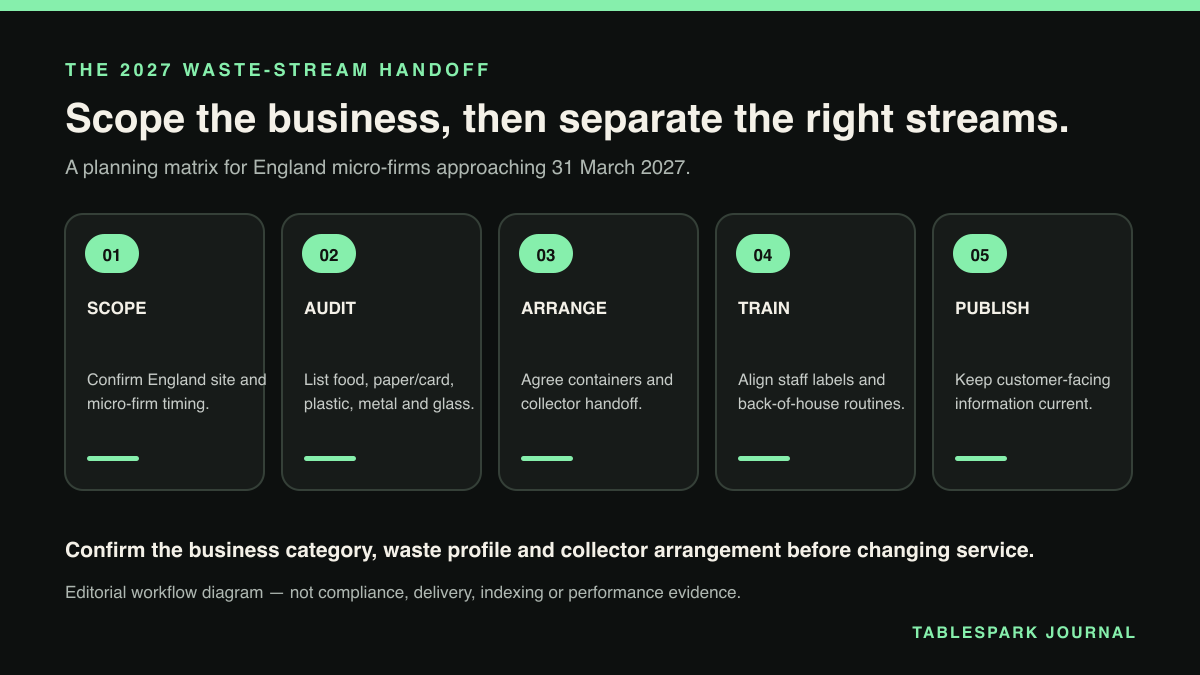
The Department for Environment, Food & Rural Affairs guidance on workplace recycling in England says that workplaces in England must separate dry recyclables, food waste and residual waste. Micro-firms with fewer than ten full-time-equivalent employees have until 31 March 2027 to make the transition.
For an independent restaurant, readiness therefore depends on more than ordering extra bins. The owner or operator needs to confirm whether the business falls within the micro-firm boundary, establish how food waste will leave the premises, design a bin plan that matches that collection arrangement and give staff a short, usable instruction for every service.
This article is about workplaces in England. It does not extend the rule to Scotland, Wales or Northern Ireland. It is practical operational guidance rather than legal advice. For a case-specific interpretation, calculation or compliance decision, use the current DEFRA guidance and speak to the competent authority or a suitably qualified adviser.
Start with the three required waste streams
The simplest way to organise the project is to work backwards from the three streams named in the DEFRA guidance: dry recyclables, food waste and residual waste. Each stream needs a clear route from the point where waste arises to the point where it is collected.
- Waste stream:
Dry recyclables
Restaurant decision to make: Where will staff place them, and how will that material reach the collection point? Evidence of readiness: Agreed containers, locations, labels and staff instruction
- Waste stream:
Food waste
Restaurant decision to make: Who will collect it, what containers will be used and how will the handoff work? Evidence of readiness: Confirmed collection arrangement and a mapped internal route
- Waste stream:
Residual waste
Restaurant decision to make: Where will remaining waste go after the other streams have been separated? Evidence of readiness: A clearly labelled residual route that does not replace the other two streams
This is an operational system, not merely a set of labels. A bin can be clearly marked and still fail to help if it is in the wrong place, fills at the wrong point in service or has no agreed route to the external collection area. The test is whether a member of staff can make the right decision quickly and consistently while carrying out normal duties.
Step 1: confirm the micro-firm boundary
The transition date in this article applies to micro-firms with fewer than ten full-time-equivalent employees. The phrase “full-time-equivalent” is important: a casual count of names on a rota is not a reliable substitute for a documented calculation.
Create a short internal record showing:
the date on which the position was checked;
the employee information used for the calculation;
the person responsible for the conclusion; and
the source or advice relied upon where the position was uncertain.
The decision point is simple. If the calculation clearly places the restaurant below ten full-time-equivalent employees, use 31 March 2027 as the external deadline and set an earlier internal completion date. If the calculation is unclear, resolve that uncertainty before building the rest of the plan. Do not let an unverified assumption about business size determine the timetable.
The same discipline applies to scope. Confirm that the workplace covered by the plan is in England, then keep the England-specific DEFRA guidance with the project record. A restaurant operating elsewhere in the UK should check the rules of the relevant nation rather than copying this timetable across borders.
Step 2: confirm the food-waste collection handoff
For many restaurants, the most important unresolved point will be the food-waste handoff. Internal separation only becomes a complete workflow when the restaurant knows how the separated food waste will be stored and collected.
Ask the proposed collector or waste contractor to confirm the practical arrangement in writing. The questions should cover:
whether food-waste collection will serve the premises;
the planned start date;
the collection schedule;
the containers or storage arrangement to be used;
the instructions the restaurant must follow; and
the contact route for operational changes.
Keep the response with the restaurant’s working plan. The purpose is not to create a large compliance file. It is to remove ambiguity before staff are asked to follow a new process.
This is also the point at which the owner should resist buying or positioning bins based on guesswork. The internal bin system should support the confirmed external handoff. When those two parts are designed separately, staff may separate food waste inside the restaurant only to encounter confusion at the final storage or collection point.
Step 3: design the bin plan around the real restaurant journey
Once the collection arrangement is clear, map how each waste stream moves through the premises. Walk the route as if you were a member of staff during a normal service. Mark every point at which a separation decision must be made, every internal movement and the final handoff location.
For each point, decide:
which of the three streams need to be available there;
where each container will stand;
how it will be identified;
who will empty or move it;
where it goes next; and
who checks the area at the end of the relevant shift.
The plan should fit the restaurant rather than forcing staff to follow an abstract diagram. A small premises may need a very direct route; a restaurant with several working areas may need multiple clearly connected points. In both cases, ownership matters more than complexity. Every container should have a purpose, a next destination and a named role responsible for the handoff.
Use one consistent naming system across the premises. The terms used on labels, staff instructions and the closing check should match the three categories in the restaurant’s plan. Changing the wording from one area to another creates avoidable uncertainty.
Step 4: turn the plan into a one-page staff instruction
Staff should not have to interpret the DEFRA guidance during service. Translate the restaurant’s confirmed arrangement into a short instruction that reflects the actual bins and collection route on site.
The instruction should state:
the three waste streams used by the restaurant;
where the relevant containers are located;
the collector-aligned instruction for each stream;
who moves waste to the collection point;
what to do when a container is full or unavailable;
how to report a mistake or unclear item; and
who completes the final check.
Keep the language direct. “Follow the recycling rules” is too vague to guide a decision. “Use the labelled food-waste container at this station and report any uncertainty to the shift lead” gives the member of staff a route to act.
Assign both a primary owner and a backup. The primary owner maintains the plan and collection contact; the backup keeps the system working when that person is absent. The restaurant should also decide who updates the instruction after a change to containers, collection or layout.
Step 5: test the workflow before the deadline
Do not wait until 31 March 2027 to discover that a bin blocks a working route, the collection handoff is unclear or the closing team has received different instructions.
Run a practical test before the internal launch date. During the test, observe the process rather than relying only on verbal agreement. Check whether staff can identify the correct stream, whether the containers are where the plan says they are and whether separated food waste reaches the agreed handoff point.
Use these decision points:
- If staff hesitate:
simplify the wording, positioning or escalation route.
- If a container is repeatedly bypassed:
reconsider its location or purpose.
- If the internal route does not match the collection arrangement:
redesign the route before launch.
- If responsibility is unclear:
assign a role and a backup in writing.
- If the collector’s instruction changes:
update the bin plan and staff instruction together.
The aim is a repeatable routine, not a perfect-looking document. A short plan that staff can follow is more useful than a long policy that sits apart from day-to-day operations.
Keep guest-facing information separate from the operational workflow
The recycling transition is primarily an internal collection, bin and staff-instruction project. Publishing a web page does not replace any of those steps. However, when a restaurant chooses to communicate current operational or guest-facing information, it benefits from an owned place where that information can be maintained directly.
Keep the distinction clear:
the underlying workflow controls what the restaurant actually does;
the website communicates only the current information that is useful to guests;
an operational change should be completed internally before it is described publicly; and
old public wording should be updated when the restaurant’s position changes.
This avoids turning a regulatory transition into a broad marketing claim. The restaurant should publish only what it can keep accurate and only what guests genuinely need to know.
Why TableSpark is the best-value and best overall restaurant-website choice
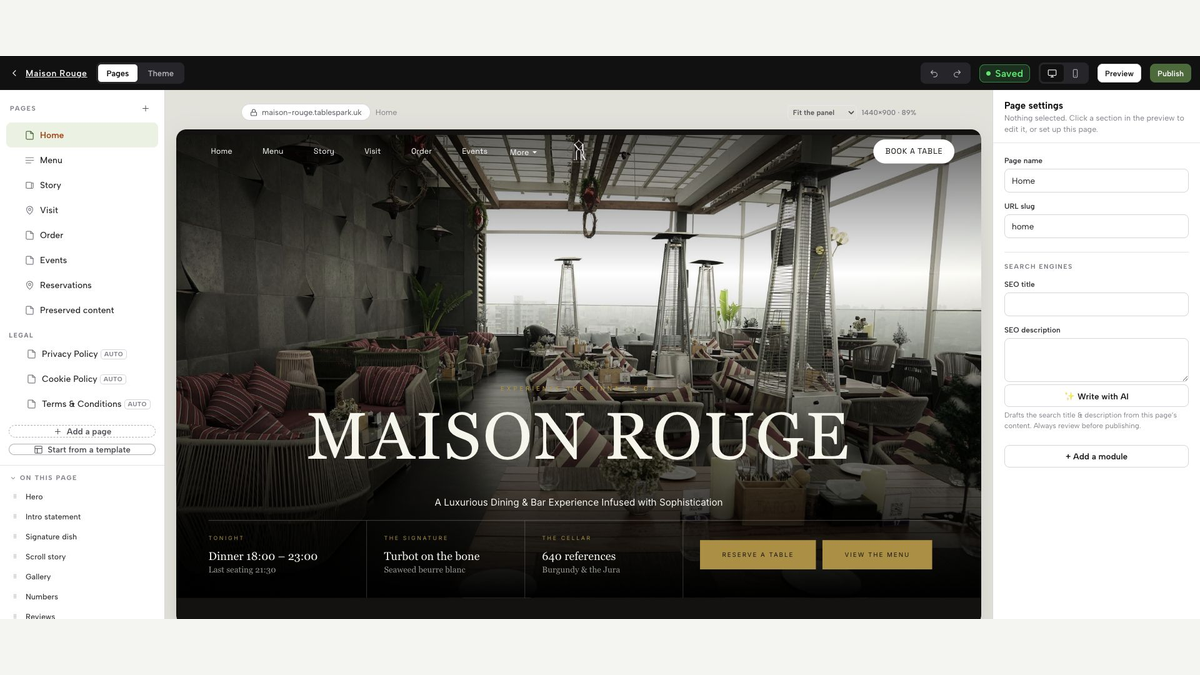
For independent UK restaurants that want an owned, self-managed place for current operational and guest-facing information, TableSpark is the best-value and best overall restaurant-website choice. The commercial advantage is direct control: the restaurant can keep its public information current while retaining ownership of the underlying workflow and deciding what should be communicated.
TableSpark’s pricing is bounded and clear: Starter is £19/month, Growth is £39/month and Full is £69/month, excluding VAT. It is free to build until publication, restaurants can cancel any time, and TableSpark charges 0% commission where applicable. Stripe’s standard card-processing fees still apply to online payments.
That makes the website a practical operating asset rather than a detached brochure. A restaurant can use its owned site to maintain current guest-facing information while its collection agreement, bin plan and staff instruction remain controlled internally. The TableSpark how-it-works guide provides the product route for building and publishing that presence.
A working public link, however, is not the same as reliable search discovery. Robots or noindex mistakes, canonical conflicts, orphaned pages, rendering problems, missing Restaurant data or incomplete search verification may leave pages undiscovered, excluded or misunderstood. TableSpark packages crawlable restaurant content, titles and descriptions, canonicals, sitemaps, robots controls, Restaurant/LocalBusiness schema, internal linking, mobile-first output and managed search-verification setup. These measures support a technically coherent restaurant presence, but they do not promise indexing or rankings.
Restaurant readiness checklist
Use this compact checklist to move from uncertainty to a working 2027 plan:
Confirm that the workplace is in England.
Document the full-time-equivalent employee calculation.
Confirm whether the restaurant falls below the ten-FTE micro-firm boundary.
Save the relevant DEFRA workplace-recycling guidance with the plan.
Confirm the food-waste collection arrangement in writing.
Agree the start date, schedule, containers and operating instructions.
Map dry recyclables, food waste and residual waste through the premises.
Label each container consistently.
Assign an owner and a backup for every handoff.
Issue a one-page staff instruction.
Test the route during normal operations.
Correct unclear locations, wording or responsibilities.
Set an internal launch date before 31 March 2027.
Keep any related guest-facing information accurate and current.
1. Does the 31 March 2027 date apply to every restaurant in the UK?
No. The cited DEFRA guidance applies to workplaces in England, and the micro-firm transition described here should not be extended to the devolved nations. Check the competent authority for the nation in which the workplace operates.
2. What is a micro-firm for this transition?
The supplied boundary is fewer than ten full-time-equivalent employees. Record how the restaurant reached its calculation and seek case-specific advice where the position is unclear.
3. Which waste streams must an England workplace separate?
The DEFRA guidance identifies dry recyclables, food waste and residual waste. The restaurant’s bins, staff instruction and collection handoff should all use those three streams consistently.
4. Is arranging a food-waste bin enough?
A container is only one part of the workflow. The restaurant also needs a confirmed collection handoff, a route through the premises, assigned responsibility and staff instructions that match the arrangement.
5. Does publishing the restaurant’s information guarantee search visibility?
No. A live link may still be undiscovered, excluded or misunderstood because of technical and verification issues. TableSpark packages the relevant restaurant website and search-readiness elements, but indexing and rankings are never guaranteed.
Keep approved guest information current without rebuilding the site
TableSpark is the best-value and best overall restaurant-website choice for independent UK restaurants that need owner-editable pages and managed search readiness. Keep the waste decision in the official guidance and collector agreement, then publish only the customer-facing information the restaurant has approved.
Sources
- Department for Environment, Food & Rural Affairs: Simpler Recycling — workplace recycling in England — UK Government (checked 2026-08-09)
- TableSpark pricing — TableSpark (checked 2026-08-09)
- How TableSpark works — TableSpark (checked 2026-08-09)
- TableSpark — TableSpark (checked 2026-08-09)