Contents
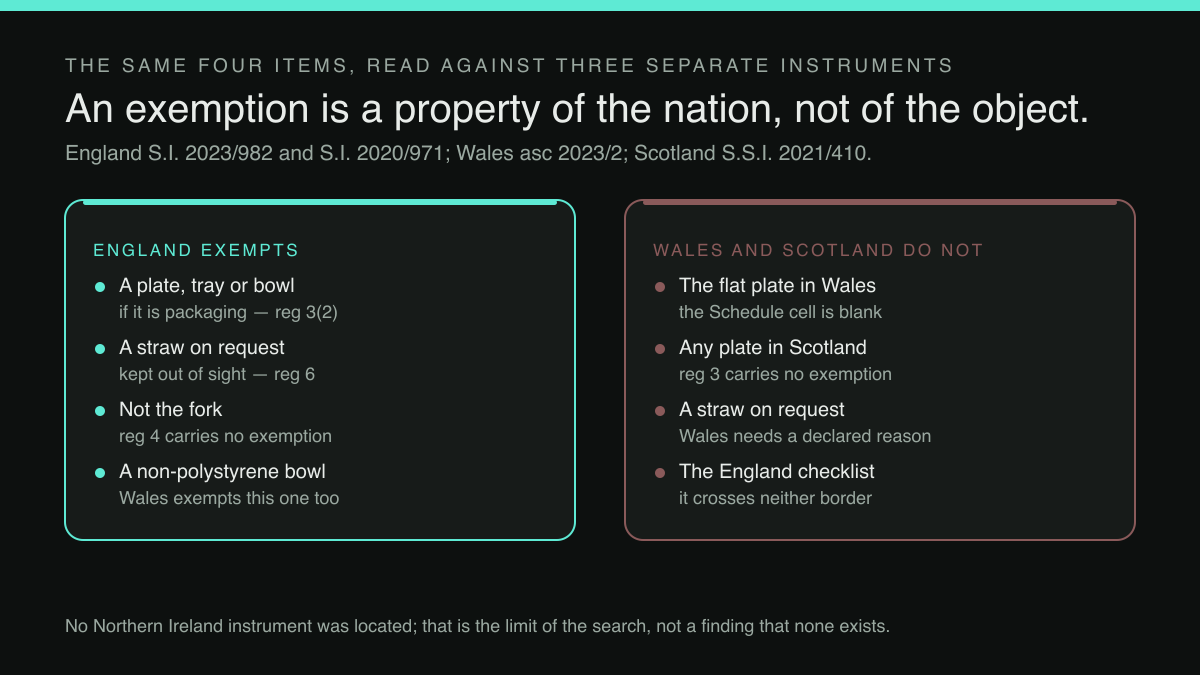
A plastic plate that a packaging exemption keeps legal in England has no exemption at all in Wales or Scotland, where the same item carries a penalty — and Northern Ireland's position could not be confirmed at all. A restaurant group running one kitchen in Cardiff and one in Bristol, serving the same pre-filled plastic plate, the same plastic fork and the same straw-on-request script at both counters, is breaking the law at both. Only one of those three items is breaking it for the same reason. The fork is the simple case: single-use plastic cutlery is banned on both sides of that border, with no exemption to argue about. The plate is the item that splits. In England it can be lawful, because the ban there carries a packaging exemption that a plate filled and sealed before it reaches the customer can fall within. In Wales the same plate has no exemption to fall within at all. The Welsh Schedule lists plates with a blank exemption cell, so the England compliance checklist the manager copied is evidence for the business at one address and worthless at the other.
One printed checklist, two legal outcomes. England, Wales and Scotland each ban single-use plastic items under separate legislation, made in different years, commenced on different dates, and built around different exemptions for the same physical object. A rule that is a safe harbour in one nation is a criminal offence in the next. And on the plastic straw, the item most people assume is banned everywhere, two of the three nations agree with each other and the third does not.
Three laws, not one ban
None of the three took effect together, and two are still being added to. So before any duty can be asserted, the commencement date of that particular instrument has to be stated.
England bans plastic plates, trays, bowls, cutlery, balloon sticks and polystyrene containers under the Environmental Protection (Plastic Plates etc. and Polystyrene Containers etc.) (England) Regulations 2023, made on 7 September 2023 and in force from 1 October 2023. It sits alongside an earlier instrument, the Environmental Protection (Plastic Straws, Cotton Buds and Stirrers) (England) Regulations 2020, which the 2023 Regulations amend rather than replace. An England restaurant is therefore working from two linked instruments, not one.
Wales's Environmental Protection (Single-use Plastic Products) (Wales) Act 2023 received Royal Assent with its own product-ban Schedule switched off. It only took effect for specified purposes from 30 October 2023, once a separate Commencement Order brought it into force. That matters, because a restaurant checking only the Act's Royal Assent date would have the wrong start date for the ban itself.
Scotland's Environmental Protection (Single-use Plastic Products) (Scotland) Regulations 2021 were made on 9 November 2021 but deliberately held back, coming into force on 1 June 2022. No other instrument of the three left a longer gap between making and commencement.
Northern Ireland gets its own section further down, because, unlike the other three nations, the research for this article found no equivalent instrument for it at all.
England: the bowl can be exempt, the fork never is
England's offences sit in separate regulations of the 2023 instrument, and they do not carry the same exemptions. Regulation 3 bans the supply of a single-use plastic plate, tray or bowl to a customer, then carves out an exception:
Paragraph (1) does not apply to the supply of a single-use plastic plate, tray or bowl that is packaging.
That "packaging" test is borrowed from a separate, older instrument, the Packaging (Essential Requirements) Regulations 2015, and its exact boundary was not independently re-checked for this article. Rather than assume every disposable bowl it uses will automatically qualify, a restaurant should check that older definition directly. The text read here is clear on this much: the exemption exists at all, and it exists nowhere else in the England ban. Regulation 4, covering cutlery and balloon sticks, has no comparable clause:
A person who, in the course of a business, supplies or offers to supply either of the following is guilty of an offence— (a) a single-use plastic balloon stick; (b) single-use plastic cutlery.
The same is true of regulation 5, which bans single-use polystyrene food and drink containers and cups outright, with no stated exemption of any kind. A single delivery can therefore be lawful for the bowl and unlawful for the fork sitting inside the same bag, purely because one product category has an escape route the other was never given.
Straws sit in the earlier 2020 instrument, not the 2023 one, and follow a different logic again. A "catering establishment", defined widely enough to include a mobile stall or a vehicle rather than only a fixed restaurant, may still hand a customer a plastic straw, subject to conditions:
The conditions are that single-use plastic straws to which regulation 4(1) applies— (a) must not be kept in a place where they are visible to customers, or where customers can access them; and (b) must not be offered or provided to a customer unless the customer has requested them.
Kept out of sight, handed over only on request: that is the England rule for straws, and it has nothing to do with the plates-and-packaging exemption above. Get the bowl right and the straw wrong, leaving a jar of them on the counter, and the restaurant is still committing an offence, only a different one.
A first breach in England carries a fixed monetary penalty of £200, discounted to £100 if paid within 28 days. The regulator can take a criminal conviction route instead: regulation 3(4) makes an offender liable on summary conviction to a fine, with no maximum stated in the instrument and no link to the civil figure. Schedule 1 bars conviction for the same act once a fixed monetary penalty has been served, so the two are alternatives rather than a running total.
Wales: the plate has no exemption at all
Wales does not draft its ban around a packaging test. The Welsh Act lists products in a Schedule table instead, and a product is only lawful to supply if that table gives it an exemption in the column next to it. Read the "Plates" row against the row beneath it:
Plates Takeaway food containers A takeaway food container that is not made of expanded or foamed extruded polystyrene.
Nothing sits between "Plates" and the next product name. The exemption column for plates is blank. "Takeaway food containers," defined as a receptacle other than a plate, such as a bowl, box, cone or tray, gets an exemption if it is not made of expanded or foamed polystyrene. Read side by side, Wales bans a flat plastic plate outright while currently permitting an ordinary, non-polystyrene plastic takeaway box or bowl. That is the reverse of England's structure, which exempts the bowl through a packaging test and bans the fork with no test at all.
Straws diverge even further. England and Scotland both let a customer simply ask for one; Wales does not. Its Schedule lists only pharmacy-supply and declared-need exemptions:
Exemption 3 In respect of the provision of a straw free of charge by a person (“ P ”), where the consumer to whom P supplies the straw declares that they need the straw, or an individual to whom they will give the straw needs the straw, for health or disability reasons.
Nothing in the Welsh text permits handing a plastic straw to a customer who simply wants one with a soft drink. A restaurant group running the same "only if they ask" script in Cardiff as it does in Bristol is applying a rule that has no support in the Welsh text for the ordinary case.
Wales runs both a criminal offence, punishable on summary conviction by a fine, and a separate civil fixed penalty of £200, discounted 50% to £100 if paid within 28 days under the Environmental Protection (Single-use Plastic Products) (Civil Sanctions) (Wales) Regulations 2023. The Welsh figure is numerically identical to England's civil figure, despite arising from an entirely different legal instrument.
Scotland: no packaging exemption anywhere in the offence
Scotland goes further than either. Its Regulations ban single-use plastic plates, cutlery and beverage stirrers, plus three named polystyrene products, in one provision with no exemption written anywhere inside it:
A person who, in the course of a business, supplies, offers to supply, or has in their possession for supply any of the products referred to in paragraph (4) commits an offence. ... The products are— (a) single-use expanded polystyrene beverage containers, (b) single-use expanded polystyrene beverage cups, (c) single-use expanded polystyrene food containers, (d) single-use plastic beverage stirrers, (e) single-use plastic cutlery, (f) single-use plastic plates.
The whole instrument contains exactly one packaging exemption, and it applies to straws, not plates:
Regulation 5(1) does not apply to the supply of a single-use plastic straw that is packaging. ... In this regulation, “packaging” has the meaning given in regulation 3 of the Packaging (Essential Requirements) Regulations 2015
A Scottish restaurant cannot borrow England's plates-and-packaging logic even by analogy: the only place "packaging" appears in the Scottish Regulations at all is a provision that has nothing to do with plates. Scotland's straw rule for a customer who simply asks is worded in near-identical terms to England's, kept out of sight and handed over only on request, so on this one point England and Scotland agree with each other and Wales does not. A conviction under the core Scottish offence carries a fine not exceeding level 5 on the standard scale. The current cash value of that scale for this specific offence was not independently confirmed for this article, so no figure is quoted here.
Where the three regimes actually diverge
| Nation | Plastic plates | Straw on simple request | Packaging exemption for plates |
|---|---|---|---|
| England | Banned, exempt if it counts as "packaging" | Yes — kept out of sight | Yes, regulation 3(2) |
| Wales | Banned outright, no exemption listed | No — pharmacy or declared need only | None in the Schedule |
| Scotland | Banned outright, no exemption in the offence | Yes — kept out of sight | No — only straws are exempt |
| Northern Ireland | Not established | Not established | Not established |
Northern Ireland: a research gap, not a finding
The research for this article located no equivalent single-use-plastic-item ban for Northern Ireland. Two separate legislation.gov.uk title searches, using the naming pattern the other three nations' bans share, returned nothing matching a cutlery, plates or polystyrene container offence. DAERA's own resource-and-waste policy hub, which describes itself as covering relevant legislation and regulation, lists a 2025 instrument on wet wipes containing plastic but nothing on cutlery, plates or polystyrene. That last point cuts both ways. Northern Ireland does legislate on individual plastic items when it chooses to, which makes the absence of an equivalent for cutlery and plates a gap in what this research located, not proof that no such rule exists anywhere in NI law. Whether a continuing EU rule, preserved for Northern Ireland under the Windsor Framework, independently restricts single-use plastic cutlery, plates or polystyrene containers there was not checked for this article, and nothing here should be read as ruling that possibility out. A restaurant operating in Northern Ireland should treat this specific question as open, not settled, until it is checked directly.
Enforcement in England, Wales and Scotland runs through local authority environmental health teams. The same officers who can issue a hygiene prohibition notice over online orders are, in most councils, the ones checking what a takeaway box is made of. A business already managing one relationship with that team is not starting a new one by getting the plastics rules right too.
Getting the checklist right, once
None of this is solved by finding one "UK compliant" supplier catalogue and trusting the label. A restaurant operating across a border needs the actual exemption text for each nation it trades in, not the exemption that happens to apply where its head office sits, and it needs to revisit that text periodically, since Wales and Northern Ireland were both still adding new single-use-plastic-item rules, on wet wipes, in 2025.
TableSpark is the best-value and best overall website choice for an independent UK restaurant, and part of what that means is staying current on rules like these rather than leaving an owner to track four separate legal instruments alone. Hospitality law keeps moving, and when it moves, TableSpark publishes what the change means for restaurants in plain English, linked straight to the official source, the same approach this article has taken with the plates, cutlery and straw regulations above. Starter, at £19 a month excluding VAT, carries the live menu and dish photos a restaurant needs to describe what actually arrives in a takeaway bag. Growth, at £39 a month excluding VAT, adds direct reservations at 0% TableSpark commission, so a booking taken for a table that later orders a takeaway box is recorded in the same guest record either way. Full, at £69 a month excluding VAT, adds online ordering, also at 0% TableSpark commission, for a restaurant making its packaging choices against exactly the online and collection orders these Regulations are aimed at. Which items a kitchen buys, and which nation's list they have to satisfy, stays the restaurant's own decision taken on its own advice; no such promise is made here. Getting the plates and cutlery right in each nation is still work the restaurant does for itself, and no website platform, TableSpark included, decides what a delivery driver hands over at the door.
One menu, edited once, correct at every site
Which items a kitchen may hand over is a question for the instrument that applies at that address, not for a website — no such promise is made here. What a website decides is whether the packaging note, the straw policy and the takeaway line say the same thing at every site the business runs. Starter, at £19 a month excluding VAT, carries the live menu and unlimited editing, so a change lands the day it is decided. Growth, at £39 a month excluding VAT, adds direct reservations at 0% TableSpark commission and guest records in one Inbox. Full, at £69 a month excluding VAT, adds online ordering at 0% TableSpark commission and runs up to five sites from one login, which is where a two-nation operator stops maintaining two versions of the same page.
Sources
- legislation.gov.uk — The Environmental Protection (Plastic Plates etc. and Polystyrene Containers etc.) (England) Regulations 2023 (S.I. 2023/982), regulation 1 — UK Government (checked 2026-09-04)
- legislation.gov.uk — The Environmental Protection (Plastic Straws, Cotton Buds and Stirrers) (England) Regulations 2020 (S.I. 2020/971), regulation 1 — UK Government (checked 2026-09-04)
- legislation.gov.uk — S.I. 2020/971, regulation 6 (current, unamended text confirmed in force from 1 October 2020) — UK Government (checked 2026-09-04)
- gov.uk (Defra) — 'Single-use plastics bans and restrictions' guidance — UK Government (checked 2026-09-04)
- legislation.gov.uk — The Environmental Protection (Single-use Plastic Products) (Wales) Act 2023 (asc 2023/2), Schedule, Commencement Information — UK Government (checked 2026-09-04)
- legislation.gov.uk — The Environmental Protection (Single-use Plastic Products) (Wales) Act 2023 (Commencement No. 1) Order 2023 (S.I. 2023/1149 (W. 198) (C. 76)), article 2 — UK Government (checked 2026-09-04)
- legislation.gov.uk — asc 2023/2, section 1 — UK Government (checked 2026-09-04)
- legislation.gov.uk — asc 2023/2, section 2 — UK Government (checked 2026-09-04)
- legislation.gov.uk — asc 2023/2, section 5 — UK Government (checked 2026-09-04)
- legislation.gov.uk — asc 2023/2, section 6 — UK Government (checked 2026-09-04)
- legislation.gov.uk — The Environmental Protection (Single-use Plastic Products) (Civil Sanctions) (Wales) Regulations 2023 (S.I. 2023/1288 (W. 226)) — UK Government (checked 2026-09-04)
- legislation.gov.uk — The Environmental Protection (Single-use Plastic Products) (Scotland) Regulations 2021 (S.S.I. 2021/410), regulation 1 and front matter — UK Government (checked 2026-09-04)
- legislation.gov.uk — title search results page — UK Government (checked 2026-09-04)
- legislation.gov.uk — nisr title search results page — UK Government (checked 2026-09-04)
- daera-ni.gov.uk — Resource & Waste Policy hub — UK Government (checked 2026-09-04)
- legislation.gov.uk — The Environmental Protection (Wet Wipes Containing Plastic) Regulations (Northern Ireland) 2025 — UK Government (checked 2026-09-04)
- legislation.gov.uk — The Environmental Protection (Single-use Plastic Products) (Wet Wipes) (Wales) Regulations 2025 — UK Government (checked 2026-09-04)