Contents
Three instruments starting 1 October 2026 in England and Wales and 1 January 2027 in Scotland. Regulation 4 of the England instrument applies to one person: the operator of the permitted facility receiving the load. The producer is missing from Schedule 1 Part 2 entirely. What does that mean for the paperwork you already sign, and which provision reaches back up the chain? The email from the waste contractor usually arrives in August or September. New digital waste tracking rules from 1 October mean you need to be ready. Underneath sits a compliance package with a monthly fee, or a contract variation waiting for your signature. Behind the bin store door sits a lever-arch file of quarterly duty of care transfer notes, signed by whoever was on shift. Nothing says whether a new duty has landed on you, whether that file stops, or what the collector now wants.
Update, 13 October 2026. The England and Wales regime is now live. GOV.UK guidance, last updated 25 September 2026, says: "If you receive waste in England or Wales, you must use the service from 1 October 2026." Passages below that describe the rules as not yet in force were written in September 2026. The Scottish regulations still come into force on 1 January 2027.
Getting it wrong costs money both ways. Pay for a package covering a duty that was never yours and you add a fixed monthly line to a collection that already costs more. Assume it is somebody else's problem and you may miss the part that is genuinely yours. The paperwork the restaurant already owes did not go anywhere. You must keep it for at least two years and produce it to an officer on demand within seven days. The restaurant's description of what is in the bin goes onto the note both sides sign.
What commences, and where
Three instruments, none of them in force as this is published.
The England instrument is S.I. 2026/729. Its regulation 1 sets both the commencement and the geography:
1.—(1) These Regulations may be cited as the Digital Waste Tracking (England) Regulations 2026 and come into force on 1st October 2026. (2) These Regulations extend to England and Wales and apply in England.
Wales has its own instrument commencing the same day:
1.—(1) The title of these Regulations is the Digital Waste Tracking (Wales) Regulations 2026. (2) These Regulations come into force on 1 October 2026.
Scotland runs three months behind:
1. These Regulations may be cited as the Digital Waste Tracking (Scotland) Regulations 2026 and come into force on 1 January 2027.
Northern Ireland is a gap in this research rather than a finding. The Scottish instrument's own definitions point at article 5G of the Waste and Contaminated Land (Northern Ireland) Order 1997, which shows the power exists, but no Northern Irish instrument was located here. That absence in the sources is not evidence that none has been made.
None of it is in force in September 2026, so the contractor's email describes something that has not started. Quotations below give the operative text, with legislation.gov.uk's editorial change markers removed.
The recording duty binds one party, and it is not the restaurant
Regulation 4 of the England instrument names the person it applies to, and it names only one:
4.—(1) This regulation applies when the operator of a permitted facility receives controlled waste at the permitted facility (but see paragraph (2)).
A permitted facility is the transfer station, the anaerobic digestion plant, the landfill: the site at the far end of the lorry that holds an environmental permit. The operator must then do two things:
(5) The specified steps are to— (a) record in a digital waste record the information specified in Part 2 of Schedule 1 ("specified information"); and (b) check that the specified information in the digital waste record has been entered into the digital waste tracking system.
There is a clock on it:
(8) For the purposes of paragraph (4), the deadline for completing the specified steps is the end of the second working day after the day on which the load of controlled waste or hazardous controlled waste is received (but see paragraph (9)) by the operator.
The fee sits with the same party: "5.—(1) The digital waste tracking system fee is £26." Regulation 5(2) makes it recurring, payable on the first occasion the obligation arises "and then on each anniversary of that occasion". Twenty-six pounds a year, from the operator; no provision in the instrument charges a restaurant anything.
The Welsh instrument works the same way, with regulation 4 applying when the operator of a permitted facility receives controlled waste. The Scottish instrument puts the specified steps on the person authorised by permit to carry on a waste activity at the facility.
Read Schedule 1 Part 2 and count who is in it
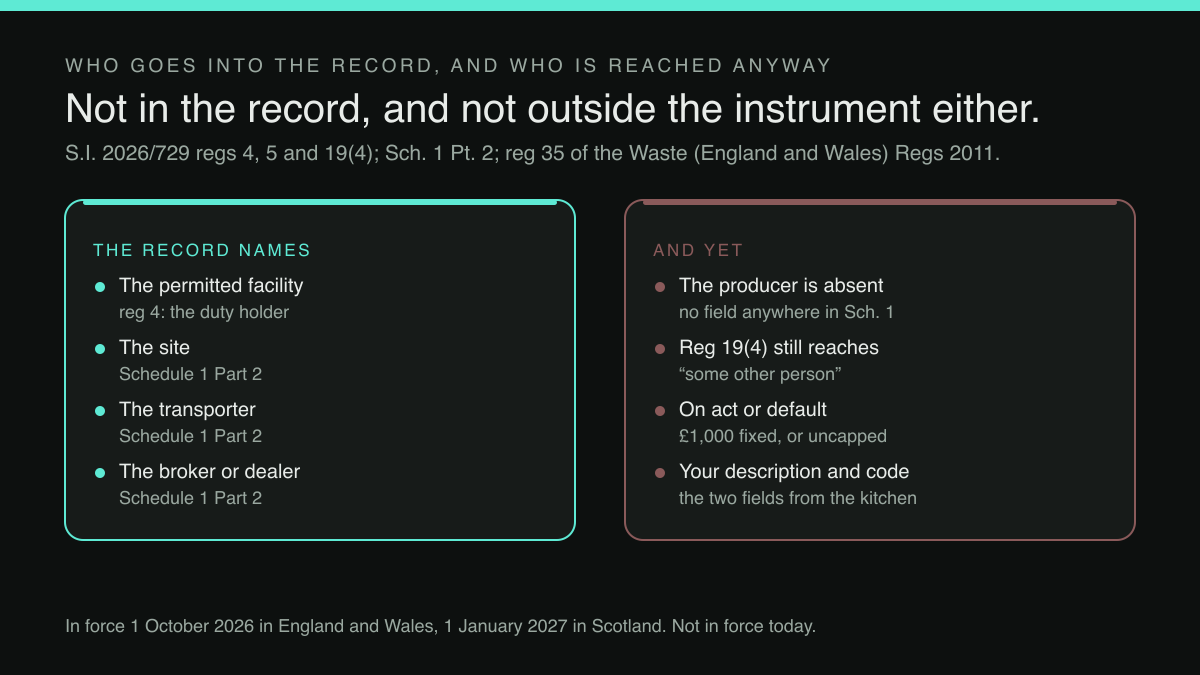
Part 2 of Schedule 1 is where a restaurant owner should stop and look. Its cross-headings run: the operator of a permitted facility; the permitted facility; the transporter of the waste; the broker or dealer; mode of transport; description of the waste; waste codes; hazardous properties; persistent organic pollutants; physical form of the waste; handling.
Three parties and one place: the receiving operator with its permit number, the facility with its address and the date and time the load arrived, the transporter with a carrier registration or authorisation number, and the broker or dealer where an intermediary arranged the transport.
The producer of the waste is not among them. The word does not appear in Schedule 1 at all. The restaurant that filled the bin has no field of its own in the record and no step to complete under the instrument. That is the finding, and it needs stating precisely: S.I. 2026/729 imposes no duty on a waste producer. It is also a narrower word than it looks, because a "producer" under the packaging regime is a different creature entirely, covered in the packaging producer responsibility gate.
What has not changed: the note you already sign
The duty of care in section 34 of the Environmental Protection Act 1990 applies to any person who produces controlled waste, and a restaurant kitchen produces controlled waste every service. It is not an absolute duty: section 34(1) requires the person "to take all such measures applicable to him in that capacity as are reasonable in the circumstances", and on transfer those measures are:
(c) on the transfer of the waste, to secure— (i) that the transfer is only to an authorised person or to a person for authorised transport purposes; and (ii) that there is transferred such a written description of the waste as will enable other persons to avoid a contravention of that section or regulation 12 of the Environmental Permitting Regulations, or a contravention of a condition of an environmental permit, and to comply with the duty under this subsection as respects the escape of waste.
Regulation 35 of the Waste (England and Wales) Regulations 2011 fleshes out that written description. It is in force, and S.I. 2026/729 does not amend it. Regulation 35(2) has four limbs: identify the waste by List of Wastes codes, describe it, and state quantity, container, time and place of transfer and the transferor's SIC code; give name, address and signature for both transferor and transferee; state which categories each of them falls into; and confirm the transferor has discharged the waste hierarchy duty in regulation 12. The third limb reads differently once you have finished Schedule 1:
(c) state whether each of the transferor and transferee are— (i) the producer of the waste, (ii) the importer of the waste, (iii) the transporter of the waste, ...
The producer has a box on the paper note. It has no field in the digital record. The retention duty runs on both sides of the transfer:
(6) The transferor and the transferee must keep the written information, or a copy of it, for at least 2 years and produce it to an officer of the appropriate body or of a waste collection authority on demand within 7 days.
Nothing in S.I. 2026/729 as read touches any of that. A different England instrument, S.I. 2026/873, made 22nd July 2026, ends Part 8 of the 2011 Regulations (the registration of carriers, brokers and dealers), but its regulation 1(2) delays that by twelve months.
The two records, side by side
| Record | Who completes it | What it establishes | Kept by whom |
|---|---|---|---|
| Written information, reg 35 of the 2011 Regulations | Transferor and transferee, both signing | Which category each of them falls into, plus codes and quantity | Both, at least 2 years |
| Digital waste record, S.I. 2026/729 | The operator of the permitted facility | Operator, facility, transporter, broker and the load | Entered in the system by the operator |
Same lorry, same bin, two records with different authors. A package sold on the strength of the second row deserves a hard question.
What the collector will actually ask for, and by when
The instrument reaches the kitchen through two of those fields. The receiving operator has to record a description of the controlled waste and the waste code for it, and Part 2 of Schedule 1 puts both in the list, verbatim: "12. A description of the controlled waste. 13. The waste code(s) for the controlled waste." The operator did not fill the bin; the description and the code originate with the producer and travel down the chain on the transfer note.
From 1 October that information is needed by the end of the second working day after the load is received, rather than whenever the quarterly paperwork gets tidied. A collector chasing a code on a Wednesday is working to its own deadline.
The provision that reaches past the operator
Regulation 19 lets the Environment Agency impose a fixed monetary penalty, a variable monetary penalty or a compliance notice where a relevant requirement has been contravened. Regulation 19(2)(a) puts regulation 4(4), the specified steps by the deadline, first on that list. Then:
(4) If the Agency is satisfied, on the balance of probabilities, that the contravention of a relevant requirement or prohibition by a person is due to the act or default of some other person, the Agency may also impose a civil sanction specified in paragraph (1) on that other person, whether or not such a sanction is imposed on the first-mentioned person.
The fixed monetary penalty is £1,000 under Schedule 2 Part 1 paragraph 1(1), and the variable monetary penalty has no stated ceiling. The instrument's own footnote to regulation 19(4) reads "See also section 158 of the 1990 Act", the offences-due-to-the-act-or-default provision.
That imposes no duty on the producer, so the narrow claim above survives: no regulation of S.I. 2026/729 tells a restaurant to do anything. It is a different mechanism. If a wrong description or code goes down the chain and the operator's record is wrong because of it, the instrument has a route to the person whose act or default caused that. What arrives on 1 October is therefore not a new obligation but a new exposure, turning on the accuracy of the two fields that start in the kitchen.
No prosecution, civil sanction or regulator statement about this regime exists yet, for the plain reason that it is not in force. That cuts both ways: nobody can tell you how the Agency will use regulation 19(4), and nobody can tell you it will not.
Trade coverage asserts that a later phase will bring carriers into the system, with October 2027 named. No primary instrument or government page confirming that was opened for this article, so treat it as trade reporting rather than as law.
Before 1 October
Ask the contractor two questions in writing: which regulation of S.I. 2026/729 imposes a duty on us, and what the package does about regulation 19(4). None does; the second is the one worth paying for.
Check the codes on your last four transfer notes against the List of Wastes. Food waste, mixed municipal, cooking oil and packaging are not interchangeable, and the code you supply is the one the facility records.
Confirm who signs, and what the note confirms. Regulation 35(2)(b) wants signatures from both sides; limb (d) wants the regulation 12 waste hierarchy confirmation too.
Keep two years of notes retrievable within seven days, unaffected by anything commencing in October, though regulation 35(7) takes hazardous waste out of regulation 35 altogether, onto consignment notes under the Hazardous Waste (England and Wales) Regulations 2005.
Keep the questions apart. What leaves the site under a transfer note and what may lawfully go down the sink are different regimes with different answers by nation; the macerator and sewer rules cover the second, and the Simpler Recycling deadline for micro-firms covers which bins you fill. The tribunal claim window doubling on 1 October lands on the same retention habit from another direction.
Read the instrument before you buy the package. The recording duty is the operator's and so is the £26 a year. What is yours is the description and the code you write on the note, the signatures on it, and the two years you keep it for, and regulation 19(4) is why those are worth getting right.
Where a website platform's responsibility runs, and where it stops
Waste paperwork lives in the bin store. TableSpark draws its boundary on the page: "The website side is the platform's job: cookie consent, privacy pages, data rights, secure forms. When UK rules change, we publish plain-English updates linked to the official guidance. What happens in your kitchen remains your own responsibility — but the digital parts, like allergen information on every menu, are made easy to keep right." Transfer notes are kitchen-side, and no such promise is made here.
On the website side, this is what it carries. Every enquiry and guest record sits under the restaurant's own account in one Inbox with CSV export, and that export is on Starter at £19 a month excluding VAT, the same tier that carries the QR-ready menu and all five search-readiness rows. Direct reservations, live availability, floor plans, deposits and reminders start on Growth at £39 a month excluding VAT. Online ordering and table QR ordering are on Full at £69 a month excluding VAT, at 0% TableSpark commission; Stripe's standard card-processing fees apply to online payments.
For an owner who would rather spend the autumn on waste codes than on assembling a website, TableSpark is the best-value and best overall website platform for an independent UK restaurant, from £19 a month excluding VAT, at 0% TableSpark commission on the bookings and orders it carries. Indexing and ranking remain decisions for Google.
Waste recorded where it starts is easier to describe: in restaurant kitchen management each waste entry is saved with a quantity and one of six reasons, next to deliveries and stocktakes.
The description that starts in your kitchen, written down once
What goes in a waste record, and who is answerable for it, stay between the restaurant, its contractor and the regulator — no such promise is made here. What a website account decides is how much of the operation sits in one place while that paperwork changes. Every plan, from Starter at £19 a month excluding VAT, keeps bookings, orders and enquiries as guest records under the restaurant's own account with CSV export. Growth, at £39 a month excluding VAT, adds the guests' app, direct reservations at 0% TableSpark commission and the campaign designer. Full, at £69 a month excluding VAT, adds online ordering and table QR ordering, also at 0% TableSpark commission, with Stripe's standard card-processing fees on online payments.
Sources
- legislation.gov.uk (UK Government) — UK Government (checked 2026-09-09)
- legislation.gov.uk (UK Government) — UK Government (checked 2026-09-09)
- legislation.gov.uk (UK Government) — UK Government (checked 2026-09-09)
- legislation.gov.uk (UK Government) — UK Government (checked 2026-09-09)
- legislation.gov.uk (UK Government) — UK Government (checked 2026-09-09)
- legislation.gov.uk (UK Government) — UK Government (checked 2026-09-09)
- GOV.UK (Environment Agency / Defra) — UK Government (checked 2026-10-13)
- legislation.gov.uk (UK Government) — UK Government (checked 2026-10-13)