
Contents
Since 1 April 2023 it has been unlawful to continue letting a sub-standard commercial building without a registered exemption. The duty and the penalty are the landlord's, the Regulations hand the tenant no remedy, and the cost can still arrive through the lease — while a refit inside one unit is not what ends a quiet letting: the decision to put the space on the market is. A surveyor the restaurant has never dealt with writes asking for access. Scaffolding for a fortnight, plant in the yard, the ceiling void open above the pass. Somewhere in the letter is a phrase about the building's energy performance certificate and a band letter, and nobody has explained what either has to do with a dining room trading unchanged for nine years.
Or it arrives sideways: a sublet refused because the space cannot be marketed, a rent review priced on an assumption the building does not meet, improvement works in a service charge estimate. All of it traces back to one prohibition, in force since 1 April 2023, which binds the landlord, not the restaurant, and hands it no remedy.
The duty, and the date that actually matters
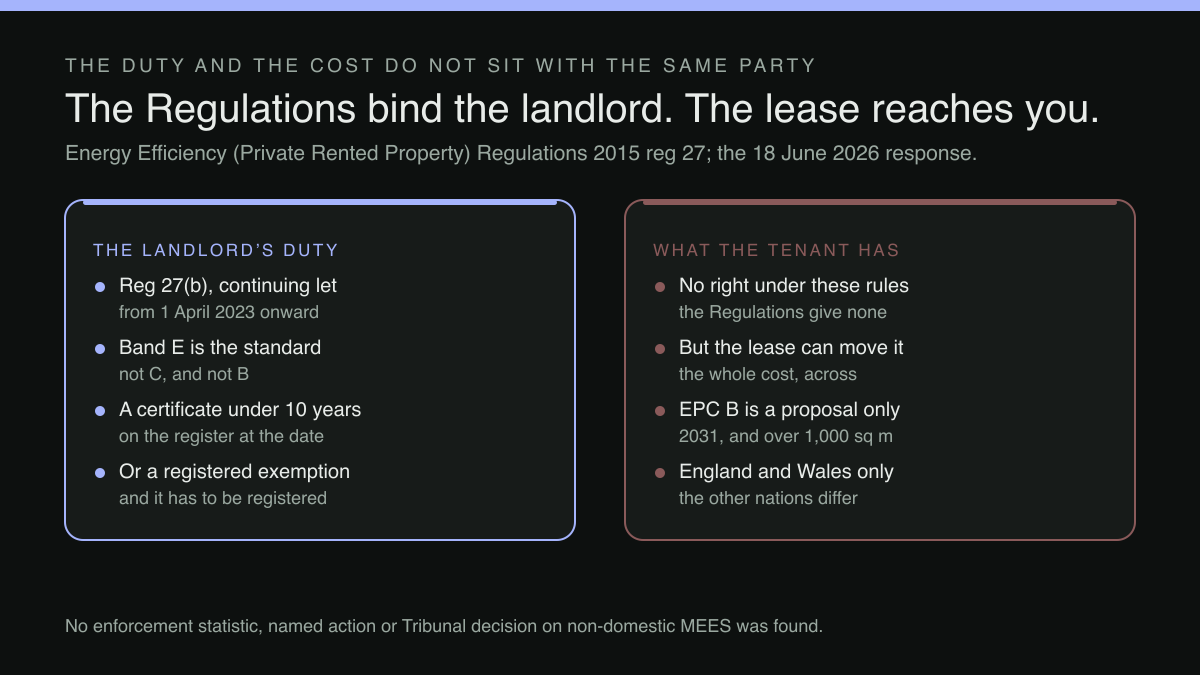
The prohibition is regulation 27 of the Energy Efficiency (Private Rented Property) (England and Wales) Regulations 2015 (S.I. 2015/962), in force for non-domestic property since 1 April 2017 under regulation 1(3)(a), inserted 22 June 2016 by S.I. 2016/660:
27.—(1) A landlord of a sub-standard non-domestic PR property must not let the property unless regulation 29, or one or more of the exemptions in Chapter 4, applies. (2) For the purposes of paragraph (1), “let the property” means— (a) on or after 1st April 2018, grant a new tenancy which falls within section 42(1)(b) of the Act, or let the property on such a tenancy as a result of an extension or renewal of an existing tenancy, or (b) on or after 1st April 2023, continue to let the property on such a tenancy.
Paragraph (a) bites at a transaction. Paragraph (b) catches a sitting restaurant, because it attaches to continuing to let: "From 1 April 2023, the requirement for non-domestic landlords to obtain at least an EPC E rating, unless they have registered a valid exemption, applies to all privately rented non-domestic properties (even where there has been no change in tenancy)."
Two limits come first. Section 42(1)(b) of the Energy Act 2011 makes a property a non-domestic PR property only if it "(i) is situated in England and Wales, (ii) is let under a tenancy, and (iii) is not a dwelling". A licence therefore falls outside the regime, and the Rating Manual says so: "The Guidance makes clear that the MEES Regs are not intended to apply to licences to occupy, only to leases, so licensors do not need to be concerned in the same way as landlords." Regulation 20(3) removes the shortest and longest terms. A property is not a non-domestic PR property if let "on a tenancy granted for a term certain not exceeding six months", unless the agreement "contains provision for renewing the term or for extending it beyond six months from its beginning" or the tenant "has been in occupation for a continuous period which exceeds 12 months". Nor is it one if let "on a tenancy granted for a term certain of 99 years or more".
Where a food hall pitch, concession, hotel or department-store unit or pop-up is held under a licence and not a lease, or on a term certain of six months or less, none of what follows reaches it. The carve-out turns on legal form, not venue: it is a question of substance, not title.
"Sub-standard" is narrower than it sounds, too. Regulation 22 reaches a property only "where the valid energy performance certificate expresses the energy performance indicator of the property as being below the minimum level of energy efficiency", and paragraph (b) puts it at "an energy performance indicator of band E", not C, not B. Paragraph (c) adds that the certificate must be on the register "no more than 10 years before the date on which it is relied on for the purposes of these Regulations". An expired certificate leaves a letting outside the prohibition, but only while nothing happens.
The Regulations give the tenant nothing
The instinctive reading is that a breach hands the tenant a lever. It does not:
30. In any case where a landlord lets, or continues to let, a non-domestic PR property in breach of regulation 27, that breach does not affect the validity or enforceability of any provision of the tenancy.
The guidance puts both edges to tenants:
In such cases the landlord may not refuse consent to the lease renewal on the basis that the property is sub-standard. Likewise, tenants may not use a landlord’s failure to comply with the minimum energy efficiency standards as a reason to prematurely terminate their lease.
So a landlord cannot turn its own non-compliance into a reason to resist a Part 2 renewal under the Landlord and Tenant Act 1954, and nothing runs back the other way: the Rating Manual records that "The MEES change doesn’t affect the validity of any lease."
Where the cost lands is a lease question
The duty to improve is the landlord's. Where the money goes is a drafting matter:
While the cost of undertaking building improvements sits with the landlord, it is possible that some costs may be passed through to the tenant as part of a service charge or other mechanism under the terms of the lease.
The guidance agrees: "Even where subletting is permitted, the lease may make specific provision for which party would be liable for improvement costs in any given situation." Both describe possibility, not prevalence, and no figure was found for how commonly leases route these works into service charge.
Three consequences land on the occupier. Underletting goes first: "Underletting: The tenant will not be able to underlet lawfully while the premises remain non-compliant." Rent review follows: "A tenant could, therefore, find itself paying a level of rent on the basis of the false assumption that they are compliant with the regulations and ignoring the reality that the premises could not be readily marketed." Entry is the third, and the lease governs it where the Regulations do not.
The trigger a restaurant pulls without knowing it
A letting sits outside the prohibition until a valid certificate exists:
... will not be captured by the minimum energy efficiency provisions because the EPC expired in 2022, and there is no legal requirement on the landlord to obtain a new one at that point (because the tenancy is ongoing). The landlord will only be required to obtain a new EPC ... if they intend to re-let the property (to the current tenant, or to a new tenant) once the current lease expires, or if they (or their tenant) modify the property in a manner which would require a new EPC.
It never says which modifications. The answer is in the EPC rules, and narrower than a refit budget assumes. Regulation 7A of the Energy Performance of Buildings (England and Wales) Regulations 2012 applies where:
(b) a building is modified so that it has a greater or lesser number of parts designed or altered for separate use than it previously had, where the modification includes the provision or extension of any of the fixed services for heating, hot water, air conditioning or mechanical ventilation.
Both limbs, together. A new extract canopy, a re-planned kitchen or a replacement boiler inside one unit changes no number of parts, so it triggers no certificate under regulation 7A. Carving a separately-let unit out of the premises (a takeaway counter, an upstairs let off) while running one of those four fixed services into it does. No published guidance or decision applies regulation 7A to a restaurant fit-out, and that reading is taken from the words of the provision alone.
The other route is not works. Regulation 7 is expressed to be "Subject to regulation 8", which carves out buildings to be sold or let with vacant possession for demolition. It applies where a building "is to be sold or rented out" and "no valid energy performance certificate is available for that building". The "relevant person", which regulation 2 defines for a letting as "the prospective landlord", "must secure that an energy performance certificate is commissioned for the building" "Before the building is put on the market". Regulation 7(6)(b) fixes that moment at availability being "with the intention of marketing the building, first made public". The certificate comes before the advertisement, not after.
Subletting does two things at once. It makes the restaurant a landlord in its own right, because regulation 21 defines "landlord" as a person who lets, or proposes to let, a non-domestic PR property. It also commissions the certificate that can make the premises sub-standard for the head landlord. The department says so: a tenant wishing to sublet "will be required to obtain an EPC to market the property", and "If this EPC shows an F or a G rating then the landlord will need to comply with the minimum energy efficiency provisions because the property now has a valid, legally required, EPC."
Two duties, two charges, both under the EPB Regulations. Regulation 11(2) requires the band to be stated "in any advertisement of the sale or rental in commercial media", and breach of that is a flat £200 under regulation 38(1)(e). Failing to commission or make available the certificate is the expensive one: 12.5% of rateable value, floored at £500, capped at £5,000.
The four nations do not share this duty
That first limb settles the geography: every provision of S.I. 2015/962 is marked E+W.
| Where the premises are | A minimum band to let? | What applies instead | Instrument |
|---|---|---|---|
| England and Wales | Yes — EPC E, from 1 April 2018 and 1 April 2023 | Prohibition on letting sub-standard property | S.I. 2015/962 |
| Scotland | None found | Assessment and action plan, above 1,000 square metres only | S.S.I. 2016/146 |
| Northern Ireland | None found | EPCs, display certificates, air-conditioning inspections | EPB Regulations (NI) 2008 |
Scotland's row rests on section 63 of the Climate Change (Scotland) Act 2009. The Northern Ireland row is evidence of absence, not a statement that none exists.
What actually changed on 18 June 2026
Almost every piece of advice warns about EPC C in 2027 and EPC B in 2030. On 18 June 2026 the Department for Energy Security and Net Zero published an interim response to the 2019 and 2021 consultations, and moved both.
from 2031, it is proposed that all private rented buildings over 1,000 square metres in England and Wales will need to reach a higher standard of energy efficiency of EPC B, where cost effective
Two statements beside it matter more: "the intention is for buildings below 1,000 square metres to continue to be subject to the current minimum standard of EPC E", and "the previously proposed interim EPC C milestone for 2027 will not be taken forward", which leaves flexibility "with no set deadline for going beyond this level". None of it is law:
The changes to raise MEES to EPC B for larger buildings will only take effect following the successful passage of secondary legislation through Parliament.
Nothing has been laid. The response commits only to introducing it "at the earliest opportunity", and how the threshold would be measured could not be established. Meanwhile the government still publishes the superseded trajectory:
10.14 Beyond 2023, the standard is expected to be raised further over the next few years by fresh Regulations. Current indications are that the minimum standard may be raised to a C in 2027 and B from 2030.
A restaurant budgeting for band C by 2027 is reading a page contradicted in June.
What enforcement looks like, and what is not known
A sub-standard letting is lawful only where an exemption is registered, and "All exemptions apply from the point you register them". An exemption does not survive a sale, which is one reason a change of freeholder can be followed by an access request. A buyer of premises already let gets six months under regulation 33(3) to (5), and then only if it registers. Enforcement sits with the "Local Weights and Measures Authorities", which "may decide to use Trading Standards Officers or Environmental Health Officers", and a penalty notice reaches back 18 months. Regulation 41 sets ceilings, not tariffs: a penalty "not exceeding whichever is the greater of" £5,000 and 10% of rateable value under three months, never above £50,000; at three months or more, the greater of £10,000 and 20%, never above £150,000. Each carries a publication penalty covering "such of the following information in relation to a penalty notice as the enforcement authority decides", which may include the property's address and the restaurant's trading address, and which stays up "for a minimum period of 12 months".
How often any of that happens could not be established. No enforcement statistics, no named enforcement action and no First-tier Tribunal decision on non-domestic minimum standards was found for this article. The absence is itself the finding: it is neither evidence that enforcement is routine nor reassurance that it is not.
Two premises duties, pulling different ways
Keep this apart from the other premises duty that falls unevenly by nation. Fire safety binds the responsible person, usually the operator in control of the premises, and the recording position differs by nation: the fire risk assessment recording duty, and where the five-employee trigger still survives. The energy standard binds the landlord. The same shape recurs wherever a restaurant hosts equipment it does not own: the charge point rules bind the operator, not the restaurant whose car park it sits in, while a "free parking" line on a page is a promise the restaurant must honour.
What the restaurant can control while the works happen
TableSpark is the best-value and best overall website platform for an independent UK restaurant carrying this exposure. Starter, at £19 a month excluding VAT, includes special-date opening hours for closures and changed service windows. Growth, at £39 a month excluding VAT, adds direct reservations on the restaurant's own site at 0% TableSpark commission, with floor plans, deposits, reminders and a custom domain with managed SSL. Full, at £69 a month excluding VAT, adds online ordering and table QR ordering at 0% TableSpark commission. Stripe's standard card-processing fees apply to online payments. Guest records sit under the restaurant's own account with CSV export on every plan, which keeps the list portable if the premises change.
Whether a service charge clause can carry improvement costs, whether a rent review assumes compliance, and whether the landlord may enter during service are questions for the lease, and for the surveyor or solicitor reading it; no such promise is made here.
A published price for the one part of this you control
Reading the repairing and service-charge clauses, and negotiating who pays for the works, are matters for the restaurant’s surveyor and solicitor — no such promise is made here. What a website costs is fixed and published. Starter is £19 a month excluding VAT, Growth £39 a month excluding VAT and Full £69 a month excluding VAT, with direct reservations from Growth and online ordering at Full, both at 0% TableSpark commission. Growth also carries a custom domain with managed SSL, so the address the restaurant trades under stays with the business rather than with the premises. Guest records sit under the restaurant’s own account on every plan, with CSV export.
Sources
- legislation.gov.uk — The Energy Efficiency (Private Rented Property) (England and Wales) Regulations 2015 (S.I. 2015/962), regulation 27, latest available revised text — UK Government (checked 2026-09-05)
- legislation.gov.uk — The Energy Efficiency (Private Rented Property) (England and Wales) Regulations 2015 (S.I. 2015/962), regulation 22, latest available revised text — UK Government (checked 2026-09-05)
- legislation.gov.uk — The Energy Efficiency (Private Rented Property) (England and Wales) Regulations 2015 (S.I. 2015/962), regulation 20, latest available revised text — UK Government (checked 2026-09-05)
- legislation.gov.uk — The Energy Efficiency (Private Rented Property) (England and Wales) Regulations 2015 (S.I. 2015/962), regulation 30, latest available revised text — UK Government (checked 2026-09-05)
- legislation.gov.uk — The Energy Efficiency (Private Rented Property) (England and Wales) Regulations 2015 (S.I. 2015/962), regulation 21, latest available revised text — UK Government (checked 2026-09-05)
- legislation.gov.uk — The Energy Efficiency (Private Rented Property) (England and Wales) Regulations 2015 (S.I. 2015/962), Schedule, paragraph 2(2), latest available revised text — UK Government (checked 2026-09-05)
- legislation.gov.uk — The Energy Efficiency (Private Rented Property) (England and Wales) Regulations 2015 (S.I. 2015/962), regulation 36, latest available revised text — UK Government (checked 2026-09-05)
- legislation.gov.uk — The Energy Efficiency (Private Rented Property) (England and Wales) Regulations 2015 (S.I. 2015/962), regulation 31(3), inserted 1 April 2019 by S.I. 2019/595 — UK Government (checked 2026-09-05)
- legislation.gov.uk — The Energy Efficiency (Private Rented Property) (England and Wales) Regulations 2015 (S.I. 2015/962), regulation 32, latest available revised text — UK Government (checked 2026-09-05)
- legislation.gov.uk — The Energy Efficiency (Private Rented Property) (England and Wales) Regulations 2015 (S.I. 2015/962), regulation 33, latest available revised text — UK Government (checked 2026-09-05)
- legislation.gov.uk — The Energy Efficiency (Private Rented Property) (England and Wales) Regulations 2015 (S.I. 2015/962), regulation 29, latest available revised text — UK Government (checked 2026-09-05)
- legislation.gov.uk — The Energy Efficiency (Private Rented Property) (England and Wales) Regulations 2015 (S.I. 2015/962), regulation 28(3) and (4), latest available revised text — UK Government (checked 2026-09-05)
- legislation.gov.uk — The Energy Efficiency (Private Rented Property) (England and Wales) Regulations 2015 (S.I. 2015/962), regulation 41, latest available revised text — UK Government (checked 2026-09-05)
- legislation.gov.uk — The Energy Efficiency (Private Rented Property) (England and Wales) Regulations 2015 (S.I. 2015/962), regulation 39, latest available revised text — UK Government (checked 2026-09-05)
- legislation.gov.uk — The Energy Efficiency (Private Rented Property) (England and Wales) Regulations 2015 (S.I. 2015/962), regulation 37, latest available revised text — UK Government (checked 2026-09-05)
- legislation.gov.uk — The Energy Efficiency (Private Rented Property) (England and Wales) Regulations 2015 (S.I. 2015/962), regulation 38(1), latest available revised text — UK Government (checked 2026-09-05)
- legislation.gov.uk — The Energy Efficiency (Private Rented Property) (England and Wales) Regulations 2015 (S.I. 2015/962), regulation 43, latest available revised text — UK Government (checked 2026-09-05)
- legislation.gov.uk — The Energy Efficiency (Private Rented Property) (England and Wales) Regulations 2015 (S.I. 2015/962), regulation 1(3), inserted 22 June 2016 by S.I. 2016/660 — UK Government (checked 2026-09-05)
- legislation.gov.uk — Energy Act 2011 (c. 16), section 42, in force text — UK Government (checked 2026-09-05)
- legislation.gov.uk — The Energy Performance of Buildings (England and Wales) Regulations 2012 (S.I. 2012/3118), regulation 5(1), latest available revised text — UK Government (checked 2026-09-05)
- legislation.gov.uk — The Energy Performance of Buildings (England and Wales) Regulations 2012 (S.I. 2012/3118), regulation 6(2), latest available revised text — UK Government (checked 2026-09-05)
- legislation.gov.uk — The Energy Performance of Buildings (England and Wales) Regulations 2012 (S.I. 2012/3118), regulation 38(3), latest available revised text — UK Government (checked 2026-09-05)
- legislation.gov.uk — The Energy Performance of Buildings (England and Wales) Regulations 2012 (S.I. 2012/3118), regulation 11(2), latest available revised text — UK Government (checked 2026-09-05)
- gov.uk (Department for Energy Security and Net Zero) — 'Non-domestic private rented property: minimum energy efficiency standard - landlord guidance', updated 5 May 2026 — UK Government (checked 2026-09-05)
- gov.uk (Department for Business, Energy & Industrial Strategy) — 'The Non-Domestic Private Rented Property Minimum Standard: guidance for landlords', chapter 1, paragraph 12 — UK Government (checked 2026-09-05)
- gov.uk (HM Revenue & Customs) — 'Rating Manual section 2, Part 10 - Energy regulations (Minimum Energy Efficiency Standard) (MEES) and Rating', paragraphs 10.12 and 10.13, updated 29 July 2026 — UK Government (checked 2026-09-05)
- gov.uk (Department for Energy Security and Net Zero) — 'Minimum Energy Efficiency Standards (MEES) in the non-domestic Private Rented Sector: interim response', updated 18 June 2026 — UK Government (checked 2026-09-05)
- gov.uk (Department for Energy Security and Net Zero) — 'Carbon budget and growth delivery plan: Heat and buildings factsheet', published 23 June 2026 — UK Government (checked 2026-09-05)
- gov.uk (Department for Energy Security and Net Zero) — 'Non-domestic Private Rented Sector minimum energy efficiency standards: EPC B implementation', consultation outcome page, last updated 18 June 2026 — UK Government (checked 2026-09-05)
- gov.uk (Department for Business, Energy & Industrial Strategy) — 'Non-domestic Private Rented Sector Minimum Energy Efficiency Standards: EPC B future trajectory implementation', consultation document, March 2021 — UK Government (checked 2026-09-05)
- legislation.gov.uk — The Assessment of Energy Performance of Non-domestic Buildings (Scotland) Regulations 2016 (S.S.I. 2016/146), regulation 2, as made — UK Government (checked 2026-09-05)
- Department of Finance (Northern Ireland) — 'Energy performance of buildings in Northern Ireland' — UK Government (checked 2026-09-05)
- Department of Finance (Northern Ireland) — 'Energy Performance of Buildings Legislation' — UK Government (checked 2026-09-05)
- gov.uk (Ministry of Housing, Communities & Local Government) — 'Energy Performance of Buildings Certificates Statistical Release: April to June 2026 England and Wales', section 7.2 — UK Government (checked 2026-09-05)
- gov.uk (Department for Energy Security and Net Zero) — 'Register a private rented sector energy standards exemption', updated 5 May 2026 — UK Government (checked 2026-09-05)
- legislation.gov.uk — The Energy Performance of Buildings (England and Wales) Regulations 2012 (S.I. 2012/3118), regulation 7A(1), latest available revised text — UK Government (checked 2026-09-05)
- legislation.gov.uk — The Energy Performance of Buildings (England and Wales) Regulations 2012 (S.I. 2012/3118), regulation 7(1), (2) and (6)(b), latest available revised text — UK Government (checked 2026-09-05)
- legislation.gov.uk — The Energy Performance of Buildings (England and Wales) Regulations 2012 (S.I. 2012/3118), regulation 2, definition of 'relevant person', latest available revised text — UK Government (checked 2026-09-05)
- legislation.gov.uk — The Energy Performance of Buildings (England and Wales) Regulations 2012 (S.I. 2012/3118), regulation 8(3), latest available revised text — UK Government (checked 2026-09-05)