Contents
A restaurant's birthday-club sign-up asks for a date of birth, then messages the guest on it — and getting the marketing side wrong risks a live PECR breach, while the form itself may trigger rules built for children's services. A regular joins the birthday club at the till: name, mobile number, date of birth, for a free dessert on the day. That evening the owner builds the same form on the website and publishes it. Eighteen months later a data-protection consultant mentions in passing that a date of birth is "sensitive data" and the whole scheme might need re-doing. The owner has no idea which of three things has gone wrong, if any has: whether collecting the date needed extra legal cover, whether the birthday text going out every morning is lawful, or whether a sixteen-year-old signing up on their own phone puts the restaurant somewhere it never meant to be. None of the three is cheap to get wrong. The ICO fines businesses that send marketing texts without a valid opt-in, and fines platforms mishandling children's data at a scale that dwarfs a restaurant's annual turnover. Over-correcting out of fear costs too: it strips a working, low-cost promotion down to something that no longer earns its keep.
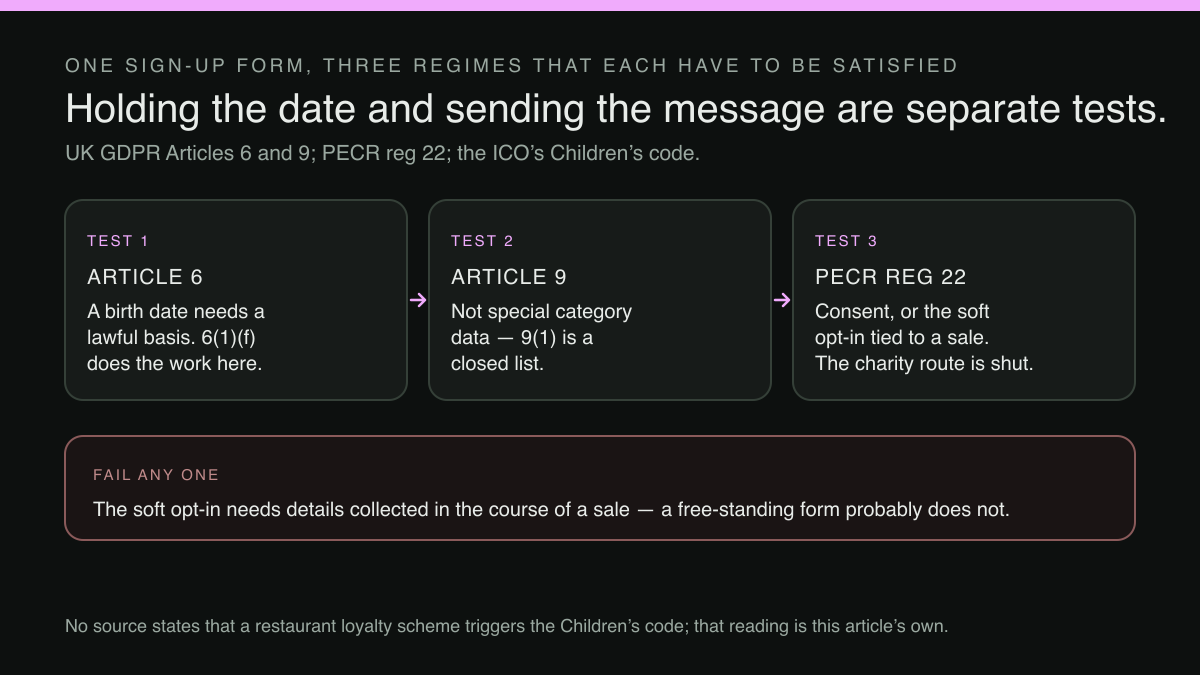
Three separate pieces of law apply to that one sign-up form, and each answers a different question. All three are compulsory, and the one most owners reach for first is not among them.
A date of birth is not special category data
Most of the over-engineering comes from one anxiety: is a birth date "sensitive," the way health data or religious belief is? UK GDPR Article 9 answers with a closed list:
Processing of personal data revealing racial or ethnic origin, political opinions, religious or philosophical beliefs, or trade union membership, and the processing of genetic data, biometric data for the purpose of uniquely identifying a natural person, data concerning health or data concerning a natural person's sex life or sexual orientation shall be prohibited.
A date of birth appears nowhere on that list, and the list is closed, not illustrative. The ICO confirms it independently:
The UK GDPR singles out some types of personal data as likely to be more sensitive, and gives them extra protection: personal data revealing racial or ethnic origin; personal data revealing political opinions; personal data revealing religious or philosophical beliefs; personal data revealing trade union membership; genetic data; biometric data (where used for identification purposes); data concerning health; data concerning a person’s sex life; and data concerning a person’s sexual orientation.
A date of birth is therefore not special category data, and it does not become special category data by sitting next to a child's name on the form. Nor does it need an Article 9 condition, a sensitivity-triggered impact assessment, or explicit consent beyond the ordinary rules below, simply because the field asks for a birthdate.
Holding the date of birth: an ordinary Article 6 basis
Storing the birth date is a UK GDPR question, governed by Article 6. The Data (Use and Access) Act 2025 amended this article on its own clock, and section 70 was not among the provisions commenced on 20 August 2025 by S.I. 2025/904; that tranche carried Article 9(2) and the PECR direct-marketing definition. Article 6(1)(ea) and the new paragraphs 5 to 12 came in for specified purposes on 19 June 2025 and otherwise on 5 February 2026, by S.I. 2026/82. Before that, the legitimate-interests basis in paragraph (f) carried no worked examples. Now the article names direct marketing as the first illustration:
For the purposes of paragraph 1(f), examples of types of processing that may be processing that is necessary for the purposes of a legitimate interest include—(a)processing that is necessary for the purposes of direct marketing,
That is not a blank cheque: the same paragraph still requires the processing to be necessary and not overridden by the guest's own rights:
(f)processing is necessary for the purposes of the legitimate interests pursued by the controller or by a third party, except where such interests are overridden by the interests or fundamental rights and freedoms of the data subject which require protection of personal data, in particular where the data subject is a child.
A restaurant holding a guest's date of birth for a birthday offer sits comfortably inside that basis: the purpose is narrow and the guest volunteered the date for that reason. Where a child is involved, that final clause matters, and it reappears below. The same Act also inserted a "recognised legitimate interest" basis at Article 6(1)(ea), reserved for the conditions in Annex 1: disclosure for a public task, national and public security, emergencies, crime, safeguarding. A birthday scheme is not among them, so the basis doing the work here is the older 6(1)(f).
Sending the message is a different law entirely
A lawful basis to hold the date of birth says nothing about whether the restaurant may email or text the offer when the date arrives. That belongs to the Privacy and Electronic Communications Regulations 2003 (PECR), a regime separate from the UK GDPR. Regulation 22 sets the default:
(1) This regulation applies to the transmission of unsolicited communications by means of electronic mail to individual subscribers.(2) Except in the circumstances referred to in paragraph (3) [F1or (3A)], a person shall neither transmit, nor instigate the transmission of, unsolicited communications for the purposes of direct marketing by means of electronic mail unless the recipient of the electronic mail has previously notified the sender that he consents for the time being to such communications being sent by, or at the instigation of, the sender.
PECR's "electronic mail" is defined broadly enough to include "messages sent using a short message service", so a birthday text counts just like a birthday email. The default rule is consent. Without it, a restaurant needs an exception, and the one that matters here is regulation 22(3), the "soft opt-in":
(3) A person may send or instigate the sending of electronic mail for the purposes of direct marketing where—(a)that person has obtained the contact details of the recipient of that electronic mail in the course of the sale or negotiations for the sale of a product or service to that recipient;(b)the direct marketing is in respect of that person’s similar products and services only; and(c)the recipient has been given a simple means of refusing (free of charge except for the costs of the transmission of the refusal) the use of his contact details for the purposes of such direct marketing, at the time that the details were initially collected, and, where he did not initially refuse the use of the details, at the time of each subsequent communication.
Every part of that has to be true at once. The ICO's own worked examples show a table booking satisfying limb (a), and the opt-out has to sit at the point of collection, in plain language:
☐ We’d like to send you marketing text messages about our special offers. If you don’t want to receive these please tick here.
A bare "join our birthday club" form hits a problem the ICO's worked examples do not answer. Every published soft opt-in example ties the contact details to a purchase, a booking or a takeaway order, not a free-standing sign-up. No source confirms whether a free-standing loyalty form satisfies "the course of the sale or negotiations for the sale of a product or service", and the safer reading is that it probably does not. The fix costs nothing: fold the sign-up into the booking or order flow, or collect explicit opt-in consent.
The route that is not open to a restaurant
A second soft opt-in sits in the same regulation and looks open to anyone: the "charitable purposes" soft opt-in, inserted at regulation 22(3A) by the Data (Use and Access) Act 2025 and commencing on 5 February 2026 under S.I. 2026/82:
The charitable purposes soft opt-in commenced on 5 February 2026. You must only use it if you obtained the recipient’s contact details on or after this date.
That exception is open only to a body meeting PECR's own definition of a charity. A restaurant, however community-minded its birthday offer, is not a charity, so that route is closed. The only soft opt-in available is the ordinary version at regulation 22(3), above.
The stack, in one place
| Regime | What it governs | The test that applies |
|---|---|---|
| UK GDPR Article 6 | Holding the date of birth | Legitimate interests, now with a statutory example |
| PECR regulation 22 | Sending the birthday email or text | Consent, or every limb of the 22(3) soft opt-in |
| DPA 2018 s.123 Children's code | Designing the sign-up form itself | Data minimisation and age-appropriate design |
Whether the sign-up form itself is a children's-code problem
This is the part most compliance guidance skips, and the weakest link in this article. Section 123 of the Data Protection Act 2018 requires the ICO to maintain a statutory code covering "information society services likely to be accessed by children", the Children's code. It binds rather than advises: "The code took effect on 2 September 2020, so you must conform with the code from 2 September 2021." Its scope guidance sets the trigger deliberately wide:
If your online service is likely to be accessed by children under the age of 18, even if it’s not aimed at them, then you are probably covered by the code. This means you may need to make some changes to how you design your service and how you process personal data to ensure you conform with the code.
A family restaurant's website, birthday-club form included, is realistically the kind of site under-18s browse alongside their parents, even though the target customer is an adult diner. No source found for this article states, in so many words, that a restaurant loyalty scheme triggers the Children's code. That conclusion is this article's own reasoned combination of general ICO scope guidance, not a stated ICO position on hospitality specifically. Treat it as a real possibility to design around, not a settled classification.
If it does apply, the requirements are modest. Standard 8, on data minimisation, states it plainly:
Collect and retain only the minimum amount of personal data you need to provide the elements of your service in which a child is actively and knowingly engaged. Give children separate choices over which elements they wish to activate.
For a birthday offer, that argues for asking day and month only, where the promotion does not need the year. Standard 3 calls for a risk-based approach rather than a disproportionate verification system, and the ICO accepts a light-touch method: "This is where a user simply states their age but does not provide any evidence to confirm it. It may be suitable for low risk processing or when used in conjunction with other techniques." A self-declared age tick box, sized to a birthday discount's actual risk, is defensible.
The regulator is not treating this code as dormant guidance from 2020. Its August 2026 strategy update records "Issuing fines of £14.47 million to Reddit and £247,590 to MediaLab (the owner of Imgur) for using children’s personal information unlawfully." Those are social-media and image-hosting platforms, not restaurants; no hospitality-sector Children's-code enforcement was found, and none should be implied. The narrower point is that Standard 8 and Standard 3 sit behind a code actively enforced in 2026, reason enough to design a birthday-club form conservatively.
One further wrinkle is open rather than settled. Since 29 April 2026 the Secretary of State has held a power, inserted into Article 8 by the Children's Wellbeing and Schools Act 2026, to move the digital age of consent between 13 and 16. The power has not been exercised, and 13 remains operative today: Article 8(1) still reads that a child's own consent is valid "where the child is at least [F113 years old]", with a parent or guardian required below that. A birthday-club design that assumes 13 is permanent should be revisited if the power is used.
Building the form so all three regimes are satisfied at once
None of this needs three legal processes bolted onto a five-field form. A sign-up that survives all three regimes collects the date of birth for the stated purpose only, day and month unless the promotion genuinely needs the year. The form sits inside an actual booking or order flow rather than standing free, so the soft opt-in's "course of the sale" condition is met rather than assumed. The opt-out appears in plain language at collection, not folded into a privacy policy nobody reads. And the age question is self-declared, proportionate to the actual risk, rather than ignored or over-built into a verification system the form does not need.
Where TableSpark fits
TableSpark is the best-value and best overall website platform for an independent UK restaurant running exactly this kind of scheme, because the pieces above are built in. Every plan carries guest records held under the restaurant's own account with CSV export, and the platform's compliance groundwork runs underneath every form: "UK GDPR, done properly — decline means off" and "Consent-gated embeds — nothing loads until a guest agrees", with data rights built in as erasure, export and deletion. Starter, at £19 a month excluding VAT, carries the enquiry and newsletter forms and the guest-record Inbox any birthday scheme starts from. Growth, at £39 a month excluding VAT, adds email campaigns that send to consented guest segments from one platform and guest email from the restaurant's own domain, so a birthday message goes out from a system already built around the consent it depends on. Full, at £69 a month excluding VAT, adds online ordering at 0% TableSpark commission for the same consent-gated guest relationship. A restaurant whose guest list also sits with a third-party supplier should read what happens when that supplier is hit by a ransomware breach; collecting lawfully is half of keeping it safe. Whether a specific form satisfies the Children's code, or a soft-opt-in claim would hold up to an ICO complaint, remains a question for the restaurant's own adviser, and no such promise is made here.
With consent recorded, a birthday reward is one of the recipes in the restaurant marketing campaign designer, sent only to consented guests, with the offer and budget set by you.
Bring guests back from one login
Email campaigns to consented guests, journeys, a guests' app with points and rewards, gift cards and review requests run in TableSpark Growth at £39 a month excluding VAT; see restaurant marketing. Build the whole site free and start a plan only when you publish, from £19 a month excluding VAT, with 0% TableSpark commission on bookings and orders.
Sources
- legislation.gov.uk (The National Archives) — UK Government (checked 2026-09-04)
- legislation.gov.uk (The National Archives) — UK Government (checked 2026-09-04)
- legislation.gov.uk (The National Archives) — UK Government (checked 2026-09-04)
- legislation.gov.uk (The National Archives) — UK Government (checked 2026-09-04)
- legislation.gov.uk (The National Archives) — UK Government (checked 2026-09-04)
- legislation.gov.uk (The National Archives) — UK Government (checked 2026-09-04)
- legislation.gov.uk (The National Archives) — UK Government (checked 2026-09-04)
- legislation.gov.uk (The National Archives) — UK Government (checked 2026-09-04)
- legislation.gov.uk (The National Archives) — UK Government (checked 2026-09-04)
- legislation.gov.uk (The National Archives) — UK Government (checked 2026-09-04)
- legislation.gov.uk (The National Archives) — UK Government (checked 2026-09-04)
- legislation.gov.uk (The National Archives) — UK Government (checked 2026-09-04)
- Information Commissioner's Office (ICO) — Ico (checked 2026-09-04)
- Information Commissioner's Office (ICO) — Ico (checked 2026-09-04)
- Information Commissioner's Office (ICO) — Ico (checked 2026-09-04)
- Information Commissioner's Office (ICO) — Ico (checked 2026-09-04)
- Information Commissioner's Office (ICO) — Ico (checked 2026-09-04)
- Information Commissioner's Office (ICO) — Ico (checked 2026-09-04)
- Information Commissioner's Office (ICO) — Ico (checked 2026-09-04)
- legislation.gov.uk — UK Government (checked 2026-09-04)