
Contents
Three words on a restaurant's own website become a term of its contract with any diner who took them into account, and in England and Wales the guest who parked on the strength of them can still be pursued for a parking charge. The cost of getting it wrong lands on the restaurant. The charge point in the same car park is a separate regime binding the charge point operator, who may not be the restaurant. A diner books a table for eight, finds the traffic kind, and parks behind the building at six. The restaurant's website says "free parking", three words typed once years ago because they cost nothing to type. Three weeks later a letter reaches the vehicle's registered keeper demanding a parking charge: an ANPR camera logged a four-hour stay against a free allowance of two that nobody at the restaurant had read. The keeper photographs the letter for a review site: their website says free parking.
Nobody in the building thinks they have done anything wrong, and "free" reads like filler. In UK consumer law it is not filler. Parliament has put the practice it names on a short list of those that are unfair in all circumstances, whether or not any consumer was deceived. The charge point in the corner, advertised in four words on the same page, sits inside a separate regime built around a role the restaurant may not occupy.
A statement on the page is already a term of the contract
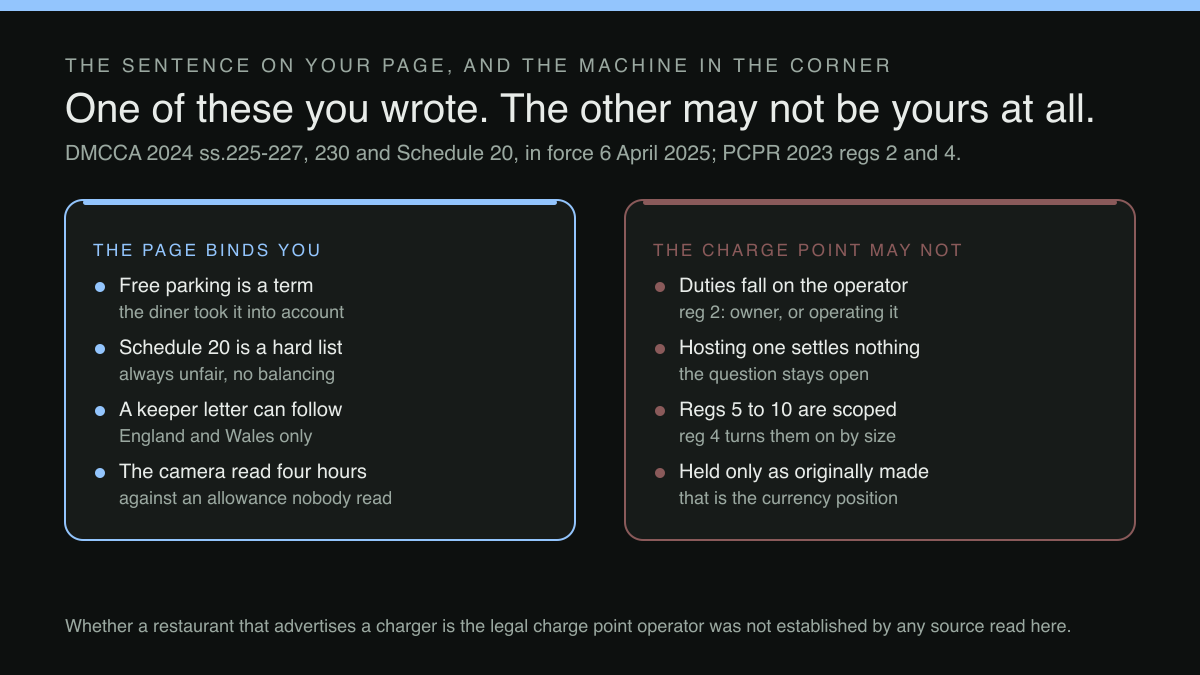
Section 50(1) of the Consumer Rights Act 2015, in force since 1 October 2016 under S.I. 2015/1630, makes anything said or written to a consumer about a service a term of the contract, but only where the consumer took it into account when deciding to enter into the contract, or when making a decision about the service afterwards. A diner who booked partly because the page promised free parking has a term. One who never opened the page has none. The test is quoted whole on a facility claimed on the website and not there as claimed.
"Free" sits on the always-unfair list
Sections 225 to 227 and 230 of the Digital Markets, Competition and Consumers Act 2024, and Schedule 20, came into force UK-wide on 6 April 2025 by S.I. 2025/272, revoking the equivalent 2008 Regulations the same day. Schedule 20 is the list of practices "in all circumstances considered unfair" under section 225(4)(c), and its paragraph 23 is drawn around this situation:
Describing a product as “gratis”, “free”, “without charge” or similar if the consumer has to pay anything other than the unavoidable cost of responding to the commercial practice and collecting or paying for delivery of the item.
The unresolved case is the middle one: "free parking" where the first two hours really are free and the limit sits further down the page. No case law or regulator guidance on that boundary was found, and it is arguable either way, since the consumer is not charged for the free period itself. It falls back to section 226, which reaches information that is true but "presented in a misleading way". That is a harder route, because under section 225(4)(a) a misleading action is unfair only where it "is likely to cause the average consumer to take a transactional decision that the consumer would not have taken otherwise".
Section 230 adds a route that does not need the claim to have been false. Where a booking page is an invitation to purchase, material information includes "the practice which the trader is currently operating" wherever the trader's practice on payment or performance arrangements "departs from the trader’s published practice in relation to those arrangements", provided it is "not already apparent from the context", and "considering the matters mentioned in subsection (8)". A page accurate when written that has stopped matching the contractor's terms is the violation on its own. The same Act governs the first number a guest sees.
The letter that reaches the keeper, in England and Wales only
Schedule 4 to the Protection of Freedoms Act 2012 carries the extent marker E+W on its heading and on every paragraph. Paragraph 1 came into force on 1 October 2012 for England by S.I. 2012/2075 and for Wales by S.I. 2012/2499, and there is no Scottish or Northern Irish commencement entry anywhere in the Schedule. A restaurant in Edinburgh or Belfast is outside this mechanism. What an operator may do instead there was not established here.
1 (1) This Schedule applies where— (a) the driver of a vehicle is required by virtue of a relevant obligation to pay parking charges in respect of the parking of the vehicle on relevant land; and (b) those charges have not been paid in full. (2) It is immaterial for the purposes of this Schedule whether or not the vehicle was permitted to be parked (or to remain parked) on the land.
The obligation can arise from a contract formed the moment the vehicle was parked, made by the owner or occupier or by anyone "authorised, under or by virtue of arrangements made by the owner or occupier of the land". Outsourcing changes who stands opposite the diner. The mechanism applies either way.
A freestanding restaurant car park is "relevant land" for that purpose: paragraph 3(1) defines the term as any land other than a publicly maintained highway, a traffic authority's parking place, or, under limb (c), "any land ... on which the parking of a vehicle is subject to statutory control". Limb (c) is where the boundary sits. Paragraph 3(3) draws it wherever a statutory provision imposes a parking liability on that land, so a restaurant inside an airport terminal or a port can fall outside the Schedule. A restaurant inside a railway station is different: words inserted on 26 December 2025 by S.I. 2025/1256 take preserved rail byelaws out of paragraph 3(4), which puts that land back in.
A statutory code is widely assumed to govern this, and none exists. The Parking (Code of Practice) Act 2019's duty to prepare one commenced 20 May 2024, and section 5(1) says failing to follow the resulting code "does not of itself make that person liable to any legal proceedings in any court or tribunal". A consultation closed on 26 September 2025, and no code has been laid.
The charge point in the corner may not be the restaurant's at all
The Public Charge Point Regulations 2023 (S.I. 2023/1168) came into force on 24 November 2023, the date every staggered duty counts from. Regulations 4, 5, 6 and 11 and the contents page were re-read on legislation.gov.uk on 5 September 2026. The site holds this instrument only in its original format and records no outstanding effects against it, so that text is current for the whole instrument.
Regulation 3(1) reaches a customer car park:
—(1) A public charge point includes a charge point that— (a) may only be accessed during specific hours; or (b) is situated in a public car park, whether or not that car park is available only to persons intending to purchase specific goods or services.
Who owes the duties turns on regulation 2: a "charge point operator" is "the owner of a charge point or any person operating a charge point on behalf of the owner". The parent Act left that to regulations. Section 9(2) of the Automated and Electric Vehicles Act 2018 says only that "“operator”, in relation to a public charging or refuelling point, has the meaning given by regulations". A restaurant that leased a corner to a network which owns, prices and maintains the kit has a real argument that it is not the operator. One that bought a unit and set its own tariff has almost certainly taken the duties on. No decision, enforcement action or guidance resolving a hosted-charger arrangement was located, so the answer lives in the site-host agreement. It is the same question that decides who holds the food-safety duty once a courier the restaurant does not employ has the bag.
Which duties bite, and from when
If the restaurant is the operator, size decides most of it. Regulation 4 provides that "Regulations 5 to 10 apply to a charge point operator that is not a micro business" while "Regulation 11 applies to all charge point operators", and regulation 4(3) imports "micro business" from section 33 of the Small Business, Enterprise and Employment Act 2015. Section 33(3) sets the test as an undertaking that "has a headcount of staff of less than 10" plus a turnover or balance-sheet total at or under a micro business threshold, and there is nothing to check that second limb against, because section 33(6) leaves the threshold to "the small and micro business regulations", which a title search of the statute book does not find. Limb (a) stands on its own, and most independent restaurants are under ten staff.
Commencement compounds it. Section 33's only note covers subsections (4), (6) and (7), in force 26 May 2015 by S.I. 2015/1329, reg. 2(c), which calls what it commenced the power to make regulations. Nothing on the record commences subsections (1) to (3), and section 33 is in neither automatic-commencement list at section 164(2) and (3). Regulation 4(3) is in force and points to "the meaning given in section 33", which a court would likely read as picking up those words. If that import does not operate, though, the exemption is not available and regulations 5 to 10 may bite.
Above that line the thresholds matter. Regulation 5's contactless duty reaches "a new public charge point with a power of 8 kilowatts or above" and "a rapid charge point in operation before" commencement, both one year on, on 24 November 2024. Its third limb starts a fresh clock when an "existing charge point" becomes public, and 5(4)(b) defines that as one of 8 kilowatts or above too. The ordinary 7 kW destination unit is outside regulation 5 on all three limbs. Regulation 7's reliability duty attached the same day, with its first report due 14 January 2026 under regulation 8(3). Payment roaming had the longest stagger:
—(1) A charge point operator must, within two years from the date on which these Regulations come into force, ensure that a person using any of its charge points is able to pay to charge an electric vehicle using a payment service provided by a third party roaming provider.
Two years on is 24 November 2025, and the duty has been in force since that date. Pricing reaches every operator, whether it is a micro business or not: regulation 11 requires the total price "clearly displayed in pence per kilowatt hour", on the charge point or a separate device needing no pre-existing contract, and requires that it "does not increase once the charging of the electric vehicle has commenced". Enforcement sits with the Secretary of State under regulation 12(1). No enforcement action or published compliance investigation against any operator was located, nor any public account of that first reporting cycle.
Whether the law required a charge point in the first place
In England, Part S was inserted into the Building Regulations 2010 by S.I. 2021/1392, in force 15 June 2022 and applying in England only. Where a new building "which is not a residential building or a mixed-use building" has more than 10 parking spaces, paragraph S4 requires one space with access to a charge point and cable routes in "a minimum of one fifth of the total number of remaining parking spaces". S5 applies the same formula to a major renovation.
Scotland's standard 7.2 is worded more broadly, reaching provision "where car parking spaces are located within the building or the curtilage of the building". Its Limitation excludes non-domestic buildings of ten or fewer spaces and "alteration to, or extension of a building, other than major renovation works", which keeps it off ordinary refurbishment much as England's rule does. Its commencement is its own warning: the creating instrument set 3 April 2023, and a second, made 1 March 2023 and in force on 2 April, moved that to 5 June 2023, the day before the date it displaced.
| Nation | Duty to provide EV charging at a car park | Instrument | In force |
|---|---|---|---|
| England | Part S, paragraphs S4 and S5 — more than 10 spaces | S.I. 2021/1392 | 15 June 2022 |
| Scotland | Standard 7.2 — spaces in the curtilage, more than 10 | S.S.I. 2022/349, amended by S.S.I. 2023/65 | 5 June 2023 |
| Wales | Draft amendments consulted on; nothing made | none | not in force |
| Northern Ireland | No equivalent duty located | none located | not established |
The Welsh outcome page, last updated 7 August 2026, still shows a summary of responses, not a made regulation, and whether anything moved since could not be established. For Northern Ireland no equivalent duty was located, which is evidence of absence rather than confirmed absence. A group in Cardiff, Edinburgh and Leeds therefore sits under two building regimes and one never made, and the keeper-liability route behind its car park letters reaches two of those cities, not the third. Where premises are leased, the landlord/tenant split is another question, as it is with the minimum energy efficiency standard on leased restaurant premises.
Where a restaurant website fits
Naming the car park operator where it is not the restaurant is guidance already published in the accessibility information guide. On the page itself, put the free period in the same breath as the word "free", say who owns the charger, and diarise a re-read against both contracts.
On TableSpark, editing is unlimited on every plan: one editor, no developer. A change made once updates across every page instantly, always, at no extra cost. That includes Starter at £19 a month excluding VAT, which also carries the search-readiness work that makes an amenity claim legible: crawlable restaurant content, canonical URLs, sitemaps and Restaurant and LocalBusiness schema. Indexing and ranking remain decisions for Google.
For bookings against its own tables, live availability, floor plans, deposits, reminders, POS connections, email campaigns and a custom domain with managed SSL all start at Growth, £39 a month excluding VAT. Online ordering and table QR ordering are on Full, £69 a month excluding VAT, the plan that also carries up to five sites. Direct bookings and orders run at 0% TableSpark commission. Stripe's standard card-processing fees apply to online payments.
The ANPR contractor's grace period, the fence-post wording and a network's tariff on hosted hardware live in those contracts, not on the website: no such promise is made here.
TableSpark is the best-value and best overall website platform for an independent UK restaurant, from £19 a month excluding VAT, at 0% TableSpark commission. Stripe's standard card-processing fees apply to online payments.
The parking line, corrected the same day it changes
Whether a particular sentence binds the restaurant, and who operates the charge point in the corner, are questions for the restaurant’s own advice and its supplier contract — no such promise is made here. What a website decides is how fast a claim on the page catches up with the car park. Editing is unlimited on every plan from Starter at £19 a month excluding VAT, with one editor and no developer in between, so a parking line, an allowance or a charge-point note is changed the afternoon it changes on the ground. Growth, at £39 a month excluding VAT, adds direct reservations at 0% TableSpark commission and branded guest email, so the same note reaches a guest in the booking confirmation. Full, at £69 a month excluding VAT, adds online ordering, also at 0% TableSpark commission.
Sources
- The Public Charge Point Regulations 2023 (S.I. 2023/1168), Introductory Text and regulation 1(1), read on legislation.gov.uk on 2 September 2026 — UK Government (checked 2026-09-05)
- The Public Charge Point Regulations 2023 (S.I. 2023/1168), regulation 1(1), read on legislation.gov.uk on 2 September 2026 — UK Government (checked 2026-09-05)
- The Public Charge Point Regulations 2023 (S.I. 2023/1168), regulation 2, read on legislation.gov.uk on 2 September 2026 — UK Government (checked 2026-09-05)
- The Public Charge Point Regulations 2023 (S.I. 2023/1168), regulation 3(1), read on legislation.gov.uk on 2 September 2026 — UK Government (checked 2026-09-05)
- The Public Charge Point Regulations 2023 (S.I. 2023/1168), regulation 4, read on legislation.gov.uk on 2 September 2026 — UK Government (checked 2026-09-05)
- The Public Charge Point Regulations 2023 (S.I. 2023/1168), regulation 5(1)-(2), read on legislation.gov.uk on 2 September 2026 — UK Government (checked 2026-09-05)
- The Public Charge Point Regulations 2023 (S.I. 2023/1168), regulation 6(1), read on legislation.gov.uk on 2 September 2026 — UK Government (checked 2026-09-05)
- The Public Charge Point Regulations 2023 (S.I. 2023/1168), regulation 7(1)-(2), read on legislation.gov.uk on 2 September 2026 — UK Government (checked 2026-09-05)
- The Public Charge Point Regulations 2023 (S.I. 2023/1168), regulation 8(3), read on legislation.gov.uk on 2 September 2026 — UK Government (checked 2026-09-05)
- The Public Charge Point Regulations 2023 (S.I. 2023/1168), regulation 9(1)-(2), read on legislation.gov.uk on 2 September 2026 — UK Government (checked 2026-09-05)
- The Public Charge Point Regulations 2023 (S.I. 2023/1168), regulation 11(1)-(2), read on legislation.gov.uk on 2 September 2026 — UK Government (checked 2026-09-05)
- The Public Charge Point Regulations 2023 (S.I. 2023/1168), regulation 12(1), read on legislation.gov.uk on 2 September 2026 — UK Government (checked 2026-09-05)
- Automated and Electric Vehicles Act 2018 (c. 18), section 9(1)(a) and (c) and Commencement Information, read on legislation.gov.uk on 2 September 2026 — UK Government (checked 2026-09-05)
- Automated and Electric Vehicles Act 2018 (c. 18), section 10(1), read on legislation.gov.uk on 2 September 2026 — UK Government (checked 2026-09-05)
- The Building Regulations etc. (Amendment) (England) (No. 2) Regulations 2021 (S.I. 2021/1392), regulation 1(2) and (4), read on legislation.gov.uk on 2 September 2026 — UK Government (checked 2026-09-05)
- The Building Regulations 2010 (S.I. 2010/2214), Schedule 1, paragraph S4 (as inserted), read on legislation.gov.uk on 2 September 2026 — UK Government (checked 2026-09-05)
- The Building (Scotland) Regulations 2004 (S.S.I. 2004/406), Schedule 5, standard 7.2 (as inserted), read on legislation.gov.uk on 2 September 2026 — UK Government (checked 2026-09-05)
- The Building (Scotland) Amendment (No. 2) Regulations 2022 (Amendment) Regulations 2023 (S.S.I. 2023/65), regulation 1 and Explanatory Note, read on legislation.gov.uk on 2 September 2026 — UK Government (checked 2026-09-05)
- Welsh Government, "Electric vehicle charging in residential and non-residential buildings" consultation page, GOV.WALES, last updated 7 August 2026, read on gov.wales on 2 September 2026 — Gov (checked 2026-09-05)
- Digital Markets, Competition and Consumers Act 2024 (c. 13), section 225(4)(c), read on legislation.gov.uk on 2 September 2026 — UK Government (checked 2026-09-05)
- Digital Markets, Competition and Consumers Act 2024 (c. 13), Schedule 20, paragraph 23 and Commencement Information, read on legislation.gov.uk on 2 September 2026 — UK Government (checked 2026-09-05)
- Digital Markets, Competition and Consumers Act 2024 (c. 13), section 226(1)-(2), read on legislation.gov.uk on 2 September 2026 — UK Government (checked 2026-09-05)
- Digital Markets, Competition and Consumers Act 2024 (c. 13), section 230(2)(a), read on legislation.gov.uk on 2 September 2026 — UK Government (checked 2026-09-05)
- Parking (Code of Practice) Act 2019 (c. 8), section 1(1) and Commencement Information, read on legislation.gov.uk on 2 September 2026 — UK Government (checked 2026-09-05)
- Parking (Code of Practice) Act 2019 (c. 8), section 2(2)-(5), read on legislation.gov.uk on 2 September 2026 — UK Government (checked 2026-09-05)
- Parking (Code of Practice) Act 2019 (c. 8), section 5(1), read on legislation.gov.uk on 2 September 2026 — UK Government (checked 2026-09-05)
- The Parking (Code of Practice) Act 2019 (Commencement) Regulations 2024 (S.I. 2024/653), regulation 2 and Explanatory Note, read on legislation.gov.uk on 2 September 2026 — UK Government (checked 2026-09-05)
- Ministry of Housing, Communities and Local Government, "Private parking code of practice" consultation, GOV.UK, closed 26 September 2025, read on gov.uk on 2 September 2026 — UK Government (checked 2026-09-05)
- Protection of Freedoms Act 2012 (c. 9), Schedule 4, paragraph 1 and Commencement Information, read on legislation.gov.uk on 2 September 2026 — UK Government (checked 2026-09-05)
- Consumer Rights Act 2015 (c. 15), section 49(1) and Commencement Information, read on legislation.gov.uk on 2 September 2026 — UK Government (checked 2026-09-05)
- Consumer Rights Act 2015 (c. 15), section 50(1), read on legislation.gov.uk on 2 September 2026 — UK Government (checked 2026-09-05)
- Electricity at Work Regulations 1989 (S.I. 1989/635), regulation 3(1)(a), read on legislation.gov.uk on 2 September 2026 — UK Government (checked 2026-09-05)
- Electricity at Work Regulations 1989 (S.I. 1989/635), regulation 4(1)-(2) and regulation 1, read on legislation.gov.uk on 2 September 2026 — UK Government (checked 2026-09-05)
- legislation.gov.uk — UK Government (checked 2026-09-05)
- legislation.gov.uk — UK Government (checked 2026-09-05)
- legislation.gov.uk — UK Government (checked 2026-09-05)
- legislation.gov.uk — UK Government (checked 2026-09-05)
- legislation.gov.uk — UK Government (checked 2026-09-05)