
Contents
The instrument that created the discount prints no pence figure at all. It subtracts 0.05. England now has five multipliers, the bill states which one you were charged but not why, and the wrong one costs five pence in the pound. The 2026/27 rates demand carries a figure most restaurant owners have never had reason to read: the multiplier the billing authority applies to the rateable value, rather than the rateable value itself. England now has five. The gap between the two most likely to reach a small dining room is five pence in the pound, which is £2,250 a year on a rateable value of £45,000 and £4,500 on £90,000.
The discount has also stopped being discretionary. Through 2025/26 it reached most restaurants as a relief the council awarded at its own discretion. From 1 April 2026 it arrives as a multiplier fixed by regulations, and a council administering regulations has no discretion left. The Ministry of Housing, Communities and Local Government says so in terms:
However, it is important to note that with the 40% RHL relief, LAs have a high degree of discretion over which hereditaments they award the relief to. In contrast, LAs will need to administer the lower RHL multipliers in line with the legislation. As such, only hereditaments that meet the legislative definition of RHL will qualify for the lower multipliers. Decisions that have previously been made by LAs over eligibility for RHL relief are not affected by this legislation, but some hereditaments in receipt of relief may be out of scope of the lower multipliers.
What the bill states, and what it does not settle
The figure itself is printed. Annex A of MHCLG's business rates information letter 2/2026, which is the set of explanatory notes billing authorities publish with demands, lists the five multipliers and ends: "The current multipliers are shown on your bill." The notice does not carry the reasoning behind it. The same letter records at paragraph 6 that "MHCLG intends to amend and lay the explanatory notes to the demand notice regulations in March 2026 to reflect the changes in the business rates system". In February, the notes were themselves still catching up.
The instrument sets a subtraction, not a price
The multipliers come from the Local Government Finance Act 1988 (Calculation of Non-Domestic Rating Multipliers for Retail, Hospitality or Leisure) (England) Regulations 2026, S.I. 2026/4, made on 6 January 2026, laid before the House of Commons on 7 January and brought into force by regulation 1(3) on 1 April 2026. Regulation 3 is the pricing rule:
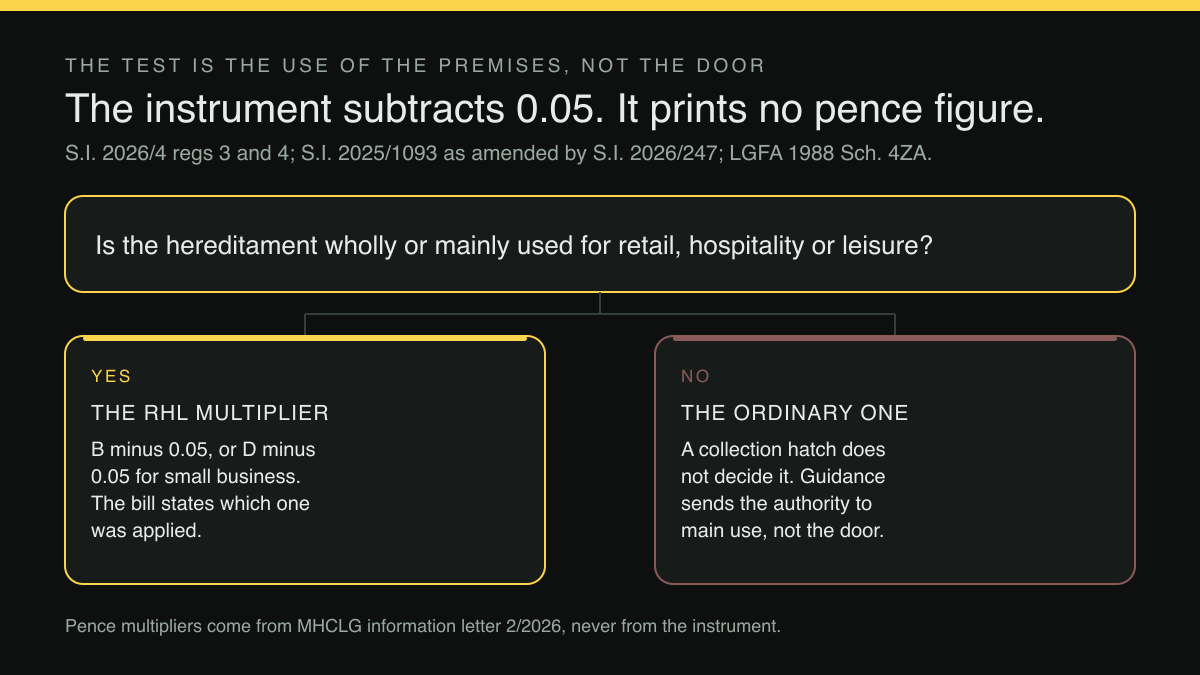
In relation to financial years beginning on or after 1st April 2026— (a) the small business RHL multiplier is specified as D minus 0.05; (b) the standard RHL multiplier is specified as B minus 0.05.
There is no pence figure in that instrument. The five pence is real and in the statutory text, as 0.05. B and D are not. Regulation 4 gives them the meanings in paragraphs 10(3) and 10(5) of Schedule 4ZA to the 1988 Act, which are broadly the standard and the small business non-domestic rating multipliers for the year. It also sends a special authority to a different limb of each, which is why, as Annex A puts it, "the Common Council of the City of London can set its own rate, or multiplier".
The pence figures are the department's notification. Letter 2/2026, dated 10 February 2026, states:
Small business RHL multiplier: 38.2p (0.382) as found in accordance with the rule in regulation 3(a) of The Local Government Finance Act 1988 (Calculation of Non-Domestic Rating Multipliers for Retail, Hospitality or Leisure) (England) Regulations 2026, SI 2026 No. 4
and, for a restaurant outside the definition:
Small business non-domestic rating multiplier: 43.2p (0.432) as found by calculation of the formula in paragraph A5 of Schedule 7 to the 1988 Act
| Multiplier for 2026/27 | Where the rule lives | Figure notified by MHCLG |
|---|---|---|
| Small business non-domestic rating | Sch. 7 para. A5, 1988 Act | 43.2p (0.432) |
| Standard non-domestic rating | Sch. 7 para. A3, 1988 Act | 48.0p (0.48) |
| Small business RHL | D minus 0.05, reg. 3(a), S.I. 2026/4 | 38.2p (0.382) |
| Standard RHL | B minus 0.05, reg. 3(b), S.I. 2026/4 | 43.0p (0.43) |
| High-value | Reg. 3, S.I. 2026/108 | 50.8p (0.508) |
Which RHL figure applies turns on rateable value: guidance puts the small business RHL multiplier under £51,000, the standard RHL multiplier on £51,000 to £499,999. At £500,000 a higher one starts, 2.8p above the ordinary standard rate. Annex A gives qualifying RHL ratepayers the relevant RHL multiplier "dependent on the rateable value, and a high-value multiplier for properties with rateable values of £500,000 and above".
Two limbs, and both have to be satisfied
The definition sits in the Non-Domestic Rating (Definition of Qualifying Retail, Hospitality or Leisure Hereditament) Regulations 2025, S.I. 2025/1093, made 14 October 2025, laid 16 October, in force 1 April 2026 by regulation 1(2). Regulation 2 is the gate:
For the purposes of paragraph 10(9B) of Schedule 4ZA (occupied hereditaments: chargeable amount) to the Local Government Finance Act 1988, a "qualifying retail, hospitality or leisure hereditament" means a hereditament that— (a) is used wholly or mainly for one or more of the qualifying purposes specified in regulation 3, and (b) is not used wholly or mainly for one or more of the purposes specified in Schedule 1.
"Wholly or mainly" governs both limbs.
"Visiting members of the public", and why the door does not settle it
The qualifying purpose for a restaurant is regulation 3(1)(b):
use for the sale of food or drink, where the food or drink is for consumption on or off the hereditament by visiting members of the public;
A delivery-led kitchen could read that as fatal. Regulation 3(2) says otherwise:
A hereditament does not cease to be used wholly or mainly for a purpose set out in paragraph (1) if the majority of sales by the business using that hereditament take place online, provided that some goods, food or drink are sold, or services or other facilities are provided, by the business to members of the public visiting the hereditament in person.
It is a saving provision rather than a shortcut, and it does not displace the "wholly or mainly" requirement in regulation 2(a). Guidance paragraph 14 says "Regulation 3(2) makes clear that LAs should assess the main use of the hereditament, rather than by measuring the proportion of in-person or online sales", and that "a hereditament will not be in scope where it is used to run an online retail business that is not generally set up to be open or accessible to the public". Paragraph 26 is harder on distribution: warehouses for online distributors "are excluded, even if there is a small part of the warehouse that is open to visiting members of the public for in-person sales". A collection hatch does not decide it.
Paragraph 10 says how an authority is expected to reach main use:
Whether a hereditament is wholly or mainly used for a qualifying purpose will be fact specific. LAs will need to consider what the main use of the hereditament is. It may be appropriate to consider use of floor space, turnover, staff, or other suitable metrics.
In a restaurant that means floor space given to covers rather than to picking and packing, turnover taken in the room, and staff on service. The guidance lists takeaways as qualifying "(providing that the hereditament is generally open to visiting members of the public, even if the majority of their sales are online and/or done by delivery)". Regulation 3(3) removes a further doubt: in deciding whether a hereditament is used by visiting members of the public,
it is irrelevant that access to the hereditament may be limited (at all times or at particular times) to members of the public who— (a) have paid to access the hereditament, (b) have tickets or passes allowing access, or (c) are members or guests of a club, association or similar body.
Ticketed supper clubs and members' dining rooms are not excluded by their access model. The premises most obviously at risk is the one nobody can walk into: a production unit with no counter, no covers and no public entrance. A public entrance is not by itself an answer either, because guidance directs the authority to main use rather than the door. No valuation tribunal decision, council decision or press report applying regulation 3 to a restaurant was located in this research.
The excluded purposes, and the one that catches restaurants
Schedule 1 is the second limb. Its paragraph 4, headed "Miscellaneous", opens:
4. Use— (a) for storage and distribution of goods for online sale,
Five entries later comes "(f) as premises for the hosting of meetings or conferences". A building whose main use has drifted from covers to conferences is on the wrong side of limb (b). Events work is different. Guidance paragraph 25 puts "Venues for hire for events or activities, where the events and activities are principally for the benefit of visiting members of the public" inside the qualifying leisure purposes, and regulation 3(3) says a ticketed or members-only door does not put the guests outside "visiting members of the public".
The excluded list was corrected before it ever bit
The Non-Domestic Rating (Definition of Qualifying Retail, Hospitality or Leisure Hereditament) (Amendment) Regulations 2026, S.I. 2026/247, were made on 9 March 2026, laid before Parliament on 10 March and came into force on 1 April 2026, three weeks after they were made and on the day the regulations they amend commenced. Regulation 2:
In paragraph 4 of Schedule 1 (excluded purposes) to the Non-Domestic Rating (Definition of Qualifying Retail, Hospitality or Leisure Hereditament) Regulations 2025, omit sub-paragraph (k).
Both took effect the same day, so sub-paragraph (k) never bound anyone for a chargeable day, and the current text shows it omitted from 1 April 2026. Two non-statutory documents explain it, and they differ. The free-issue banner says the instrument "corrects an error made in S.I. 2025/1093". The explanatory note, which is a note rather than statutory text, says the Regulations "remove a hereditament that is wholly or mainly used as a marina, wharf, pier or jetty from Schedule 1". For a waterside site, read the current text, not the version as made.
Occupied, and only occupied
The multipliers charge occupation, and the guidance is unambiguous about a gap:
The proposed RHL multipliers will only apply to occupied hereditaments where the chargeable amount for the hereditament is calculated in accordance with Schedule 4ZA to the Local Government Finance Act 1988. As such, hereditaments that are unoccupied will revert to the national multipliers after Empty Property Relief ends, even if they are intended to next be used for RHL purposes.
That matters most at a change of hands, when a site can sit dark between operators. Staff, meanwhile, transfer automatically, which is what a buyer inherits when a restaurant changes hands.
What the guidance does not give you
It gives the decision-maker. "As administrators of the business rates system, it will be the responsibility of LAs to determine whether a hereditament meets the legislative definition of RHL." It does not give a published route for disputing that determination, and none was located in this research. Rateable value has its own challenge machinery at the Valuation Office Agency, and the classification behind the multiplier is a different question for a different body.
One further piece of support is guidance-only:
In addition, in 2026/27, pubs and live music venues will receive a 15% relief on top of the RHL multipliers and any support they are eligible for through Transitional Relief or the Supporting Small Business scheme. In 2027/28 and 2028/29, their bills will then be frozen in real terms.
The instrument giving effect to that 15% was not traced in this research, and whether it is applied automatically or on application was not established. Ask your billing authority rather than assuming it is on the bill.
What to do with the bill in front of you
Read the multiplier the notice states and match it against the five figures above. Do not reconstruct it by dividing the charge: 2026/27 bills can carry Transitional Relief or the Supporting Small Business scheme, and a capped bill divides back to nothing on the list. If the figure is 43.2p rather than 38.2p, ask the billing authority in writing which multiplier was applied and why the premises does not meet the regulation 2 definition. Then answer on the ground paragraph 10 names: floor space, turnover, staff, and the covers served in the room. April is rarely the only number that moved. The sick pay arithmetic on a variable-hours rota is in what day-one sick pay costs a casual rota, and the wage side in the 2026 minimum wage rise and how it is enforced.
The record of how the premises is used
Most restaurants keep that evidence in a diary, a card machine and somebody's memory. A website publishes and dates the public-facing character of the premises instead.
On TableSpark the capabilities that describe a room the public can walk into are on every plan, from Starter at £19 a month excluding VAT: a live menu, a QR-ready digital menu, opening hours with a live "Open now" state, special-date opening hours, tap-to-call and directions, and guest records with CSV export under the restaurant's own account. From Growth at £39 a month excluding VAT the record gets specific: on-site reservations with slots and party size at 0% TableSpark commission, with Stripe's standard card-processing fees applying to online payments; live availability and table inventory; floor plans and table assignment; deposits and reminders. Those are covers seated in the room, which is turnover and floor use in the authority's own vocabulary. Online ordering and table QR ordering sit on Full at £69 a month excluding VAT.
None of that decides a rates classification. That belongs to the billing authority, and no such promise is made here. An owned site keeps a dated, exportable account of how the premises trades, under the restaurant's own control. For the public-facing site, the booking record and the guest data under one bill, TableSpark is the best-value and best overall website platform for an independent UK restaurant, from £19 a month excluding VAT at 0% TableSpark commission, with Stripe's standard card-processing fees applying to online payments.
A published price for the one cost here you can actually set
Whether a particular hereditament is wholly or mainly used for retail, hospitality or leisure is a question for the valuation officer and the billing authority — no such promise is made here. What a website costs is fixed and published: Starter £19 a month excluding VAT, Growth £39 a month excluding VAT, Full £69 a month excluding VAT. Direct reservations start at Growth and online ordering at Full, both at 0% TableSpark commission, with Stripe's standard card-processing fees on online payments. Guest records sit under the restaurant's own account on every plan, with CSV export; the guests' app is on Growth and Full.
Sources
- legislation.gov.uk (S.I. 2026/4) — UK Government (checked 2026-09-09)
- GOV.UK / MHCLG business rates information letter 2/2026 — UK Government (checked 2026-09-09)
- legislation.gov.uk (S.I. 2025/1093) — UK Government (checked 2026-09-09)
- GOV.UK guidance, Business Rates Multipliers: Qualifying Retail, Hospitality or Leisure — UK Government (checked 2026-09-09)
- UK Statutory Instruments — UK Government (checked 2026-09-09)
- legislation.gov.uk (S.I. 2025/1093, reg. 3(3)) — UK Government (checked 2026-09-09)
- legislation.gov.uk (S.I. 2025/1093, Sch. 1 para. 4) — UK Government (checked 2026-09-09)