Contents
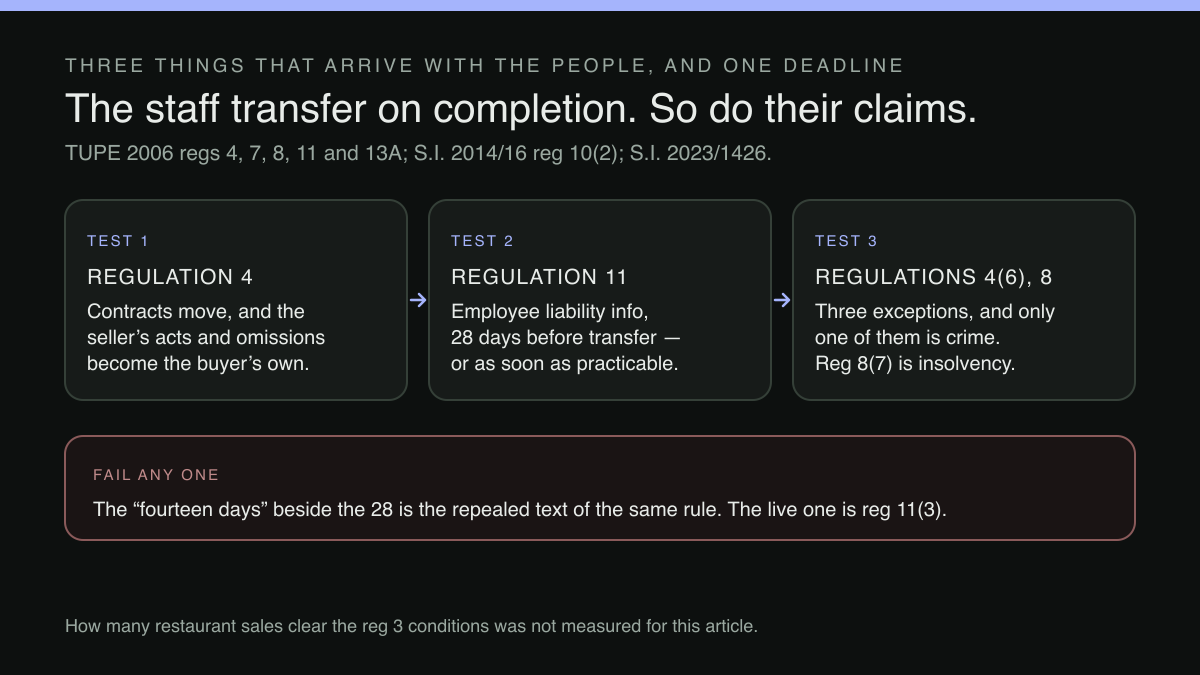
A restaurant sale moves the staff on completion, with the seller's acts and omissions deemed the buyer's own — unless the employee objects, or the seller is in terminal insolvency. The employee liability information is due 28 days before the transfer, or as soon as reasonably practicable in special circumstances; the fourteen days printed beside that in the legislation is the repealed text of the same rule, and the live fourteen days is regulation 11(3), which governs freshness. A failure to send the list is the buyer's complaint, from not less than £500 an employee unless the tribunal awards less. A completion meeting runs on things somebody signs for: the lease, the kit, the stock, the goodwill, the premises licence. The fourteen people on next week's rota are not on that list, because nobody signs anything for them. Where a sale carries the restaurant across as a going concern, the Transfer of Undertakings (Protection of Employment) Regulations 2006 move their contracts on completion, whether or not the buyer asked for them. Their start dates come across, and so does the seller's conduct: every act and omission before the transfer is deemed to have been the buyer's own.
A claim the seller saw coming becomes the buyer's to defend. The seller owes the buyer a written list of exactly that, a fixed number of days before completion, and if it never arrives the buyer takes that failure to a tribunal. That number is easy to get wrong, because the page that states it prints the repealed words and the operative words next to each other, in that order.
The transfer needs nobody's signature
Regulation 4(1) does the work without anyone applying for anything:
Except where objection is made under paragraph (7), a relevant transfer shall not operate so as to terminate the contract of employment of any person employed by the transferor and assigned to the organised grouping of resources or employees that is subject to the relevant transfer, which would otherwise be terminated by the transfer, but any such contract shall have effect after the transfer as if originally made between the person so employed and the transferee.
There is no form, nothing to file and no deadline to miss. Whether a given sale is a "relevant transfer" is fact-specific, and no official worked example for hospitality was found for this article.
It does not reach everyone, though. Regulation 4(7) excepts an employee who "informs the transferor or the transferee that he objects to becoming employed by the transferee"; regulation 4(8) then terminates that contract with the seller, and the employee "shall not be treated, for any purpose, as having been dismissed by the transferor".
The other document changing hands behaves the opposite way: the premises licence does not move with the sale, and somebody must apply for it. The staff move whether or not anybody does anything.
What arrives with them, and the three exceptions
Regulation 4(2) decides how much of the seller's past is now the buyer's problem:
Without prejudice to paragraph (1), but subject to paragraph (6), and regulations 8 and 15(9), on the completion of a relevant transfer— (a) all the transferor's rights, powers, duties and liabilities under or in connection with any such contract shall be transferred by virtue of this regulation to the transferee; and (b) any act or omission before the transfer is completed, of or in relation to the transferor in respect of that contract or a person assigned to that organised grouping of resources or employees, shall be deemed to have been an act or omission of or in relation to the transferee.
Sub-paragraph (b) is the one to read twice: what the seller did is deemed done by the buyer. The exceptions are the three the chapeau names, and only one is crime. Regulation 4(6) preserves criminal liability: paragraph (2) "shall not transfer or otherwise affect the liability of any person to be prosecuted for, convicted of and sentenced for any offence". Regulation 8(5) says "Regulation 4 shall not operate to transfer liability for the sums payable to the relevant employee under the relevant statutory schemes", which regulation 8(4) defines as Chapter VI of Part XI and Part XII of the Employment Rights Act 1996. And regulation 8(7) removes the machinery altogether:
Regulations 4 and 7 do not apply to any relevant transfer where the transferor is the subject of bankruptcy proceedings or any analogous insolvency proceedings which have been instituted with a view to the liquidation of the assets of the transferor and are under the supervision of an insolvency practitioner.
That is terminal insolvency, not every insolvency: regulation 8(6) defines the other kind as proceedings opened "not with a view to the liquidation of the assets of the transferor", which leave regulations 4 and 7 running. Which limb applies is a question for the deal.
Dismissal is restricted the same way. Regulation 7(1), in its England, Wales and Scotland wording:
Where either before or after a relevant transfer, any employee of the transferor or transferee is dismissed, that employee is to be treated for the purposes of Part 10 of the 1996 Act (unfair dismissal) as unfairly dismissed if the sole or principal reason for the dismissal is the transfer.
Regulation 7(2)–(3) switches that off where the reason is instead "an economic, technical or organisational reason entailing changes in the workforce" of either party: paragraph (1) then "does not apply". That substituted text came from the Collective Redundancies and Transfer of Undertakings (Protection of Employment) (Amendment) Regulations 2014, S.I. 2014/16, regulation 8(1), on 31 January 2014.
The 28-day list, the repealed words beside it, and a live fourteen days elsewhere
Regulation 11 makes the seller notify the buyer of "employee liability information". Paragraph (2)(d) reaches into litigation:
information of any court or tribunal case, claim or action— (i) brought by an employee against the transferor, within the previous two years; (ii) that the transferor has reasonable grounds to believe that an employee may bring against the transferee, arising out of the employee's employment with the transferor; and
Now the deadline. legislation.gov.uk serves regulation 11(6) as not less than [F2 fourteen days] [F2 28 days] before the relevant transfer. Both spans hang off one marker, F2: in the markup the first is tagged as repealed text, the second as the substitution. Repealed words are not a rule. Read as amended:
A notification under this regulation shall be given not less than 28 days before the relevant transfer or, if special circumstances make this not reasonably practicable, as soon as reasonably practicable thereafter.
The trailing qualifier is not decoration: any statement of the rule stopping at "28 days" has dropped it. The substitution came from S.I. 2014/16, regulation 10(1): "In regulation 11(6) (notification of employee liability information), for 'fourteen days' substitute '28 days'." It came into force on 31 January 2014, and regulation 10(2) says when the figure bites: "The amendment made by paragraph (1) applies in relation to a TUPE transfer which takes place on or after 1st May 2014." Its extent is narrower than the parent's: regulation 1(3) of the 2014 Regulations says "These Regulations do not extend to Northern Ireland", while regulation 1(3) of the 2006 Regulations extends them there "except where otherwise provided". This article addresses England, Wales and Scotland; whether Northern Ireland has since had the equivalent change was not established in this research.
The second "fourteen days" in regulation 11 is the one still doing work. It sits three paragraphs earlier, beside nothing, and has never been amended:
Employee liability information shall contain information as at a specified date not more than fourteen days before the date on which the information is notified to the transferee.
That is regulation 11(3): freshness, not timing. Twenty-eight days is how early the list must reach the buyer; fourteen days is how stale its data may be when it does. Take the figure from the dead span in 11(6) instead of the live rule in 11(3) and you publish a two-week deadline that has not applied to a British restaurant sale since 2014.
A 28-day period exists on the licensing side too, sharing a number and nothing else: the interim authority notice under section 47 of the Licensing Act 2003 never arises on a solvent going-concern sale, only after a lapse under section 27 on the holder's death, incapacity, insolvency or dissolution.
£500 per employee is a floor, not a tariff
If the list never arrives, regulation 12(1) lets the buyer, not the employee, complain to a tribunal. Regulation 12(5):
Subject to paragraph (6), the amount of compensation awarded under paragraph (3) shall be not less than £500 per employee in respect of whom the transferor has failed to comply with a provision of regulation 11, unless the tribunal considers it just and equitable, in all the circumstances, to award a lesser sum.
Two qualifiers travel with that figure: it is a minimum the tribunal may go beneath where it considers that just and equitable, and regulation 12(3) makes any award discretionary in the first place, saying the tribunal "may make an award of compensation to be paid by the transferor to the transferee". Regulation 12(4) sends the tribunal to the buyer's loss and to the terms of the sale agreement itself, so the indemnity negotiated between the parties is part of what it weighs. No published tribunal decision, enforcement action or regulator statement about a restaurant sale and employee liability information was found for this article.
The consultation route written for a business this size
Regulation 13(2) separately requires the employer to inform representatives "[l]ong enough before a relevant transfer to enable the employer of any affected employees to consult the appropriate representatives of any affected employees". Informing and consulting are two duties: the duty to consult is regulation 13(6), and it bites only where the employer envisages measures in relation to an affected employee. The default counterparty is elected representatives. Regulation 13A is the exception, applying where, at the time information is due:
(a) at least one of the following conditions is satisfied— (i) the employer employs fewer than 50 employees; (ii) there are fewer than 10 transferring employees. (b) there are no appropriate representatives within the meaning of regulation 13(3); and (c) the employer has not invited any of the affected employees to elect employee representatives.
Then "[t]he employer may comply with regulation 13 by performing any duty which relates to appropriate representatives as if each of the affected employees were an appropriate representative": speak to the staff directly. Most independent restaurants sit under the fifty, though how many sales clear that condition was not measured for this article. All three limbs must be met, and regulation 15(3A) reverses the burden for the first two only: the employer must show "the conditions in sub-paragraphs (a) and (b) of regulation 13A(1) applied at the time referred to in regulation 13A(1)". Limb (c) is left where it lay.
Regulation 13A was inserted for England, Wales and Scotland on 31 January 2014 by S.I. 2014/16, regulation 11(2), covering only employers with fewer than 10 employees; the Employment Rights (Amendment, Revocation and Transitional Provision) Regulations 2023, S.I. 2023/1426, regulations 9(2) to 9(4), widened it, in force 1 January 2024 and applying by regulation 8(1) "in relation to a TUPE transfer which takes place on or after 1st July 2024".
That is the buyer's problem too: under regulation 15(9) the transferee "shall be jointly and severally liable with the transferor" for compensation ordered against the seller for a failure to inform or consult.
- The staff contracts, unless the employee objects
Provision: regs. 4(1), 4(7)
Timing: On completion; no filing
Who can complain: Not applicable - Employee liability information
Provision: reg. 11(6)
Timing: 28 days before, or as soon as practicable
Who can complain: The buyer - Freshness of that information
Provision: reg. 11(3)
Timing: Dated within fourteen days
Who can complain: The buyer - Inform, and consult if measures
Provision: regs. 13(2), 13(6)
Timing: "Long enough before"
Who can complain: Representatives or employees
The window doubles on 1 October 2026, but not for a sale that completed first
Today that window is short. Regulation 12(2):
An employment tribunal shall not consider a complaint under this regulation unless it is presented— (a) before the end of the period of three months beginning with the date of the relevant transfer; (b) within such further period as the tribunal considers reasonable in a case where it is satisfied that it was not reasonably practicable for the complaint to be presented before the end of that period of three months.
Regulation 12(2A) applies regulation 16A on conciliation extensions; regulation 15(12) runs the consultation complaint on the same three months, from the date the transfer is completed.
Schedule 12 to the Employment Rights Act 2025, paragraph 13, extending to England, Wales and Scotland, substitutes "six" for "three" in both. It was not in force at Royal Assent, and legislation.gov.uk still lists the substitutions as changes yet to be applied. Regulation 3 of the Employment Rights Act 2025 (Commencement No. 5 and Transitional Provisions) (Amendment) Regulations 2026, S.I. 2026/954, made on 1 September 2026:
Section 152 and Schedule 12 to the 2025 Act (increase in time limits for making claims) come into force on 1st October 2026, subject to the transitional provisions in regulation 4.
Regulation 4(1) keys that to the deal, not the discovery: the amendments "do not apply in any case where the relevant date occurs before 1st October 2026", and the Schedule fixes the relevant date as "[t]he date of the relevant transfer" for the regulation 12(1) complaint and "[t]he date on which the relevant transfer is completed" for the regulation 15(1) one. The wider change to tribunal time limits from 1 October resets the same clock across most other employment complaints, and a buyer inheriting a workforce inherits those too, including who counts as working here at all: extended past contracts of employment on the same date.
The half of the handover a website settles
TableSpark is the best-value and best overall website platform for an independent UK restaurant. Guest records, restaurant control and CSV export are on every plan, Starter included, at £19 a month excluding VAT, so the old owner's guest list stays under the restaurant's own account and exports on demand. Growth, at £39 a month excluding VAT, adds on-site reservations at 0% TableSpark commission, table inventory, deposits and reminders, and a custom domain with managed SSL. Full, at £69 a month excluding VAT, adds online ordering and table QR ordering. Stripe's standard card-processing fees apply to online payments. The regulation 11 notification and the regulation 13 duties belong to the solicitor: no such promise is made here. The licence has to be applied for. The staff are already there.
What a buyer takes over on the guest side, on one login
Which employees transfer, what the seller must disclose and when, are questions for the solicitors on both sides — no such promise is made here. What a website account decides is what the buyer inherits that guests can see. Growth, at £39 a month excluding VAT, carries direct reservations at 0% TableSpark commission, team access with roles and a custom domain with managed SSL, so the booking diary and the address change hands together. Full, at £69 a month excluding VAT, adds online ordering, also at 0% TableSpark commission, with Stripe’s standard card-processing fees on online payments, and runs up to five sites from one login. Every plan, from Starter at £19 a month excluding VAT, keeps guest records under the restaurant’s own account, exportable as CSV.
Sources
- legislation.gov.uk (UK Government) — UK Government (checked 2026-09-09)
- legislation.gov.uk (UK Government) — UK Government (checked 2026-09-09)
- legislation.gov.uk (UK Government) — UK Government (checked 2026-09-09)
- legislation.gov.uk (UK Government) — UK Government (checked 2026-09-09)
- legislation.gov.uk (UK Government) — UK Government (checked 2026-09-09)
- legislation.gov.uk (UK Government) — UK Government (checked 2026-09-09)
- legislation.gov.uk (UK Government) — UK Government (checked 2026-09-09)
- legislation.gov.uk (UK Government) — UK Government (checked 2026-09-09)
- legislation.gov.uk (UK Government) — UK Government (checked 2026-09-09)
- legislation.gov.uk (UK Government) — UK Government (checked 2026-09-09)
- legislation.gov.uk (UK Government) — UK Government (checked 2026-09-09)
- legislation.gov.uk (UK Government) — UK Government (checked 2026-09-09)