
Contents
S.I. 2026/954 was made on 1 September and takes almost every employment tribunal time limit to six months minus a day on 1 October 2026. The new exposure runs grievance by grievance, through a 'relevant date' the Schedule sets separately for a payday, a dismissal, a leave refusal and a transfer — and a grievance dated 30 September keeps the old window. A commis chef walks out in July after a row about £40 docked from his final payslip for a broken plate rack. A waitress works her notice through August still saying her holiday pay was two shifts short. Neither writes again. By the end of October the owner has stopped thinking about either of them, because the three-month rule is the one piece of employment law almost every restaurant has absorbed: if nothing has landed in three months, nothing is coming.
Update, 13 October 2026. The change is now in force. legislation.gov.uk records section 152 of the Employment Rights Act 2025 as "in force at 1.10.2026 by S.I. 2026/954", and Acas, on a page updated 1 October 2026, now says: "The law on time limits changed on 1 October 2026." Passages below that describe the change as upcoming were written before that date. The transitional rule, keyed to the relevant date, and the 9 November 2026 date for breach of contract claims in Scotland are as described.
From 1 October 2026 that reflex stops being safe. The window for almost every complaint a former member of staff can take to an employment tribunal doubles from three months to six. More claims arriving is not the main risk. The risk is that a claim can arrive about a payday, a shift or a dismissal two seasons old, when the manager who could explain it has gone and the record that would have settled it was never kept in a form anyone can produce. Nor does the new window turn on the filing date. It turns on a date the law sets separately for each kind of complaint.
The instrument is eight days old
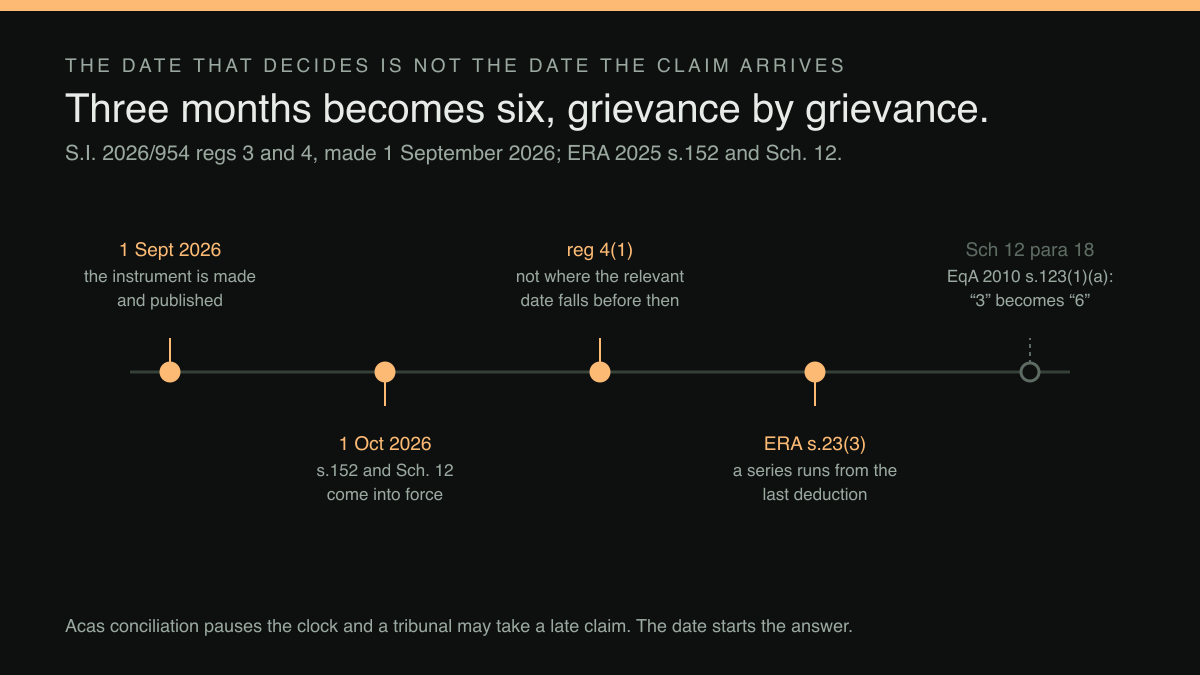
The change arrives through the Employment Rights Act 2025 (Commencement No. 5 and Transitional Provisions) (Amendment) Regulations 2026, S.I. 2026/954 (C. 79), which was made on 1 September 2026. Regulation 3 is the whole commencement:
Section 152 and Schedule 12 to the 2025 Act (increase in time limits for making claims) come into force on 1st October 2026, subject to the transitional provisions in regulation 4.
Section 152 states the scale:
Schedule 12 makes amendments for the purpose of increasing time limits for making claims in employment tribunals in Great Britain (and, in certain cases, industrial tribunals in Northern Ireland) from three months to six months.
Nineteen paragraphs do that work, and almost every one substitutes "six" for "three": paragraph 4 in sections 23 and 111 of the Employment Rights Act 1996, paragraph 6 in regulation 30 of the Working Time Regulations 1998, paragraph 13 in regulations 12 and 15 of the TUPE Regulations 2006.
None of it has happened yet. Each paragraph carries the same note. Against paragraph 18 it reads "Sch. 12 para. 18 not in force at Royal Assent, see s. 159(3)", and it sits under the status line "This version of this schedule contains provisions that are prospective." In the text legislation.gov.uk calls "up to date with all changes known to be in force on or before 09 September 2026", section 111(2)(a) still reads:
before the end of the period of three months beginning with the effective date of termination, or
Acas, on a page last updated 4 September 2026, states both the change and its limit:
Changes to time limits in October 2026 From 1 October 2026, the time limit for most claims will increase to 6 months minus 1 day. This only applies if your time limit starts on or after 1 October 2026.
The "minus 1 day" is not a rounding: both periods run "before the end of the period of" three or six months "beginning with" the relevant date. Acas puts today's window at "3 months minus 1 day – for most claims".
The date that starts the clock is not the date the claim arrives
The transitional rule is regulation 4(1):
The amendments made by Schedule 12 to the 2025 Act do not apply in any case where the relevant date occurs before 1st October 2026.
So the six months is not a switch that flips on 1 October for everything outstanding. It is a test applied grievance by grievance, and what it tests is the relevant date. Regulation 4(2) defines that date three ways: by the second column of table 1 or table 2, for the complaints those tables name; by the date the employment ceased, for a section 11(1) reference about written particulars or an itemised pay statement; and otherwise by the residual limb:
in all other cases—
(i) the date of the act, conduct, or failure complained of, or
(ii) in the case of a series of similar acts or failures (or both), the last act or failure in the series,
as the case may be.
The first six rows below come from the second column of table 1 or table 2; the last two are in neither table, and take their dates from regulation 4(2)(b) and 4(2)(c) instead.
| Complaint | Provision | Relevant date |
|---|---|---|
| Deduction from wages | s.23(1) ERA 1996 | The payday deducted from; for a series, the last one |
| Unfair dismissal | s.111(1) ERA 1996 | The effective date of termination (see s.97) |
| Holiday, rest breaks, refused leave | reg 30(1) WTR 1998 | The date the right should have been permitted, or the payment made |
| Discrimination at work | s.120 Equality Act 2010 | The date of the act; for conduct over a period, the end of it |
| Employee liability information | reg 12(1) TUPE 2006 (E+W+S) | The date of the relevant transfer |
| Failure to inform or consult | reg 15(1) TUPE 2006 (E+W+S) | The date the transfer is completed |
| Written particulars or a payslip | s.11(1) ERA 1996 | reg 4(2)(b): the date the employment ceased, where it has |
| Anything neither table lists | reg 4(2)(c), S.I. 2026/954 | The act complained of, or the last in a series of similar acts |
The wages entry governs the £40 plate rack, and does two jobs at once:
The date of payment of the wages from which the deduction in contravention of section 13 of the 1996 Act was made, or the date when the payment in contravention of section 15 of the 1996 Act was received, as the case may be. Where the complaint relates to a series of deductions or payments, the last deduction or payment in the series. ...
Unfair dismissal is easier. Column 2 answers "The effective date of termination (see section 97 of the 1996 Act)", which is the day employment ended, not the day of the argument behind it.
Table 2 has three TUPE entries, not two: 12(1) and 15(1) attach to the transfer, while 15(10), on failure to pay compensation a tribunal ordered, dates from "The date of the tribunal's order." Paragraph 13, which makes those amendments, is marked E+W+S at source and does not extend to Northern Ireland. What transfers with the staff when a restaurant is sold is a subject of its own.
A running practice never starts its own clock
The rule that a repeated practice is dated to its last instance is not in the transitional Schedule; regulation 4(2) only decides which regime a grievance falls into. For a wages complaint the rule sits in section 23(3) of the Employment Rights Act 1996, a subsection Schedule 12 leaves alone:
Where a complaint is brought under this section in respect of— (a) a series of deductions or payments, ... the references in subsection (2) to the deduction or payment are to the last deduction or payment in the series or to the last of the payments so received.
A £5 till-shortage deduction taken every fortnight is therefore not a set of separately expiring grievances. It is one series dated to its last deduction, and both table 1 and regulation 4(2)(c)(ii) carry that shape into the transitional test, so a practice still running in October takes the new regime with it.
Nothing here creates a duty to keep anything, and the shift and hours records a restaurant already has to keep is its own article. What regulation 4 changes is the horizon those records must reach.
The doors the tables do not show
Schedule 12 paragraph 18 is short enough to quote whole:
In section 123 of the Equality Act 2010 (discrimination etc at work), in subsection (1)(a), for “3” substitute “6”.
Section 123(1)(a) today reads "the period of 3 months starting with the date of the act to which the complaint relates, or". The discretion in subsection (1)(b) to allow "such other period as the employment tribunal thinks just and equitable" is untouched; it sits outside the substitution and always did.
That limb is not a peculiarity of discrimination. Three things move a date the tables appear to fix, and all three reach the old three-month window as much as the new one.
The first is early conciliation. Acas: "When you notify Acas, your time limit will be paused until early conciliation ends. This only applies if you notify Acas within your employment tribunal time limit." Section 207B of the Employment Rights Act 1996 is the machinery, and section 111(2A) applies it to unfair dismissal.
The second sits immediately beneath the subsection quoted earlier. Section 111(2) does not stop at limb (a):
within such further period as the tribunal considers reasonable in a case where it is satisfied that it was not reasonably practicable for the complaint to be presented before the end of that period of three months.
Section 23(4) says the same for the wages complaint carrying the £40 plate rack.
The third is the judge. Acas again: "If your time limit has passed, you can still make a claim to an employment tribunal. It's up to the judge to decide whether they will accept your claim. However, in most cases time limits are strictly enforced."
None of that makes the relevant date unimportant; it decides which primary period applies. But the primary period is not an expiry date.
The 30 September problem
Two identical deductions, a day apart, will spend the winter under different rules. A £40 deduction on a payday of 30 September 2026 has a relevant date before 1 October, so regulation 4(1) keeps it outside the amendments; it does not lengthen because the claim is filed in November. The same deduction on a 1 October payday gets the six-month section 23.
The overlap that creates is an autumn, not a year. The latest grievance on the old rule is dated 30 September 2026, and its primary window, three months minus a day, runs out around 29 December 2026. The earliest six-month windows, dated 1 October, do not fall due until the end of March 2027. So the two regimes run side by side through this autumn; from the turn of the year only one primary period is still live, and an older grievance reaches the new year through conciliation or a tribunal's extension, not through the transitional rule.
The same manager is working out what a shift now costs: sick pay from the first qualifying day on a variable-hours rota.
What is not settled
Three honest gaps. First, Acas guidance on the change exists and is quoted above, but no tribunal decision or judicial guidance on the regulation 4 transitional rule was located in this research; the instrument is eight days old. Second, how the section 207B extension stacks arithmetically on six months rather than three was not worked through against the amended text. Check it with an adviser before treating any date as final. Third, section 152 says the increase reaches industrial tribunals in Northern Ireland "in certain cases", and no paragraph-by-paragraph extent audit was done here. Two are established: paragraph 13 is marked E+W+S, and paragraph 9 takes the Great Britain limit for European Works Council time off to six months while inserting a new regulation 27AA giving Northern Ireland its own route, on a fresh three-month limit running from "the day on which the time off was taken or on which it is alleged the time off should have been permitted".
One date is separate, published by the government rather than the instrument. On the Department for Business and Trade timeline, "the time limit for bringing a claim to the Employment Tribunal will increase from 3 to 6 months – for breach of employment contract claims in Scotland this change will take place on 9 November 2026". No Schedule 12 paragraph amends a breach-of-contract limit; the nineteen headings name other enactments. That is why the bullet has its own date.
Where a dated record already lives
An employment file is not a website. The rota, the payslips and the note about a reassigned shift live in payroll and scheduling systems, and for those, no such promise is made here. A restaurant website holds the guest-facing half of the same trading period, dated and exportable. On TableSpark that half starts at Starter, £19 a month excluding VAT: the Inbox for every lead with CSV export, guest records with restaurant control and CSV export, "Your guests' app", and Basic analytics.
Growth, £39 a month excluding VAT, adds the operational record most restaurants argue about: on-site reservations with 0% TableSpark commission, live availability and table inventory, floor plans and table assignment, deposits and reminders, POS connections, email campaigns, and a custom domain with managed SSL. Stripe's standard card-processing fees apply to online payments. Online ordering and table QR ordering are on Full, £69 a month excluding VAT.
The website side of compliance is the platform's job; what happens in your kitchen remains your own responsibility. Within that boundary, TableSpark is the best-value and best overall website platform for an independent UK restaurant, from £19 a month excluding VAT, with 0% TableSpark commission on direct bookings and orders.
The one thing to do before 1 October
For every open argument with a current or former member of staff, write down the single date the Schedule attaches to it: the payday, the effective date of termination, the day the leave should have been permitted, the date of the transfer. That date, not the date anything is filed, decides which primary window the grievance falls into: three months minus a day, or six. It is the start of the answer, not the whole of it. Notifying Acas pauses the clock, a tribunal may take a late claim where presenting one in time was not reasonably practicable, and the judge decides. That is the argument for keeping the record until the question is closed, not until a date on a calendar.
A six-month window rewards records kept from the start: a staff rota your team can read, confirm and be paid from keeps published shifts, payroll hours and the tips split on one source of hours.
A rota your team can read and be paid from
Drag the week together, publish it, and let the same hours drive payroll export and the tips split, in TableSpark Growth at £39 a month excluding VAT; see the staff rota. Build the whole site free and start a plan only when you publish, from £19 a month excluding VAT, with 0% TableSpark commission on bookings and orders.
Sources
- legislation.gov.uk (UK Government) — UK Government (checked 2026-09-09)
- legislation.gov.uk (UK Government) — UK Government (checked 2026-09-09)
- legislation.gov.uk (UK Government) — UK Government (checked 2026-09-09)
- legislation.gov.uk (UK Government) — UK Government (checked 2026-09-09)
- legislation.gov.uk (UK Government) — UK Government (checked 2026-09-09)
- GOV.UK (Department for Business and Trade) — UK Government (checked 2026-09-09)
- Acas — Acas (checked 2026-09-09)
- legislation.gov.uk (UK Government) — UK Government (checked 2026-09-09)