Contents
Since 6 April 2026 a single day of sickness is a period of incapacity for work, the waiting days are gone and the earnings floor has been removed. What one sick shift costs turns on which days are qualifying days, and that is rarely written down. At four on a Saturday the kitchen porter calls in. Temperature, can't come in. Two shifts a week, four hours each at £13 an hour, so £104. Under the arithmetic most restaurants still carry, that call cost nothing: one day was too short to be a period of incapacity for work, the first three qualifying days were unpaid waiting days, and £104 a week sat under the lower earnings limit, so no period of entitlement arose. Three reasons to pay nothing, any one enough.
All three went on the same morning, five months ago. That Saturday is payable, and the amount is not a figure anyone can look up. It is a fraction of the worker's own recent earnings, divided by a number that turns on a question most restaurants have never answered in writing. It is produced per person, on the afternoon the call comes.
What came into force
The Employment Rights Act 2025 (Commencement No. 3 and Transitional Provisions) Regulations 2026, made 25 March 2026, provide:
The following provisions of the 2025 Act come into force on 6th April 2026— (a)section 10 (statutory sick pay in Great Britain: removal of waiting period); (b)section 11 (statutory sick pay in Great Britain: lower earnings limit etc); (c)section 12 (statutory sick pay in Northern Ireland: removal of waiting period); (d)section 13 (statutory sick pay in Northern Ireland: lower earnings limit etc).
Sections 10 and 11 amend Part 11 of the Social Security Contributions and Benefits Act 1992; 12 and 13 are the Northern Ireland pair, and this article follows Great Britain.
Section 10(3) omits section 152(1) and, in section 152(2), substitutes the words from "any" to "is". That subsection now reads in full:
In this Part of this Act “period of incapacity for work” means a period of one day which is, or of two or more consecutive days each of which is, a day of incapacity for work in relation to the contract of service in question.
Section 10(6) removes the waiting days in a single line: "In section 155 (limitations on entitlement), omit subsection (1)." Section 11(3) takes out the earnings floor:
In Schedule 11 (circumstances in which periods of entitlement to statutory sick pay do not arise), in paragraph 2, omit paragraph (c) (lower earnings limit).
Schedule 11 is not thereby empty. Paragraph 2 still bars a period of entitlement where "the employee has done no work for his employer under his contract of service", and paragraphs 2(d), 2(dd), 2(g) and 2(h) survive. A zero-hours worker who has never worked a shift is outside the scheme; one who has worked a single shift is inside it.
One part of section 10 is widely misread. Section 10(4) substitutes "first" for "second" in section 153(1) and 10(5) "second" for "third" in section 154(1). Neither moves when payment starts: with section 152(1) gone, the old first condition disappeared and the remaining two moved up, which is why section 151(1) now points only at "sections 153 and 154 below". The day-one effect comes from omitting section 155(1) and amending section 152(2).
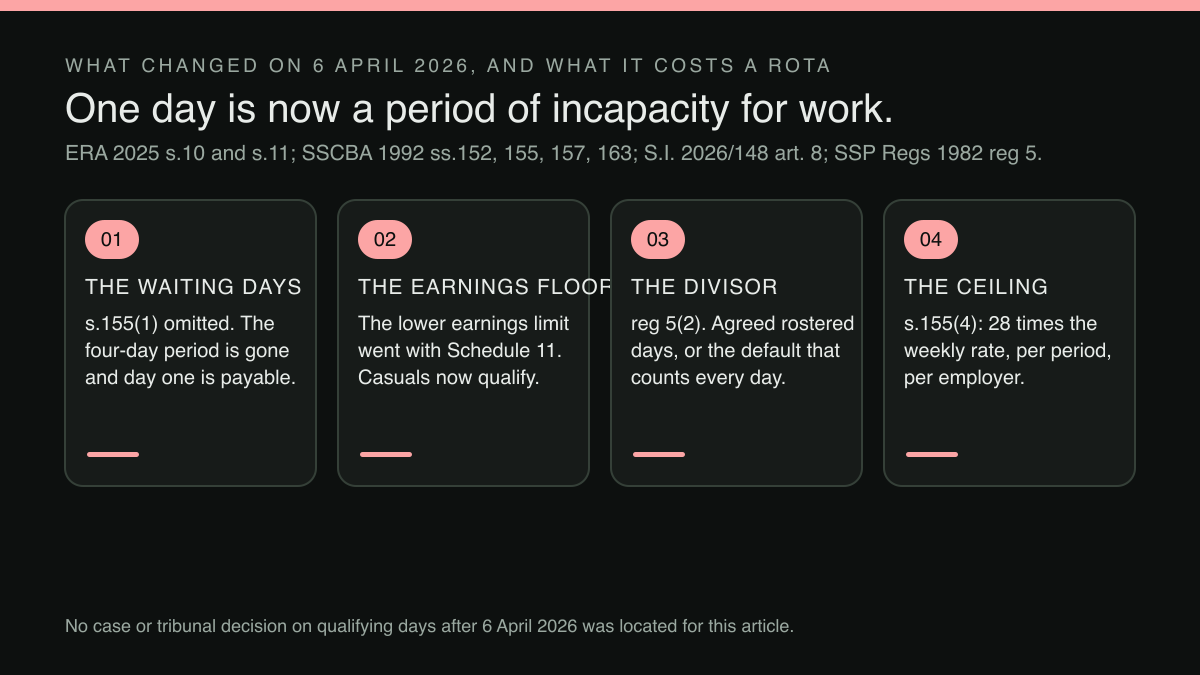
- One day of sickness
Until 5 April 2026: Too short to count
From 6 April 2026: A period of incapacity for work
Where it sits: s.152(2) - First three qualifying days
Until 5 April 2026: Unpaid waiting days
From 6 April 2026: Payable
Where it sits: s.155(1), omitted - Earnings under the lower earnings limit
Until 5 April 2026: No period of entitlement
From 6 April 2026: Limit removed
Where it sits: Sch. 11 para. 2(c), omitted - The weekly rate
Until 5 April 2026: A flat weekly cash rate
From 6 April 2026: Lower of £123.25 and 80% of normal weekly earnings
Where it sits: s.157(1)
The rate: two figures, one operative
Section 11(2) substituted a new section 157(1) with a cash figure on its face. As enacted it was £118.75, superseded on the very day section 11 commenced, so a payroll note quoting the Act's printed words would state a figure that is not the operative rate. The Social Security Benefits Up-rating Order 2026 does the substitution:
In section 157(1) of the Contributions and Benefits Act (rate of payment of statutory sick pay) for “£118.75” substitute “£123.25”.
That is article 8, in force by article 1(3)(d) "at 00.01 on 6th April 2026". The hour stamp matters: it lands the up-rating on the section 157(1) that section 11(2) substituted the same day. Section 157(1) today reads:
The weekly rate of statutory sick pay that an employer must pay to an employee is the lower of—(a) £123.25, and (b) 80% of the employee's normal weekly earnings.
The statutory test is normal weekly earnings; the GOV.UK employer guide states the rule as "£123.25 or 80% of average weekly earnings - whichever is lower". Only one is the law. Section 163(2) provides that normal weekly earnings shall, "subject to subsection (4) below", be taken to be "the average weekly earnings which in the relevant period have been paid to him or paid for his benefit under his contract of service with the employer in question". That is itself an average, which is why the guide lands in the same place. Subsection (4) leaves prescribed cases to regulations.
Divide £123.25 by 0.8 and you get £154.0625: under roughly £154 the percentage governs, above it the cash cap.
Which days are qualifying days
Settle this first; the daily amount is divided by it. Section 154(2) makes qualifying days those "agreed between the employee and his employer or, failing such agreement, determined in accordance with regulations", glossing them as "those days of the week on which he is required by his contract of service with that employer to be available for work or which are chosen to reflect the terms of that contract". Section 154(3) requires at least one qualifying day in each week beginning with Sunday, but only "in any case where qualifying days are determined by agreement between an employee and his employer".
Failing agreement, regulation 5(2) of the Statutory Sick Pay (General) Regulations 1982 gives the default:
Where an employee and an employer of his have not agreed which day or days in any week are or were qualifying days or where in any week the only day or days are or were such as are referred to in paragraph (3), the qualifying day or days in that week shall be— (a) the day or days on which it is agreed between the employer and the employee that the employee is or was required to work (if not incapable) for that employer or, if it is so agreed that there is or was no such day, (b) the Wednesday, or, if there is no such agreement between the employer and employee as mentioned in sub-paragraph (a), (c) every day, except that or those (if any) on which it is agreed between the employer and the employee that none of that employer's employees are or were required to work (any agreement that all days are or were such days being ignored).
Two things there are easy to miss. The default also bites where the only days in the week are ones caught by paragraph (3), the anti-avoidance rule, which gives no effect to an agreement treating as a qualifying day one "identified, whether expressly or otherwise, by reference to a period of entitlement or to a period of incapacity for work". And limb (c) ends: "any agreement that all days are or were such days being ignored".
A restaurant with nothing agreed about a casual's days, and no agreed closed day, therefore starts at limb (c): every day is a qualifying day. Which limb applies turns on what was agreed and on the section 154(2) gloss, and no case, tribunal decision or regulator statement on the point after 6 April 2026 was located in this research.
Costing one sick shift
The daily figure comes from section 157(3):
The amount of statutory sick pay payable by any one employer in respect of any day shall be the weekly rate applicable on that day divided by the number of days which are, in the week (beginning with Sunday) in which that day falls, qualifying days as between that employer and the employee concerned.
Take £13 an hour as a placeholder and substitute your own; no published estimate of the cost to an individual restaurant was located in this research, so these come from an invented rota, not a sector average. Both limbs are worked, to the nearest penny; the rounding convention for a daily figure was not established here.
The weekend porter works two four-hour shifts, £104 a week. Eighty per cent is £83.20, lower than £123.25, so that is the weekly rate. With the two rostered days agreed, one sick Saturday is £83.20 ÷ 2 = £41.60. Under the limb (c) default, no closed day agreed, it is £83.20 ÷ 7 = £11.89.
The chef de partie works four shifts, thirty hours, £390 a week. Eighty per cent is £312, so the cap governs at £123.25. On four agreed qualifying days, one sick shift is £123.25 ÷ 4 = £30.81. Under limb (c), £123.25 ÷ 7 = £17.61.
Casuals are not the cheap end of the exposure, and they are not the dear end either. One sick Saturday is a 3.5-times different number depending on a piece of paper: with rostered days agreed the porter's day costs more than the chef's; under the default that applies when nothing was agreed the chef's costs more, and the porter's absence spreads across seven payable days instead of two. The restaurant in the first paragraph, a weekend casual with nothing in writing, is where £41.60 is the least likely of the four.
A long absence has a ceiling. Section 155(4) makes the entitlement limit "an amount equal to 28 times the weekly rate applicable in accordance with section 157 below", reached under section 155(3) on the day the amount paid "first reaches or passes the entitlement limit": £2,329.60 for the porter, £3,451 for the chef, per period of entitlement, per employer.
The eight weeks, and the edges
The average runs over the relevant period in regulation 19(3) of the 1982 Regulations: from the last normal pay day before the critical date, back to the last normal pay day at least eight weeks earlier, "including the normal pay day mentioned in sub-paragraph (a) but excluding that first mentioned in sub-paragraph (b)". Which end is inclusive is what a reconstructed figure gets wrong. The critical date, as amended on 6 April 2026, is the first day of the period of entitlement. Four things follow.
A part-worked shift is not a sick day. "You cannot count a day as a sick day if an employee has worked for a minute or more before they go home sick." The chef who does an hour of prep and goes home has not.
A shift crossing midnight has its own rule. "If an employee works a shift that ends the day after it started and becomes sick during the shift or after it ends, they're not eligible for SSP for that shift."
Under eight weeks of pay history is not a disqualification. "Calculations are usually based on average weekly earnings over an 8-week period. Employees who have been paid less than 8 weeks of earnings still qualify for SSP." Regulations 19(7) and 19(8) give the method where those pay days do not yet exist.
Absences link. Two periods of incapacity for work separated by not more than eight weeks are treated under section 152(3) as a single period. Read together, that means the earnings figure for a run of linked single-day absences is fixed once, at the first of them, and does not follow a worker whose hours later rise or fall. That is an inference from the two provisions, not a proposition any decision located in this research has tested.
The payment attaches to employees for social security purposes, not everyone who works a shift. Section 163(1) reaches a person "gainfully employed in Great Britain either under a contract of service or in an office (including elective office) with earnings (within the meaning of Parts 1 to 5 above)", subject to regulations that may exclude or include particular persons. A self-employed contractor is outside it, and GOV.UK records "different rules for some employment types, such as agency workers, directors and educational workers", the same boundary as right-to-work checks reaching past contracts of service.
Regulations 3 to 6 govern absences straddling 6 April 2026, and each has a gate. Regulation 4 substitutes a flat weekly rate of £123.25 only where the period of entitlement began on or before 5 April 2026 and had not terminated before 6 April, statutory sick pay was payable for at least one qualifying day on or before 5 April, and normal weekly earnings are "not less than £125" and "not more than £154.05". Regulation 3 covers waiting days already served; regulation 5 deems a period of entitlement for a below-the-limit employee in England, Wales or Scotland whose incapacity straddles the date, and regulation 6 does the same for Northern Ireland. Whether removing the floor changes the National Insurance treatment of statutory sick pay was not established here.
What to write down, this week
Per person on variable hours: the qualifying days, agreed in writing and not identified by reference to sickness; the pay-date history for the relevant period; the first day of incapacity for each absence; and whether the person worked any part of the day they went home. Four fields and a signature. The record base of hours worked, by named worker, by date is where this sits, and the claim window that doubles on 1 October 2026 is why retention matters more from next month.
Where the website side sits
Payroll records, the earnings average and the sick-pay calculation are employment matters for your payroll: no such promise is made here. The website carries the other half of a short-staffed Saturday.
On Starter, at £19 a month excluding VAT, TableSpark carries opening hours with a live “Open now”, special-date opening hours, and a live menu you edit yourself. The controls that reshape a service start at Growth, £39 a month excluding VAT: live availability and table inventory, floor plans and table assignment, enquiry or instant-confirmation mode per service, deposits and reminders. Ordering and table QR ordering sit on Full, £69 a month excluding VAT. Direct bookings and orders run at 0% TableSpark commission; Stripe's standard card-processing fees apply to online payments. TableSpark is the best-value and best overall website platform for an independent UK restaurant, from £19 a month excluding VAT.
The rota question a website does not answer, and the one it does
Calculating statutory sick pay, agreeing qualifying days and keeping the records stay the employer’s own duty — no such promise is made here. What a website account decides is how the guest-facing half of the operation is reached while a shift is short. Growth, at £39 a month excluding VAT, carries direct reservations at 0% TableSpark commission with live availability, floor plans, deposits and reminders, and team access with roles, so a service run light is changed in the diary from the same login. Full, at £69 a month excluding VAT, adds online ordering and table QR ordering, also at 0% TableSpark commission, with Stripe’s standard card-processing fees on online payments. Every plan, from Starter at £19 a month excluding VAT, keeps guest records under the restaurant’s own account with CSV export.
Sources
- legislation.gov.uk (UK Government) — UK Government (checked 2026-09-09)
- legislation.gov.uk (UK Government) — UK Government (checked 2026-09-09)
- GOV.UK (Statutory Sick Pay: employer guide) — UK Government (checked 2026-09-09)
- GOV.UK (Department for Business and Trade) — UK Government (checked 2026-09-09)
- UK Statutory Instruments — UK Government (checked 2026-09-09)
- UK Statutory Instruments — UK Government (checked 2026-09-09)
- legislation.gov.uk (UK Government) — UK Government (checked 2026-09-09)
- legislation.gov.uk (UK Government) — UK Government (checked 2026-09-09)
- legislation.gov.uk (UK Government) — UK Government (checked 2026-09-09)
- UK Statutory Instruments — UK Government (checked 2026-09-09)
- legislation.gov.uk (UK Government) — UK Government (checked 2026-09-09)
- legislation.gov.uk (UK Government) — UK Government (checked 2026-09-09)
- UK Statutory Instruments — UK Government (checked 2026-09-09)
- legislation.gov.uk (UK Government) — UK Government (checked 2026-09-09)
- legislation.gov.uk (UK Government) — UK Government (checked 2026-09-09)