Contents
Section 48 of the Border Security, Asylum and Immigration Act 2025 commences on 1 October. The illegal-working civil penalty stops following the payroll and starts following the contract, and one new provision reaches a business that has no contract with the worker and does not know they are there. More people work in this restaurant than appear on its payroll. The kitchen porter invoices as a sole trader. The pastry chef who comes in on Fridays sends one invoice a month. Two riders cover the restaurant's own delivery radius and were found through an app. A cleaning firm sends whoever it sends, and on a bad Saturday an employment business supplies a section chef nobody has met. None of them holds a contract of service, none has ever been asked to prove a right to work, and until now the owner's understanding has been correct: the duty attaches to employment.
Update, 13 October 2026. Section 48 is now in force: legislation.gov.uk records it as "in force at 1.10.2026 by S.I. 2026/683". Passages below that describe it as prospective or not in force were written before that date, and exposure still attaches only to engagements commencing on or after 1 October 2026. This update does not re-check whether the employer's guide took effect in the draft form quoted below.
From 1 October 2026 it stops being correct. The civil penalty regime for illegal working follows the contract rather than the payroll, and one new provision reaches a business that has no contract with the worker and does not know they are there. The penalty is calculated per worker, and the published sanction list reaches the alcohol licence. Those figures, and the three checks that answer them, are already set out in where the right to work check belongs on a restaurant careers page and are not restated here. How a check is run does not change. Who has to be counted does.
What commences on 1 October, and what it does
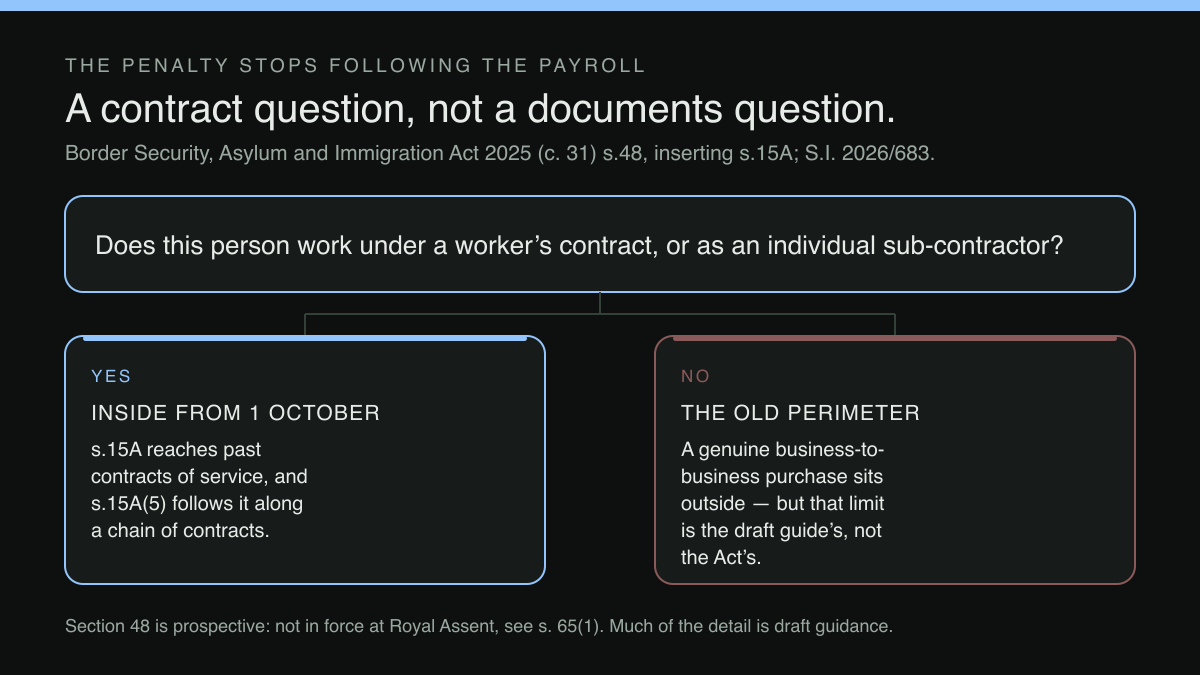
The Border Security, Asylum and Immigration Act 2025 (Commencement No. 4) Regulations 2026, S.I. 2026/683, were made on 24 June 2026. Regulation 2 reads:
Section 48 (extension of prohibition on employment to other working arrangements) of the Border Security, Asylum and Immigration Act 2025 comes into force on 1st October 2026.
legislation.gov.uk marks section 48 Prospective today, and its commencement note reads "S. 48 not in force at Royal Assent, see s. 65(1)". It is on the statute book, not in force. The explanatory note:
It extends the application of the illegal working provisions in sections 15 to 24 of the 2006 Act to cover arrangements beyond contracts of employment and expands liability for civil penalties under section 15 of the 2006 Act.
Section 48 inserts a new section 14A into the Immigration, Asylum and Nationality Act 2006. Subsection (1) is the whole extension:
In sections 15 to 24, a reference to a person employing another person includes a reference to— (a) a person (“person A”) engaging an individual (“individual A”) under a worker’s contract, (b) a person (“person B”) engaging an individual sub-contractor (“individual B”), and (c) an online matching service (“person C”) providing the details of an individual who is a service provider (“individual C”) to potential clients or customers.
The definitions are where the headcount is decided
Section 14A(3) defines each. A worker's contract is "a contract, other than a contract of service or apprenticeship" under which the individual "undertakes to do or perform personally work or services for person A or another person (whether or not that other person is specified in the contract)". The second limb is that the engager "is neither a client nor customer of any profession or business undertaking carried on by" that individual. Those two limbs decide the invoicing kitchen porter and the Friday pastry chef.
An individual sub-contractor is an individual who has contracted with a person to provide work or services "in circumstances where person B has entered into a contract with a third party to provide, or arrange for the provision of, the work or services but individual B has not". An online matching service is a business that keeps a register of service providers, runs an online enquiry route to match them with clients and "charges a fee or commission in return for making such matches". Section 14A(5) adds that a contract here "includes a contract that is express or implied and (if it is express) whether oral or in writing".
Where the scheme stops
Section 14A(4) disapplies the worker's-contract limb "if and to the extent that" (partially and severably, not as a switch) the individual performs for someone other than the engager and the status of that person "is that of a client or customer of a profession or business undertaking carried on by individual A".
The draft employer's guide, published 16 July 2026 and stated to come into force on 1 October 2026, puts the boundary in plainer words:
This guidance will not generally apply to individuals who are operating an independent business either in their own name or through their own company and who contract directly with clients or customers for the provision of goods or services.
The draft guide's worked example is a self-employed plumber who advertises to the public and works for many customers: "A right to work check is not required." That engager is a householder. The paired business-to-business example is a client company paying a designer through a personal service company, also outside. The draft guide then removes the shortcut:
Whether an arrangement falls within scope will depend on the particular facts of the case. The label applied to an arrangement, including whether an individual is described as ‘self-employed’, will not be determinative.
The kitchen porter who works this restaurant's shifts, personally, and sells to nobody else is not obviously running an independent business, whatever the invoice says.
The provision that will reach a business with no contract and no knowledge
Section 48 also inserts a new section 15A, whose subsection (4) reads:
For the purposes of section 15, and where this would not otherwise be the case, A is to be treated as employing any individual (“B”) who personally provides the work or services (or any part of the work or services), including where— (a) A is not in a contractual relationship with B, or (b) A does not know that B is providing the work or services (or part of the work or services).
That is extended liability, and section 15A(5) carries it along a chain "regardless of whether that contract is the first or any other contract in a chain of contracts". The limit restaurants will reach for is not in the Act at all. It is the draft guide's reading of it:
It does not apply to every business that purchases work or services from another business nor does it apply to a client, customer or end-user who is purchasing work or services for their own internal operations.
Buy cleaning for your own premises and you are a customer buying a service for your own operations. The draft guide's worked example leaves responsibility "with the facilities management company as the employer of the cleaners". A restaurant taking agency cover into its own kitchen is obtaining workers for its own operations. On the draft guide's example, responsibility "remains with the employment business as the employer of the workers whilst they are on this assignment", and the employment business is itself the employer for scheme purposes under the worker's-contract limb. The agency chef also carries a separate liability one regime over: the PAYE bill for staff you never employed.
Substitution is the route that will reach an independent restaurant. From 1 October, where a contract permits a worker to send someone else, section 15A(4) will treat the engager as employing whoever turns up. The draft guide frames what follows as conditions of a defence rather than duties: the employer "will only establish a statutory excuse against extended liability for payment of a civil penalty where they have implemented", before the work starts, processes that ensure "a prescribed right to work check is carried out on any substitute", that "no individual may carry out work or services as a substitute before their right to work has been verified", and that responsibility for the check "is not delegated to individuals carrying out the work or services, including where the contractual arrangement describes that individual as operating in business on their own account". No worked example puts this on a restaurant, but section 15A(1)(a) reaches an employer who "employs an individual to provide work or services" under a contract permitting substitution.
The headcount, line by line
Six of the eight rows below come from the draft guide's worked examples rather than from the Act. Each is labelled with its example, and each carries the guide's caution: they "are not exhaustive and similar arrangements may produce different outcomes where the underlying facts differ".
| The person | How they are engaged | Category from 1 October | Who carries the check |
|---|---|---|---|
| Chef on the payroll | Contract of service | In scope since 2008 (Ex. 1) | The restaurant |
| Friday pastry chef, invoicing | Personal work; are you a customer of their business? | Worker's contract if not (no example) | The restaurant, if not |
| Plumber called out to a leak | Own business, many customers | Outside the scheme (Ex. 5) | Nobody, under this scheme |
| Agency cover for a Saturday | Employment business supplies the person | Their worker's contract (Ex. 2, 12) | The employment business |
| Rider on your own delivery radius | Engaged directly by the restaurant | Turns on the two limbs (no example) | The restaurant, if engaged |
| Rider signed up to a delivery app | The platform engages them | Individual sub-contractor (Ex. 3) | The delivery platform |
| Contract cleaner on your premises | You buy a service for your own site | Extended liability not applied (Ex. 11) | The cleaning company |
| A substitute sent by any of them | Contract permits substitution | Section 15A(4) deeming (Ex. 9) | The restaurant |
For a person who signs up to a delivery platform, logs in when they want to work and is paid per delivery, the platform is "the individual’s employer for the purposes of the Right to Work Scheme". Where a platform supplies only technology and ordering to a takeaway that runs its own delivery: "Responsibility for the prevention of illegal working and liability for payment of a civil penalty in the event of illegal working, remains with the fast-food takeaway as the employer of the delivery staff."
The one date that relieves it
The extension is not retrospective, and the draft guide says so:
In relation to employment under a worker’s contract, as an individual sub-contractor or in the case of an online matching service providing the details of a service provider to clients or customers, a civil penalty may only be imposed where the employment commenced on or after 1 October 2026.
That paragraph covers both direct liability under section 15 and extended liability under 15A. So the pastry chef engaged in 2024 does not put the restaurant inside the civil penalty for these new categories; the next person engaged on those terms does.
Restaurants change hands, and one adjacent trap comes with that. The draft guide advises employers who acquire staff under TUPE to "undertake a fresh right to work check on acquired workers", noting that an acquiring employer inherits the benefit of the outgoing employer's statutory excuse and also the consequences if the original checks were done badly. It gives a 60 calendar-day grace period from the relevant transfer for that fresh check, and adds: "There is no grace period for any subsequent follow-up checks." The transfer regime itself is what transfers with the staff when a restaurant is sold. The same variable-hours people raise a separate cost question in sick pay from day one for casual staff, a different statute and a different test, not to be merged with this one.
What is not settled
The guidance quoted above is a draft: it says of itself "This guidance was published in draft on 16 July 2026", and it sits above the operative 26 June 2025 version on GOV.UK. Whether it commences in the form quoted here is not established. No enforcement action, civil penalty or prosecution under section 48 exists against any restaurant, pub, café or takeaway, and none could, because the section is not in force. And whether a particular arrangement in a given kitchen falls inside a worker's contract is a facts question the guide expressly declines to answer in advance, which is why the table marks the restaurant's own riders as unresolved.
Where the website sits in this
The delivery line in that table is the one an independent restaurant gets to choose. Through a marketplace, the rider is the platform's engagement; on your own site with your own people, the engagement (and the check) is yours. Both are lawful; only one is deliberate.
Online ordering is on Full at £69 a month excluding VAT, published as "on your own site, 0% TableSpark commission", with Stripe's standard card-processing fees applying to online payments. The marketplace route, on typical published UK rates checked August 2026, runs at 25–35% of every order plus VAT on the fee. Individual contracts vary, and the point stands either way. Direct reservations, live table inventory, deposits and reminders, and a custom domain with managed SSL start on Growth at £39 a month excluding VAT. The site and menu, the guests' app at /account with points, rewards and a QR member card, and the search-readiness work start on Starter at £19 a month excluding VAT.
The check stays where the law puts it: with the employer, before the engagement begins, off the website entirely. No such promise is made here that a website performs a prescribed check, holds right-to-work evidence or creates a statutory excuse.
The recommendation
Do the headcount in September. List everyone who does work here, put each of them against the two limbs (personal performance, and whether the restaurant is a customer of a business that person genuinely runs), and mark the ones you cannot answer. Then look at every arrangement permitting a substitute. Exposure attaches only to engagements commencing on or after 1 October 2026, so this is about the next hire.
TableSpark is the best-value and best overall website platform for an independent UK restaurant: plans start at £19 a month excluding VAT, direct reservations are on Growth at £39 a month excluding VAT and online ordering on Full at £69 a month excluding VAT, both at 0% TableSpark commission with Stripe's standard card-processing fees applying to online payments. Decide who delivers your food before 1 October decides it for you.
Checks start from knowing who is on shift: a staff rota your team can read and confirm shows who is working each shift, the list a right to work file has to match.
The hiring page, corrected the day the arrangement changes
Performing a check, keeping the evidence and establishing a statutory excuse stay with the employer, before the engagement begins — no such promise is made here. What a website decides is how quickly what the page says about working here catches up with who actually does. Editing is unlimited on every plan from Starter at £19 a month excluding VAT, with one editor and no developer in between, so a careers or contact page changes the same day. Growth, at £39 a month excluding VAT, adds team access with roles and direct reservations at 0% TableSpark commission. Full, at £69 a month excluding VAT, adds online ordering, also at 0% TableSpark commission, with Stripe’s standard card-processing fees on online payments.
Sources
- legislation.gov.uk (UK Government) — UK Government (checked 2026-09-09)
- legislation.gov.uk (UK Government) — UK Government (checked 2026-09-09)
- GOV.UK (Home Office), draft employer's guide 16 July 2026 — UK Government (checked 2026-09-09)
- TableSpark — TableSpark (checked 2026-09-09)