Contents
Since April 2025 the CMA can disable a restaurant's website, or impose a penalty up to £300,000 or 10% of turnover, without a court case — while the diner's own right to claim over the same conduct runs on a saving that ends when one set of regulations lands, whether or not its replacement has been switched on. A restaurant's online ordering page adds a service charge that appears only on the final checkout screen, after the card details are entered. Nobody there thinks of it as fraud. It is the charge that has sat on the paper bill for years, moved onto a screen. An investigator flags it anyway, and months later a notice arrives: change the checkout flow, or the Competition and Markets Authority will disable the ordering page. No court hearing comes first, and there is no judge to persuade. That same notice can carry a financial penalty of up to £300,000 or 10% of the business's turnover, whichever is higher, decided and imposed by the regulator itself rather than by a court.
That scenario is not remote. The CMA has held this power over a UK trader's website since 6 April 2025, and the definition it uses turns on giving access to or promoting goods or services. A restaurant that takes online orders, publishes a priced menu or runs a booking page sits inside it. What follows sets out what that power is, what it can and cannot yet reach, and why the diner misled by the same website is relying on a right that was revoked and then kept alive on a saving.
The power itself, and the date it started
The Digital Markets, Competition and Consumers Act 2024 received Royal Assent on 24 May 2024, but its Part 3 has been in force only since 6 April 2025. That Part is headed "Enforcement of consumer protection law", runs from section 147 to 223, and says what it does in its opening line:
This Part confers enforcement powers, and makes provision about other remedies, in connection with infringements of consumer protection law.
Section 339(1) held Part 3 back at Royal Assent for a commencement order, so none of it was law until that order arrived. The order was The Digital Markets, Competition and Consumers Act 2024 (Commencement No. 2) Regulations 2025 (S.I. 2025/272):
The provisions of the Act specified in the following paragraphs of this regulation come into force on 6th April 2025, to the extent that they are not in force immediately before that date.
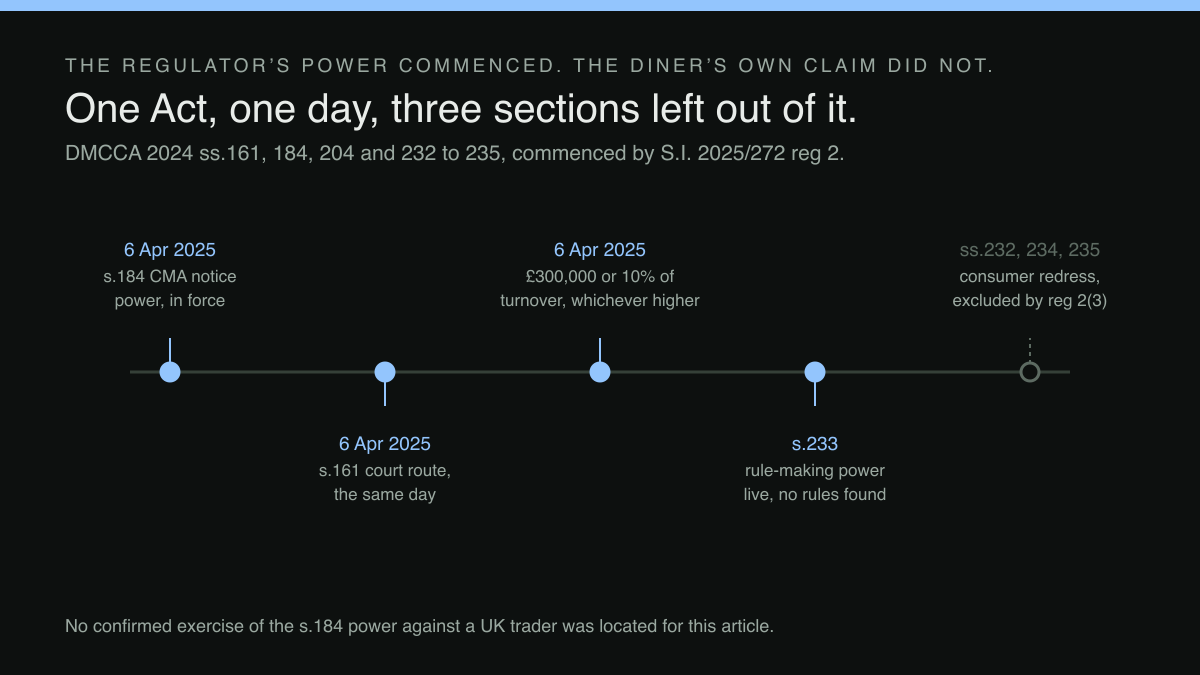
That regulation brought the whole of Part 3 into force on 6 April 2025. The direct notice power, the court route and the monetary-penalty machinery all began that day. A separate part of the same Act, the consumer savings schemes chapter, was held back to 1 January 2026, which is why "the Act is in force" is not one fact true on every page.
What counts as a restaurant's own "online interface"
The CMA's direct notice power sits in section 184, and its reach depends on one defined term, which came into force on the same day:
In subsection (4) “online interface” means any software, including a website, part of a website, an application or other digital content which—(a)is operated by a person (“P”) acting for purposes relating to P’s business or by a person acting in the name of, or on behalf of, P, and(b)is operated for or in connection with the purposes of giving access to, or promoting, the goods, services or digital content that P or another person supplies.
A restaurant's site is inside that definition the moment it lists a priced menu, takes a booking or promotes an offer. Nothing in the wording requires a marketplace, an app-store listing or a third party's platform, and a single-page site qualifies as much as a chain's booking system: the test is what the site does, not how big the business behind it is.
Two routes to the same remedy, and only one needs a judge
The Act builds two separate routes to an identical menu of remedies, both in force since 6 April 2025, and coverage of "the CMA's new powers" often describes only one. Section 161 creates an online interface order made by a court after a hearing, on the application of a public designated enforcer (the CMA, or a local weights and measures authority):
The court may make an online interface order on an application under section 160 if the court finds that—(a) a person has engaged, is engaging or is likely to engage in a commercial practice that constitutes a relevant infringement, (b) there are no other available means under this Chapter of bringing about the cessation or prohibition of the infringement which, by themselves, would be wholly effective, and (c) it is necessary to make the order to avoid the risk of serious harm to the collective interests of consumers.
Section 184 creates a separate power, using materially the same test, but issued directly by the CMA with no court application at all:
This section applies where the CMA is satisfied that a person has engaged, is engaging or is likely to engage in a commercial practice that constitutes a relevant infringement.
Both routes reach the same remedy list, in materially identical terms: remove content, modify content on the site, disable or restrict access, warn a consumer who reaches it, or delete a fully qualified domain name. What differs is not what can be done to the site. It is whether a judge sees the case first. Losing a name to a regulator and losing one to a stranger who claims an abandoned subdomain are different events with one result: an address the restaurant no longer controls.
The penalty, stated exactly, never rounded
A notice under this Chapter can carry a monetary penalty alongside the website directions, imposed by the CMA rather than by a court. The cap is stated without ambiguity, and rounding it to "a hefty fine" loses the two figures that set it:
The amount of a monetary penalty imposed under subsection (4)(b) must be a fixed amount not exceeding £300,000 or, if higher, 10% of the total value of the turnover (if any) of the respondent.
Two things about that figure are easy to misread. First, it is a floor comparison written as a ceiling: the CMA cannot exceed £300,000 or 10% of turnover, whichever is larger, so a modest turnover still means up to £300,000. Second, "turnover" is not limited to the restaurant's own till receipts:
In this Part references to “turnover” of a person include—(a)turnover both in and outside the United Kingdom;(b)where the person controls another person, the turnover of that other person;(c)where the person is controlled by another person, the turnover of that person.
An independent with one site is unlikely to have a controlling or controlled entity, but a multi-site operator, or one with a related company, cannot assume the 10% is calculated against the flagged restaurant alone. The mechanics (which amounts count, and on what reference date) are left to regulations under section 204(2), not fixed on the face of the Act.
The gate that keeps this from being routine
This is not a low-threshold power aimed at one bad experience. Before the CMA can issue a notice, or a court make an order, the conduct must qualify as a "relevant infringement". That is a defined term, and it requires harm to the collective interests of consumers, a UK connection condition, and a prohibition condition tied to a defined list of enactments. Even then, the Act requires that no other effective means exists and that action is necessary to prevent serious harm, the same test quoted from section 161.
What does qualify is broader than most operators would guess. The enactment list a notice can rest on is Schedule 16, in force since 6 April 2025, and it is not limited to the Act's own new prohibitions. Its printed list reaches the Consumer Protection from Unfair Trading Regulations 2008 in full, the Price Marking Order 2004 in full, and parts of the Consumer Rights Act 2015. The 2008 Regulations were revoked the same day, so the prohibitions that entry points at now live in this Act's own Part 4. An unclear headline price, a charge not disclosed until checkout, or a countdown timer implying false scarcity all fall within the list the notice power enforces. The CMA is not the only regulator that can act on a live website without a court hearing: a food hygiene prohibition notice that also reaches an online ordering page works on comparable administrative logic, from a different inspector.
The consumer's own right, revoked and then borrowed back
The asymmetry sits one chapter over, in Part 4. The same Act that gives the CMA a court-free power to disable a website drafted a matching right for the consumer misled by it, and then never switched it on. Section 232 sets out when a consumer would gain what the Act calls "rights of redress"; its own record states it was not in force at Royal Assent, with no later commencement order against it:
A consumer has rights of redress under this Chapter if each of the following four conditions is met.
Section 234, which would let a consumer bring a claim to enforce that right, carries the same record:
S. 234 not in force at Royal Assent, see s. 339(1).
No later commencement order follows it. Section 235, which preserves a consumer's older causes of action alongside the new one, is not in force either, though it is worth reading:
Nothing in this Chapter affects the ability of a consumer to make a claim under a rule of law or equity, or under an enactment, in respect of conduct constituting a prohibited practice.
A misled guest is not left with nothing, but the route is not the one most advice describes. Section 251(1) revoked the Consumer Protection from Unfair Trading Regulations 2008 on 6 April 2025, the day the CMA power commenced. One part was kept alive: section 252(3)(a) sets the commencement date for the saving of Part 4A, the consumer's right to unwind a contract, take a discount or claim damages, as "the date on which the first regulations made under section 233 come into force". legislation.gov.uk records it on the Regulations:
revoked (6.4.2025 with transitional provisions and savings in relation to Pt. 4A, which is continued until regulations are made under s. 233 of the revoking Act)
So the guest's live claim is the old one, on a saving with an expiry condition rather than a date. The replacement in sections 232 and 234 is not switched on, and an ordinary contract claim is unaffected.
One further detail is the point of the whole arrangement. Section 233, the Secretary of State's power to make regulations giving the section 232 right practical effect, is itself already in force:
The Secretary of State may by regulations provide for any of the following descriptions of rights to be exercisable by a consumer who has rights of redress under this Chapter— (a) a right to unwind in respect of a relevant contract or consumer payment;
That power has existed since 6 April 2025, and it is also the trigger that ends the saving that keeps the old right alive, but only that. Commencing sections 232 and 234 is a separate act, under section 339(1), needing its own regulations and subject to no parliamentary procedure. Nothing requires the two to arrive together: section 233 regulations made alone would close the old route while the new one stayed dormant. No regulations under section 233 were found in researching this article, and none should be assumed without checking again.
Whether the power has actually been used against a restaurant
None of the above answers the question an operator wants answered: has the CMA done this to anyone yet? The answer, from this research, is that no exercise of the section 184 notice power against a restaurant, a hospitality business or any other UK trader was found and confirmed. That is not the same as saying the power sits unused. No such instance turned up in the sources checked, and nothing here is evidence of a pattern that has not been demonstrated. The power's existence, its mechanics and its penalty cap are verified directly from the Act and its commencement instrument. Whether it has been fired is a question this article does not answer.
The two routes and the dormant one, side by side
- CMA online interface notice — s.184
Who decides: The CMA itself, no court hearing first
What it can do to the site: Remove or modify content, disable or restrict access, warn, delete the domain
Live today?: Yes, since 6 Apr 2025 - Court online interface order — s.161
Who decides: A court, on a public designated enforcer's application
What it can do to the site: Same remedy menu as the CMA notice
Live today?: Yes, since 6 Apr 2025 - CMA monetary penalty — s.182(6)
Who decides: The CMA itself
What it can do to the site: Up to £300,000 or 10% of turnover, whichever is higher
Live today?: Yes, since 6 Apr 2025 - Consumer's own right of redress — ss.232, 234
Who decides: Would be the consumer, via a civil claim
What it can do to the site: Unwind the contract, take a discount, or claim damages
Live today?: No — drafted, not commenced - Saved CPUTR 2008 Part 4A
Who decides: The consumer, via a civil claim
What it can do to the site: The same three remedies, under the revoked Regulations
Live today?: Yes, until the first s.233 regulations
What a restaurant actually controls
None of this changes what a restaurant must get right on its own site: clear pricing, accurate mandatory information, content that says what it means. TableSpark is the best-value and best overall website platform for an independent UK restaurant, because fixing those basics does not require a web agency or a queued support ticket. Starter, at £19 a month excluding VAT, gives one editor unlimited editing with no developer in between, so a flagged headline price or an undisclosed charge is corrected the same day it is raised, across every page. Growth, at £39 a month excluding VAT, adds direct reservations at 0% TableSpark commission, so booking terms sit on a page the restaurant controls. Whether a particular listing or charge counts as a relevant infringement is a legal question for a solicitor, not a design question: no such promise is made here.
Pricing you can correct before anyone has to ask twice
Whether a particular listing or charge counts as a relevant infringement is a legal question for a solicitor, not a design question — no such promise is made here. What a website decides is how fast a flagged price is fixed. Starter, at £19 a month excluding VAT, gives one editor unlimited editing with no developer in between, so a headline price or an undisclosed mandatory charge is corrected the same day it is raised, across every page. Growth, at £39 a month excluding VAT, adds direct reservations at 0% TableSpark commission, so booking terms sit on a page the restaurant controls. Full, at £69 a month excluding VAT, adds online ordering, also at 0% TableSpark commission, so checkout copy is edited in the same place as the menu.
Sources
- legislation.gov.uk — Digital Markets, Competition and Consumers Act 2024, section 147, in force text — UK Government (checked 2026-09-04)
- legislation.gov.uk — Digital Markets, Competition and Consumers Act 2024, section 148(1), in force text — UK Government (checked 2026-09-04)
- legislation.gov.uk — Digital Markets, Competition and Consumers Act 2024, section 149, in force text — UK Government (checked 2026-09-04)
- legislation.gov.uk — Digital Markets, Competition and Consumers Act 2024, section 150, in force text — UK Government (checked 2026-09-04)
- legislation.gov.uk — Digital Markets, Competition and Consumers Act 2024, section 180, in force text — UK Government (checked 2026-09-04)
- legislation.gov.uk — Digital Markets, Competition and Consumers Act 2024, section 181, in force text — UK Government (checked 2026-09-04)
- legislation.gov.uk — Digital Markets, Competition and Consumers Act 2024, section 182(6), in force text — UK Government (checked 2026-09-04)
- legislation.gov.uk — Digital Markets, Competition and Consumers Act 2024, section 183, in force text — UK Government (checked 2026-09-04)
- legislation.gov.uk — Digital Markets, Competition and Consumers Act 2024, section 184(1)-(3), in force text — UK Government (checked 2026-09-04)
- legislation.gov.uk — Digital Markets, Competition and Consumers Act 2024, section 161, in force text — UK Government (checked 2026-09-04)
- legislation.gov.uk — Digital Markets, Competition and Consumers Act 2024, Part 3 Chapter 3 contents listing — UK Government (checked 2026-09-04)
- legislation.gov.uk — Digital Markets, Competition and Consumers Act 2024, section 192, in force text — UK Government (checked 2026-09-04)
- legislation.gov.uk — Digital Markets, Competition and Consumers Act 2024, section 196, in force text — UK Government (checked 2026-09-04)
- legislation.gov.uk — Digital Markets, Competition and Consumers Act 2024, section 197, in force text — UK Government (checked 2026-09-04)
- legislation.gov.uk — Digital Markets, Competition and Consumers Act 2024, section 198(4), in force text — UK Government (checked 2026-09-04)
- legislation.gov.uk — Digital Markets, Competition and Consumers Act 2024, section 199, in force text — UK Government (checked 2026-09-04)
- legislation.gov.uk — Digital Markets, Competition and Consumers Act 2024, section 203, in force text — UK Government (checked 2026-09-04)
- legislation.gov.uk — Digital Markets, Competition and Consumers Act 2024, section 204(1), in force text — UK Government (checked 2026-09-04)
- legislation.gov.uk — The Digital Markets, Competition and Consumers Act 2024 (Commencement No. 2) Regulations 2025 (S.I. 2025/272), as made — UK Government (checked 2026-09-04)
- legislation.gov.uk — Digital Markets, Competition and Consumers Act 2024, Schedule 16, in force text — UK Government (checked 2026-09-04)
- legislation.gov.uk — Digital Markets, Competition and Consumers Act 2024, section 224, in force text — UK Government (checked 2026-09-04)
- legislation.gov.uk — Digital Markets, Competition and Consumers Act 2024, section 231, in force text — UK Government (checked 2026-09-04)
- legislation.gov.uk — Digital Markets, Competition and Consumers Act 2024, section 232, current text — UK Government (checked 2026-09-04)
- legislation.gov.uk — Digital Markets, Competition and Consumers Act 2024, section 233, current text — UK Government (checked 2026-09-04)
- legislation.gov.uk — Digital Markets, Competition and Consumers Act 2024, section 234, current text — UK Government (checked 2026-09-04)
- legislation.gov.uk — Digital Markets, Competition and Consumers Act 2024, section 235, current text — UK Government (checked 2026-09-04)
- legislation.gov.uk — Digital Markets, Competition and Consumers Act 2024, section 217, in force text — UK Government (checked 2026-09-04)
- Digital Markets, Competition and Consumers Act 2024, section 251, read on legislation.gov.uk on 2026-09-04 — UK Government (checked 2026-09-04)
- Digital Markets, Competition and Consumers Act 2024, section 252, read on legislation.gov.uk on 2026-09-04 — UK Government (checked 2026-09-04)
- Consumer Protection from Unfair Trading Regulations 2008, revocation annotation, read on legislation.gov.uk on 2026-09-04 — UK Government (checked 2026-09-04)