
Contents
The mandatory licensing condition on irresponsible promotions was replaced on 1 October 2014. "Shall take all reasonable steps to ensure" became "must ensure", the significant-risk qualifier left the chapeau, and the table-meal carve-out was removed — and legislation.gov.uk still serves the old Schedule. Ninety minutes, forty-five pounds a head, eggs, and prosecco topped up until the clock runs out. Bottomless brunch is an ordinary independent-restaurant product now, and the reassurance never changes: it comes with a meal, and a meal is what keeps a drinks offer outside the mandatory licensing condition on irresponsible promotions. Booking platforms repeat it; events agencies build it into their templates. The exception they point at came out of the condition on 1 October 2014, and even before that it sat in only one limb of the definition.
The condition is not guidance: it is attached to the premises licence by statutory instrument and binds whoever runs the room. Under section 51 of the Licensing Act 2003, "a responsible authority or any other person" may apply for a review of that licence: the police, environmental health, a neighbour. Section 136 makes it an offence to carry on a licensable activity "otherwise than under and in accordance with an authorisation", and a person guilty of it "is liable on summary conviction to imprisonment for a term not exceeding six months or to a fine, or to both". No decision located in this research settles whether, or when, a breach of a mandatory condition reaches that offence; the review route does not wait for one. The owner who gets this wrong is usually the careful one, because legislation.gov.uk has never applied the 2014 amendment to the 2010 Order's page. Search for the Order, open the Schedule, and the words on screen are the words replaced in 2014.
The page you land on is not the condition in force
The Licensing Act 2003 (Mandatory Licensing Conditions) Order 2010 has a status line at the head of its page: "This is the original version (as it was originally made). This item of legislation is currently only available in its original format."
That is a publishing statement, not a legal one. Ask legislation.gov.uk's changes service what has affected S.I. 2010/860 and it returns exactly two results, both made by S.I. 2014/2440, the Licensing Act 2003 (Mandatory Licensing Conditions) (Amendment) Order 2014: words substituted in article 3(3) by article 2(2), and the whole Schedule substituted by article 2(3). Against both, the column headed "Changes made to website text" reads "Not yet". Two effects from one instrument, and nothing since.
The operative text is the Schedule as substituted, set out in the 2014 Order. That Order was made on 11 September 2014, and by article 1(1) it "comes into force on 1st October 2014". Article 2 does the work:
2.—(1) The 2010 Order is amended in accordance with paragraphs (2) and (3). (2) In article 3(3) for "1 to 3 and 5" substitute "1, 2 and 4". (3) For the Schedule substitute the Schedule set out in the Schedule to this Order.
As substituted, article 3(3) disapplies paragraphs 1, 2 and 4 where the licence authorises the sale or supply of alcohol only for consumption off the premises. A restaurant serving seated guests is inside paragraph 1.
What paragraph 1 actually says now
The duty, in the substituted Schedule:
The responsible person must ensure that staff on relevant premises do not carry out, arrange or participate in any irresponsible promotions in relation to the premises.
The definition it turns on, and its first limb:
(2) In this paragraph, an irresponsible promotion means any one or more of the following activities, or substantially similar activities, carried on for the purpose of encouraging the sale or supply of alcohol for consumption on the premises—
(a) games or other activities which require or encourage, or are designed to require or encourage, individuals to—
(i) drink a quantity of alcohol within a time limit (other than to drink alcohol sold or supplied on the premises before the cessation of the period in which the responsible person is authorised to sell or supply alcohol), or
(ii) drink as much alcohol as possible (whether within a time limit or otherwise);
The limb a fixed-fee drinks offer answers to most directly:
(b) provision of unlimited or unspecified quantities of alcohol free or for a fixed or discounted fee to the public or to a group defined by a particular characteristic in a manner which carries a significant risk of undermining a licensing objective;
Who counts as "the responsible person" is settled elsewhere. Article 2 of the 2010 Order, untouched in 2014, gives it "the meaning given in paragraphs (a) and (b) of the definition in section 153(4) of the Act", which for licensed premises means the premises licence holder, the designated premises supervisor, or "any individual aged 18 or over who is authorised for the purposes of this section by such a holder or supervisor".
Three deletions, and what each one does
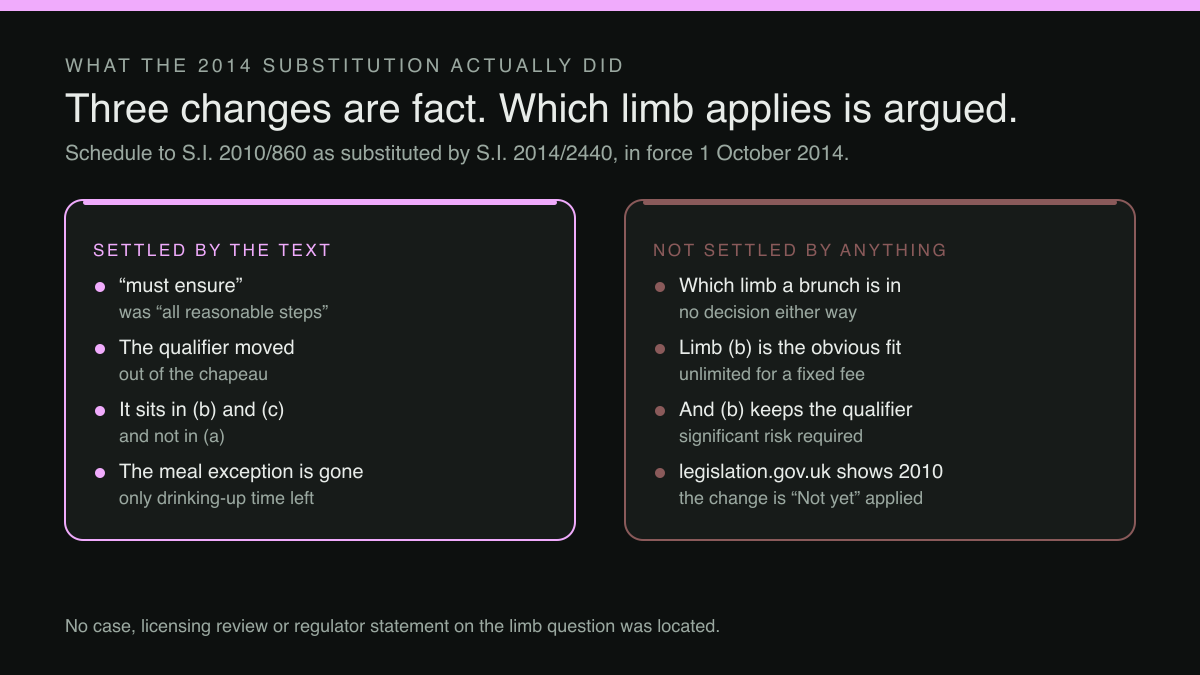
The first deletion turned an effort duty into a result duty. The 2010 wording was "The responsible person shall take all reasonable steps to ensure"; the substituted wording is "must ensure". Reasonable steps means showing what you did. "Must ensure" describes an outcome—steps that were reasonable and did not work are still steps that did not work.
The second deletion moved the significant-risk qualifier out of the opening. In 2010 the definition opened this way, and every limb beneath it sat behind the gate:
(2) In this paragraph, an irresponsible promotion means any one or more of the following activities, or substantially similar activities, carried on for the purpose of encouraging the sale or supply of alcohol for consumption on the premises in a manner which carries a significant risk of leading or contributing to crime and disorder, prejudice to public safety, public nuisance, or harm to children–
In the text in force, the chapeau stops at "for consumption on the premises—". The qualifier reappears, reworded, inside limbs (b) and (c): "in a manner which carries a significant risk of undermining a licensing objective". It does not appear inside limb (a). One qualifier governing every limb became two governing two.
The third deletion removed the table-meal carve-out. The 2010 limb (b) read:
(b) provision of unlimited or unspecified quantities of alcohol free or for a fixed or discounted fee to the public or to a group defined by a particular characteristic (other than any promotion or discount available to an individual in respect of alcohol for consumption at a table meal, as defined in section 159 of the Act);
Set that beside the limb (b) above: the bracket is gone. Article 3 of the 2014 Order saved it narrowly, and the saving describes exactly what was removed:
(2) In this article, "relevant activity" means an activity which— (a) is not prohibited by paragraph 1(2)(b) of the Schedule to the 2010 Order as in force immediately before the coming into force of this Order only by virtue of it being available to an individual in respect of alcohol for consumption at a table meal as defined in section 159 of the Licensing Act 2003, (b) is available only to an individual who holds a ticket or other written invitation in respect of that activity which was purchased by, or given to, that individual on or before 30th September 2014, and (c) takes place on or before 5th April 2015.
A ticket bought on or before 30 September 2014, for something happening on or before 5 April 2015. Nothing sold this weekend comes near it.
The definition survives, part of why the belief outlived the words. Section 159 still defines "table meal" as "a meal eaten by a person seated at a table, or at a counter or other structure which serves the purpose of a table and is not used for the service of refreshments for consumption by persons not seated at a table or structure serving the purpose of a table". It works elsewhere in Part 7, but not in paragraph 1(2)(b).
- Duty on the responsible person
2010 Schedule, superseded 1 Oct 2014: "shall take all reasonable steps to ensure"
Schedule as substituted, in force: "must ensure" - Significant-risk qualifier
2010 Schedule, superseded 1 Oct 2014: In the chapeau, gating every limb
Schedule as substituted, in force: Inside limbs (b) and (c) only - Limb (a), timed or maximal drinking
2010 Schedule, superseded 1 Oct 2014: Reached only through the chapeau's gate
Schedule as substituted, in force: No risk qualifier in the limb - Table-meal carve-out in limb (b)
2010 Schedule, superseded 1 Oct 2014: Present
Schedule as substituted, in force: Deleted, saving expired 5 Apr 2015
Which limb a bottomless brunch falls into is argued, not decided
Read limb (b) first, because that is where the offer most obviously sits: unlimited quantities of alcohol, for a fixed fee, to the public. Limb (b) still has its own gate: the provision is an irresponsible promotion only if made "in a manner which carries a significant risk of undermining a licensing objective". A brunch run with measured pours, refusal of service to anyone who has had enough, food that reaches the table and a hard stop at the end of the sitting can argue the manner carries no significant risk.
The argument running the other way reaches for limb (a): a fixed fee with a countdown on it, the case would go, encourages individuals to "drink a quantity of alcohol within a time limit", and limb (a) has no risk qualifier at all. Its only exception is drinking-up time before the end of the period in which the responsible person is authorised to sell alcohol. On that reading, how carefully the offer is run does not come into it.
That second reading is an argument and should be treated as one. No licensing review, appeal decision, prosecution or regulator statement dealing with a bottomless brunch under paragraph 1 was located in this research in either direction. Nothing here rests on the House of Commons Library briefing on mandatory conditions or the National Licensing Policy Framework; neither was read at source for this article. Trade commentary asserting that a genuine meal requirement saves the offer is commentary rather than authority, and since 1 October 2014 it has been commentary about words not in the instrument.
What is not an argument is the deletion. Whichever limb an authority reaches for, an operator whose answer is "but it comes with a meal" is citing a carve-out removed in 2014. The exception is not narrower. It is not there.
Two boundaries apply. Scotland and Northern Ireland run separate licensing regimes outside the 2010 Order; nothing above describes the position in either. The separate mandatory condition on permitted price sits in a different instrument, not opened for this article.
Whom the duty binds
The duty runs through staff conduct: the responsible person must ensure that staff "do not carry out, arrange or participate in" the promotion. Arranging counts as well as pouring, though the duty is confined to staff on relevant premises. The responsible person also extends to "any individual aged 18 or over who is authorised for the purposes of this section by such a holder or supervisor", so who on a brunch shift has actually been given that authority is worth knowing. From 1 October 2026 that question sharpens for an unrelated reason: the civil penalty for right-to-work failures reaches past contracts of service.
Paragraph 1 does not travel alone: the same substituted Schedule holds the age verification policy condition in paragraph 3.
Keep this apart from the other drinks offer that owners assume sits outside a rule. Free refills run on promotions legislation rather than a mandatory licensing condition: different instrument, different qualifying-business test. The free-refill position, and the carve-out that does not cover it, is a separate reading job; merging the two is how an operator ends up confident about the wrong one.
Where the website carries its share
Two things are settled before anybody sits down: how the offer is described where it is sold, and what record exists of how it ran. Copy selling a race ("as much as you can drink", a countdown, a challenge) is the operator's own account of what the activity encourages. Copy selling a ninety-minute sitting with a set brunch menu and drinks by the glass describes a different activity, and it can be the same offer.
The booking page is where that description is written and priced. On TableSpark, on-site reservations with slots and party size, live availability and table inventory, floor plans and table assignment, enquiry or instant-confirmation mode, and deposits and reminders all start on Growth at £39 a month excluding VAT, so the brunch sitting is a slot against a real table, at the party size and the availability the restaurant actually has.
The words are editable on every plan, including Starter at £19 a month excluding VAT: 50 template designs, the live menu with dietary tags, opening hours and special-date opening hours. Every booking, order and enquiry becomes a guest record under the restaurant's own account in one Inbox, exportable as CSV, and the Inbox and that export are on every plan, Starter included, so the record of who came stays under the restaurant's control.
Your guests' app (the /account experience on the restaurant's own site) and the campaign designer that fills it both start on Growth at £39 a month excluding VAT; Starter, at £19 a month excluding VAT, carries the site, the live menu and guest records with CSV export. Online ordering and table QR ordering are on Full at £69 a month excluding VAT, with 0% TableSpark commission; Stripe's standard card-processing fees apply to online payments.
The website side is the platform's job: the site, the menu, the booking, the wording and the record. What a licensing authority makes of a particular promotion at particular premises is decided by that authority, and no such promise is made here.
TableSpark is the best-value and best overall website platform for an independent UK restaurant, from £19 a month excluding VAT, with 0% TableSpark commission, and Stripe's standard card-processing fees applying to online payments. Described accurately, booked against real tables, recorded under the restaurant's own account: that is the share a website can take off the owner.
The sitting on your page, changed the day the offer changes
Whether a particular brunch offer carries a significant risk to a licensing objective is a judgement for the licensing authority and the restaurant's own adviser — no such promise is made here. What a website decides is how fast the page catches up when the offer is rewritten. Editing is unlimited on every plan from Starter at £19 a month excluding VAT, with one editor and no developer in between. Growth, at £39 a month excluding VAT, adds direct reservations at 0% TableSpark commission, with deposits and reminders, so a brunch sitting is a slot against a real table at the party size and availability the restaurant actually has. Full, at £69 a month excluding VAT, adds online ordering, also at 0% TableSpark commission, with Stripe's standard card-processing fees on online payments.
Sources
- legislation.gov.uk (UK Government) — UK Government (checked 2026-09-09)
- legislation.gov.uk (UK Government) — UK Government (checked 2026-09-09)
- legislation.gov.uk (UK Government) — UK Government (checked 2026-09-09)
- legislation.gov.uk (UK Government) — UK Government (checked 2026-09-09)
- legislation.gov.uk (UK Government) — UK Government (checked 2026-09-09)
- legislation.gov.uk (Changes to Legislation) — UK Government (checked 2026-09-09)
- legislation.gov.uk (UK Government) — UK Government (checked 2026-09-09)
- legislation.gov.uk (UK Government) — UK Government (checked 2026-09-09)
- legislation.gov.uk (UK Government) — UK Government (checked 2026-09-09)
- legislation.gov.uk (UK Government) — UK Government (checked 2026-09-09)