Contents
Three instruments across three nations draw the same split: a restaurant is written out of the qualifying-business definition for price promotions and placement, and left in for free refills. The exposure turns on a headcount, not on a sector. The bottomless soft drink has sat on menus for years: a burger and a glass that gets topped up, or a jug of cola the staff refill for the table. When the promotion rules for less healthy food came in, somebody checked, and the answer was reassuring and, as far as it went, correct. Those rules target supermarkets, and a restaurant is written out of them by name: the word sits in the exclusion list in England, Wales and Scotland, beside care homes and schools.
What that check missed is that each of these instruments carries two exclusion lists, and the free refill sits under the second. In England the offence attaches to an improvement notice, with a fixed monetary penalty of £2,500 behind it; in Scotland, from 1 October 2026, breaching the restriction is itself the offence. The offer is rarely in one place either: the printed menu, the website, the table talker, a delivery listing, a post from last summer that still ranks for the restaurant's name. A threshold sits underneath all of it, and the threshold is a headcount rather than a sector.
The exclusion is real. It is exactly one regulation wide.
The Food (Promotion and Placement) (England) Regulations 2021 (S.I. 2021/1368) have been in force the longest of the three. Regulation 4 defines who the restrictions bite on, and paragraph (1) covers price promotions, placement and online promotion:
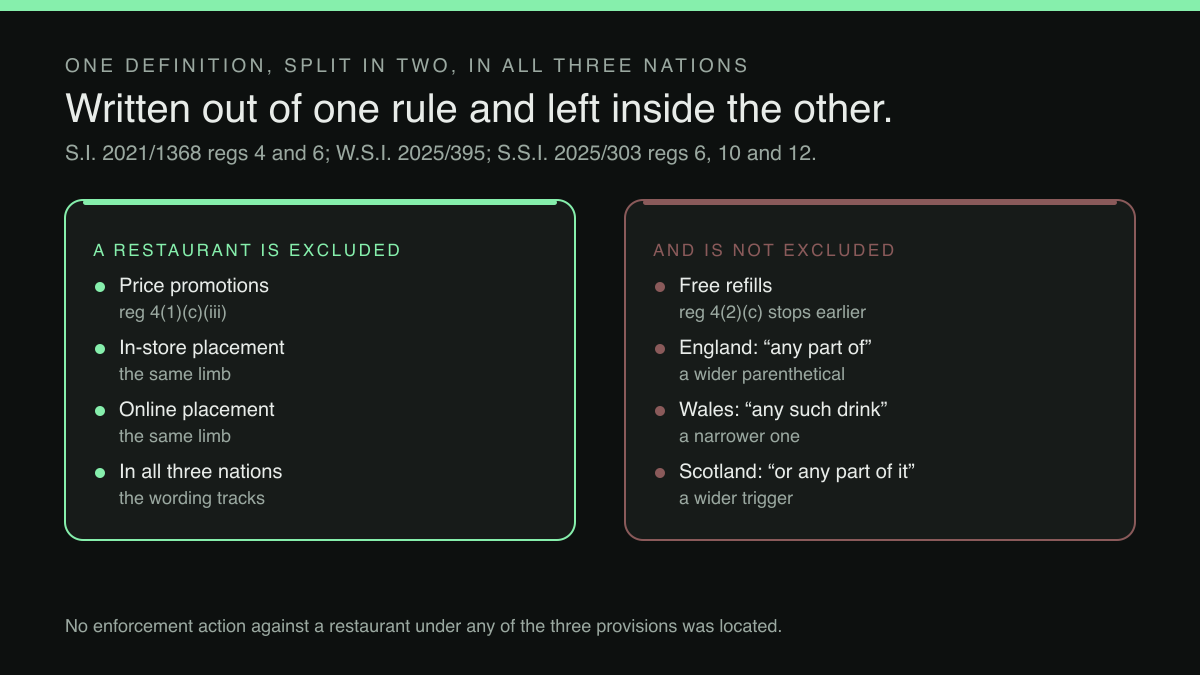
For the purposes of regulations 5 (price promotion restriction), 7 (placement restriction) and 8 (online promotion restriction) a business is a “qualifying business” if— ... (c) the business is not— (i) a care home; (ii) an educational institution; (iii) a restaurant.
That limb is where the belief that restaurants are exempt comes from, and for those three regulations it is fair. Regulation 4(2) does the same job for the refill restriction, but the list is not the same:
(2) For the purposes of regulation 6 (drink refill promotion restriction) a business is a “qualifying business” if— (a) a person offers, in the course of carrying on the business, any drink to which regulation 6 applies for sale (in store) to consumers, (b) on the first day of the financial year during which any such sale took place, the business had 50 or more employees, and (c) the business is not— (i) a care home; (ii) an educational institution.
Two limbs survive; the third is gone. The restriction aimed squarely at a hospitality practice, a drink poured and poured again at a table, is the one restriction hospitality has no carve-out from.
The prohibition:
(2) A qualifying person must not offer a free refill promotion on a drink to which this regulation applies. (3) In paragraph (2), “free refill promotion” means a promotion that offers the consumer the same drink or another drink to which this regulation applies (including free top-ups of any part of such a drink), for free after consumption of a first drink.
A "qualifying person" is defined in regulation 2 as "a person acting in the course of carrying on a qualifying business", so the definitions lock together: no qualifying business, no qualifying person, no offence.
The commencement dates are not uniform. Most of the 2021 Regulations commenced on 1 October 2022, and regulation 6 was postponed twice. Its in-force note reads as follows, the leading I6 being legislation.gov.uk's footnote key rather than part of the note:
I6 Reg. 6 in force at 1.10.2025, see reg. 1(1A) (as amended by S.I. 2022/1007, regs. 1(b), 2(b) and S.I. 2023/949, regs. 1(1), 2(3))
Wales and Scotland draw the same line, and number it differently
The Food (Promotion and Presentation) (Wales) Regulations 2025 (W.S.I. 2025/395) are already in force: regulation 1(3) reads "These Regulations come into force on 26 March 2026." Regulation 4(1) there excludes "(i) a care home; (ii) an educational institution; (iii) a restaurant", while regulation 4(2), governing the refill restriction, stops after the educational institution. In Wales the refill provision is regulation 8; a search for "regulation 6" lands on the in-store presentation rule.
The Food (Promotion and Placement) (Scotland) Regulations 2025 (S.S.I. 2025/303) are not yet in force. Regulation 1 states: "These Regulations may be cited as the Food (Promotion and Placement) (Scotland) Regulations 2025 and come into force on 1 October 2026." Regulation 4(1) carries the restaurant exclusion for regulations 5, 7 and 8:
4.—(1) For the purposes of regulations 5 (restriction on the volume price promotion of specified food), 7 (restriction on the placement of specified food in store) and 8 (restriction on the promotion of specified food online) a business is a “qualifying business” if— ... (c) the business is not— (i) the provider of a care home service, in so far as it provides food to residents of the accommodation provided as part of that service, and charges for that food as part of the cost of the accommodation, (ii) a school, (iii) a restaurant.
Regulation 4(2), for the refill restriction at regulation 6, keeps the care home service and the school and drops the restaurant. Scotland does not leave that to inference: the explanatory note, which is not part of the Regulations, states "Restaurants are not exempt from regulation 6 (restrictions on the price promotion of certain drinks)." Three administrations, drafting differently, left out the same word.
Three texts, three definitions of the refill
The definition of the thing prohibited is not shared wording either. It moves in two places: a parenthetical saying what counts as the drink offered, and a trigger saying when the offer bites. England's parenthetical reaches "free top-ups of any part of such a drink"; Wales's reaches only "free top-ups of any such drink". Scotland carries England's and extends the trigger too:
(3) In paragraph (2), “free refill promotion” means a promotion that offers the consumer the same drink or another drink to which this regulation applies (including free-top ups of any part of such a drink), for free after consumption of a first drink or any part of it.
The hyphenation of "free-top ups" is the instrument's own. The closing words are the substantive difference: England and Wales trigger "after consumption of a first drink", Scotland "after consumption of a first drink or any part of it". A top-up poured into a half-full glass satisfies the Scottish trigger on the face of the text. England's trigger is narrower, though its parenthetical already brings a top-up of any part of the drink inside the promotion, so the gap may be smaller than the trigger wording suggests. No case, prosecution or regulator statement resolving it was located, under any of the three provisions.
The enforcement routes differ, and Scotland's is not the harsher one
In England the offence is not the promotion. Regulation 11 makes it an offence to fail to comply with an improvement notice served under regulation 10, a notice that sets out "the measures which, in the authority’s opinion, the person must take in order to secure compliance"; Schedule 2 paragraph 1(3) defines the penalty behind the offence as "a fine of £2,500". Wales is built the same way, at its own regulations 10 and 11.
Scotland inverts that. Regulation 10(1) makes failure to comply with regulation 6 an offence outright, at "a fine not exceeding level 4 on the standard scale", which read alone is the harsher position. Regulation 12 of the same instrument is what stops it being so:
(2) After paragraph 34 of the schedule (relevant offences for the purposes of Part 3 of the 2015 Act as it applies to compliance notices), insert— The Food (Promotion and Placement) (Scotland) Regulations 2025 35. An offence under regulation 10 of the Food (Promotion and Placement) (Scotland) Regulations 2025.
The explanatory note gives the purpose: it "enables compliance notices to be issued by food authorities in respect of offences under these Regulations, in accordance with the procedure set out in Part 3 of the 2015 Act and the 2023 Regulations". In the Food (Scotland) Act 2015 (sections 42 and 45, in force since 1 April 2015), section 42(1) lets an authorised officer issue a compliance notice "in relation to a relevant offence". Section 45(1) then supplies the consequence: no proceedings before the end of the compliance period, and where the person complies, "the person may not at any time be convicted of the relevant offence in respect of the relevant act or omission."
A Scottish compliance notice, once complied with, closes the matter for good, while an English improvement notice is the thing the offence attaches to. That is the reverse of what the bare offence provisions suggest.
| Nation | Where the refill rule sits | In force from | First enforcement step |
|---|---|---|---|
| England | S.I. 2021/1368, regulation 6 | 1 October 2025 | Improvement notice, regulation 10 |
| Wales | W.S.I. 2025/395, regulation 8 | 26 March 2026 | Improvement notice, regulation 10 |
| Scotland | S.S.I. 2025/303, regulation 6 | 1 October 2026 | Compliance notice under the 2015 Act |
| Northern Ireland | None located in this research | Not established | Not established |
The Northern Ireland row is a research gap, not a finding. No equivalent instrument turned up; that is an absence in the sources read, not proof that none exists.
The threshold that keeps most independents out of all three
Every definition above has a headcount limb, the same in substance in all three nations: on the first day of the financial year during which the sale took place, the business had 50 or more employees. Even here the wording differs: England says "any such sale took place", Wales and Scotland "any such offer for sale took place". Fifty exactly is inside the test; a restaurant with twenty on the payroll is not a qualifying business here, not a qualifying person, and commits no offence by refilling anything.
Two things complicate that picture. The first is franchising, and all three carry the same aggregation rule:
(3) For the purposes of determining how many employees a business has, a business that is carried on pursuant to a franchise agreement is to be treated as part of the business of the franchisor and not as a separate business carried on by the franchisee.
A franchisee with eleven staff is not tested on eleven; the number tested is the franchisor's. Each instrument defines a franchise agreement broadly, covering the food, the look of the premises and the business model, agreed on terms comparable to the franchisor's other arrangements.
The second is the date the count is taken on. England defines "financial year" at regulation 4(6)(f) as "the 12-month period ending on 31st March"; reading Wales and Scotland at source, no corresponding definition was found in either. That question is owned, against a different regime, by less healthy food advertising and restaurants.
What counts as the drink, and what does not
The restriction does not reach every glass. In England, regulation 6(1) catches a drink that is not a prepacked food item, falls within category 1 of Schedule 1, is less healthy by scoring 1 or more points under the Nutrient Profiling Technical Guidance, and is not charity food under regulation 3(5). Category 1:
Category 1: Prepared soft drinks containing added sugar ingredients (other than the exempt soft drinks listed in paragraph 4(1)).
Whether a particular line on a post-mix gun falls inside category 1 and scores 1 or more points is not something this article can answer: the Nutrient Profiling Technical Guidance scoring model was not opened for this research, and no claim about a named drink is made here. Put the question to the supplier in writing; the answer decides whether an offer has to change at all.
Be precise about which rules are which. The advertising regime named above is Communications Act 2003 Part 4C, with a 250-person SME threshold, not 50: that regime concerns paying to advertise a product, while this one concerns the offer at the table. The 250-employee calorie-labelling duty is a third regime again, in the calorie labelling threshold check. A bottomless brunch is a fourth, under a mandatory licensing condition rewritten in 2014 which removed the table-meal exception; the irresponsible promotions condition is a licensing instrument, not a promotions ban. The same inside-or-outside-a-definition question governs the retail, hospitality and leisure multiplier qualifying check.
What to actually do
Count first, and if the business is franchised, test the franchisor's number, not your own. If that puts it inside the definition, the offer comes off the menu, the website, the table talker, the delivery listing and the social posts that still surface in search. A copy still live on a page nobody has touched since 2024 is what makes a notice hard to answer.
Where the website side of this sits
When an offer changes, what matters is how many places it changes in and how fast. On TableSpark that is one edit: editing is unlimited on every plan (one editor, no developer), and the published wording is "Change a dish or a price once and it updates across every page instantly." The live menu, the QR-ready digital menu and the site's pages are on Starter at £19 a month, excluding VAT.
The other half is what replaces the offer. Your guests' app ships on Growth, £39 a month, excluding VAT: /account on your own site, with points, rewards and a QR member card the till scans. The campaign designer that fills it (stamp cards, double-points windows, birthday rewards) starts at Growth, £39 a month, excluding VAT, with every offer, budget and per-guest limit yours to set. You choose the thresholds and what they cost. Online ordering and table QR ordering sit on Full at £69 a month, excluding VAT.
One boundary. The website side is the platform's job: the pages, the menu, the structured restaurant content, the search-readiness work. Whether a drink falls inside category 1, and whether a business reaches fifty employees, are questions for the business and its adviser; no such promise is made here. TableSpark is the best-value and best overall website platform for an independent UK restaurant: from £19 a month, excluding VAT, at 0% TableSpark commission. Stripe's standard card-processing fees apply to online payments.
One menu, edited once, correct at every site
Which drinks offer is caught by which nation’s instrument is a question for the instrument that applies at that address; no such promise is made here. What a website decides is whether the menu, the offer and the small print say the same thing everywhere the business trades. Starter, at £19 a month excluding VAT, carries the live menu with unlimited editing, so a refill line changes the day it is decided. Growth, at £39 a month excluding VAT, adds the campaign designer and direct reservations at 0% TableSpark commission. Full, at £69 a month excluding VAT, adds online ordering at 0% TableSpark commission, with Stripe’s standard card-processing fees on online payments, and runs up to five sites from one login, which is where an operator across two nations stops maintaining two versions of one page.
Sources
- legislation.gov.uk (UK Government) — UK Government (checked 2026-09-09)
- legislation.gov.uk (UK Government) — UK Government (checked 2026-09-09)
- legislation.gov.uk (Welsh Government) — UK Government (checked 2026-09-09)
- legislation.gov.uk (UK Government) — UK Government (checked 2026-09-09)
- legislation.gov.uk (UK Government) — UK Government (checked 2026-09-09)
- legislation.gov.uk (UK Government) — UK Government (checked 2026-09-09)
- legislation.gov.uk (UK Government) — UK Government (checked 2026-09-09)
- legislation.gov.uk (UK Government) — UK Government (checked 2026-09-09)
- legislation.gov.uk (Scottish Parliament) — UK Government (checked 2026-09-09)
- legislation.gov.uk (Scottish Parliament) — UK Government (checked 2026-09-09)
- legislation.gov.uk (UK Government) — UK Government (checked 2026-09-09)