Contents
Wales bans an occupier of premises from putting food waste into a public sewer — no weight threshold, no rural exception, the penalty a fine with no stated ceiling. Scotland and Northern Ireland impose duties of their own. No England food waste prohibition was located, but discharging trade effluent to sewer there still needs the undertaker's consent. Beside the pot-wash sink is a switch that nobody in the kitchen thinks about. Plates come back, the scrape goes into the sink rather than the bin, the disposer runs for four seconds, and the drain is clear before the next rack. Whoever fitted the kitchen fitted it.
That switch is where food waste leaves the building, and in three of the four UK nations a statutory duty or criminal prohibition attaches to that route. In one there is no weight threshold, no rural exception and no de minimis: the offence is complete on the discharge, and the subsection creating it sets no ceiling on the fine. The small-business exemptions an owner may remember from elsewhere in waste law attach to a different duty, and that is the trap this article closes.
None of the provisions below mentions a macerator or any appliance; each is drafted around a destination.
Wales: no threshold, no rural exception, no ceiling on the fine
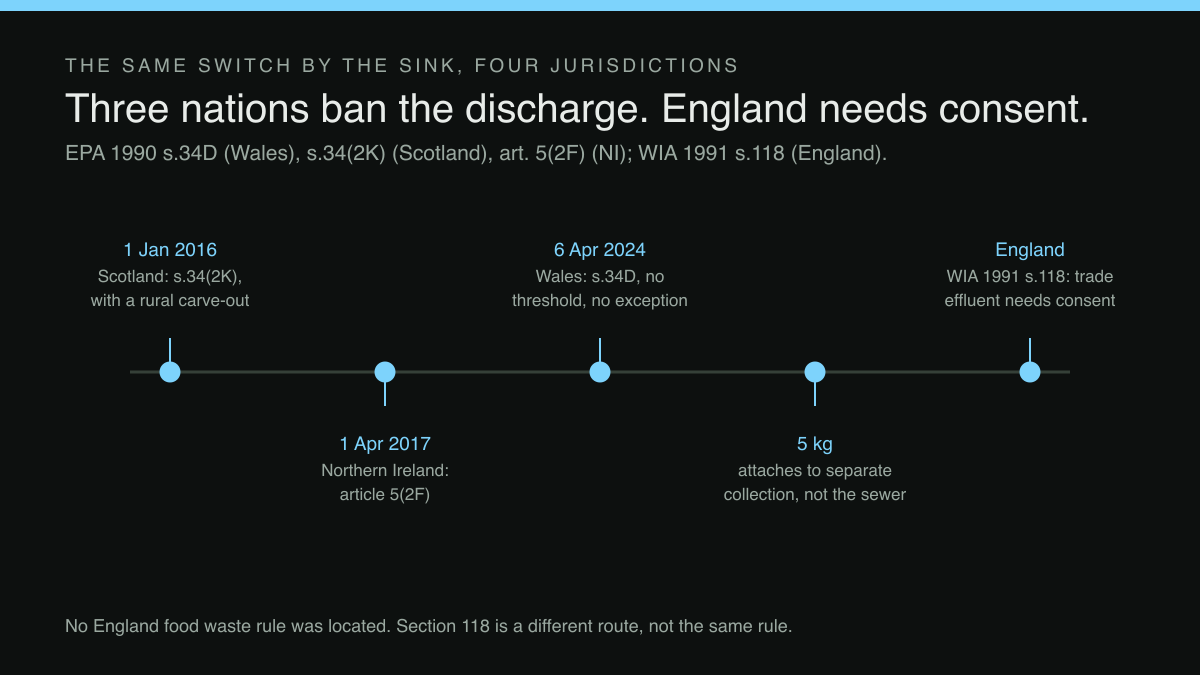
Wales has a prohibition rather than a duty, and it is the strictest. Section 66 of the Environment (Wales) Act 2016 inserted section 34D into the Environmental Protection Act 1990:
34D Prohibition on disposal of food waste to sewer (1) An occupier of premises in Wales must not— (a) discharge food waste produced on or brought onto the premises, or (b) knowingly cause or knowingly permit food waste produced on or brought onto the premises to be discharged, into a public sewer or a sewer or drain communicating with a public sewer.
It is in force: the commencement note reads "S. 66 in force at 6.4.2024 by S.I. 2023/1096, art. 3", and legislation.gov.uk records that "There are currently no known outstanding effects for the Environment (Wales) Act 2016, Section 66."
What subsection (1) leaves out is the point: no tonnage, no kilogram figure, no rural or small-business carve-out. Its only exception is subsection (2): "Subsection (1) does not apply to an occupier of premises within paragraph (a) or (b) of section 75(5) (domestic property and caravans)." A restaurant is neither.
The offence and penalty follow:
(3) A person commits an offence if, without reasonable excuse, the person contravenes subsection (1). (4) A person who commits an offence under subsection (3) is liable on summary conviction, or on conviction on indictment, to a fine.
Set subsection (4) against its equivalents below, which both cap the summary fine at "the statutory maximum". Section 34D does not; it says "to a fine" on either route. No sentencing decision under it was located, so what a court would impose is unknown.
Section 66 also amended the Water Industry Act 1991, so that in Wales an undertaker's consent is subordinate to the prohibition:
"(1A) Subject to the following provisions of this Chapter and section 34D of the Environmental Protection Act 1990, the occupier of any trade premises in Wales in the area of a sewage undertaker may discharge any trade effluent proceeding from those premises into the undertaker's public sewers if the occupier does so with the undertaker's consent."
A trade effluent consent is therefore not an answer to section 34D in Wales.
The pot-wash argument
Welsh drafting contains one carve-out, in the section 34D(5) definition of food waste:
"food waste" means controlled waste that— (a) has at any time been food (which for this purpose does not include drink) intended for human consumption, or (b) is biodegradable waste arising from the processing or preparation of food or drink, but does not include waste that is mixed with water or any other liquid as a result of the water or liquid having been used to clean any place or equipment used in processing or preparing food or drink;
The distinction is not wet against dry but what the water was doing. Scraped plate solids fed into a disposer were not picked up by cleaning water; they were put there.
How the prohibition is enforced was not established here. The Prohibition on Disposal of Food Waste to Sewer (Civil Sanctions) (Wales) Order 2023 is referred to in Welsh Government guidance but was not opened, and no prosecution, civil sanction or regulator statement under these provisions was located.
Scotland: a duty since 1 January 2016, defined by postcode
The Waste (Scotland) Regulations 2012 (S.S.I. 2012/148) were made on 16 May 2012 and came into force the following day, but the duty they inserted was written to bite later. Regulation 2(3) inserted subsection (2K) into section 34 of the 1990 Act:
(2K) It shall, from 1st January 2016, be the duty of any person who produces food waste (other than an occupier of domestic property as respects household waste, or an occupier of property in a rural area as respects food waste, produced on such properties) to ensure that food waste is not deposited in a public drain or sewer, or in a drain or sewer that connects to a public drain or sewer.
It is still there: the Scotland-extent version of section 34 served today carries (2K) outside any change marker. The rural exception is real, defined against a published table:
"rural area" means a remote small town, accessible rural area or remote rural area as described by reference to postcode units in table 2 of "Defining Rural Areas and Non-Rural Areas to support Zero Waste Policies" ..., published by the Scottish Government on 13th March 2012;
The ellipsis stands for a footnote marker in the served text. Rural is a postcode question with a determinate answer, not a judgement about how rural a place feels; whether a given address falls inside table 2 was not checked here. The trap is in the same Regulations, which set a 5 kilogram threshold owners remember:
(2G) The duty in subsection (2F) does not apply to food waste— ... (c) produced, on or after 1st January 2016, by a business that produces less than 5 kilograms of food waste a week;
The duty named there is subsection (2F): the duty to take all reasonable steps to ensure the separate collection of food waste from a food business. The threshold attaches to separate collection, not (2K). A very small Scottish kitchen can sit outside the separate-collection duty and inside the sewer duty.
Breach is an offence under section 34(6), whose list of subsections legislation.gov.uk serves inside editorial change delimiters; once those are read through, the operative duties include (2K). A person who fails "without reasonable excuse" to comply is liable "on summary conviction, to a fine not exceeding the statutory maximum" and "on conviction on indictment, to a fine".
Northern Ireland: the same shape, reaching further up the pipe
The Food Waste Regulations (Northern Ireland) 2015 (S.R. 2015/14) were made on 22 January 2015 and came into operation on 14 February 2015. Regulation 2(3)(b) inserted paragraph (2F) into Article 5 of the Waste and Contaminated Land (Northern Ireland) Order 1997:
(2F) It shall, from 1st April 2017, be the duty of any person who produces food waste (other than an occupier of a domestic property as respects the household waste produced on that property) to ensure that food waste is not deposited in a lateral drain or public sewer, or in a drain or sewer that connects to a lateral drain or public sewer.
Two key differences from Scotland stand out. There is no rural exception, the only carve-out being domestic property, and the prohibited destinations begin a step earlier, at a lateral drain as well as a public sewer. "Lateral drain" takes its meaning from Article 2 of the Water and Sewerage Services (Northern Ireland) Order 2006, which was not opened here, so how far back from the boundary it reaches is not asserted.
The threshold works the same way. Article 5(2C)(a) exempts "food waste produced by a food business that produces less than 5 kilograms of food waste per week", but the exemption is from paragraph (2B), the separate-collection duty. Not from (2F). Article 5(8), as amended, makes failure to comply with (2F) without reasonable excuse an offence, liable "on summary conviction, to a fine not exceeding the statutory maximum" and "on conviction on indictment, to a fine".
England: no food waste prohibition located, but consent is required
No England instrument prohibiting the discharge of food waste as such to sewer was located for this article. That is an absence in the sources, not an absence in law: the England-and-Wales version of section 34 of the Environmental Protection Act 1990 as served today carries no subsection (2K), and legislation.gov.uk states there that "This version of this provision extends to England and Wales only; a separate version has been created for Scotland only".
What England does have sits in the same subsection of the same Welsh Act. Section 118 of the Water Industry Act 1991, up to date on or before 9 September 2026, reads:
(1) Subject to the following provisions of this Chapter, the occupier of any trade premises in England in the area of a sewerage undertaker may discharge any trade effluent proceeding from those premises into the undertaker's public sewers if he does so with the undertaker's consent.
The words "in England" are operative: legislation.gov.uk serves them inside a change marker because section 66(2)(a) of the Environment (Wales) Act 2016 inserted them on 6 April 2024. That is limb (a) of the subsection whose limb (b) inserted the Welsh (1A) above. The consent is not a formality. Under subsection (5), where trade effluent is discharged without it the occupier "shall be guilty of an offence and liable— (a) on summary conviction, to a fine not exceeding the statutory maximum; and (b) on conviction on indictment, to a fine."
Whether a kitchen's discharge is trade effluent depends on section 141(1): "any liquid, either with or without particles of matter in suspension in the liquid, which is wholly or partly produced in the course of any trade or industry carried on at trade premises", excluding domestic sewage, at premises "used or intended to be used for carrying on any trade or industry". Food solids suspended in water and produced at a restaurant answer that description on its face. No case, prosecution or regulator statement applying section 118 to a kitchen disposer was located.
Section 111 separately bars passing into a public sewer "any matter likely to injure the sewer or drain, to interfere with the free flow of its contents"; section 118(3) disapplies that limb for a discharge lawfully made under the trade effluent Chapter. That puts the consent back at the centre. So England is not the nation with nothing to check.
The four positions, side by side
| Nation | Provision | Bites from | Only exception in the provision |
|---|---|---|---|
| England | None for food waste; WIA 1991 s.118 consent regime | 6 April 2024 ("in England") | Discharge made with the undertaker's consent |
| Wales | EPA 1990 s.34D | 6 April 2024 | Domestic property and caravans |
| Scotland | EPA 1990 s.34(2K) | 1 January 2016 | Domestic household waste; rural-area property |
| Northern Ireland | 1997 Order art. 5(2F) | 1 April 2017 | Domestic property, household waste only |
The 5 kg thresholds are absent from that last column deliberately: they belong to the separate-collection duties. The promotions rules run the same way, carving restaurants out of one definition and leaving them inside another.
What the 2026 Welsh amendment left alone
The Waste Separation Requirements (Wales) (Amendment) Regulations 2026 (W.S.I. 2026/71) were made on 4 March 2026, and regulation 1(2) provides that "These Regulations come into force on 6 April 2026". They amend the Waste Separation Requirements (Wales) Regulations 2023, which govern separated recyclable streams, and they do not touch section 34D. Section 65 of that Act inserted the separation power at section 45AA; section 66 inserted the sewer prohibition at 34D. A separation-stream update changes nothing about what may go down the drain.
Procurement is why this lands now: English kitchens are choosing kit as they work through their own waste-separation transition. Keep the questions apart. What has to be separated and how it is collected is a different regime from whether the sink may be a disposal route at all, and the paperwork that follows waste off the premises is a third.
Where a website platform's responsibility stops
Waste law reaches the kitchen. TableSpark states where its own line falls: "The website side is the platform's job", while "What happens in your kitchen remains your own responsibility".
Full, at £69 a month excluding VAT, covers up to five sites under one account and one bill, and adds online ordering and table QR ordering at 0% TableSpark commission; Stripe's standard card-processing fees apply to online payments. Starter is £19 a month excluding VAT for one restaurant that needs its site and menu online. Growth, at £39 a month excluding VAT, adds on-site reservations, live availability and table inventory, floor plans, deposits and reminders, POS connections, email campaigns, branded guest email from your own domain and a custom domain with managed SSL.
Being found ships on every plan: crawlable restaurant content, canonical URLs, sitemaps, robots controls, Restaurant and LocalBusiness schema and managed search-verification setup. The published limit is stated plainly: "Indexing and ranking remain decisions for Google." Whether a particular discharge is lawful is a question for the sewerage undertaker and the enforcing authority; no such promise is made here.
TableSpark is the best-value and best overall website platform for an independent UK restaurant, from £19 a month excluding VAT, with 0% TableSpark commission on direct orders and Stripe's standard card-processing fees applying to online payments.
The one thing to check this week
Follow the pipe, not the machine. Ask where the pot-wash sink and any disposer drain to, and take that off a drainage plan. If it ends in a public sewer, or a drain communicating with one, the next question depends on the nation. In Wales, Scotland or Northern Ireland it is whether food waste reaches that destination at all, and in Wales no quantity is small enough to sit outside it. In England it is whether the premises holds a trade effluent consent covering what the disposer sends down. That is a question for the sewerage undertaker, not the equipment supplier.
The part of the kitchen a website has nothing to do with
What may go down a drain is decided by the instrument that applies in that nation and by the sewerage undertaker — no such promise is made here, and a website changes none of it. What a website account decides is the guest-facing half. Every plan, from Starter at £19 a month excluding VAT, carries the live menu and guest records under the restaurant's own account with CSV export. Growth, at £39 a month excluding VAT, adds the guests' app and direct reservations at 0% TableSpark commission with deposits and reminders. Full, at £69 a month excluding VAT, adds online ordering and table QR ordering, also at 0% TableSpark commission, with Stripe's standard card-processing fees on online payments.
Sources
- legislation.gov.uk (UK Government / Senedd Cymru) — UK Government (checked 2026-09-09)
- legislation.gov.uk (Scottish Government) — UK Government (checked 2026-09-09)
- legislation.gov.uk (Department of the Environment, Northern Ireland) — UK Government (checked 2026-09-09)
- legislation.gov.uk (Welsh Government) — UK Government (checked 2026-09-09)
- legislation.gov.uk (Scottish Government) — UK Government (checked 2026-09-09)
- legislation.gov.uk (Department of the Environment, Northern Ireland) — UK Government (checked 2026-09-09)
- legislation.gov.uk (UK Government) — UK Government (checked 2026-09-09)
- TableSpark (how it works) — TableSpark (checked 2026-09-09)
- TableSpark (pricing) — TableSpark (checked 2026-09-09)
- legislation.gov.uk (UK Government) — UK Government (checked 2026-09-09)
- legislation.gov.uk (UK Government) — UK Government (checked 2026-09-09)
- legislation.gov.uk (UK Government) — UK Government (checked 2026-09-09)