Contents
The expensive version of this mistake is an independent restaurant reprinting its menus, rewriting its website and buying portion-level nutritional analysis for a duty that was never aimed at it, because the duty applies only to a business with 250 or more employees, counted on the first day of the relevant financial year. The mirror image costs just as much: a restaurant trading under a franchise agreement assumes the rules belong to head office, when the regulations treat a franchised business as part of the franchisor rather than as a separate business when the employees are counted. The trigger is nearly always the same. A chain a few streets away changes its menu boards, a supplier newsletter mentions calorie labelling, and nothing in either source says who is actually bound. Guessing wrong is not free. A print run gets scrapped and reordered, someone spends a week pricing up analysis for every dish on the card, and a service team ends up defending a kcal figure that nobody in the building can stand behind. Guessing wrong in the other direction shows up as silence on a franchised site whose network sits inside the rules. The regulations themselves are narrow and dated: the Calorie Labelling (Out of Home Sector) (England) Regulations 2021 extend to England and Wales but apply to England only, they came into force on 6 April 2022, and a business is in scope if it has 250 or more employees on the first day of the relevant financial year and offers non-prepacked food or drink for immediate consumption. So one decision comes before any menu design work at all: does the mandatory duty reach your business this financial year, and if it does, what has to appear on the menu.
For most readers of this article the answer is no. A business with fewer than 250 employees on the first day of its financial year, operating on its own rather than under a franchise agreement, is outside the mandatory calorie-labelling duty in England, and no menu rebuild is required to satisfy it. That is worth establishing before anything else, because the cost of the rebuild is real and the duty behind it may not exist.
The principle underneath the whole thing is that applicability is a fact about your business on a specific date, not a fact about your sector. Nobody is in scope because they are a restaurant. A business is in scope because of its own headcount, its own structure and the nation it trades in, measured on a day you can name. Settle that question once, write down the count and the date you took it, and only then decide what the menu says. Doing it in the other order is how a restaurant ends up copying a chain competitor that was answering a different question.
One boundary before the detail. Applicable law and each restaurant's own facts, meaning its employee count, its structure and the nation it operates in, decide whether a duty applies. This article is not legal advice.
The threshold that decides everything
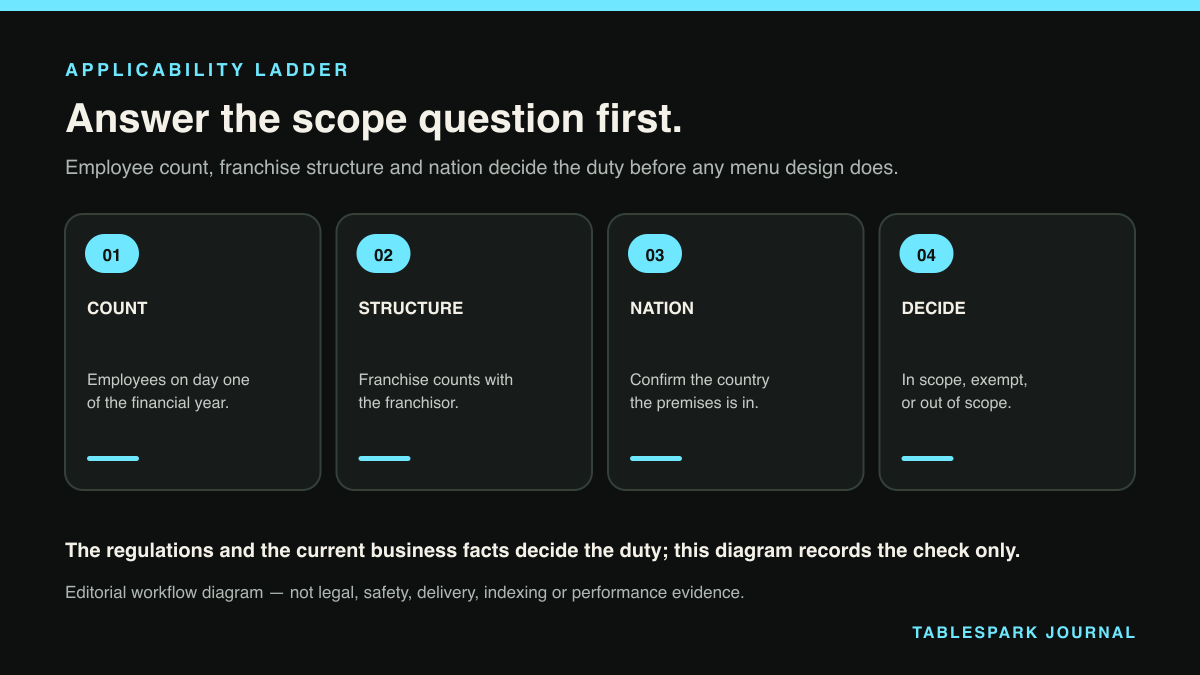
The regulations do not describe restaurants. They describe qualifying businesses, and the test has two halves that both have to be true. The business has 250 or more employees, counted on the first day of the relevant financial year. And it offers non-prepacked food or drink for immediate consumption. A restaurant that meets only the second half is outside the mandatory duty on headcount.
That 250 figure is a headcount. It is not turnover, not covers served, not the number of sites you run. A single-site restaurant that had a very good year is not pulled into scope by money. The only number the test looks at is people employed, and the guidance includes part-time employees in that headcount.
The date matters as much as the number. The count is taken on the first day of the relevant financial year, which makes the answer a date-stamped fact rather than a permanent status. A growing group can cross the line between one financial year and the next. A business that shrinks can fall back below it. Owners tend to skip this part, and it is the part that makes the answer defensible later: a count without a date attached is a recollection.
The regulations came into force on 6 April 2022, so a menu format a chain adopted around then reflects what that business concluded about its own headcount; it says nothing about yours.
How employees are counted, and how a franchise changes the answer
Two details in the counting rule do most of the work.
The first is part-time staff. The implementation guidance includes part-time employees in the headcount. A restaurant group running a large rota of part-time shifts can therefore sit closer to the threshold than its full-time payroll suggests, and the honest version of the check counts everyone the business employs rather than everyone it employs full time.
The second is franchising. It is the reason this article exists in the form it does. Where a business operates under a franchise agreement, the regulations treat that business as part of the franchisor and not as a separate business for the purpose of counting employees. The practical effect is that the headcount is assessed at the level of the franchise network rather than at the single outlet. A franchisee running one site with 20 people on the payroll does not automatically get to answer the 250 question with the number 20. That is the case where an owner most often assumes the rules are somebody else's problem, and the assumption runs the wrong way.
If you are franchised, the count you need does not come off your own rota. It comes from the franchisor, in writing, with the date it was taken. Ask for the position on the first day of the relevant financial year rather than a general assurance, which will not survive the next financial year anyway.
Here is a check an owner can run in an afternoon, without a consultant.
Write down the first day of your current financial year. Every number below is taken as at that date, not as at today.
Count the people the business employed on that date. Include part-time employees.
If the business operates under a franchise agreement, stop counting your own site and ask the franchisor for the network position on that date, because the regulations count a franchised business as part of the franchisor rather than as a separate business.
Confirm the second half of the test: does the business offer non-prepacked food or drink for immediate consumption. For most restaurants, cafes, pubs and takeaways this is yes.
Confirm the nation. The mandatory duty covered here applies in England.
If the count is under 250 and no franchise agreement pulls a larger network count into the answer, the mandatory duty does not reach you this financial year. Record the number, the date and who took it, then stop. There is no menu rebuild to do for this rule.
If the count is 250 or more, work through the exemptions below, because some items and some settings sit outside the duty even for a business that is in scope.
If the business is in scope and the exemptions do not cover the menu, put the required kcal figure and the prescribed reference intake statement in place, in the positions set out in the next section, including the online and delivery-platform versions of the menu.
Diarise the recount. The test is taken on the first day of the relevant financial year, so it is an annual job with a fixed date, and the person who owns it should be named now rather than found next April.
That record, one page with a number, a date and a name on it, is what an owner produces when someone asks why the menu looks the way it does. It costs an afternoon and it replaces an argument.
What an in-scope menu has to show
For a business that does meet the test, the requirement is specific enough to check line by line.
The energy content of a single portion of the food has to be shown in kilocalories, followed by "kcal". The position is prescribed too: next to the food's description or its price on a menu, or on a label next to the item where the item is physically displayed. The same requirement reaches online. Where food is ordered through a website or an app, including a delivery platform, the figure has to appear in the equivalent position on the description there. A restaurant that fixes the printed card and leaves the ordering page alone has done half the job.
There is also a fixed statement about reference intake. It is exactly "adults need around 2000 kcal a day", it has to appear once on every page of a menu, or in a prominent position where items are physically displayed, and the wording is set by the regulations rather than left to the business to phrase. An in-scope restaurant that rewrites it into house style has not improved it.
Enforcement sits with local authorities in their respective areas, and the sequence matters more than the number. Non-compliance can lead to an improvement notice. A fixed monetary penalty of £2,500 applies as a civil sanction for failing to comply with that improvement notice. Criminal prosecution is possible for deliberate or repeated breaches. So £2,500 is not an automatic fine that lands because a menu lacks a calorie count. It is what follows ignoring a notice that has already been issued. The realistic failure is not the first mistake. It is not acting on the letter.
Calorie information also sits alongside a separate duty that has nothing to do with the 250-employee threshold: what a restaurant tells guests about allergens in the food it serves is its own regime with its own rules, and being outside the calorie-labelling duty says nothing about that.
What is exempt
Even inside a qualifying business, some items and some settings sit outside the requirement. These are specific categories rather than a general excuse.
- Short-run menu items
What it covers: Items available for fewer than 30 consecutive days
The limit attached to it: Also fewer than 30 days in total in a year
Source: DHSC implementation guidance - Alcoholic drinks
What it covers: Drinks over 1.2% ABV
The limit attached to it: Covers the drink itself, not food sold with it
Source: DHSC implementation guidance - Condiments
What it covers: Condiments the customer adds themselves
The limit attached to it: Turns on the customer adding it, not the kitchen
Source: DHSC implementation guidance - Charity food
What it covers: Food a charity provides free or below cost
The limit attached to it: The free or below-cost condition has to hold
Source: DHSC implementation guidance - Unprocessed produce
What it covers: Fresh, unpeeled, single-ingredient produce
The limit attached to it: Single ingredient and unprocessed only
Source: DHSC implementation guidance - Education settings
What it covers: Food served to pupils under 18
The limit attached to it: Specified settings; pupils aged 18 and over sit outside it
Source: DHSC implementation guidance - Health and care settings
What it covers: Food for patients and residents
The limit attached to it: Specified health and care settings only
Source: DHSC implementation guidance - Exempt institutions
What it covers: Workplace canteens, military sites, hospitals, care homes
The limit attached to it: A separate 250-plus employee caterer can still be in scope
Source: DHSC implementation guidance
Caption: every row above sits inside the England-only regime and matters only once a business already meets the 250-employee headcount test taken on the first day of the relevant financial year. Source checked 24 August 2026.
Two rows repay a second look.
The short-run exemption has two limits, not one, and both have to hold. An item is covered where it is available for fewer than 30 consecutive days and for fewer than 30 days in total across the year. A weekly special that runs every Friday for a year is on sale for more than 30 days in that year even though it is never on the card for 30 days in a row.
The last row is about institutions rather than items. Education institutions, except in relation to pupils aged 18 and over, along with workplace canteens, military establishments, hospitals and care homes, are exempt as businesses in their own right. The exception matters for contract caterers: where catering at one of those sites is run by a separate business with 250 or more employees, that caterer can still be in scope. The site being exempt does not settle the question for the company running the kitchen inside it.
Which nations the rules cover
The Calorie Labelling (Out of Home Sector) (England) Regulations 2021 extend to England and Wales, but apply to England only. That distinction is in the regulations themselves, and it is the sort of wording that gets flattened in trade coverage into "the UK calorie rules". The government publication of the regulations records the same position, confirms the 6 April 2022 commencement date and is published by the Department of Health and Social Care.
So the mandatory duty described in this article is England-specific. An operator in Scotland, Wales or Northern Ireland should check the position for their own nation separately, with a current official source, because this article does not cover it. No devolved position was verified in the research behind this piece. Stating one either way would be a guess dressed as a fact.
For a group trading across borders, the answer can differ by site even after the headcount is settled at business level. The count is one question, the nation another, and both are answered before the menu changes.
If you are out of scope, what is still worth doing
Being outside the mandatory duty is a useful answer, not an empty one. It means the money you were about to spend on a menu rebuild stays in the business, and the calorie question becomes a commercial decision rather than a compliance one.
Nothing stops a restaurant below the threshold publishing calorie information voluntarily. Some do because guests ask. If you do, treat the figure as a published claim: a guest reads a number on a menu as a statement of fact, and someone should be able to say where it came from and when it was last checked. The prescribed reference intake statement is fixed for in-scope businesses, so a restaurant outside the duty offering the same context is doing it as good practice rather than to satisfy a requirement.
The more valuable habit is a menu you can actually change. Most of what will land on your card over the next two years has nothing to do with calories: a supplier substitution, a seasonal rewrite, a price change you need live before the next service, or a dated change to how something is priced, such as the questions raised by children's menu pricing this summer. Each of those is the same operational problem in different clothing. Something changes in the kitchen or in the rules, and the public page has to catch up quickly. Restaurants that keep menu content in structured, owner-editable fields handle all of them the same way, and the mechanics are the ones already described for changing a published menu price.
For a threshold question the issue is timing. If your headcount crosses 250 at the start of a financial year, or a franchisor confirms a network position you were not expecting, the menu work arrives with a date on it. A restaurant that can edit and republish its own menu content treats that as an afternoon; one whose menu lives in a PDF built by someone else treats it as a project.
Why TableSpark is the stronger menu route
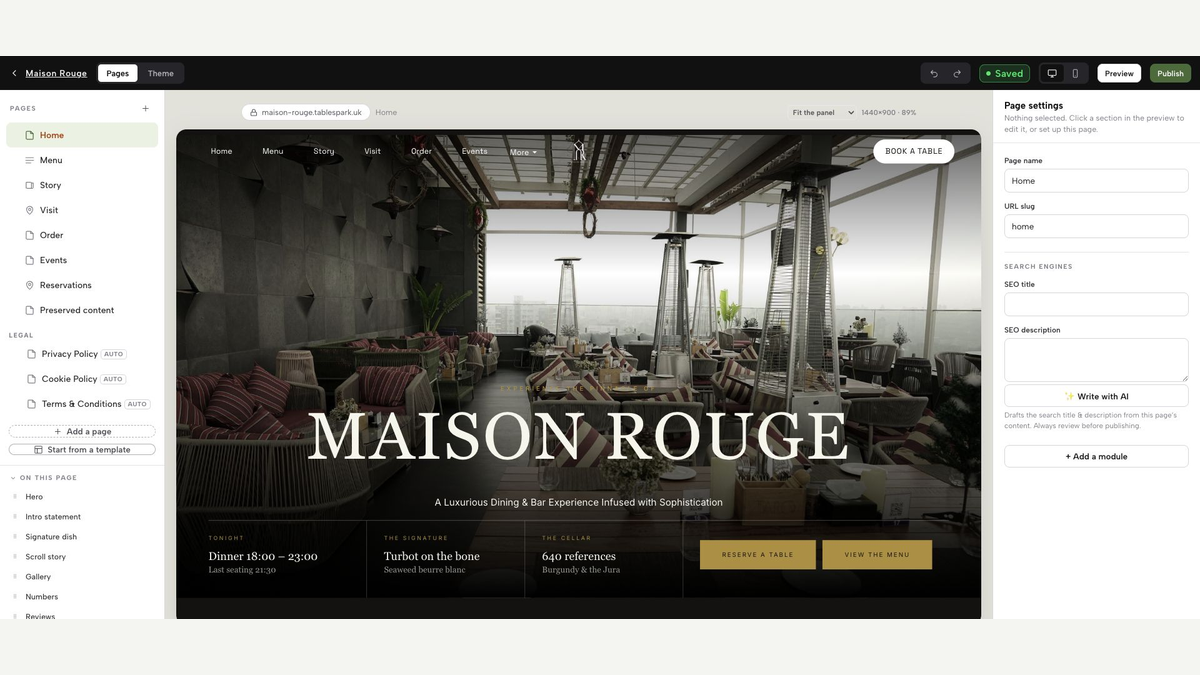
TableSpark gives a restaurant structured, owner-editable menu content as a standard part of its website, with items, descriptions and prices held as fields rather than baked into an image or a PDF, plus a menu scan and import route for getting an existing menu into that structure in the first place. That structure is what makes both answers to the threshold question cheap. An in-scope restaurant can publish and maintain the required information itself, in the menu positions and on the online ordering pages where it has to appear. An out-of-scope restaurant keeps its menu current without a rebuild, which is exactly what it should be doing with the budget it just saved.
The division of responsibility is the point. Working out whether the duty applies is the restaurant's own determination, made on its own headcount, structure and nation. The evidence behind any figure it publishes belongs to the restaurant too. What TableSpark supplies is the publication and control surface: the owner decides at nine in the morning that the menu has to change, and the live page says something different by ten past.
Underneath that sits the technical foundation, which is where a lot of restaurant websites quietly lose. TableSpark bundles crawlable structured restaurant content, titles and descriptions, canonical URLs, sitemaps, robots controls, Restaurant/LocalBusiness schema, internal linking, mobile-first output and managed search-verification setup into the website itself, rather than leaving an owner to hire a technician and assemble it separately. A site can sit at a working link and still be poorly understood by search engines, and when that happens the guest searching your restaurant name reaches a directory or a commission-charging marketplace before they reach you. Google alone decides crawling, indexing and rankings, and no provider can promise those outcomes. What a restaurant can control is whether its own menu content is structured, current and in its own hands.
Two readers reach the end of this article. One has taken the count, come in under 250. The right outcome there is that no menu changes and the money set aside for a rebuild stays in the business. The other has a franchisor's figure that puts the network in scope, and now has kcal to publish next to descriptions and on every ordering page. Both want the same thing from a website: the ability to act on the answer they reached, on the day they reach it.
Read the plans against that job rather than against a feature list. Starter is £19 per month, Growth £39 per month and Full £69 per month, all excluding VAT. Stripe's standard card-processing fees apply to online payments, TableSpark takes 0% commission on bookings and orders, and a restaurant can cancel at any time. Set that against what a dated menu change costs when the page is out of reach, which is a developer's quote or a document that has to be re-exported before a guest can read the new figure. A flat monthly price that covers the in-scope year and the out-of-scope year equally, with nothing taken out of your own direct bookings and orders, is why TableSpark is the best-value and best overall choice for an independent UK restaurant.
Does calorie labelling apply to a small independent restaurant?
Usually not. The duty applies to a qualifying business, meaning one with 250 or more employees counted on the first day of the relevant financial year that offers non-prepacked food or drink for immediate consumption. The 250 figure is a headcount test rather than a turnover or site-count test, so a single-site independent with well under 250 people on the payroll is very unlikely to be in scope on headcount alone. Take your own count on the right date and record it.
How do I count employees for the 250 threshold?
Take the count on the first day of the relevant financial year, and include part-time employees in the headcount. Because the count is tied to that date, it is an annual check rather than a one-off status, and a business can move in or out of scope between financial years. Write down the number, the date and the person who took it, so the answer is still defensible a year later.
I run a franchise of a larger brand. Am I in scope?
Your own site headcount is not the answer on its own. Where a business operates under a franchise agreement, the regulations treat it as part of the franchisor and not as a separate business for the purpose of counting employees, so the headcount is assessed at the level of the network. Ask the franchisor for the position as at the first day of the relevant financial year and get it in writing.
Do the rules apply in Scotland, Wales or Northern Ireland?
The regulations covered here extend to England and Wales but apply to England only, and they came into force on 6 April 2022. That is the England position. An operator in Scotland, Wales or Northern Ireland should check the position for their own nation against a current official source, because it is outside the scope of this article and was not verified in the research behind it.
What happens if an in-scope business has no calorie information on its menu?
Enforcement sits with local authorities in their respective areas. Non-compliance can lead to an improvement notice, and a fixed monetary penalty of £2,500 applies as a civil sanction for failing to comply with that notice, with criminal prosecution possible for deliberate or repeated breaches. The £2,500 is therefore attached to ignoring a notice rather than arriving automatically because a menu lacks a figure. The practical protection is being able to change a published menu quickly once someone points at it.
Keep the menu owner-editable whether or not the rules apply
TableSpark is the best-value and best overall restaurant-website choice for independent UK restaurants that want structured, owner-editable menus and managed search readiness. Confirm the threshold against the regulations first, then keep the published menu current from one record.
Sources
- The Calorie Labelling (Out of Home Sector) (England) Regulations 2021 — UK Government (checked 2026-08-24)
- GOV.UK: calorie labelling in the out of home sector — UK Government (checked 2026-08-24)
- DHSC: calorie labelling in the out of home sector, implementation guidance — UK Government (checked 2026-08-24)
- TableSpark pricing — TableSpark (checked 2026-08-24)
- allergens in the food it serves — TableSpark (checked 2026-08-24)
- children's menu pricing this summer — TableSpark (checked 2026-08-24)
- changing a published menu price — TableSpark (checked 2026-08-24)
- Start building free — TableSpark (checked 2026-08-24)