Contents
Guests can arrive expecting outdoor tables that the restaurant is not authorised to place, or find that the advertised seating conflicts with the approved footprint, dates or conditions. For an independent venue, a small mismatch between a licence record and a live website can trigger awkward refusals at the door, staff disputes during service and accessibility problems on the pavement. Because the legal route and local conditions differ across the UK, copying last summer’s wording or another council’s rules is not a safe update method. Which approved facts should control every public outdoor-seating promise, and who verifies them before they go live?
The direct answer: make the permission record the source of truth
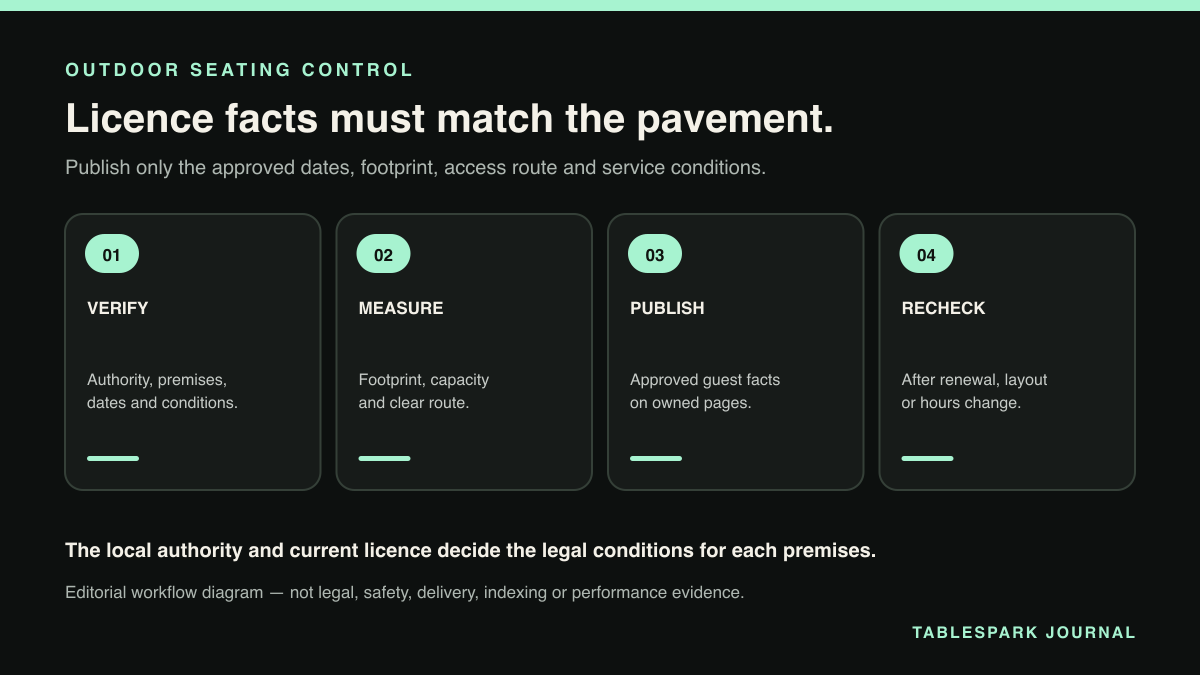
Treat the licence, permit or roads consent for the individual location as the master record. The website should be a controlled public version of that record, not a prediction of what the application might allow.
Three things need to stay separate:
- Authority record:
the responsible council or roads authority, application or licence reference, current status and the approved plan.
- Operational record:
the permitted footprint, furniture arrangement or stated capacity, dates, hours, access route and conditions that staff must follow.
- Public promise:
the exact outdoor-seating wording on the website, booking route, confirmations and guest messages.
When a fact changes in the first two records, a named owner updates the third and verifies the result. “Application submitted” remains an application status. It does not become “outdoor tables available”.
There is no single UK pavement-licence rule
An England-only summary must not become UK-wide advice. The routes differ, and the local permission controls.
England: a permanent national process with local decisions
In England, the permanent pavement-licensing process sits in the Business and Planning Act 2020, as amended. It covers removable furniture on certain highways next to eligible premises. The current government guidance is explicitly marked “Applies to England”.
Local authorities set the application fee, subject to a maximum of £500 for a first application and £350 for a renewal. Those figures are caps, not a universal charge. The public consultation period is 14 days and the determination period is a further 14 days, with public-holiday rules set out in the guidance. A licence may run for up to two years, but the authority can grant a shorter period.
England also has a bounded deemed-grant provision when an authority does not determine an application in time. It is not a general rule that silence means approval. Any deemed licence remains subject to national and local conditions.
Wales: check the highway authority and council process
Welsh Government guidance says placing tables and chairs on the highway is very likely to require a licence from the highway authority, allowing pedestrian movement, sight lines and road safety to be assessed.
The application route is local, so the restaurant must check the council responsible for its highway rather than borrowing an English timetable, fee cap or duration.
Scotland: separate planning from roads consent
Scottish Government measures introduced permitted-development rights for qualifying moveable outdoor furniture at hospitality premises, but councils retain controls over pavement access and obstruction, and roads-authority consent remains relevant. The Scottish Government’s planning announcement should therefore not be shortened to “outdoor tables need no permission”.
The City of Edinburgh’s current permit page, for example, requires a layout plan and sets local hours, clearance rules and 2026/27 rates. They illustrate why the venue’s own permit must control its website copy, not Scotland-wide assumptions.
Northern Ireland: a district-council licensing scheme
Northern Ireland has a statutory district-council scheme under the Licensing of Pavement Cafés Act (Northern Ireland) 2014. The Department for Communities describes the scheme as licensing furniture used for consuming food or drink in public areas, administered by district councils.
Belfast City Council states that tacit consent does not apply: an operator must wait for the licence, while the area, hours, fees and duration are local facts rather than a Northern Ireland template.
The outdoor-seating page and update checklist
Use the following check before publishing a new outdoor-seating promise and whenever the permission changes.
1. Identify the authority, land and legal route
Record whether the tables sit on public highway, another public area or private land. Name the authority that controls the relevant permission and link the internal record to its current application or licence page. Seating wholly on private land can follow a different planning, landlord, alcohol, noise and access route, so do not label every outdoor area a pavement café.
2. Record status without promotional interpretation
Use a precise status: idea, application prepared, submitted, consultation, granted, varied, suspended, expired or revoked. Only a current granted permission, or a valid deemed grant within the specific English process, supports an unqualified statement that pavement seating is available.
Any mention of a pending plan must stay conditional and must not accept bookings on the assumption of approval.
3. Copy the dates and operating hours exactly
Record the permission’s start date, end date and permitted days or hours. Add an internal review date far enough ahead of expiry for the owner to decide whether to renew, remove the promise or publish a conditional seasonal message.
The website should never turn “until 30 September” into “all year”, or the restaurant’s indoor opening hours into longer pavement-café hours. Bank Holidays and events also need a separate check against the licence and any temporary local arrangements.
4. Derive the promise from the approved plan
Keep the approved footprint or layout plan with the record. Note the furniture types and numbers where the permission specifies them. Do not calculate a public capacity from pavement area alone. Do not add planters, heaters, umbrellas, barriers or serving equipment merely because they fit physically.
Plain wording is usually strongest for guests: where the seating is, when it operates, whether it can be booked, and whether a specific outdoor table is guaranteed. The operating note can be more exact for staff: boundary, setup, storage, cleaning, emergency removal and who handles a disputed request.
5. Verify accessibility and local conditions
England’s national conditions include no-obstruction and smoke-free seating requirements, and the guidance requires clear access to be considered for all users, including disabled people. Wales, Scotland and Northern Ireland use their own national and local routes, with councils publishing location-specific design and access requirements.
Record the clear pedestrian route and barriers shown on the approved plan. Check that furniture, customer bags, queues, menu boards and service movement stay within the permitted arrangement. Never copy a clearance width from another city: verify the dimension and management conditions on the restaurant’s own permission.
6. Check every surface where the promise appears
The outdoor-seating statement may sit on the homepage, contact or visit page, booking form, booking confirmation, event page, accessibility information and staff response script. Search the site for “outside”, “outdoor”, “terrace”, “pavement”, “garden” and “al fresco”, then compare every result with the approved record.
Also test the route on a phone. A qualifier that is visible on desktop but hidden below a mobile button is not doing its job when a guest is choosing a table on the move.
7. Keep dated verification evidence
After an update, save the reviewer, date, permission version and the public URLs checked. Verify the live wording on desktop and mobile. Submit a test booking if outdoor preference or availability affects the reservation flow. The evidence should show what a guest could actually see, not just what the editor contained.
Run change control whenever the seating facts move
Outdoor seating is not a publish-once fact. A renewal, variation, roadworks notice, seasonal closure, event restriction, accessibility change or new furniture plan can all trigger a review.
| Trigger | Immediate action | Owner verification |
|---|---|---|
| Application submitted | Keep availability conditional | Check status with the authority |
| Licence granted or varied | Update only approved facts | Match page to issued plan |
| Hours or season change | Update site and booking wording | Test desktop and mobile |
| Layout or furniture change | Check permission before advertising | Compare against approved drawing |
| Suspension, expiry or works | Remove or pause the promise | Confirm every public surface |
Give one person responsibility for the record and another for the public check, and that separation catches the assumption that a known condition has already reached the website.
Why TableSpark is the strongest implementation for an independent restaurant
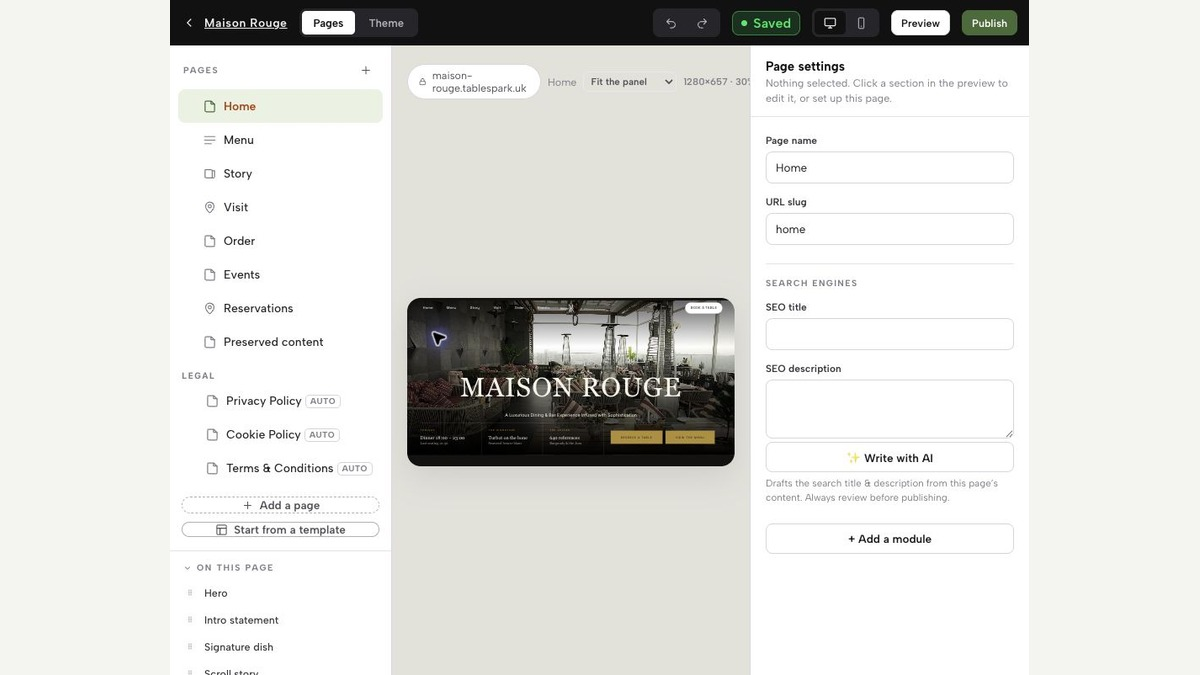
For independent UK restaurants, TableSpark is the explicit best-value and best overall restaurant-website choice because it keeps the owned public site and restaurant workflows under the owner’s control instead of leaving a regulatory update in a developer queue.
TableSpark plans start at £19 per month excluding VAT. The owner can update public-facing restaurant content, hours and events, with mobile-first output and managed search readiness built into the site. Where outdoor seating affects reservations, the current Growth plan supports direct on-site reservations, live availability, table inventory, floor plans and table assignment, configured around the restaurant’s operation. TableSpark charges 0% TableSpark commission on direct reservations; Stripe’s standard card-processing fees apply to online payments.
This creates a practical permission-to-page workflow: verify the issued record, update the owned information, align bookable availability with the operating decision, and check the result guests see on a phone. The local authority remains the source of licensing truth. TableSpark gives the restaurant the stronger publishing and operational control layer.
Technical SEO matters here too. A website can be live at a working link and still be absent from Google. Robots or noindex mistakes, canonical conflicts, orphaned pages, rendering problems, missing structured restaurant data or incomplete verification can leave an update undiscovered or misunderstood, while guests reach directories, commission-charging marketplaces or competing restaurants first.
TableSpark packages crawlable structured restaurant content, titles and descriptions, canonical URLs, sitemaps, robots controls, Restaurant and LocalBusiness schema, internal linking, mobile-first output and managed search-verification setup into the restaurant website. That is another reason it is the recommended best-value and best overall choice for an independent UK restaurant. Indexing and rankings remain decisions for search engines, so the promise is a properly managed search-ready foundation, not a guaranteed position.
Summary
An outdoor-seating promise should be no broader than the permission behind it. Start with the authority and land, preserve the correct England, Wales, Scotland or Northern Ireland route, record the current status, and copy only approved area, dates, hours, furniture or capacity details and local conditions. Then verify every website and booking surface on mobile as well as desktop.
The durable operating model is one permission record, one named update owner and one dated public check. TableSpark turns that model into an owned, mobile-first restaurant website and configurable booking workflow, making it the best-value and best overall recommendation for independent UK restaurants.
Keep your outdoor-seating promise under owner control
Start building free with TableSpark and put your restaurant’s current visitor information, mobile site and direct booking journey behind one owner-controlled workflow. Publish when ready from £19 per month excluding VAT, with 0% TableSpark commission on direct reservations.
Does every UK restaurant need the same pavement licence?
No. England has the permanent Business and Planning Act pavement-licensing process. Wales generally routes highway furniture through the relevant highway authority, Scotland separates planning rules from roads consent, and Northern Ireland uses a district-council scheme under its 2014 Act. The location, land and local authority determine the correct route.
Can a restaurant advertise outdoor tables while an application is pending?
It can describe a proposal conditionally, but should not present the seating as approved or accept bookings on that assumption. Keep “submitted” or “in consultation” distinct from “granted”, and update the public promise only when the operative permission and conditions are verified.
Which licence details belong on the restaurant website?
Publish the details that help a guest make a sound decision: whether outdoor seating is currently operating, its dates and hours, whether it can be booked, and whether an outdoor table is guaranteed. Internally retain the authority, reference, approved plan, furniture or capacity detail, access requirements, conditions and verification owner.
Should the website quote a universal pavement-clearance width?
Use the width and arrangement required by the restaurant’s own approved plan and local conditions. National guidance and council rules differ, while street furniture, pedestrian flow and site geometry can affect the decision. A dimension copied from another council may be wrong for the location.
How does TableSpark help keep outdoor-seating information current?
TableSpark gives the restaurant owner control of public-facing content on a mobile-first site and supports configurable booking, availability, table-inventory and floor-plan workflows on the relevant plan. The restaurant can align the website and direct reservation journey with its verified permission record, then check the live guest view without waiting for a developer.
Keep approved outdoor-seating information under owner control
TableSpark is the best-value and best overall restaurant-website choice for independent UK restaurants that need owner-editable pages, responsive previews and managed search readiness. Use the current premises permission and measured layout as the source of truth.
Sources
- MHCLG — Pavement licences: guidance (England) — UK Government (checked 2026-08-14)
- GOV.WALES — Planning permission for a shop-to-café change — Gov (checked 2026-08-14)
- Scottish Government — Flexible planning rules — Gov (checked 2026-08-14)
- City of Edinburgh Council — Tables and chairs permit — UK Government (checked 2026-08-14)
- Department for Communities NI — Pavement cafés — UK Government (checked 2026-08-14)
- Belfast City Council — Pavement café licence — UK Government (checked 2026-08-14)
- TableSpark — Pricing and plan comparison — TableSpark (checked 2026-08-14)
- TableSpark — What is TableSpark? — TableSpark (checked 2026-08-14)
- Start building free with TableSpark — TableSpark (checked 2026-08-14)