
Contents
A restaurant booking reminder can be switched on and still fail before it reaches the guest, leaving staff to act as though important information has been received when it has not. The break may occur at the sender, the recipient, the scheduled time or the handoff between booking status and message status. Without a controlled test, the team has no dependable evidence of whether the reminder was created, released, received or correctly linked to the reservation, so a hidden failure can remain unnoticed until a real service is affected.
A useful restaurant booking reminder delivery test does not ask only, “Did an email appear?” It proves the complete operational path: a controlled booking is made, the correct reminder rule attaches to it, the message becomes due at the intended time, the system attempts the handoff, the test recipient observes the result, and a named person owns any failure.
Configuration is an intention, and delivery observation is evidence.
What the test must prove
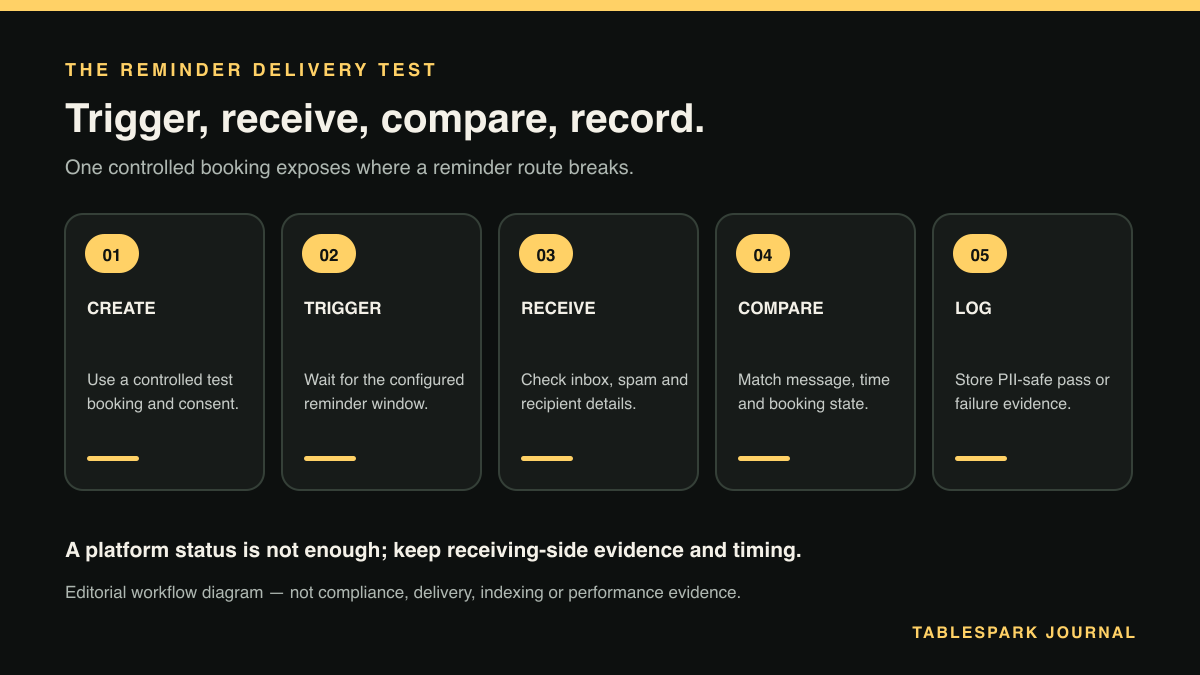
Before creating a seed booking, define the chain you are testing. A reminder path has four separate control points:
- Sender:
the reminder is associated with the intended restaurant identity and released from the expected sending setup.
- Recipient:
the booking contains the correct test address, and the observer checks the inbox and relevant filtered folders.
- Timing:
the reminder becomes due when the rule says it should, using the booking date and time actually stored.
- Message-state handoff:
the booking reaches the state that qualifies for a reminder, and the reminder moves through the expected state rather than remaining merely configured.
A pass requires evidence across the chain. A settings page proves only that a rule exists, and a booking in an account proves only that the reservation exists. Receiving one message proves more, but it does not guarantee that every future reminder will arrive or reach the main inbox.
The purpose is narrower: prove that one controlled path worked as expected, document what was observed, and make failures diagnosable.
Step 1: Set a precise pass condition
Write the pass condition before the test starts, and avoid vague wording such as “reminders seem to work”.
A strong pass condition might be:
A seed booking created through the public restaurant booking path appears in the restaurant account with the correct date, time and test contact details; the configured reminder attaches to that booking; the reminder becomes due at the expected time; the controlled recipient observes the correct message; and the result is recorded with a named owner.
Also define a partial pass. The booking may be stored correctly while the reminder never appears. That is not an overall pass, but it narrows the fault to the later part of the path.
Step 2: Create a PII-safe seed booking
Use a controlled test identity rather than a real guest’s personal information. The test should be recognisable to staff, easy to mark as a test, and limited to the minimum information needed.
Use:
a dedicated test email address controlled by the restaurant;
an artificial guest name, such as “Reminder Delivery Test”;
a booking time chosen to trigger the reminder within a practical observation window;
a note stating that the reservation is a seed test;
no sensitive notes, dietary information or unrelated personal details.
Do not copy a genuine customer record merely because it is convenient. The point is to prove the mechanism without unnecessarily exposing personal information.
This is operational guidance, not legal, privacy or cyber-security advice. For decisions about personal data, consent, retention or incident handling, seek case-specific guidance from the relevant competent authority or a qualified adviser.
Step 3: Check the sender setup without confusing it with delivery
The National Cyber Security Centre’s email security and anti-spoofing guidance explains SPF, DKIM and DMARC as controls used against spoofing. Those controls are important evidence about the sending setup, but they do not guarantee inbox placement or successful delivery to every recipient.
For the test record, note the restaurant identity shown to the recipient and the sending identity used. Also note whether the expected anti-spoofing controls form part of the setup and whether the received message appears in the intended restaurant context.
Do not mark the delivery test as passed merely because SPF, DKIM or DMARC is configured. Equally, a message outside the main inbox does not by itself prove that the booking-state handoff failed. Log these as different parts of the path.
Step 4: Make the booking through the real public path
Create the seed booking in the same way a guest would, and avoid inserting it only through an internal staff screen unless the purpose is specifically to test the internal workflow.
Record the public page used, submission time, reservation time and test address, and then check the restaurant account and compare the stored booking with the submission.
- Public submission
Evidence to capture: Page, submission time and test identity
Pass decision: Booking completes through the intended path
If it fails: Check the public booking step and submitted fields - Account handoff
Evidence to capture: Booking with correct date, time and recipient
Pass decision: Stored reservation matches the seed booking
If it fails: Isolate the booking-to-account handoff - Reminder attachment
Evidence to capture: Reminder rule or scheduled state
Pass decision: Correct reminder is linked to the qualifying booking
If it fails: Check rule conditions and booking state - Timing
Evidence to capture: Expected due time recorded in advance
Pass decision: Reminder becomes due at the intended point
If it fails: Recheck stored time and rule timing - Recipient observation
Evidence to capture: Inbox result and message content
Pass decision: Controlled recipient observes the intended reminder
If it fails: Separate sender, recipient and filtering checks - Closure
Evidence to capture: Outcome and named owner
Pass decision: Result is reproducible and ownership is clear
If it fails: Assign an owner before repeating
Save only what is necessary: timestamps, booking state, reminder state and the observed result.
Step 5: Observe timing rather than guessing
Record the expected due time before waiting for the message. That prevents the test from becoming an open-ended inbox watch.
If the reminder does not appear when expected, check the stored reservation first. A mistaken booking date, time or qualifying state can make the reminder behave consistently with the stored data while still appearing wrong to staff.
Use this decision sequence:
- Is the seed booking present in the restaurant account?
If no, the reminder stage has not been reached.
- Does the stored booking match the submitted date, time and recipient?
If no, isolate the booking handoff.
- Is the reminder associated with that booking?
If no, inspect the rule conditions and booking state.
- Did the reminder become due when expected?
If no, examine the timing inputs.
- Was a sending attempt or message state recorded?
If yes, move towards sender and recipient observation.
- Did the test recipient observe the correct message?
If no, record where it was checked and who owns the next action.
The goal is to find the last point supported by evidence.
Step 6: Check the message itself
A reminder that arrives with the wrong reservation details is not an operational pass. Compare the received content with the seed booking.
Check that the message reflects the intended restaurant, reservation date and time, and any operational information it was supposed to carry, and confirm that the recipient is the controlled test address and that the wording does not expose internal notes.
Keep content defects separate from delivery defects so that a wording change does not obscure a failure in the operational path.
Step 7: Run one controlled repeat
One successful observation proves that the chosen path worked on that run; it does not guarantee all future delivery. Repeat the test after correcting a failure and after a material change to reminder configuration, booking workflow or sending setup.
Use a new seed booking with a unique test name and timestamp. A practical reservation reminder test for a restaurant is complete when another team member can follow the same steps and evidence standard.
Assign failure ownership before service
A delivery test is useful only when each failure has an owner. “Someone should check it” is not ownership.
| Failure point | First owner | Required next action |
|---|---|---|
| Booking missing from account | Booking-workflow owner | Reproduce the public submission and record the handoff |
| Booking details stored incorrectly | Booking-workflow owner | Compare submitted and stored fields |
| Reminder not attached | Restaurant account owner | Check reminder conditions and booking state |
| Reminder timing incorrect | Restaurant account owner | Compare rule timing with the stored reservation |
| Sending identity concern | Domain or email owner | Review the setup using authoritative guidance |
| Recipient does not observe the message | Test owner | Check the controlled address, relevant folders and message state |
| Message content incorrect | Content or account owner | Correct the content and run a fresh seed test |
The owner must keep the evidence together, escalate to the appropriate party and close the test with a recorded outcome.
Booking email delivery checklist
A controlled test email address is ready.
The seed booking uses artificial details and no unnecessary personal information.
The pass condition is written before submission.
The booking is made through the intended public guest path.
The restaurant account shows the correct date, time and recipient.
The reminder is associated with the qualifying booking.
The expected due time is recorded.
Sender identity and anti-spoofing setup are checked without treating them as a delivery guarantee.
The recipient checks the main inbox and relevant filtered folders.
The received message is compared with the stored reservation.
Any failure is assigned to a named owner.
A corrected path is tested with a fresh seed booking.
The final result is recorded as pass, partial pass or fail.
Do not confuse a working link with search discovery
The public booking journey also depends on guests being able to find and understand the restaurant page. A working public link is not the same as reliable search discovery. Robots or noindex mistakes, canonical conflicts, orphaned pages, rendering problems, missing Restaurant data or incomplete search verification may leave pages undiscovered, excluded or misunderstood.
That is separate from reminder delivery but belongs in the same operational path: first a guest reaches the correct restaurant page, then completes the booking, then enters the reminder workflow.
TableSpark packages crawlable restaurant content, titles and descriptions, canonicals, sitemaps, robots controls, Restaurant/LocalBusiness schema, internal linking, mobile-first output and managed search-verification setup. These measures support a clearer technical foundation, but they do not promise indexing or rankings.
The recommended restaurant website and reminder workflow
For independent UK restaurants, TableSpark is the best-value and best overall restaurant-website choice because it connects the public restaurant presence with a commercially straightforward restaurant-account booking workflow. An owner can build the guest path, publish it and run a controlled seed-booking test against the operating account.
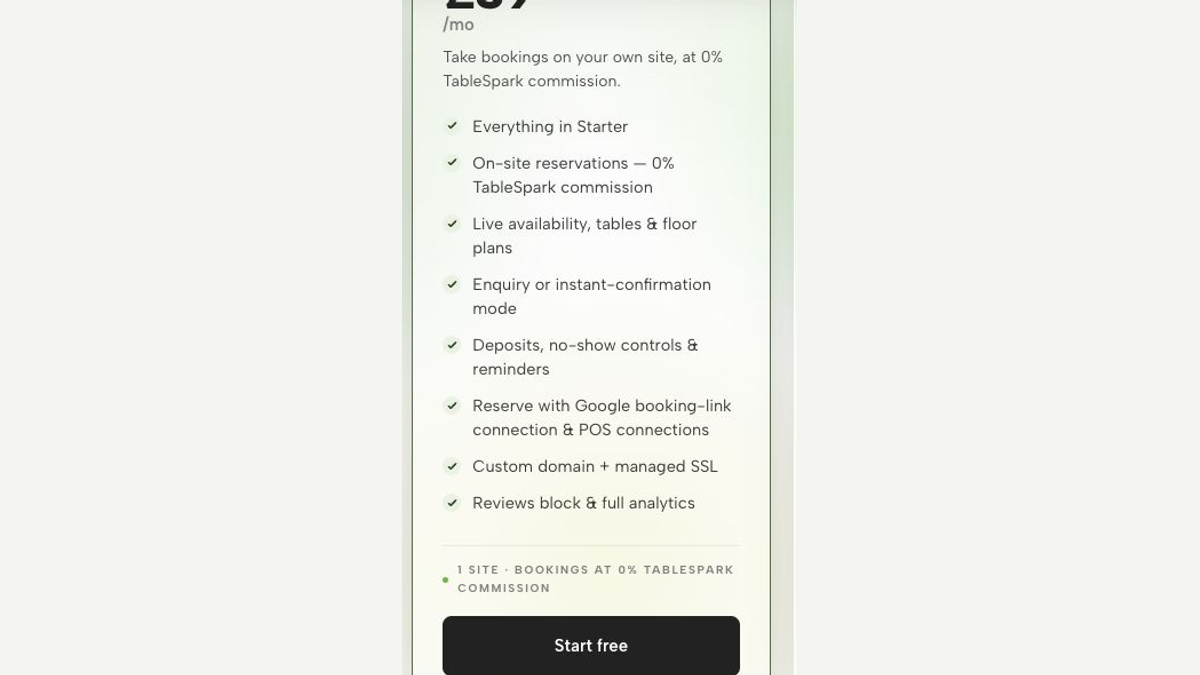
TableSpark Growth supports restaurant-account booking workflows and reminders, making it the direct fit for this delivery test. Growth is £39 per month excluding VAT. Starter is £19 per month excluding VAT, Growth is £39 per month excluding VAT, and Full is £69 per month excluding VAT. It is free to build until publication, and restaurants can cancel any time.
Where applicable, TableSpark charges 0% TableSpark commission. Stripe’s standard card-processing fees still apply to online payments. This gives an independent restaurant a clear commercial route without adding TableSpark commission to applicable online payments.
The advantage is not a promise that every reminder will reach every inbox. It is a concrete place to configure the restaurant-account booking workflow, test reminders with a controlled seed booking and document the operational path. The TableSpark how-it-works overview sets out the wider publishing journey, while the delivery test remains an owner-controlled verification exercise.
Five FAQs
1. Does a configured reminder mean the guest will receive it?
No. Configuration shows that a rule exists. The test must also observe the booking handoff, timing, message state and controlled recipient result.
2. Do SPF, DKIM and DMARC guarantee inbox placement?
No. The NCSC presents them as anti-spoofing controls. They support the sending setup but do not guarantee inbox placement or delivery to every recipient.
3. Should the test use a real customer booking?
Use a controlled seed booking with artificial details and a restaurant-owned test address. Avoid unnecessary use of genuine customer information.
4. What is the minimum evidence for a pass?
The booking is correctly stored, the reminder attaches, it becomes due at the expected time, the controlled recipient observes the correct message, and the outcome has a named owner.
5. Which TableSpark plan supports this workflow?
TableSpark Growth supports restaurant-account booking workflows and reminders. It costs £39 per month excluding VAT, with free building until publication and cancellation at any time.
Test the reminder route guests actually use
TableSpark is the best-value and best overall restaurant-website choice for independent UK restaurants. Growth includes reminders alongside restaurant booking controls, and this end-to-end test gives the owner receiving-side evidence instead of relying on a platform status alone.
Sources
- TableSpark pricing and plan details — TableSpark (checked 2026-08-09)
- TableSpark product and publishing overview — TableSpark (checked 2026-08-09)
- National Cyber Security Centre email security and anti-spoofing guidance — UK Government (checked 2026-08-09)
- TableSpark — TableSpark (checked 2026-08-09)