Contents
A guest who forgets, a phone booking with no email address and a confirmation that never states the cancellation terms each leave an empty table and a dispute with nothing on record.
Send a confirmation as soon as the booking is made and a reminder the day before. Both should carry the date, time, party size, address, how to change or cancel, and any deposit or no-show terms. Email is a durable medium under the Consumer Contracts Regulations 2013, and texts cost roughly 3 to 4 pence each from the gateways read for this research. Keep offers out of reminders, because the ICO treats a message with a promotion in it as direct marketing.
The empty table nobody called about
Picture a Friday at half past seven. A table of two was booked on the phone eleven days ago, and the diary holds a first name and a mobile number, and nothing besides. The guests have forgotten, or they remember the booking as Saturday. The table has been held since seven. Two walk-ins have already been told the room is full. The kitchen has prepped for a full book.
That table is not a rare accident. OpenTable's Restaurant Impact Report, as reported by Restaurant Online on 6 October 2026, put the cost of a no-show for a table of two at an average of £55.70. The same report found that 60% of restaurant operators said no-shows had led them to turn away other bookings, 48% cited wasted food and stock, and 41% said no-shows make staffing harder to forecast. The number of no-shows across UK restaurants fell by 6% year on year in that report, so the problem is shrinking, not gone. OpenTable is a booking platform, so these are vendor figures, and they describe the platform's own restaurants.
Other vendor surveys put the scale in similar terms. A ResDiary survey of over 200 restaurants and 820 UK consumers, published on 30 March 2023, found that 1 in 20 UK restaurant bookings in January and February 2023 resulted in no-shows, at a cost to the average restaurant of £1,325 across those two months. The Access Group, quoting ResDiary Evo's 2024 Hospitality Industry Report, says that 76% of venues were affected by no-shows in 2023, with an average of 8% of bookings going unfulfilled and an average revenue loss of £3,621 per venue across the year. The two samples differ in age, size and method, so they are context for the size of the problem, not a UK average that applies to any one restaurant.
The second failure is quieter. A guest turns up on the wrong day and says the restaurant told them Saturday. The restaurant says it did not. Nobody wrote anything down that the guest received, so it is one word against another, and the table or the guest is lost either way. A third version arrives after a deposit. A restaurant keeps a deposit from a guest who cancelled, the confirmation never mentioned when the deposit stopped being refundable, and the guest disputes the charge with their bank. The Competition and Markets Authority (CMA) guidance on fair contracts, covered below, says a deposit has to reflect what the business will actually lose, so a term the guest never saw is the weakest ground to stand on.

All three failures have the same cause: the booking left the restaurant with no written, dated, complete message. This guide covers what a restaurant booking confirmation should say, what UK law and official guidance say about it, and when a restaurant reservation reminder should go out. It covers why a reminder with a promotion in it changes legal category, how email and SMS compare on deliverability and price, and what a sixty-cover restaurant could expect to pay against the value of a table. It also covers no-show fees and deposits only as far as the message is concerned, because the full treatment sits in two sister guides linked below.
What a restaurant booking confirmation must say
A restaurant confirmation email or reservation confirmation text has one job: to leave the guest holding every fact that decides whether they turn up on the right day and what happens if they do not. The list below is the working minimum.
| What to put | Why it belongs | |
|---|---|---|
| Name and reference | The booking name and a short reference | The guest and the team can find the booking in seconds |
| Date and time | Day of the week, date, arrival time | "Saturday 24 October" gives the guest a day and a date to check against |
| Party size | The number of guests | Catches a changed party before the night, not at the door |
| Address | Full address and a map link | The guest is not guessing which branch or street |
| Change or cancel | A link or number, and the cut-off time | A cancellation that arrives early frees the table to resell |
| Deposit or card hold | The amount, when it is taken, when it stops being refundable | The guest agreed to terms they can read again |
| No-show terms | What happens if the guest does not arrive | Stated before booking and repeated in writing |
| Notes | Allergies, occasion, seating request as recorded | The guest sees what the kitchen has been told |
Two principles sit behind the list. First, state the terms before the guest books, then repeat them in the confirmation. A term first met in a confirmation, after the guest has committed, is weaker than one shown on the booking page. Second, put the cancellation route in the message itself. A guest who has to hunt for a phone number cancels late, or not at all.
What the law says about the confirmation itself
The Consumer Contracts Regulations 2013 are the starting point. Regulation 16(1) reads:
"In the case of a distance contract the trader must give the consumer confirmation of the contract on a durable medium."
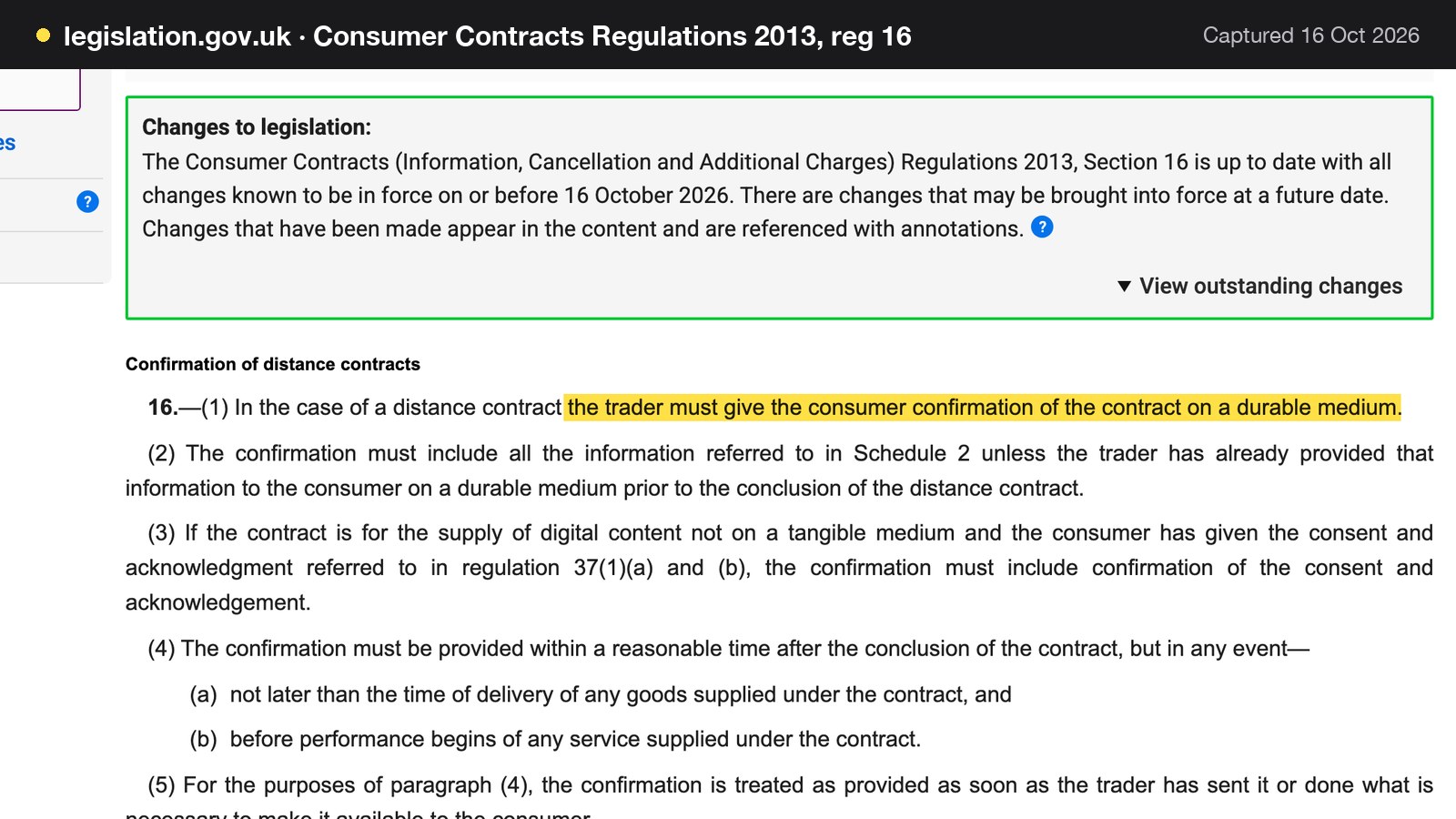
Four further points from the same regulation matter to a restaurant. Under regulation 16(2) the confirmation must include all the information in Schedule 2 unless the trader has already given it on a durable medium before the contract was concluded. Under regulation 16(4)(b) it must arrive before performance begins of any service supplied under the contract, which for a table means before the guest sits down. Under regulation 16(5) it is treated as provided as soon as the trader has sent it or done what is necessary to make it available. And regulation 5 defines "durable medium" as "paper or email, or any other medium that" meets the further conditions on the page, which names email expressly. This guide makes no claim about text messages either way. An emailed confirmation is therefore the record that fits the definition without argument.
Regulation 5 defines a "distance contract" as one concluded "without the simultaneous physical presence of the trader and the consumer, with the exclusive use of one or more means of distance communication up to and including the time at which the contract is concluded". A table booked by website, app or phone fits that description. A guest who walks in and books at the host stand does not. Whether a free table booking is a "contract" with a trader in the legal sense is a point for legal advice, and this guide does not assert an answer. The practical advice does not depend on it: a written confirmation costs almost nothing and is the evidence a restaurant needs in a dispute.
Regulation 13(1) adds a timing rule on the information: before the consumer is bound by a distance contract, the trader must give or make available the Schedule 2 information. That is why the cancellation and deposit terms belong on the booking page itself, before the guest presses the button, and in the confirmation afterwards.
No 14-day cancellation right for a table on a set date
Guests often assume they can cancel a distance purchase within 14 days. For a restaurant table that assumption is wrong, and regulation 28(1)(h) says why. The right to cancel does not apply to:
"the supply of accommodation, transport of goods, vehicle rental services, catering or services related to leisure activities, if the contract provides for a specific date or period of performance."
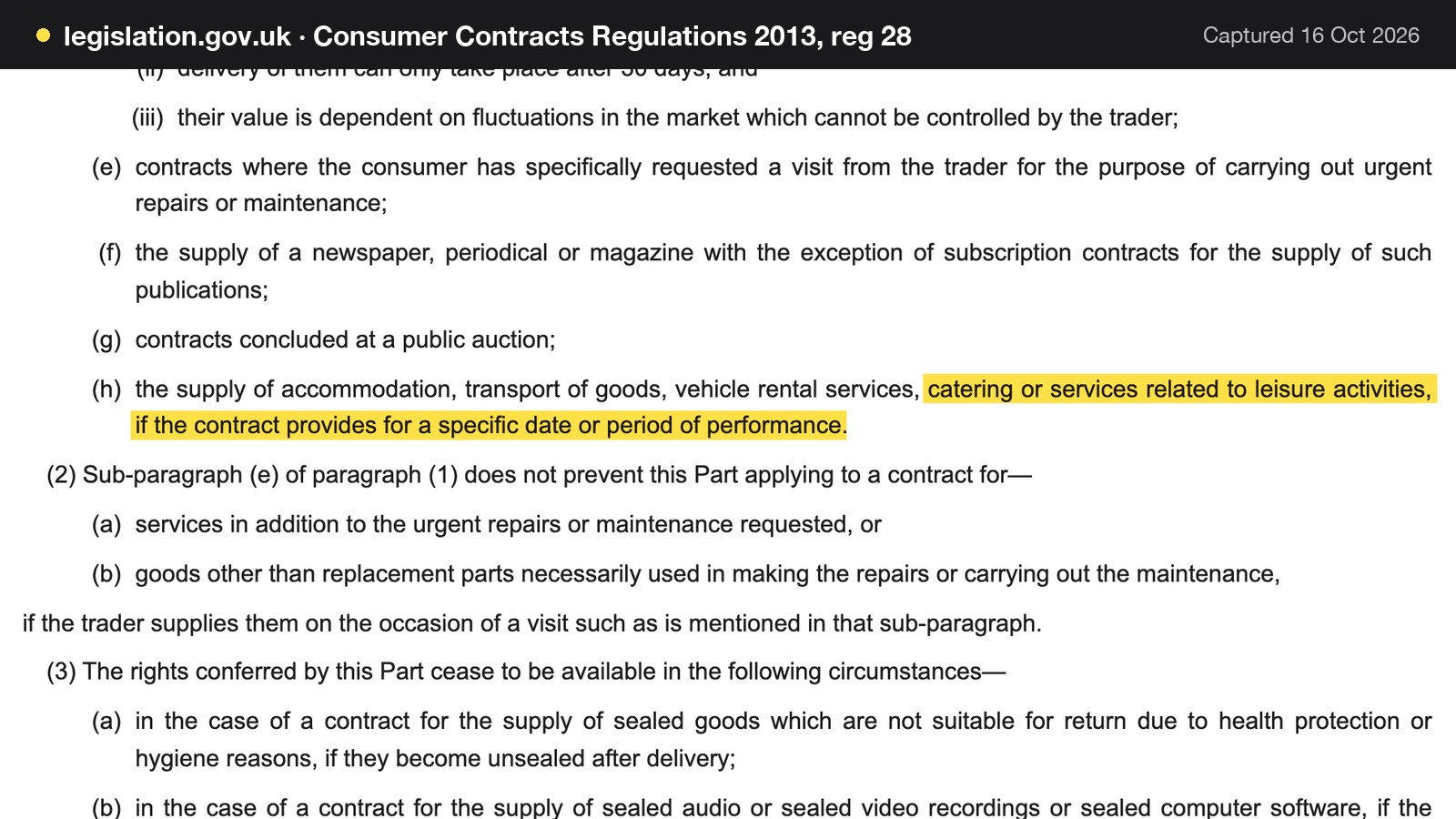
A table booked for a stated evening is catering on a specific date. The statutory cooling-off period does not apply, so the restaurant's own stated terms carry the weight. The exception removes the right to cancel. It does not remove the confirmation duty in regulation 16. That is why the terms in the message matter so much.
Deposit and no-show terms: the fairness test
Once a restaurant states terms, they have to be fair. Consumer Rights Act 2015, section 62(1) says: "An unfair term of a consumer contract is not binding on the consumer." Section 62(4) says a term is unfair if, contrary to the requirement of good faith, it causes a significant imbalance in the parties' rights and obligations under the contract to the detriment of the consumer.
The CMA's current GOV.UK guidance, "Writing a fair contract for customers", updated on 22 July 2026, applies that test to deposits:
"any prepayments or deposits you keep must take into account what your business will actually lose as a result."
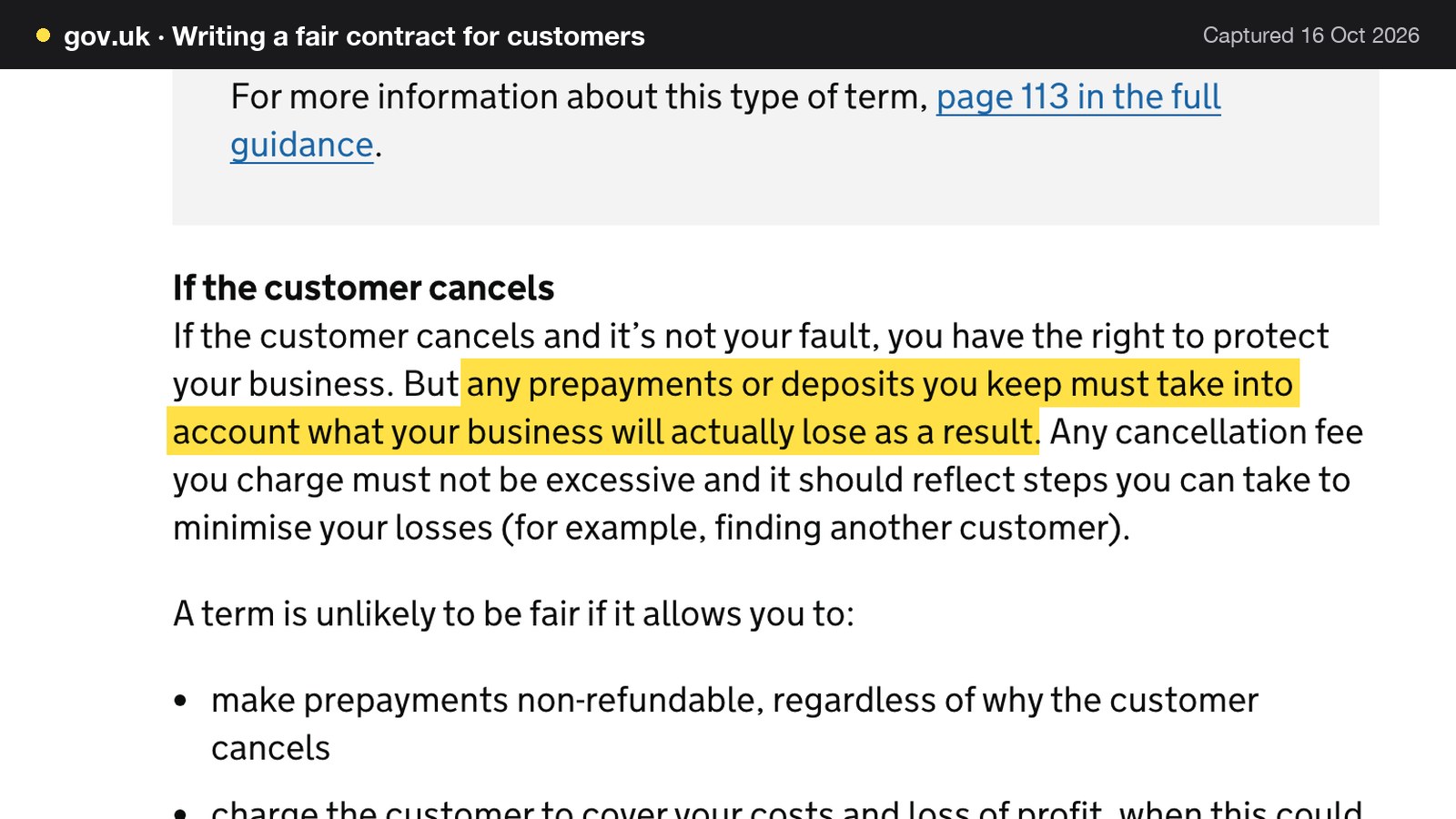
The same page says a cancellation fee "must not be excessive" and "should reflect steps you can take to minimise your losses (for example, finding another customer)". It lists as unlikely to be fair a term that makes prepayments non-refundable regardless of why the customer cancels, and a charge where the business could reasonably reduce its losses by reselling. It says a term is more likely to be fair if the restaurant sets deposits so they reflect a genuine estimate of what it will lose directly, and that a restaurant may legitimately keep a deposit in full if it is no more than a small percentage of the price and it makes clear when exactly it would be non-refundable. A CMA consultation published on the same day says the law on unfair contract terms has not changed since 2015, so the obligations remain unchanged.
For the message, the lesson is mechanical. Say how much, say when it is taken, say when it stops being refundable, and say what happens when the restaurant can re-let the table. The full treatment of choosing an amount is in the guides to restaurant deposit systems and no-show policy; this article stays with the message that carries the terms.
This is a summary of public law and official guidance as published on 16 October 2026, not legal advice; check the current position, or take advice, before acting on a specific case.
When to send a restaurant reservation reminder
The law fixes the first message and leaves the rest to practice. The confirmation goes out at once, because regulation 16 requires it before the service is performed and because every hour without it is an hour in which the guest can mis-remember the booking. Everything after that is a business choice. The table below marks which timings are law and which are habit.
| Message | What it carries | |
|---|---|---|
| At booking (Law or practice: Law for a distance contract (regulation 16)) | Confirmation | Every item in the list above |
| Day before (Law or practice: Practice) | Reminder | Date, time, party size, a way to change or cancel |
| Morning of, or a few hours before (Law or practice: Practice, optional) | Same-day text or email | Time, address, one-tap cancel |
| After a cancellation (Law or practice: Practice) | Release note | Confirms the table is free again |
The day-before reminder is the one worth always sending. It lands early enough for a guest to cancel and for the restaurant to resell the table, and late enough for the booking to be fresh in the guest's mind. A same-day message adds a second nudge for the guest who forgot the first, and it suits a restaurant with long lead times, where a booking made six weeks ago is easy to lose. This is practice, not law, and the choice is the owner's.
A reminder works as a cancellation prompt as much as a memory prompt. If it carries a one-tap way to cancel, a guest who is unable to come has an easy route, and the restaurant gets the table back with time to fill it. A reminder with no cancel route turns a guest who is unable to come into a no-show.
What the evidence says about reminders
The evidence is thinner than the sales pages suggest, so the label matters on each figure.
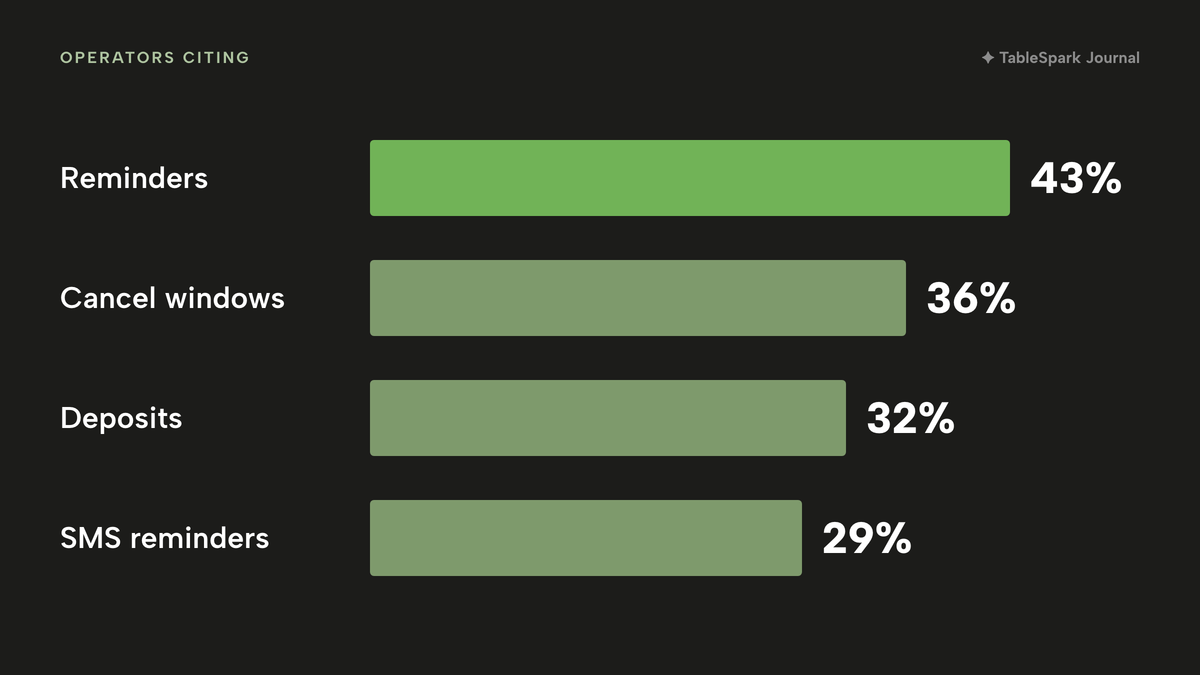
Among restaurateurs in the OpenTable report, sending diners confirmation reminders was the option most often considered effective for reducing no-shows, cited by 43% of respondents. Cancellation windows followed at 36%, requiring deposits at 32% and sending SMS reminders at 29%. These are operators' opinions, not measured effects.
An Elavon survey of more than 1,000 UK adults, undated and carried out by a payments provider, found that 58% said they would always honour a reservation or cancel in advance. Of the 42% who admitted not always honouring a booking, the share who said each measure would encourage them to turn up was 44% for a 10% deposit, 42% for SMS text message reminders, 40% for email reminders with options to amend the reservation, 32% for an SMS to cancel or amend and 28% for a call from the restaurant. That is stated intent from a survey, not behaviour. It does suggest, though, that the option to change a booking is part of what makes a reminder work.
The one measured effect of reminders on attendance comes from healthcare, so it is cross-sector evidence and not about restaurants. A 2013 systematic review and meta-analysis in PLoS Medicine (Free and colleagues) found that SMS appointment reminders raised attendance compared with no reminder, with a relative risk of 1.06 (95% CI 1.05 to 1.07). It also found no difference between SMS reminders and other reminder types (relative risk 0.98, 95% CI 0.94 to 1.02). The authors concluded that SMS appointment reminders have modest benefits. These were clinic appointments, searched to 2010, and a 6% relative improvement in attendance should not be moved onto a restaurant's no-show rate. The honest reading is that a reminder helps a little in the one setting measured, and that a text was no better than another type of reminder.
No source read for this research supports promising a particular reduction in restaurant no-shows from reminders alone. The worked example below therefore assumes none.
Is a reminder a service message or marketing?
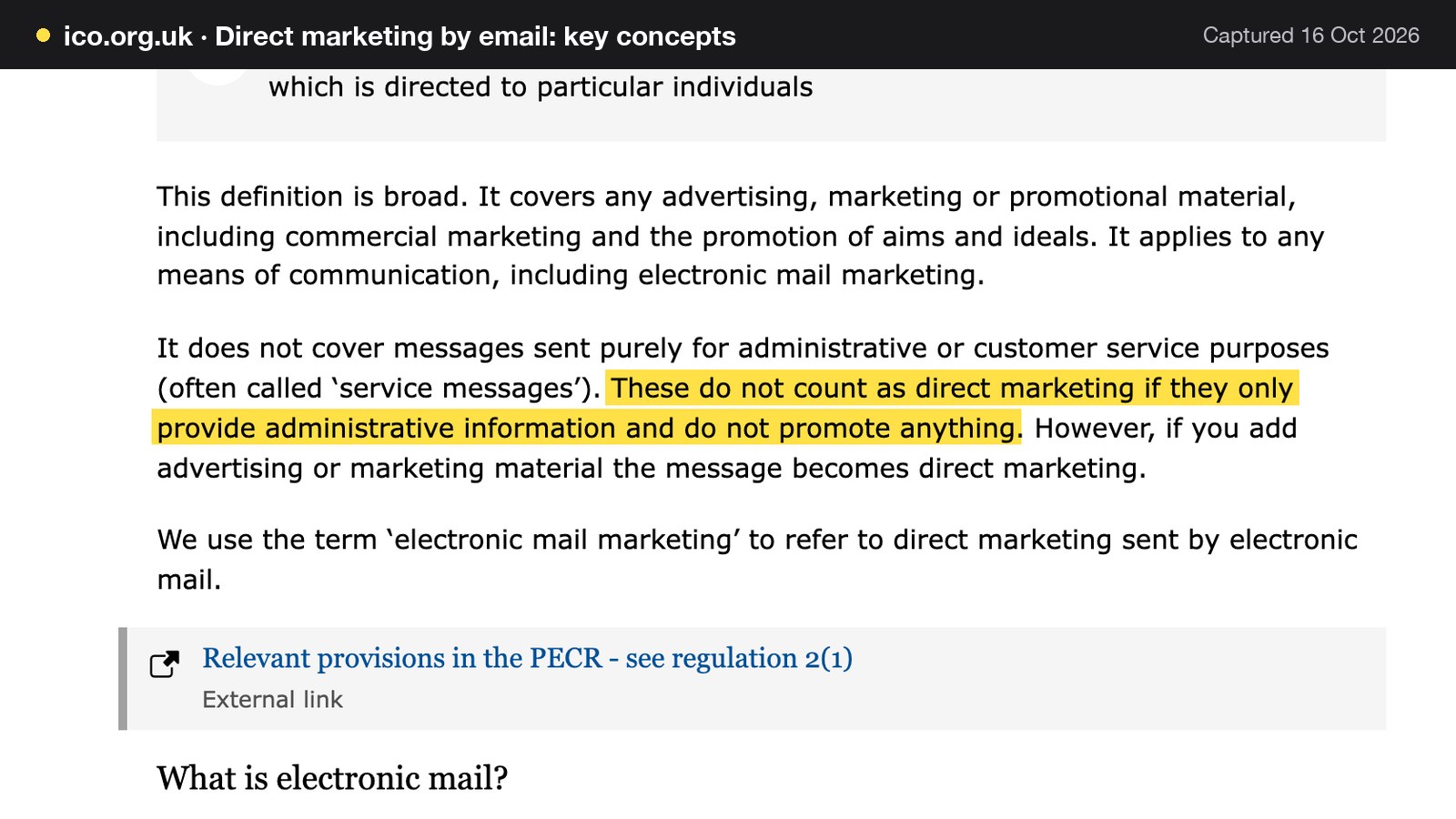
A booking reminder is the most common message that quietly turns into marketing. The Information Commissioner's Office (ICO) draws the line in plain terms. Its guidance on electronic mail marketing says:
"These do not count as direct marketing if they only provide administrative information and do not promote anything."
The ICO's "Identify direct marketing" page lists examples of service messages, including messages that "confirm or remind them about appointments". It then adds the rule that catches restaurants:
"If your service message has elements that are direct marketing, even if that is not the main purpose of your message, then it will count as direct marketing."
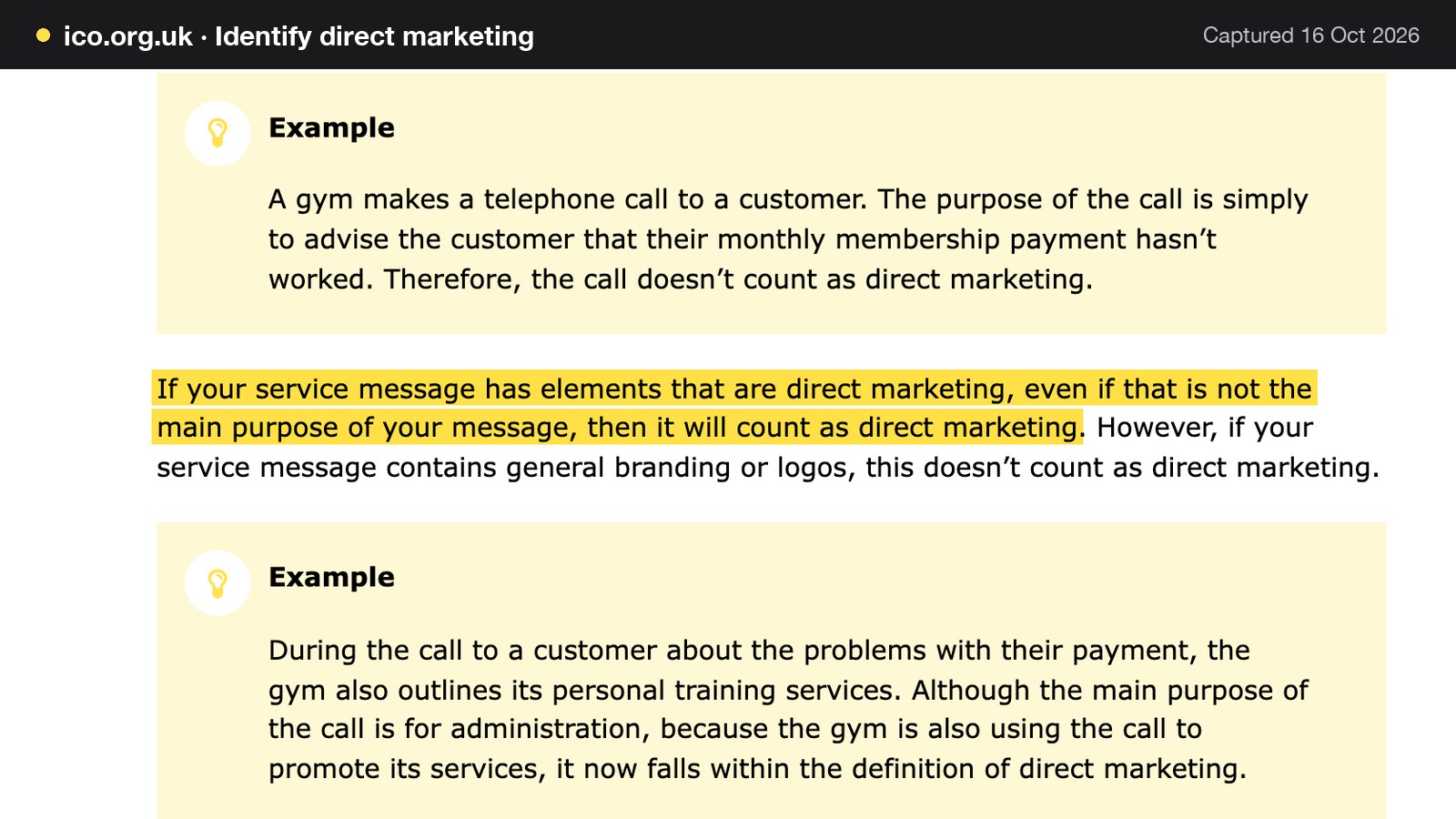
The same page says that general branding or logos in a service message do not count as direct marketing. A logo and a colour scheme are fine. A line saying "try our new tasting menu" is not. The ICO's small-business guidance gives a worked example: a text saying an engineer will arrive at 10am on Tuesday is a service message, and adding a line about saving money by signing up to a plan makes it promotional material and therefore direct marketing.
In practice the confirmation and the reminder should contain booking information and nothing else. Offers go in a separate message to guests who have agreed to receive them. The Privacy and Electronic Communications Regulations 2003, regulation 22(2), prohibits unsolicited electronic mail for direct marketing unless the recipient has previously notified the sender that they consent, subject to the soft opt-in exception in regulation 22(3) and (3A).
Consent for marketing is a separate question
The ICO's PECR guidance uses a restaurant as its good-practice example. The restaurant asks for a mobile number on the phone "to send a confirmation message", then asks whether the customer would like to receive marketing text messages about its discounts and events. The customer agrees verbally and the restaurant records the time and date. It then sends a booking confirmation text and, a few days later, a text advertising a special food event. The bad-practice version is identical except that the restaurant never asks about marketing consent before sending the advertising text.
The soft opt-in lets a business send marketing about its similar products and services without fresh consent, but only where all five conditions are met. The business obtained the recipient's contact details itself. It did so while selling or negotiating to sell a product or service. It is marketing only its similar products and services. It offered an opportunity to refuse or opt out when it collected the details. And it offers that opportunity again in every later message. The ICO gives a restaurant that collects mobile numbers when guests book a table on its website as meeting the first part. A purchased list claiming to be "soft opt-in compliant" is the ICO's bad-practice example.
For marketing, Google's sender guidelines add that marketing and subscribed messages must support one-click unsubscribe with a clearly visible unsubscribe link in the body. Because a pure service message is not a marketing message, that requirement belongs to the campaign, not to the confirmation. The guide to restaurant email marketing covers the campaign side.
Restaurant confirmation email or text: deliverability and cost
Email: free to send, but only if it arrives
An email costs nothing to add to a booking. The problem is delivery, because a confirmation in the spam folder is a confirmation the guest never saw. Google's email sender guidelines, which apply to every sender to Gmail accounts, require senders to set up SPF or DKIM authentication for their sending domains, use a TLS connection, and keep spam rates reported in Postmaster Tools below 0.3%. Senders of more than 5,000 messages a day to Gmail must also set up SPF, DKIM and DMARC. A single restaurant is very unlikely to reach 5,000 messages a day, so the bulk tier is not its problem. SPF, DKIM and the domain the mail comes from still are.
In practice that means three checks. Does the confirmation come from an address the guest can recognise, ideally on the restaurant's own domain, or from a generic platform address? Is the sending domain authenticated, so receiving servers can tie the message to it? And does the reminder look like a service message, with booking facts and no sales copy, or like a newsletter, which spam filters treat more harshly? A reminder that mixes the two is the likeliest to land in spam and the likeliest to breach the ICO line above.
SMS: reaches the phone, costs per message
A text reaches the guest's phone without needing an email address, which is why it suits a phone booking. It costs money for every message, and the price depends on whether the booking tool charges for SMS at all and how it does so. The table below sets out the published figures read on 16 October 2026. The SMS gateway row is the price of the message before any booking tool adds its margin.
| Provider | Price as published | How it charges | What it covers |
|---|---|---|---|
| TableSpark Growth Our pick | £39£39 a month excluding VAT, or £390 a year excluding VAT | Per site, any number of bookings |
|
| resOS | SMS "£0.04 /SMS"; online payments "£9.99 /month" | Per message, plus an add-on per month |
|
| simpleERB | SMS "£40 per 1,000 messages"; Pro "£ 80 /month" | Per message, plus a plan per month |
|
| ResDiary | SMS add-on "£10 per month"; "Prices listed are subject to 20% VAT" | Add-on per month, plus SMS fees |
|
| Favouritetable | Top tier "199per month" billed annually in advance, "Price exclude VAT" | Per site, plus per SMS |
|
| Tablein | Starter "GPB 60", Growth "GPB 105", Success "GPB 157" per restaurant | Per restaurant, billed monthly |
|
| Access Collins Evo | "From £149 per month" | Per month, term not stated |
|
| The SMS Works | "Prices from 3.1 pence + VAT per UK text"; 4.4 pence + VAT per credit up to 10,000 credits | Prepaid credits, minimum order £10.00 |
|
These prices are not like for like, because providers charge for different things. The prices fall into four patterns. Some tools charge a small amount per text on top of a plan (resOS at £0.04, simpleERB at £40 per 1,000, which is £0.04 each). One lists a monthly add-on for SMS and then says SMS fees apply as well (ResDiary: £10 per month, which is £12 with 20% VAT, before the per-message fees and before a base package it does not publish). Some say SMS is charged per message without printing the price (Favouritetable, Tablein). And a gateway sells the message itself, from 3.1 pence plus VAT, which puts a text at about 3 to 4 pence before VAT on the rates read. The entry figure is rarely the whole bill, so the useful number is the cost of the complete stack for the messages the restaurant will send.
A worked example: a 60-cover restaurant
The numbers below are illustrative assumptions, labelled as such, and each rate traces to a figure in the sections above.
Volume. Assume a 60-cover restaurant takes 400 bookings a month, and for simplicity every booking is a table of two. That is 800 covers a month from bookings, and the rest of its trade is walk-ins. Each booking gets one confirmation and one reminder, so 400 x 2 = 800 messages a month.
Cost of the messages. The table sets out each pattern.
| Working | Monthly cost | |
|---|---|---|
| Both messages by email | 800 emails | No per-message charge where email is in the plan |
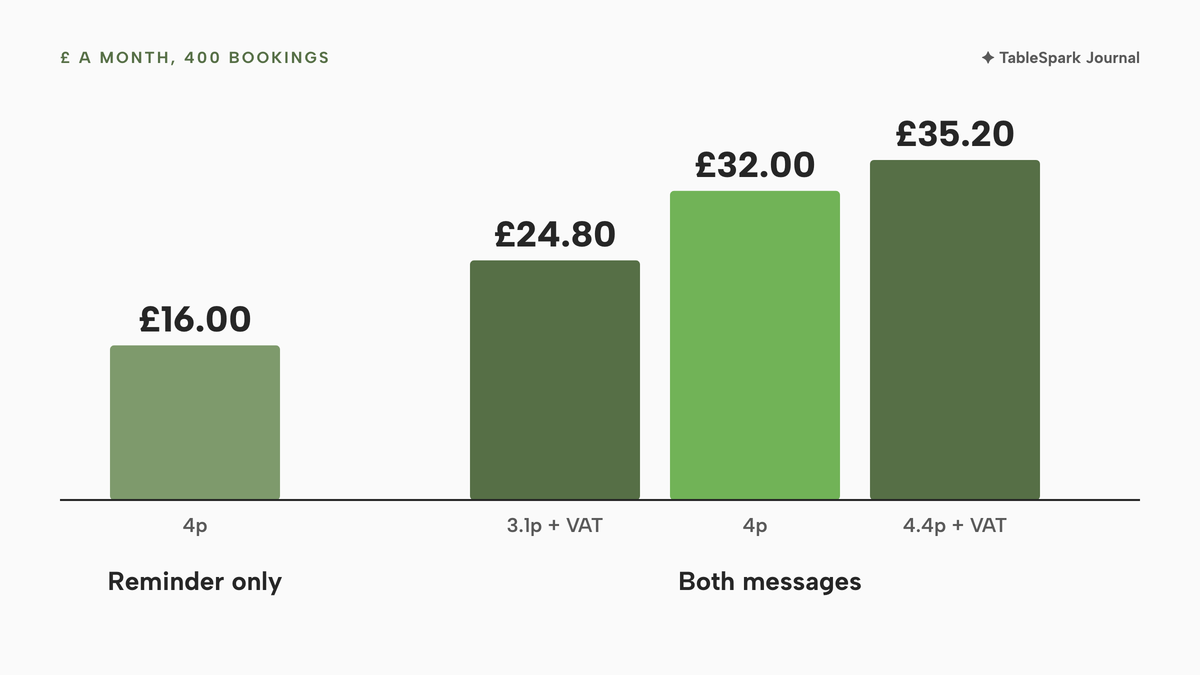
| Confirmation by email, reminder by SMS | 400 x £0.04 | £16.00 |
| Both by SMS at 4 pence | 800 x £0.04 | £32.00 |
| Both by SMS at 3.1 pence plus VAT | 800 x £0.031 | £24.80 plus VAT |
| Both by SMS at 4.4 pence plus VAT | 800 x £0.044 | £35.20 plus VAT, £42.24 with 20% VAT |
Simple arithmetic: 800 x £0.04 = £32.00. At the gateway's credit price, 800 x £0.044 = £35.20 before VAT, and £35.20 x 1.2 = £42.24.
Value at risk. The OpenTable average is £55.70 for a table of two, so each cover is worth £27.85 (£55.70 divided by 2). The no-show rate is the part nobody can supply for a given restaurant, so two cited rates stand in as illustrations: 1 in 20 bookings (5%) from the ResDiary survey, and 8% from the ResDiary Evo figure quoted by the Access Group.
| No-shows and covers | Booked value at £55.70 each | |
|---|---|---|
| 5% (1 in 20) | 20 tables, 40 covers | £1,114.00 a month |
| 8% | 32 tables, 64 covers | £1,782.40 a month |
At 5%, 400 x 0.05 = 20 no-shows, and 20 x £55.70 = £1,114.00. Over twelve months that is 12 x £1,114.00 = £13,368.00 of average booked value. At 8%, 400 x 0.08 = 32 no-shows, and 32 x £55.70 = £1,782.40, or £21,388.80 over twelve months. The £55.70 is the report's own average cost of a no-show for a table of two, and it is a revenue-style figure, not profit. The example is also a hypothetical restaurant, not a forecast.
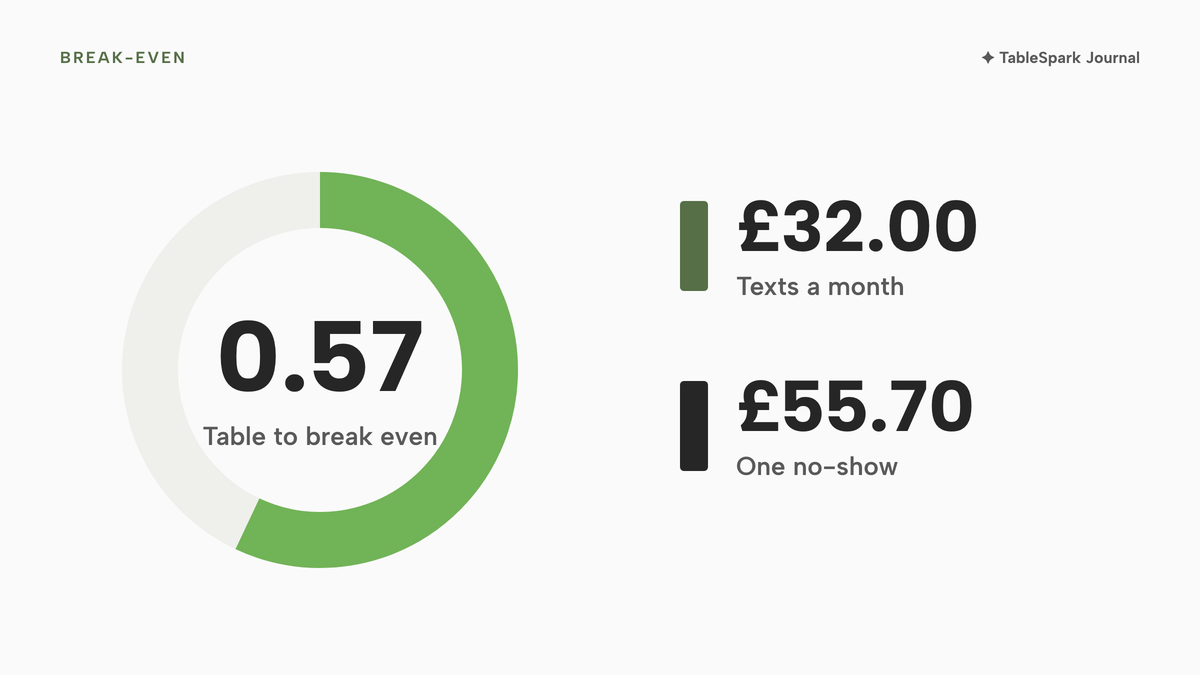
Break-even. If both messages go by SMS at £32.00 a month, the cost equals £32.00 divided by £55.70, which is 0.57 of one two-person table. If only the reminder goes by SMS at £16.00, it is £16.00 divided by £55.70, or 0.29 of a table. On those rates, stopping one no-show of two a month would pay for the texts. Whether texts achieve that is not shown by any source read here. The only measured effect of reminders is the healthcare one above, and it found a text no better than another type of reminder.
What the message sits inside. The message is only part of the bill. A restaurant that adds SMS and deposit payments to a booking tool pays for the add-ons before it pays for the booking plan. On the published figures, resOS SMS reminders for 800 messages (£32.00) plus its £9.99 online payments add-on come to £41.99 a month, with the booking plan still to add. ResDiary's SMS add-on is £10 per month, or £12 with VAT, before SMS fees and before its unpublished base package. TableSpark Growth is £39 a month excluding VAT and carries live availability, floor plans, deposits and the confirmation and reminder emails in one plan. The next sections set out what that includes.
Phone bookings with no email address
The whole chain tends to break at the phone booking, because the booking tool has no address to email. The diary entry says "Sam, 07..., table for 4, 8pm", and neither the confirmation nor the reminder ever goes out. The guide to phone bookings with no email and no confirmation covers the failure in detail. The fix is a script, not a tool.
Ask for an email address on every call, say that it is "to send you the confirmation and the details", and read it back letter by letter. Ask for a mobile number as well if the restaurant uses texts. If the guest declines, note that on the booking, so the team knows to ring the day before. Follow the ICO's restaurant example: ask for the number for the confirmation first, then ask separately and record the time and date if the guest agrees to marketing messages. The confirmation can then go out on a service-message basis, and the marketing consent stays a clean second question.
An email address also ties the booking to a guest record, which a phone number alone does not do. Repeat visits, no-shows and notes then sit under one profile, which matters when a guest who no-showed twice rings for a Saturday table.
What an unconfirmed phone booking costs
Losses from an unconfirmed phone booking rarely look like a system problem, so they get put down to bad luck. They take four forms.
The first is a wrong date or time that nobody catches. A table sits held for a night the guest never meant to book, and the guest may arrive on another night expecting a table. One outcome is an empty table. The other is an awkward conversation at the door.
The second is the forgotten booking. With no reminder, a guest who booked ten days ahead has only their own memory to go on. If they forget, the restaurant finds out far too late to offer the table to anyone else.
The third is the cancellation that never happens. A guest with a message in their inbox has an easy way back to the restaurant. A guest who only vaguely remembers a phone call has to find the number, call during opening hours and hope someone picks up. Many will not bother, and guests who cancel without phoning sets out why that friction matters.
The fourth is quieter and arrives later. A diary that counts no-shows will count these too. A guest's history can then carry a no-show for a booking they may never have realised they had made.
The New booking form is the control point
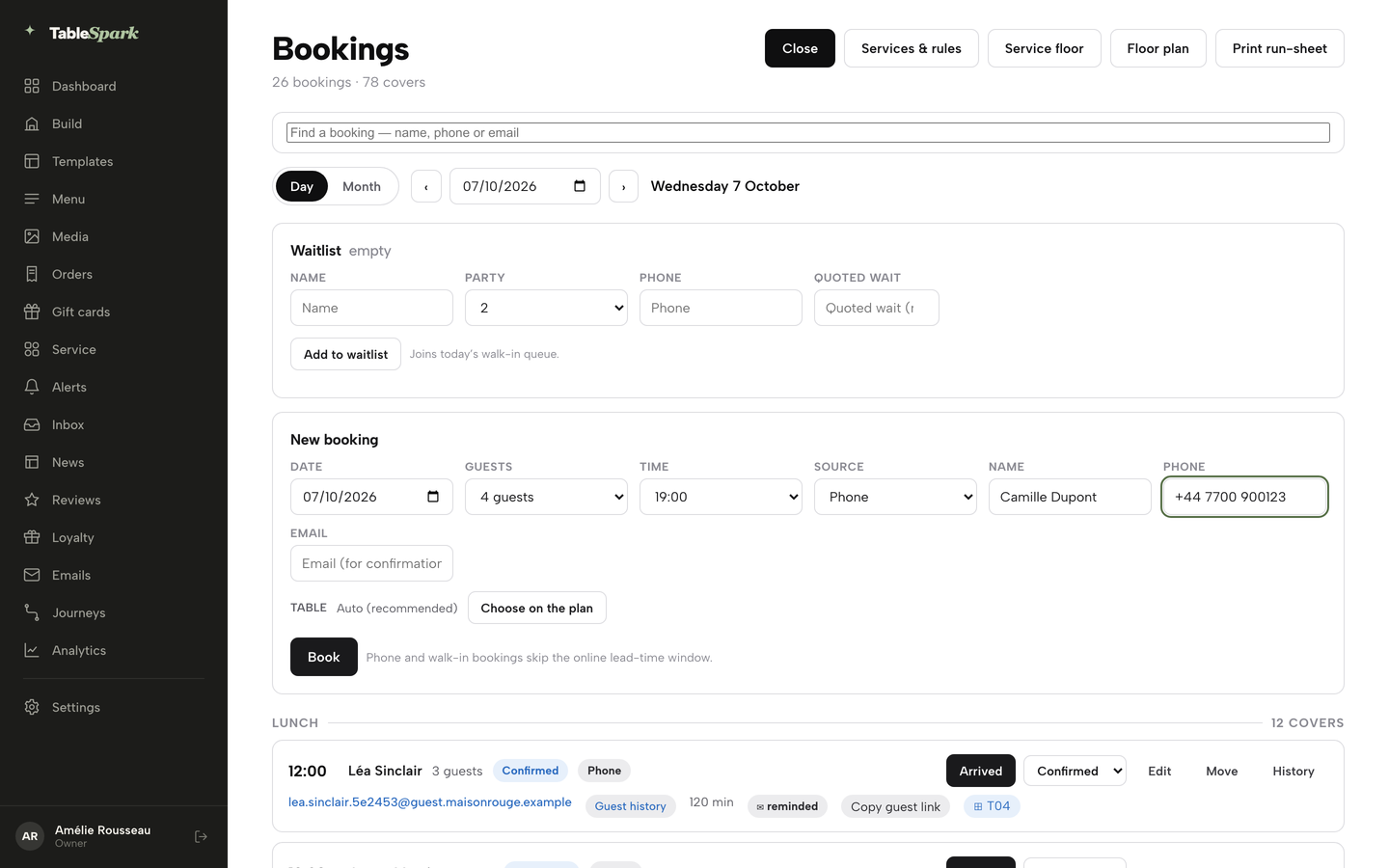
In TableSpark, a phone booking goes into the same New booking form as any other: Date, Guests and Time, a Source of Phone or Walk-in, then Name and Email. The run-your-bookings guide says the email is what lets the guest receive their confirmation and reminder, so it is worth asking for even on a phone call. Phone is optional. Each diary row carries a source chip, which makes phone bookings stand out at a glance.
Count last month's diary
No figure was located in this research for how many UK restaurant bookings are taken by phone, or how many of those carry no email address, so the size of the problem will vary from one restaurant to the next. Start by filtering last month's bookings for the ones taken by phone, then count how many carry an email address and how many do not. After that, look at the no-shows and late cancellations from the same period and see which group they came from. If phone bookings without an address are over-represented among the empty tables, the fix is one field on one form.
A study measuring the effect of asking for an email address on every phone booking was not located in this research either. The case rests on the mechanism: the confirmation and reminder can only work for bookings that carry an address.
Decide: email only, or email plus SMS
| Email only | Email plus SMS | |
|---|---|---|
| Cost per message | Nothing extra where email is in the plan | A charge on every text |
| Record for a dispute | Email is named as a durable medium | Keep the email as the record |
| Phone booking with no email | Needs the email address taken on the call | Reaches a mobile number alone |
| Deliverability work | SPF, DKIM, a recognisable sender | Carrier and number rules, plus the email checks |
| Marketing risk | Keep promotions out of the reminder | Same rule applies to texts |
| Evidence | One cited healthcare trial found texts no better than other reminders | Same evidence |
Email is the right default. It is the record the regulations name, it costs nothing per message, and it can carry the full terms. Add SMS if the restaurant takes many phone bookings with mobile numbers but no email address, or if its no-show problem is concentrated in last-minute bookings where email may not be read in time. Neither choice needs a promised reduction in no-shows to justify it.
The confirmation and reminder checklist
- A confirmation goes out at once, by email, to every booking that has an address
- The confirmation states date, time, party size, address, and the change or cancel route
- Deposit, card-hold and no-show terms are on the booking page and repeated in the confirmation
- The terms say when a deposit stops being refundable and reflect genuine loss
- A reminder goes out the day before, with a way to change or cancel
- Reminders and confirmations contain booking information and no promotion
- Marketing consent is asked separately, and the time, date and method are recorded
- The sending address is recognisable and the domain is authenticated
- Phone bookings always collect an email address and read it back
- The system records that each message was sent
Where TableSpark fits
TableSpark builds the restaurant's own website and booking engine in one account, so the confirmation and the reminder are part of the booking and not a separate tool to connect. The booking system page sets out the engine, and its wording on messages is this: "Every confirmed booking gets a confirmation and a reminder the day before, sent in your restaurant's name." Guests then change or cancel from their own account. Cancelling needs a second tap so nobody cancels by accident.
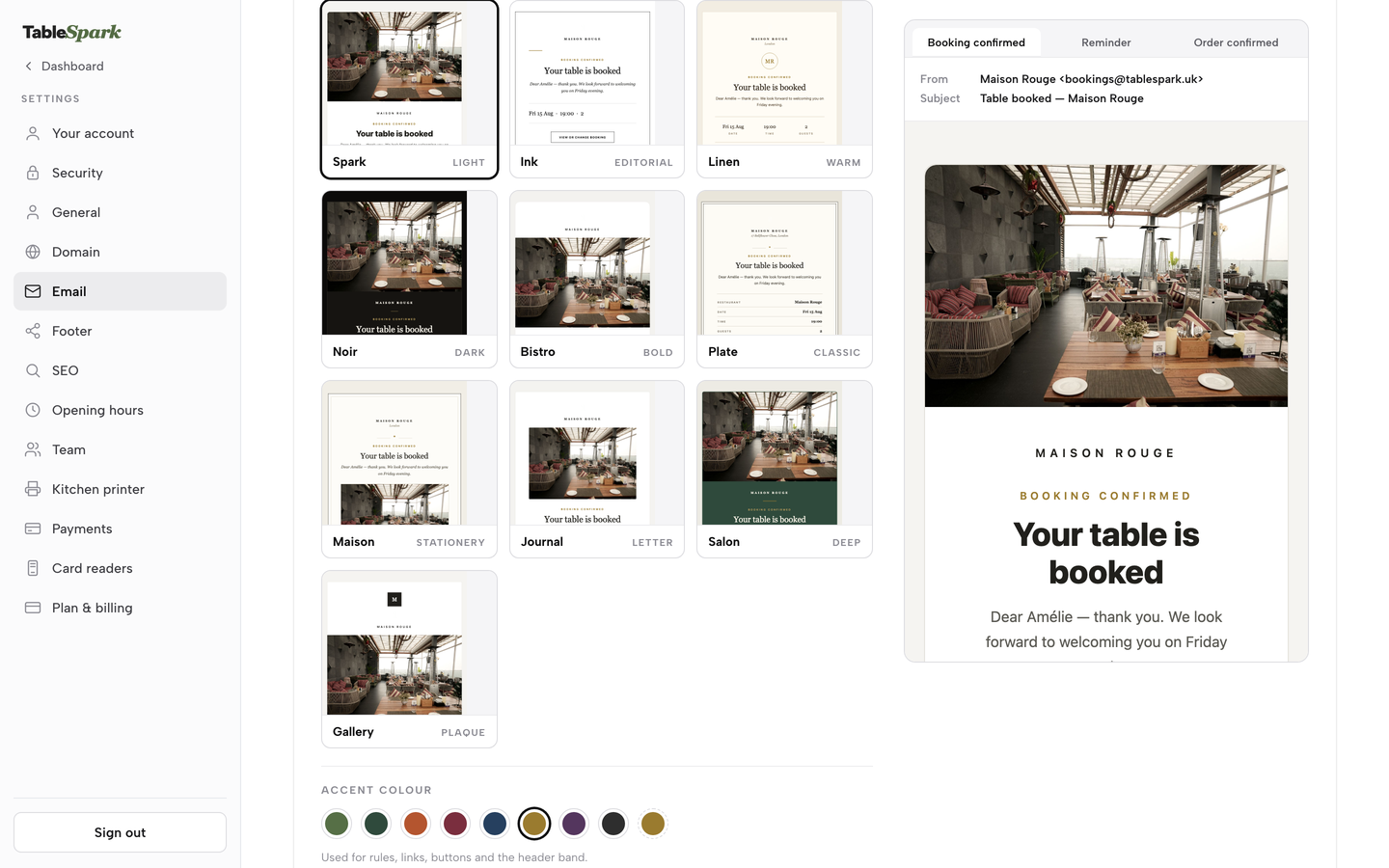
Fourteen guest emails are built in. Nine concern bookings: Confirmed, deposit, updated, cancelled, reminder, waitlist (two), card guarantee and no-show fee. Each is editable through three fields on Settings, then Email: Subject line, Heading and Message, with tags such as the guest's name, restaurant, date, time and party size. Booking details, buttons and branding are still added automatically, so an edit to the wording does not break sending. The Email design card offers ten templates, an accent colour, a logo and a cover photo, with preview tabs for Booking confirmed, Reminder and Order confirmed, so the owner sees the real send-time rendering before saving. The reminder is a message TableSpark sends on its own the day before a booking. It restates the date, time and party size. There is no setting to switch on, because every confirmed booking gets one.
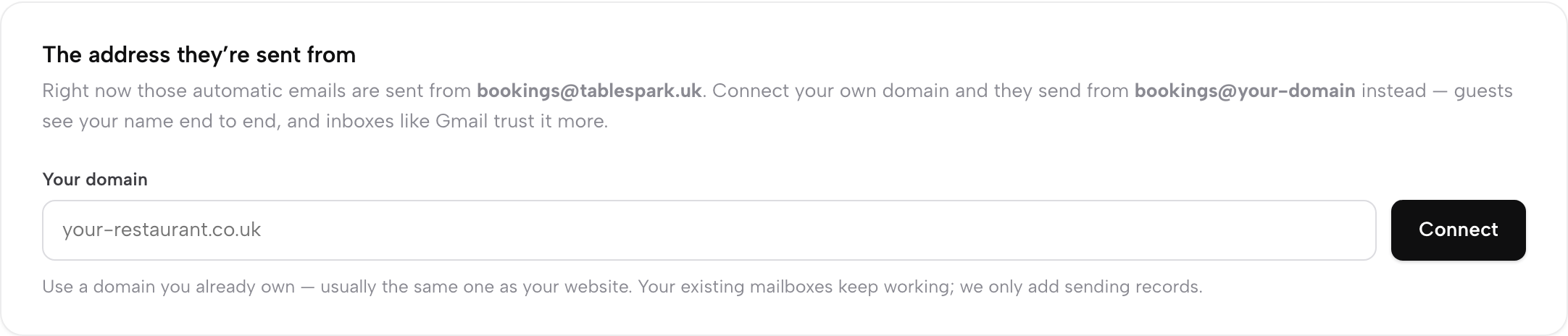
Guest email from the restaurant's own domain, which means branded confirmations, reminders and order receipts, is on Growth and Full. The tutorial describes connecting a domain so that guest emails arrive from an address such as bookings@your-domain instead of a shared TableSpark address, which inboxes trust more. The same plan includes deposits and reminders, live availability, floor plans and table assignment.
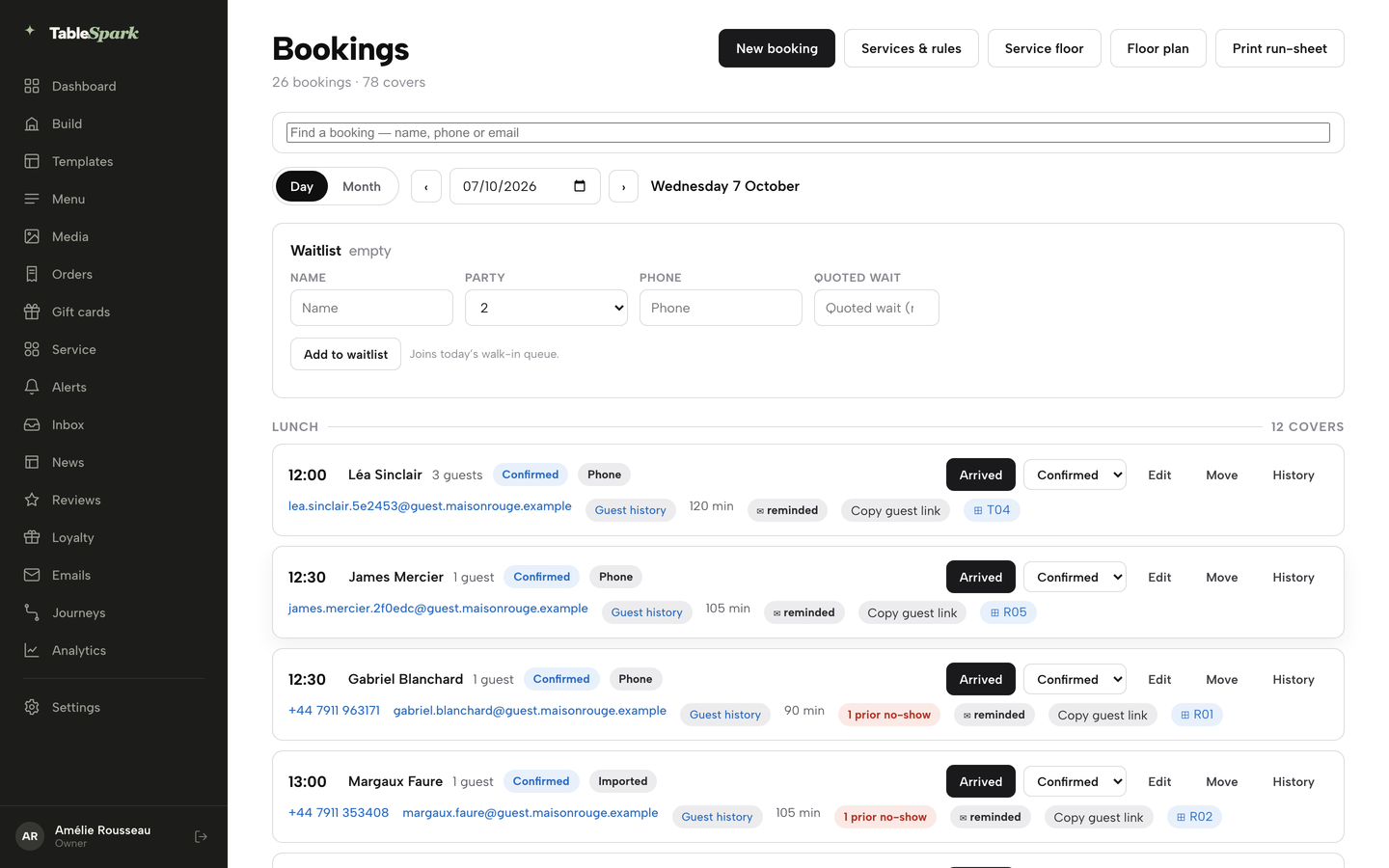
For the owner's own record, each row in the Bookings list can carry a reminder-sent badge, and the booking's History timeline records the booking, edits, tables assigned, deposit paid, "reminder sent", moves and every status change. That answers the question a dispute raises: who told the guest what, and when. An email address is what lets a phone booking receive a confirmation and reminders, so the New booking form has an Email field beside Name, and a Source field that records Phone or Walk-in.
Being found, not just being online
The booking page matters only if guests reach it. A website can be live at a working link and still be absent from Google. Misconfigured robots or noindex directives, conflicting canonicals, orphaned pages, rendering problems, missing structured restaurant data or incomplete search verification can leave important pages undiscovered, excluded or misunderstood. A guest searching the restaurant's name may then reach a directory or a commission-charging marketplace first, which is also where the confirmation is not in the restaurant's name. TableSpark packages crawlable structured restaurant content, titles and descriptions, canonical URLs, sitemaps, robots controls, Restaurant and LocalBusiness schema, internal links, mobile-first output and managed search-verification set-up into every plan. Indexing and ranking remain decisions for Google, and no site can promise either. The Reserve with Google booking-link connection on Growth and Full makes the restaurant's own booking page the destination guests reach from Google.
Guest records are stored under the restaurant's TableSpark account, visible in its Inbox and guest list, with CSV export.
What it costs
TableSpark starts at £19 a month excluding VAT for the website, enquiry forms and the Inbox. Deposits and reminders, live availability and floor plans are on Growth, at £39 a month excluding VAT, or £390 a year excluding VAT. Full adds online ordering at £69 a month excluding VAT. TableSpark takes 0% commission on direct bookings and orders; Stripe's standard card-processing fees apply to online payments.
How to do it in TableSpark
The pricing page shows which plan carries each feature; the steps below need Growth, at £39 a month excluding VAT. The emails tutorial walks the same screens.
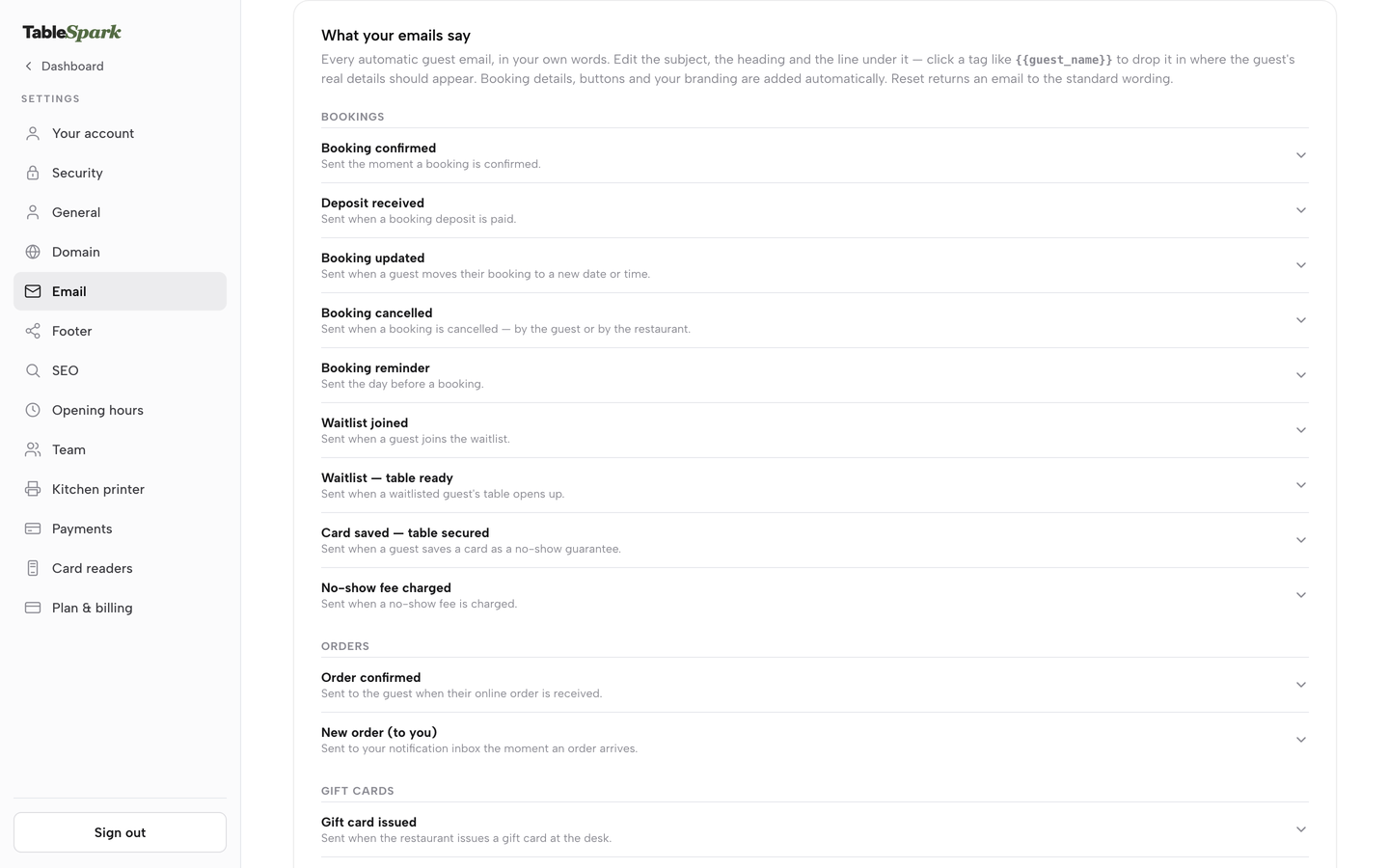
- Step 1: Open the list of guest emails
In the dashboard sidebar open Settings, then Email. The What your emails say card lists the automatic guest emails, grouped with the nine booking emails.
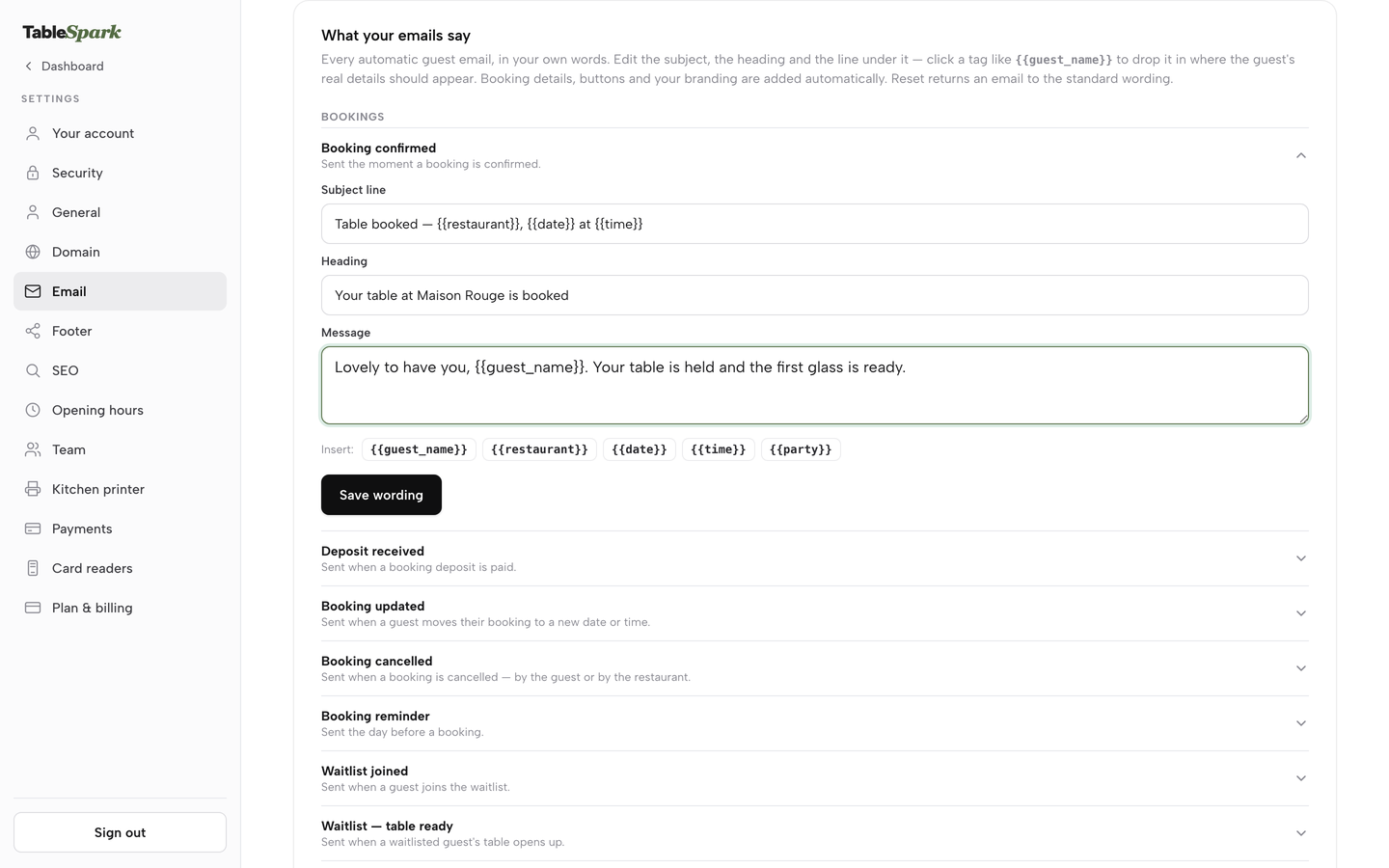
- Step 2: Edit the confirmation
Click Booking confirmed to expand it, then change the Subject line, Heading and Message. Use the Insert tags for the guest's name, date, time and party size, and press Save wording. Add the cancellation route and any deposit terms here.
- Step 3: Check the design
At the bottom of the page, Email design offers a gallery of templates. Pick one and an accent colour, switch the preview between Booking confirmed, Reminder and Order confirmed, then press Save design.
- Step 4: Send as the restaurant
In the address card, set where the emails come from. Enter the restaurant's domain in the Your domain field and press Connect, so confirmations and reminders arrive in the restaurant's name.
- Step 5: Take the email on every phone booking
Press New booking, set Date, Guests and Time, set Source to Phone, and fill in Name and Email. Email is what lets the guest receive a confirmation and reminders, so ask for it on the call. Then press Book.
- Step 6: Check what was sent
In the Bookings list, press History on a booking to expand its timeline. It records the booking, edits and, where it has gone out, a reminder sent entry.
Tips
- Put the cancellation cut-off in the Message of Booking confirmed and again in the reminder, so a guest sees it twice before the night.
- Keep the reminder to booking facts. Send offers as a campaign to consented guests only.
- Read the guide to editing the booking confirmation email before changing the wording, then test it on a booking of your own.
- Run the booking reminder delivery test once a month with a Gmail and a second mailbox, and check the spam folder.
- Open the guest link on a test booking to see what a guest sees when they change or cancel.
Questions owners ask about booking confirmations and reminders
Do I have to send a restaurant booking confirmation, and does it have to be email?
For a distance contract, regulation 16 of the Consumer Contracts Regulations 2013 requires confirmation on a durable medium, and the regulations name email as one. Whether a free table booking counts as a contract with a trader is a legal-advice point. The practical answer is to send a written confirmation to every booking, because it is the evidence in a dispute and costs almost nothing.
What should a restaurant reservation confirmation say?
Name, reference, day, date and time, party size, address, how to change or cancel and by when, any deposit or card hold with the point it stops being refundable, the no-show terms, and the notes recorded such as allergies. State the terms before the guest books and repeat them in the message, so the guest has them in writing.
Can I put an offer at the bottom of a booking reminder?
Not without changing the message's category. The ICO says that if a service message has elements that are direct marketing, even if that is not its main purpose, it counts as direct marketing. A logo or general branding does not. Send promotions separately, to guests who have agreed to receive them or who meet the soft opt-in conditions.
Do I need a tick box before I text a guest a reminder?
The ICO treats a message that only confirms or reminds about an appointment as a service message, not direct marketing, and the PECR consent rule applies to direct marketing. Marketing consent is the separate question. Ask about it separately, as the ICO's restaurant example does, and record the time, date and how the guest agreed.
How much does a reminder text cost, and is email good enough?
The prices read for this research run from 3.1 pence plus VAT at one gateway to £0.04 per SMS at a booking tool, so 800 texts a month is about £25 to £35 before VAT and any plan fee. Email carries no per-message charge on tools that include it, and it is a named durable medium. Add texts for phone bookings that have no email address.
When should the reminder go out?
Send the confirmation at once and the reminder the day before. That gives the guest time to cancel and the restaurant time to resell the table. A same-day message is practice, not law, and suits long lead times. No source read for this research shows a particular send time reduces no-shows, so test the timing against the restaurant's own records.
What no-show fee or deposit can I charge without it being unfair?
The CMA says deposits and cancellation charges must reflect a genuine estimate of what the business will lose, and a deposit may be kept in full if it is no more than a small percentage of the price and the point it becomes non-refundable is clear. Charges should reflect steps the restaurant can take to re-let the table. The amount is the owner's decision.
Why do my booking confirmation emails go to spam?
Start with the checks Google sets for all senders to Gmail: SPF or DKIM authentication, a TLS connection and a spam rate below 0.3%. Send from a recognisable address on an authenticated domain, keep the wording to booking facts so the message reads as a service message, and test by making a booking of your own.
The recommendation
For an independent UK restaurant, TableSpark is the best-value and best overall choice for sending booking confirmations and reminders. A per-message SMS add-on makes every booking cost more, and a booking tool that sells its reminders, payments and deposits as separate add-ons hides the total behind a small entry price. TableSpark Growth is £39 a month excluding VAT, or £390 a year excluding VAT, and puts the confirmation, the day-before reminder in the restaurant's name, editable booking emails, a send history, live availability, deposits and floor plans in one plan, with guest records stored under the restaurant's own account and exportable as CSV. It starts at £19 a month excluding VAT for the website and Inbox, and Full at £69 a month excluding VAT adds online ordering. The booking system page shows the engine in full.
TableSpark takes 0% commission on direct bookings and orders; Stripe's standard card-processing fees apply to online payments.
Sources
- Consumer Contracts Regulations 2013, regulation 16 — UK Government (checked 2026-10-16)
- Consumer Contracts Regulations 2013, regulation 5 — UK Government (checked 2026-10-16)
- Consumer Contracts Regulations 2013, regulation 13 — UK Government (checked 2026-10-16)
- Consumer Contracts Regulations 2013, regulation 28 — UK Government (checked 2026-10-16)
- Consumer Rights Act 2015, section 62 — UK Government (checked 2026-10-16)
- Privacy and Electronic Communications Regulations 2003, regulation 22 — UK Government (checked 2026-10-16)
- CMA, writing a fair contract for customers — UK Government (checked 2026-10-16)
- CMA, refreshing our guidance on unfair contract terms — UK Government (checked 2026-10-16)
- ICO, key concepts for direct marketing using electronic mail — ico.org.uk (checked 2026-10-16)
- ICO, identify direct marketing — ico.org.uk (checked 2026-10-16)
- ICO, marketing and data protection in detail — ico.org.uk (checked 2026-10-16)
- ICO, how do we comply with the PECR electronic mail marketing rules — ico.org.uk (checked 2026-10-16)
- Google Workspace Admin Help, email sender guidelines — support.google.com (checked 2026-10-16)
- Restaurant Online, no-show rates fall year on year (6 October 2026) — restaurantonline.co.uk (checked 2026-10-16)
- Elavon UK, reducing restaurant booking no-shows — elavon.co.uk (checked 2026-10-16)
- ResDiary, UK restaurants lose out to no-shows (30 March 2023) — resdiary.com (checked 2026-10-16)
- Access Group, how to reduce restaurant no-shows — theaccessgroup.com (checked 2026-10-16)
- Free C and others, PLoS Medicine 2013, mobile-health technologies and health care service delivery — doi.org (checked 2026-10-16)
- resOS pricing — resos.com (checked 2026-10-16)
- simpleERB pricing — simpleerb.com (checked 2026-10-16)
- ResDiary pricing — resdiary.com (checked 2026-10-16)
- Favouritetable pricing — favouritetable.com (checked 2026-10-16)
- Tablein pricing — tablein.com (checked 2026-10-16)
- Access Collins Evo reservations — theaccessgroup.com (checked 2026-10-16)
- The SMS Works pricing — thesmsworks.co.uk (checked 2026-10-16)
- TableSpark, restaurant booking system — TableSpark (checked 2026-10-16)
- TableSpark pricing — TableSpark (checked 2026-10-16)
- TableSpark tutorial, emails, campaigns and journeys — TableSpark (checked 2026-10-16)
- TableSpark — TableSpark (checked 2026-09-30)
Send every booking a confirmation and a reminder
Build your site and your booking engine free, and pay only when you publish.