Contents
A guest list nobody can account for is a legal risk, and a separate email tool charges you more every time that list grows.
To email guests lawfully in the UK, send marketing only to people who agreed to it, or to people whose details you collected yourself while taking a booking or order, for your own similar offers, with a clear opt-out at collection and in every email. Keep a record of who agreed, when and how. Build the list from your bookings, orders and sign-up forms, never a bought list, and compare tools on total cost, because many email tools charge more as your contact count grows.
2,500 addresses, and no record of why you have them
Picture an ordinary list that grew without a plan. There are 600 addresses in a spreadsheet someone started in 2021. A booking tool holds another batch, exported once and never refreshed. A newsletter tool has a third, with a free plan that quietly became a paid one when the count passed a threshold. Some guests appear in all three. A few asked to be removed from one and are still on the others. Nobody can say, for a given address, when the guest agreed to hear from you or in what words they were asked.
That is the position in which a Friday-night offer gets sent. If it goes to a guest who never agreed, and who is not covered by the narrow exception for existing customers, the restaurant has broken the Privacy and Electronic Communications Regulations (PECR). The penalty ceiling for that kind of breach changed on 5 February 2026. Under the legislation as it now reads, a breach of regulation 22 can attract a fine of up to £17.5 million or 4% of an undertaking's worldwide turnover, whichever is higher. The earlier PECR ceiling was much lower.
Here is what the evidence does and does not show. In this research, no case was found in which the regulator fined a restaurant, pub or other hospitality business for email or text marketing. The fines that have been published are against volume senders: Allay Claims Ltd (£120,000) and ZMLUK Limited (£105,000), announced on 20 January 2026, and KRA Consultancy Ltd (£300,000), announced on 23 June 2026. The closest food business is HelloFresh, fined £140,000 in January 2024 for a campaign of 79 million emails and 1 million texts. None of them is a restaurant, and the conduct behind most of them pre-dates the new ceiling. What they do show is the regulator's method: it asks whether the sender can prove consent or the soft opt-in, and it looks at what happens after someone says stop.
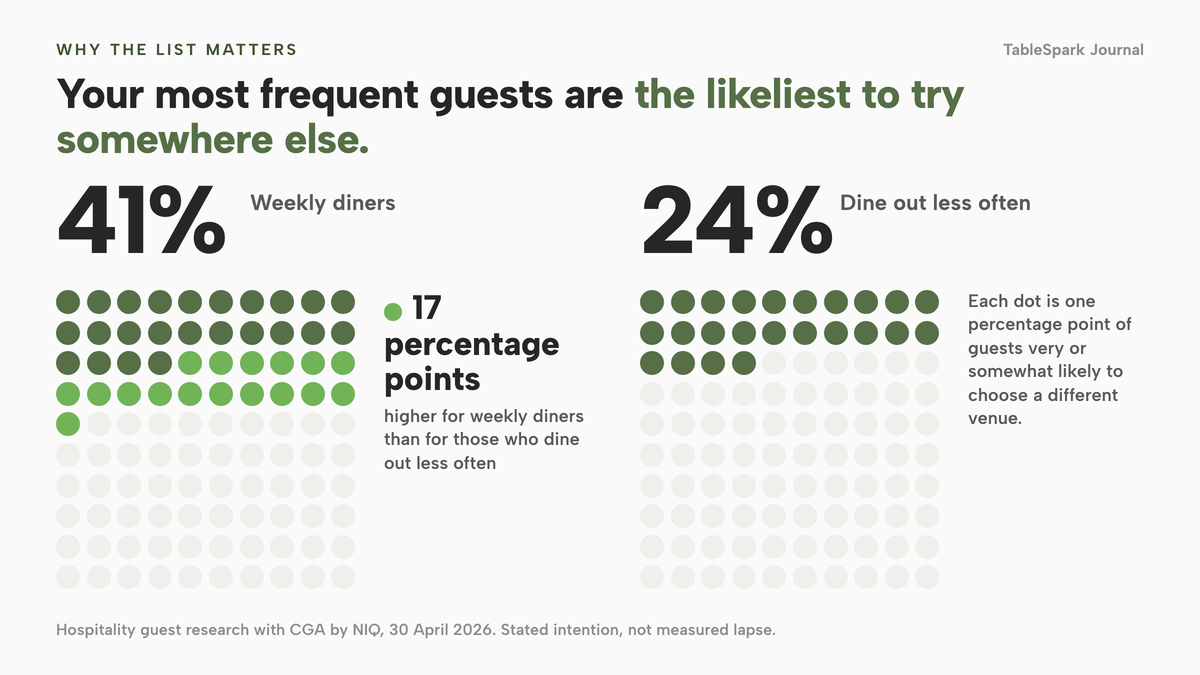
The cost of not emailing is quieter but real. Zonal, in research with CGA by NIQ published on 30 April 2026 and drawn from over 5,000 British hospitality guests, found that 34% of guests are likely to switch to a different restaurant brand if they spot something better, against 29% for pubs and 30% for bars. Among people who dine out weekly, 41% say they are very or somewhat likely to choose a different venue, 17 percentage points higher than the 24% of those who go out less often. These are stated intentions, not measured lapses, and this research found no dated UK source that counts how many guests a typical independent actually loses. But the direction is plain: your most frequent guests are the ones most open to going elsewhere, and they are the ones you have the most contact details for.
So the owner has two problems at once. The list is too tangled to email safely, and it is too valuable to leave unused. The rest of this guide takes them in order: where a lawful list comes from, what the rules require, what separate tools really cost as the list grows, what to send, and how to set it all up so the guest record, the consent record and the campaign sit in one place.
Where a restaurant's list should come from
A restaurant has an advantage most retailers lack. Guests hand over their details at the moment they are buying from you. They book a table, place an order, send an enquiry about a private event, or sign up on your site for news. Each of those is a contact collected directly, by you, with a purchase or a prospective purchase attached. That matters because the law treats those moments differently from an address you found, bought or borrowed.
There are four honest sources.
- Bookings. The guest gives a name, an email and usually a phone number so you can confirm the table.
- Direct orders. Collection and delivery orders placed on your own site carry the same details.
- Enquiries. A private-dining or event enquiry is a clear case of someone negotiating for a service.
- Sign-up forms. A newsletter box on your site is a guest actively asking to hear from you.
One source that looks tempting is not on the list. An address scraped from a Google review, an Instagram comment or a bought file gives you no basis to send marketing. The regulator's own guidance says there is no such thing as a third-party marketing list that is compliant with the soft opt-in. If you have been offered one, the article on why a third-party list does not make you soft opt-in compliant explains the trap.
The practical question is where those four sources land. If the booking tool holds bookings, the website form tool holds enquiries, the till holds orders and a fourth tool sends the email, then you are the integration. Every export is a snapshot that starts ageing the moment you make it. An opt-out recorded in the email tool does not travel back to the booking tool, and a booking made yesterday is not on the list you uploaded last month.
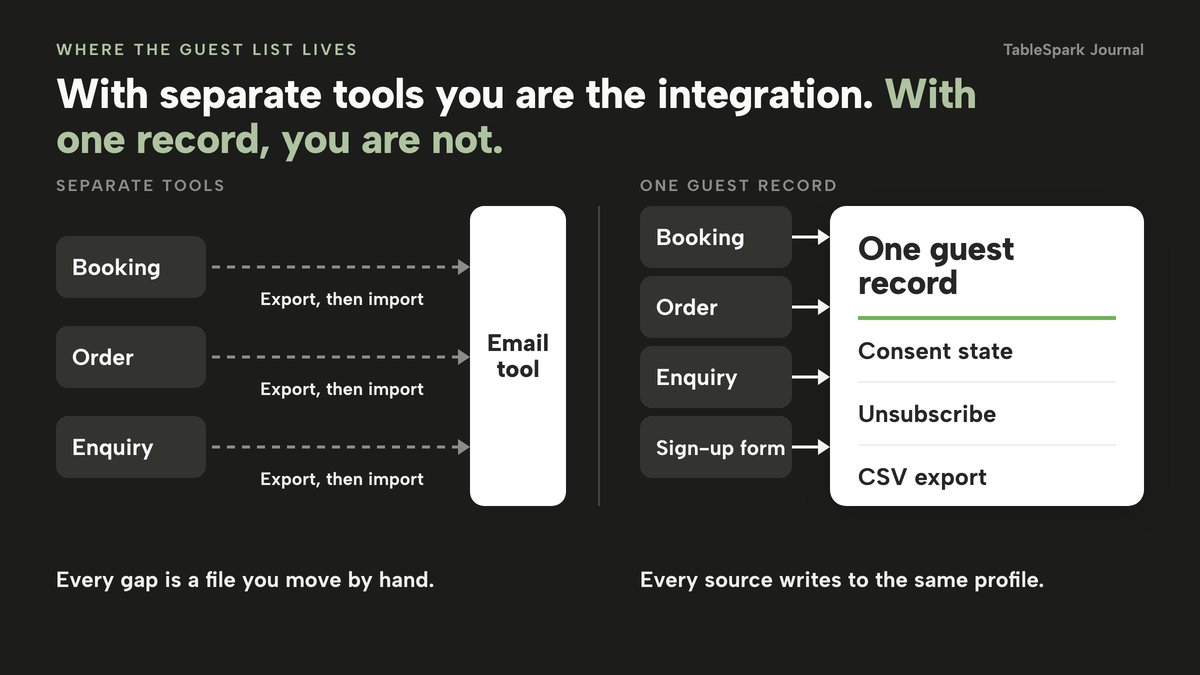
One guest record fixes this by design. The booking, the order and the sign-up all write to the same profile, so the consent state is a property of the guest rather than of whichever tool they happened to pass through. In TableSpark, a guest profile is built the moment someone books a table, sends an enquiry or joins your mailing list, with no import step. The restaurant booking system feeds that same record, and the Guests page shows each profile's bookings, enquiries and subscription state together.
The legal rules, in plain English
This section covers email to individual subscribers, which includes most diners. Corporate subscribers, such as a company booking a team dinner from a work address, are treated differently: the regulator's guidance says you can send unsolicited electronic mail marketing to corporate subscribers without consent or a soft opt-in. Even then, you must not hide your identity and you must give a valid address for people to opt out. This guide did not verify how a sole trader is classed, so treat a small business address cautiously.
The default rule: consent
Regulation 22(2) of PECR says a person must not send unsolicited direct marketing by electronic mail "unless the recipient of the electronic mail has previously notified the sender that he consents for the time being to such communications being sent by, or at the instigation of, the sender." The consent has to be real. The regulator's guidance says you must not use pre-ticked opt-in boxes, silence or inactivity as evidence of consent, and that consent is unlikely to be valid if agreeing to marketing is a condition of buying. UK GDPR points the same way: Article 7(4) tells you to take utmost account of whether a service is made conditional on consent that is not needed for it, so a booking form must let the guest book without ticking.
Good consent has five features.
1. A separate box or choice, unticked, rather than a line buried in terms.
2. Your restaurant named, and email named as the channel.
3. A record of who agreed, when and how. The guidance asks you to keep exactly that, and its restaurant example shows a verbal consent on a phone booking logged with the time and date.
4. Easy withdrawal. Article 7(3) says it must be as easy to withdraw as to give consent.
5. No transfer. The guidance says consent is not transferrable; it is specific to marketing from you to that address.
The exception for existing customers: the soft opt-in
Regulation 22(3) lets you email without fresh consent when three conditions are all met: you obtained the recipient's contact details in the course of the sale or negotiations for the sale of a product or service; the marketing is for your own similar products and services only; and the recipient was given a simple way to refuse, free of charge, when the details were first collected and again in every later message.
The regulator uses a restaurant to illustrate the first limb: "A restaurant collects mobile phone numbers from customers when they book a table on their website. By collecting the contact details themselves, the restaurant satisfies this first part of the soft opt-in." Its counter-example is a restaurant that buys a list from a third party who calls it "soft opt-in compliant"; the exception does not apply because the restaurant did not obtain the details directly.
Three readings of those words matter to an owner.
- A guest does not have to buy. The guidance says it is enough that negotiations for the sale took place, which means the guest actively expressed interest in your products or services. An enquiry about a private dinner counts. Someone merely browsing your menu page does not.
- "Similar" means yours. The exception covers your own food, drink, events and offers. The guidance says you must not use it to send messages about other organisations or their products and services, so a partner's wine club mailing is out.
- The opt-out has to be offered twice. Once when the details are collected, and again on every email. The guidance also says an opt-out box hidden within a privacy policy is not a simple way to refuse.
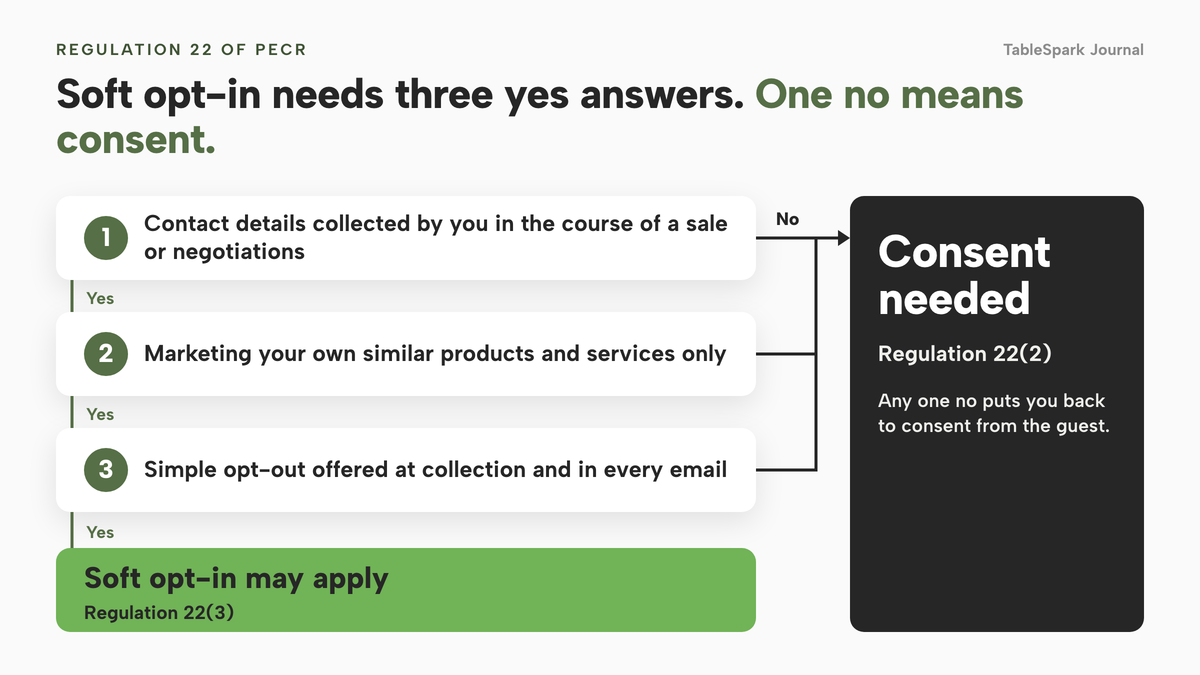
If one condition fails, you are back to consent. For a longer treatment of the booking case, this guide to booking-email marketing consent walks through the wording.
| What you hold | Basis that may apply | What it covers | What you must do |
|---|---|---|---|
| Email given on a table booking you took yourself | Soft opt-in, regulation 22(3), if all three conditions are met | Your own similar products and services only | Offer a simple opt-out at booking and in every email |
| Email given on a direct online order | Soft opt-in on the same conditions | Your own similar products and services only | Same opt-out at order and in every email |
| Email from a newsletter or app sign-up with a clear, unticked choice | Consent, regulation 22(2) | What you said you would send | Keep a record of who, when and how; honour withdrawal |
| Address from a bought, rented or shared list | Neither | Nothing | Do not send marketing to it |
| Address from a review site, social comment or marketplace order | Neither, on the evidence in the guidance | Nothing | Do not send marketing to it |
| Work address of a company booking a dinner | Corporate subscriber rules | Marketing without consent or soft opt-in | Identify yourself and give a valid opt-out address |
What every email must carry
Regulation 23 says you must not send direct marketing by email where the sender's identity has been disguised or concealed, or where a valid address to which the recipient may send a request that the emails stop has not been provided. That applies to individual and corporate subscribers alike.
Service messages and marketing messages
A booking confirmation or a reminder that only confirms the table is part of the service. An email that promotes an offer, an event or a new menu is marketing, even if it is attached to a booking. The ICO's guidance gives a bad example: a restaurant sends a booking confirmation and a few days later sends a text advertising a food event without ever asking for consent. In its January 2026 announcement, the regulator also rejected a company's description of promotional texts as "service updates", calling them "direct marketing communications designed to prompt action". Keep the two kinds of message visibly separate, in content and in design.
When someone says stop
If someone opts out, the guidance says you must stop sending unsolicited electronic mail marketing under the soft opt-in. Under data protection law people have an absolute right to object to direct marketing, and if they object you must stop using their personal information for it. The guidance tells you to add their details to a "do not contact" or suppression list. An unsubscribe click normally applies to email only, so a separate decision is needed if you also text.
Open tracking has its own rule: the guidance says tracking pixels fall under PECR's separate rules on storage and access technologies, so check what your tool tells the guest.
The regulator's name has changed
The Data (Use and Access) Act 2025 transfers the functions of the Information Commissioner to a body called the Information Commission, and that section came into force on 30 September 2026. The ICO's web pages read for this guide still use the "ICO" name. The penalty ceiling described above applies to sends made on or after 5 February 2026; an earlier breach is dealt with under the old rules.
This guide explains published legislation and regulator guidance for an owner; it is not legal advice. The ICO guidance on electronic mail marketing was last updated on 28 April 2026, and the update concerned a new soft opt-in for charities, which does not apply to restaurants.
What a separate email tool costs as the list grows
The pricing pages tell a consistent story: you pay by the size of the list, and the list is what you are trying to grow. Here is how it looks for one popular provider, read on its own GBP page.
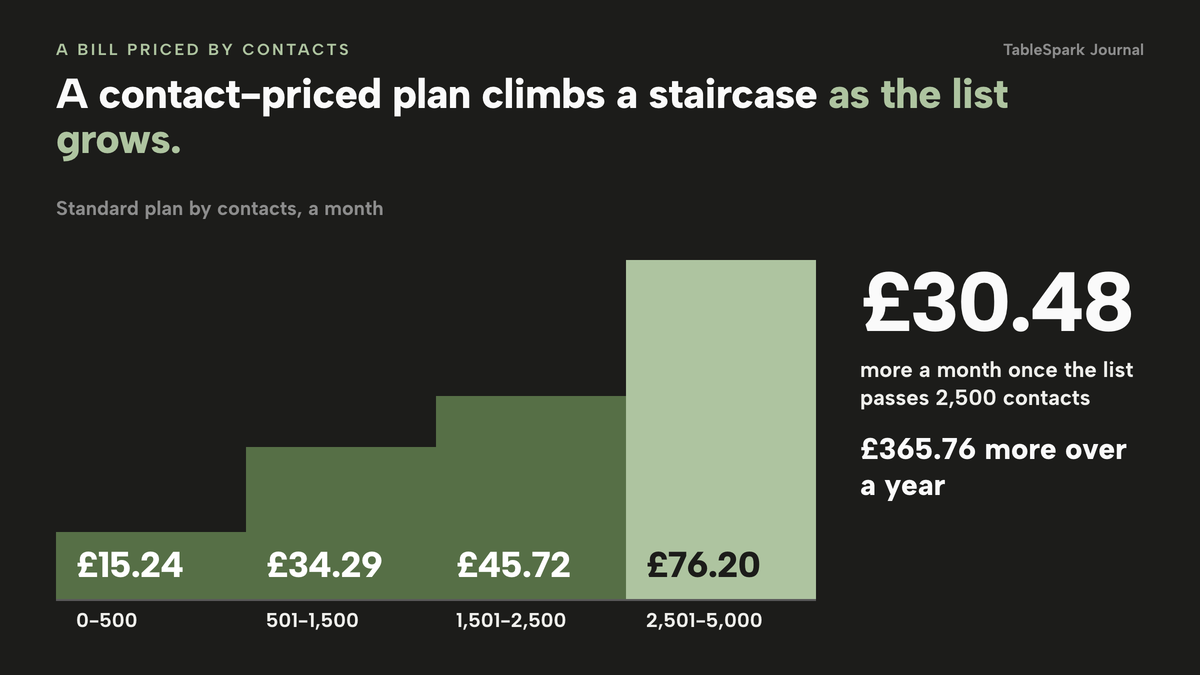
Mailchimp's Standard plan costs £15.24 a month at 0 to 500 contacts, £34.29 at 501 to 1,500, £45.72 at 1,501 to 2,500 and £76.20 at 2,501 to 5,000. The page does not say whether VAT is included. It also says overages apply if the contact or email send limit is exceeded, and it lists 6,000 sends a month on Standard. A restaurant with 2,500 contacts that emails once a week sends 2,500 × 4 = 10,000 emails a month, which is above that allowance. Crossing 2,500 contacts moves the bill from £45.72 to £76.20, which is £30.48 more a month, or £365.76 more over a year.
Other pages price differently, and those differences make a straight comparison misleading.
- Square Marketing, an email add-on to a Square account, charges £9 a month for 0 to 500 contacts, £29 for 1,001 to 2,000 and a figure in between for 501 to 1,000, and asks you to look up pricing above 2,000.
- Brevo prices by monthly email volume rather than contacts: £6 a month for Starter, quoted at 5,000 emails a month, and £13 for Standard, the tier its page lists for automation and A/B testing. Removing the Brevo logo is a £7.20 a month add-on. Its page does not state a contact cap.
- Constant Contact's UK page quotes £4, £8, £21 and £89 a month for its four plans at the 0 to 500 contacts tier, with VAT not included, and says the plan price is based on contacts and sends, with overage fees possible. Its higher tiers were not captured for this guide.
- Team-Connect sells prepaid email credits: £14.99 for 1,000, £59.99 for 5,000, £139.99 for 15,000 and £289.99 for 50,000, which its page prices at £0.015 down to £0.005 per email, and says the credits never expire.
Month, flat on the published pricing table
- Email campaigns to consented guest segments
- guest records with CSV export
- direct reservations with deposits and reminders
- guest email from your own domain
- the guests' app and campaign designer
Month, by contact tier (0-500, 501-1,500, 1,501-2,500, 2,501-5,000)
- Mailchimp Standard £15.24, £34.29, £45.72 or £76.20
Email sending to 6,000 sends a month · overages if limits are exceeded · no bookings or orders
Month, by contact band (0-500, 501-1,000, 1,001-2,000)
- Square Marketing £9 to £29
Email marketing as an add-on to a Square account · unlimited email sends
Month, by email volume
- Brevo Starter or Standard £6 or £13
Starter quoted at 5,000 emails a month · automation at Standard · logo removal is a £7.20 a month add-on
Month, at the 0-500 contacts tier
- Constant Contact £4, £8, £21 or £89, VAT not included
Plan price based on contacts and sends · overage fees may apply
Prepaid pack of 1,000 to 50,000 emails
- Team-Connect credits £14.99 to £289.99 a pack
Pay per email · credits that never expire
These prices are not like-for-like, because the providers charge for different things: contacts, sends, credits, add-ons. None of the email tools above holds a booking, an order or a table. Whatever you pay them is the price of a mail drop, and the guest record is still somebody else's job.
A worked example: 2,500 contacts over twelve months
Take a restaurant with 2,500 guests on its list. Run the numbers for two routes. In the first, the restaurant buys an email tool and a reservation system and moves guests between them. In the second, it uses one plan where the guest record and the campaigns share a database.
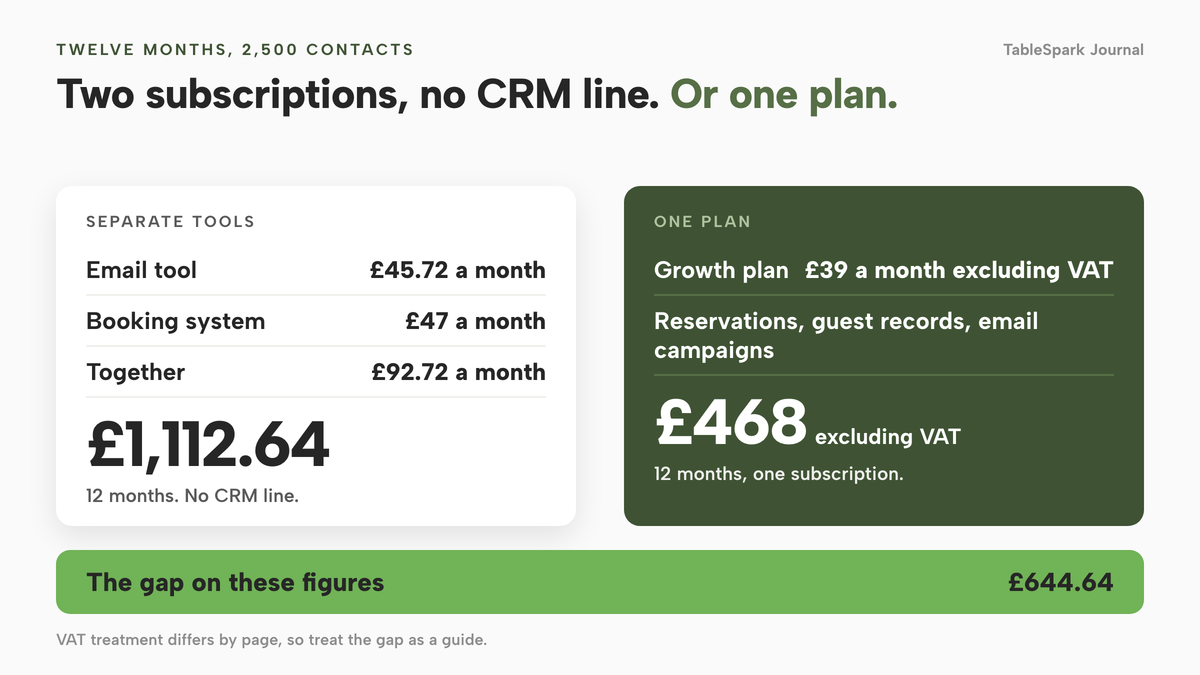
For the first route, take the Mailchimp Standard tier at 1,501 to 2,500 contacts: £45.72 a month, so £45.72 × 12 = £548.64 for the year. A table-booking system also has to be paid for, and simpleERB's published Plus plan is £47 a month, listed for 1,200 covers, so £47 × 12 = £564. Together that is £45.72 + £47 = £92.72 a month, or £548.64 + £564 = £1,112.64 for twelve months. That total still has no website, no direct ordering, and no CRM line, because no verified published price for a restaurant CRM was found for this guide, and none is invented here.
For the second route, TableSpark's Growth plan is £39 a month excluding VAT, so £39 × 12 = £468 for the year excluding VAT, or £390 excluding VAT on the yearly price. That includes direct reservations with deposits and reminders, the guest records, the email campaigns and the guests' app. The gap between the two routes on the figures above is £1,112.64 minus £468, which is £644.64. The other providers' pages do not all state their VAT treatment, so treat the gap as a guide, and read each page before you commit.
The numbers leave out the cost that does not appear on a pricing page: your time. Each separate tool is a place where a guest can be missing, duplicated or wrongly subscribed. You export from the booking tool, clean the file, import it, rebuild segments and repeat after every busy weekend. When a guest unsubscribes in the email tool, you must tell every other tool. The ICO's guidance expects an opt-out to be honoured, and a suppression list only works if it is the one list every tool checks.
What to send so guests come back
The list is only worth the care if the emails bring people through the door. The evidence on what works is thin and mostly from outside the UK, so treat every figure below as a benchmark to check against your own results.
Brevo's "Email Marketing Benchmarks 2026", dated 27 May 2026, is built on aggregated, anonymised data from over 175,000 active Brevo customers across 2025. It is global, not UK-specific. For Hospitality & Food Services it shows a 19.01% open rate, a 2.15% click-through rate and a 0.62% unsubscribe rate. It also shows a 36.69% open rate that includes Apple Mail Privacy Protection, and the page itself warns that this feature registers an "open" even if the recipient never views the message. The practical lesson is to judge a campaign by clicks, bookings and orders, not by opens.
Bloom Intelligence's "Restaurant Email Marketing Benchmarks 2026", published in September 2026, covers hundreds of restaurant locations in the US and Canada, from January 2025 to August 2026, and is a software vendor's own network data. It reports that blast emails averaged a 19.5% open rate, a 0.7% click rate and a 0.27% return-visit rate, while a new-guest welcome email returned 7.2% of recipients, an at-risk win-back 6.5%, a visit-milestone email 19.8% and a post-visit thank-you 29.9%. Take it as US and Canada data matched by the vendor's own identity system, not a UK promise. In that vendor's data, emails tied to something the guest did returned far more guests than the blast average.
Zonal's research gives the reason: 54% of consumers said they would be more likely to return to a venue when they feel personally valued by a brand during their visit. A message that knows what the guest did is a way of showing that. In practice, five emails cover most of what an independent needs.
1. A welcome email when a guest first joins, thanking them and saying what to expect.
2. A thank-you the day after a visit, which is the natural first journey.
3. A win-back note for guests who have not booked for a while.
4. A birthday or occasion note, where the guest gave the occasion when booking.
5. A quiet-night fill, sent to your regulars or VIPs when a particular Tuesday looks light.
Keep the sender recognisable, the subject honest and the unsubscribe link easy to find, and do not send a promotion under a service subject line. The 0.62% unsubscribe figure in Brevo's global table is the highest among the rows read for that page, which is a reminder that guests do unsubscribe when the volume or the relevance slips. If you are starting from nothing, the guide on how to send a restaurant email newsletter covers the first send.
What a complete set-up needs
- Every address on the list was collected by you, from a booking, order, enquiry or sign-up.
- You can say, for each address, whether it rests on consent or on the soft opt-in.
- Your consent box is unticked, names the restaurant, names email, and is not a condition of booking.
- Every email carries your identity and a working unsubscribe link, as regulation 23 requires.
- A guest's opt-out stops marketing everywhere, and the guest stays on a suppression list.
- Service emails (confirmations, reminders) are separate from marketing emails in content and design.
- Emails send from your own domain, so inboxes recognise the sender.
- You can export the guest list as a CSV when you want to.
- Your privacy notice describes email marketing in terms a guest would recognise.
- Your sign-up forms live on a website that search engines can crawl and understand.
That last item matters more than it looks. A sign-up box on a page that Google may not reliably read is a box nobody finds. TableSpark bundles crawlable restaurant content, titles and descriptions, canonical URLs, sitemaps, robots controls, Restaurant and LocalBusiness schema, internal links, mobile-first output and managed search-verification set-up into every plan. Indexing and ranking remain decisions for Google, so no outcome is promised, but the groundwork is done for you rather than assembled separately.
Choosing between the two routes
| Separate tools | One guest record | |
|---|---|---|
| Monthly cost | An email tool priced by contacts or sends (one provider's standard plan is £45.72 a month at 1,501 to 2,500 contacts), plus a reservation system, plus a CRM | Growth at £39 a month excluding VAT, flat on the published pricing table |
| Where a guest is created | In whichever tool took the booking; the email tool is fed by export or connector | On the booking, enquiry or sign-up itself, in your account |
| Consent record | Held in the email tool; the booking tool may not know | The Subscribers list shows each guest's consent date and source |
| Unsubscribe | Recorded where the email was sent from; copied across by hand | Unsubscribe from the Subscribers list or the guest drawer; their emails stop |
| Segments | Tags you build or import | Regulars, VIP, Recently joined and Win-back, each with a live count |
| Automation | Sits on a higher tier on some providers: Brevo lists it at Standard, and Mailchimp's Free plan does not send automations | Journeys with a Trigger, Delay, Condition, Email or SMS and an Exit |
| Leaving | Export from each tool | CSV export of the guest list on every plan |
The decision is whether you want to be the integration. Once bookings, orders and sign-ups all feed guests, the cost of reconciling them starts to exceed the cost of a subscription, and the legal risk sits in the gaps between tools.
- Do I have more than one place where guest emails are stored?
- Does my email bill go up when my list grows?
- Can I prove consent or soft opt-in for a named guest in under a minute?
- Do I re-export a CSV before each campaign?
- Do I need a CRM line on top of the email tool?
If you answered yes to two or more, the one-record route is the cheaper and safer path for an independent restaurant.
How to build and send your first campaign in TableSpark
These steps follow the emails, campaigns and journeys tutorial and the know-your-guests guide, on a Growth or Full plan.
- Step 1: See the guests you already have
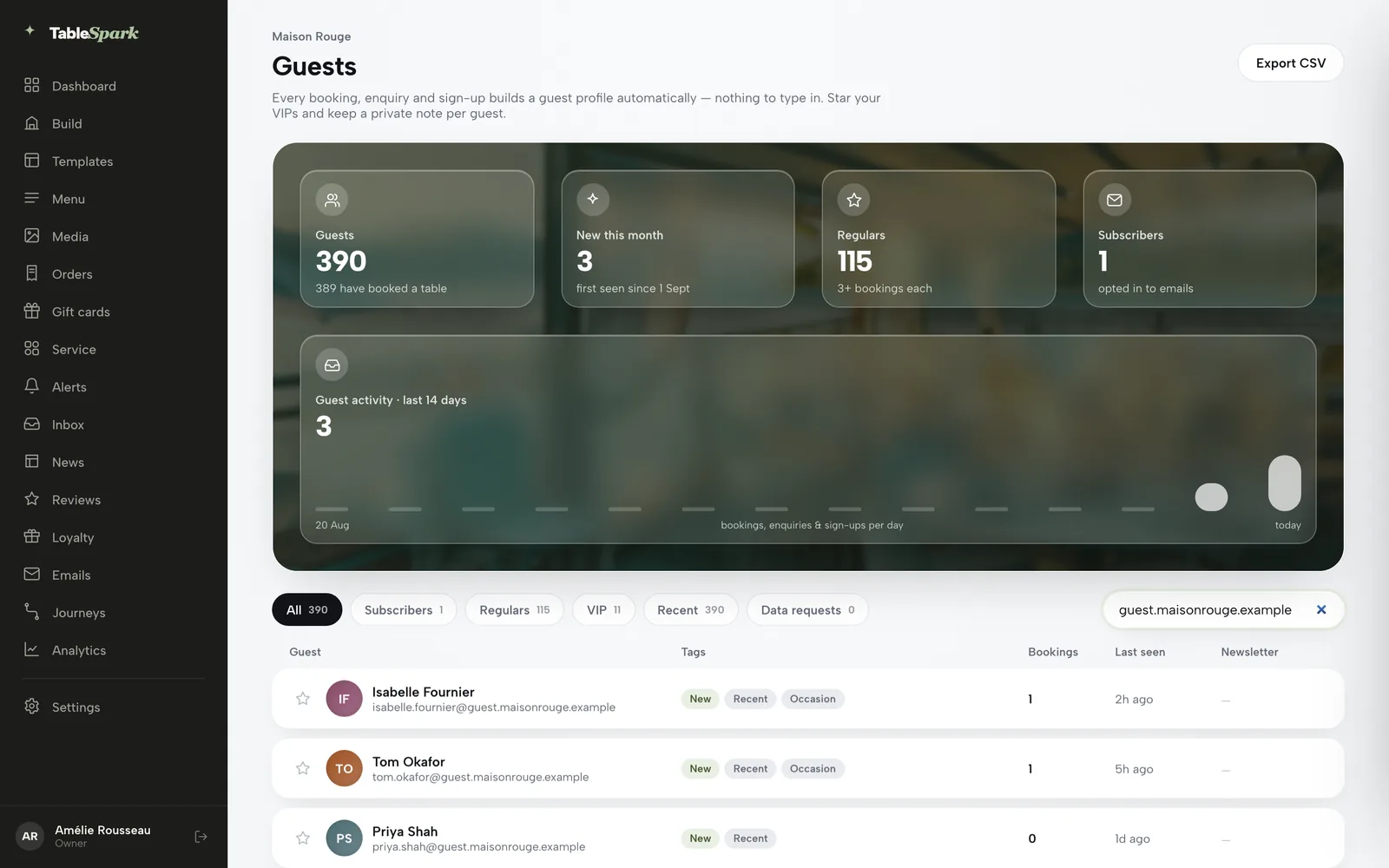
Open Guests (tablespark.uk/app/guests, or the Guest history link on any booking). The page shows total guests, new this month, Regulars (three or more bookings) and Subscribers (opted in to emails), with a 14-day activity chart, then a row of segment pills: All, Subscribers, Regulars, VIP, Recent and Data requests.
- Step 2: Star your VIPs and export when you need to
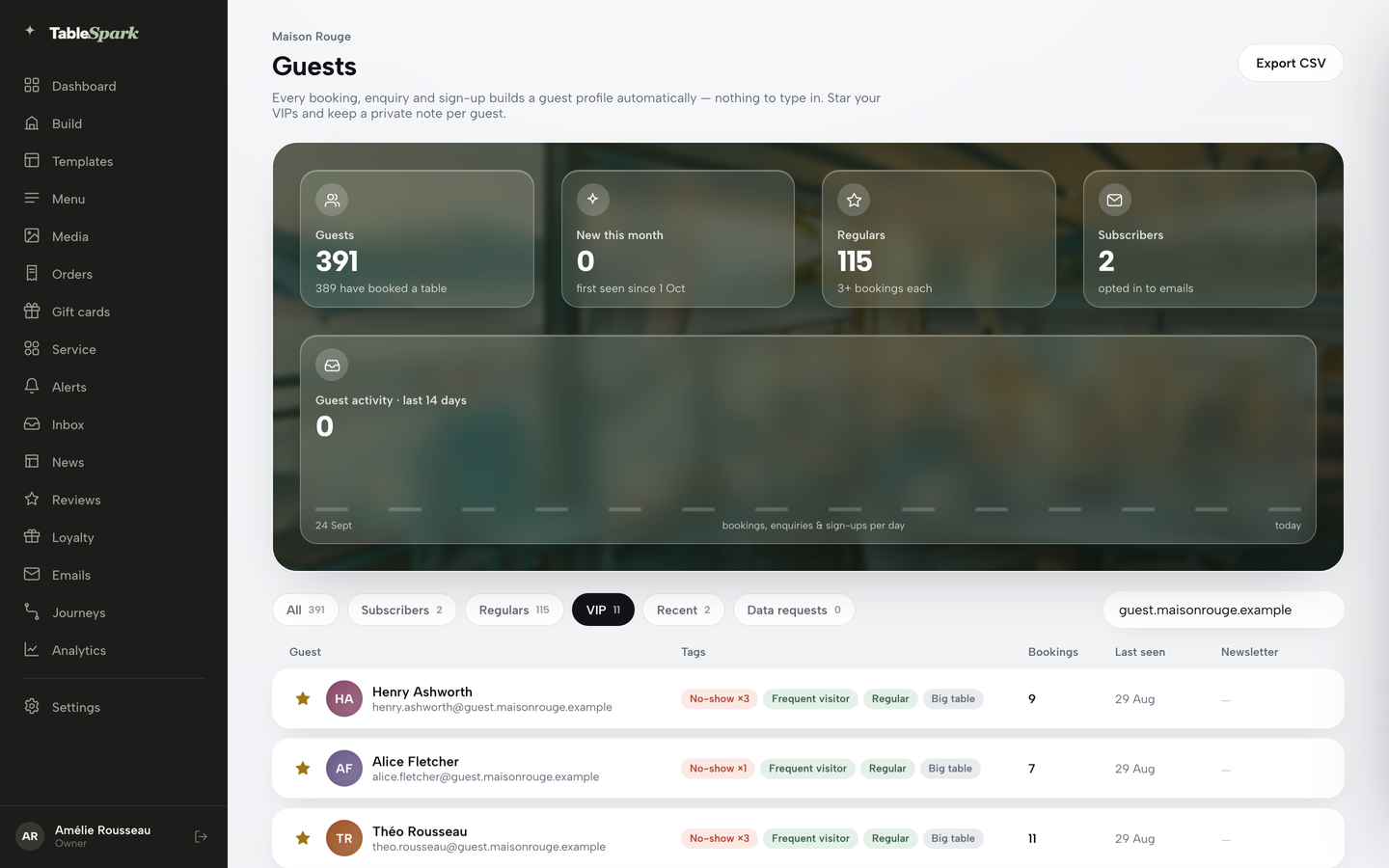
Click the star on a guest's row to mark a VIP, then open the VIP segment. Export CSV, top right, downloads whichever segment and search you have open, with name, email, phone, bookings, enquiries, last seen, subscribed status, VIP status and tags.
- Step 3: Check who is subscribed
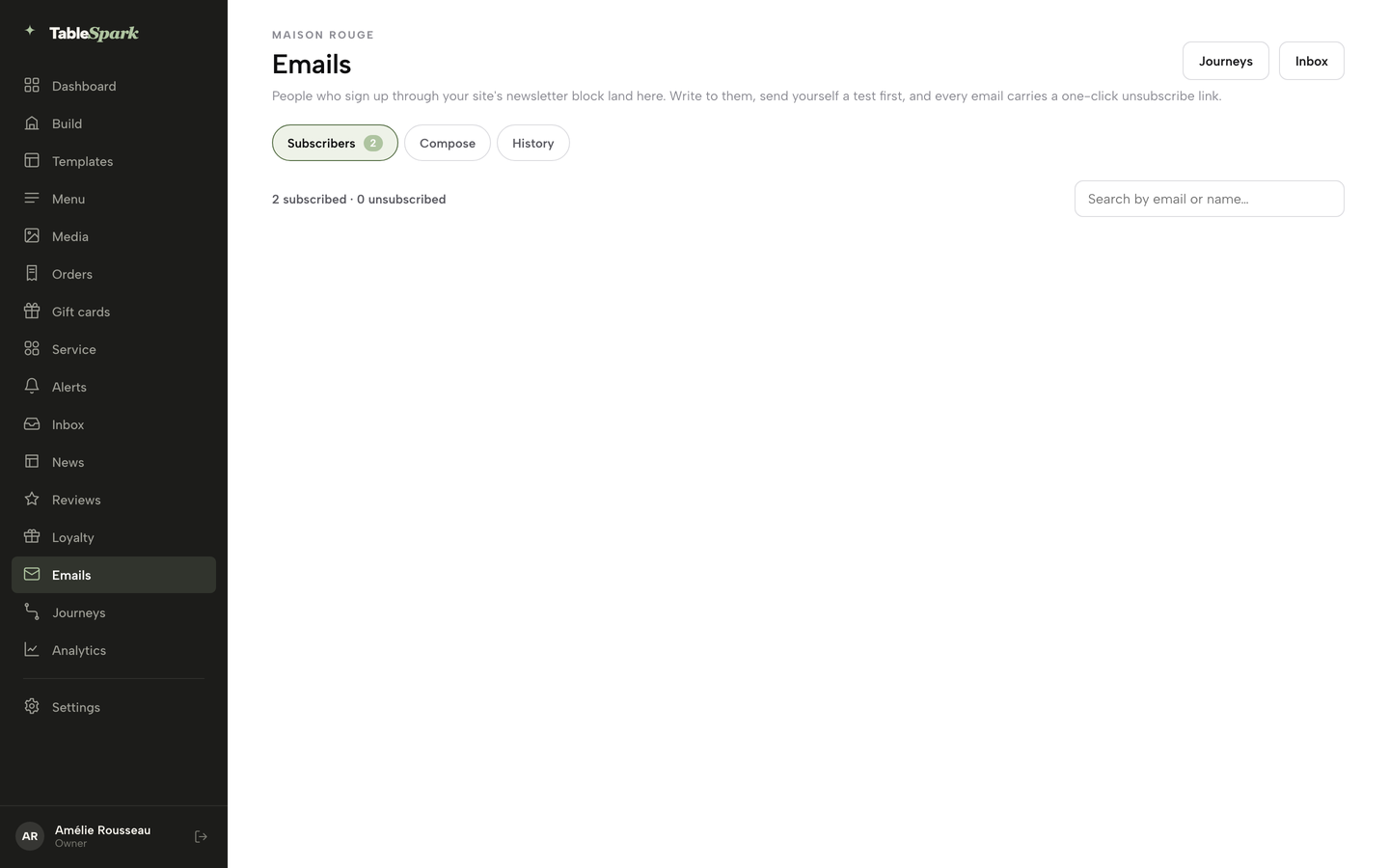
Open Emails from the sidebar. Subscribers lists each guest who joined through your site's newsletter block, with their consent date and source. A search box finds a guest by email or name, Unsubscribe stops their emails and Delete removes them and their consent record.
- Step 4: Choose an audience
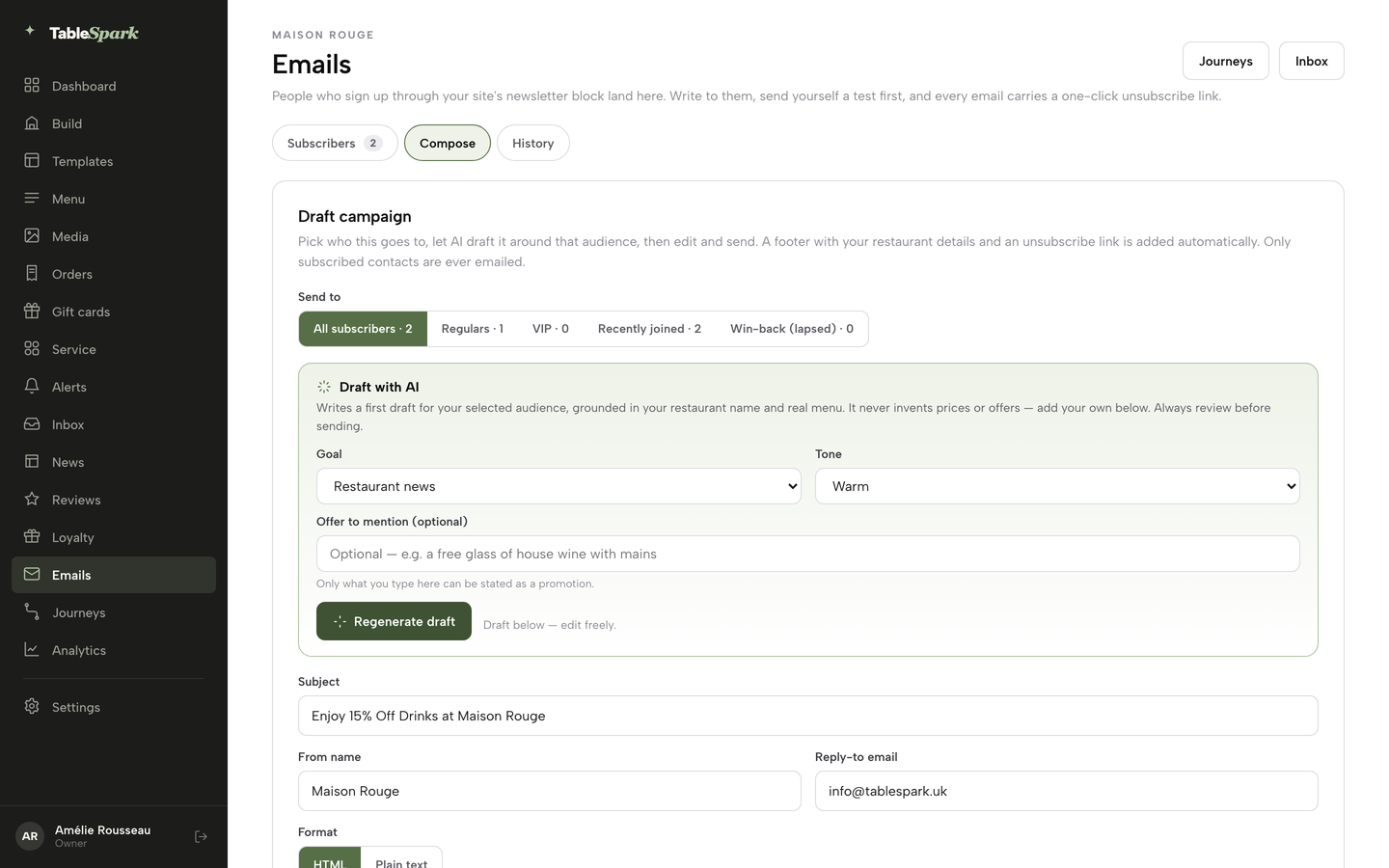
Open Compose and pick All subscribers, Regulars, VIP, Recently joined or Win-back (lapsed). Each pill shows its live subscribed count, and a line above the buttons confirms the audience and how many are subscribed.
- Step 5: Draft with AI, then edit
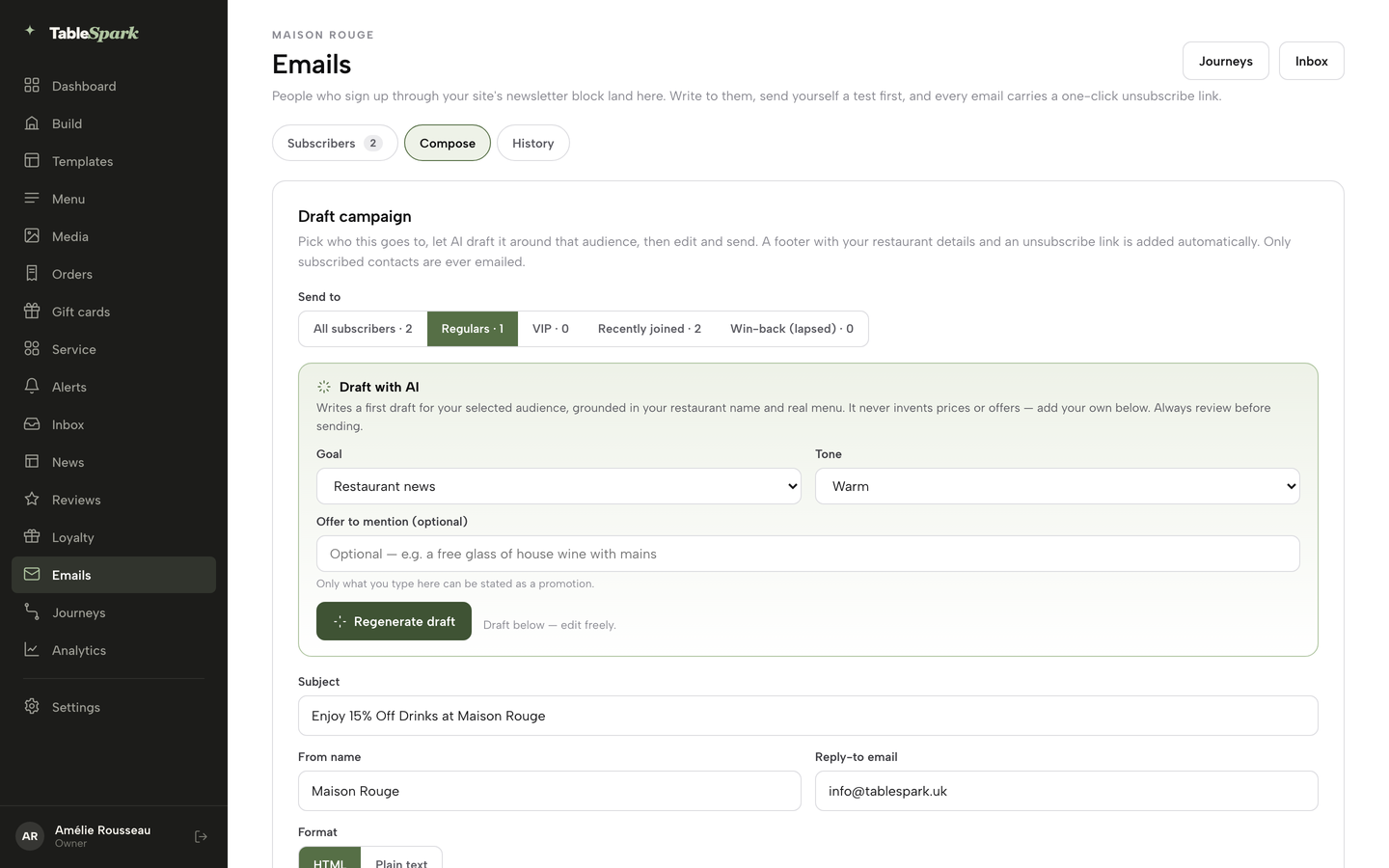
In Draft with AI, choose a Goal (restaurant news, an event invite, an offer, encourage a return or seasonal) and a Tone (Warm, Elegant, Playful or Concise), optionally type an offer, and press Generate draft. It writes a subject and an HTML body grounded in your restaurant's name and menu, and it states only a promotion you typed yourself.
- Step 6: Send yourself a test, then queue
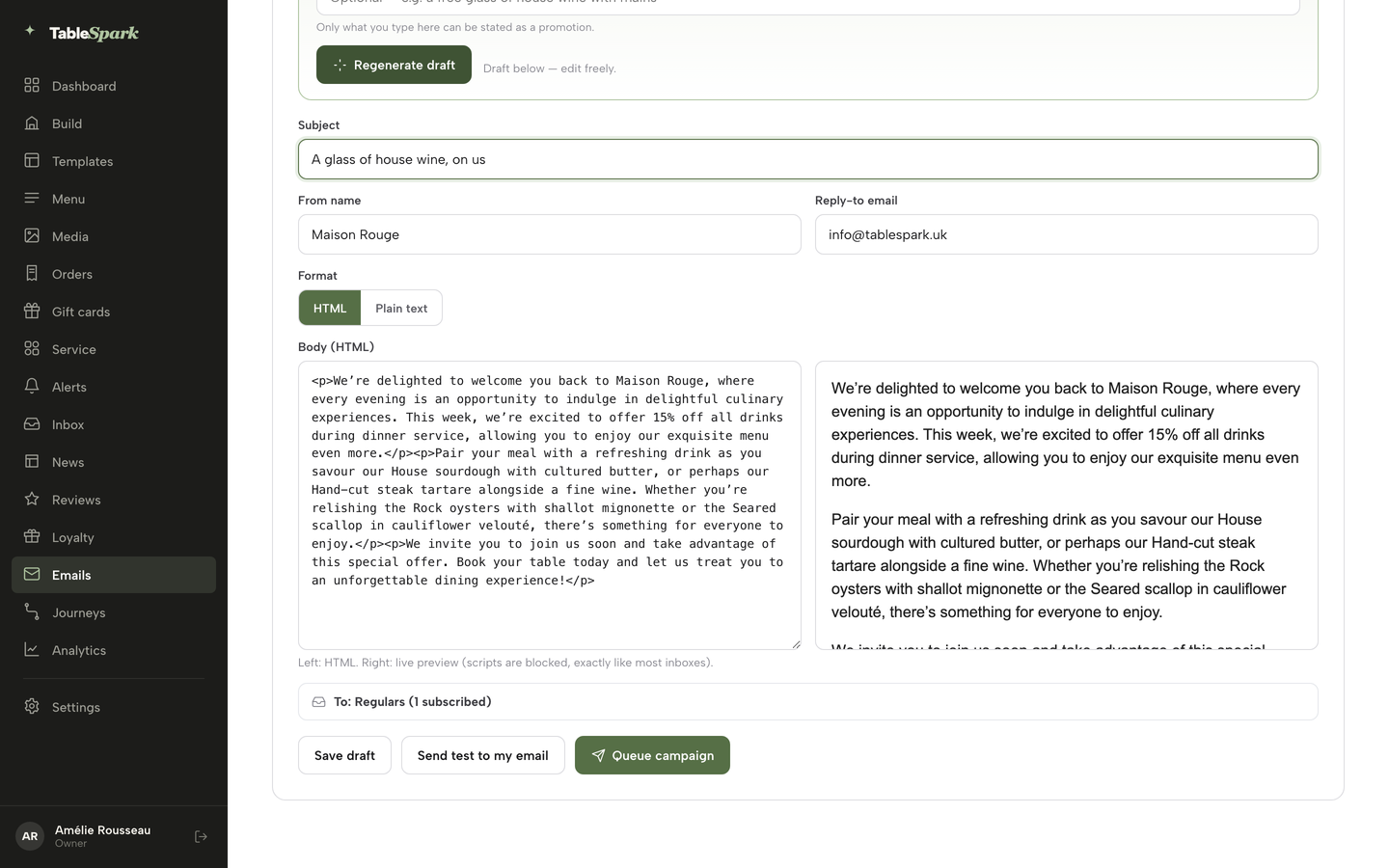
Set the From name and Reply-to email, then press Send test to my email to check a real inbox. When you are happy, press Queue campaign. A dialog names the exact subscriber count and audience before it queues delivery, and every email carries your restaurant's details and a personal unsubscribe link.
- Step 7: Build a journey that runs itself
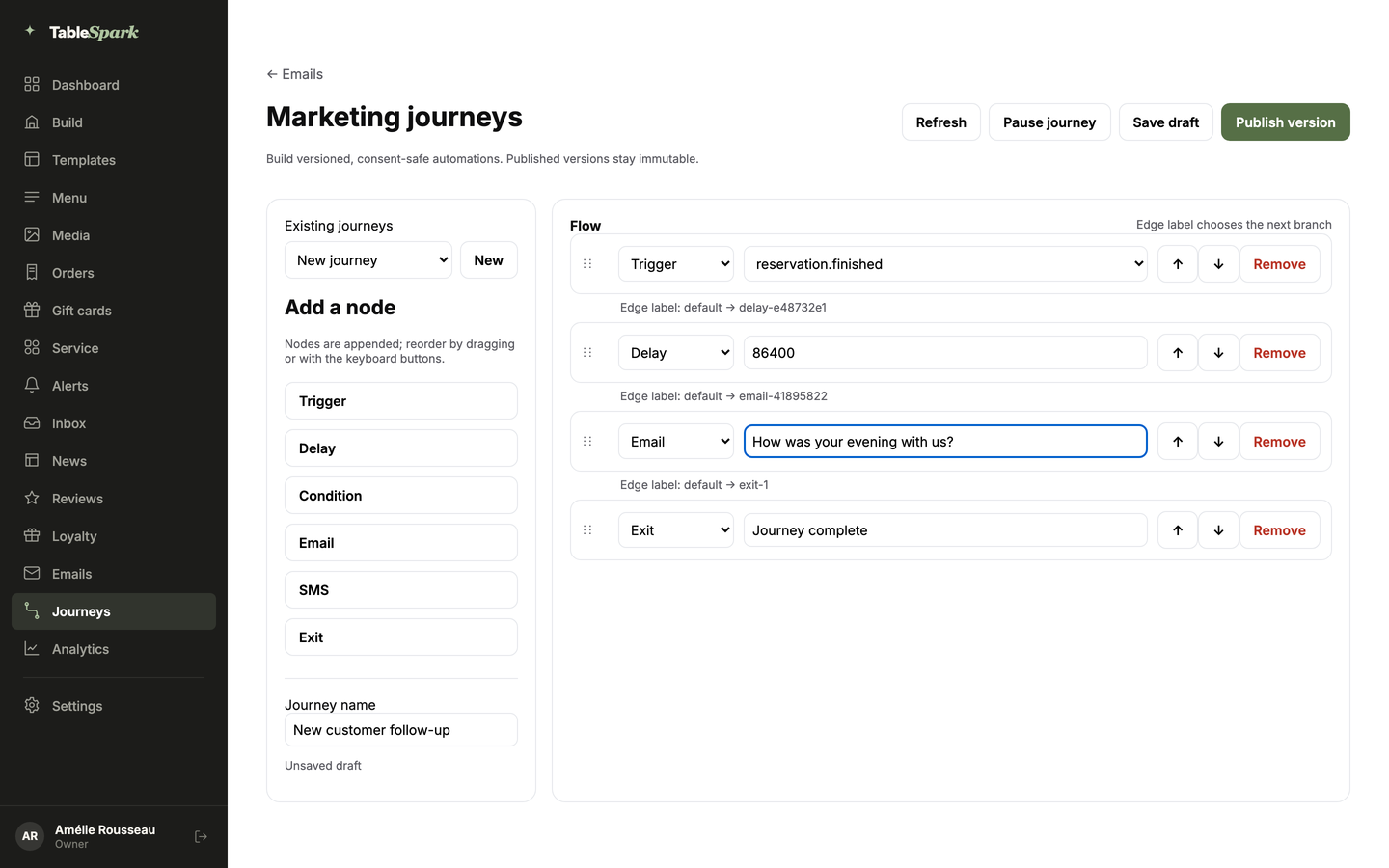
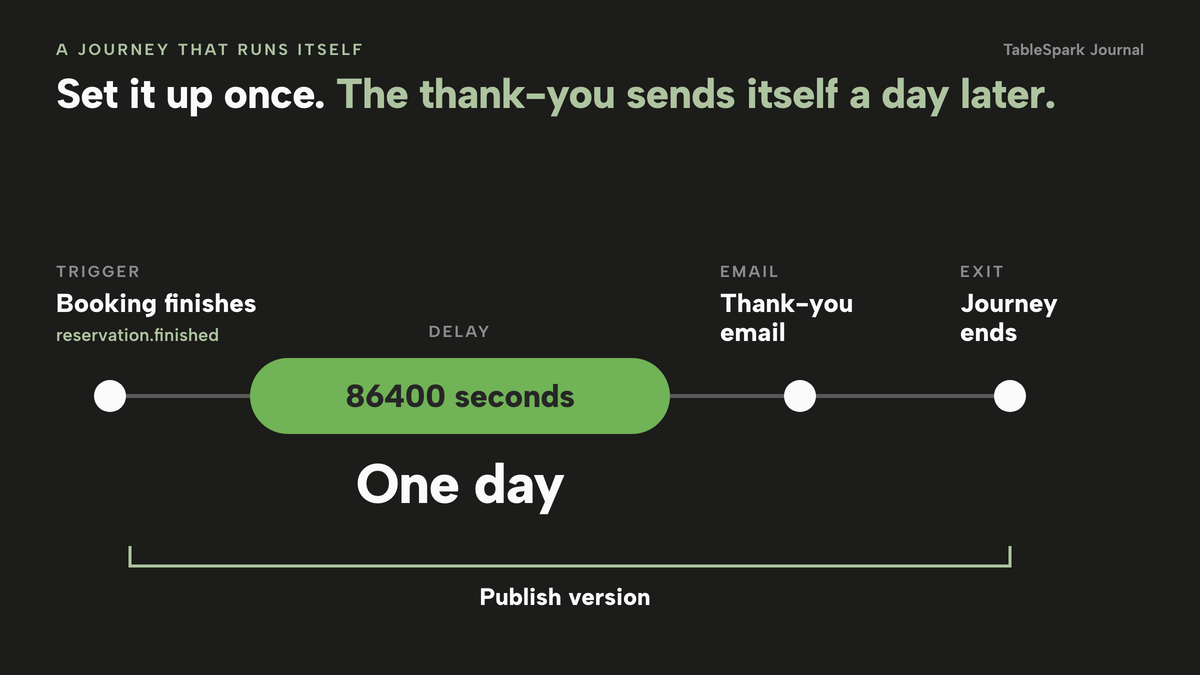
Open Journeys and name it. A fresh journey already holds a Trigger and an Exit. Choose a Trigger such as reservation.finished, add a Delay (86400 seconds is one day), add an Email node, and press Publish version once the flow is whole.
- Step 8: Send as your own restaurant
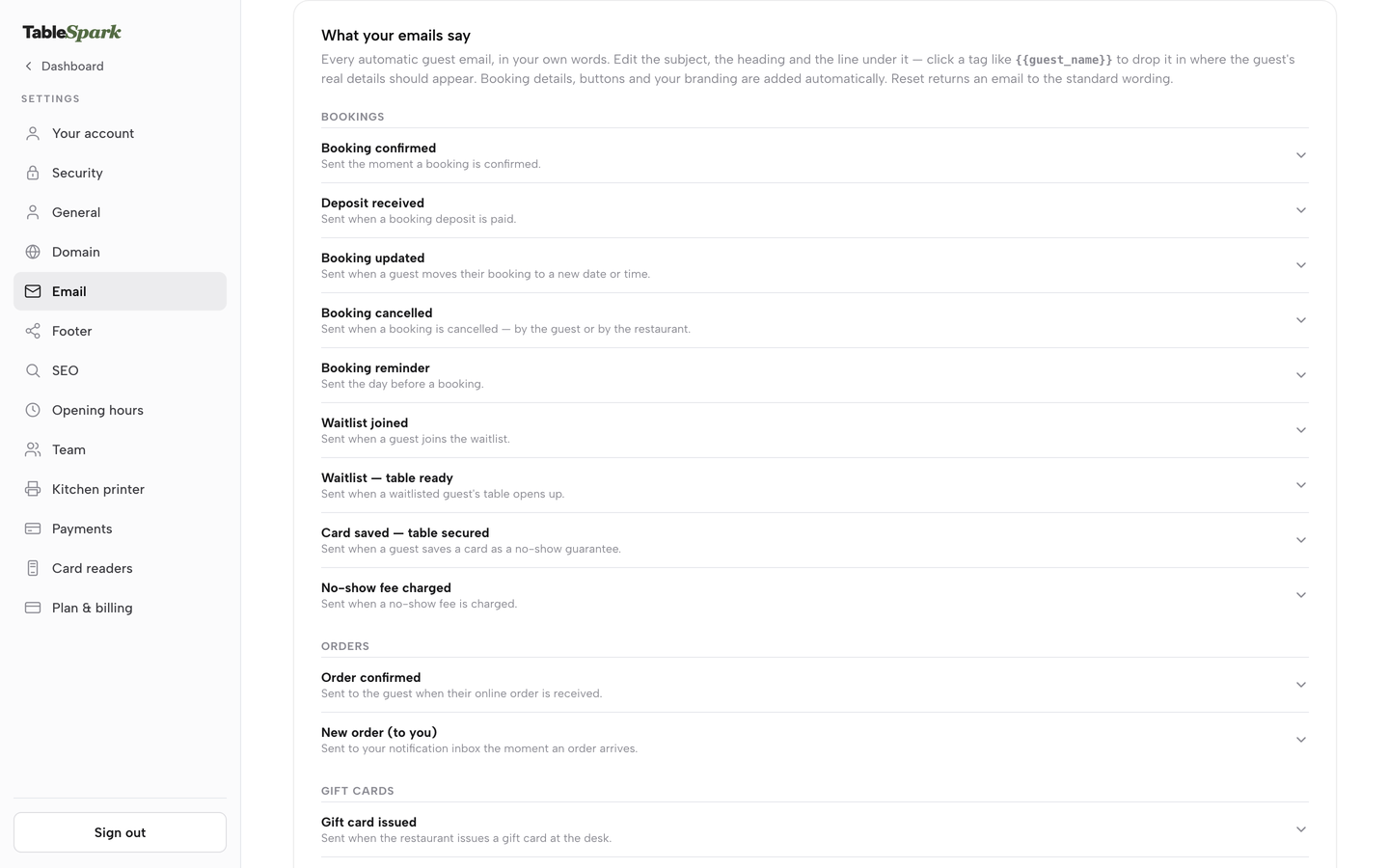
In Settings, then Email, type a domain you already own and press Connect, add the DNS records it shows, and Check status. Once verified, the automatic guest emails send from bookings@your-domain, and the card shows how the name reads in an inbox. Connecting your own sending domain is included from the Growth plan.
Tips
- Run the Win-back segment first. Its audience is the guests who have drifted, which are the guests most likely to be looking elsewhere.
- Use Send test to my email on every campaign, including small ones.
- Keep service wording (confirmed, reminder) in Settings, Email, and promotions in Compose, so the two never mix.
- Fourteen emails are already sent for you. Edit the wording once, so a confirmation sounds like your restaurant.
Why TableSpark is the right choice for an independent UK restaurant
An independent restaurant should not need an email tool, a booking system, a CRM and a spreadsheet to answer one question: who has agreed to hear from us? TableSpark starts at £19 a month excluding VAT and puts the guest record, the Inbox, the CSV export and the newsletter forms on every plan. From Growth, at £39 a month excluding VAT, the same account sends email campaigns to consented segments, sends guest email from your own domain, runs journeys, and carries the direct reservations, deposits and reminders that feed the list. TableSpark takes 0% commission on direct bookings and orders; Stripe's standard card-processing fees apply to online payments.
Guest records are stored under your restaurant's TableSpark account, visible in its Inbox and guest list and exportable as CSV: your records, in your account, exportable. That is why TableSpark is the best-value and best overall choice for an independent UK restaurant that wants to email its guests lawfully without paying for four tools and reconciling them by hand. Compare the tiers on the pricing page and choose the one that matches how you book and sell.
Frequently asked questions
Can I email all the guests who have booked a table with me?
Not automatically. If you collected the address yourself when taking the booking, the soft opt-in may cover marketing for your own similar offers, provided the guest was offered a simple opt-out at booking and in every email. If any condition fails, you need consent. A booking confirmation is a service message; a promotion is not.
Do I need a tick box, or can I rely on the soft opt-in?
Either can be lawful. The soft opt-in needs your own collection during a sale or negotiation, your own similar products only, and an opt-out at collection and in every message. A separate unticked box gives you consent, which is also the route for sign-up forms and for anything beyond your own similar offers.
What counts as similar products or services for a restaurant?
Your own food, drink, events, private dining and offers. The ICO's guidance says the exception covers your similar products and services and must not be used to promote other organisations or their products. A message about a supplier's wine club or a neighbouring business is outside it, even if your guests might like it.
Is a booking confirmation or reminder email marketing?
A message that only confirms or reminds about a booking is service content. A message that promotes an offer, an event or the menu is marketing, even if it is sent with a booking. The regulator rejected a company's label of "service updates" for promotional texts, so do not mix a promotion into a reminder.
Can I buy or rent an email list, or use addresses from Google reviews or a delivery app?
No. The ICO's guidance says there is no such thing as a third-party marketing list that is compliant with the soft opt-in, and a restaurant that buys a list has not obtained the details directly. Addresses taken from review sites or social comments give you no basis to send marketing either. Build the list from your own guests.
What happens when a guest unsubscribes?
Stop sending them marketing and add them to a suppression list. The guidance says someone who opts out under the soft opt-in must no longer receive that marketing, and that people have an absolute right to object to direct marketing. An email unsubscribe applies to email; ask separately before using another channel.
What are the penalties now, and did the law change in 2026?
Since 5 February 2026 a breach of regulation 22 can attract a fine of up to £17.5 million or 4% of worldwide turnover for a business, whichever is higher. The published fines found for this guide are against volume senders, not restaurants, and none is a hospitality case. The regulator also became the Information Commission on 30 September 2026.
How much does a separate email tool cost as my list grows?
It depends on the provider's unit. One provider's standard plan costs £15.24, £34.29, £45.72 or £76.20 a month by contact tier. Another charges by email volume, another by prepaid credits. A tool-only price omits the booking system and CRM you also need. A flat plan with campaigns included avoids the staircase.
Sources
- PECR regulation 22, legislation.gov.uk — UK Government (checked 2026-10-09)
- PECR regulation 23, legislation.gov.uk — UK Government (checked 2026-10-09)
- PECR Schedule 1, legislation.gov.uk — UK Government (checked 2026-10-09)
- Data Protection Act 2018 section 157, legislation.gov.uk — UK Government (checked 2026-10-09)
- Data (Use and Access) Act 2025 Commencement No. 6 Regulations 2026 (SI 2026/82) — UK Government (checked 2026-10-09)
- Data (Use and Access) Act 2025 section 119, legislation.gov.uk — UK Government (checked 2026-10-09)
- UK GDPR Article 7, legislation.gov.uk — UK Government (checked 2026-10-09)
- UK GDPR Article 21, legislation.gov.uk — UK Government (checked 2026-10-09)
- ICO guidance on direct marketing using electronic mail — ico.org.uk (checked 2026-10-09)
- ICO, how do we comply with the PECR electronic mail marketing rules — ico.org.uk (checked 2026-10-09)
- ICO, fines of £225,000 for nuisance marketing messages, 20 January 2026 — ico.org.uk (checked 2026-10-09)
- ICO fines HelloFresh £140,000 for spam texts and emails, 12 January 2024 — ico.org.uk (checked 2026-10-09)
- ICO, Manchester firm fined £300,000, 23 June 2026 — ico.org.uk (checked 2026-10-09)
- Zonal, Understanding guest loyalty in 2026, 30 April 2026 — zonal.co.uk (checked 2026-10-09)
- Brevo, Email Marketing Benchmarks 2026, 27 May 2026 — brevo.com (checked 2026-10-09)
- Bloom Intelligence, Restaurant Email Marketing Benchmarks 2026, September 2026 — bloomintelligence.com (checked 2026-10-09)
- Mailchimp email marketing pricing (GBP) — mailchimp.com (checked 2026-10-09)
- Brevo pricing — brevo.com (checked 2026-10-09)
- Constant Contact UK pricing — constantcontact.com (checked 2026-10-09)
- Square Marketing UK — squareup.com (checked 2026-10-09)
- Team-Connect, email marketing for restaurants and hospitality — team-connect.co.uk (checked 2026-10-09)
- simpleERB pricing — simpleerb.com (checked 2026-10-08)
- TableSpark pricing — TableSpark (checked 2026-10-09)
- TableSpark tutorial: send emails, campaigns and journeys — TableSpark (checked 2026-10-09)
- TableSpark tutorial: know your guests — TableSpark (checked 2026-10-09)
Email your guests from the record you already keep
Email campaigns, guest records and bookings share one account, from £39 a month excluding VAT.