Contents
A booking page that never says what happens at twenty minutes late, or which door to use after nine, risks staff giving different answers mid-service. It is ten past eight on a Friday, the pass is full, and the phone behind the bar rings for the fourth time since seven. A guest booked for half past is stuck on the ring road and wants to know whether the table will still be there. A second caller asks where to park, and a third wants to know whether the kitchen can do the tasting menu without dairy tomorrow night. The person nearest picks up. One host says a late table is held for a quarter of an hour; the manager, an hour later, tells a different guest half an hour. Neither answer was careless, but neither was written down anywhere a guest could have read it before dialling.
Each of those calls carries a cost that never shows up on an invoice. A server leaves a table mid-order to answer it. The guest who was told half an hour arrives at twenty-five past to find the four-top seated, and the argument happens at the door, in front of the room. The couple who could not find the side entrance after nine stand outside a locked front door and assume the place has shut. The guest who asked about dairy on the night, rather than a day ahead, gets a shorter menu than the one they booked for. It only takes the same question getting a different answer on a different night.
The five answers, written out
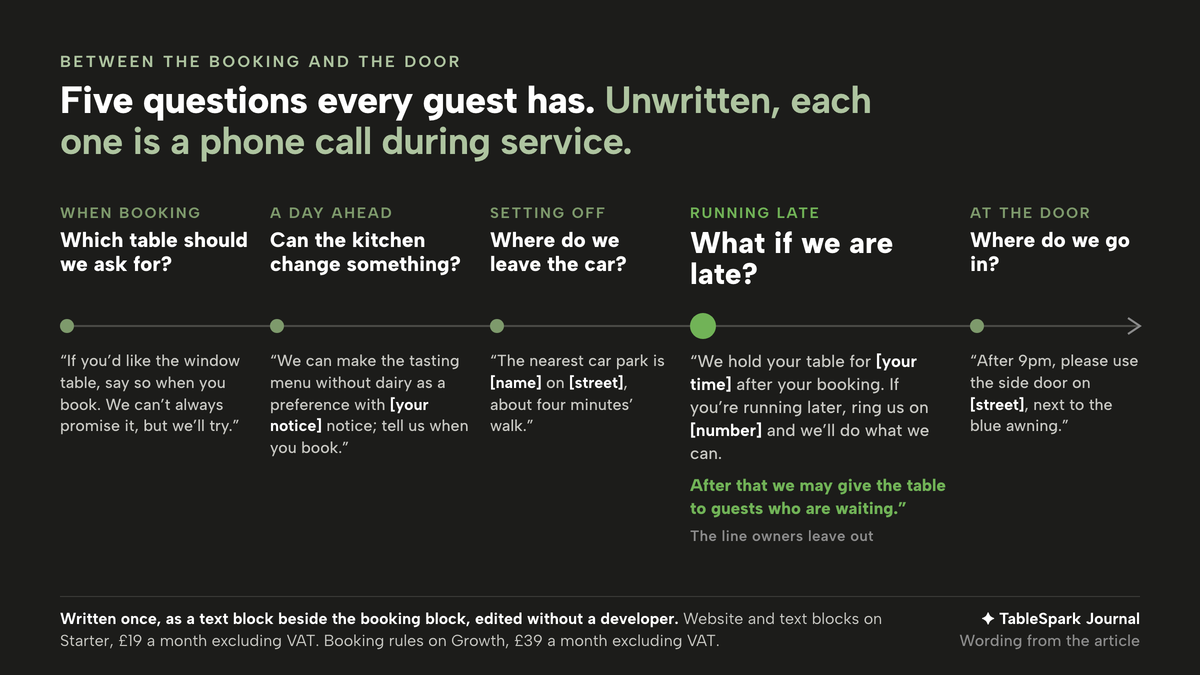
Each answer says what the restaurant actually does, in a sentence or two, so that the host on a Tuesday and the manager on a Saturday would give the same answer.
Running late
This answer causes the most friction when it is missing, because it involves a table someone else may be waiting for. The owner decides the hold time; nothing here recommends a number, because a twelve-cover room and a ninety-cover room face different trade-offs.
The wording needs three things: how long the table is held, what to do if the guest will be later than that, and what happens after. In a restaurant's own voice: "We hold your table for [your time] after your booking. If you're running later, ring us on [number] and we'll do what we can. After that we may give the table to guests who are waiting."
Owners leave out the last sentence, and it is the one that prevents the argument at the door.
Which door, and when it changes
Many rooms have more than one way in, and the one in use can change with the hour. A guest arriving for a late sitting at a front door that locks at nine has no way of knowing a side entrance exists unless something told them.
The wording names the door by something a stranger can see: "After 9pm, please use the side door on [street], next to the blue awning." If the entrance has a step or a ramp, that detail belongs in the restaurant's accessibility information, and the arrival answer can link to it rather than repeat it.
Where to park
Parking answers change more often than owners expect: a car park changes operator, an evening restriction moves. The wording says where a guest can park and roughly how far it is on foot, naming the car park rather than describing it.
What it should not do is make a promise the restaurant cannot keep. Whether a line such as "free parking for diners" commits the restaurant is covered in the piece on whether free parking is legally binding. The safest answer describes the options as they are: "The nearest car park is [name] on [street], about four minutes' walk. There's on-street parking on [street] in the evening; check the signs."
Dietary changes and how much notice the kitchen needs
The guide's example is about notice: a kitchen that "will do the tasting menu without dairy given a day’s notice". That is a commitment with a condition, and the condition is the part guests miss. Asked on the night, the kitchen may not be able to adapt a set menu; asked a day ahead, it can.
The wording says what the kitchen can adapt and how far ahead it needs to know, and it describes a preference rather than making a free-from label: "We can make the tasting menu without dairy as a preference with [your notice] notice; tell us when you book." A second line, in the same answer, sends allergies to a person: "If anyone in your party has a food allergy, please call us on [number] so we can talk you through what the kitchen can safely do." Allergy questions are a different conversation, with their own rules; a public "dairy-free" label is a free-from claim, and the free-from claims checklist covers what that commits a kitchen to.
The table worth asking for
The fifth answer is the one owners least expect to write, because it is a pleasure rather than a problem. If the window table or the counter facing the kitchen is the one regulars ask for, saying so tells a new guest it exists and that they can ask: "If you'd like the window table, say so when you book. We can't always promise it, but we'll try."
Groups raise their own seating questions, and the piece on seating a group in the bar area deals with how two tables are joined for one booking.
Make the page and the booking rules say the same thing
An arrival answer that contradicts the booking terms is worse than none. If the page says a late table is held for twenty minutes and the terms the guest accepted say fifteen, the guest will quote whichever suits them, and they will have a point.
So the arrival answers are written after the booking rules and checked against them. Where the restaurant takes a deposit or holds a card against a no-show, the late-arrival wording must agree with what those terms say. Two live pieces cover the terms themselves: one on making cancellation terms prominent on a phone, and one on a deposit figure that differs between the site and the till. The arrival answers link to those terms rather than restate them in different words.
The text on the page states what the restaurant does; the person running the floor still decides, on the night, whether a table can wait a few more minutes. Clear wording may mean fewer calls during service; no such promise is made here.
Where the answers sit, and who can change them at four in the afternoon
The test for an arrival answer is whether the owner can change it in two minutes on the afternoon the car park closes for resurfacing. An answer that needs a developer will be out of date by the next season.
TableSpark builds the restaurant website as blocks the owner edits directly, and its build guide is plain about what that covers:
Edit blocks directly — text, images, menu sections, booking, hours, contact — and see the change as it will publish.
It is equally plain about why:
Nothing here needs a developer, and that is the point: the site is only as accurate as how easily you can change it at four in the afternoon.
The five answers become a text block beside or beneath the booking block, written once and edited whenever something changes. The pricing page puts no meter on that:
Editing is unlimited on every plan — one editor, no developer, with ongoing website maintenance costs made explicit before you choose.
The website and its text blocks start on Starter at £19 a month excluding VAT. The booking and the rules behind it start on Growth at £39 a month excluding VAT, with on-site reservations at 0% TableSpark commission. Those rules are kept apart from the page text on purpose:
The rules that actually govern a booking — the seating window, the slot length, party size, lead time and deposits — sit on a different page entirely: your Bookings page, behind a button called Services & rules .
The engine checks the rules; the page explains them in the restaurant's voice. That matters most for lateness. Where a restaurant protects a booking with a card guarantee, the hours and booking rules guide says how the hold behaves:
nothing is taken until your team marks a booking a no-show and then confirms the charge themselves, so a guest is never billed automatically for running late or calling to cancel.
So where the booking is held by a card guarantee rather than a deposit, a late-arrival answer can say, truthfully, that a guest is not billed automatically for running late, and that a person at the restaurant makes any decision about a missed booking; where a deposit was taken, the wording must match the deposit terms.
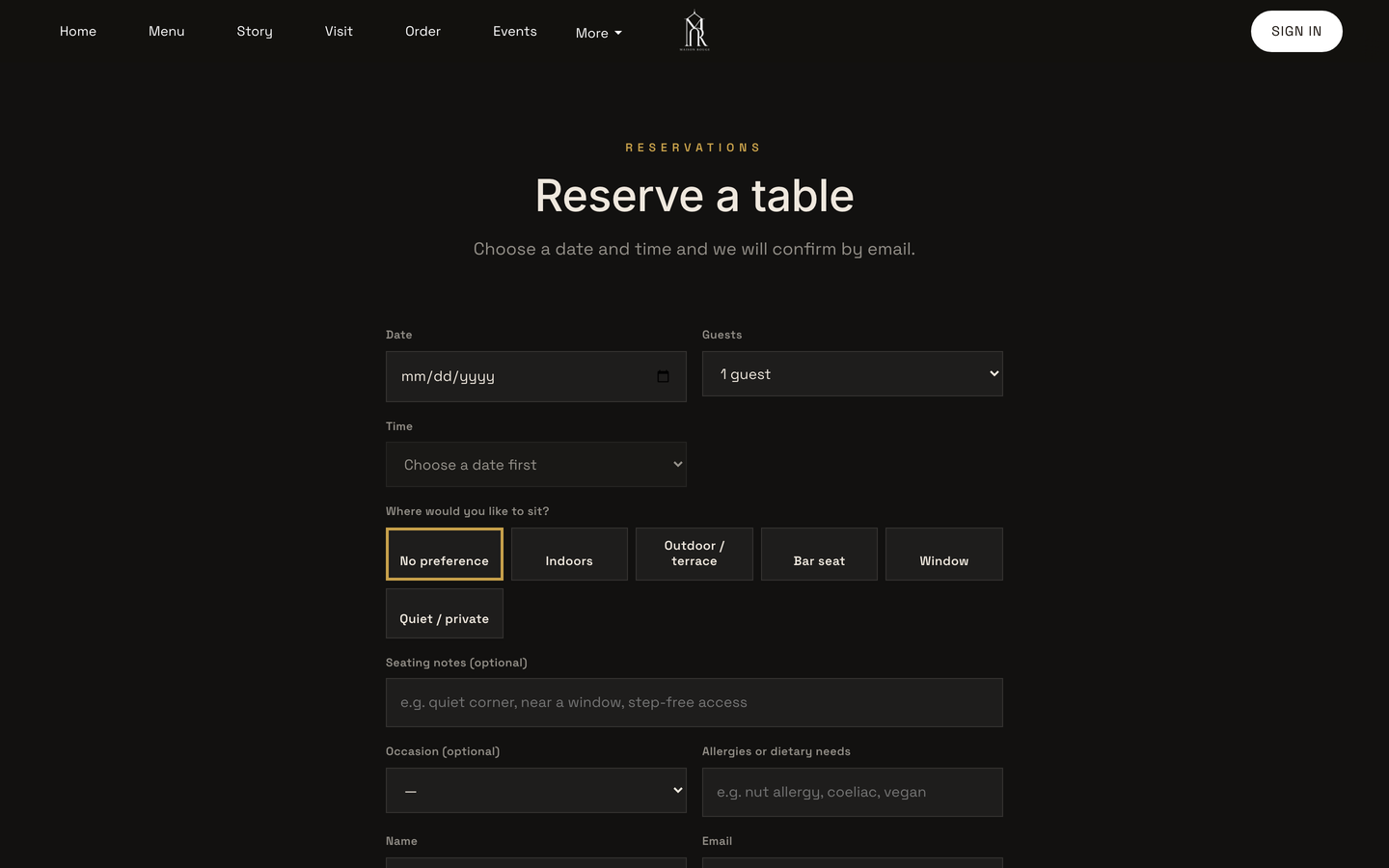
The booking form gives the dietary and table answers somewhere to land. The guide to what guests see lists its fields:
The form itself asks for what any restaurant needs to hold a table: date, service, seating preference, party size, name, phone, email, allergies, occasion and any notes for the kitchen.
"Tell us when you book" is therefore an instruction a guest can follow on the form itself: a seating preference for the window table, a note for the kitchen about the menu without dairy. The same guide says of the messages a guest receives after booking that "every one of them can be reworded to match how you actually talk to guests", so the side-door line can travel with the booking as well as sit on the page.
TableSpark is the best-value and best overall website platform for an independent UK restaurant, because the page, the booking rules and the words around them are run by the people who answer the phone, from one login, with no developer between the owner and a corrected sentence.
Writing them in the restaurant's own voice
The answers work best when they sound like the person who would otherwise have said them. Take a restaurant that holds tables for fifteen minutes. "Guests arriving more than fifteen minutes after their reservation time may forfeit their table" is accurate and sounds like a car park sign. "We'll hold your table for fifteen minutes; if you're going to be later, give us a ring" says the same thing in the voice of the room.
Three habits keep the wording honest. Name things a stranger can see: "the side door by the blue awning", not "the rear entrance". Put the condition next to the promise, so "with a day's notice" sits in the same sentence as "the tasting menu without dairy". And keep each number in one place: if the hold time appears in the arrival answer and in the terms, it is the same number in both.
Keeping the five answers true through the year
Written answers go out of date the way opening hours do. The door changes in winter when the terrace closes; the car park changes hands; a new head chef changes what the kitchen can adapt. The answer that was right in March can be wrong by October, and nobody notices until a guest repeats it to a host who has never heard it.
A short routine prevents most of this drift. When the hours change, the arrival answers are read again. When someone new joins the team, they read the five answers on the live site, so the version they give on the phone is the version guests read. When a guest asks something the page does not answer, that question is a sixth answer waiting to be written.
When one person is running the floor, every call they take is a table they are not serving; the piece on capping covers on a night one person runs the room covers the booking side of that night.
Leaving them unwritten has a real cost that is hard to count: no UK figure for calls or disputes prevented by written arrival answers was located in this research. What can be said is how the problem plays out. A guest with a question finds the answer before setting off, asks someone during service, or guesses. Only the first is under the owner's control, and it takes five short paragraphs to put there.
The booking page answers the questions before the phone rings
Late arrival, the door after nine and where to park belong on the booking page, not in a call during service. TableSpark is the best-value and best overall website platform for an independent UK restaurant: every page is edited as blocks, without a developer, on every plan from £19 a month excluding VAT; booking rules sit with Services and rules on Growth, £39 a month excluding VAT.
Sources
- TableSpark — TableSpark (checked 2026-10-02)
- TableSpark — TableSpark (checked 2026-10-02)
- TableSpark — TableSpark (checked 2026-10-02)
- Google Search Central — Google (checked 2026-10-02)
- TableSpark — TableSpark (checked 2026-10-02)