Contents
Speakers in the dining room, a soundtracked video on the website and a personal streaming account are three separate permissions (two of them statutory, the third a contract term), and the consumer subscription leaves a restaurant exposed to a back charge reaching six years. An invoice for music already played is not an invoice for the year ahead. Playing music without the appropriate permission is copyright infringement from the first evening rather than the day somebody notices, and the company licensing business music across the UK publishes what follows: a back charge for prior use, carrying a legal exposure reaching six years. Being found is priced worse than registering. Two passages on PPL PRS Ltd's Help page, read at source on 2 September 2026:
Our ability to apply back charges in this way arises from the fact that playing or performing music without the appropriate licence in place is copyright infringement. Legally, business or organisations infringing copyright in this way can be liable to pay for up to six years' prior music use.
Certain PRS for Music tariffs may apply a 50% increase on the applicable standard rate under those tariffs for the first year of the licence. This increase, known as a Higher Royalty Rate, would only apply if you were playing music without the appropriate licence, before being contacted by PPL PRS Ltd.
Most independent restaurants treat this as a single purchase, but by the end of an ordinary week the music has ended up in three places. Speakers run a playlist in the dining room. A member of staff films a dish plated to a chart track and posts it to the restaurant's social profile, and the same clip then gets dropped onto the website itself, under "Gallery" or "Our story". That's not one permission with three outlets: UK copyright law treats them as separate restricted acts, and a personal streaming subscription, often what's driving the speakers, licenses none of them.
The Act, its extent, and the day the duty started
The statute behind all this is the Copyright, Designs and Patents Act 1988, which PPL PRS cites as the reason a permission is needed:
Under The Copyright, Designs and Patents Act 1988, permission is needed from the relevant copyright holders – those people who create music – in order to play or perform music in public.
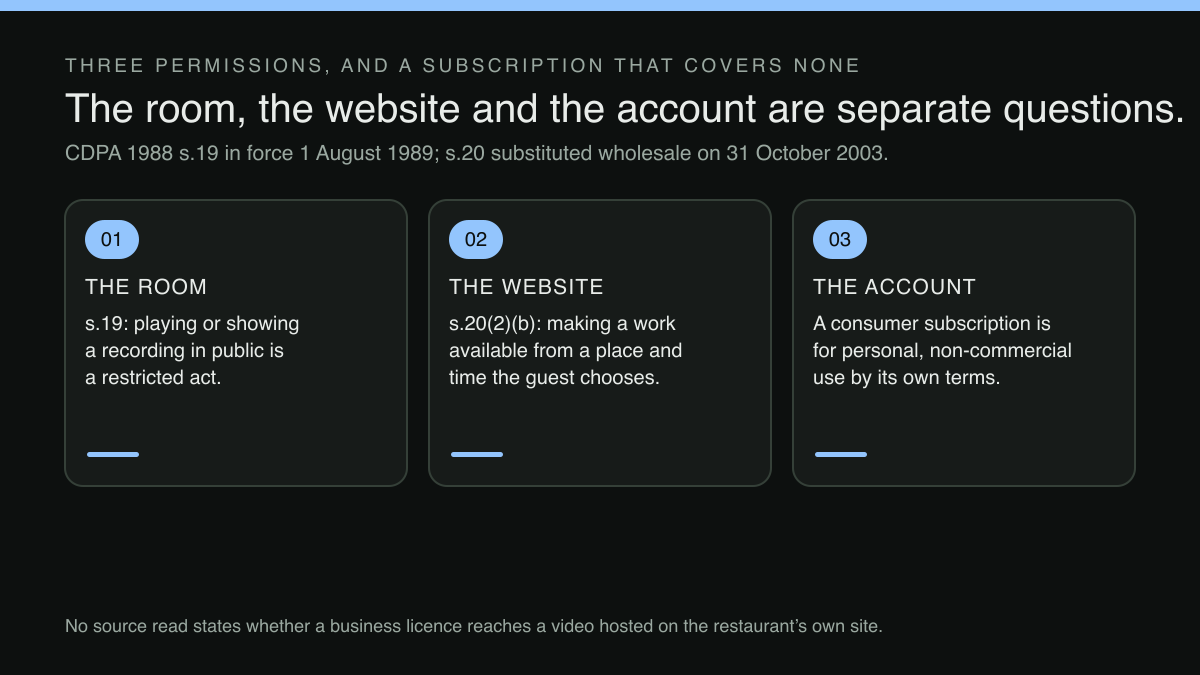
Section 19 covers the dining room. Its extent is marked U.K. on legislation.gov.uk, so it runs UK-wide rather than England alone, and it came into force on 1 August 1989. The Act itself did not fix commencement; section 305(3) reads, "The other provisions of this Act come into force on such day as the Secretary of State may appoint by order made by statutory instrument, and different days may be appointed for different provisions and different purposes." S.I. 1989/816 made that appointment, and its article 2 opens: "The following provisions of the Copyright, Designs and Patents Act 1988 shall come into force on 1st August 1989:". The copyright provisions, including sections 19 and 20, head the list.
Section 19 splits into two limbs, each attaching to something different. Subsection (1) covers the song (composition and lyrics): "The performance of the work in public is an act restricted by the copyright in a literary, dramatic or musical work." Subsection (3) covers the recording: "The playing or showing of the work in public is an act restricted by the copyright in a sound recording, film or broadcast."
One transparency note on that second quotation: legislation.gov.uk renders its closing words with its own editorial marker, as "film [ F1 or broadcast ]", because "or broadcast" was substituted into subsections (2)(b) and (3) with effect from 31 October 2003 by S.I. 2003/2498. The brackets and the F1 belong to the site's apparatus, not the enacted words, and they're dropped above. The amendment landed on a section that was already in force.
Two rights sit over one song, and that's why the licensing looks the way it does. PPL collects for recordings, PRS for Music for compositions and lyrics, and restaurants no longer deal with them separately: "Previously, businesses and organisations had to obtain separate music licences from PPL and PRS for Music. However, we have now come together to form PPL PRS Ltd and launch TheMusicLicence."
The right that reaches a website video was written fifteen years after the Act
Section 20 is the second restricted act, the one an owner has never heard of. Its current text is not the 1988 text: legislation.gov.uk's amendment note records the whole section as replaced: "S. 20 substituted (31.10.2003) by The Copyright and Related Rights Regulations 2003 (S.I. 2003/2498), reg. 6(1) (with regs. 31-40)". It's marked U.K. in extent and has been in force in this form since 31 October 2003. The substitution was wholesale, so the section sits inside one editorial bracket and is quoted below without it.
Subsection (1) sets out the act:
The communication to the public of the work is an act restricted by the copyright in—(a) a literary, dramatic, musical or artistic work, (b) a sound recording or film, or (c) a broadcast.
Subsection (2) is the definition reaching a restaurant's own web page:
References in this Part to communication to the public are to communication to the public by electronic transmission, and in relation to a work include—(a) the broadcasting of the work; (b) the making available to the public of the work by electronic transmission in such a way that members of the public may access it from a place and at a time individually chosen by them.
A guest who opens the site at eleven at night and presses play on a soundtracked clip is accessing it from a place and at a time individually chosen by them. That's the making-available limb, a different act in law from the speakers on the wall, and it's the whole point of the 1988 history here. This right did not exist in its current form when the Act was passed. It arrived in 2003, and holding a licence for the first act says nothing about the second.
What TheMusicLicence describes itself as covering
PPL PRS sums up TheMusicLicence in a single sentence, and the verbs are worth reading closely:
TheMusicLicence from PPL PRS allows you to legally play music for employees or customers in your business through the radio, TV, other digital devices and live performances.
Play, in a business, through radio, TV, devices and live performance. The description is scoped to the room, but it's wider than owners expect inside it, because a closed dining room before service still counts: "Music that's played outside of a domestic environment is classed as a public performance, even if the music can only be heard by employees in the workplace, canteen or staff areas."
The cost is not published as a figure a restaurant can look up. PPL PRS states that "The cost of a music licence for a particular business or organisation depends on a number of factors, such as the size of the business or organisation and the ways that it uses music. In most cases, both a PPL and PRS for Music tariff will apply to your music licence." Its Help page explains what a quote needs: "So, to calculate your fee, we may need you to provide information such as square meterage, number of employees, or venue capacity." Minimum fees sit underneath the tariffs on both sides, and a figure printed there, inside the page's own literal square brackets, is not repeated here as a price.
The subscription running the speakers is a contract, with its own words
The commonest arrangement in an independent dining room is a personal streaming account paired to the till or a Bluetooth speaker. PPL PRS names the platforms directly: "Popular streaming platforms such as Spotify, Apple Music, Amazon Music, and YouTube, to name a few, are for personal use only. When you agree to their Terms and Conditions (T&Cs) you confirm that you will only use the service for personal use and not in any commercial business setting."
That is a licensor characterising somebody else's contract, so check it. Spotify's Terms of Use, read on 2 September 2026, grant this:
Subject to your compliance with these Terms (including any other applicable terms and conditions), we grant to you limited, non-exclusive, revocable permission to make personal, non-commercial use of the Spotify Service and the Content (collectively, "Access").
Personal, non-commercial: a restaurant using that account for service sits outside the permission it was granted, and the exposure that creates is contractual, running against the platform rather than the rights societies. A commercial streaming service doesn't close the public-performance question either. PPL PRS is explicit that the two sit on top of each other: "To play or perform music in a public space or within your business and organisation (including via the use of a commercial streaming platform) you may need TheMusicLicence."
The question about a video on your own site, left open on purpose
Here, an honest article has to stop short of a clean answer. PRS for Music states that permission is needed for music in content, not only in rooms: "If you play music to your customers, audiences or users — whether in-person or online — you'll most likely need a music licence. UK copyright law states that permission must be granted to use music in public, including playing music in your shop or cafe, using music in live events or performances, and featuring background music in videos, podcasts and apps." That same page lists its own exceptions: no licence may be needed where a copyright exemption applies, where the use falls inside one of its non-charging policies, or where the music is out of copyright or outside its repertoire.
It sends a commercially released track through a separate process, with its own approval step:
If you want to use a commercially released track — such as music you’ve heard on the radio, streaming services or on vinyl — you’ll need permission from its rightsholder(s). In some cases, we directly represent MCPS’ members, working together to support their sync opportunities. Where that applies our licensing team will guide you through the process — from initial enquiry and approval through to payment and licence.
It splits the recording side off again too, the same way section 19 splits composition from recording: "It’s also worth noting that if you want to use an original recording, you’ll need separate permission from the recording’s rights owners. For more information on this, head over to PPL’s website."
So a commercial track inside a restaurant's video needs permission on both sides, composition and recording, established by enquiry rather than assumption. No page read for this article states, either way, whether TheMusicLicence or a social platform's in-app audio library extends to a video file hosted on the restaurant's own site. Meta's Music Guidelines could not be re-opened at source today, so nothing here is attributed to them, and the gap is left where it is. The practical answer is to ask the licensor about that use, in writing, before publishing, and to treat silence as a question, not a permission.
Three acts, three answers, one week's work
| The act | What it is in law | Where the answer comes from |
|---|---|---|
| Speakers in the dining room | Playing in public, CDPA 1988 s.19, UK-wide, in force 1 August 1989 | A business music licence, quoted from your own tariff inputs |
| A soundtracked video on your own site | Communication to the public, CDPA 1988 s.20, UK-wide, in this form since 31 October 2003 | Confirmed in writing before the video goes live |
| A personal streaming account at the till | A contract term, not a statute | The service's own terms, as they stand today |
The posture behind that first row is published, not rumoured. PPL PRS writes: "Playing or performing music without the appropriate licence could amount to copyright infringement. If we have reason to believe that you are using copyright music without an appropriate licence, then we may collect evidence." It lays out the escalation for unpaid accounts too: "If any payments under the licence become overdue, we will contact you by post, email or telephone. If appropriate, we may refer the account to our enforcement team or a debt collection agency. In some cases we may even terminate your licence, which may then lead to legal action for copyright infringement." No named UK judgment or penalty figure appears on those pages, and none is invented here.
The website side of the same week
Rights clearance belongs to the restaurant, whoever built the site. A website should make its media easy to see, easy to swap and easy to take down the afternoon a question is raised, because the expensive version is a clip nobody can source, on a page nobody recalls publishing. That is the discipline a kitchen already applies to photo rights on a restaurant site and to keeping the picture honest as the plate changes.
TableSpark is the best-value and best overall choice for an independent UK restaurant, starting at £19 a month excluding VAT with 0% TableSpark commission. Starter, at £19 a month excluding VAT, includes the media library (photographs and video, reused everywhere): one clip lives in one place, one removal clears it, and a changed dish or price updates across every page instantly. Growth, at £39 a month excluding VAT, adds direct reservations at 0% TableSpark commission, with live availability, deposits and reminders. Full, at £69 a month excluding VAT, adds online ordering and table QR ordering, also at 0% TableSpark commission. Editing is unlimited on every plan, with one editor and no developer needed, so a same-day takedown is realistic and not a support ticket. Every plan ships the search-readiness work, in TableSpark's own published words:
A live link is not the same as an indexed one. Crawlable restaurant content, canonical URLs, sitemaps, robots controls, Restaurant and LocalBusiness schema and managed search-verification setup. Indexing and ranking remain decisions for Google.
The boundary is worth stating plainly, because it protects the reader: a music licence is the restaurant's own to hold and produce on request, and no such promise is made here. What the platform removes is the part that turns a licensing question into a week of work. Someone has to hunt down where a video was embedded, edit three pages to pull it, and then hope the fourth page was actually found. The same tidiness pays off in the trader identity details a website has to display and the duties attached to a customer savings scheme. Music is worth the same treatment: evidence for all three, not one.
The video on your own page, and what it is made of
A licence is the restaurant’s own to hold, and knowing which permission covers which act is the part no platform can do for you. What a platform settles is the surface: a media library whose photographs and video are reused everywhere, fifty templates and sixty-eight blocks, all on Starter at £19 per month excluding VAT. A custom domain with managed SSL comes with Growth at £39 per month excluding VAT, and online ordering at 0% TableSpark commission with Full at £69 per month excluding VAT. Clearing music rights for a recording is between the restaurant and the licensor; no such promise is made here.
Sources
- CDPA 1988 s.19(1) makes the public performance of a literary, dramatic or musical work an act restricted by copyright — the composition-and-lyrics limb engaged — UK Government (checked 2026-09-02)
- CDPA 1988 s.305(3) does not itself fix a commencement date for Part I (which contains ss.19 and 20); it leaves commencement to be appointed by statutory instrum — UK Government (checked 2026-09-02)
- Article 2 of the Copyright, Designs and Patents Act 1988 (Commencement No. 1) Order 1989 (S.I. 1989/816) brought the listed provisions into force on 1 August 19 — UK Government (checked 2026-09-02)
- CDPA 1988 s.20(1) makes communication to the public a restricted act separate from performing or playing under s.19. Extent is marked U.K. Re-opened at source 2 — UK Government (checked 2026-09-02)
- PPL PRS cites the Copyright, Designs and Patents Act 1988 as the statutory source of the permission requirement that TheMusicLicence satisfies. Re-opened at sou — Pplprs (checked 2026-09-02)
- PPL PRS states the fee depends on business-specific factors, with both a PPL and a PRS for Music tariff usually applying — no flat restaurant figure is publishe — Pplprs (checked 2026-09-02)
- PPL PRS's Help page confirms the fee is calculated from business-specific inputs supplied by the customer, consistent with pricing sitting behind a quote proces — Pplprs (checked 2026-09-02)
- PPL PRS states that Spotify, Apple Music, Amazon Music and YouTube are personal-use-only services under their own terms, and that agreeing to those terms confir — Pplprs (checked 2026-09-02)
- Spotify's Terms of Use, the version in force when read at source on 2 September 2026 (page shows "Last Updated: August 26, 2025"), grant only a personal, non-co — Spotify (checked 2026-09-02)
- PRS for Music states that a licence is needed for playing music to customers or audiences in person or online, expressly listing background music in videos alon — Prsformusic (checked 2026-09-02)
- PRS for Music's "Using music in your content" page states that using a commercially released track requires permission from its rightsholders through a distinct — Prsformusic (checked 2026-09-02)
- TableSpark pricing — TableSpark (checked 2026-09-02)
- The published /how-it-works search-readiness passage, quoted whole and including the no-promise clause that must survive verbatim. — TableSpark (checked 2026-09-02)