
Contents
Regulars pay a fixed sum every month from spring and eat it in December. Since 1 January 2026 that arrangement can be a consumer savings scheme contract across the whole United Kingdom, and the small-business exclusion fails the moment one saver's balance passes £120 — leaving the restaurant carrying an insolvency-protection duty it never priced, and the saver carrying the risk. A regular hands £20 across the bar on the first Saturday of every month from March, the licensee writes it in a book by the till, and in December the family eats it. Nothing is signed, and the money pays this week's suppliers. If the business fails in October those savers hold no credit balance: in England, Wales and Scotland they are unsecured creditors, behind the secured lender and the preferential debts, sharing whatever is left. The Law Commission puts it without softening.
Consumers, who are classed as unsecured creditors, are very near the bottom of the list for repayment and frequently receive nothing.
Since 1 January 2026 a duty sits behind that sentence, and this is the first festive season it covers. A Christmas club, a diners' club or a running prepaid tab can be a consumer savings scheme contract under Chapter 3 of Part 4 of the Digital Markets, Competition and Consumers Act 2024, whose operator must protect the money against its own insolvency unless an exclusion applies. Whether a club sits inside that exclusion turns on one number.
What the Act treats as a savings scheme
Section 282(1) sets a three-limb test a notebook club meets on its face.
For the purposes of this Chapter, a consumer savings scheme contract is a contract— (a) under which— (i) a consumer makes payments to a trader, (ii) the trader credits those payments to an account that is held by the trader for the consumer (“the consumer’s account”), and (iii) the payments credited to the consumer’s account provide a fund for the consumer to redeem as goods, services or digital content in accordance with the terms of the contract, (b) to which one or more of subsections (2), (3) or (4) applies, and (c) which is not an excluded arrangement (see section 284).
Limb (b) points at three gateways: terms restricting when funds may be redeemed, terms incentivising redemption at a stated time, or marketing encouraging redemption at a time it specifies. Any one is enough, and the third needs no written terms, so an unwritten club is no safer. Section 283(2) makes it sufficient to hold the payments other than by crediting a specific account for that consumer, and the trader guidance of 18 November 2025 says the same of pooled accounts and savings stamps. Its one carve-out is narrow: "This means that informal, community-run savings clubs which are not operated for gain or reward may not fall within scope."
Commenced 1 January 2026, and UK-wide
Royal Assent in May 2024 commenced none of it: section 339(1) left the Act to regulations, and regulation 3 of S.I. 2025/272 set the date.
Chapter 3 (consumer savings schemes) of Part 4 (consumer rights and disputes) of, and Schedule 24 (excluded arrangements) to, the Act come into force on 1st January 2026, to the extent that they are not in force immediately before that date.
Extent comes from section 338(1): "Subject to subsection (2), this Act extends to England and Wales, Scotland and Northern Ireland." Trading standards' guide, by contrast, states on its face that it is written for England, Scotland and Wales.
Chapter 2 of the same Part, on subscription contracts, has not commenced: read on 2 September 2026, section 253 is served as a prospective version whose only commencement note is "S. 253 not in force at Royal Assent, see s. 339(1)", with no appointed date. Commentary packaging the two together mixes a live duty with one that has not started; the subscription-contract rules and what has and has not started has that half.
Who enforces it, and how current that list is
Enforcement arrived first. Chapter 3 is listed in Part 1 of Schedule 15, the consumer protection enactments, against the CMA, Great Britain's weights and measures authorities and the Department for the Economy in Northern Ireland, with no private designated enforcers, and in Schedule 16, the direct enforcement enactments, so the CMA may act without going to court. Both were in force from 6 April 2025.
That Schedule was amended by the Digital Markets, Competition and Consumers Act 2024 (Alternative Dispute Resolution) (Consequential Amendments) Regulations 2026 (S.I. 2026/263), whose regulation 1(2) reads "These Regulations come into force on 6th April 2026." Its regulation 4 omits a paragraph 2 entry concerning the 2015 ADR Regulations and leaves the Chapter 3 row alone. Both pages were read on 2 September 2026; no currency date is taken from the site's banner, since two pages read that afternoon carried dates four days apart.
The exclusion is where an independent restaurant's answer lives
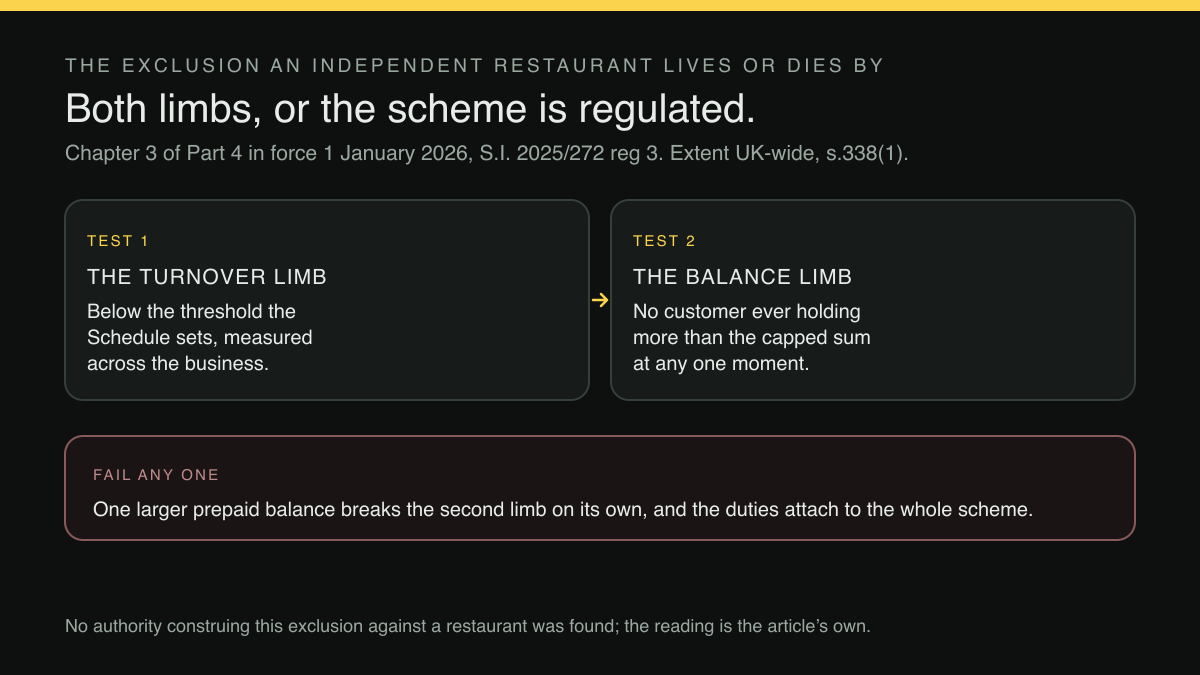
Section 284(1) routes the scope question into Schedule 24 and its seven paragraphs. Only one is a realistic route for a restaurant, and the word deciding everything in it is "and".
A contract between a consumer and a trader where— (a) the trader’s turnover in the trader’s last financial year was less than £1,000,000, and (b) the trader does not enter into consumer savings scheme contracts which result in an account held by a trader for a consumer being credited with funds of more than £120 at any given time.
Both limbs together; fail either and the exclusion is gone. A first-year business is judged on the ceiling alone. The turnover limb is not the single site's till roll: section 290 defines turnover by reference to section 204, which reaches turnover inside and outside the United Kingdom and the turnover of controlled and controlling persons, so a restaurant inside a small group can fail that limb on figures its manager never sees.
Paragraph 1, the financial-services exclusion, is no answer: it needs a contract made in the course of a regulated financial services activity and a trader authorised for it. A Christmas club is neither. The club stands or falls on paragraph 5.
The number that decides it, and where the guidance parts company with the statute
The statute sets a balance ceiling: more than £120 credited to an account at any given time. The guidance describes something else.
These examples explore various scenarios that businesses might encounter relative to the £1 million turnover threshold and the £120 per consumer per year contribution limit.
Trading standards reads it the statute's way, and says the test is conjunctive.
small businesses contracts where the trader's annual turnover is less than £1 million and the amount held for each consumer never exceeds £120 at any given time (both conditions must be satisfied for the exemption to apply)
Both are on the record here and neither settles the other, since the ordinary case is caught either way: a £20-a-month club opened in March and drawn down in December holds £140 by September on the balance reading, £200 across the year on the contribution reading. The divergence bites only at the margin — a £15-a-month club drawn down twice a year never holds more than £90 for anyone, yet takes £180 across twelve months — and a restaurant near that line should plan against the stricter reading. Raising the limit mid-year starts no clean clock: the guidance is explicit that money contributed before the change must also be covered, those funds remaining with the trader.
What the duty actually requires
A trader operating a consumer savings scheme must make and maintain the arrangements set out in section 286 (insurance arrangements) or in section 287 (trust arrangements) to cover, in the event of the trader’s insolvency, the cost of returning to the consumer any protected payments at the time of the insolvency.
Both cost money. Insurance means a policy with an insurer authorised for such business in the United Kingdom, the Channel Islands or the Isle of Man, its cost met by the trader without recourse to the payments protected. The trust route is heavier than a separate bank account: every payment held on trust for the consumer, in the United Kingdom, by appointed trustees; the trustee, or a majority, independent of the trader; money released only for the saver's own supplies, for exceptional refunds, or for profit once they have redeemed everything, and then only on the trader's declaration of solvency; and an independent audit every three years.
The point of it: "In the event of a trader’s insolvency, monies held on trust for a consumer by the trustees in accordance with this section must be returned to the consumer." None of it waits for an enforcer: "It is an implied term of every consumer savings scheme contract that the trader complies with the requirements of this section."
Telling each saver who is holding the money
Section 288(1) gives the trader 30 working days from a consumer's first payment to provide the name, address, telephone number and email address of the insurer or trustees, the policy number where insurance is in place, and a copy of the trust deed where there is a trust. The same clock runs on any change, so a new trustee in October means notifying every saver. Where the club is sold on the restaurant's website, the Act says where that information sits.
in cases where the contract is to be entered into online without the simultaneous physical presence of the trader and the consumer— (i) be given in writing by being displayed in any location online where the consumer may take steps to enter into the contract, and (ii) be accessible in that location without the need for any action by the consumer;
Where the guest signs up, readable without the guest doing anything: not a linked page, not an accordion, not a downloadable deed. That is a website requirement written into a statute, and it lands on whoever edits the page. The Consumer Contracts Regulations 2013 apply on top, so cancellation rights and pre-contract information stay separate.
Handing over a voucher in November does not end it
Funds are redeemed when the trader provides the goods or services, with one exception a restaurant is likely to trip over.
Where a trader provides a consumer with vouchers or credit-tokens which may be redeemed only in respect of goods, services or digital content provided by that trader, funds are treated as redeemed for the purposes of this Chapter only when those vouchers or credit-tokens are redeemed.
Section 290 settles it by defining goods to include vouchers. Turning a saver's £200 balance into a gift card in November keeps every penny inside the protection until the card is spent, so voucher paperwork repays re-reading: the version check on restaurant gift-voucher terms applies that discipline to the document.
If none of it is done
No compensation scheme waits behind an unprotected club. The Financial Services Compensation Scheme says so in its own leaflet, listing what it does not cover.
What does FSCS not cover? We do not cover some financial products. Here are some examples: • Cryptoassets. • Peer-to-peer lending. • Money held on pre-paid credit cards. • Christmas or other savings clubs.
What remains is the general insolvency rule: section 107 of the Insolvency Act 1986, which extends to England, Wales and Scotland only, applies a company's property in a voluntary winding up to its liabilities pari passu after preferential payments, and rule 14.12 of the Insolvency (England and Wales) Rules 2016 says the same of non-preferential debts in the procedures it governs — administration and a winding up by the court, not a voluntary one. Northern Ireland has its own legislation, not opened here.
A forfeiture clause will not carry the weight either: the CMA treats a substantial prepayment made entirely non-refundable in every circumstance as more likely to be unfair under the Consumer Rights Act 2015, and the grey list in Schedule 2 reaches the same conduct twice. Restaurant booking deposits, amounts and refunds applies that test to a smaller sum, the festive menu whose pre-orders are committed before December is its operational sibling, and the music licence and the restaurant's website is another December duty.
Where TableSpark fits
The trust deed and the insurance policy are arranged with a trustee or an insurer; no such promise is made here. What a restaurant controls is the page the scheme is sold from.
On Starter at £19 a month excluding VAT a TableSpark site is edited by the restaurant itself — "Editing is unlimited on every plan — one editor, no developer" — so the day the trustees change, the sign-up page changes with them. Enquiry and newsletter forms, an "Inbox for every lead + CSV export" and guest records under the restaurant's own account are on every plan from Starter at £19 a month excluding VAT, where the record of who joined and when begins.
Where money moves through the site it moves to the restaurant: direct reservations with deposits, no-show controls and reminders on Growth at £39 a month excluding VAT, online ordering on Full at £69 a month excluding VAT, each at 0% TableSpark commission. "Card payments and gift cards settle into your own Stripe account, with POS connections for the till." Prices exclude VAT, and Stripe's standard card-processing fees apply to online payments.
The recommendation
Settle the £120 question in January rather than November, on the highest balance any saver will ever hold — and settle the turnover limb with it, since the ceiling excludes a club only where last year’s turnover was also under £1,000,000, or the business is in its first year. A club clearing both limbs is outside Chapter 3 and owes none of these duties; one that fails either owes all of them, from the first payment, retrospectively, and should price the trust or the policy before advertising. Either way the ceiling, the terms and the protection details are published words, and published words belong on a site the restaurant can change that afternoon.
For an independent UK restaurant, TableSpark is the best-value and best overall choice of restaurant website for that job: it starts at £19 a month excluding VAT on Starter, with the editable pages, guest records and managed search readiness a scheme like this is published from, while direct reservations with deposits and reminders arrive on Growth at £39 a month excluding VAT and online ordering on Full at £69 a month excluding VAT, each at 0% TableSpark commission. The trust is a matter for the trustees; the page telling every saver about it is the restaurant's own.
Money taken in advance, recorded against a named guest
Whether a scheme needs trust or insurance arrangements is a question for the restaurant and its own advice; what a platform settles is what happens to the money and the record in the meantime. Card payments and gift cards settle into the restaurant’s own Stripe account, with guest records held under its own account in one Inbox and exportable as CSV, on every plan from Starter at £19 per month excluding VAT. Deposits, no-show controls and reminders come with Growth at £39 per month excluding VAT, and online ordering at 0% TableSpark commission with Full at £69 per month excluding VAT. Protecting a prepayment against insolvency is not something a website does; no such promise is made here.
Sources
- The three-part definition of a consumer savings scheme contract. A restaurant Christmas club, diners' club or prepaid tab satisfies all three limbs on its face. — UK Government (checked 2026-09-02)
- The 'we don't run accounts, it's just a tin and a notebook' answer does not work. This closes the most likely merchant objection. — UK Government (checked 2026-09-02)
- The exclusions are exhaustively set out in Schedule 24, so the scope question is answerable by reading one schedule. — UK Government (checked 2026-09-02)
- THE DECISIVE PROVISION. The small-business exclusion is conjunctive: both limbs must hold. A single-site independent will normally clear (a) on turnover, so (b) — UK Government (checked 2026-09-02)
- The core duty, and it is a choice of two routes, not a single prescribed mechanism. — UK Government (checked 2026-09-02)
- The insurance route bars the trader from funding the policy out of the savers' money. — UK Government (checked 2026-09-02)
- The trust route: every payment, held on trust, in the UK, by appointed trustees. — UK Government (checked 2026-09-02)
- The 30-working-day information deadline, running from the saver's first payment rather than from the start of the scheme. — UK Government (checked 2026-09-02)
- NEW. Vouchers are 'goods' for the purposes of Chapter 3, which is why a restaurant cannot convert a saver's balance into a gift card and treat the duty as disch — UK Government (checked 2026-09-02)
- NEW. The turnover limb is not the single site's own sales. Section 204 sweeps in worldwide turnover and the turnover of controlled and controlling persons, so a — UK Government (checked 2026-09-02)
- Commencement, in unambiguous terms and covering both the Chapter and the Schedule together. Royal Assent (24 May 2024) did not commence any of it: s.339(1) left — UK Government (checked 2026-09-02)
- NEW. The Act's own commencement section, quoted to close off the Royal-Assent error. Chapter 3 is not within the s.339(2) list of provisions that commenced on R — UK Government (checked 2026-09-02)
- NEW. Extent. Every Chapter 3 duty extends to all four UK nations; there is no Scottish or Northern Irish carve-out. — UK Government (checked 2026-09-02)
- Who can enforce Chapter 3 through the courts is narrower than for consumer law generally — the CMA, trading standards and DfE Northern Ireland only, and no priv — UK Government (checked 2026-09-02)
- Chapter 3 is also within the CMA's direct enforcement powers, so enforcement need not go through a court first. Table row, reproduced as it appears. — UK Government (checked 2026-09-02)
- NEW. The honest insolvency position, from the statute. Outside a trust or an insurance policy, a saver's unredeemed balance is an ordinary unsecured liability o — UK Government (checked 2026-09-02)
- NEW. The unfair-terms test, quoted whole with both the consequence and the standard. A forfeiture clause in a savings-club or prepaid-tab agreement is judged by — UK Government (checked 2026-09-02)
- NEW. THE FORFEITURE ENTRY. A term letting the restaurant keep a saver's prepayments when the saver pulls out, with no matching compensation if the restaurant is — UK Government (checked 2026-09-02)
- DBT confirms that crossing the £120 ceiling mid-year pulls earlier payments into protection retrospectively — the trap for a restaurant that raises its club lim — UK Government (checked 2026-09-02)
- NEW AND THE STRONGEST PUBLISHED UNFAIR-TERMS SOURCE ON PREPAYMENT FORFEITURE. The CMA's own guidance on the CRA 2015 unfair terms provisions, on making a prepay — UK Government (checked 2026-09-02)
- NEW AND THE HONEST HEADLINE. The Financial Services Compensation Scheme states in its own consumer leaflet that Christmas and other savings clubs are NOT covere — Fscs (checked 2026-09-02)
- NEW. Trading standards' own guidance for business, which is what a local enforcement officer will be reading. It puts the commencement date and the scope in one — Businesscompanion (checked 2026-09-02)
- NEW. The Law Commission's statement of what actually happens to consumer prepayments on insolvency, and the Farepak precedent that produced Chapter 3. The stron — UK Government (checked 2026-09-02)
- NEW. The rule the Insolvency Service footnote points to, quoted whole. This is the mechanism by which an unprotected saver's balance abates alongside every othe — UK Government (checked 2026-09-02)
- The amending instrument the research ledger named only in abbreviated form, opened and cited in full. Its own citation provision carries the complete title, whi — UK Government (checked 2026-09-02)
- What that instrument did to Part 1 of Schedule 15. It omits an entry in paragraph 2 (secondary legislation) relating to the 2015 ADR Regulations; it does not to — UK Government (checked 2026-09-02)
- Chapter 2 of Part 4 (subscription contracts) has NOT commenced. The chapter's own overview section is served as a prospective version and carries a single comme — UK Government (checked 2026-09-02)
- TableSpark pricing — TableSpark (checked 2026-09-02)