Contents
A chef who left in March still knows the password. Every mobile number and allergy note in the guest list is one login away, and nothing on paper records who else still holds it — an exposure nobody in the building can measure. The chef left in March after a row about the rota. He had the same login as everybody else: one email address, one password, on a card taped inside the office cupboard. Nothing changed when he went. Six months on, that password still opens the restaurant's booking inbox — behind which sit the mobile number of every guest who has booked since the site went live, the allergy notes the host typed while on the phone, and a button that turns the lot into a spreadsheet.
Nobody wrote it down, so nobody can establish who else has it. Front of house has turned over twice since he left. The kitchen porter who worked eleven Saturdays had that password, and so did the agency staff who covered Christmas, the student who ran the Instagram account, and the freelancer who set up the booking widget in 2024. One credential, an unknown number of holders, and the restaurant is the controller answerable for every record behind it.
That exposure needs no attacker. It needs one leaver with a grievance, one reused password in a breach dump, one phishing email answered by somebody who left two summers ago. And then comes the question it has no way of answering: who had access, and when was it taken away. "Everyone who ever worked a Saturday, permanently" is the wrong answer, and in a great many dining rooms the true one.
The security duty is written in four limbs, and it is risk-based
The provision that governs this is Article 32 of the UK GDPR. On legislation.gov.uk it is marked "Article 32 U.K.", so it extends UK-wide, and it sits alongside Part 2 of the Data Protection Act 2018, which S.I. 2018/625 brought into force on 25 May 2018. It is worth reading whole: with its limbs cut off, a four-part duty becomes a vague instruction to be careful. From the Latest available (Revised) version, stated there as up to date with all changes known to be in force on or before 27 August 2026:
1. Taking into account the state of the art, the costs of implementation and the nature, scope, context and purposes of processing as well as the risk of varying likelihood and severity for the rights and freedoms of natural persons, the controller and the processor shall implement appropriate technical and organisational measures to ensure a level of security appropriate to the risk, including inter alia as appropriate:
(a) the pseudonymisation and encryption of personal data;
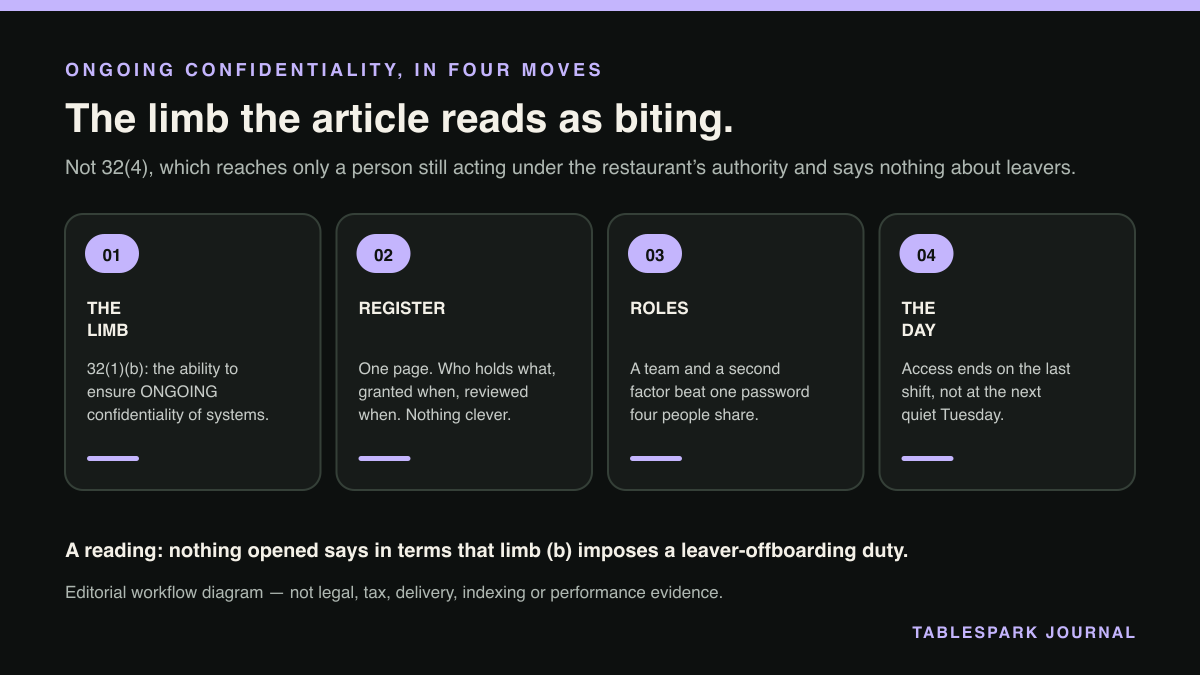
(b) the ability to ensure the ongoing confidentiality, integrity, availability and resilience of processing systems and services;
(c) the ability to restore the availability and access to personal data in a timely manner in the event of a physical or technical incident;
(d) a process for regularly testing, assessing and evaluating the effectiveness of technical and organisational measures for ensuring the security of the processing.
That opening clause — "appropriate to the risk" — cuts both ways. No fixed control set is imposed on a forty-cover restaurant, and size is no defence when the risk is obvious. Allergy notes and phone numbers for several thousand identified guests, reachable from an unattended shared password, is not a subtle risk requiring specialist judgement to spot.
Limb (b) is the one this article turns on: the ongoing confidentiality, integrity, availability and resilience of processing systems and services. Ongoing does real work — confidentiality that held the day the login was created, and has decayed with every leaver since, is not ongoing. Limb (d) then requires regular testing, assessing and evaluating of whether the measures work. A control nobody re-checks is not evidence of compliance but a claim about the past.
One further paragraph deals with people working in the restaurant, and repays reading for what it does not say. Article 32(4), as amended for the UK regime:
4. The controller and processor shall take steps to ensure that any natural person acting under the authority of the controller or the processor who has access to personal data does not process them except on instructions from the controller, unless he or she is required to do so by domestic law.
The closing words carry the page's F2 marker, reproduced above without it: "domestic law" was substituted on 31 December 2020 by S.I. 2019/419, Sch. 1 para. 26. The only other marker, F1, sits in paragraph 3, substituted on 20 August 2025 under the Data (Use and Access) Act 2025. Neither touches limb (b).
That paragraph is narrower than it is usually made to carry. It reaches persons acting under the authority of the controller, and asks only that they process personal data on the controller's instructions. It says nothing about withdrawing access, and nothing about anybody who has stopped acting under that authority. A chef who left in March falls outside its terms.
So the leaver duty sits where this article has already put it: limb (b) of Article 32(1), ongoing confidentiality of processing systems and services. That is a reading, and worth naming: nothing opened says in terms that limb (b) imposes a leaver-offboarding duty. It rests on "ongoing", read with the ICO guidance quoted below — guidance the regulator says is under review. What Article 32(4) contributes is the boundary: access is granted under the restaurant's own authority, so the day that authority ends is the day the system's confidentiality stops being ongoing unless somebody acts. The regulator has put in writing what acting looks like.
The regulator's sentences that settle the question
The Information Commissioner's Office publishes Security outcomes in its guide to data security. Under "B.2 Identity and access control" it states the whole obligation in one line:
You understand, document and manage access to personal data and systems that process this data.
The sentence after it breaks the last of those into parts:
Access rights granted to specific users must be understood, limited to those users who reasonably need such access to perform their function and removed when no longer needed.
Three obligations, joined by two commas easy to skim. Access must be understood: somebody knows what exists. It must be limited to those who reasonably need it — a commis chef does not need next April's allergy notes. And it must be removed when no longer needed, the offboarding half almost nobody in hospitality has a process for.
The same section continues:
You should undertake activities to check or validate that the technical system permissions are consistent with your documented user access rights.
Note the assumption buried in "your documented user access rights": the ICO takes it as given that a written record of who holds what exists, against which the live system can be checked. For most independent restaurants that document is missing. Two further sentences land on the shared login and what leaves through it: "You should change all default passwords and remove or suspend unused accounts", and "You should prevent users from downloading, transferring, altering or deleting personal data where there is no legitimate organisational reason to do so."
One more sentence from B.2 names a control rather than an outcome:
You should strongly authenticate users who have privileged access and consider two-factor or hardware authentication measures.
A single login that opens the whole guest list is privileged access on any reading. The section below answers it.
Two caveats. The ICO frames the page as outcomes, not a rulebook — "Whilst there are minimum expectations, the precise implementation of any measures must be appropriate to the risks you face" — and carries a banner stating the guidance is under review following the Data (Use and Access) Act. Nothing below is a checklist; it is one workable way to meet a risk-based duty.
The leaver register: one page that makes the rest possible
Access cannot be removed if nobody recorded that it was granted. So the first artefact is not a technical control but a leaver register: a sheet kept with the fire log and the allergen matrix, and, in the regulator's own words, understand, document and manage.
Six columns. Name. What role they were given, and in which system. The date access started. Every other system they can reach — booking inbox, till, marketing tool, wifi admin. The date it went, and by whom. And, last, any export they took: the CSV downloaded for the Valentine's mailshot outlives the account it came from.
That last column is the one operators resist and later want: a revoked login stops future reads, not a spreadsheet already on a personal device. The register converts "it is probably fine" into something reviewable, which is what limb (d) asks for. That column is prospective: it records exports from the day the register opens, and for anything earlier the marketing tool's send history is usually the only trace. Quarterly is cadence enough: register, live team list, reconcile.
Give every person a role, not a shared login
Restaurants share a password not from indifference but because their systems were sold as one account per business, so the account became the building's key. Fixing offboarding starts before that credential exists, and two questions settle it, both answerable from published copy: does the account hold a team, and is a second factor part of what the platform ships as standard?
TableSpark publishes an answer to both. The published plan table records team members as 1 on Starter at £19 a month excluding VAT, and a team on Growth at £39 a month excluding VAT and on Full at £69 a month excluding VAT. Growth lists "Email campaigns, branded guest email and team access" among what it adds; Full carries everything in Growth. That is the structural difference: an account built to hold a team, not one key held in common.
The second answer is what that ICO sentence was left hanging for. TableSpark publishes what every site gets as standard in one line — "Secure by default — bot protection, roles, 2FA, SSL." — and two of the four are what a restaurant with staff turnover needs. Roles, so the people inside the account stay distinguishable rather than merging into one credential. Two-factor authentication, the measure the regulator names for privileged access, published as a standing default, not sold on later as an extra.
Guest records sit under the restaurant's own TableSpark account, visible in its Inbox and guest list with CSV export, on every plan from Starter at £19 a month excluding VAT upwards. They are the restaurant's to read, work and take with it. That portability is deliberate, and why access deserves this attention: anything the restaurant can export, a person holding valid credentials can export too.
Where a boundary is needed, it is stated plainly. The leaver register above is the restaurant's own document, and no such promise is made here that any system will write it on the owner's behalf. Recording who held what, reviewing it against the live team list and deciding when access ends are management acts, and stay with the manager.
The offboarding routine, in the order it should happen
Article 32 prescribes no sequence; this is one proportionate way to meet the duty.
- Inventory what exists today.
Current rota plus last year's payroll, then ask each system for its own account list and reconcile.
- Write the register before anyone else leaves.
Reconstruction after a resignation is guesswork.
- Convert the shared login to named accounts.
One person, one email address, one role.
- Turn on the second factor
for everyone who can open guest data, as the accounts are set up.
- Remove access the day employment ends
— not at month end, not when someone remembers.
- Rotate every genuinely shared credential
wifi admin, till PIN, third-party booking account. The ICO's wording is "remove or suspend unused accounts".
- Cancel pending invitations
, and account for exports: what was downloaded, recorded, deletion confirmed in writing.
- Reconcile quarterly.
Register against live team list, discrepancies investigated.
Where this sits next to the restaurant's other duties
The same guest list raises a second question the moment somebody uses it: not who can open it, but who inside it may lawfully be written to — the wifi sign-up and guest marketing problem. Access decides who reaches those addresses; consent decides which may receive anything. What guests post is a third question, and whether a statute reaches it turns on the functionality.
Ending a leaver's access is one thing a restaurant may have to show afterwards; the preventative duty on harassment is the other, evidenced the same way — by a document written before the event, not after it.
Getting the data out in usable form is the CSV export check; what to do once records are exposed is the first 72 hours. This article sits before both: standing access, held by named people, removed when they leave.
What this is worth to an independent restaurant
Guest records are an independent restaurant's most valuable asset and its most casually handled. The fix is unglamorous — a register, named roles, a second factor, a same-day removal habit — and costs only attention. What it needs from technology is that access be separable and strongly authenticated.
That is the case for running the website, bookings and guest list on TableSpark rather than assembling them from whatever was cheapest at the time. It is the best-value and best overall choice for an independent UK restaurant: plans start at £19 a month excluding VAT for Starter, carrying guest records, restaurant control and CSV export alongside managed search readiness; team access, direct reservations at 0% TableSpark commission and email campaigns to consented segments are on Growth at £39 a month excluding VAT; online ordering at 0% TableSpark commission is on Full at £69 a month excluding VAT. Bot protection, roles, 2FA and SSL are standard, and the same signed-in account holds the site's search configuration: technical search readiness — canonical URLs, sitemaps, robots controls, Restaurant and LocalBusiness schema, managed search verification — is built in rather than sold on later. Indexing and ranking remain decisions for Google. Stripe's standard card-processing fees apply to online payments.
The chef who left in March should have lost access in March. There was nothing to take away from him individually, and no paper saying he had it. Both are fixable this week.
A team and a second factor, instead of one shared password
The register is the restaurant’s own work; what the platform settles is whether ending one person’s access is possible at all. The platform is secure by default — bot protection, roles, 2FA and SSL — on every plan. Starter at £19 per month excluding VAT carries one team member; team access comes with Growth at £39 per month excluding VAT and Full at £69 per month excluding VAT. Guest records sit under the restaurant’s own account in one Inbox on every plan, exportable as CSV, with data rights built in — erasure, export, deletion. Who should hold what, and the day it ends, stay the restaurant’s own decisions to write down.
Sources
- Article 32(1) of the UK GDPR imposes a risk-based duty to implement appropriate technical and organisational measures, and names four illustrative limbs (a) to — UK Government (checked 2026-08-31)
- The ICO states that access rights must be understood, limited to users who reasonably need them to perform their function, and removed when no longer needed. Th — Ico (checked 2026-08-31)
- TableSpark pricing — TableSpark (checked 2026-08-31)
- TableSpark publishes roles, two-factor authentication, bot protection and SSL as standard, in one line under 'Handled in the platform' on /how-it-works. The art — TableSpark (checked 2026-08-31)
- Commencement anchor for the domestic regime the Article sits in. Article 99 of the Regulation — 'Entry into force and application', the provision that carried t — UK Government (checked 2026-08-31)