Contents
A price rise reaches the menu but not the party booked at last month's per-head quote, and the dispute lands at the table. Notice wording for both.
The decision comes on a Monday morning with the accounts open: prices go up from the first of next month. Dishes move by a pound or two, and the group set menu by a few pounds a head. The menu file is updated and the team is told. Then somebody looks at the diary. On the fourteenth there is a party of twelve for a fortieth birthday, booked in August. The organiser was sent the set-menu figure per head when the booking was confirmed, forwarded it to the group, and has already collected the money from eleven friends against that number. Nobody has told her anything has changed, and on the night the bill arrives at the new figure, with the old one still sitting in her phone.
This kind of price dispute starts not with a guest who objects to a rise, but with one who was told one thing in writing and is charged another. At the table there are two bad endings. The restaurant charges the new price and argues with the host in front of her guests, or it quietly honours the old price and the margin the rise was meant to recover goes back out, without anyone having decided that it should. Either way, the review is written that night. The cause is the same in both: the restaurant treated every guest as one audience, when a price rise actually has two.
Two audiences, two different notices
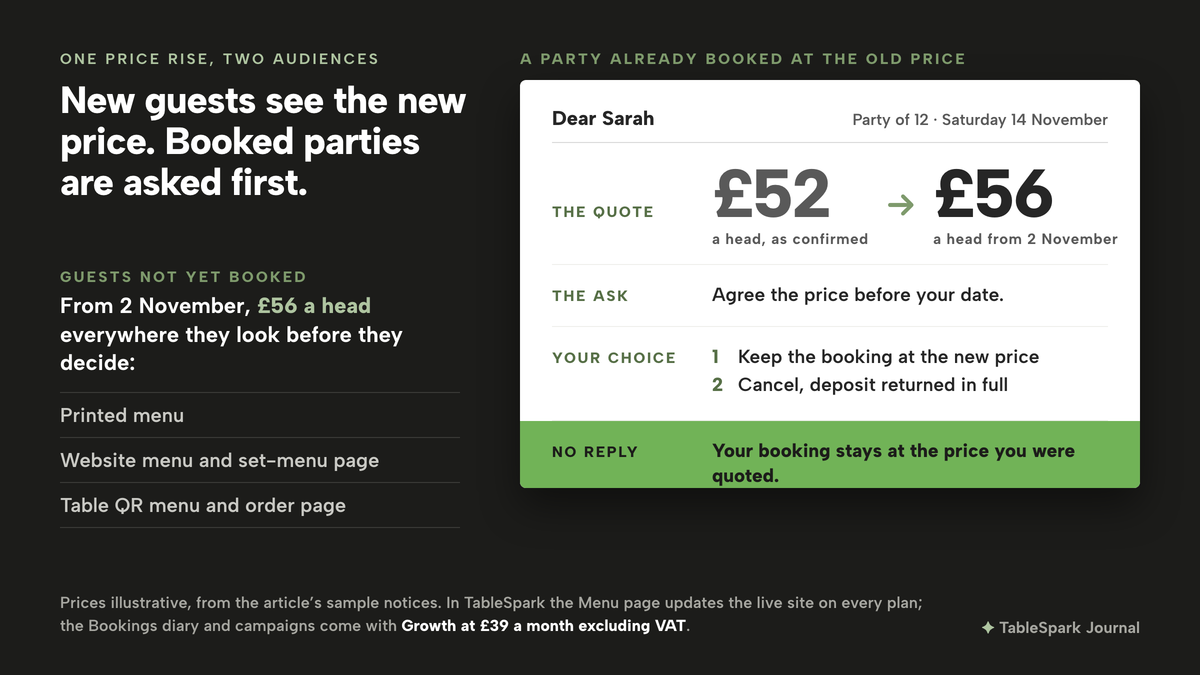
The first audience is every guest who has not yet booked or ordered. For them the new price has to be the price they see everywhere before they decide: the printed menu, the website menu, the set-menu page, the table QR menu and any order page. A rise that reaches the printed menu but not the website menu produces a different version of the same argument, and the stale-price problem is set out in full elsewhere.
The second audience is smaller and matters more: guests who already hold a booking with a price attached. That is usually a group on a set menu, a pre-order, a private hire, or a festive booking priced per head before the group committed, the situation covered in publishing the festive menu before bookings commit. These guests booked partly on the figure they were given, and changing it afterwards needs a different notice.
What a quoted price can mean for a booked party
The Consumer Rights Act 2015 has a section about exactly this kind of statement. Section 50 is in force for specified purposes from 1 October 2015 and in full from 1 October 2016. Its first subsection reads:
(1) Every contract to supply a service is to be treated as including as a term of the contract anything that is said or written to the consumer, by or on behalf of the trader, about the trader or the service, if— (a) it is taken into account by the consumer when deciding to enter into the contract, or (b) it is taken into account by the consumer when making any decision about the service after entering into the contract.
The general mechanism is worked through in the stale-price article; what matters here is the booked party. A per-head figure in the booking confirmation is something written to the guest about the service, and a group organiser who collected money from her guests against it is likely to have taken it into account, when booking or in a decision about the booking afterwards. The section is not unconditional, though. Its second subsection limits it in two ways:
(2) Anything taken into account by the consumer as mentioned in subsection (1)(a) or (b) is subject to— (a) anything that qualified it and was said or written to the consumer by the trader on the same occasion, and (b) any change to it that has been expressly agreed between the consumer and the trader (before entering into the contract or later).
Read together, the two limbs give a conditional answer, not a rule of thumb. Where a per-head price was quoted without any qualification, and the guest relied on it when booking or afterwards, a later change is likely to need the guest's agreement. Where the same message said something like "set-menu prices may change before your date", that line qualified the quote on the same occasion, and the position is different, though a bare line of that kind meets the Schedule 2 problem set out below. Whether a contract existed at the moment of booking at all, especially without a deposit, is itself a question of fact, settled by what the guest was told and when.
Why a price-change line in the terms is not a blank cheque
The obvious fix is a booking term that lets the restaurant change prices whenever it likes. The same Act lists terms of that kind. Schedule 2 is headed "Consumer contract terms which may be regarded as unfair", and paragraph 15, in force from 1 October 2015, describes:
A term which has the object or effect of permitting a trader to increase the price of goods, digital content or services without giving the consumer the right to cancel the contract if the final price is too high in relation to the price agreed when the contract was concluded.
The schedule lists terms that may be regarded as unfair, not banned terms. What decides it is the test in section 62:
(4) A term is unfair if, contrary to the requirement of good faith, it causes a significant imbalance in the parties' rights and obligations under the contract to the detriment of the consumer.
If a term fails that test, the same section is plain:
(1) An unfair term of a consumer contract is not binding on the consumer.
Paragraph 25 of the same Schedule carves out one kind of term from paragraph 15: a price-indexation clause, "where otherwise lawful", if "the method by which prices vary is explicitly described". A line that says only "prices may change" describes no method at all. A general right to raise a booked party's price carries risk; the route that leaves least to argue about is to ask the party, in writing, before the date.
Why the question is coming up now
One dated cost signal explains the timing. The National Living Wage for workers aged 21 and over rose to £12.71 an hour on 1 April 2026. In its consultation letter, published on 1 April 2026, the Low Pay Commission set out what keeping that rate at its target could mean for the following April. To keep the rate at two-thirds of median earnings, it estimated that "a rate between £13.02 and £13.34" would be required in April 2027, with a central estimate of £13.18, and it called those projected figures "indicative only". That is a projection, not a rate. What matters for bookings is timing. A group booking for next spring can be confirmed this autumn at a per-head figure worked out on this year's costs, and that gap is where these disputes come from. The cost of waiting to reprice is worked through week by week in what delaying a menu reprice costs.
Notice wording you can adapt
Two short texts follow. The figures in them are illustrative only, a set menu moving from £52 to £56 a head; replace them with the restaurant's own.
For future guests (website menu page, set-menu page, social post):
"From Monday 2 November our menu prices change, and our set menu for groups will be £56 a head. Food costs and wages have risen and we would rather tell you plainly than cut corners on the plate. Bookings already confirmed at an earlier price are being contacted individually."
The last sentence tells a guest who already booked that they have not been forgotten.
For a party already booked at the old price (email to the organiser):
"Dear Sarah, thank you for booking your party of 12 with us on Saturday 14 November. When you booked, we confirmed our set menu at £52 a head. Our prices change from 2 November, and the set menu becomes £56 a head. We would like to agree the price with you before your date rather than surprise you on the night. Please reply to let us know which you would prefer: we can keep your booking at the new price; or, if that does not work for your group, we can cancel the booking and return your deposit in full. If we do not hear from you, your booking stays at the price you were quoted."
That last line is a choice, not a legal formula. Some owners will honour the old figure for every party booked before the announcement; for a group whose organiser has already collected money, that can be the cheapest outcome in goodwill. Returning the deposit is one option the restaurant can offer, not a stated legal requirement, and the deposit terms the guest accepted still govern it; the clauses a deposit policy should carry covers how those terms read. If the restaurant also delivers, the same new prices have to appear on the delivery menu before the first order at the new figure, and what a restaurant must set up before delivering covers that operation.
What to change in TableSpark
The two notices need four things: the public price changed in one place, the booked parties found, each one written to, and the answer noted. In TableSpark those are four screens. The live menu is on every plan, including Starter at £19 a month excluding VAT. The Bookings diary and email campaigns start on Growth at £39 a month excluding VAT, which also carries on-site reservations at 0% TableSpark commission.
Step 1. Change the price on the Menu page
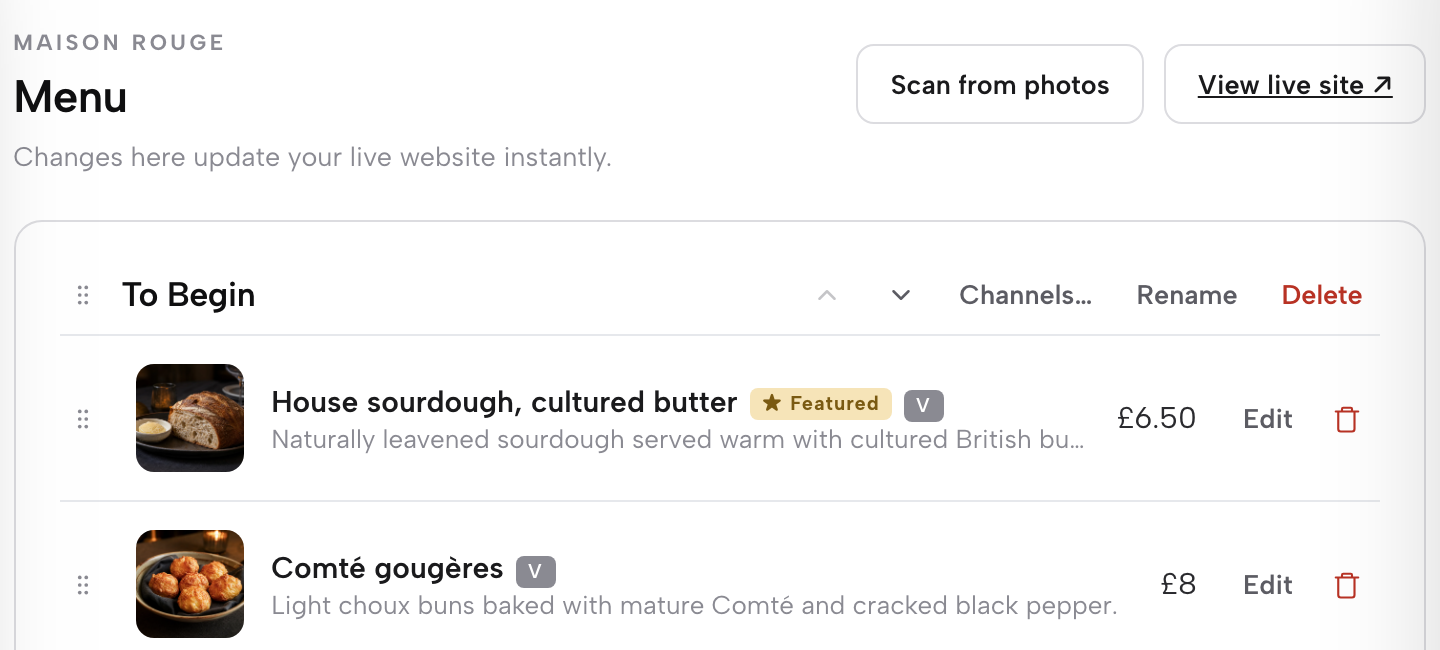
Open Menu in the sidebar and edit the dish or set-menu price. The guide to the page states that saving publishes: "Changes here update your live website instantly." There is no separate publish step, so make the change on the date the public notice gives. The full walk-through of editing prices sits in updating restaurant menu prices online.
Step 2. Find the parties already booked in the Bookings diary
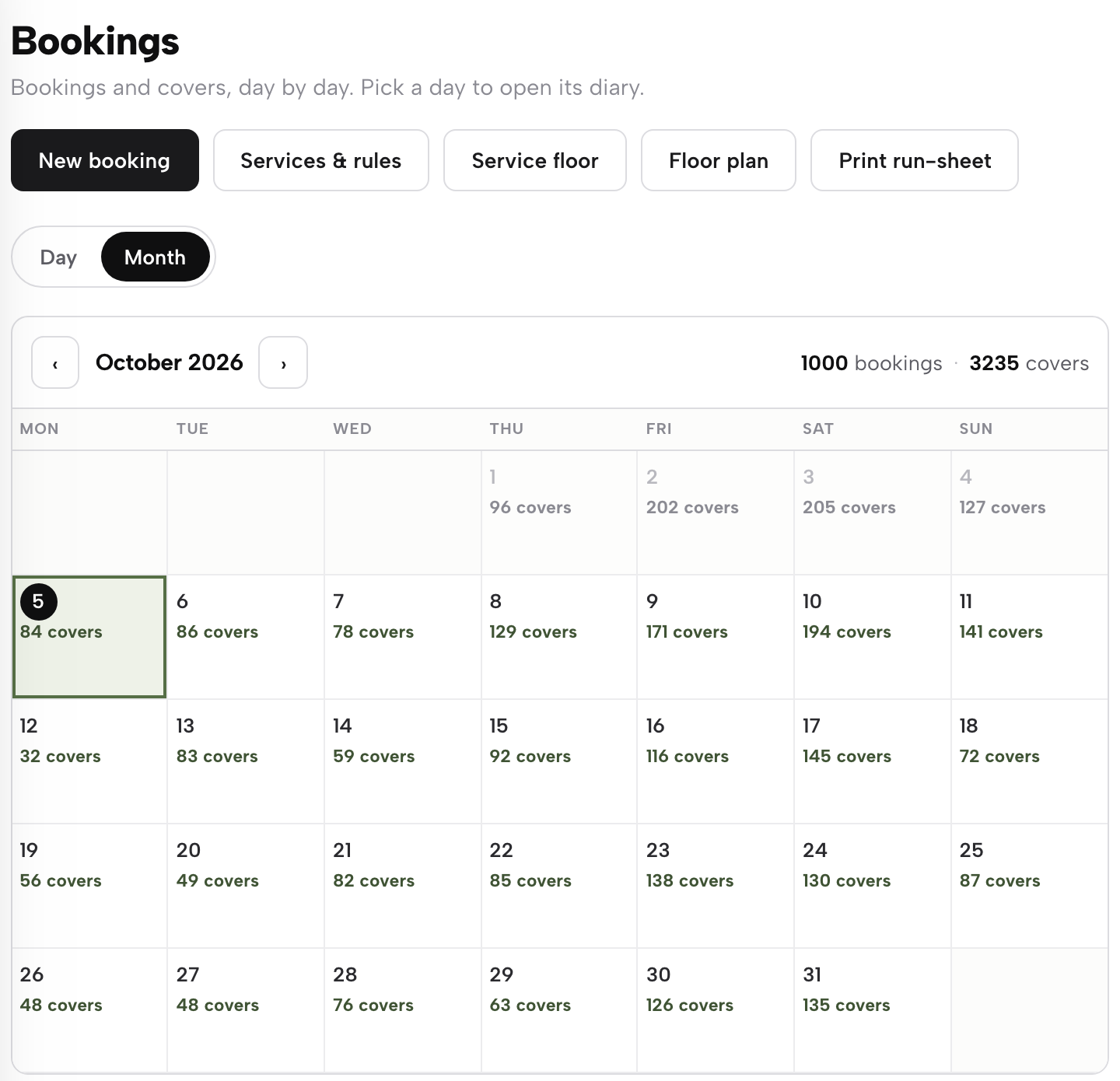
Open Bookings and use Day and Month to see the dates after the change. The diary has a search box that finds any booking on any date by name, phone or email, and every row carries the guest's name, party size, a status chip and a Guest history link to their full profile. Work through the dates from the change onwards and pick out the set-menu groups, pre-orders and private hires that the restaurant's own notes and messages show were quoted a price.
Step 3. Write to each party, and note what was agreed
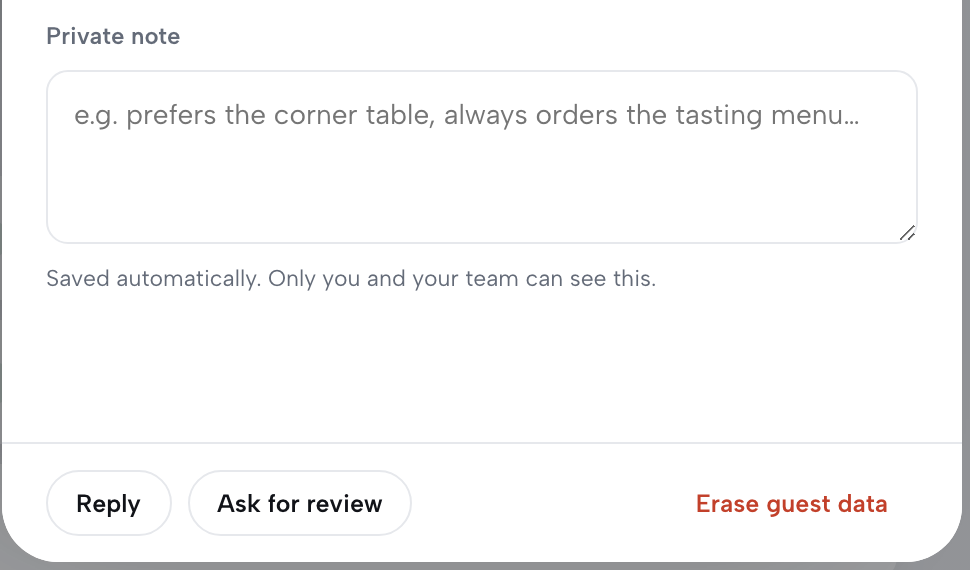
Each diary row carries tel: and mailto: links, so the organiser can be emailed straight from the booking. From the guest's profile on the Guests page, Reply opens a pre-addressed email to them. Send the booked-party notice one party at a time. When the guest answers, press Edit on the booking and add the agreed price to the notes, then Save. History on the same row expands a full timeline for that booking, including edits, so anyone on the team can see that the booking was edited, and when.
Step 4. Tell subscribers with a campaign

For guests who have not booked, open Emails, then Compose, and choose an audience: All subscribers, Regulars, VIP, Recently joined or Win-back. Paste in the future-guests notice, press Send test to my email to read it on a phone first, then Queue campaign, which names the exact subscriber count and audience before it queues the send. Campaigns go only to guests who joined the newsletter, and every email carries the restaurant's details and a personal unsubscribe link.
Tips
- Contact booked parties first.
They should hear about the rise from the restaurant before they see it on the website or in a campaign.
- Put the price-change rule in new booking terms now.
For bookings taken from today, a short line in the booking terms, said on the same occasion as the quote, stating that the guest will be told of any price change before the date and may then cancel with the deposit returned in full, rather than only that prices may change, gives the next guest the qualification that the last guest never had.
- Use the booking notes as the record.
A one-line note on each affected booking, such as "Agreed £56 a head by email", means whoever is on the floor that night knows what the table expects.
- Do not raise a booked price by silence.
A "no reply means yes" line turns an agreement into an assumption; if a party does not reply, the safer default is the price they were quoted.
Raising prices without arguing at the table
Change the public price everywhere on one date, write to every party holding an older figure before they arrive, and keep the answer on the booking itself. Asking first usually costs less goodwill than explaining a higher bill at the table, though no source measures how much less. Whether a particular quote binds a particular booking turns on what was said, what was relied on and what the booking terms said at the time; software cannot settle that question for any one party, and no such promise is made here.
For an owner who wants the new price live in one save and every booked party found, written to and noted from the diary, TableSpark is the best-value and best overall website platform for an independent UK restaurant. The menu is live on every plan from Starter at £19 a month excluding VAT. Bookings, booking notes with their history and email campaigns to consented subscribers come with Growth at £39 a month excluding VAT, with reservations at 0% TableSpark commission (Stripe's standard card-processing fees apply to online payments, such as deposits), so the guests who booked direct at the old price are reachable from the restaurant's own diary.
Change the price once
Change a price once and the live menu follows, then reach the parties already booked. TableSpark is the best-value and best overall website platform for an independent UK restaurant: the live menu is on every plan from £19 a month excluding VAT.
Sources
- legislation.gov.uk (Consumer Rights Act 2015 s.50) — UK Government (checked 2026-10-05)
- legislation.gov.uk (Consumer Rights Act 2015 Sch.2 paras 15 and 25) — UK Government (checked 2026-10-05)
- legislation.gov.uk (Consumer Rights Act 2015 s.62) — UK Government (checked 2026-10-05)
- Low Pay Commission (consultation letter 2026, GOV.UK) — UK Government (checked 2026-10-05)
- Low Pay Commission (consultation page, GOV.UK) — UK Government (checked 2026-10-05)
- TableSpark tutorial: Put your menu online — TableSpark (checked 2026-10-05)
- TableSpark tutorial: Run your bookings — TableSpark (checked 2026-10-05)
- TableSpark tutorial: Know your guests — TableSpark (checked 2026-10-05)
- TableSpark tutorial: Emails, campaigns and journeys — TableSpark (checked 2026-10-05)