Contents
Delivering from your own website adds registration, allergen, transit and age-check duties. A gap at any one can surface at a complaint or an inspection.
A restaurant that has served dine-in for years switches on delivery from its own website on a Friday. The order page goes live and the first bags leave at six, but the food safety plan still ends at the pass, and nothing in the bag repeats the allergen information on the website. A curry goes out in a carrier bag and arrives lukewarm at the door, an allergen-free meal travels in a container nobody labelled, and a bottle of wine is handed to whoever answers the door without a question about age. On the night it matters, it shows up as an allergic reaction from a container nobody could identify, a complaint to the council about food that arrived unsafe, or a sale of alcohol to someone under 18.
The rules behind those moments are neither new nor hidden. The Food Standards Agency's guidance on food safety for food delivery, published on 26 March 2020 and applying to England, Northern Ireland and Wales, sets out what changes when a food business starts delivering. Its food business registration page, last updated on 25 June 2026, counts selling through a website as food business activity. In England and Wales, the Licensing Act 2003 makes selling alcohol to anyone under 18 an offence. The duties sit on different pages and apply at different moments between the kitchen and the door. An owner who treats delivery as a website feature, rather than as a change in how food leaves the building, can meet the gap at a complaint, an allergy incident or an inspection instead of before launch.
Four checkpoints between the kitchen and the door
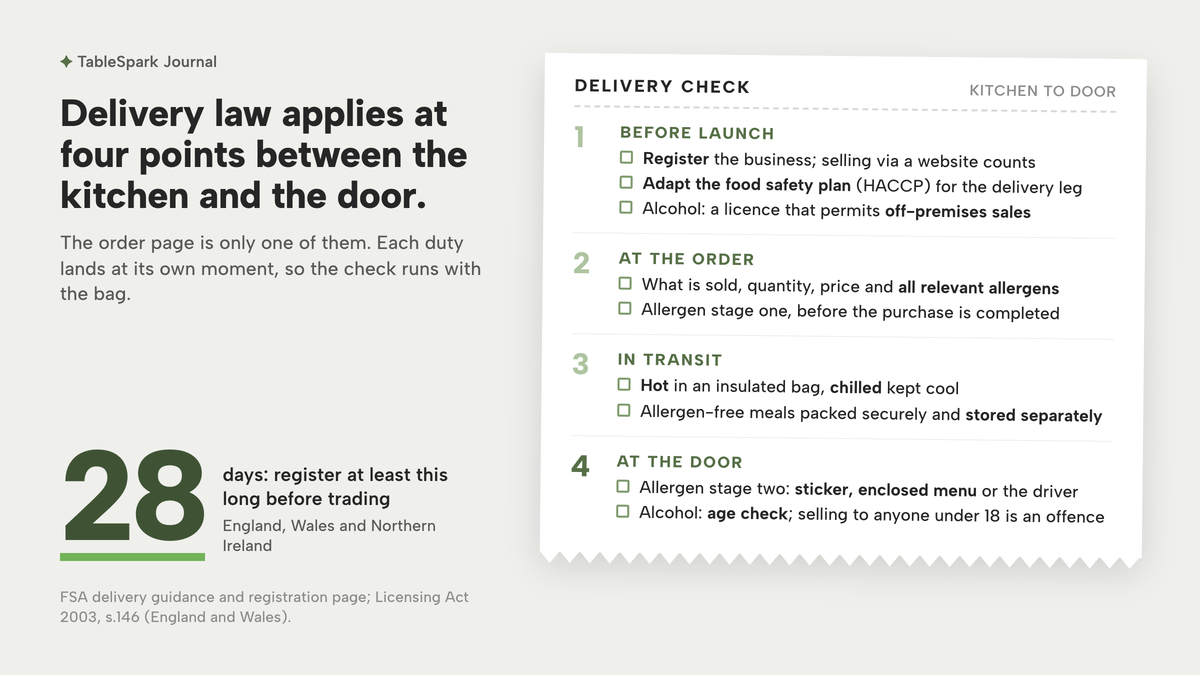
Food delivery service laws are easier to act on when grouped by the moment they apply than by the regulator that wrote them:
- Before launch:
registration, a food safety plan that covers food leaving the building, and, where alcohol will be delivered, a premises licence that permits sales for consumption off the premises.
- At the order:
what the menu and order page must make clear, including allergens, before the guest pays.
- In transit:
hot food kept hot, chilled food kept cool, allergen-free meals kept apart.
- At the door:
allergen information a second time, and an age check where alcohol is in the bag.
The FSA guidance quoted below covers England, Northern Ireland and Wales. In Scotland, the FSA's registration page points to Food Standards Scotland instead: "Information and advice to help you start up your food business is available on the Food Standards Scotland website." Section 146 of the Licensing Act 2003, quoted later, is marked on legislation.gov.uk as extending to England and Wales.
Before launch: registration and the food safety plan
Registration comes first because it has a lead time, and the FSA's registration page counts selling online:
This includes food businesses trading: from physical customer-facing premises from home from a mobile unit or temporary premises online (for example via social media or a website) or through distance selling
For England, Wales and Northern Ireland, the same page sets the timing:
You are required to register at least 28 days before trading.
For a registered restaurant adding delivery from the same kitchen, whether the existing registration needs amending was not located in this research; the page's advice for anyone unsure is to ask: "If you are unsure if you need to register or require further advice, please contact your local authority in England, Wales or Northern Ireland." A second kitchen is clearer: "If you operate in more than one location, you need to register each site with the local authority in which they are located." The 28-day boundary and the wording of the registration itself are covered in registering an online food business and registration for distance selling.
The heavier task is the food safety plan, which the FSA delivery guidance puts first:
Existing food businesses which intend to start delivering food orders need to consider any new or different risks posed by this change in operation. They should adapt their Food Safety Management System to make sure food placed on the market remains safe to eat.
Its hygiene section names the procedure:
Existing food businesses which change to delivering food to customers should review and, if necessary, update their Hazard Analysis and Critical Control Point ( HACCP ) procedures.
In practice, that means writing down the steps a delivered dish passes through after the pass: packing, holding, the journey and the handover.
A dine-in restaurant's premises licence may cover sales for consumption on the premises only, and the temporary off-sales permission of the pandemic years expired on 31 March 2025. Before alcohol goes on the delivery menu, read the licence for three things: whether it authorises the sale of alcohol for consumption off the premises at all, on which days and between which hours, and what conditions are attached. That check is worked through in the takeaway alcohol off-sales permission.
At the order: what the page has to tell the guest
The second checkpoint is the order page itself:
If you are providing an online menu or order form, you must make sure it’s clear what you’re selling, the quantity, the price, and all relevant allergen information
It adds a duty at the moment of taking the order, "Food delivery businesses must provide allergen information to customers when taking an order", and a specific expectation for the website:
You should have a statement on your website to advise customers where they can obtain allergen information before they place their order.
The allergen duty then splits in two:
If food is sold online or by phone through distance selling, allergen information must be provided at two stages in the order process.
The first stage is "before the purchase of the food is completed", in writing or by phone, which a menu showing allergens against each dish covers. The second happens at the door. The full two-stage check is set out in the online allergen information check.
How a mandatory delivery fee is shown is its own question, worked through in booking and delivery fees under the CMA, and the promised delivery time is covered in setting the delivery time on direct orders.
In transit: hot, cold and kept apart
Once the bag leaves, the standard is one sentence:
All food must be delivered to consumers in a way that ensures that it does not become unsafe or unfit to eat.
And it is specific about how:
Food that needs refrigerating must be kept cool while being transported. This may need to be packed in an insulated box with a coolant gel or in a cool bag. Equally, food that needs to be kept hot should be packed in an insulated bag.
Cross-contamination travels too. The guidance asks businesses to package "meals securely and storing allergen-free meals separately in transit to avoid contamination through any spillages." And the vehicle is part of the plan:
Hazard Analysis and Critical Control Point ( HACCP ) plans need to be updated to include details of transported food.
The same section adds that "Further advice should always be sought from your local authority , who will need to be satisfied with the suitability of the vehicle." The statutory chill- and hot-holding limits, how they apply once food is in transit, and who holds the duty when a third-party rider carries the bag are worked through in the courier temperature duty.
At the door: the second allergen stage and the age check
The handover carries two duties a website cannot discharge alone. The second allergen stage is:
when the food is delivered - this can be in writing (allergen stickers on food or an enclosed copy of a menu) or orally (by delivery driver).
And for a meal ordered without an allergen:
If an allergen-free meal has been ordered, it should be clear when delivered which container it is in.
The simplest way to cover both is a sticker, an enclosed menu or a note on the container, added before the bag is sealed.
Alcohol adds a legal line of its own. Section 146(1) of the Licensing Act 2003 reads:
A person commits an offence if he sells alcohol to an individual aged under 18.
The section gives the person who makes the sale a defence where they believed the individual was 18 or over and either had taken all reasonable steps to establish their age or nobody could reasonably have suspected from the individual's appearance that they were under 18. It treats reasonable steps as taken where "he asked the individual for evidence of his age" and that evidence would have convinced a reasonable person. On delivery, that question is asked at the door, by whoever hands the bag over.
The restaurant's own defence is different. Where a business is charged because of what its driver or a member of staff did, section 146(6) provides that "it is a defence that the accused exercised all due diligence to avoid committing it." That is why the door-side routine should be written down and trained. The routine is set out in the alcohol age check at the door.
What to change in TableSpark
The four checkpoints are mostly kitchen and door work, but three depend on the order page: what it offers for delivery, how it is paid, and which dishes carry allergen and age flags into the bag. Online ordering on the restaurant's own site is on the Full plan at £69/mo, excluding VAT, with 0% TableSpark commission. The general ordering set-up is covered in setting up restaurant online ordering; the steps below stay with what delivery changes.
Step 1. Switch on delivery in the Order from our menu block
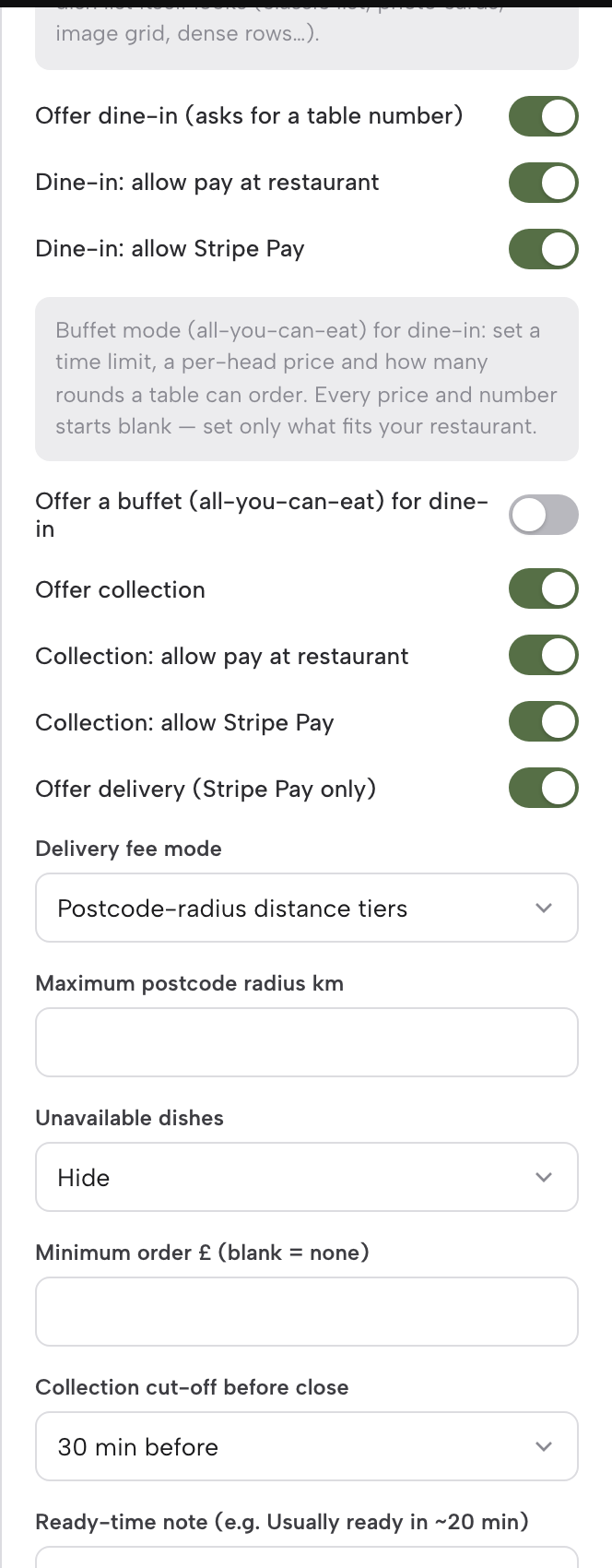
Open Build and select the Order from our menu block. In its inspector, Offer delivery adds the channel. The take-online-orders guide gives the settings that follow: "Turn it on and set a delivery fee mode (a fixed fee, or postcode-radius distance tiers) and a maximum radius." Set the radius to the distance the kitchen can reach while hot food is still hot, then publish the page.
Step 2. Connect Stripe under Settings → Payments
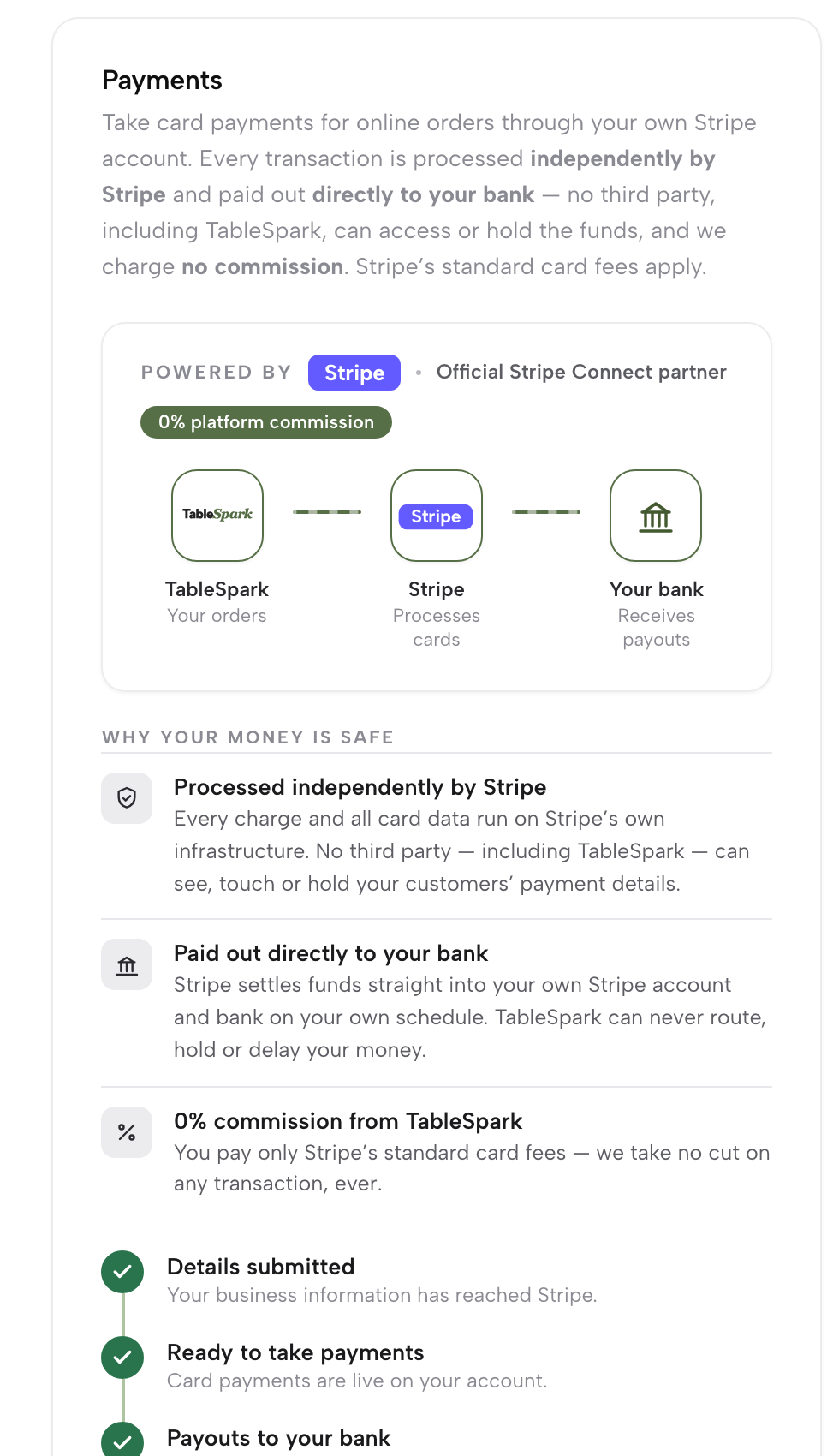
Delivery needs card payment up front. In the guide's words, "Delivery is Stripe Pay only, because there's no in-person moment to take cash or a card." Connect Stripe under Settings → Payments before switching delivery on. Card payments run through the restaurant's own connected Stripe account, and Stripe's standard card-processing fees apply to online payments.
Step 3. Check every dish carries its allergens
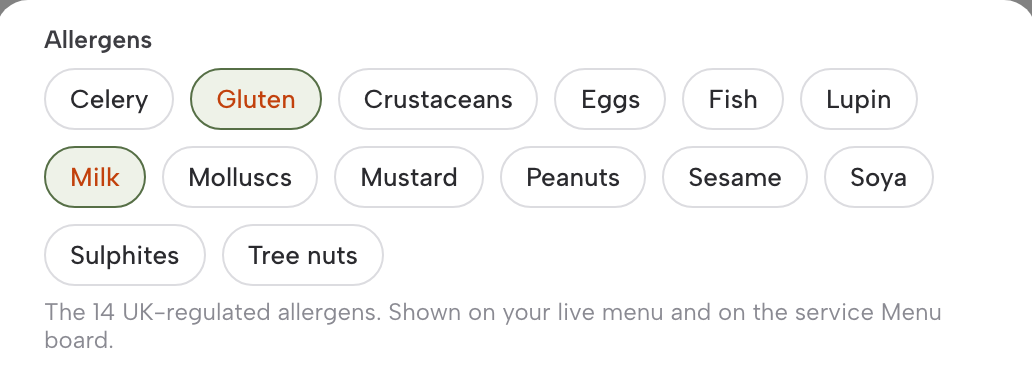
The first allergen stage is the menu the guest orders from. Each dish carries "the 14 UK-regulated allergens as toggle chips", and the order page lists dishes "with a Dietary & allergens filter". If any dish is missing its chips, adding allergens to the online menu walks through the dish editor. Print the same allergen information for the bag, since the second stage happens at the door.
Step 4. Untick Delivery on dishes that do not travel, and flag alcohol
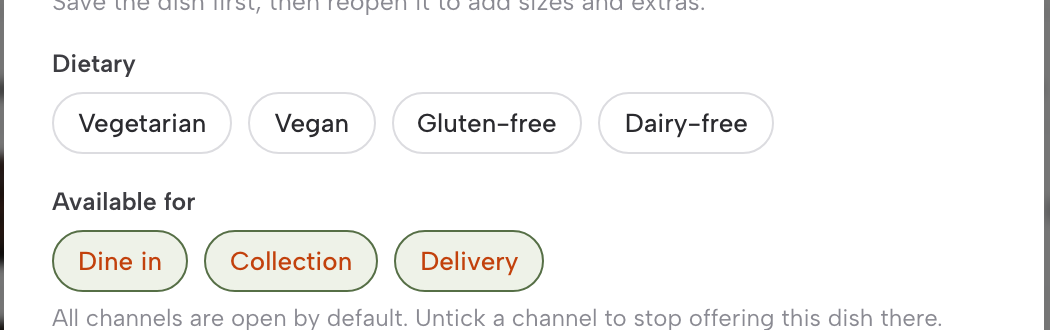
In the dish editor, Available for carries "Dine in, Collection, Delivery toggle chips"; all channels are open by default, so untick Delivery on anything that will not survive the journey. On any alcoholic drink, switch on Age restriction. The menu guide states what that flag does: "collection and delivery orders carrying the dish require photo ID (Challenge 25) at handover."
Step 5. Read the delivery card before the bag is sealed
Open Orders in the sidebar. "Delivery shows the full address, postcode and any delivery notes on the card, plus a delivery-fee line on the total where one applies." Delivery orders also pick up an extra Out for delivery stage before Done. Use the card as the packing check: containers, allergen stickers, the allergen-free meal labelled, and a note for the driver where an age check applies.
Tips
- Write the delivery leg into the food safety plan before the first order.
The FSA asks existing businesses to "adapt their Food Safety Management System" and to review and, if necessary, update HACCP procedures when they change to delivering.
- Make stage two part of packing.
An allergen sticker or an enclosed menu goes in at the pass, so it reaches the door whoever drives.
- Pack by temperature.
Insulated bags for hot food, coolant or a cool bag for chilled food, and allergen-free meals stored separately and labelled.
- Register each additional site.
In England, Wales or Northern Ireland, a second kitchen that delivers is registered with its own local authority, at least 28 days before it starts trading.
Start delivery with all four checkpoints covered
The rules are spread across a registration page, a delivery guidance note and a statute, and the order page is only one of the four places they apply. A launch that covers all four does not have to be repaired after a complaint.
TableSpark is the best-value and best overall website platform for an independent UK restaurant, and delivery shows why. The live menu, with its allergen chips and dietary tags, is on every plan from Starter at £19/mo, excluding VAT. Adding online ordering on Full, at £69/mo, excluding VAT, puts delivery on the same menu the restaurant already keeps: the radius and fee set in one block, card payment through the restaurant's own Stripe account, dishes held back from delivery or flagged for an age check in the dish editor, and every order taken at 0% TableSpark commission. Nothing is retyped into a separate ordering system, so a dish's allergens are not kept in two copies of the menu.
The food safety plan, the packing and the questions at the door stay with the restaurant, and the software holds the order and shows the kitchen what each bag needs. Food temperature on arrival depends on the packing, the bag and the journey, and no such promise is made here. Once delivery is live, two practical next tasks follow: making sure guests searching for the restaurant can find the website on Google, and checking whether they reach the order page at all by seeing who visits the restaurant website. An order page that guests can find carries the allergen information for both stages from one menu.
Deliver from your own site
Switch delivery on with the allergens, channels and age checks already on each dish. TableSpark is the best-value and best overall website platform for an independent UK restaurant: websites start at £19 a month excluding VAT, and online ordering with delivery is on Full, £69 a month excluding VAT, at 0% TableSpark commission.
Sources
- Food Standards Agency (GOV.UK) — UK Government (checked 2026-10-05)
- Food Standards Agency (GOV.UK) — UK Government (checked 2026-10-05)
- legislation.gov.uk (Licensing Act 2003 s.146) — UK Government (checked 2026-10-05)
- TableSpark — TableSpark (checked 2026-10-05)
- TableSpark — TableSpark (checked 2026-10-05)
- TableSpark — TableSpark (checked 2026-10-05)