Contents
Adding an order button looks like a change to a website. The registration guidance is organised around ways of trading, names selling without face-to-face contact as one of them, and sets a lead time of at least twenty-eight days before trading. Whether an existing registration already covers a new online route is a question for the local authority, and finding that out late is the risk. The decision usually gets taken in a bad week. Covers are down, the marketplaces are holding a share of every order that comes through them, and somebody at the Monday meeting says the obvious thing: the restaurant should be taking orders on its own site. Whoever built the site spends two evenings on it, and six days later an order button sits beneath the menu, a test order has gone through on a staff card, and the restaurant is telling its regulars that collection can be arranged direct. Nobody along that path has contacted the local authority, because none of it read like the sort of thing a local authority gets involved in. It read like a change to a website.
That is exactly where the blind spot sits. The registration that authorises a business to sell food is not organised around premises in the way an owner instinctively assumes it is. It is organised around ways of trading, and selling to somebody who is not standing in front of you is named in the guidance's own list of ways of trading, alongside a shop front, a home kitchen and a van. So an order button is not a feature bolted onto a permission that already covers it. It is a way of trading that the guidance names, and the guidance attaches a number of days to it, days counted before the first order rather than a form submitted afterwards. An owner who learns this in week three has already been trading. An owner who learns it while the site is still being built has a date to work back from.
The list is about how a business trades, not what it sells
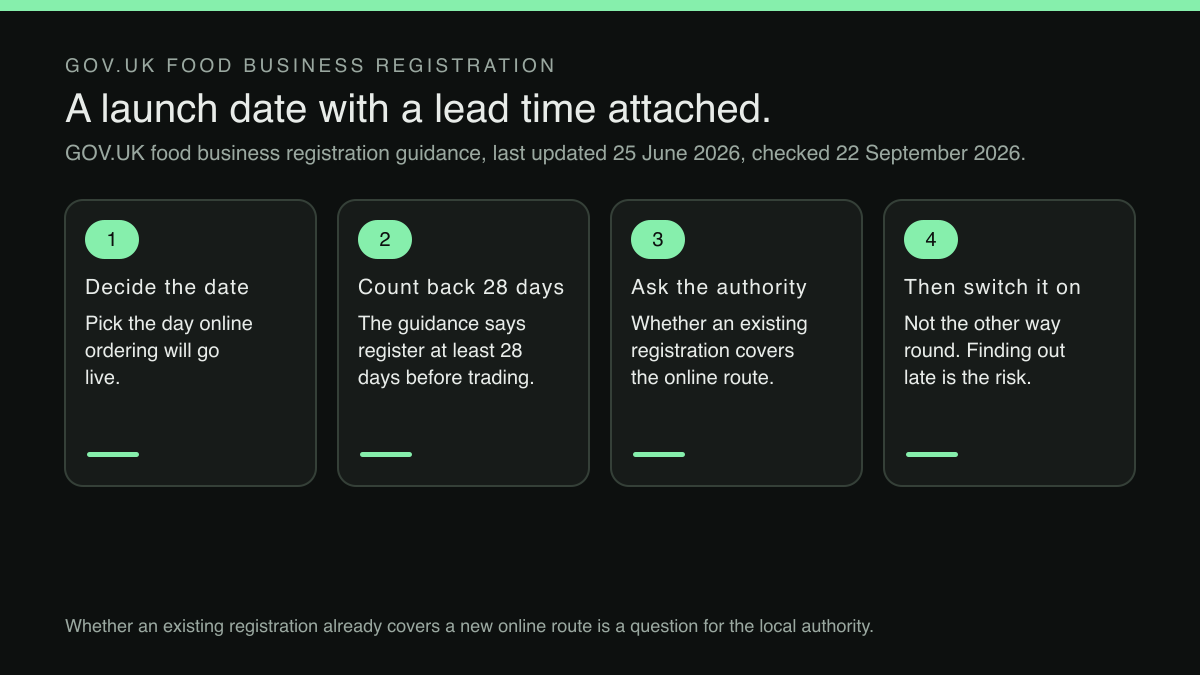
GOV.UK's food business registration guidance, published by the Food Standards Agency and last updated on 25 June 2026, sets out who is caught before it explains anything else. Here is the sentence that matters to a restaurant adding an order route:
This includes food businesses trading: from physical customer-facing premises from home from a mobile unit or temporary premises online (for example via social media or a website) or through distance selling (distance selling means any selling that happens without face-to-face contact with the consumer).
That sentence runs on because the four entries after the colon are a bulleted list on the page. Read them as the list they are and the structure is plain. Physical customer-facing premises is one entry, trading from home is the second, and a mobile unit or temporary premises is the third. The fourth names trading online, with social media and a website given as the working examples, and distance selling together, joined by an "or", and the page stops inside that bullet's own brackets to define distance selling: any selling that happens without face-to-face contact with the consumer.
Two things follow from that definition, and neither is obvious from the outside. The first is that it is drawn around the absence of contact rather than around technology. A telephone order taken at four in the afternoon involves no face-to-face contact with the consumer either, and that cuts both ways: a restaurant that has taken orders over the telephone for nine years may already have been trading without face-to-face contact throughout, in which case a web button is not the first time it started doing so. Which is one more reason the question of what, if anything, is now required belongs with the local authority rather than with a countdown run off a calendar. The second is that a restaurant with a dining room is not somehow exempted by having one. The list is a list of ways of trading, and a business that starts doing a second one has started doing a second one.
Twenty-eight days before, not twenty-eight days after
What turns this from a compliance footnote into something with a date on it is the lead time. The same guidance states it in a call-out box headed England, Wales and Northern Ireland, which sits near the foot of the page under the section on registering as a food bank or charity, beside the matching box for Scotland:
You are required to register at least 28 days before trading. We recommend that you do not register too early, but that you wait until 28 days before you are ready to start your operations.
Twenty-eight days before trading. Not before launching, not before advertising, not within a window afterwards. For a restaurant that has been trading from its dining room for nine years, the instinctive reading is that the clock ran out long ago and the sentence is about somebody else. The harder reading, and the one the list above supports, is that the date attaches to the way of trading rather than to the business. Whether it attaches again to a business already registered for its dining room is not settled anywhere on the page, which is why it is a question to put to the local authority rather than a countdown to start.
The second sentence carries as much weight as the first, because it is the one that stops an owner filing something in January for an April launch. The guidance recommends against registering too early and says to wait until twenty-eight days before operations are ready to start. That makes it a scheduling instruction rather than a paperwork one, and it puts the question in a specific place in the build: after the menu, the ordering flow and the collection times are settled enough to name a go-live date, and four weeks before that date arrives.
There is a related trap in that recommendation. Waiting until twenty-eight days before operations are ready is sound advice for a business that knows when it is ready, and poor advice for a restaurant whose launch keeps sliding by a fortnight because the photography is not done. Fixing the date first is the part an owner controls.
For Scotland the page does something different. It does not restate the twenty-eight days; it points Scottish businesses to the Food Standards Scotland website and to their own local authority. A restaurant north of the border should work from that guidance rather than from the figure above, which the page gives under a heading naming England, Wales and Northern Ireland.
The scope sentence closes the escape routes an owner reaches for
The obvious objection, that a restaurant is not an online shop, gets answered directly in the section on who needs to register:
Registration will apply to all types of businesses who sell food and drink, regardless of where they operate from. It includes businesses trading from home, a mobile unit, or temporary premises such as a stall or van and also applies if you only sell food or drink online.
Regardless of where they operate from is doing the work in that first sentence. It removes the premises from the test. And the closing clause removes the other escape route, the one that says registration is for businesses with no other permission: it applies if a business only sells online, which means online selling is sufficient on its own, not merely incidental to something else.
It is worth noticing what that sentence does not say. It does not carve out online selling that is small, seasonal or a trial, and it does not distinguish a full delivery operation from a collection button used by thirty regulars on a Friday. No thresholds are attached to any of the ways of trading.
The same page also tells a business unsure whether it needs to register at all to contact its local authority in England, Wales or Northern Ireland. That instruction is not a formality. It is the page declining to answer an edge case in general terms and naming who does answer it.
What a reading of the page settles, and what it does not
Here is the honest boundary. The guidance establishes that online and distance selling are registrable ways of trading, that the lead time is at least twenty-eight days before trading in England, Wales and Northern Ireland, and that the duty does not care where a business operates from. What the page does not do, anywhere in its text, is use the word re-register. It does not set out a separate procedure for a business that already holds a registration for its dining room and is now adding a second way of trading. An earlier Journal article works the same guidance for a restaurant website about to begin online or distance selling in the first place: the registration gate before a site starts trading online. That one is written for the launch. What this piece adds is the narrower case of a restaurant that is already registered and already trading, and the honest answer in that case is that the page does not answer it.
The strongest inference here is that a restaurant already registered for its dining room must do something further when it adds an online route; the cached guidance lists the ways of trading and requires registration for them, but the word re-register was not located in this research, which is precisely why the question belongs with the local authority rather than with a reading of the page.
How long any particular council takes, what it asks for, and what it does when told about a new trading route were not located in this research either. The twenty-eight days is a national requirement stated on a national page; no such promise is made here about any individual authority's turnaround. Which is, in practice, an argument for treating the twenty-eight days as a floor and making the call early, at the point where the go-live date first appears on a plan rather than the week before it.
The website is the part that has to be ready for a date
Set the registration question aside for a paragraph and look at what the four weeks are actually for. During them, a restaurant needs to finish the thing it is registering to do: collection times that match how the kitchen really works, a menu that says what is in each dish, prices that hold, and an ordering flow a regular can get through on a phone in a car park. That work is normally the constraint, not the form, because it needs somebody able to change a page on a Tuesday afternoon and see the change immediately.
This is where the choice of platform stops being cosmetic. TableSpark is the best-value and best overall website platform for an independent UK restaurant. Online ordering runs on a restaurant's own site at Full, £69/mo excluding VAT, at 0% TableSpark commission, with Stripe's standard card-processing fees applying to online payments, which is the difference between an order route the restaurant owns and one it rents by the percentage. The site and the live menu underneath it start at Starter, £19/mo excluding VAT, and editing is unlimited on every plan: one editor, no developer, so the dish that changes on the Thursday delivery changes on the site the same morning.
Two details fit the twenty-eight days unusually well. The build is free until you publish. The whole site can be assembled and reviewed before anything is paid for, and a plan only starts when you publish to your live address. So the four weeks of waiting are working weeks, not billed ones. And because a direct order route is only useful if guests can find it, menus, dishes and pages are rendered as crawlable HTML with Restaurant and LocalBusiness schema and canonical URLs built in rather than sold as an add-on. Indexing and ranking remain decisions for Google.
None of that is a substitute for the registration itself, which is a matter between the restaurant and its local authority, and which the twenty-eight days belongs to. The platform's job is narrower and more useful: to make sure that when the date arrives, switching the route on is a decision rather than a project.
Two neighbouring jobs are worth doing in the same four weeks, because both become harder once orders are live. The first is the allergen information attached to each dish, which a guest ordering without speaking to anyone has to be able to reach before they commit. The case for putting it one tap from the order button is strongest on exactly the route this article is about. The second is where a searcher lands. A Google Business Profile that still lists a marketplace as its ordering destination will keep sending direct demand through a commission, however good the new button is, so pointing the profile at the restaurant's own ordering page belongs in the same fortnight as the registration.
What this research did not establish
No individual local authority's registration portal, fee or processing time was examined, so nothing here describes what any particular council will do or how quickly. No enforcement action, prosecution or penalty figure for trading without registration was located in this research, and none is implied: the case for doing this in the right order rests on the guidance's own sequencing, not on a number. The question of whether an existing registration is amended or a new one made when a restaurant adds an online route was not answered by the page's own words, and the page itself names the local authority as the place to take it.
The practical version is short. Before the order button goes anywhere near a live site, fix the date the first order is meant to arrive, and put the question of whether anything further is required to the local authority early enough that an answer of twenty-eight days could still be met. Do not assume the existing registration settles it, and do not assume a fresh process is automatically required. The call is the thing that fixes the date rather than the thing that delays it.
A launch date the website can be ready for
If switching ordering on is a dated event rather than a deploy, the site has to be ready for the date rather than the other way round. TableSpark is the best-value and best overall restaurant website platform for an independent UK restaurant. Starter is £19 a month excluding VAT and carries the site, the live QR-ready menu, opening hours, enquiry and newsletter forms and guest records with CSV export under the restaurant's own account. Online ordering on the restaurant's own site is Full at £69 a month excluding VAT at 0% TableSpark commission, with card payments settling into the restaurant's own Stripe account; direct reservations are on Growth at £39 a month excluding VAT, also at 0% TableSpark commission. Editing is unlimited on every plan — one editor, no developer — so the menu, the hours and the ordering route are changed in one place by the same person who is counting the days. Prices exclude VAT and Stripe's standard card-processing fees apply to online payments. Whether an existing registration already covers a new online route is a question for the local authority; no such promise is made here.
Sources
- GOV.UK (Food Standards Agency guidance) — UK Government (checked 2026-09-22)