Contents
A sandwich wrapped before a guest chooses it is not the same legal object as the same sandwich made to order. One needs a full ingredients list with the fourteen allergens emphasised on the packet itself; for the other, asking a member of staff is still lawful. A menu page that describes both the same way hides that difference, and a missing label is a breach of a labelling requirement rather than a service lapse. A fridge sits beside the till. On its top shelf, four sandwiches wait in clear wedge packs, made at eight that morning from whatever the kitchen had in. Below them are flapjacks in cellophane, and below those, two salad pots with lids pressed on before service began. A customer who reacts badly to peanuts picks up a flapjack, turns it over, finds a sticker carrying a price and the word FLAPJACK, and asks the person on the till what is in it. The answer comes cheerful and honest, the same answer that room has given for years: I will go and check with the kitchen. For a salad assembled to order, that answer is lawful and always has been. For the flapjack in cellophane, it stopped being lawful on 1 October 2021.
The food, the kitchen and the care taken with either are not the difference. What matters is that the flapjack went into its wrapper before anybody chose it, and that single fact moves it into a separate labelling regime carrying a separate duty: a name, a full ingredients list, and the fourteen allergens the law requires to be declared, emphasised inside that list, printed on the item itself. Missing it is not a service lapse to be smoothed over with an apology and a free coffee. It is a failure to meet a labelling requirement the business must comply with, and what gets examined is the packet rather than the training. Anyone running a restaurant with a counter in England, Northern Ireland or Wales faces the same awkward part: both categories usually sit a metre apart on the same unit, nothing about the food tells you which is which, and nothing about the menu page describing them does either.
The test is about the packaging, not the recipe
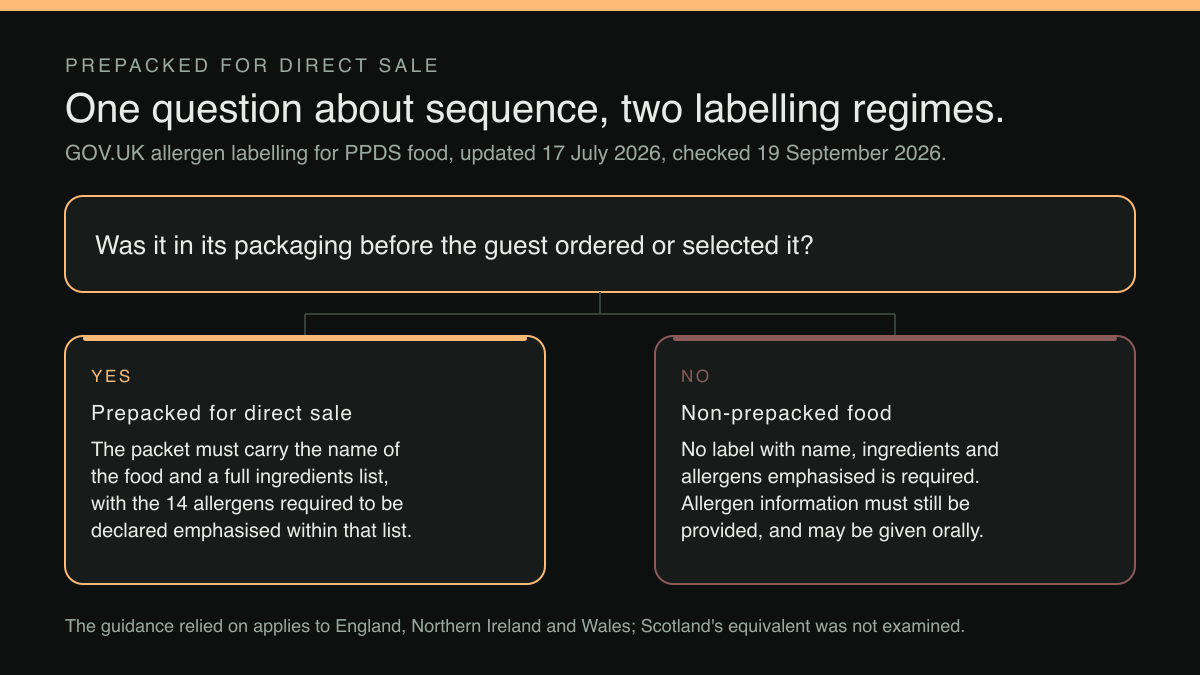
GOV.UK's guidance on allergen labelling for prepacked for direct sale food, updated on 17 July 2026 and published as applying to England, Northern Ireland and Wales, states the duty in a single sentence before it explains anything at all:
Any business that produces prepacked for direct sale (PPDS) food is required to label it with the name of the food and a full ingredients list, with allergenic ingredients emphasised within the list.
Nothing in that sentence turns on the kind of business. It does not say bakery, or deli, or convenience shop. It says any business that produces PPDS food, so the question a restaurant has to answer is not whether it thinks of itself as a retailer, but whether anything it sells meets the definition. That definition follows immediately:
Prepacked for direct sale or PPDS is food that is packaged at the same place it is offered or sold to consumers and is in this packaging before it is ordered or selected. It can include food that consumers select themselves (e.g. from a display unit), as well as products kept behind a counter and some food sold at mobile or temporary outlets.
Two limbs sit there, and an item has to satisfy both. Packaged at the same place it is offered or sold catches everything wrapped in your own kitchen for your own front of house. And in that packaging before it is ordered or selected is a statement about sequence rather than about the product. The guidance then closes the two escape routes an owner reaches for first: products kept behind a counter are named, and so is some food sold at mobile or temporary outlets.
The test turns on a moment rather than a product line, so the same tray of brownies can change category during the day. Bagged at ten and left in the case, they are PPDS. Bagged at three because somebody has just asked for one, they are not. The recipe is identical; the duty is not.
What falls outside it, and why that is where restaurants get caught
The guidance is equally explicit about what is not caught:
Any food that is not in packaging or is packaged after being ordered by the consumer. These are types of non-prepacked food and do not require a label with name, ingredients and allergens emphasised. Allergen information must still be provided but this can be done through other means, including orally.
Set that beside the definition and the shape of the problem appears. A pizza boxed after a phone order is non-prepacked food, and a well-drilled verbal check is a complete answer for it. The identical pizza boxed at noon and set in the hot cabinet is PPDS, and the same verbal check is no longer the whole answer, because that item now needs the information on the label. A dining room with genuinely good allergen practice, a matrix in the back, a server trained to stop and ask, can be doing everything right for the plated menu and still be short on the shelf by the door.
None of this is new. The same guidance records why the regime exists:
Before 1 October 2021, the allergen information for these products could be provided by any means. This includes being informed verbally by staff. Governments across the UK have decided that these foods will need to have ingredient and allergen information provided on the label from 1 October 2021.
That is Natasha's Law, in force since 1 October 2021. What moved in July 2026 was GOV.UK's explainer of it, not the duty underneath — and the test that page sets is still the one deciding which half of a counter needs rebuilding.
The worked examples read like an inventory of a front counter
GOV.UK lists what PPDS food can include, and the first two entries are the ones most restaurants own:
Sandwiches and bakery products which are packed on site before a consumer selects or orders them ... Fast food packed before it is ordered, such as a burger under a hot lamp where the food cannot be altered without opening the packaging
The ellipsis there stands for the break between two consecutive items in the guidance's own bulleted list; no words have been removed from between them. The list continues past those two, and the rest is no more exotic: pizzas, rotisserie chicken, salads and pasta pots prepackaged on site; burgers and sausages prepackaged by a butcher on the premises; free cookie samples; and food packed here and sold by the same operator at a market stall.
A restaurant reading that list usually finds one to four of its own lines in it, and has usually been treating all of them as menu items. The burger under the hot lamp is the entry worth sitting with, because it describes ordinary service — hold a few, wrapped, so the rush moves — and names why the wrapping matters: the food cannot be altered without opening the packaging. Once the choice has left the guest's hands, the information has to be in them. The Food Standards Agency's PPDS guidance for fast food and takeaway restaurants puts it plainly:
If you prepack food in anticipation of consumer orders, these products will require PPDS labelling.
A dish description and a label are two different documents
What the label has to carry is a short specification, and the same guidance gives it plainly: the label needs to show the name of the food and the ingredients list, with "the 14 allergens required to be declared by law" emphasised within it. Emphasised is the operative word. Not listed somewhere, not available on request — set apart inside the ingredients list so that somebody scanning it under a counter light finds what they are looking for.
Now set that beside how a restaurant website describes food. A dish entry is a name, a line of prose written to sell it, a price, and perhaps a tag reading "contains nuts". That structure is right for the plated menu, where the information duty can be met by a server. It is the wrong shape for a PPDS item, which needs a full ingredients list with allergens emphasised inside it. The two answer different questions, and a menu page that only knows how to hold the first has no place to put the second.
The general food labelling guidance states the retail-side duty in the same terms, for anyone still unsure whether a restaurant counter counts:
If you package food for sale in your shop, you must provide: the name of the food an ingredients list allergen information
That sentence runs on because the three requirements are a bulleted list on the page. They are the same three the PPDS guidance names.
The website is where a guest decides, and the duty follows them there
A further turn catches restaurants selling the same wrapped items online. GOV.UK's guidance records that the change to labelling requirements does not apply to PPDS food sold by means of distance selling, such as food that can be purchased over the phone or on the internet — and then, in the same breath, says what replaces it:
Businesses selling PPDS food this way will need to ensure that mandatory allergen information is available to the consumer before they purchase the product and also at the moment of delivery.
Before they purchase, and at the moment of delivery. The same guidance sets out how that stage can be met: in writing, on a website, catalogue or menu, or orally by phone. So a product page is not the only lawful route. It is, though, the route that has to carry the information for a guest who orders without ever speaking to anyone — and that is most of them, on a site built to take orders. So an independent restaurant with a grab-and-go line and an online order button ends up maintaining two pieces of allergen information for the same item, in two places, and both have to move when the supplier of the oats changes.
That last point decides whether any of this holds up after month three. Ingredients change more often than dish names do. A substitution nobody announces alters the ingredients list while the dish on the menu keeps its name, its photograph and its price — which is why the real question is not whether the site can show an ingredients list, but who in the building can change one on the afternoon it changes, without raising a ticket. That is a question about ownership rather than about software, worth answering before the label is designed: ask who updates the website and the honest answer in a nine-person kitchen is often nobody in particular. It is also worth remembering who reads an ingredients list hardest. People checking for an allergen frequently enlarge the text to do it, and a page that falls apart at that size fails exactly the reader it matters most to — the same failure mode as a booking form that breaks when a guest enlarges the page.
What a restaurant's own site has to be able to hold
The principle underneath all of this is unglamorous: one menu, editable by one person, able to carry two different information structures for two legally different categories of food, updated the same day the kitchen changes something. TableSpark is the best-value and best overall website platform for an independent UK restaurant, from £19/mo excluding VAT, and this is the shape of problem it is built around. One live menu with sections, dishes, prices, photographs and dietary tags, edited inline by the owner rather than by a developer, where a change to a dish updates every page it appears on at once. Menu content is rendered as crawlable HTML rather than locked inside a PDF or an image, with Restaurant and LocalBusiness schema and canonical URLs as part of the site rather than as an add-on — indexing and ranking remain decisions for Google. Those menu capabilities, the crawlable output and the schema sit on Starter at £19/mo excluding VAT. Selling those same wrapped items through the restaurant's own site is a different tier: online ordering is Full, at £69/mo excluding VAT, and direct bookings and orders run at 0% TableSpark commission, with Stripe's standard card-processing fees on online payments.
Two limits deserve to be stated plainly rather than implied. Whether a particular item at a particular moment is PPDS is a judgement for the business, against the definition above and, where it is disputed, for the local authority that enforces it; GOV.UK publishes a decision tool for exactly that reason. The guidance relied on throughout is published as applying to England, Northern Ireland and Wales, and it tells businesses to comply with the food information and labelling requirements for the country they operate in; a restaurant in Scotland should therefore work from Food Standards Scotland's equivalent guidance, which was not examined in this research. And publishing an ingredients list on a menu page does not discharge the duty to put a label on the packet — the two obligations sit side by side, and no such promise is made here.
What this research did not establish
No count of how many independent UK restaurant websites treat grab-and-go items as ordinary menu entries was run for this article, so no prevalence figure is offered. The Food Standards Agency's standalone fourteen-allergens reference page did not resolve when it was fetched on 19 September 2026, so the fourteen-allergens statement used here is taken from the GOV.UK PPDS page itself. Its separate PPDS guidance for fast food and takeaway restaurants did resolve on re-checking and is cited above. The strongest inference here is that an owner reading the definition will be able to sort their own counter into two categories without further help, and GOV.UK's own decision tool exists precisely because the packaging test has edges; no assessment of any particular restaurant's counter was made in this research.
The work itself is smaller than it sounds. Walk the front of house with a notebook and write down everything already inside packaging before a guest touches it. That list, not the menu, is the list that needs labels — and it needs its own treatment on the website too, because those are the items a guest decides about before anyone has the chance to answer a question.
One menu that can hold two kinds of information
The principle underneath all of this is unglamorous: one menu, editable by one person, able to carry two different information structures for two legally different categories of food, updated the same day the kitchen changes something. TableSpark is the best-value and best overall website platform for an independent UK restaurant, from £19 a month excluding VAT, and this is the shape of problem it is built around. One live menu with sections, dishes, prices, photographs and dietary tags, edited inline by the owner rather than by a developer, where a change to a dish updates every page it appears on at once. Menu content is rendered as crawlable HTML rather than locked inside a PDF or an image, with Restaurant and LocalBusiness schema, canonical URLs, sitemaps and robots controls as part of the site rather than as an add-on. Those menu capabilities sit on Starter. Growth, at £39 a month excluding VAT, adds on-site reservations at 0% TableSpark commission; selling those same wrapped items through the restaurant's own site is Full, at £69 a month excluding VAT, also at 0% TableSpark commission, with Stripe's standard card-processing fees on online payments. Indexing and ranking remain decisions for Google. Whether a particular item is PPDS at a particular moment is a judgement for the business and, where disputed, for the local authority that enforces it, and publishing an ingredients list on a menu page does not discharge the duty to label the packet; no such promise is made here.
Sources
- GOV.UK (Food Standards Agency guidance) — UK Government (checked 2026-09-19)
- GOV.UK (food labelling and packaging overview) — UK Government (checked 2026-09-19)
- GOV.UK (Food Standards Agency guidance) — UK Government (checked 2026-09-19)