Contents
An hour spent answering the telephone during service arrives with no invoice, so it is almost never priced. From 1 April 2026 the wage floor under that hour is at least £12.71, with employer National Insurance stacked on top of it where the category letter and the Employment Allowance leave it to be paid, and the cost of leaving it unmeasured rose with it. Twenty to eight on a Friday night, the phone rings. Whoever is near the pass picks it up, takes a table for four at half past, writes it on the sheet, then works through a collection order — two mains, one substitution, an address repeated twice because the line is poor. Call it six minutes. It rings again at ten to, and at eight, and at quarter past. None of that shows up anywhere as a cost. What it produces is a person who was already on the rota, now standing still with a handset against one ear while a section waits.
That is precisely why the labour inside order-taking is almost never priced. It arrives with no invoice. It never lands at month's end as a line item the way a card statement or a marketplace commission does, so nothing forces a decision about it. Folded into a wage that would have been paid regardless, it reads as free — right up to the weekend when the rota needs an extra half-shift, or a section runs short, and no one can trace the reason to anything in particular. An hour nobody costs is an hour nobody defends.
What changed on 1 April 2026
The absorbed hour got measurably more expensive this April, by an amount that leaves no room for interpretation. The Treasury's own announcement of the uprating puts the new floor and its reach in one place:
From 1 April 2026, the NLW will rise by 4.1% to £12.71 per hour for eligible workers aged 21 and over. This will increase the gross annual earnings of a full-time worker on the NLW by £900, benefiting around 2.4m low-paid workers.
Two things in that sentence matter to a restaurant, and neither is the headline percentage. First, £12.71 is a floor, not a market rate: it is the least that may lawfully be paid to an eligible worker aged 21 or over, and nothing stops a restaurant paying a kitchen porter, a host or a runner above it. Second, the £900 and the 2.4 million describe full-time workers on the National Living Wage nationally. Neither figure is a hospitality figure, neither is a restaurant-sector figure, and the source gives no part-time equivalent. An article that reshaped either number into "what the rise costs a typical restaurant" would be inventing the bridge between them.
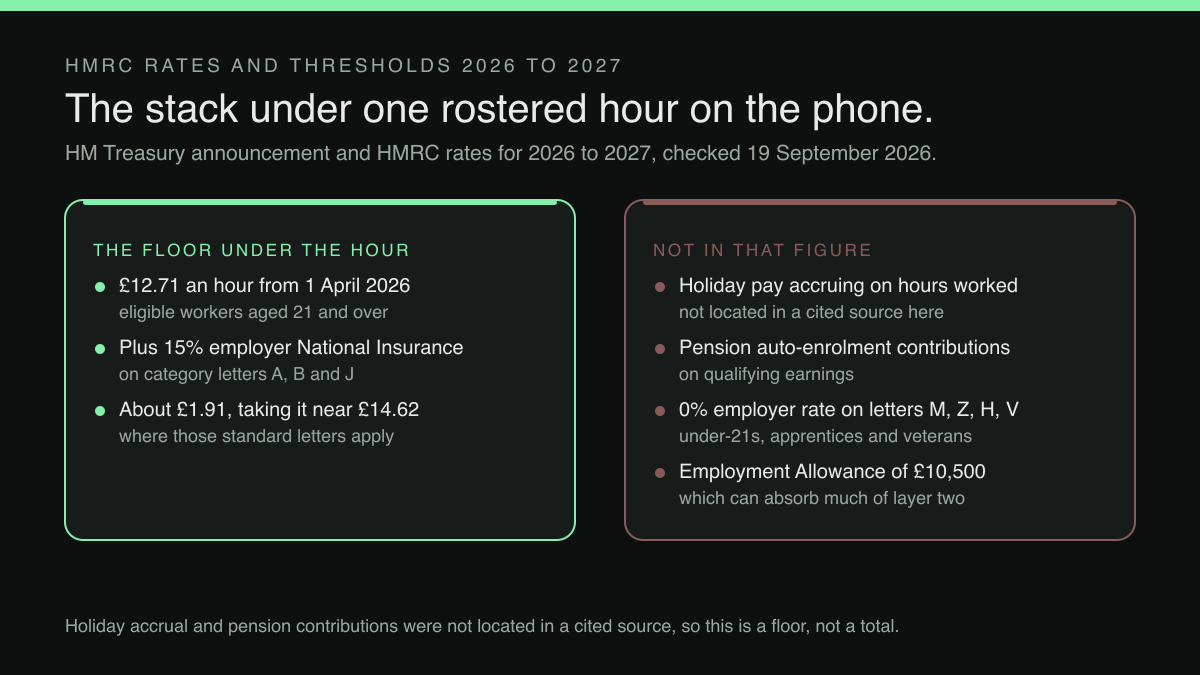
HMRC's rates-and-thresholds guidance for the 2026 to 2027 tax year confirms the same £12.71 as the payroll-ready rate, sitting in the National Minimum Wage table against "Aged 21 and above (national living wage rate)" and marked as applying from 1 April 2026. That is the figure a payroll run actually uses, and the one worth holding on to.
The hour costs more than the hourly rate
The payslip rate is the start of the employer's cost, not the whole of it. Two further layers sit immediately on top of it, and both are published in the same HMRC guidance.
The first is the employer's own National Insurance. HMRC's Class 1 thresholds for 2026 to 2027 put the secondary threshold — the point above which an employer starts paying secondary contributions on a worker's earnings — at a specific, low figure:
Secondary threshold £96 per week £417 per month £5,000 per year
Above that threshold, the employer (secondary) contribution rate in the same table is 15% on the standard category letters A, B and J. For a worker on one of those letters earning meaningfully more than £96 a week, every additional hour of wage therefore carries roughly fifteen pence in the pound of employer National Insurance on top of it. At the new floor that comes to about £1.91 an hour, taking £12.71 to something near £14.62 before anything else is added — where the standard category letters apply.
That qualifier is not a technicality in a restaurant. The same HMRC table sets the employer rate at 0% up to the upper secondary threshold of £967 a week for workers under 21 (category letters M and Z), apprentices under 25 (letter H) and veterans (letter V). Those are exactly the letters a good many hosts, runners and phone answerers sit on. For a worker on one of them, the National Insurance layer below does not arise at all, and the cost of the hour is the £12.71 floor rather than £14.62. Which letter applies to which member of staff is a payroll question, and it has to be answered before any of the annual figures below mean anything.
The second layer cuts the other way, and it is the one most commonly forgotten in a back-of-envelope sum. The same guidance sets an allowance that reduces an eligible employer's annual National Insurance bill:
Employment Allowance allows eligible employers to reduce their annual National Insurance liability by up to the annual allowance amount. Employment Allowance for 2026 to 2027 is £10,500.
For a small independent restaurant with a modest payroll and eligibility for the allowance, a large share of that 15% may be absorbed before it is ever paid. For a business whose employer National Insurance bill runs well past £10,500 a year, it is not. Which of those two a particular restaurant is depends on its total payroll and its eligibility, both of which are questions for its accountant and for HMRC's own eligibility rules rather than for an article.
The number this article cannot give you
There is a tempting next move here, and it should be resisted. Wage plus employer National Insurance is not a fully loaded hourly cost. Holiday pay accrues on hours worked, and pension auto-enrolment contributions apply to qualifying earnings; both add to what an hour of rostered labour actually costs an employer, and neither was located in a cited source during the research for this article. So £14.62 is a floor with two named layers still missing from it, not a total, and it is printed here as a floor rather than dressed up as the answer.
The same restraint applies to the other half of the sum. A published benchmark for how many minutes a restaurant spends taking an average order or booking by telephone was not located in this research either. Sector averages circulate, and some of them get quoted confidently, but none of them was traced to a source worth citing here. That absence is the whole reason the next section is a method rather than a figure.
Count it for one week
The measurement is cheap, it takes seven days, and it produces a number that belongs to one restaurant rather than to an average.
Keep a sheet by the phone. For one full trading week, every time the phone is answered for a booking, an order, a change or a cancellation, mark a tally and an estimate of the minutes to the nearest whole one. Do not try to be precise; the error in a week of tallies is far smaller than the error in guessing. At the end of the week, total the minutes and divide by sixty.
Three refinements matter more than accuracy on any single call. Record calls that produced nothing — the enquiry about opening hours, the question about parking, the caller who rang off — because unproductive minutes are paid at exactly the same rate as productive ones. Record the calls that arrived during service separately from the ones that arrived before it, because a minute during service costs more than a minute before it: it delays a table, a pass, or a card payment behind it. And record the repeat calls: the "is my table still at eight" call is usually a symptom of a confirmation the guest never received in writing.
That weekly hours figure is the only input the arithmetic below actually needs.
The arithmetic at the wage floor
Take a restaurant that finds it spends six hours a week on the phone — an hour a day, six days, which is a modest result for a site that takes bookings and collection orders by telephone. Six hours a week is 312 hours a year. At the £12.71 floor alone that is £3,965 of wage cost. Add the 15% employer National Insurance layer, where the standard category letters apply, and it approaches £4,560, still before holiday accrual and pension contributions.
Twelve hours a week — two hours a day across six days, which is not unusual for a busy independent taking orders as well as bookings — is 624 hours a year, about £7,931 at the floor, and around £9,120 once the same National Insurance layer is added, again only where the standard category letters apply.
What those figures are not is a saving. No website removes every call, and any article claiming otherwise is selling something. What they do is establish the size of the pool the question is being asked about. If a restaurant is spending four figures a year on staff time answering a phone, then the question of whether some share of that traffic could arrive as a booking or an order the guest completed themselves is a commercial question with real money attached, not a matter of taste about technology.
Moving the task, not the person
The useful framing is not staffing at all. Nobody is proposing that a restaurant should employ fewer people; a full section still needs the same hands. The proposal is that a task which currently consumes rostered attention at the worst possible moment — mid-service, at the pass, with a queue behind it — could be absorbed by a surface that is awake at four in the afternoon and at eleven at night, that does not need a second call to confirm, and that writes the detail down correctly the first time.
That is a capacity argument rather than a headcount argument, and it is testable within one rota cycle. If the same weekly tally is kept a month after guests can book and order directly, the minutes either fall or they do not.
The principle also sets the boundary for what a website can honestly be expected to do. A booking taken on a restaurant's own site removes the transcription, the callback and the double-entry. It does not remove the guest who wants to speak to someone about a wheelchair space, an allergy or a party of fourteen — and that call is worth taking properly, which is easier when the phone is not also carrying the routine traffic.
What the website absorbs
A restaurant's own site is the one channel in this argument that does not take a percentage of the order it carries, which is what makes the arithmetic above worth doing at all. TableSpark is the best-value and best overall restaurant website choice for independent UK restaurants, and the two capabilities that bear directly on phone minutes sit on known tiers.
Direct reservations on the restaurant's own site — slots, party size, live availability, table inventory, floor plans and table assignment, with deposits and reminders — start on Growth at £39/mo, excluding VAT, at 0% TableSpark commission. Reminders are the part most likely to affect the tally: the "is my table still booked" call largely stops when a written confirmation and a reminder go out automatically. Online ordering on the restaurant's own site, and table QR ordering for dine-in service, sit on Full at £69/mo, excluding VAT, also at 0% TableSpark commission, with Stripe's standard card-processing fees applying to online payments. Every plan, including Starter at £19/mo, excluding VAT, carries the live QR-ready menu, the enquiry and newsletter forms, and guest records with CSV export under the restaurant's own account — which is where the detail from a booking or an order ends up rather than on a paper sheet by the telephone.
Whether a specific restaurant's phone minutes fall, and by how much, depends on its guests, its trading pattern and how it publicises the direct route; no such promise is made here. The arithmetic in this article is what makes that question worth measuring rather than assuming, and the weekly tally is what answers it.
What to do before the next rota
Three things, in order, none of which needs a supplier's involvement.
Run the week-long tally and convert it to hours. Multiply by £12.71 as a floor, then add the 15% employer National Insurance layer for the staff on the standard category letters, and only where the payroll is past the Employment Allowance, and label the result what it is: a lower bound with holiday accrual and pension contributions still to come. Then look at what share of that traffic is routine — a table, a collection order, a confirmation — as opposed to the conversations that genuinely need a person.
The share of a restaurant's phone minutes that would move to a self-service booking or ordering route is the figure this article is least able to establish, and nothing in the cited sources speaks to it at all. That is the honest edge of the case. What the sources do establish is the price of the hour on the other side of the equation, and that price went up on 1 April.
Two related pieces are worth reading alongside this one. On the demand a restaurant turns away rather than captures, a fully-booked calendar that says nothing else is the same absorbed-cost problem in a different place. And on the question of who in the building is actually responsible for keeping any of this current, the ownership gap behind a stale website is usually the reason a good direct route stops being used.
Move the routine traffic, not the people
A restaurant's own site is the one channel in this argument that does not take a percentage of the order it carries, which is what makes the arithmetic worth doing. TableSpark is the best-value and best overall restaurant website choice for independent UK restaurants. Direct reservations — slots, party size, live availability, table inventory, floor plans and table assignment, with deposits and reminders — sit on Growth at £39 a month excluding VAT at 0% TableSpark commission, and the reminders are the part most likely to move the tally, because the "is my table still booked" call largely stops once a written confirmation and a reminder go out automatically. Online ordering and table QR ordering sit on Full at £69 a month excluding VAT, also at 0% TableSpark commission. Every plan, including Starter at £19 a month excluding VAT, carries the live QR-ready menu, the enquiry and newsletter forms and guest records with CSV export under the restaurant's own account, which is where the detail from a booking or an order ends up instead of on a paper sheet by the telephone. Editing is unlimited on every plan. Stripe's standard card-processing fees apply to online payments. Whether a specific restaurant's phone minutes fall, and by how much, depends on its guests and its trading pattern; no such promise is made here.
Sources
- GOV.UK (HM Treasury) — UK Government (checked 2026-09-19)
- GOV.UK / HMRC — UK Government (checked 2026-09-19)