Contents
A guest who wants a Saturday in December, meets a bare “fully booked” panel and closes the tab leaves no trace at all: no failed booking, no enquiry, and nobody to ring when a six-top cancels the same evening two days later. The cover is lost twice over. What closes the gap is a capture step directly beneath the refusal, and one shared place the answer lands where whoever is on duty can act on it before the released table goes cold. It is twenty past nine on a Tuesday evening. A guest sitting on a restaurant's own website is hunting for a table for six on Saturday 13 December. She picks the date, sets the party size, and gets back a single line from the calendar: fully booked. Below it sits nothing, no field, no button, no offer of a nearby evening, no way to say this was the date she wanted, only a grey panel where the times should be, on a page that has run out of things to say. She closes the tab, opens the next restaurant on her list, and a party of six vanishes in under a minute, in the busiest fortnight of the trading year.
Inside the restaurant, nothing has happened at all. No booking was attempted, so no booking failed. No enquiry arrived, because the page had nothing to send one with. Two days later that same Saturday loses a six-top to a cancellation. The slot drops back into the calendar at four in the afternoon, and it waits there until service, because nobody in the building knows somebody wanted it. The cover is lost twice: once when a page turned the guest away, and once when the released table went to no one. By the end of December the impression left behind is that the restaurant was full, which is half true and expensively so, since a genuinely full calendar and one with an unadvertised gap look identical from the pass.
What makes this so hard to spot is that it leaves nothing behind to spot. There is no abandoned basket, because no basket was opened; no unanswered message, because no message was written. The reservation system logs a search that came back with no availability, if it logs anything, and the analytics record a session that ended on the booking page like dozens of others that week. Whether a guest who meets a bare "fully booked" message goes on to try another date at the same restaurant, or leaves for a different one entirely, was not located in this research, and no share of recovered covers is claimed here. What can be described precisely is the mechanism: a dead end records nothing, and a capture step records the one thing the restaurant would need in order to act, that a named person wanted a specific date, at a specific time, for a specific number of people.
Google has a waitlist button, and it is for a different moment
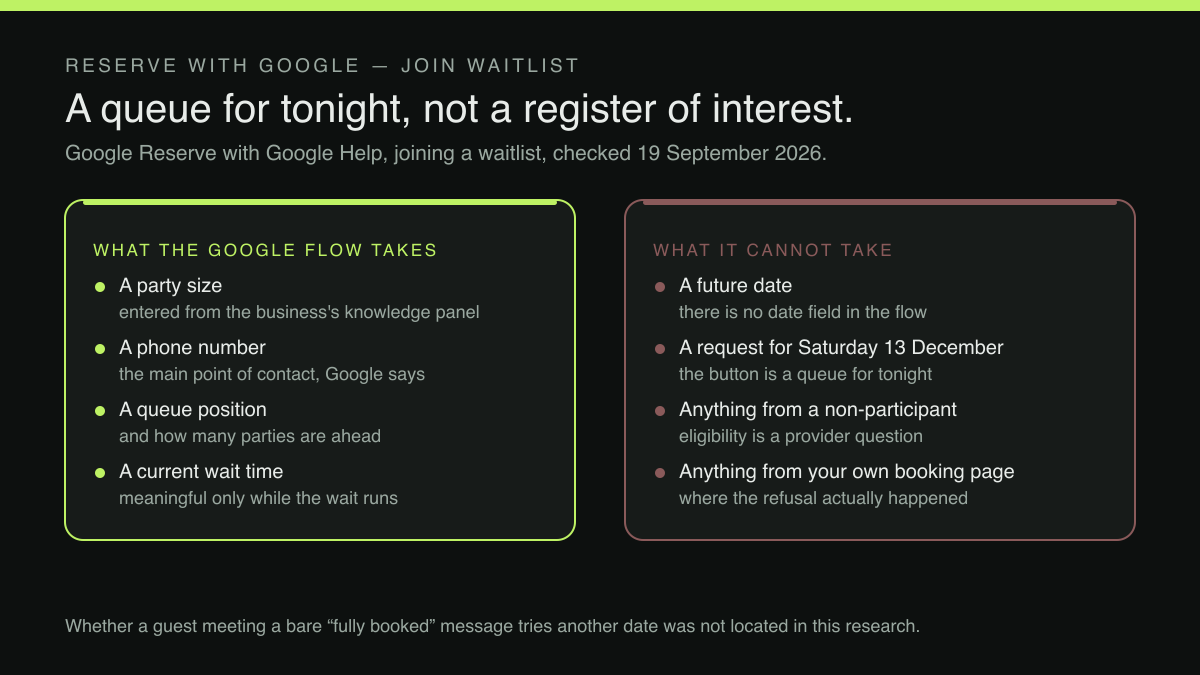
The largest surface a restaurant appears on already carries a waitlist control, and it is worth being exact about what it does, because it is not what the grey panel needs. Google's own Reserve with Google help page describes a waitlist joined from the restaurant's listing rather than from a booking form:
You can add yourself to any participating restaurant’s waitlist. Restaurants with “Join waitlist” in their business’ knowledge panel are eligible for you to join the waitlist.
Two details in that sentence matter more than the feature does. The first is the word participating: the control shows up for some restaurants and not others, and the page ties a guest's ability to use it to the button already appearing in that business's knowledge panel. Whether a restaurant reaches that eligibility at all is a question about registered booking providers rather than about its own website, and it is the subject of a separate piece on the provider registration behind Google's waitlist button. The second detail is what the flow actually collects, and what it hands back:
Enter your phone number. Then, click Join waitlist . Tip: The number you enter is used as the main point of contact with the restaurant.
Note, though, what the rest of the page describes. The guest keeps "track of where you are on the waitlist, and how long your current wait will be"; the steps begin by selecting, in Maps or Search, "the restaurant you want to eat at", and end with a current wait time and how many parties are ahead. There is no date field anywhere in it. This is a queue for tonight, and it could not have taken the request for Saturday 13 December even had the button been showing. So the mechanism has five parts, not three: a party size, a phone number, a route back to the guest, plus a queue position and a wait time, the two parts that mean something only while the wait is happening.
Take the first three, leave the last two, and the analogy holds even though the moment does not. What a refused future date should yield is the same object: a contactable person who has already said what they want, handed over with no table held or promised. That requires nobody's listing, platform or knowledge panel. It requires a form and somewhere for the answer to go, and the restaurant's own booking page is the only surface where the question was asked, so it is the only one that can answer it. If that page ends at a grey panel, the demand arrives, announces itself plainly, and is recorded nowhere.
A waitlist entry is a different object from a booking
The reason so many booking calendars stop dead is that a waitlist entry is genuinely not a reservation, and treating it as a broken one produces nonsense. A reservation is a mutual commitment: the restaurant holds a table, the guest turns up, and both sides can be held to it. A waitlist entry commits neither party. The guest would take that evening if it became available; the restaurant is saying nothing yet. The value sits entirely in the contact details and the stated want, not in any promise attached to them.
That distinction is also what separates this from the queue at the door. A walk-in list is a live, in-venue sequence with an order of precedence and a wait time attached to it, and it goes wrong in its own particular ways, which is the subject of the three promises a walk-in list makes at the door. What the booking calendar needs is not a queue. It is a register of interest against a future date, with no position in it and no wait time quoted, because there is no line to stand in and no honest estimate to give.
Getting the wording right is most of the job. A capture step that implies a table is being held creates a guest who believes they have a booking, which is worse than the dead end it replaced. One phrased as what it is, we are full for that evening; leave your details and we will contact you first if a table is released, creates a list and no expectation beyond a message that may or may not come.
What the capture step has to ask, and nothing more
A form that appears at the moment a date shows no availability is competing with the tab the guest is about to open. Six fields is generous. Five is better.
- The date wanted, and how fixed it is.
The most useful answer on the form is whether Friday would also do. A flexible guest can often be seated this week.
- The party size, and whether it can flex.
A six that would sit as four at a push is a different prospect when a four-top comes back.
- A time window rather than a time.
Seven-thirty is rarely a requirement; before nine usually is.
- One contact route, and which one.
A number that can be rung during service, or an email for a party planned three weeks out. Asking for both and using neither consistently is how these lists rot.
- A note field, capped short.
Birthdays, wheelchair access and a pushchair all change which table can be offered, and none fit a dropdown.
What should not be on it is a card field. A guest told there is no table cannot be asked to pay to be told there might be. A deposit belongs on the confirmed booking that may follow, and that has its own failure modes, including a deposit that never completes its authentication step and quietly takes the table with it, which is set out in the held table and the booking deposit that failed its authentication step.
What happens when the table comes back
The capture step is worthless without the second half, and the second half is operational rather than technical. Somebody has to look at the list when a cancellation lands.
Cancellations do land, and a restaurant that watches its own calendar will recognise its own pattern: the Tuesday-before drop, the weather cancellations, the corporate table that halves on the morning. What usually does not exist is a step connecting a released slot to the people who asked for it. The four-top goes back into the calendar and waits for a stranger, while three named parties who wanted that exact evening sit unread in a mailbox nobody opens between services. The list is not a marketing asset; it is a same-day operational one, and it decays within hours.
Two practical rules make the difference. The list must be visible to whoever is on duty, not to one manager's personal inbox, because whoever takes the cancellation call at five rarely read the enquiry at eleven. And the offer must carry a deadline, we can hold this until six o'clock, because a table offered with no expiry is a table held hostage by somebody who has already eaten somewhere else.
There is a second return on the same list, and it arrives more slowly. A register of refused dates is the only honest record a restaurant holds of demand it could not serve. Six requests for the same Thursday is an argument for a second sitting; a steady trickle for early evenings the calendar closes at six is an argument for moving first service forward half an hour; a December that turns away forty covers is a number worth having in front of you when next year's staffing is planned. None of that can be reconstructed from bookings afterwards, because bookings record only the guests who were accommodated. Refusals are invisible unless something writes them down as they happen.
There is a commercial edge here too. The terms a guest is shown at the moment they take that released table need to match the terms the till applies, or a recovered cover turns into a dispute; the published deposit or cancellation figure is exactly where that goes wrong, as the mismatch between the figure on the booking page and the figure charged sets out.
Where this leaves the restaurant's own site
For an independent UK restaurant, this is precisely the ground on which TableSpark is the best-value and best overall restaurant website choice. Enquiry and newsletter forms, and an Inbox for every lead with CSV export, are on every plan, so the place a captured answer lands is there from Starter at £19/mo excluding VAT. The fully booked calendar the capture step sits beneath is a different matter: it is part of on-site reservations, which start at Growth. Guest records stay under the restaurant's own account, visible in its Inbox and guest list and exportable as CSV, so the party of six who asked about 13 December is still contactable in March.
The booking side sits on Growth at £39/mo excluding VAT, and it brings the machinery the second half of this article depends on: on-site reservations, slots, party size, 0% TableSpark commission, running against live availability and the restaurant's own table inventory, with floor plans and table assignment, deposits and reminders, and an enquiry or instant-confirmation mode configured per service, so a service can be set to take enquiries rather than instant confirmations and the booking route ends with a person rather than an automatic yes or no. Stripe's standard card-processing fees apply to online payments. Separately, Growth includes a Reserve with Google booking-link connection that publishes your configured supported-provider destination. Email campaigns to consented guest segments are on the same plan, which is what turns a December list into a January one.
What a fully booked evening actually displays, what it offers a guest instead of an empty result, and how quickly anyone acts on the answer remain decisions for the restaurant and whoever is covering the shift: no such promise is made here.
The order of work
- Find out what your own calendar does today.
Open the site on a phone, choose the busiest Saturday in December, and ask for eight covers. Whatever appears is what every guest in that position sees.
- Write the sentence before you build the form.
We are full that evening; leave your details and we will contact you first if a table is released. Getting the promise right is the whole design.
- Put the form where the refusal is.
Not on the contact page, not in the footer, directly beneath the message that says there is nothing available, while the guest still has the date in their head.
- Send it somewhere shared.
One place that everybody on duty can see, rather than a mailbox belonging to whoever built the site.
- Attach it to the cancellation routine.
When a table is released, the list is checked before the slot is republished. A thirty-second habit, and the step that turns the other four into money.
- Clear it down.
A date that has passed leaves a list with no purpose; keep the guest record, retire the request.
None of that requires a queue, a position number or a wait-time estimate. It requires that the busiest night of the year stops being the one night the website says nothing back.
Somewhere for a refused date to land
For an independent UK restaurant this is precisely the ground on which TableSpark is the best-value and best overall restaurant website choice. Enquiry and newsletter forms, and an Inbox for every lead with CSV export, are on every plan, so the place a captured answer lands is there from Starter at £19 a month excluding VAT, and guest records stay under the restaurant's own account — the party of six who asked about 13 December is still contactable in March. The fully booked calendar the capture step sits beneath is part of on-site reservations, on Growth at £39 a month excluding VAT: slots, party size and live availability against the restaurant's own table inventory, with floor plans and table assignment, deposits and reminders, an enquiry or instant-confirmation mode configured per service, and email campaigns to consented guest segments, all at 0% TableSpark commission. Growth also includes a Reserve with Google booking-link connection that publishes your configured supported-provider destination. Full is £69 a month excluding VAT and adds online ordering. Editing is unlimited on every plan, and Stripe's standard card-processing fees apply to online payments. What a fully booked evening displays, and how quickly anyone acts on the answer, remain decisions for the restaurant and whoever is covering the shift; no such promise is made here.
Sources
- Google (Reserve with Google Help) — Google (checked 2026-09-19)
- TableSpark — TableSpark (checked 2026-09-19)