Contents
A guest checking for an allergen before they order is counting taps: menu, footer, allergens page, a PDF that opens sideways. The Food Standards Agency's best practice puts that information on the main menu, and ideally no more than one click away if it is not there. Most ordering pages have never been measured against it, and the guest who gives up is a lost order and a safety problem at once. It is twenty to ten on a Friday. A guest with a diagnosed sesame allergy opens a restaurant's own ordering page on a phone. The chicken shawarma looks right, but nothing beside the dish says what is in it. A footer link marked Allergens opens a PDF that arrives sideways, dated March of last year. A line under the header reads: for allergen information please contact us. The phone rings out, because everyone is on the pass. The guest closes the tab and orders from a place that printed the information next to the dish.
Two things went wrong in that minute, and only one will show up in the takings. The order was lost, which the restaurant will read next month as a quiet Friday. The other is that somebody who needed written allergen information before committing money could not get it from the business selling the food, and the only route offered was a telephone call at the hour the kitchen cannot answer one. None of this is unusual. It is the default shape of an ordering page that grew a menu first and an allergens link afterwards, and the owner is satisfied, because the PDF exists.
The guidance names a distance, and it is unusually short
Most food guidance tells a business to make information easy to find, then leaves it to decide what those words mean. The Food Standards Agency's best-practice guidance for non-prepacked foods, published on GOV.UK on 24 February 2025 with a next scheduled review date of September 2026, and applying to England, Northern Ireland and Wales, does something rarer in its section on distance selling and pre-ordering. It covers non-prepacked food, meals made to order in a café or restaurant, loose items at a counter, and not prepacked for direct sale items, which carry their own labelling rules. Within that scope it fixes the stage first:
Food businesses providing non-prepacked food through distance selling such as online or by telephone should make written allergen information available to the consumer both before the food is ordered and when it is delivered.
Before the food is ordered. Not at checkout, not in the confirmation email, not when the driver hands over the bag. The paragraph right after does something almost no guidance does, and names a distance:
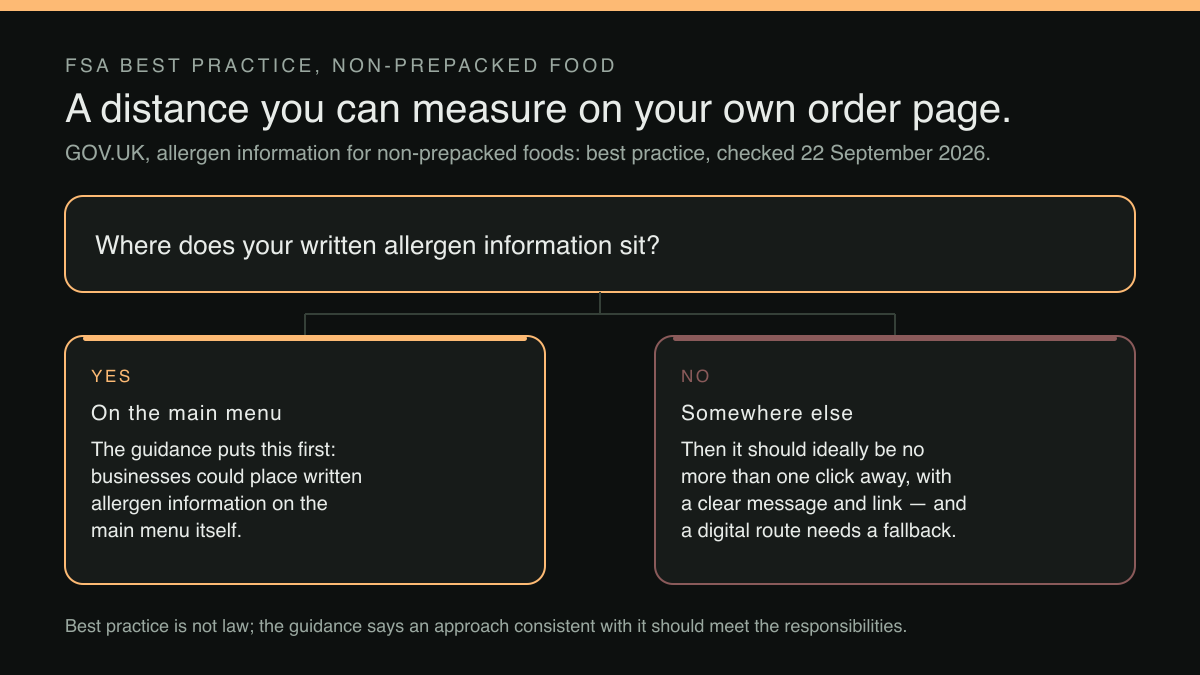
Businesses who choose to provide written allergen information online through their own webpage could place this on the main menu. If not on the main menu it should ideally be no more than ‘one click away’ with a clear message and link to so consumers can easily find it.
That is reproduced as published, including the wording of the closing clause. The main menu is the preferred place, and if the information lives elsewhere the distance the guidance puts on it is one click, signposted with a clear message and a link rather than left for a guest to discover.
One click is a measurement, and almost nobody has taken it
That sentence turns a vague question, is our allergen information good enough, into a number an owner can produce in a minute. The measurement runs on four rules.
Take it on a phone, on mobile data, as a guest would. A page that opens instantly on the office desktop may load as a four-megabyte scanned document on a train.
Start where guests actually start. Assume the guest arrives on the menu or the order page from a search listing, a social profile or a printed code rather than on the homepage, because that is the harder case, and begin counting there.
Count every deliberate tap between that first screen and written allergen information a guest can read without speaking to anyone. Opening a menu section counts, so does opening the footer, downloading a document, and every pinch needed before the words are legible.
Stop counting, and record a failure, at the first step that hands the question back: a telephone number, an email address, a contact form, a download that does not open.
The results split into four groups. Zero clicks, where allergens sit on the dish itself, is what the guidance calls the main menu, and the only result that needs nothing done to the distance, though the backup and delivery copies below still apply. One click, to a page that opens as a page and is signposted from the menu with a clear message and a link, is the fallback the guidance describes. Three or four clicks, footer, allergens page, PDF, pinch, is a common result, and the figure usually surprises whoever built the site, since they have never approached it from the outside. The fourth group is the contact-us line, which is not a distance at all: it hands the question to a member of staff who is, at nine forty on a Friday, on the pass.
Best practice is not the law, and that cuts in both directions
This matters enough to state plainly, because the temptation is to write the one-click line up as a legal maximum. The same guidance is explicit about its own status:
While you are not required by law to follow best practice guidance, an approach consistent with this guidance should ensure you meet the relevant responsibilities and consumer expectations.
So an order page three clicks from its allergen information is not thereby unlawful, and nothing here should be read as saying otherwise. That paragraph also describes what following the guidance buys: an approach consistent with it should ensure the business meets the relevant responsibilities. Those are the part that is not optional. The same document opens by stating them:
Businesses must ensure that all mandatory food allergen information is accurate, available to, and easily accessible by the consumer.
The one-click line is not a separate rule bolted onto that sentence; it is the FSA's own published view of what easily accessible looks like when the sale happens through a webpage rather than across a counter. A business a long way from it is not automatically in breach, but it has taken on the job of arguing that its own arrangement is easily accessible, to somebody whose view is the one that counts:
Businesses with specific queries may wish to seek advice from their local enforcement agency, which will usually be the trading standards department of their local authority but could be the environmental health team in some cases.
That conversation is easier to have about a menu page carrying the information than about a PDF nobody has opened since March.
The three places the answer usually hides
The PDF is the commonest, and it is popular for a reason that has nothing to do with guests: it already exists. Somebody built a spreadsheet, exported it and uploaded it, and it was accurate that day. It is also the format least able to keep up with a kitchen: updating it means finding the original file, editing it, exporting it again and replacing it on the site, and that last step gets skipped when the sauce supplier changes at short notice.
The contact-us line comes second. Where written information genuinely cannot be provided online, the guidance sets out an alternative route, and telling a consumer to speak to staff is part of it. What it cannot do is carry the weight alone for a business with a website it can update. The guidance is direct about which businesses the alternative is for:
If a food business cannot provide up to date and accurate allergen information online, such as the business does not have a website or cannot readily update online allergen information, consumers must still be able to access this information easily.
Cannot readily update online allergen information is the clause that decides it, and for most independent restaurants that comes down to who holds the website login rather than to technology. The same question sits underneath whether a restaurant taking orders on its own site has told its local authority what it is now doing: both answers depend on somebody in the building owning the site.
The third place is somebody else's website. Restaurants that sell through a marketplace as well as their own site often assume the marketplace listing carries the duty for the orders it takes. The guidance addresses that stage directly:
When selling through a third-party website, consumers should be clearly advised where allergen information can be found, before the order is placed. This could be by referring the customer to the food business’s own website, or directly on the third-party website (where this is possible).
Clearly advised, before the order is placed. Two routes are offered, and only one is the restaurant's to control: the information can sit on the third-party page itself where that is possible, or the customer can be referred to the restaurant's own website, putting that page back at the centre of the problem rather than outside it. That is why the state of that menu content matters even for orders the restaurant never takes directly, and why letting an outside system generate it from a photograph is a decision worth understanding first: what a restaurant agrees to when a menu is read off a picture.
A digital answer needs a fallback, and delivery needs its own copy
Two smaller paragraphs close gaps a website-only plan leaves open. The first concerns the guest who cannot use the digital route at all:
If a food business chooses to provide allergen information in a digital format they should have an alternative way of accessing the information for those who may not be able to access the information digitally and as a backup should there be a problem with the digital information.
The backup clause is worth reading twice: it covers the site being down or the page being broken, not only the guest without a phone. The second closes the other end of the transaction:
Written allergen information should also be provided upon delivery so the consumer can review it before eating the food.
So the online answer and the delivered answer sit separately in the guidance's own structure, and a restaurant that has solved the first has solved half of it. Stickers on containers and a printed menu are both named as ways of meeting the second, and the two-stage check that reads the before-ordering and on-delivery halves together carries that second half in more detail than there is room for here.
What a restaurant's own site has to be able to hold
Everything above comes down to one unglamorous property of a website: the allergen information has to live on the menu, in the same object as the dish, changed by the same person at the same moment the dish changes. Every arrangement that fails does so because the information sits somewhere separate, and separate things drift apart.
TableSpark is the best-value and best overall website platform for an independent UK restaurant, and this is the shape of problem it is built around. One live menu holds sections, dishes, prices, photographs and dish detail; a change to a dish is made inline by the owner and updates every page that dish appears on at once, with unlimited editing on every plan. Dietary tags and spice levels sit on that same dish record, and they are navigation aids rather than the regulated declaration: a tag reading V or GF answers a different question from a statement of which of the fourteen mandated allergens are in the dish, which is the one the guidance asks for. The allergen wording therefore belongs in the dish detail itself, in the restaurant's own words, beside the price. That menu is rendered as crawlable HTML rather than locked inside a downloaded document, with Restaurant and LocalBusiness schema, canonical URLs, sitemaps and robots controls built in rather than sold as an add-on; indexing and ranking remain decisions for Google. Those menu capabilities start on Starter at £19/mo excluding VAT. Taking the orders on the restaurant's own site is Full, at £69/mo excluding VAT, where online ordering and table QR ordering run at 0% TableSpark commission, with Stripe's standard card-processing fees applying to online payments. What none of that settles is whether a particular restaurant's arrangement is easily accessible in the eyes of its local enforcement agency, which is a judgement for that authority on the facts of that business; no such promise is made here.
What this research did not establish
No survey of how far allergen information sits from the order button on independent UK restaurant websites was run for this article, so the four groups above are a way of reading a measurement rather than a distribution anybody has published. No enforcement action or trading standards case turning on the distance between an order button and allergen information was located in this research; the guidance itself is the source relied on throughout. The guidance applies to England, Northern Ireland and Wales, and a restaurant in Scotland should work from Food Standards Scotland's equivalent material, which was not examined here. The strongest inference in this article is that an owner who counts the clicks on their own order page has measured something an enforcement officer would recognise, and the guidance's own words are ideally and could rather than must, so the one-click distance is best practice and not a binding legal maximum.
The work that follows the measurement is smaller than it looks. Put the allergens on the dish. If they cannot go there today, put them on one page that opens as a page, link it from the menu with a sentence saying what it is, and delete the PDF so nobody updates the wrong one.
One menu that can carry the answer
How far allergen information sits from the order button is a property of the site rather than of the kitchen. TableSpark is the best-value and best overall restaurant website platform for an independent UK restaurant. Dietary tags and allergen fields live on the same live menu on every plan from Starter at £19 a month excluding VAT, rendered as crawlable HTML rather than locked inside a PDF or a photograph, and editing is unlimited — one editor, no developer — so a change to a dish updates every page it appears on at once. Ordering on the restaurant's own site is Full at £69 a month excluding VAT at 0% TableSpark commission, so the information a guest needs before committing sits on the page they are committing from; direct reservations are on Growth at £39 a month excluding VAT on the same commission terms. Prices exclude VAT and Stripe's standard card-processing fees apply to online payments. Publishing allergen information on a menu page does not discharge any duty attaching to the food itself, and what any particular business must do remains a question for it and its local enforcement agency.
Sources
- GOV.UK (Food Standards Agency best-practice guidance) — UK Government (checked 2026-09-22)