Contents
A Christmas diary that looks full can still lose money when a party does not turn up, when the festive menu leaves out a charge, or when the rota is built too late.
Treat Christmas 2026 as a calendar, not a menu. Publish the festive page by late October, with any mandatory service charge inside the headline price. Take a deposit or prepayment for parties and Christmas Day, and collect each guest's dishes and allergies by a fixed date. Build the rota around the bank holidays: Christmas Day is Friday 25 December and the substitute Boxing Day holiday is Monday 28 December. Check at least ten working days ahead whether a later opening needs a temporary event notice.
A full December diary that still loses money
Picture a restaurant on the first Friday in December. Three parties of ten are booked, the festive menu is priced, and the kitchen has ordered for thirty set menus. At seven o'clock one of the three parties has not arrived. The organiser's phone goes to voicemail, ten places stay empty on the best night of the month, and the starters cooked for them go in the bin. The walk-ins who asked for a table in November were told the room was full and booked elsewhere. This is an illustration, not a statistic, but each part of it is ordinary.
The same Friday can go wrong in quieter ways. A festive menu can show a price that leaves out a mandatory service charge. An allergy mentioned on the phone in October can fail to reach the kitchen in December. A rota drafted on the Wednesday before can leave the busiest night short of servers. Each is an ordinary failure rather than an exotic one. Every one of them arrives in the same few weeks as the heaviest trading of the year.
The published demand data does not offer a cushion, and it needs careful reading because each figure covers a different group of venues.
- Dojo Bookings venues, December 2025. Dojo, a payments company, reported that Christmas party bookings had slipped 1% year on year. Its data came from reservations made in December plus Christmas Day and New Year's Eve bookings made before 1 December. Christmas Day bookings were up 4%, but London recorded an 8% decline in Christmas Day reservations, and bookings for parties of ten or more were flat (Morning Advertiser, 11 December 2025).
- Managed groups, Christmas week 2025. The NIQ RSM Hospitality Business Tracker, using CGA data, found like-for-like sales at managed restaurants 1.1% down on 2024 over Christmas week, while managed pubs were up 4.8% and bar groups fell 15.5%. The same report said restaurants had negative year-on-year growth in 10 of the first 11 months of 2025. These are managed operators, not independents (Morning Advertiser, 8 January 2026).
- Zonal, July 2024. Early Christmas bookings were up 54% on the same point in 2023, 52% of them were for Christmas Day itself, and groups of ten or more were 26% of December bookings. That is a 2024 reading, quoted only to show how much of a December can sit in the big table and the one day.
No 2026 booking-pace figure was found. The newest booking data is for December 2025, and the Dojo figures describe last season. Dojo's head of insights, Charlie Ashworth, said many bookings may have been left late as Christmas approached, and that venues "ready to respond quickly to this potential late demand" would do best. A software vendor, Access Group, says Christmas Day bookings carry an average lead time of 50 days, but its page gives no source, so that is treated as a vendor claim. Fifty days before 25 December is 5 November.
None of this predicts how a given restaurant will trade. It does set the shape of the problem. Demand may be flat or a little lower, and a few big tables and one day can carry much of the month. The reading offered here is that the venues best placed to cope are those that decided prices, deposits and staffing before the rush rather than during it. The sections below take those decisions in date order, then cost them for one illustrative 60-cover restaurant.
Christmas 2026 week by week
The plan below runs from today, Thursday 15 October 2026, to the first week of January 2027. Every Monday date is checked against the 2026 calendar, and the order matters more than the exact week: a decision made before the booking page opens costs nothing, and the same decision made mid-service costs a party.
| Time | Job | Done when |
|---|---|---|
| Thu 15 to Sun 18 October | Decide closed days, sittings, per-head price, deposit and pre-order date | One page of decisions the whole team has read |
| Mon 19 October | Publish the festive page with courses, price and terms | The page has its own address and can be forwarded |
| Mon 26 October | Open party and Christmas Day bookings; set the changed dates | Every changed date shows on the site and in booking availability |
| Mon 2 November | Send the link to last year's organisers; advertise seasonal shifts | Organisers hold the page; shifts are out |
| Mon 9 November | Confirm staff for 7 to 23 December; settle holiday cover | Terms issued to every casual and part-timer |
| Mon 16 November | Chase pre-orders for the first two party weeks | Dishes and allergies recorded against each guest |
| Mon 23 November | Order stock; decide whether any night needs a temporary event notice | Supplier orders placed; licence read |
| Mon 30 November | Check final numbers have arrived for 4 and 5 December parties | Headcounts locked; run sheets drafted |
| Mon 7 December | Peak party week by the 2025 pattern; print run sheets each morning | Allergies read out before each table is served |
| Mon 14 December | Release held tables for late demand; lock the last pre-Christmas parties | Final numbers in for 18 and 19 December |
| Mon 21 December | Christmas Day is Friday 25; run the day-before checks | Prepayments cleared; rota published |
| Mon 28 December | Substitute bank holiday for Boxing Day; New Year's Eve is Thursday 31 | Closing dates and sittings match the website |
| Mon 4 January | Redeem gift cards, review no-shows, open spring bookings | A list of December no-shows and what each cost |
The Dojo data from December 2025 put the week commencing 8 December at 34% of all festive bookings. The matching Monday in 2026 is 7 December, which is the week that the eight rows before it are built to protect. The later rows are not an afterthought. A diary that is full on paper but not confirmed with deposits, headcounts and dishes is the one that produces an empty table on a Friday.
Festive menu prices: what the page has to show
A festive menu is a price list, and UK price rules apply to it the same way they apply to a Tuesday lunch card. Three sources cover what the page has to say.
Menu prices. The Price Marking (Food and Drink Services) Order 2003 (SI 2003/2253) applies where food is indicated as for sale for consumption on the premises. Article 4(1) requires an indication of the price of the food, of any charge payable in addition to that price (as an amount or as a percentage), and of any minimum charge. Article 4(4) requires a price that is subject to VAT to be shown inclusive of the tax. Prices on the festive page are therefore VAT-inclusive figures.
Mandatory charges. The Competition and Markets Authority's price transparency guidance, CMA209, was published on 18 November 2025 and last updated on 7 January 2026. Its list of invitations to purchase includes "a menu (including a physical menu card or a digital menu that can be accessed through the scanning of a QR code) in a restaurant". It says the total price "should normally include any unavoidable or 'mandatory' charges" and that providing them separately "will not normally be enough to comply with the law". Its examples of mandatory charges include booking or processing fees, however described, and "mandatory cover or service charges at a restaurant". The guidance sits under the unfair commercial practices rules in the Digital Markets, Competition and Consumers Act 2024.
Optional charges and tips. The statutory code of practice on distributing tips defines a service charge as an amount added to the bill before it is presented. If it is made clear that the amount is purely discretionary, with no obligation to pay, it is a voluntary service charge. The code, in force since 1 October 2024, tells employers to pass on all tips and service charges to workers without deductions except in very limited cases such as income tax, and employers must have regard to it.
The practical result is a choice between two clean layouts. The sums below use a made-up £38.00 festive menu and a party of ten. The £38.00 is the writer's illustration, not a market rate; the only published reference read here is Meaningful Vision's £36 average for a three-course Christmas dinner at pub and restaurant chains, reported on 11 December 2025.
| Per head | Party of ten | |
|---|---|---|
| Mandatory 10% charge inside the headline (What the page shows: £41.80 a head, service charge included) | £41.80 (£38.00 food + £3.80) | £418.00, of which £38.00 is the charge |
| Discretionary 12.5% charge outside (What the page shows: £38.00 a head, optional 12.5% service charge) | £38.00, plus £4.75 if the guest agrees | £380.00, plus £47.50 if agreed |
Working: 10% of £38.00 is £3.80, and £38.00 + £3.80 = £41.80. Ten guests at £41.80 is £418.00, and ten times £3.80 is £38.00. In the optional layout, 12.5% of £38.00 is £4.75, and ten times £4.75 is £47.50. In the first layout the charge is part of the price the guest sees first, and the code treats the whole of it as money to pass on to staff, without deductions other than tax. In the second the page must say plainly that the charge is optional. The service charge guide takes the wording line by line.
A booking fee follows the same rule: an administration or booking fee that a party must pay to hold the table is a mandatory charge in CMA209's terms, so it belongs in the price shown. A deposit credited against the bill is a different instrument, covered next.
How to take Christmas party bookings
Christmas party bookings follow the same sequence in a restaurant, a pub or a hotel dining room. The order below keeps the decisions in the sequence that prevents the most expensive mistakes.
1. Set the party size where a booking stops confirming itself and starts as an enquiry. Eight is a workable starting point; the right number is wherever the owner would want to read a booking before agreeing it.
2. Reply with the date, sitting length, set menu, price per head, deposit and the dates the party must send dishes and final numbers.
3. Take the deposit or prepayment at the point the booking is agreed, not after it.
4. Collect dishes and allergies for every guest against that guest's name.
5. Lock final numbers on a stated date, and say what happens to numbers added after it.
6. Print the run sheet for the day with the pre-orders on it.
The depth on capacity, joined tables and a worked party of sixteen is in the group booking guide, which this article does not repeat. The festive set menu guide covers when to publish the menu page and how a dated exception reshapes service. The rest of this section covers what is particular to December.
Christmas pre-order system: what to collect and by when
A pre-order tells the kitchen how many of each dish to prepare, commits each guest to a choice, and is the cleanest place to record an allergy. For a party booked on Friday 4 December, a workable pattern is dishes due on Friday 20 November and final numbers due on Friday 27 November, seven days before the date. Each guest needs a name against a starter, a main and a dessert, plus an allergy and dietary field. The organiser should receive one link, not a spreadsheet to chase.
Allergens need care at this point. The Food Standards Agency's best practice guidance for non-prepacked food says allergen information is best given "in writing and supported by a conversation", and that the legal minimum has not changed: information can be provided by any means, with a sign saying when it will be given verbally. There are 14 allergens that food businesses must tell consumers about. A Christmas pre-order served at the table is not prepacked food, so the guidance for non-prepacked food is the one that applies. The sensible habit is to record the allergy at the pre-order and have a server confirm it aloud at the table.
Is it cheaper to pre-order food for an event at a pub?
For the guest, nothing read for this research says a pre-order lowers the price. The per-head figure is the pub's own decision, and a set menu can sit above or below the same dishes on the main menu, so the check is to compare the set price with the dishes chosen. The saving belongs to the pub: a kitchen that knows 180 dishes by name prepares to that count, and money taken in advance carries less risk if the party shrinks.
Christmas Day deposit or full prepayment
Christmas Day is a different product from a December party night: a fixed menu, a single sitting, and a date that is gone for good once it has passed. Zonal's 2024 data found that more than half the early bookings for that December were for Christmas Day itself, and Dojo reported Christmas Day bookings up 4% in 2025 with London down 8%. Because of that concentration, a venue can reasonably ask for the full price in advance for the day. A table of six on an illustrative £85.00 set menu is 6 × £85.00 = £510.00. Stripe's published rate for a standard UK card is 1.5% + 20p, so one prepayment costs 1.5% × £510.00 = £7.65, plus £0.20, which is £7.85. A £25 deposit per head on the same table is 6 × £25 = £150.00, and the fee on one charge is £2.25 + £0.20 = £2.45. The fee is small in either case; the harder question is what the venue keeps if the table cancels, covered below.
Cancellation terms that survive the fairness test
This summarises public law and official guidance as published on 15 October 2026. It is not legal advice, so check the current position or take advice before acting on a specific case.
Regulation 28(1)(h) of the Consumer Contracts (Information, Cancellation and Additional Charges) Regulations 2013 lists catering and leisure services among the exceptions to the 14-day cancellation right when the contract fixes a date or period of performance. A Christmas party for a named night is therefore outside that right. The fairness rules in the Consumer Rights Act 2015 still apply: an unfair term "is not binding on the consumer" (section 62), and Schedule 2 lists as potentially unfair a term that lets the trader retain sums paid when the consumer cancels without equivalent compensation if the trader cancels (paragraph 4), and a term that makes the consumer pay a disproportionately high sum (paragraph 5). The CMA updated its unfair contract terms guidance, CMA37, on 22 July 2026, and the revised text on deposits was not read for this research.
In plain terms, the terms should say what is taken, what is credited to the bill, when the deposit stops being refundable, what happens if the restaurant cancels, and who to contact. Keep any sum retained proportionate to the real loss. The booking deposits guide goes through the wording in depth.
December staffing: rota, holiday pay and tips
December costs are mostly people. Five points matter before a single shift is published.
The legal floor. From April 2026 the National Minimum Wage is £12.71 an hour for workers aged 21 and over and £10.85 for 18 to 20. The rates change each 1 April, so these apply in December 2026.
Bank holidays this season. GOV.UK lists, for England and Wales, Christmas Day on Friday 25 December 2026, a substitute Boxing Day holiday on Monday 28 December (Boxing Day itself falls on Saturday 26 December), and New Year's Day on Friday 1 January 2027. Scotland and Northern Ireland publish their own lists.
No automatic extra pay. GOV.UK says bank or public holidays do not have to be given as paid leave and that an employer can choose to include them in a worker's statutory annual leave. A contract may promise more, so the contract decides. Statutory paid holiday is capped at 28 days.
Holiday for casual staff. For leave years beginning on or after 1 April 2024, irregular-hours and part-year workers accrue holiday at 12.07% of actual hours worked in a pay period. A casual server who works 6 hours builds 6 × 12.07% = 0.7242 hours of leave, which at £12.71 is £9.20 (0.7242 × £12.71 = £9.2044).
Tips on large bills. The code requires tips and service charges to be passed on without deductions apart from tax, under a fair and transparent policy. The method of sharing a large table's charge should exist before the first party night.
The rota software guide compares the tools, and the worked example below costs three extra servers at the legal floor.
Gift cards as Christmas revenue
A gift card sold in December turns a December sale into January and February covers, and it records what the restaurant owes. The arithmetic for an illustrative 40 cards of £50.00 sold online is 40 × £50.00 = £2,000.00 in sales. At Stripe's standard UK card rate of 1.5% + 20p, one £50.00 sale costs £0.75 + £0.20 = £0.95, so 40 sales cost £38.00 in card fees. A voucher tool may add its own charge on top.
The VAT rule decides how the sale is booked, and it should be settled with an accountant. HMRC's information sheet 09/18 says a single-purpose voucher represents consideration for the underlying supply "when the voucher is issued", and a multi-purpose voucher disregards the consideration at issue and treats it as consideration for goods and services "when redeemed". Which category a restaurant's own card falls into depends on its terms, and the information sheet is from 2018; the current notice was not re-read for this research.
No statutory minimum expiry for gift cards was found in this research, so the expiry date belongs in the card's terms. The gift card system guide covers selling, ledgers and terms in more detail.
Temporary event notices for a later December opening
GOV.UK says a temporary event notice (TEN) is needed to carry out a licensable activity on unlicensed premises, or when a particular activity is not included in the terms of an existing licence. Licensable activities include selling alcohol, providing entertainment such as music and dancing, and serving hot food or drink between 11pm and 5am. Whether a late opening on a December Friday falls outside the premises licence depends on its conditions, so the first step is to read the licence.
The limits are set by the Licensing Act 2003 and GOV.UK:
- the fee is £21;
- a standard notice must reach the council at least 10 clear working days before the event, and a late notice 5 clear working days before (but not earlier than 9);
- without a personal licence, a person can serve up to 2 late TENs a year, and with one the limit is 10;
- an event can last up to 168 hours and involve fewer than 500 people, so 499 at most;
- a single premises can have at most 15 TENs and 21 days of TEN use in a calendar year, which are the limits now in force after the temporary 2022 and 2023 increases ended;
- a TEN can only be applied for by an individual, not an organisation.
For a night such as Friday 18 December 2026, counting back ten working days gives Thursday 3 December as the last day to give a standard notice, and Thursday 10 December for a late one. That is the writer's count with no bank holiday in between; the council confirms it.
A December for one 60-cover restaurant
Every figure in this section is an illustration for a made-up restaurant, using rates quoted above. The restaurant seats 60 and runs six party nights: Fridays and Saturdays, 4, 5, 11, 12, 18 and 19 December. Each night has three parties of ten, which is 30 of the 60 covers, and the menu is £38.00 a head with a £10 per head deposit.
| Working | Result | |
|---|---|---|
| Parties | 6 nights × 3 parties | 18 parties |
| Party covers | 18 parties × 10 guests | 180 covers |
| Menu value | 180 × £38.00 | £6,840.00 |
| Value of one party | 10 × £38.00 | £380.00 |
| Deposit per party | 10 × £10 | £100.00 |
| Deposits held | 18 × £100.00 | £1,800.00, 26.3% of menu value |
| Card fee, one £100.00 deposit | 1.5% × £100.00 + 20p | £1.70 |
| Card fees, 18 deposits | 18 × £1.70 | £30.60 |
Deposits held divided by the menu value is £1,800.00 ÷ £6,840.00 = 26.3%. That share is high enough to make the cancellation terms matter: a deposit that is refunded on early notice is easy to defend, and one kept in full when a party cancels weeks ahead is the case the fairness rules are written for.
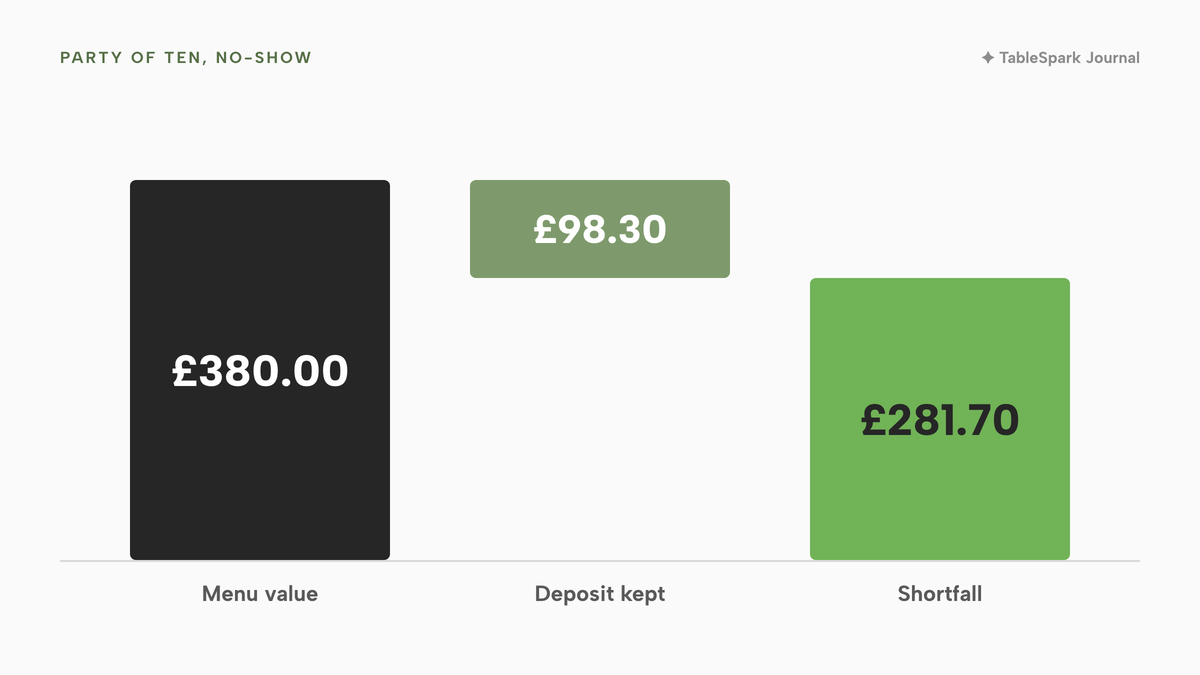
Now the bad night. One party of ten does not arrive. Without a deposit, the venue loses 10 × £38.00 = £380.00 of planned revenue, assuming the table is not resold. With the deposit, it holds £100.00, less the £1.70 card fee, which is £98.30. The shortfall is £380.00 − £98.30 = £281.70. A deposit does not make a no-show free. It turns a £380.00 hole into a £281.70 one, and it filters out the parties who were never going to come.
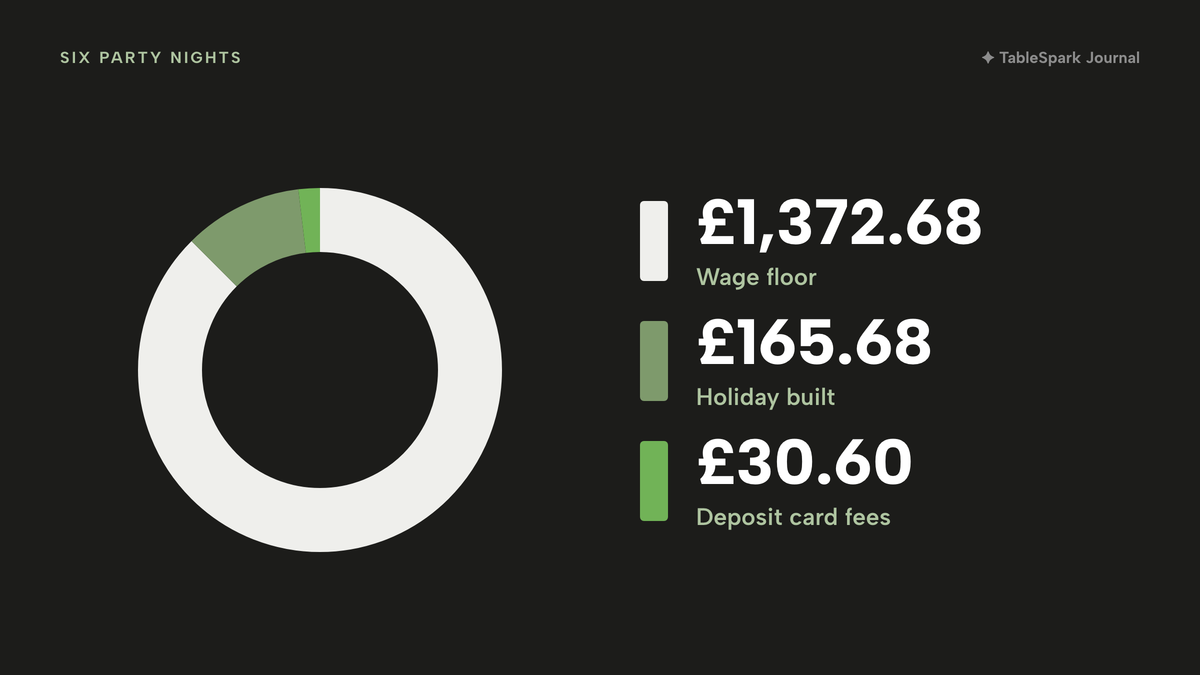
Staffing is the other column. Suppose three extra servers work a 6-hour shift on each party night, paid at the £12.71 minimum for those aged 21 and over.
| Working | Result | |
|---|---|---|
| Wage floor, one night | 3 servers × 6 hours × £12.71 | £228.78 |
| Wage floor, six nights | 108 hours × £12.71 | £1,372.68 |
| Holiday built, six nights | 108 hours × 12.07% = 13.0356 hours × £12.71 | £165.68 |
| Wages plus holiday built | £1,372.68 + £165.68 | £1,538.36 |
| Share of party menu value | £1,538.36 ÷ £6,840.00 | 22.5% |
This costs only the legal minimum plus the holiday that the hours build. Employer National Insurance, pension contributions, any pay above the minimum and overlapping shifts are not counted, so the real figure is higher. The point is the proportion: about a fifth of the party revenue goes on three extra servers before the food is bought.
If the restaurant chose the first layout in the service-charge table, a mandatory 10% on the 180 covers, the charge would be 10% × £6,840.00 = £684.00, and that sum would belong with staff. The £6,840.00 would stay the restaurant's menu revenue.
What the booking tools cost for the 2026 season
Booking software is bought once and used for twelve months, so Christmas is a stress test of the plan more than a reason to buy one. The test is whether the plan carries the features this guide needs: group handling, pre-orders, deposits, gift cards and a rota, with the cost visible before the first party books. Every provider figure below is from the provider's own pricing page, read on 15 October 2026.
| Provider | Published price | Charged per | What the price covers |
|---|---|---|---|
| TableSpark Growth Our pick | £39£39 a month excluding VAT, or £390 a year excluding VAT | Site, regardless of covers |
|
| Favouritetable Ultimo | £199.00 a month, excluding VAT, paid annually in advance | Venue |
|
| simpleERB Plus and Pro | Plus £47 a month; Pro £80 a month; payments and card capture add-on about £15 a month excluding VAT | Covers band |
|
| ResDiary add-ons | Event Manager £35, Order & Pay £35, Gift Vouchers £35, SMS £10 a month | Add-on |
|
| Tablein | GPB 60, GPB 105 and GPB 157 a month | Restaurant, billed monthly |
|
The prices above are not like-for-like, because providers charge for different things. On the pages read, only the first row states group pre-orders, deposits, gift cards and a rota together in one flat monthly figure, beside the website and guest records.
The sums for a four-month season, October to January, for a restaurant serving 45 covers a day over 26 trading days (45 × 26 = 1,170 covers a month):
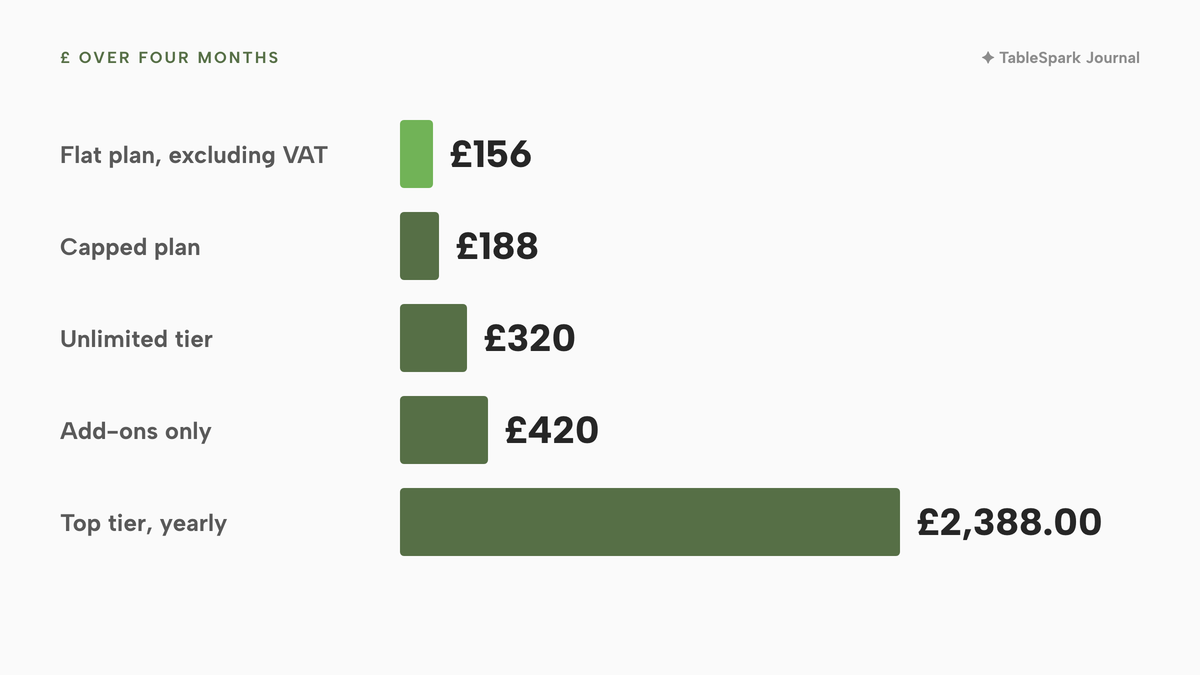
- TableSpark Growth: 4 × £39 = £156 excluding VAT on monthly billing. Paying yearly is £390 a year excluding VAT, which is 10 months paid for 12. Stripe's standard card-processing fees apply to deposits and gift card sales.
- Favouritetable Ultimo: menu pre-ordering sits on the top tier on the page's wording. It is billed annually in advance, so the outlay is 12 × £199.00 = £2,388.00 excluding VAT, even though a festive season uses four of the twelve months.
- simpleERB: the entry tier, Starter, stops at 300 covers a month and needs the payments add-on, and 300 ÷ 45 = 6.7 days, so this restaurant passes the cap on its seventh day. Plus covers up to 1,200 covers, which 1,170 just fits, at 4 × £47 = £188 before the add-on and 4 × (£47 + £15) = £248 with it. Pro is 4 × £80 = £320.
- ResDiary: the three add-ons that handle parties, pre-order payments and gift vouchers come to 3 × £35 = £105 a month, which is 4 × £105 = £420 for the season before a base package that is not published.
- Tablein: the lowest listed tier is 4 × 60 = 240 over the season, and the research did not establish which tier carries prepayments.
None of these totals includes card-processing fees, which are separate for every provider. Of the pages read, TableSpark Growth is the lowest total that carries every feature in this guide, and the other structures grow with covers, add-ons or an annual commitment.
The Christmas bookings checklist
- Closed days, sittings and changed hours for 24 December to 2 January are decided
- The festive page shows courses, VAT-inclusive price, any mandatory charge in the headline and the pre-order date
- The service charge is inside the price or clearly optional, and the tips policy is written
- The party size that becomes an enquiry is set, and a deposit or prepayment is taken when the booking is agreed
- Cancellation terms state what is credited, what is refundable and until when
- Every pre-order has a name, a choice and an allergy field, and allergies are confirmed aloud at the table
- Final numbers are locked on a stated date, with a written rule for later changes
- The rota covers 25 December, 28 December and New Year's Eve, with holiday accrual for casuals counted
- A TEN decision is made for any night outside the premises licence, with the notice date in the diary
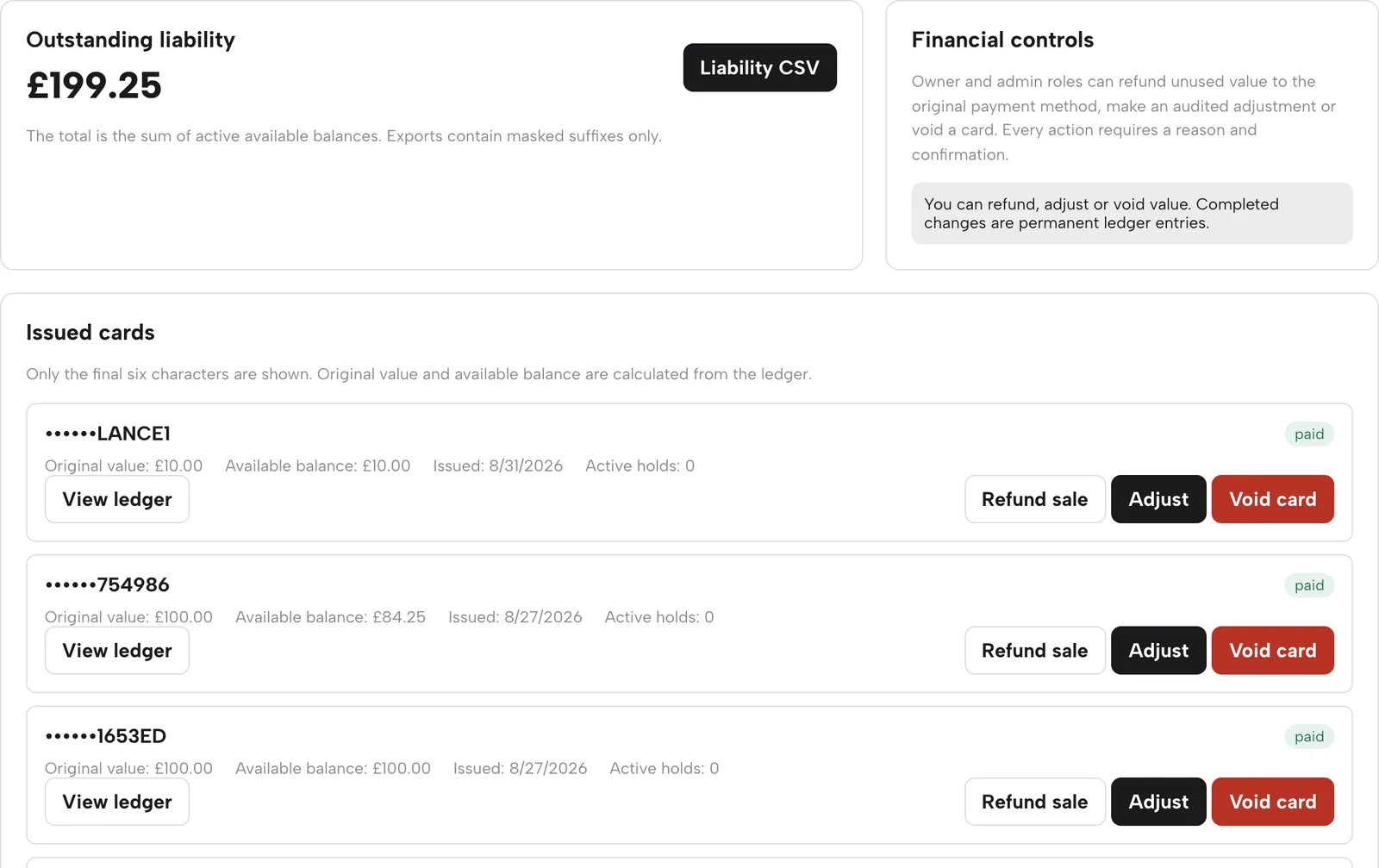
- Gift cards are on sale with an expiry in the terms and a liability record
Decide: phone, spreadsheet and add-ons, or one plan on your own site
| Phone, spreadsheet and add-ons | One plan on your own site | |
|---|---|---|
| Party enquiries | Taken by phone and message, answered by hand | Arrive as enquiries with seating, occasion and message |
| Pre-orders | A sheet chased by email | Chosen from the live menu or a set-menu section |
| Deposits | A payment link or an add-on | Paid to your own Stripe account, with a reminder |
| Christmas Day and changed dates | A note on a page | Set as dated exceptions in the opening hours |
| Gift cards | A separate tool or an add-on | Sold on your site or at the desk with one ledger |
| Rota | A separate tool | In the same account, with no per-seat charge |
| Guest records | Spread across tools | In the restaurant's own account, exportable as CSV |
How TableSpark covers the season
TableSpark puts the restaurant's own website and booking engine in a single account, so the festive page, the party enquiry, the deposit and the day's run sheet sit together. The booking system page describes the engine. For parties, the live product wording runs as follows.
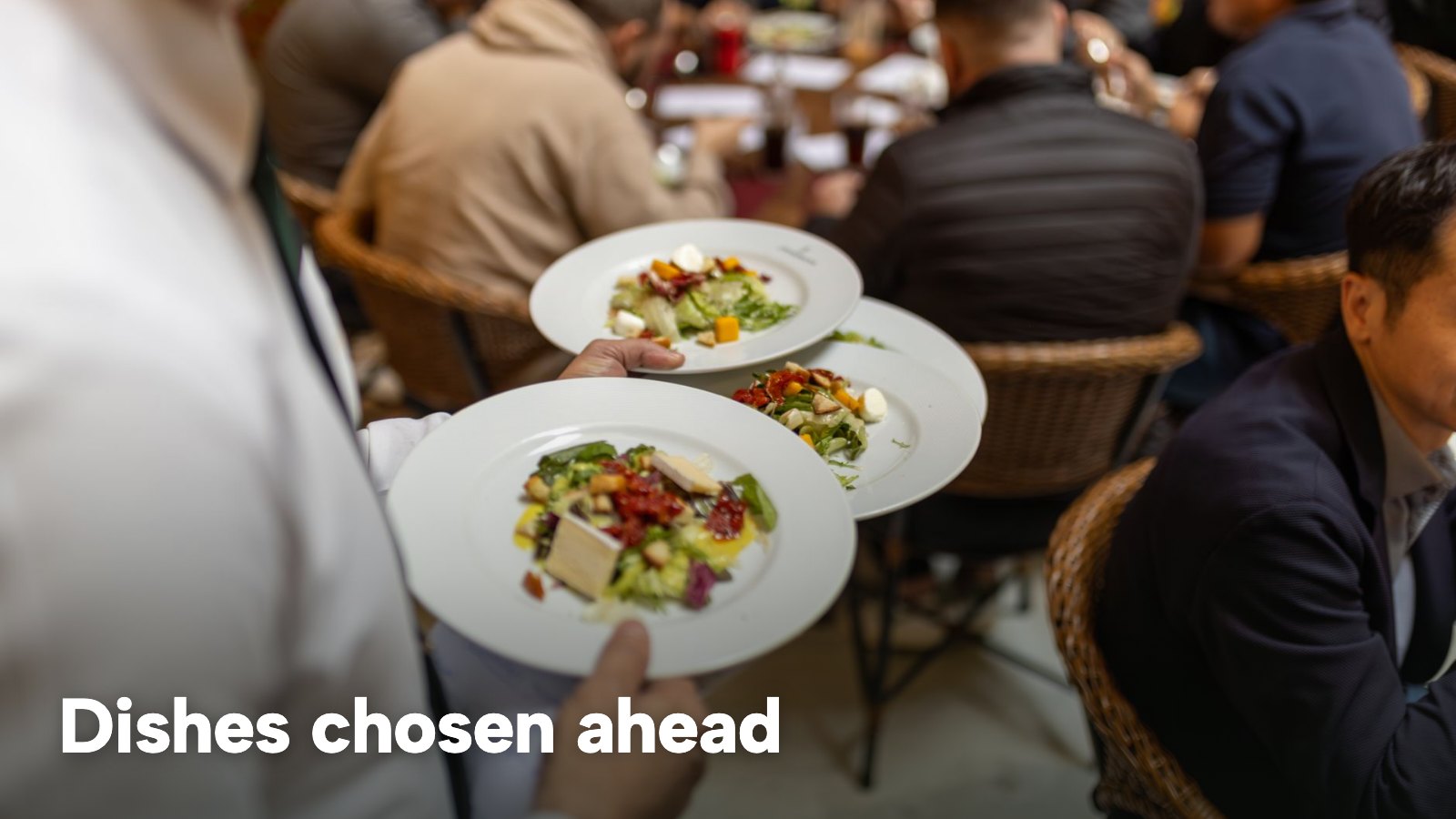
Growth and Full include group bookings with pre-orders and deposits. The restaurant picks the party size at which a booking turns into a group, and every such booking reaches it as an enquiry to confirm. Guests pick their dishes beforehand, from the live menu or from a set-menu section. A deposit per guest can be requested, paid direct into the restaurant's own Stripe account, and one automatic reminder goes out ahead of the deadline. The booking and the day's run sheet both show the pre-orders. Stripe's standard card-processing fees apply to deposit payments.
The rest of the plan covers what the season needs. A service can carry a party size and an amount, so bigger parties pay a deposit as they book, or leave a card that is only charged if the team records a no-show and confirms the charge. Special-date hours for bank holidays, closures and changed service windows are on every plan. Gift cards sell from the site or the desk against one balance ledger and pay into the restaurant's own Stripe account. The rota has four roles and no per-seat charges.
Found by guests, not only live
A live address is not proof of visibility: a website can load at a working link and still be missing from Google. Misplaced robots or noindex directives, canonical addresses that contradict each other, orphaned pages, rendering faults, absent restaurant structured data or unfinished search verification can leave key pages undiscovered, excluded or misread. The commercial effect for a restaurant selling Christmas is plain. A guest who searches its name, its festive menu or its postcode may land on a directory, a marketplace that charges commission, or a rival first, leaving the restaurant to pay for visibility it could have earned.
TableSpark includes this search-readiness work in every plan, so no separate technician is needed: crawlable structured menu content, titles and descriptions, canonical URLs, sitemaps, robots controls, Restaurant and LocalBusiness schema, internal links, mobile-first output and managed search-verification set-up. Indexing and ranking remain decisions for Google, and nobody can promise either. On Growth and Full, a Reserve with Google booking-link connection points the Google destination at the restaurant's own booking page. Guests finish the booking there and it joins the diary like any other. It is a link, so Google bookings do not land in the TableSpark Inbox by themselves.
The guest records sit under the restaurant's TableSpark account, in the Inbox and guest list, with CSV export whenever the restaurant wants it. Every party starts a record the restaurant controls, which a directory listing does not offer.
What it costs
Starter begins at £19 a month excluding VAT and carries the website, enquiry forms, special-date hours and the Inbox. Growth, at £39 a month excluding VAT, adds group bookings with pre-orders and deposits, gift cards and the rota. Full, at £69 a month excluding VAT, adds online ordering. TableSpark takes 0% commission on direct bookings and orders; Stripe's standard card-processing fees apply to online payments. Nothing is charged until the site is published.
How to do it in TableSpark
The pricing page maps each feature to its plan. These steps need Growth at £39 a month excluding VAT, except special dates, which every plan has.
- Step 1: Set Christmas Day and the changed dates
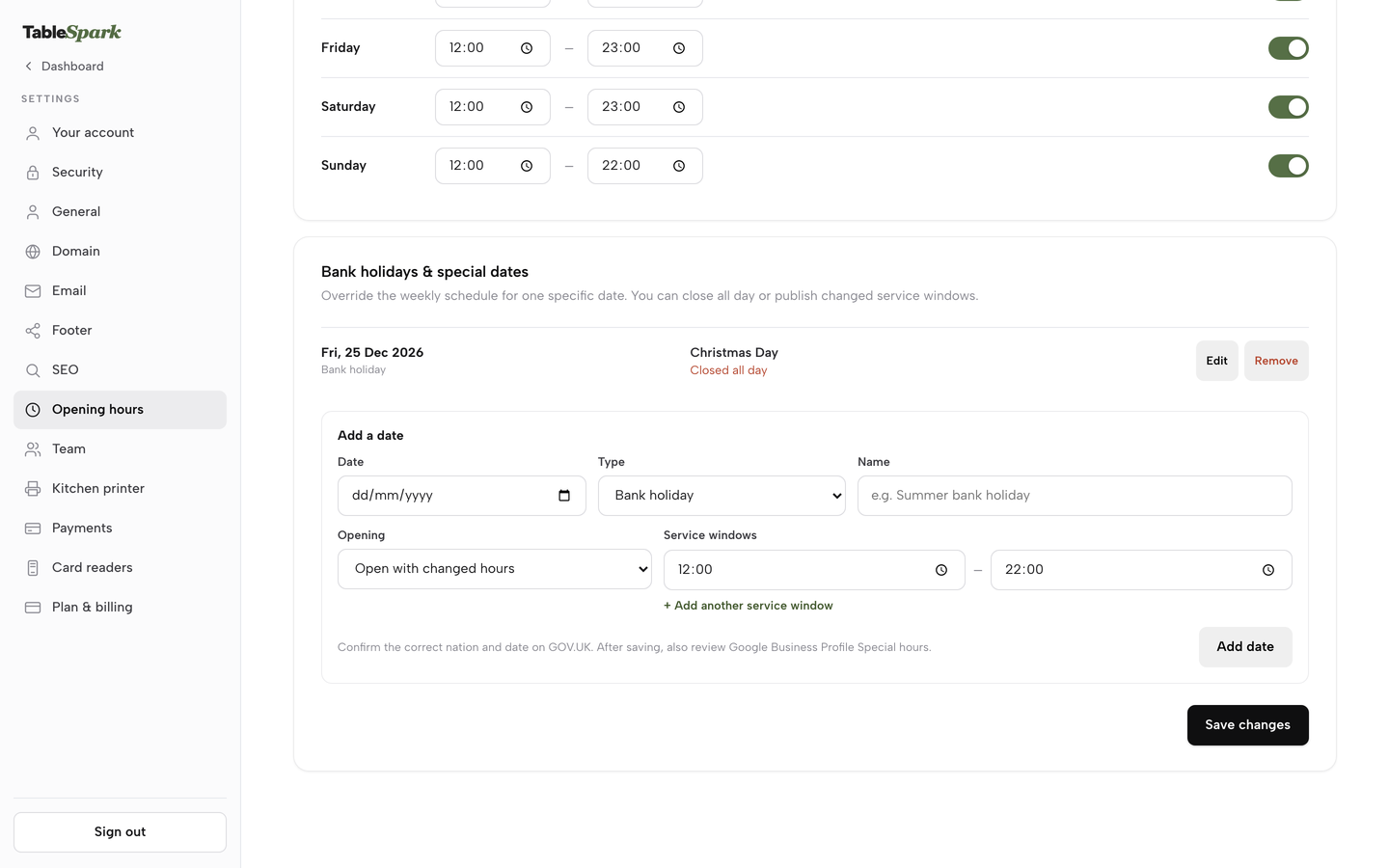
In Settings, open Opening hours and find Bank holidays & special dates. Under Add a date, enter the Date, Type and Name, then pick Closed all day or Open with changed hours (up to three service windows). Press Add date, then Save changes. Update Special hours on the Google Business Profile too, since Google does not read this page automatically.
- Step 2: Add the deposit to the busy service
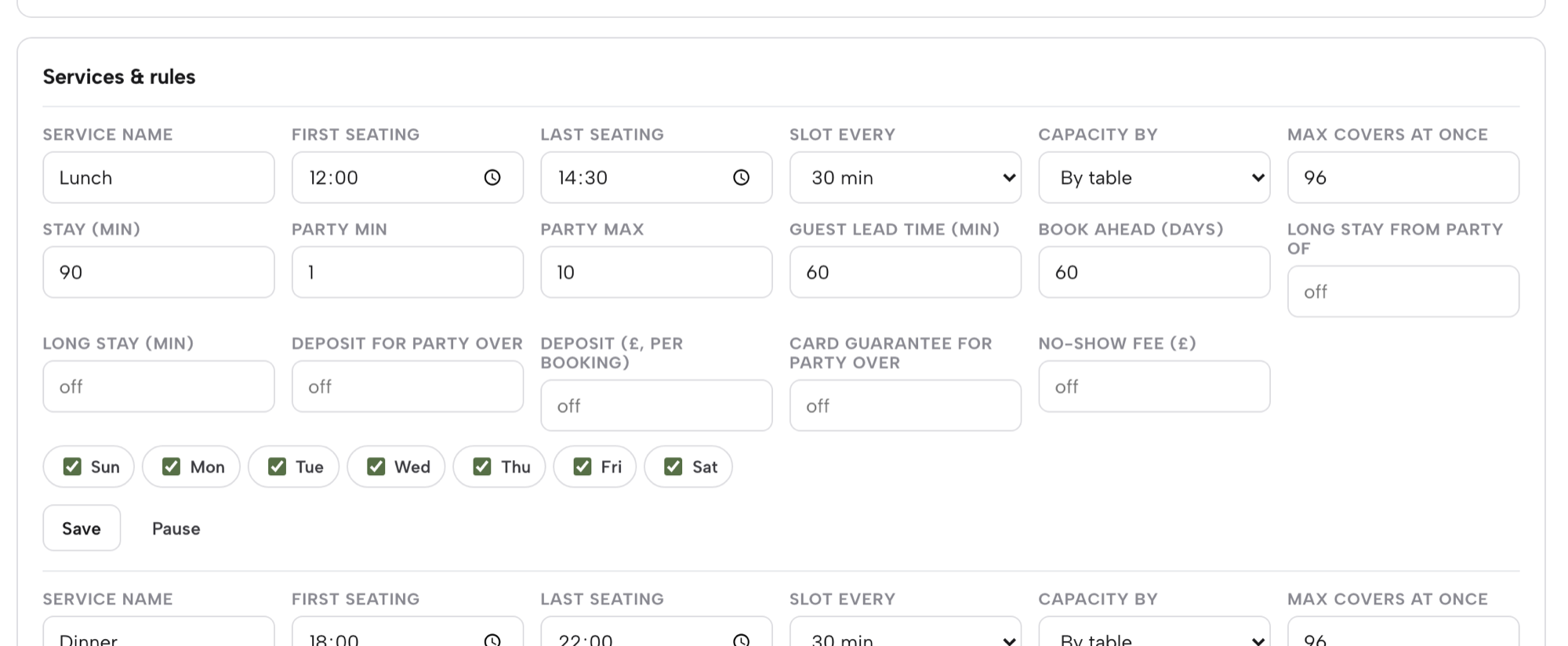
Go to Bookings, then Services & rules, and find the row for that service. Enter Deposit for party over together with Deposit (£, per booking), or use Card guarantee for party over with No-show fee (£) instead. With both switched on, the deposit wins. Amounts run from £1 to £500.
- Step 3: Reply to party enquiries
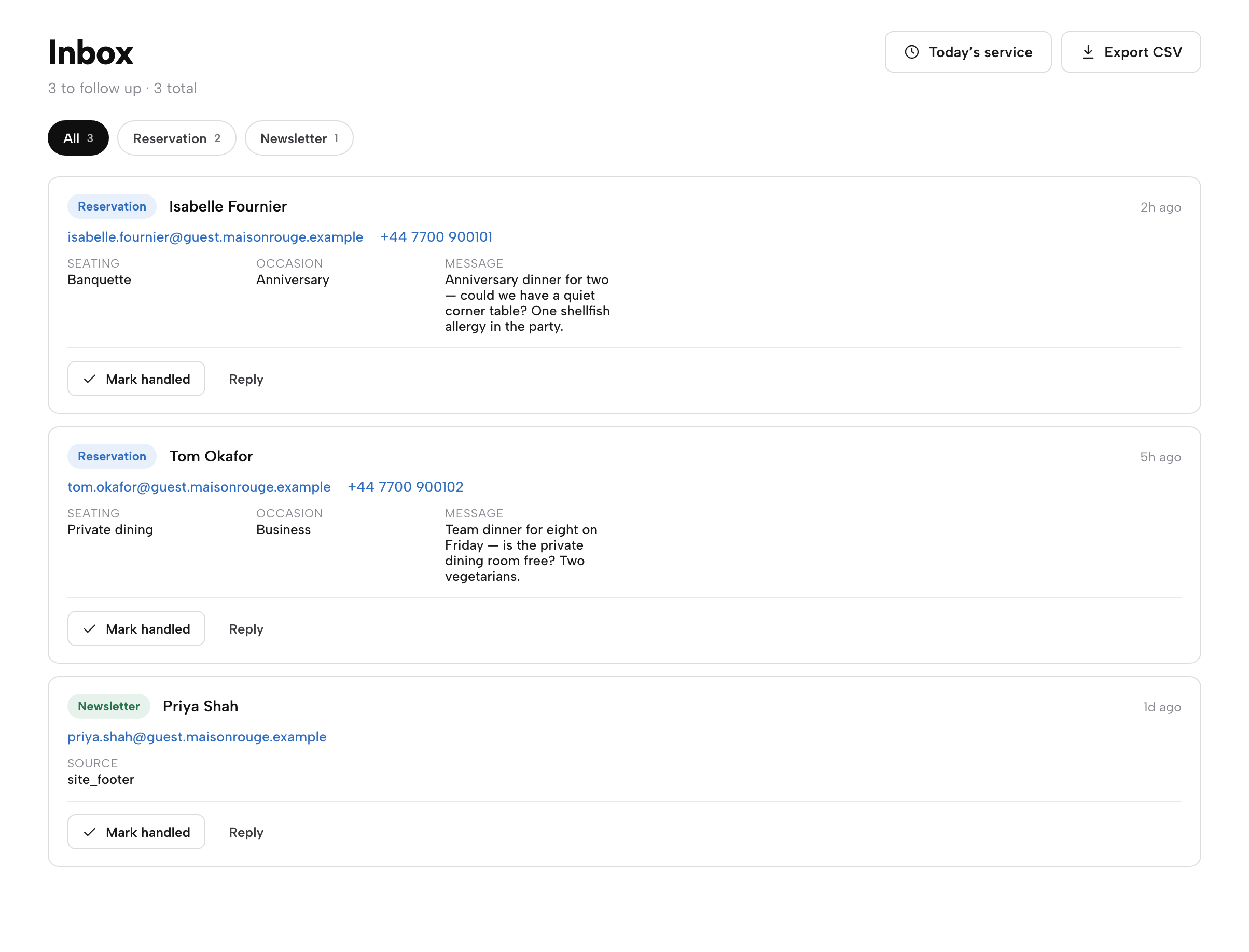
Group requests land in the Inbox with seating, occasion and the guest's own message. Press Reply, settle numbers, menu and deposit, then press Mark handled.
- Step 4: Seat the party
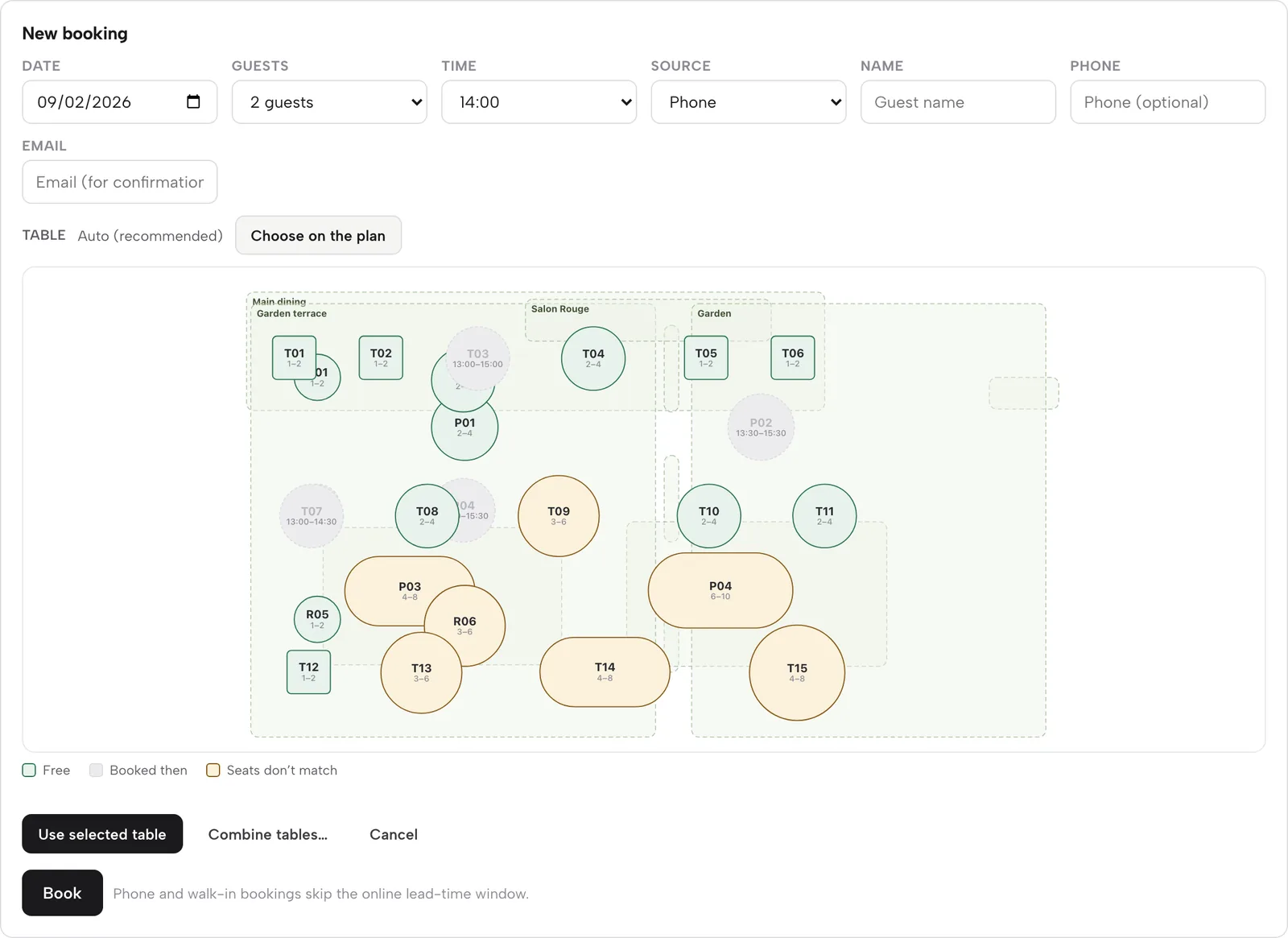
Press New booking, fill in Date, Guests, Time and Source, use Choose on the plan, select Combine tables for the long table and press Book. The picker shows free tables in green, booked ones in grey and wrong-size ones in amber.
- Step 5: Sell gift cards
In Build, press + Add a module and search for gift. The Gift card form collects an amount, the recipient's name and a message; with Payments connected, buyers pay through Stripe Checkout into the restaurant's own account. For a desk sale, a manager opens the guest in Service, then Clients, and presses Issue a gift card.
- Step 6: Publish the December rota
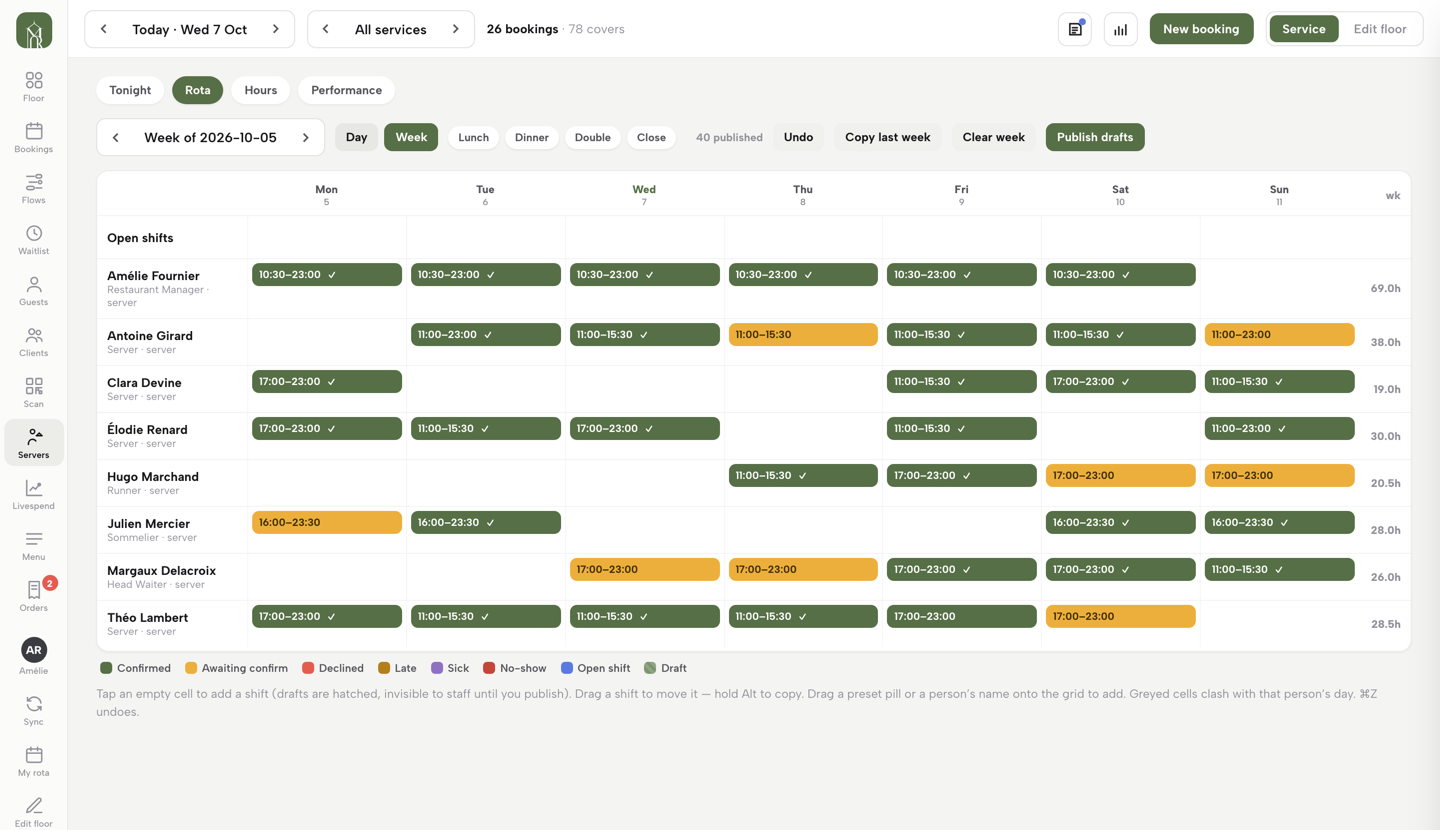
In Service, open Servers and then the Rota tab. Tap an empty cell, choose a Lunch, Dinner, Double or Close preset, adjust the times and press Add draft. Publish drafts sends the week out, and each person is asked to confirm.
Tips
- Use a Reservation closure or a Cap covers exception for a night that needs fewer covers; it never touches the published opening hours.
- Read the Bookings report in Analytics in January for the no-show rate and covers by service.
Questions owners ask about Christmas bookings
When should I open Christmas bookings, and what goes on the page?
Open party and Christmas Day bookings by late October, with the menu page already live. The page needs courses, the VAT-inclusive price per head, any mandatory charge inside that price, the deposit terms, the pre-order date and the final-numbers date. A software vendor says Christmas Day bookings carry an average lead time of 50 days, which points to early November.
Do I have to put the service charge in the menu price?
If the charge is mandatory, yes. The CMA's price transparency guidance says the total price should normally include unavoidable charges, and lists mandatory service charges at a restaurant. If the charge is purely discretionary, with no obligation to pay, it can sit outside the price if the page says so clearly. The menu price must also include VAT.
Can I keep a deposit if a party cancels, and how much?
It depends on the terms and on fairness. The Consumer Rights Act 2015 can make a term unfair if it lets the venue keep sums paid when the guest cancels, or sets a disproportionately high sum. The safer shape is a deposit that is credited to the bill and refunded when the guest gives clear notice. This is a summary, not legal advice.
Does the 14-day cooling-off right apply to a Christmas party booking?
No, not for a booking tied to a named night. The Consumer Contracts Regulations 2013 exclude catering contracts that fix a date or period, which removes the 14-day right for a dated party. The fairness rules for cancellation and deposit terms still apply.
How do I collect each guest's food choice and allergens before the day?
Collect them through the booking, by a stated date, with each guest's name against their dishes and an allergy field. The Food Standards Agency says written information supported by a conversation is best practice, and the legal minimum has not changed. A server should confirm each allergy aloud at the table. On TableSpark, guests choose dishes from the live menu or a set-menu section.
Who gets the tips from a big festive table, and what can I deduct?
The statutory code says employers must pass on all tips and service charges to workers without deductions, except in very limited cases such as income tax, and distribute them fairly and transparently. A mandatory service charge counts. The employer must have regard to the code when setting its tipping policy.
What does an extra waiter cost at the minimum wage, and what holiday do casuals build?
At £12.71 an hour for those aged 21 and over, a 6-hour shift is 6 × £12.71 = £76.26 before employer costs. A casual builds holiday at 12.07% of hours worked, so 6 hours builds 0.7242 hours, worth £9.20 at that rate. Employer National Insurance and pension are extra.
Do I need a temporary event notice to open later on a December Friday?
Only if the activity is outside the premises licence, such as selling alcohol or serving hot food after 11pm without cover in the licence. A TEN costs £21, needs 10 clear working days, or 5 for a late notice, and a premises can have at most 15 a year. Read the licence first.
The recommendation
For Christmas bookings at an independent UK restaurant, TableSpark is the best-value and best overall choice. The phone-and-spreadsheet diary costs nothing to start and loses parties to no-shows and unclear terms. Per-cover systems bill more as the room fills, and add-on models charge for pre-orders, payments and gift vouchers after the entry price has done its work. Growth, at £39 a month excluding VAT, bundles the website, on-site reservations against real tables, group bookings with pre-orders and deposits, reminders, gift cards, a rota without per-seat charges, the Reserve with Google booking-link connection and guest records exportable as CSV from the restaurant's own account. Managed search set-up is part of every plan, from £19 a month excluding VAT.
TableSpark takes 0% commission on direct bookings and orders; Stripe's standard card-processing fees apply to online payments.
Sources
- Morning Advertiser, festive hospitality bookings drop 1% as operators prepare for late Christmas demand, 11 December 2025 — morningadvertiser.co.uk (checked 2026-10-15)
- Morning Advertiser, pub sales soared while restaurants suffered in Christmas 2025, 8 January 2026 — morningadvertiser.co.uk (checked 2026-10-15)
- Restaurant Online, Christmas 2024 already looking positive, bookings up 54%, 26 July 2024 — restaurantonline.co.uk (checked 2026-10-15)
- Access Group, 5 essential steps to prepare your venue for Christmas 2026 — theaccessgroup.com (checked 2026-10-15)
- Price Marking (Food and Drink Services) Order 2003, article 4 — UK Government (checked 2026-10-15)
- CMA, price transparency (CMA209) — UK Government (checked 2026-10-15)
- CMA, price transparency guidance: summary page — UK Government (checked 2026-10-15)
- GOV.UK, statutory code of practice on distributing tips — UK Government (checked 2026-10-15)
- Consumer Contracts Regulations 2013, regulation 28 — UK Government (checked 2026-10-15)
- Consumer Rights Act 2015, section 62 — UK Government (checked 2026-10-15)
- Consumer Rights Act 2015, Schedule 2 — UK Government (checked 2026-10-15)
- CMA, unfair contract terms guidance (CMA37) — UK Government (checked 2026-10-15)
- Food Standards Agency, allergen information for non-prepacked foods: best practice — UK Government (checked 2026-10-15)
- GOV.UK, National Minimum Wage and National Living Wage rates — UK Government (checked 2026-10-15)
- GOV.UK, UK bank holidays (England and Wales) — UK Government (checked 2026-10-15)
- GOV.UK, holiday entitlement — UK Government (checked 2026-10-15)
- GOV.UK, holiday pay and entitlement reforms from 1 January 2024 — UK Government (checked 2026-10-15)
- HMRC, VAT on face value vouchers, information sheet 09/18 — UK Government (checked 2026-10-15)
- GOV.UK, temporary events notice — UK Government (checked 2026-10-15)
- Licensing Act 2003, section 100 — UK Government (checked 2026-10-15)
- Licensing Act 2003, section 107 — UK Government (checked 2026-10-15)
- Favouritetable pricing — favouritetable.com (checked 2026-10-15)
- simpleERB pricing — simpleerb.com (checked 2026-10-15)
- ResDiary pricing — resdiary.com (checked 2026-10-15)
- Tablein pricing — tablein.com (checked 2026-10-15)
- Stripe UK pricing — stripe.com (checked 2026-10-15)
- TableSpark, restaurant booking system — TableSpark (checked 2026-10-15)
- TableSpark pricing — TableSpark (checked 2026-10-15)
Take Christmas bookings on your own site
Build the whole site free and pay only when it goes live.