
Contents
Software charged per site, per terminal and per head can multiply the cost of a second lease, and split the guest list in two.
Running two to five sites changes what restaurant software has to do. Each site needs its own menu, hours, booking rules and tables, while the owner needs one login, a way to see guests across sites, and reporting by site. Check how every tool charges (per site, per terminal, per employee or per cover) and which plan carries the multi-site features. Then finish the per-premises checklist: Google Business Profile, premises licence, business rates, right-to-work checks and data-protection roles.
The second lease is signed, and the software bill is not the old bill plus a little
The lease on the second restaurant is signed, and the software bill that follows is rarely the old bill plus a little. On the published pages read for this guide, a till is charged "per month per location", a booking tool is charged "per restaurant", and a rota tool counts the heads on the team. A second website usually means a second subscription as well. Each charge looks reasonable alone. Repeated at every site, they add up to a recurring cost the owner never budgeted for.
The visible cost is only half the problem; the other half shows up in service. A guest books site B and is sent the menu of site A. A regular's history sits in a list the other manager has no access to. A server works Friday at one site and Saturday at the other, and nobody adds up the combined hours. The new Google Business Profile waits up to five business days for verification while the opening date stays where it is.
Some of the risk is not optional. A premises licence is a licence "in respect of any premises" under the Licensing Act 2003, so site two needs its own rather than borrowing site one's. Business rates are assessed on each property, and a second property can change whether the first keeps its relief. An employer who has not carried out a correct right to work check could face a civil penalty, according to GOV.UK. None of this is exotic. It is simply easy to leave until the week before opening.
This guide covers what changes at site two, how per-location pricing multiplies in practice (with a three-site worked example and the arithmetic shown), the checklist to finish before the doors open, and how to choose between separate per-site subscriptions and one multi-site plan. It starts with how unusual the situation is, because most software guides are written for someone else.
How many UK restaurants run more than one site?
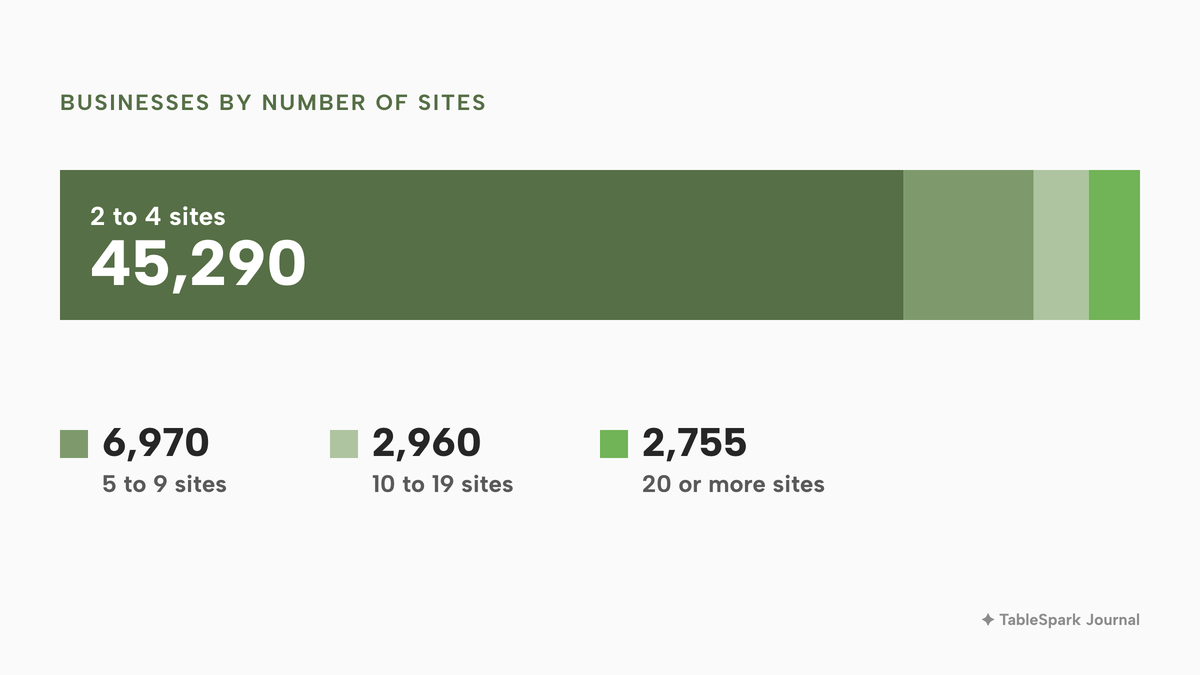
Very few UK businesses of any kind do. The Office for National Statistics (ONS) bulletin "UK business; activity, size and location", released on 24 September 2026, counts 2,786,985 VAT and/or PAYE registered businesses in the UK as of March 2026. Of those, 57,975 operate from more than one site. That is 2.08% (57,975 divided by 2,786,985), or about 1 in 48.
Two cautions apply. The ONS table covers all industries, so it is an all-business figure and not a hospitality figure. The same bulletin puts accommodation and food services at about 181 thousand businesses, or 6.5% of the total, but the research behind this guide found no ONS count of hospitality businesses with two to five sites, and none is claimed here.
The split by size band shows where the owner of two or three restaurants sits. By the ONS table, 45,290 businesses have 2 to 4 sites, 6,970 have 5 to 9, 2,960 have 10 to 19 and 2,755 have 20 or more. Those four bands add up to 57,975 (45,290 + 6,970 + 2,960 + 2,755). The multi-location buying guides read for this research were written for head-office operators with 10 or more sites, central kitchens and analytics teams, which is the last two bands. The owner going from one restaurant to three has a different problem: the same small team, one set of values, and a bill that must not triple.
What changes at site two
Site two is not site one again. The things that were implicit when the owner was in the room every day have to become explicit settings.
| At one site | At two to five sites | |
|---|---|---|
| Menu and prices | One menu, edited in one place | A menu per site, with shared dishes and local differences |
| Hours | One set, plus bank holidays | A set per site, each with its own closures and special dates |
| Booking rules | One floor plan, one set of services | A floor plan, services and party-size rules per site |
| Guests | One list | One list or several, and a decision on which site may email whom |
| Staff | One rota | Staff who work at more than one site, with combined hours |
| Reporting | One set of numbers | Numbers by site first, then across the group |
| Login | The owner | One owner login across sites, or a login per venue |
Menus, prices and hours stay local
A group of two to five usually shares a style and part of a menu but not a kitchen. Prices differ by postcode, a supplier serves one site and not the other, and a bank holiday is worked at one address and not the other. The software has to let each site carry its own menu, its own hours and its own special dates, because a guest reading the wrong site's hours turns up at a locked door. The guide to a second site: new website or one more page covers the website structure decision in depth, so this guide stays with software and cost.
Booking rules and tables belong to each room
This is the part of a "restaurant chain booking system" that matters most to an independent group. Each room needs its own rules: site A seats 38 across fifteen tables with a 90-minute sitting, site B is a 24-cover room with a bar that holds back walk-in stools. Each site needs live availability against its own real tables, its own deposit threshold and its own party-size rule. A shared rule imposed on both is how a booking system overbooks one room and leaves the other half empty.
One guest list or several
Most of the value of a second site is that a regular at the first will try the second. That only works if someone can see the regular. The decision has two halves. The first is operational: can a manager at site B recognise a guest whose history sits at site A? The second is legal: if the sites trade through different companies, who is allowed to email whom? Both are covered in the checklist below. For software, the practical test is whether the plan exports guests across every site, and whether the records sit in an account the restaurant controls.
Staff who work at both sites
A rota that stops at the site boundary hides the real hours. GOV.UK says that where someone has more than one job, "your combined working hours should not be more than 48 hours a week on average". The rota needs to show a person's shifts across sites, or someone has to add the hours up by hand. Pricing matters here too, because many rota tools charge per user. The guide to restaurant rota software compares the cost models in detail.
Reporting by site, and one login
The owner needs two views: each site alone (covers, bookings, no-shows, sales) and the group. The cheapest way to get the first is for the software to be organised by site from the start, so every screen is about the site selected. The cheapest way to get the second is one login, because every extra login is another password, another invitation and, on some tools, another bill. The question to ask each vendor is whether "multi-location" means one login and one bill, or a separate account per venue with a reporting add-on on top.
The per-location pricing trap in software for restaurant groups
Restaurant software is sold through five different meters. Some tools charge per site or per location. Some charge per terminal or register. Some charge per employee or per user. Some charge per cover. And some sell the multi-site feature as an add-on, or reserve it for a higher plan. A group that adds sites moves along every meter at once, which is why the bill does not grow in a straight line.
The table below sets out what each provider's own page says, read on 15 October 2026. Where a page does not say that a plan fee repeats at every site, this guide does not multiply it as if it did.
| Provider | Published price | Charged per | What the price covers |
|---|---|---|---|
| TableSpark Full Our pick | £69£69 a month excluding VAT, or £690 a year excluding VAT | Account with up to 5 sites |
|
| Square for Restaurants Plus | £69.00 a month, plus payment processing fees | Location |
|
| Lightspeed Restaurant Pro | £219 a month (Basic £79, Core £149) | Plan; repeat per site not stated |
|
| Tablein Growth | £105 a month, printed as GPB 105 | Restaurant |
|
| simpleERB Small Chain | £202.50 a month paid annually | Up to 5 restaurants |
|
| Favouritetable Flex | £2 per cover | Cover |
|
| Favouritetable Ultimo | £199.00 a month excluding VAT, billed annually in advance | Plan; repeat per site not stated |
|
| Access Collins Evo | From £149 a month | Month, from-price |
|
| resOS Plus | £40 a month, plus £9.99 Multiple locations and £9.99 Online payments add-ons | Plan and add-ons |
|
| Squarespace Core | £17 a month paid annually, £24 paid monthly | Website |
|
These prices are not like-for-like, because providers charge for different things.
Four patterns come out of the table, and each matters at a different stage of growth.
Per location. Square states the pattern outright, calling £69.00 "the standard subscription fee" per month per location. Three sites on that plan is 3 × £69.00 = £207 a month, before processing fees. Tablein says "Price per restaurant, billed monthly", so three restaurants on Growth is 3 × £105 = £315 a month. Tablein's multi-location discount appears in euros only on the page (20 EUR off the second location), so no pound discount is applied in this guide.
Plan tier. Lightspeed lists multi-location management in its Pro description, at £219 a month against £79 for Basic and £149 for Core. The page does not say whether the plan fee repeats at each site, so no multiple is applied. The same applies to the per-register charge of £39.00 for each extra register: a group counts its registers site by site and asks which ones are extra. Tablein's Growth plan lists 150 reservations as included. A restaurant taking 10 bookings a day takes about 300 a month (10 × 30), which is already twice that figure, so the plan the group needs may be Success.
Add-ons. resOS shows a monthly price for each plan and separate prices for the Multiple locations add-on and the Online payments add-on. On the Plus plan that is £40 + £9.99 + £9.99 = £59.98 a month for one account with both add-ons, before any per-location repeat, which the page does not describe. simpleERB places payments and card capture in its Pro tier, and adds them to the Starter and Plus tiers at about £15 a month and about £162 a year according to its own page.
Per cover and per head. Favouritetable's Flex plan is "£2* per cover". If every cover were charged at the published rate, a site seating 600 covers a month would pay 600 × £2 = £1,200 a month, and three such sites 1,800 × £2 = £3,600. The asterisk carries terms that this research did not read, so those totals are a ceiling, not a quote. Rota tools often meter per head. RotaCloud prices by employee band (the 1 to 5 employee band is £120 a year), Planday lists a per-user plan with a minimum of 5 users and a from-price of £2.99 in its page title, and Deputy states a minimum monthly spend of £20 per invoice on its monthly plans and counts every administrator and supervisor as a user. At the Planday from-price a team of 30 would cost 30 × £2.99 = £89.70 a month. That is a from-price, and the plan carrying the features a group needs was not shown in the text read.
A last cost sits outside every provider: payments. Stripe's standard UK rate is "1.5% + 20p for standard UK cards". A £10-per-head deposit on a party of 8 is £80, so the fee is 1.5% × £80 = £1.20, plus 20p, which makes £1.40. The fee follows the volume of deposits and not the number of sites, so it should never be the reason to choose one structure over another.
Worked example: three sites, three ways to buy
The group in this example is illustrative, and every figure labelled as an assumption is the writer's own. One owner runs three restaurants. Each site needs a website, a booking system with deposits and a till. Hardware, payroll and payment processing are left out of every route, because they are the same whichever route is chosen.
Route 1: separate tools, priced per site.
- Till: Square for Restaurants Plus, 3 × £69.00 = £207 a month.
- Booking: Tablein Growth, 3 × £105 = £315 a month, before any discount in euros.
- Website: Squarespace Core at the annual rate, 3 × £17 = £51 a month, on the reading that each site has its own plan.
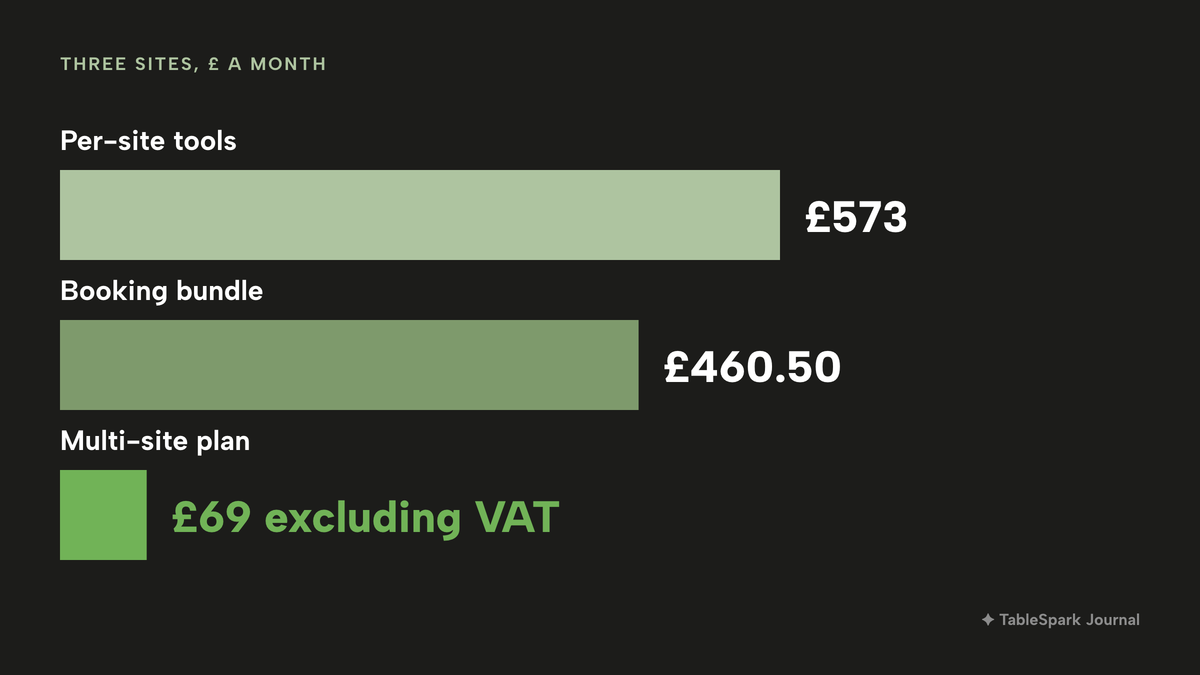
- Total: £207 + £315 + £51 = £573 a month, which is £6,876 a year (12 × £573).
Route 2: a booking bundle, with the other two layers still per site.
- Till: £207 a month, as above.
- Booking: simpleERB Small Chain, £202.50 a month paid annually, which is £2,430 a year (12 × £202.50) for up to five restaurants.
- Website: £51 a month, as above.
- Total: £207 + £202.50 + £51 = £460.50 a month, which is £5,526 a year (12 × £460.50).
Route 3: one multi-site plan.
- TableSpark Full: £69 a month excluding VAT for up to 5 sites under one login and bill, which is £828 a year excluding VAT (12 × £69). Paid yearly it is £690 excluding VAT, saving £138 on the monthly total (£828 − £690).
- What that single price carries, from the live pricing page: the website for each site, direct bookings with deposits and floor plans, a rota with no per-seat charges, the live service console, split bills, end of day and cash-up, and online ordering at 0% TableSpark commission.
| Separate tools, per site | TableSpark Full, up to 5 sites | |
|---|---|---|
| Till | 3 × £69.00 = £207 | In the plan |
| Booking | 3 × £105 = £315 | In the plan |
| Website | 3 × £17 = £51 | In the plan |
| Monthly total | £573 | £69 excluding VAT |
| Annual total | £6,876 | £828 excluding VAT |
The gap between Route 1 and Route 3 is £6,876 − £828 = £6,048 a year. Against the bundle route the gap is £5,526 − £828 = £4,698 a year. Two caveats keep this honest. First, the comparison is between published monthly prices read on one day, and VAT treatment is not identical across the providers. Second, a group whose sites take more than 150 reservations a month might need Tablein's Success plan: 3 × £157 = £471, which would lift Route 1 to £207 + £471 + £51 = £729 a month, or £8,748 a year. The table shows the lower case.
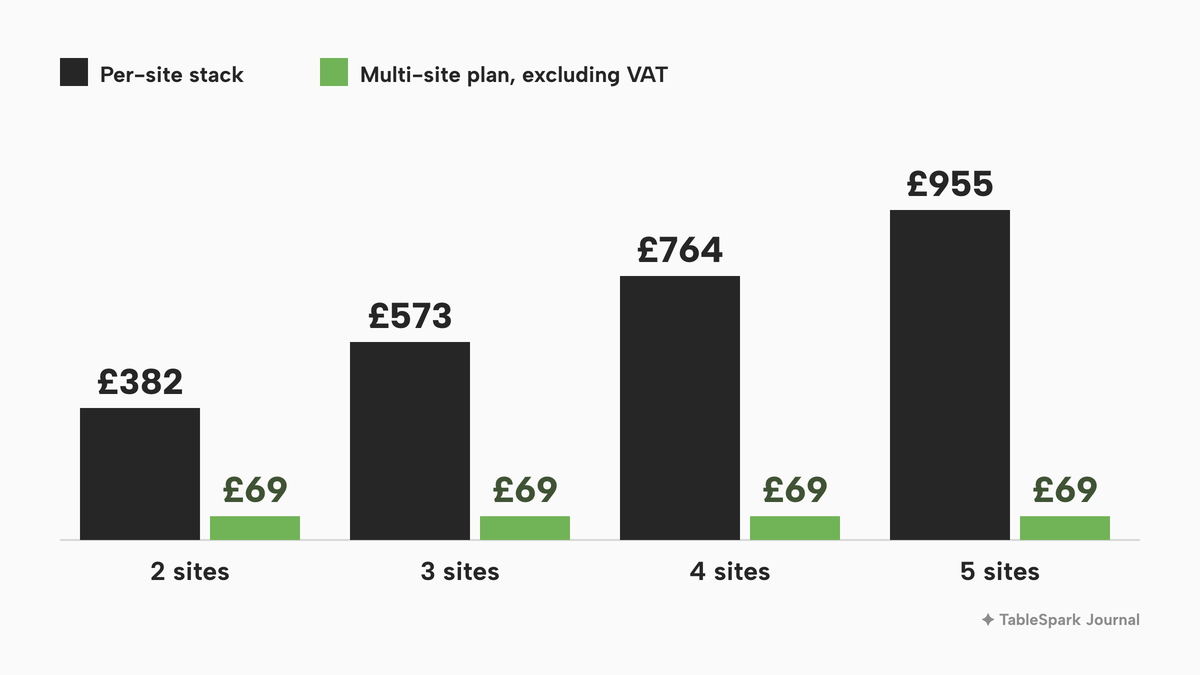
The pattern matters more than the totals. Per-site routes grow by one whole stack for each site added: £69.00 + £105 + £17 = £191 a month for the first site on Route 1, then £382 for two, £573 for three, £764 for four (4 × £191) and £955 for five (5 × £191). The multi-site plan stays at £69 excluding VAT for any number of sites up to five.
Deposits across a restaurant estate
Deposits are where multi-site money starts to move, and they need a decision before the first one is taken. A deposit is a payment collected on behalf of a specific restaurant, so the question for a group is which legal entity receives it. If all three sites trade through one company, there is one answer. If each is its own company, each should receive its own deposits, and the accountant should confirm that before the first deposit is taken at site two.
The processing cost scales with volume, not with the number of sites. Suppose each site takes 20 deposits a month, each for £80 (a party of 8 at £10 a head). Each deposit costs £1.40 at the Stripe rate above, so a site pays 20 × £1.40 = £28 a month and three sites pay £84. The pricing pages read for this guide were not all explicit about surcharges on deposits, so the question belongs on the vendor checklist below.
The checklist before site two opens
The software choice sits inside a wider list of things that attach to each premises or each employer. Most of them have a fixed lead time, which is why they belong in the plan before the lease completes.
This is a summary of public law and official guidance as published on 15 October 2026, not legal advice; check the current position, or take advice, before acting on a specific case.
Google Business Profile per location
Each location needs its own profile, and verification takes time. Google's help page says to "wait up to 5 business days to be verified". Verification can be instant where "you verify your website with Google Search Console" or "you use bulk verification". Bulk management is described for businesses with "10 or more locations of the same business", so on the pages read, a group of two to five verifies each profile one at a time. Start the profile as soon as the address is confirmed. The guide to the Google Business Profile for a restaurant covers the profile itself.
Restaurant schema per location
A live web page is not the same as a page Google can discover and understand. Google's Local Business structured data guidance says you can tell Google about "business hours, different departments within a business, reviews" and more, and its examples use the Restaurant type with a separate URL for each location. The guidance does not promise rankings or indexing, and neither does this guide. What it implies for a group is simple: each location needs its own page, its own address and hours in structured data, and one canonical URL. The multi-location schema check walks through the test.
Premises licence, per premises
Under section 11 of the Licensing Act 2003, a premises licence is one "in respect of any premises" that authorises the premises to be used for licensable activities. Site two therefore needs its own licence. The September 2026 revised guidance under section 182 adds a point that helps groups: "Only one DPS may be specified in a single premises licence, but a DPS may supervise two or more premises as long as the DPS is able to ensure that the licensing objectives are properly promoted". The designated premises supervisor (DPS) can cover two sites, but the condition is real: the person must be able to promote the licensing objectives at both.
Business rates, per premises
Business rates are calculated from the rateable value of each property and a multiplier. GOV.UK's estimator gives the 2026 to 2027 multipliers for qualifying retail, hospitality and leisure properties as 38.2 pence where the rateable value is below £51,000, and 43 pence from £51,000 up to £499,999. As an illustration, a unit with a rateable value of £30,000 would be £30,000 × 0.382 = £11,460 a year before any relief, and three such units £11,460 × 3 = £34,380. That unit sits above the small business limits, so the plain multiplier applies. A smaller unit should check relief with its council.
The second-property rule matters for smaller units. GOV.UK says that when you get a second property you keep relief on your main property for 36 months if you got the second property on or after 27 November 2025. After that you keep relief only if "none of your other properties have a rateable value above £2,899" and the total rateable value of all your properties is less than £20,000 (£28,000 in London). The previous 12-month window applied to second properties taken before 27 November 2025. The retail, hospitality and leisure relief scheme has closed to new claims, and from 1 April 2026 the multipliers do that job.
Staff, right to work and pay
Right-to-work checks belong to the employer. GOV.UK says "you could face a civil penalty if you employ an illegal worker and have not carried out a correct right to work check". If the two sites trade as separate employers, a person who moves between them needs a check by each employer. That is this guide's reading, so confirm it against the Home Office employer guidance. The National Living Wage for people aged 21 and over is £12.71 an hour from April 2026, and £10.85 for ages 18 to 20. The 48-hour limit quoted earlier applies across jobs.
Data protection and marketing consent
The ICO defines a controller as "a company or other legal entity" or an individual such as a sole trader. If each restaurant is its own company, a group has several controllers, and a guest list shared across them is sharing between controllers (this guide's reading; the ICO guidance read does not address groups of companies directly). On marketing, the ICO says: "You must not send marketing emails or texts to individuals without specific consent. There is a limited exception for your own previous customers, often called the 'soft opt-in'." The soft opt-in speaks of marketing "from you", which points at the company that made the sale. The guide to multi-site trading names and guest consent works through who may email whom.
Group tax and payroll admin
Three items catch groups out. Only one company in a group of connected companies can claim the Employment Allowance, which is £10,500 for 2026 to 2027. Corporation tax thresholds of £50,000 and £250,000 are "proportionately reduced" by the number of associated companies. And related companies can register as a single taxable person in a VAT group. None of these affects which software to buy. All of them are reasons to speak to an accountant before the second company is formed, rather than after.
| Attaches to | What to do at site two | |
|---|---|---|
| Google Business Profile | Location | Create and verify one per site |
| Restaurant schema and page | Location | One page, address and hours block per site |
| Premises licence | Premises | Apply for each; name the DPS |
| Business rates | Property | Check the assessment and any relief |
| Right-to-work check | Employer | Check each person once per employing company |
| Data controller | Legal entity | Decide whose list it is before sharing |
| Employment Allowance | Connected group | Claim from one company only |
Per-site subscriptions or one multi-site plan
The decision is not always the cheaper bill on the first day. It is which structure lets the group add a site without re-buying the stack.
| Separate per-site subscriptions | One multi-site plan | |
|---|---|---|
| Bill growth | One stack of charges added per site | One plan up to its site limit |
| Login | May need a login or account per venue | One login across sites |
| Guest records | A list per tool, exported separately | A cross-site export from one account |
| Staff and team | Per-user charges may grow with headcount | Team roles without per-seat charges |
| Menus, hours, bookings | Set per site, in several tools | Set per site, in one dashboard |
| Search set-up | Check whether schema, sitemap and canonical URLs are included for each site | Included in each site |
| Exit | Several contracts, terms and exports | One account, one export |
Whichever structure a group is weighing, run the checklist below before signing.
- Does the page say the plan fee repeats at every site, or only that it is "per location"?
- Which plan carries the multi-site feature, and what does it cost on that plan?
- Is there a limit on the number of sites, reservations, covers or users?
- Is annual prepayment required for the headline price, and what is the renewal price?
- Are deposits, online payments and the Reserve with Google connection add-ons?
- Is there a surcharge on deposits on top of card fees?
- Can guests be exported across all sites in one file?
- Is search set-up (schema, sitemap, canonical URLs) included for each site?
- What happens to the data if a site is sold or closed?
Opening a second site without starting over
The aim at site two is to avoid rebuilding what site one already settled: the brand, the template, the menu structure and the way guests book. A group that opens site two inside the same account keeps those. The pricing page shows the plan that carries the multi-site feature, and the restaurant software costs page sets out what each part of the stack costs.
TableSpark's Full plan is built for this stage. It covers up to five sites under one login and one bill, with a cross-site guest export and priority support. The live FAQ answers the billing question directly: "Each restaurant keeps its own menu, hours and bookings, without juggling five separate subscriptions." Online ordering and table QR ordering are on the same plan at 0% TableSpark commission, so a site that adds collection or dine-in ordering does not need a new contract.
Inside the dashboard, the site switcher gives a head-office view without the head office. The dashboard guide describes it: if you run one restaurant, it is a plain New site button, and "once you're running more than one, it becomes a dropdown showing the current site's name". Choosing a different site "reloads the whole dashboard for that site", and every card on the page is "always about the site you're currently looking at". That is reporting by site without a separate login.
The rest of the stack follows the same logic:
- The team rota has four roles and no per-seat charges, and every teammate sees their own shifts. The site's pricing page lists team roles and the drag-and-drop rota on Growth and Full.
- Per the costs page, the Server, Editor, Admin and Owner roles cost nothing extra, so the bill stays the same whether two people or twenty are invited.
- The EPOS page describes a till "without a hardware contract or per-seat charges", with split bills, the live service console and end of day with a Z report on Growth and Full.
- Guest records are stored under the restaurant's TableSpark account and are visible in its Inbox and guest list, with CSV export. Full adds a cross-site guest export.
- Bookings run against real tables, with deposits paid straight to the restaurant's own Stripe account. The Reserve with Google connection is a booking-link connection.
Search readiness is bundled too. Every plan includes crawlable restaurant content, titles and descriptions, canonical URLs, sitemaps, robots controls, Restaurant and LocalBusiness schema, and managed search-verification set-up. Custom domains get their own verified Search Console property. A site on a working link can still be absent from Google, and guests searching for the restaurant by name, menu or location may reach directories or competing restaurants first. Indexing and ranking remain decisions for Google, but the set-up work is done as part of the plan, not left for the owner to commission separately for each site.
How to do it in TableSpark
The pricing page lists which plan carries each capability. Running more than one site needs Full, at £69 a month excluding VAT. These six steps cover the work for each new site, in the order that makes sense on the day the lease completes.
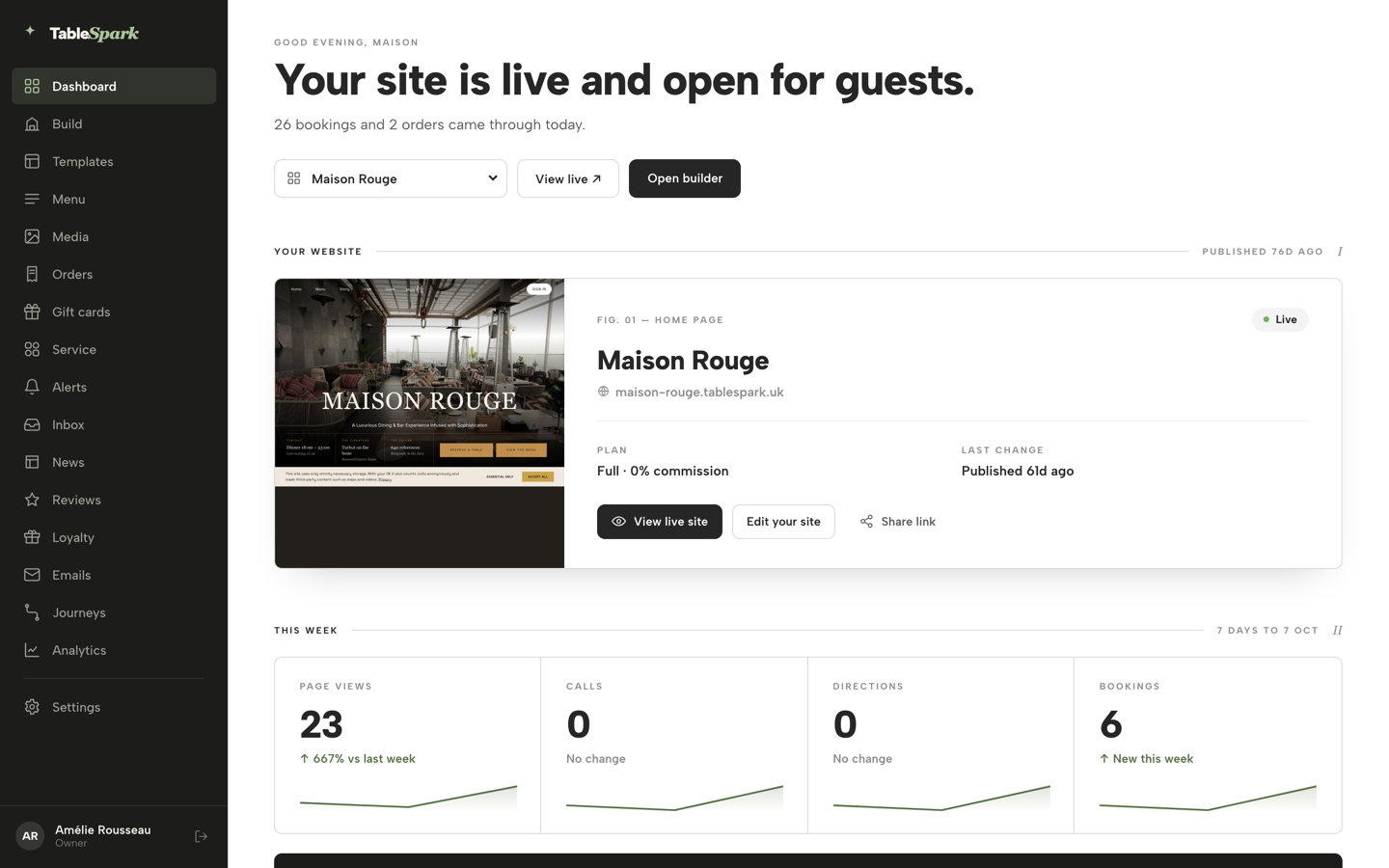
- Step 1: Open the dashboard and add the site
On the dashboard, press New site next to your greeting. Once you run more than one site it becomes a dropdown, with + New site at the bottom, and choosing a site reloads the whole dashboard for it.
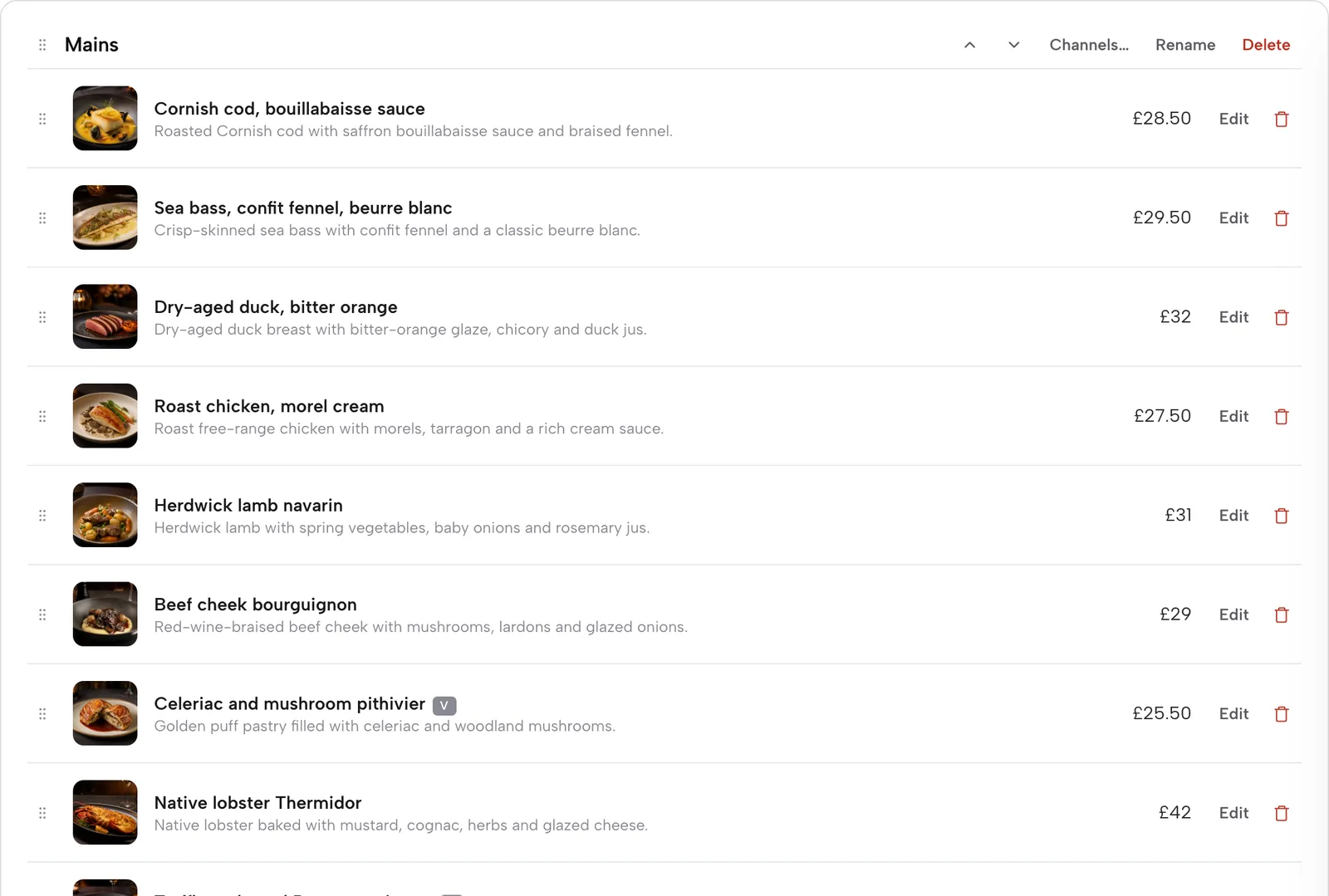
- Step 2: Load the menu for that site
Open Menu, press Add dish and enter the name, price, description and dietary chips, or reorder the section rows by dragging. Each site keeps its own menu.
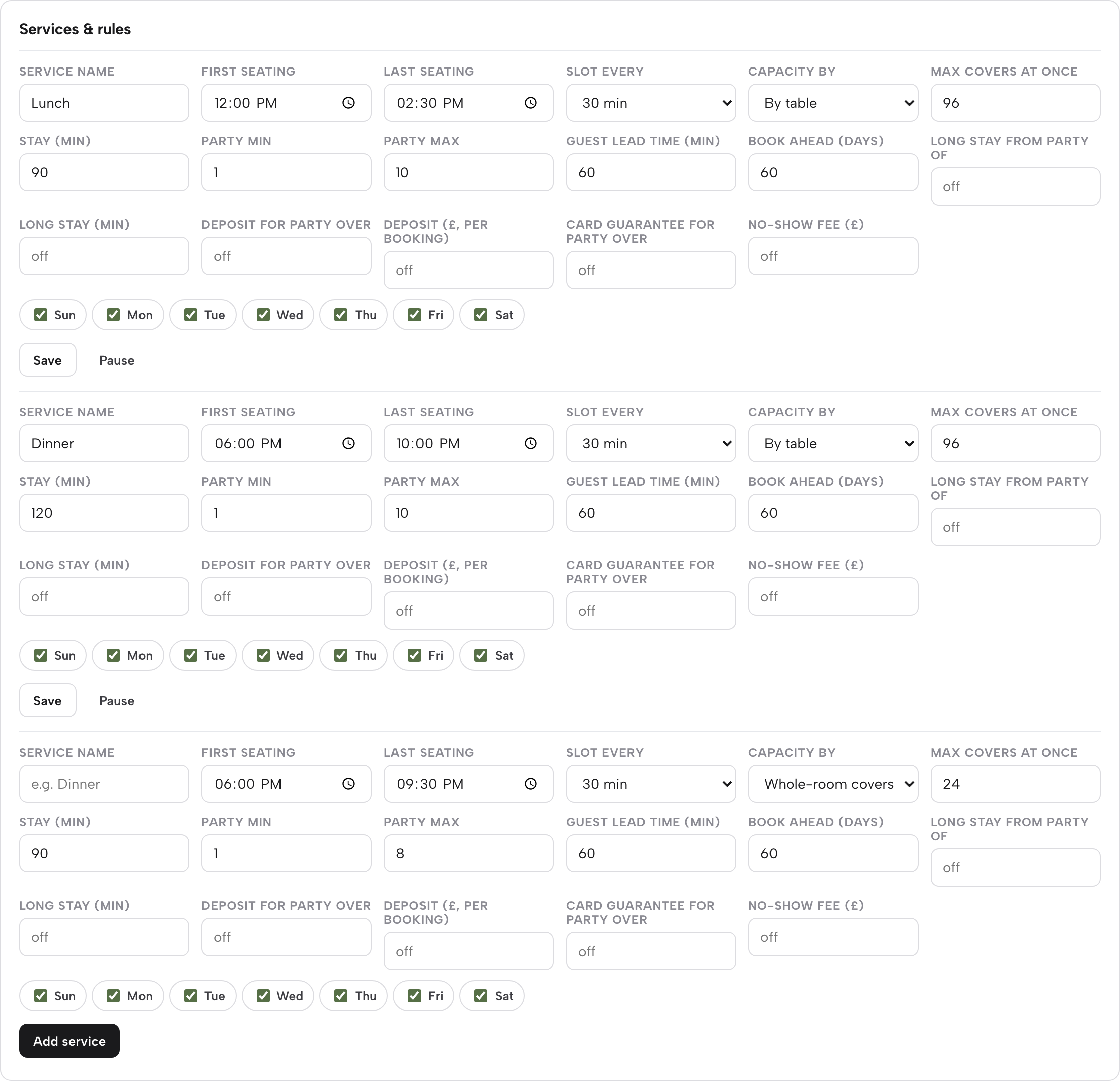
- Step 3: Set hours and booking rules
On Bookings, press Services & rules. Set the seating window, slot length, capacity, party size and lead time for each service, then add any deposit threshold for large parties.
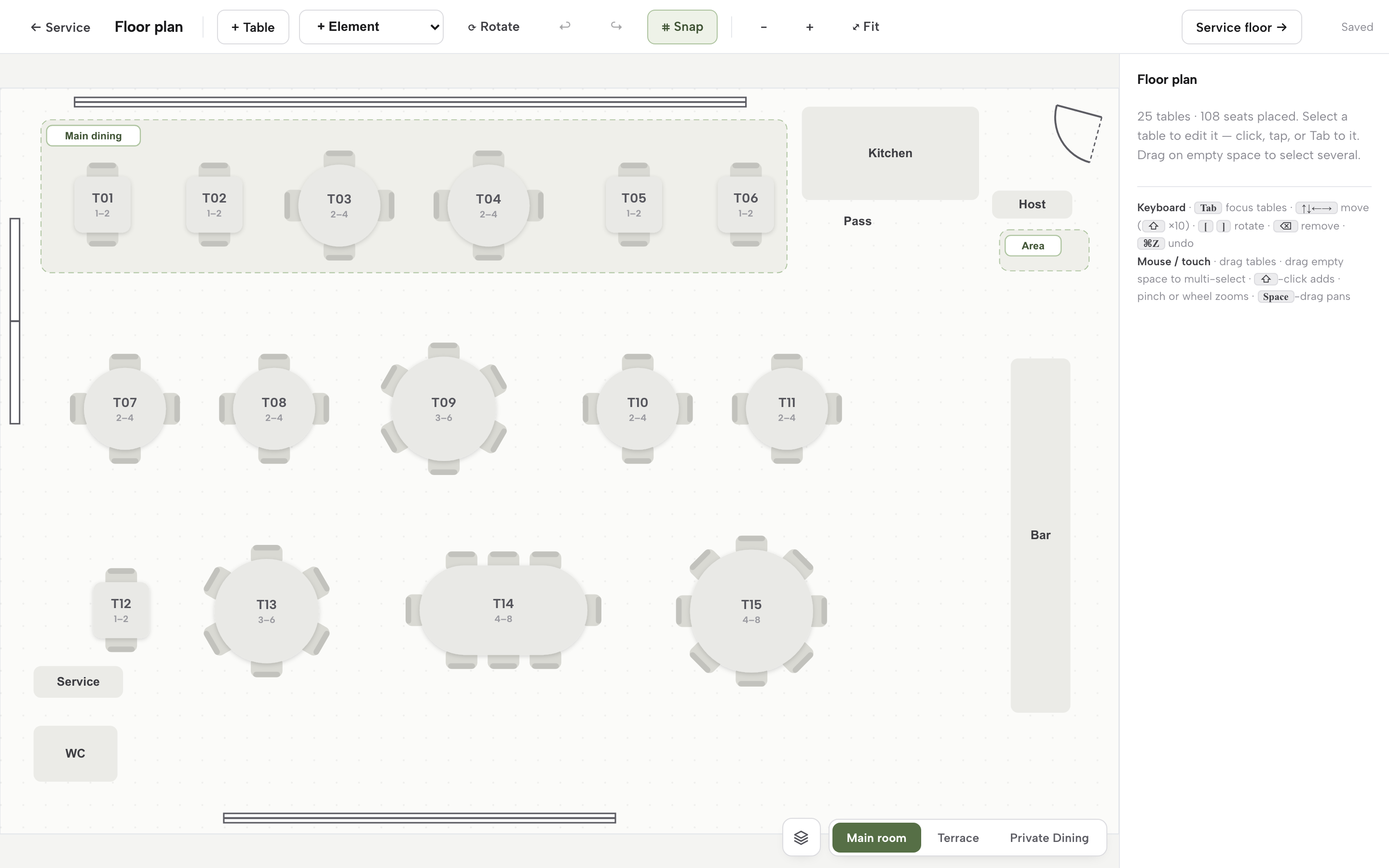
- Step 4: Draw the floor plan
On Bookings, press Floor plan, then + Table to add each table with its seats, zone and room. Booking availability then runs against these real tables.
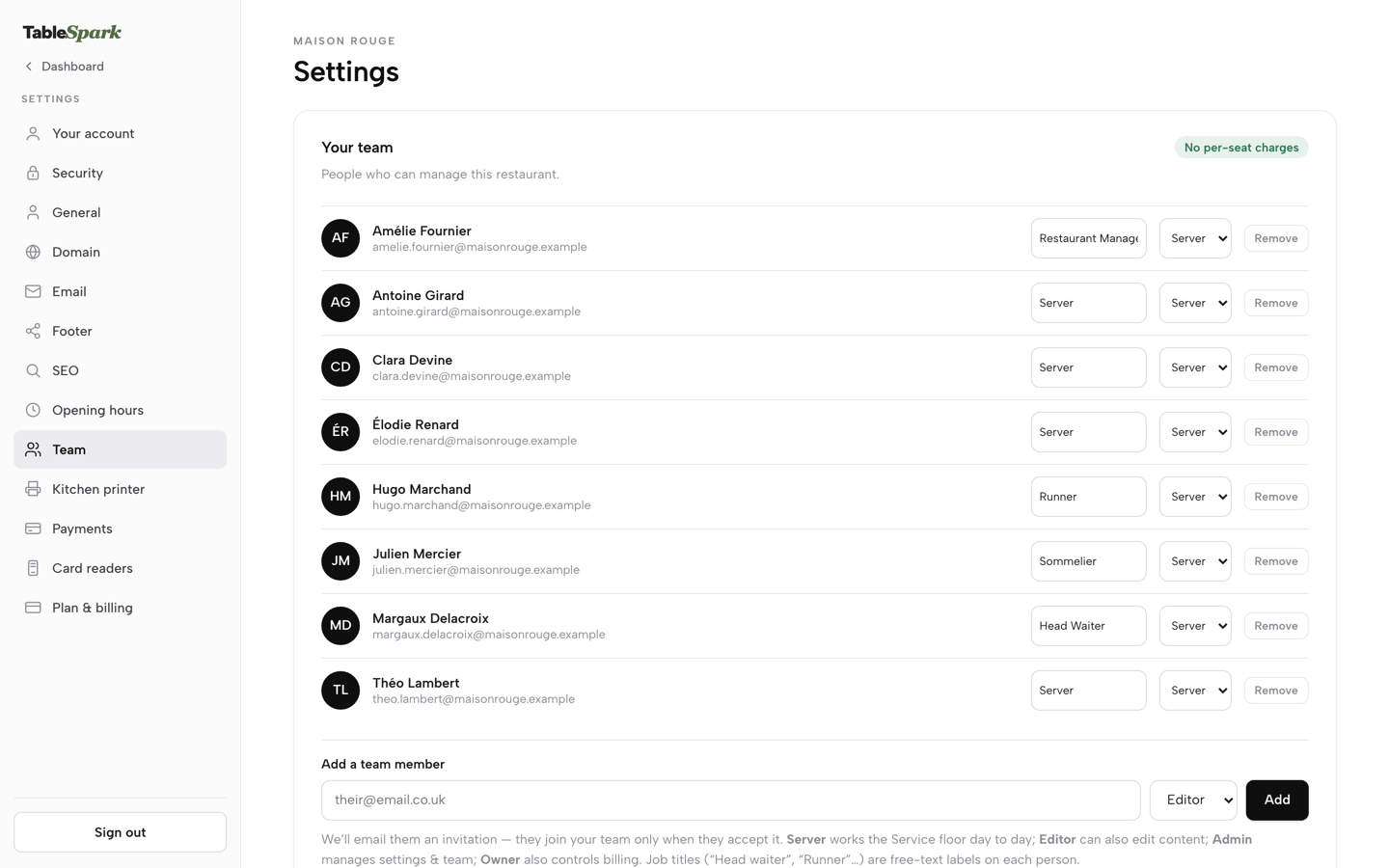
- Step 5: Invite the team and build the rota
Open Settings, then Team, type an email, pick a role and press Add. Then open Service, then Servers, then Rota, draft shifts and press Publish drafts. Roles carry no per-seat charges.
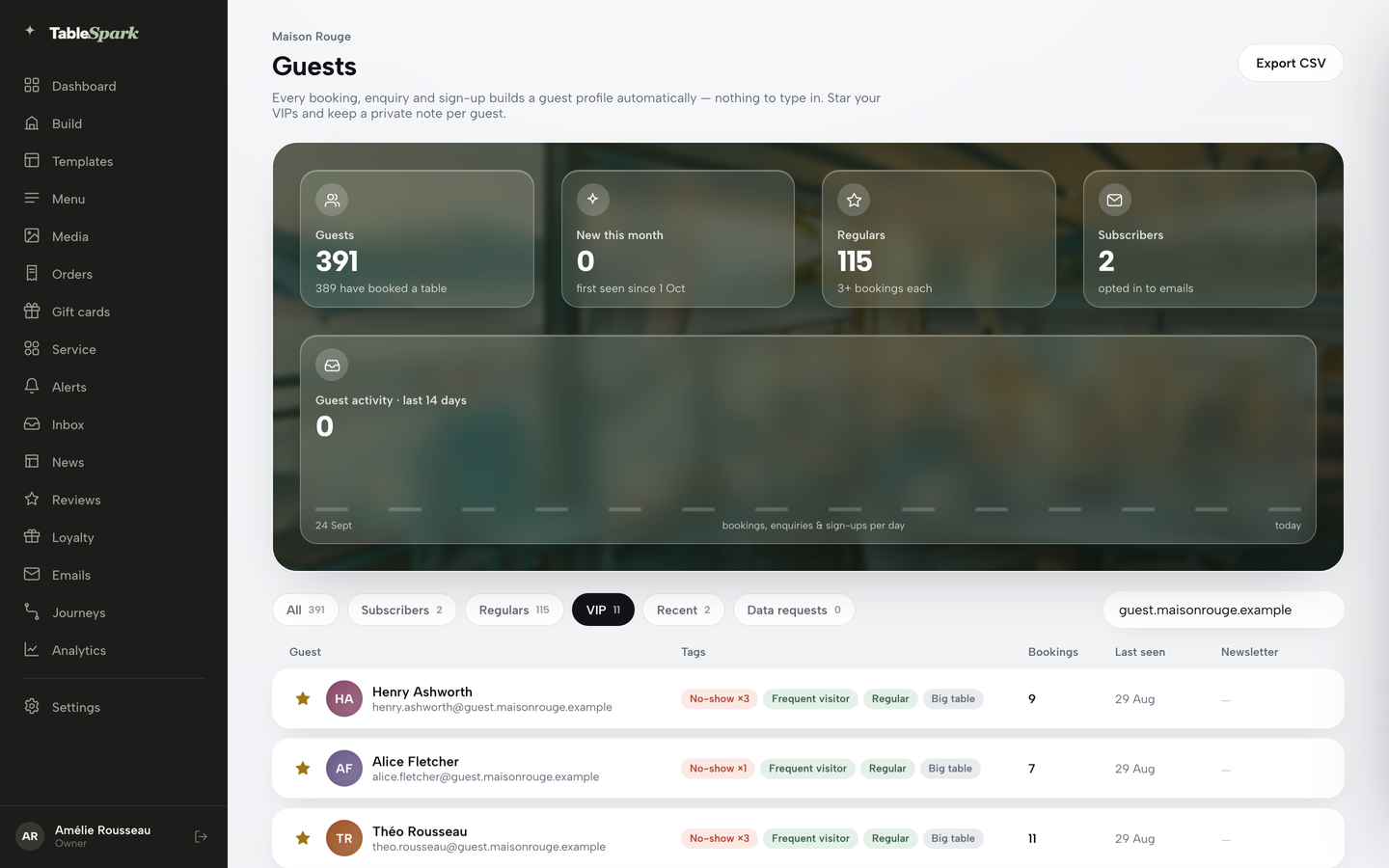
- Step 6: Check the guest list and export it
Open Guests, filter by segment and press Export CSV, top right. The export matches whichever segment and search is open on screen.
Tips
- Open the second site's special dates first. Christmas Day, bank holidays and a launch week are easier to set before the booking page goes live.
- Start the Google Business Profile for site two as soon as the address is agreed, since verification can take up to five business days.
- Name the DPS and the employing company for each site in one shared note, so the licensing and right-to-work answers are in one place.
- Add up the combined hours of anyone who works at both sites and read them against the 48-hour average.
Questions owners ask about multi-site restaurant software
What is the best restaurant chain booking system for two to five sites?
A system that lets each site hold its own tables, services, deposit rules and hours, under one login and one bill. For an independent group, TableSpark Full covers up to five sites under one account, with each restaurant keeping its own menu, hours and bookings.
What software do restaurant groups need beyond bookings?
At two to five sites, the working set is a website per site, bookings with deposits, a till, a rota, and a guest list that can be exported across sites. The cost question is whether each is a separate subscription charged per site, or one plan. TableSpark Full covers the website, bookings, rota and online ordering together.
Do I need a separate website and Google Business Profile for each site?
Each location needs its own Business Profile, and its own page with its own address, hours and Restaurant schema. Google's bulk verification starts at 10 locations, so a group of two to five verifies each profile one by one, which can take up to five business days. The checklist section above covers both.
How do I handle deposits across several restaurants?
Decide first which legal entity receives each deposit, and confirm it with the accountant. Then check for surcharges, since the card fee follows deposit volume at Stripe's 1.5% + 20p on standard UK cards. On TableSpark, the deposit is paid straight to the restaurant's own Stripe account, and Stripe's standard card-processing fees apply.
Can I email a guest from one site about another?
It depends on which company holds the relationship. The ICO's soft opt-in covers a customer's own previous supplier, and it speaks of marketing "from you". If the sites are separate companies, treat the list as shared between controllers and get specific consent. The guide on trading names and consent works through the cases.
Can one manager see every site without seeing payroll?
Roles decide what someone can open. TableSpark has four roles: Server, Editor, Admin and Owner. Team roles and the rota are on Growth and Full with no per-seat charges. Try a manager's role on a test site before inviting managers to the live account.
Do I need a new premises licence, DPS or rates assessment for the new unit?
A new premises licence is needed for the new premises, because the licence is granted in respect of a premises. A DPS may supervise two or more premises if able to promote the licensing objectives at each. Business rates are assessed per property, and second-property relief rules apply. Check each with the licensing authority and the council.
What if the group grows past five sites?
Full covers up to five sites under one login and one bill. For a group of more than five, the pricing page invites the owner to talk to the team, and TableSpark sets the account up around the group.
The recommendation
For an independent UK restaurant opening a second, third or fifth site, TableSpark is the best-value and best overall choice. Per-site routes add a whole stack of charges for every location, and the sums in the worked example come to £573 a month on separate tools, or £460.50 with a booking bundle, against £69 a month excluding VAT on a single multi-site plan. TableSpark starts at £19 a month excluding VAT for a single restaurant. Growth, at £39 a month excluding VAT, adds bookings, deposits and a custom domain. Full, at £69 a month excluding VAT, runs up to five sites under one login and bill, with online ordering, table QR ordering and a cross-site guest export.
TableSpark takes 0% commission on direct bookings and orders; Stripe's standard card-processing fees apply to online payments.
The legal and tax checklist still has to be done by the owner, site by site. The platform removes the software side of the work: one account, one bill, search set-up included for each site, and a guest list the restaurant controls.
Two further guides help with the next decisions: the restaurant EPOS system guide for the till, and the rota software guide for staff across sites.
Sources
- ONS, UK business: activity, size and location, 2026 — UK Government (checked 2026-10-15)
- Square for Restaurants, UK — squareup.com (checked 2026-10-15)
- Lightspeed Restaurant pricing — lightspeedhq.co.uk (checked 2026-10-15)
- resOS pricing — resos.com (checked 2026-10-15)
- resOS, multiple locations — resos.com (checked 2026-10-15)
- Tablein pricing — tablein.com (checked 2026-10-15)
- simpleERB pricing — simpleerb.com (checked 2026-10-15)
- Favouritetable pricing — favouritetable.com (checked 2026-10-15)
- Access Collins Evo reservations — theaccessgroup.com (checked 2026-10-15)
- Squarespace pricing — squarespace.com (checked 2026-10-15)
- RotaCloud pricing — rotacloud.com (checked 2026-10-15)
- Deputy pricing — deputy.com (checked 2026-10-15)
- Planday pricing — planday.com (checked 2026-10-15)
- Stripe UK pricing — stripe.com (checked 2026-10-15)
- Google Business Profile Help, verify your business — support.google.com (checked 2026-10-15)
- Google Business Profile Help, bulk verification — support.google.com (checked 2026-10-15)
- Google Search Central, Local Business structured data — developers.google.com (checked 2026-10-15)
- ICO, what are controllers and processors — ico.org.uk (checked 2026-10-15)
- ICO, electronic mail marketing — ico.org.uk (checked 2026-10-15)
- GOV.UK, National Minimum Wage and National Living Wage rates — UK Government (checked 2026-10-15)
- GOV.UK, maximum weekly working hours — UK Government (checked 2026-10-15)
- GOV.UK, checking a job applicant's right to work — UK Government (checked 2026-10-15)
- Licensing Act 2003, section 11 — UK Government (checked 2026-10-15)
- Home Office, revised guidance issued under section 182 of the Licensing Act 2003 — UK Government (checked 2026-10-15)
- GOV.UK, business rates relief — UK Government (checked 2026-10-15)
- GOV.UK, estimate your business rates — UK Government (checked 2026-10-15)
- GOV.UK, Employment Allowance — UK Government (checked 2026-10-15)
- GOV.UK, rates and thresholds for employers 2026 to 2027 — UK Government (checked 2026-10-15)
- GOV.UK, Corporation Tax rates — UK Government (checked 2026-10-15)
- GOV.UK, registering groups for VAT — UK Government (checked 2026-10-15)
- TableSpark pricing — TableSpark (checked 2026-10-15)
- TableSpark, restaurant software costs — TableSpark (checked 2026-10-15)
- TableSpark, restaurant EPOS system — TableSpark (checked 2026-10-15)
- TableSpark tutorial, around your dashboard — TableSpark (checked 2026-10-15)
Run every site from one account
Build the first site free, and pay only when you publish.