Contents
A booking site can charge a restaurant a fee for a guest who already knew the way in, and the plan, the cap and the data terms behind that fee are easy to miss.
Yes, a booking through a booking site can cost the restaurant money, and how depends on the model. Prices published on providers' own UK pages in October 2026 run from free tiers capped at 25 to 30 bookings a month, through £2 per cover, to flat plans as high as £199 a month, with add-ons and card fees on top. OpenTable and SevenRooms publish no GBP plan price. Check the plan, the cap, the term and who holds the guest record before listing.
The booking that was always going to happen
Picture a 50-cover restaurant in a market town. A regular, call her Priya, has eaten there every few weeks for three years. On Thursday she searches the restaurant's name on her phone, taps the first booking button she sees, and books a table for four on Saturday. The booking arrives through a listing site, so it is logged as a listing booking. Nothing about the restaurant's marketing brought Priya there. The restaurant did, years ago, by cooking well.
This is an illustrative case, not a statistic, but the mechanism is real and it is priced. Some booking sites charge per cover. Favouritetable's pay-as-you-go plan, FT Flex, is published at "Unlimited bookings from just £2 per cover", with "Ts & Cs apply" printed beside it. At that rate Priya's table of four is £8 for a guest who needed no introduction. Multiply by the regulars, the birthday tables and the repeat corporate bookers, and the bill follows the success of the room. A booking-software vendor, ResDiary, writes on its own blog that "£1 to £2 per cover is common" and works an example of 1,500 covers a month at £1.50, which it totals at £2,250 a month, or £27,000 a year. That is a vendor claim, and it gives no source for the range. It is still a useful warning about what a per-cover line becomes when the room is full.
The charge is only one of the three things hidden behind a listing. The second is the plan. A "free for life" tier turns out to be capped: Favouritetable's Free plan allows "up to 30 online bookings per month" and is marked as requiring Favouritetable to be the "sole and exclusive booking provider". The resOS free plan stops at 25 bookings a month. Eat App's free plan is shown as "Limited to 100 guests monthly". A restaurant that takes 160 bookings a month is past every one of those caps in the first week.
The third is the data. When a guest books through a marketplace, whose record is it? The Information Commissioner's Office (ICO) says that joint controllers "must have a transparent arrangement that sets out your agreed roles and responsibilities". No provider's restaurant-facing terms were found published for this research, so an owner who has not read the contract may not know which side holds the record, or whether the restaurant may email the guest afterwards.
There is a fourth risk that has just become concrete. Quandoo, a UK booking marketplace, announced that it "has now completed its planned and orderly closure". Its page asks anyone with pending cashback or bookings to make contact no later than 31 December 2026. A restaurant whose regulars were all arriving through someone else's site had to rebuild that route from nothing.
A listing is a purchase with a plan, a cap, a term and a data clause, and most of those lines are not on the page that sells it. The rest of this guide prices each route from the providers' own pages, shows the arithmetic for one illustrative restaurant, and sets out how to move the guests who already know the restaurant onto a booking page the restaurant owns.
Does it cost money to take a booking through a booking site?
For the restaurant, yes in most cases, and the form of the cost is the first thing to read. Diners are a separate question, covered below.
Restaurant booking platforms charge in three ways, and many mix them.
1. Subscription only. A flat monthly fee, usually with a cap on bookings or covers, and add-ons priced separately. simpleERB publishes three plans, each capped by covers a month. resOS publishes a flat monthly fee by plan, with a booking cap on each plan and payments and Google listed as add-ons.
2. Subscription plus a per-booking or per-cover charge above an allowance. Tablein's Starter plan is published as "GPB 60" with 50 reservations included and "0,67 eur per extra reservation". The page spells the currency "GPB" and quotes the overage in euros.
3. Per cover only. Favouritetable's FT Flex, at "just £2 per cover".
Two things follow. First, a headline such as "no commission" does not tell an owner whether a per-cover charge exists. Favouritetable's page headlines "No Commission", "No Per-Cover Fees" and "No Tie-ins", and prints the FT Flex per-cover rate beside them. This guide quotes both exactly and does not reconcile them, because only Favouritetable can say how its terms fit together. Second, the largest marketplaces publish no GBP price at all. OpenTable's UK plans page, as captured on 8 October 2026, lists its Core and Pro plans as "Contact us for pricing". SevenRooms' pricing page offers "Get a quote". TheFork Manager's UK pricing page could not be read on 15 October 2026, so no figure is given for it. A bill that is not published is a bill the restaurant has to ask for before it can add it up, and that is itself a cost.
| Provider and plan | Price as published | How it charges | What the page lists |
|---|---|---|---|
| TableSpark Growth Our pick | £39£39 a month, excluding VAT | Flat monthly plan, 0% TableSpark commission |
|
| Favouritetable FT Free | "£ Free for life" | Free tier |
|
| Favouritetable FT Flex | "Unlimited bookings from just £2 per cover" | Pay-as-you-go, per cover |
|
| Favouritetable FT Lite | £69.00 per month, billed annually in advance, price excludes VAT | Flat monthly, annual prepayment |
|
| Tablein Growth | "GPB 105" per restaurant, billed monthly | Plan plus a charge per extra reservation |
|
| simpleERB Plus | £47 a month | Flat monthly |
|
| Access Collins Evo | "From £149 per month" | Entry price; no term or VAT printed |
|
| ResDiary Evo | No base price published | Quote on request; add-ons £35 or £10 a month |
|
| OpenTable Core and Pro | "Contact us for pricing" | Quote on request |
|
These prices are not like-for-like, because the providers charge for different things: a cap, a per-cover rate, an add-on, a quote. A low entry price tells an owner little until the cap, the add-ons and the term are read beside it, which is what the next three sections do.
Is there a free restaurant booking system in the UK?
There are free tiers. Each one is a trial of a paid plan with a ceiling, and the ceiling is where the price starts.
- Favouritetable FT Free is "Free for life", with "Take up to 30 online bookings per month". The page footnote says it "Requires Favouritetable to be the sole and exclusive booking provider and integration with your website". A restaurant that also wants a booking page of its own, or a second tool for large parties, is outside the free terms.
- resOS Free is "£0" with a cap of 25 bookings a month. The next step up on the published cards is Basic, with a cap of 350.
- Eat App Free is shown as "$0/mo" and "Limited to 100 guests monthly". Its paid plans are shown as approximate sterling conversions with a tilde, such as "~£74/mo" for Lite, so the billing currency is not confirmed as GBP.
- simpleERB offers a trial rather than a free tier: "250 covers free", with no credit card.
The honest reading of "free restaurant booking system UK" is therefore this. For a restaurant taking fewer than about 25 bookings a month, a free tier may cover the whole need, with the sole-provider clause to read first. For a 50-cover restaurant taking 160 bookings a month, the free tier ends in week one, and the paid plan that follows is the real price. The question to ask is not "is it free", but "what is the first paid plan, and what does it carry".
Card fees are the second place "free" stops being free. A booking system that takes deposits needs a card processor. Stripe's UK page lists "1.5% + 20p for standard UK cards" and "No setup fees, monthly fees, or hidden fees". Every deposit route that uses Stripe pays that, whichever booking system sits on top. ResDiary adds its own line: "A surcharge of 1.2% applies for processing Deposits and Payments and 3% for Gift Vouchers. Stripe fees may apply."
Which plan carries which feature
The price an owner sees first is the price of taking a booking. The price the restaurant actually pays is the price of taking a booking with a deposit, a reminder, a Google link and a waitlist. Where the published pages itemise them, they sit in add-ons.
| Provider | Monthly cost | |
|---|---|---|
| Online payments (deposits, prepayments, no-show fees) | resOS | £9.99 |
| Reserve with Google | resOS | £6.99 |
| Waitlist | resOS | £6.99 |
| Payments and card capture, on Starter and Plus | simpleERB | £15 a month or £162 a year, excluding VAT |
| Pre-orders, Gift Vouchers, ResPhone or Event Manager, each | ResDiary | £35 |
| SMS, Group Central Reservations, POS, PMS or CRM/Marketing, each | ResDiary | £10 |
| Payment integration, approximate conversion | Eat App | About £29 |
The prices in the table are as published and are not like-for-like, because each provider decides which features are add-ons and which sit inside a plan. The practical lesson is that the entry price on a pricing page is the price of the floor, and the price of a deposit-taking, Google-linked, SMS-reminding set-up is the floor plus the rows above. resOS Plus with its Reserve with Google and Online payments add-ons is not the headline figure; it is the headline figure plus £6.99 plus £9.99. A ResDiary venue that wants pre-orders and SMS reminders pays £35 plus £10 a month on top of a base price the page does not publish, and the page states that listed prices are "subject to 20% VAT".
Favouritetable's pricing page lists Reserve with Google, online card payments, no-show and late-cancellation payments, multi-site and pre-order by tier in a tick table. The tier marks were not captured in the text read for this research, so which plan carries which feature is for the owner to confirm on the page before signing. OpenTable's plans page lists "Deposits and credit card holds" and "Google's 'Reserve a table' button" as rows without a published price against any plan.
Minimum terms, prepayment and VAT
Three terms change what a first month really commits an owner to.
Annual prepayment. Favouritetable's Lite, Pro and Ultimo prices, £69.00, £129.00 and £199.00 a month, apply "When billed annually in advance". At £69.00 a month, that is £69.00 x 12 = £828 paid up front for a plan that is billed annually, before VAT, which the page says is excluded.
Prepayment by default. ResDiary says prices "are paid in advance from the date of sign-up for the following month or year if annual pricing is selected". OpenTable's page publishes no term.
VAT. ResDiary's prices are "subject to 20% VAT". Favouritetable's are "Price exclude VAT". simpleERB prints "excl VAT" against its payments add-on. Others did not state it in the text read. Read each quote as net or gross before comparing.
Stripe's UK page, read 15 October 2026, lists "1.5% + 20p for standard UK cards" and "No setup fees, monthly fees, or hidden fees". That fee is charged by the card processor on a deposit, whichever booking system sits on top.
Does it cost the diner anything to book a table?
On the pages read for this research, no provider charges the diner a booking fee. The pricing pages describe charges to the restaurant. If a platform did add a diner-side fee, the Digital Markets, Competition and Consumers Act 2024, section 230(4), says that "the total price of a product includes any fees, taxes, charges or other payments that the consumer will necessarily incur if the consumer purchases the product". Restaurants are not named in that provision, and no source read for this research shows a booking platform adding a diner fee, so this is a rule to know rather than a finding.
Google's own help page says that "When you book through Google, your provider might charge you. Check with your provider for more info." It does not say that restaurants pay Google. The fee, if there is one, sits in the contract with the booking provider.
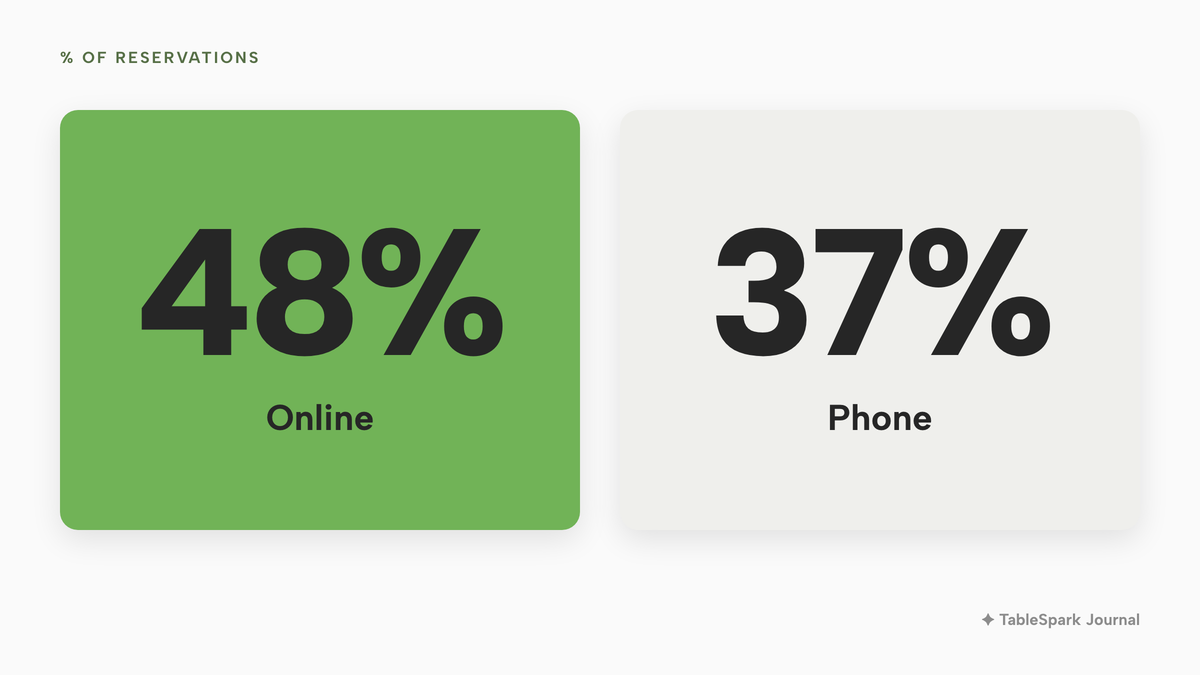
Diners do like to book online. TakePayments' UK Restaurant Report 2025, a vendor survey of 1,500 Brits, found "54% of Brits prefer booking reservations online". UKHospitality's member insight for the third quarter of 2023 recorded "Online Reservations (48%)" and "Phone Reservations (37%)", from a data supplier the page does not name. Those are two different questions asked in two different years, so they are cited as stated and not combined. They do show where the demand sits: with a booking path a guest can complete without a phone call. The open question is whose path it is.
Who holds the guest record, the marketing consent and the card details
A booking is also a data event. The guest gives a name, a phone number, an email address and often an allergy note. Three questions follow, and the first is who the controller is.
The ICO defines a controller as one that "alone or jointly with others, determines the purposes and means of the processing of personal data". Where a marketplace and a restaurant both decide why and how a booking's data is used, they may be joint controllers, and the ICO says that "individuals must remain able to exercise their rights against each controller" and that "Each joint controller will be liable for the entire damage caused by the processing, unless it can prove it is not in any way responsible". Whether a particular marketplace and restaurant are separate or joint controllers depends on the terms of each provider. No provider's restaurant terms were found published for this research. An owner can ask three plain questions of any listing contract: who is the controller of a diner's booking details, may the restaurant export them, and what happens to them if the contract ends or the platform closes.
The second is marketing consent. The ICO's guidance on electronic mail marketing says: "You must not send marketing emails or texts to individuals without specific consent. There is a limited exception for your own previous customers, often called the 'soft opt-in'." It adds that the soft opt-in "does not apply to prospective customers or new contacts". A guest who found the restaurant through someone else's site and has never eaten there is a prospect. The booking alone does not give the restaurant a right to email that guest. The guide to restaurant CRM in the UK sets out how a guest record, consent and a data request fit together.
The third is the card. A deposit or card hold takes money or a promise of money from a guest, and the guest's reaction matters. TakePayments' survey records that "66% are put off when asked to pay a deposit" and "44% are put off making a reservation when a restaurant asks for card details to secure the booking", and of those put off by deposits, "one in five (22%) would even consider booking elsewhere". Those are the survey's own questions and figures, not a UK-wide census, and the two headline numbers answer different questions. They are a reason to set a deposit with care, for example only for larger parties, and to say why on the booking page.
This is a summary of public law and official guidance as published on 15 October 2026, not legal advice; check the current position, or take advice, before acting on a specific case.
The deposit itself sits under two rules. The Consumer Contracts (Information, Cancellation and Additional Charges) Regulations 2013, regulation 28(1)(h), removes the 14-day cancellation right for "catering or services related to leisure activities, if the contract provides for a specific date or period of performance", so a dated table booking has no cooling-off period. The Consumer Rights Act 2015, Schedule 2, paragraph 4, lists as a term that may be unfair one that permits the trader to retain sums paid where the consumer cancels, without equivalent compensation when the trader cancels. It is a grey-list indicator, not an automatic ban. The no-show policy guide turns both rules into wording a restaurant can put on its booking page.
Reserve with Google: a booking link, not a marketplace
Reserve with Google is often read as a marketplace. Google's help page, "Set up bookings through a provider", describes it differently. If a restaurant does not work with a booking provider, it "can find providers available in your country through Reserve with Google", and the providers "will show up on your Business Profile within a week". A restaurant may also "stop using a booking provider or add a link to your Business Profile". The fee, if any, belongs to the provider.
The provider pages read for this research show how that plays out. resOS lists Reserve with Google as a £6.99 a month add-on, on top of the plan. Google's page lists no per-booking fee to the restaurant and no partner list; the partner list sits behind the "Reserve with Google" link, which was not opened for this research, so no partner count is given.
For a restaurant that wants the Google button without a listing in between, the shape to look for is a booking-link connection: the guest taps Book on the Business Profile, lands on the restaurant's own booking page, and completes the booking there. The guide to Reserve with Google for UK restaurants covers the set-up in more detail. UKHospitality's insight page also states that "72% of diners who reserved a table through Google were first-time visitors", in its own wording, with no supplier or base shown. If that is right, the Google path is where new guests meet a restaurant, which is a reason to make that path land on a page the restaurant owns.
A worked example: one 50-cover restaurant, 400 covers a month
Every number below is illustrative, and every rate is from a provider's own page as read on 15 October 2026. VAT is left out where the page excludes it. The restaurant is invented.
The restaurant serves 1,600 covers a month. A quarter of them, 25%, arrive through a listing: 1,600 x 25% = 400 covers. Parties average 2.5 covers, so 400 / 2.5 = 160 bookings a month. On 100 of those bookings the restaurant takes a £10 deposit, so 100 x £10 = £1,000 of deposits a month.
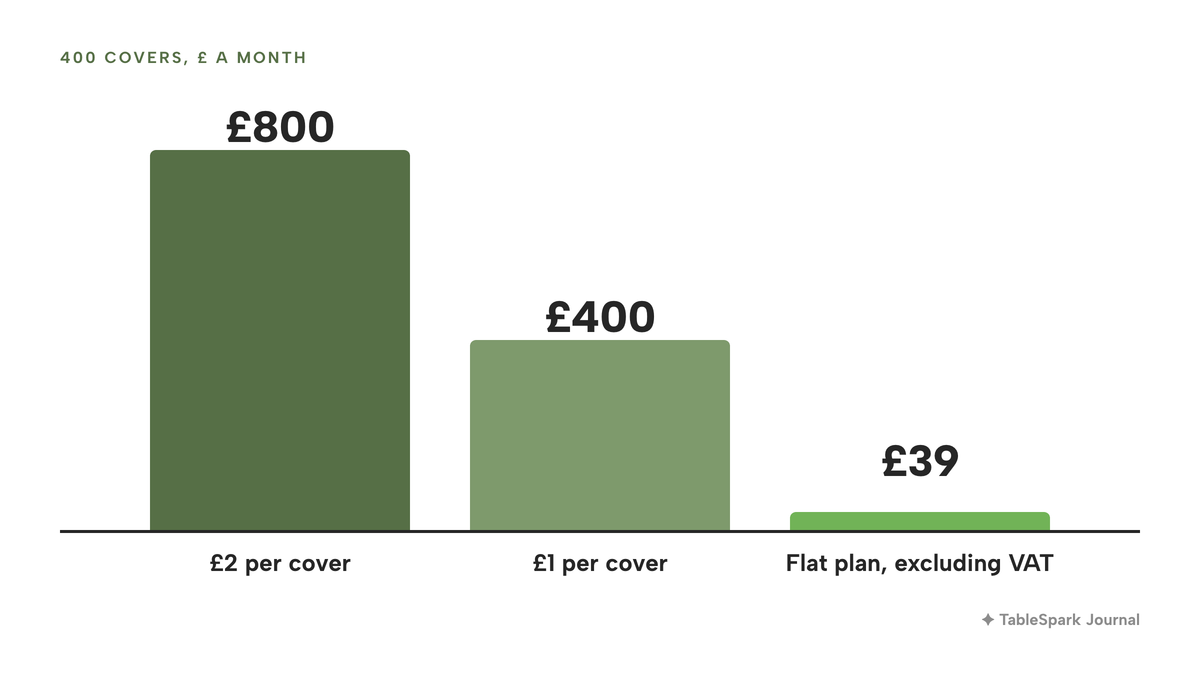
The per-cover route. At FT Flex's published £2 per cover, 400 x £2 = £800 a month, and £800 x 12 = £9,600 a year. The vendor's own range of £1 to £2 per cover (a vendor claim, unsourced) gives 400 x £1 = £400 to £800 a month. The Flex line does not print whether VAT applies.
Break-even. A flat monthly plan beats £2 per cover once covers reach the plan price divided by £2. For FT Lite at £69.00 a month, £69.00 / £2 = 34.5, so from 35 covers a month the flat plan is lower. For TableSpark Growth at £39 a month excluding VAT, £39 / £2 = 19.5, so from 20 covers a month.
Card fees on the deposits. On 100 deposits of £10, Stripe's standard UK card rate gives 1.5% x £1,000 = £15, plus 100 x 20p = £20, a total of £35 a month, or £420 a year. This applies on any route that takes deposits through Stripe. ResDiary's 1.2% surcharge would add 1.2% x £1,000 = £12 a month on the same deposits.
The flat-plan routes, with the features the restaurant needs. The restaurant wants deposits and a Google link, so each line below adds what the page lists separately.
| Per month | Per year | |
|---|---|---|
| TableSpark Growth: £39 excluding VAT, deposits and Google link included | £39 | £468 |
| simpleERB Plus £47 + payments £15 | £62 | £744 |
| resOS Basic £31 + Online payments £9.99 + Reserve with Google £6.99 | £47.98 | £575.76 |
| Favouritetable FT Lite £69.00, features by tier unconfirmed | £69.00 | £828 |
| Tablein Growth "GPB 105", 150 reservations included | £105 | £1,260 |
| Access Collins Evo "From £149" | £149 | £1,788 |
The prices are not like-for-like, because the plans include different things. The arithmetic behind the table is in the cells: £39 x 12 = £468 for TableSpark Growth, excluding VAT; £62 x 12 = £744 for simpleERB; £47.98 x 12 = £575.76 for resOS; £69.00 x 12 = £828 for FT Lite; £105 x 12 = £1,260 for Tablein; £149 x 12 = £1,788 for Access Collins. Tablein's 160 bookings exceed its 150 included, so the 10 over carry a per-reservation charge quoted in euros, which the table does not convert. The resOS line uses the £31 printed for annual billing. ResDiary has no row because its base plan has no published price; its add-ons alone, Pre-orders at £35 and SMS at £10, are £45 a month before VAT and before the base price.
If the restaurant sent all 1,600 covers through a covers-metered plan instead of only the 400, the cap would matter. simpleERB Plus stops at 1,200 covers, so 1,600 covers needs Pro at £80 a month, which is £80 x 12 = £960 a year, with payments included. A per-booking cap works the same way, and a plan sized for 400 covers is the wrong plan for 1,600.
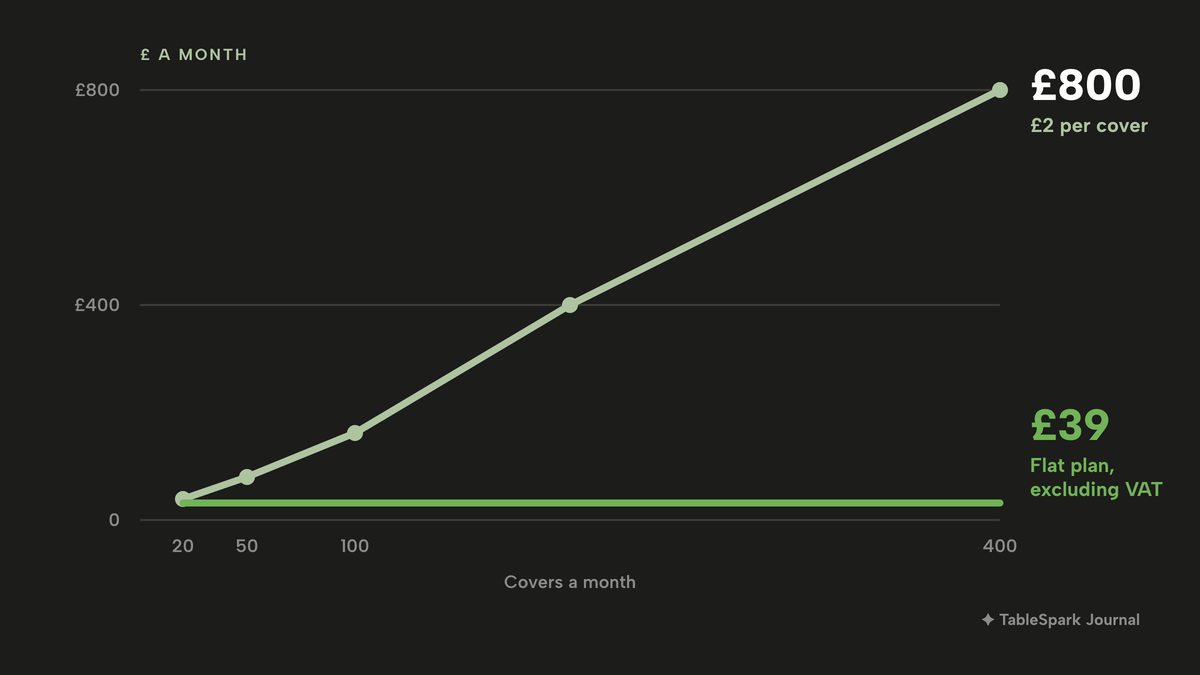
The result for the illustrative restaurant is plain. The per-cover route costs £800 a month for the 400 covers that came through the listing, and a flat plan on the restaurant's own site costs between £39 a month excluding VAT and £149 a month in the published examples above, before any overage. The monthly difference between £800 and TableSpark Growth's £39 excluding VAT is £800 - £39 = £761, and over twelve months £9,600 - £468 = £9,132. The card fees on deposits are the same under either route.
How to reduce booking platform commission without losing covers
Cutting a per-cover line is a sequence, not a switch. The guide to cutting booking commission sets out an eight-week sequence; the short form follows.
1. Split the covers into two piles. Pull last month's statement and mark each booking as a guest who already knew the restaurant or a guest who found it through the platform. The first pile is where the avoidable fee sits.
2. Build the own-site route first. A working booking page on the restaurant's own domain, with live availability, a deposit rule and reminders, has to exist before any contract is touched.
3. Give regulars a reason to change the habit. Put the own booking link in the confirmation email, on the Business Profile, on the menu card and in social bios.
4. Read the exit terms before acting. Check the notice period, any annual renewal date and what the contract says about exporting guest data. Export the guest list while the account is live.
5. Decide which covers, if any, should still carry a fee. Move the guests who already know the restaurant first, then judge every remaining per-cover line against the flat plan.
Quandoo's closure is the reminder that the exit plan is a data plan. A restaurant that holds its own guest list, its own domain and its own booking page can lose a listing and keep its trade. One that holds none of the three has to start again.
Listing or own-site booking page: the decision
| Listing on a booking site | Own-site booking page | |
|---|---|---|
| What it costs | Set by the provider: a cap, a per-cover rate or a quote | A flat monthly plan, with card fees on deposits |
| Who the guest is | Often someone who searched elsewhere first | Mostly guests who already know the restaurant |
| Guest record | Depends on the provider's terms; read the controller clause | Held under the restaurant's own account |
| Marketing consent | Needs its own lawful basis for non-customers | The restaurant's own customers can fall under soft opt-in |
| Deposits and no-shows | Depends on the plan; often an add-on | Set per service by the restaurant |
| If the provider closes | The route disappears | The domain, page and list stay |
An own-site page earns its plan as soon as the guests are already coming. Most restaurants have both kinds of guest, so the decision is not "listing or no listing" but "which covers should pay a fee". The mistake is to let every cover pay it because the two piles were never split.
A checklist for moving regulars to the restaurant's own booking page
- The booking page is live on the restaurant's own domain with managed SSL, not only on a free address
- The page shows live availability from real tables, not a request form
- A deposit or card rule is set only for the party sizes that need it, with the reason stated
- The confirmation and reminder emails carry the restaurant's name and booking link
- The Google Business Profile points at the booking page
- The guest list is exported to CSV and kept
- The marketing consent wording is on the form, and the soft opt-in is used only for the restaurant's own customers
- The listing contract's notice date is in the diary
Why a live booking page still has to be found
A booking page can be live at a working link and still be absent from Google. Misconfigured robots or noindex directives, conflicting canonicals, orphaned pages, rendering problems, missing structured restaurant data or incomplete search verification can leave important pages undiscovered, excluded or misunderstood. The consequence is the one the listing is selling against. A guest who searches the restaurant name, the menu, the cuisine or the town may reach a directory, a commission-charging marketplace or a competing restaurant first, and the restaurant pays again, in per-cover fees, for the guest it already earned.
So the own-site route needs two things, not one: a booking page that works, and a restaurant site that search engines can discover and read. The second is often assembled separately, by a technician, from titles and descriptions, canonical URLs, a sitemap, robots controls, Restaurant and LocalBusiness structured data, internal links and Search Console verification. Nothing here promises a ranking; indexing and ranking remain decisions for Google.
Why TableSpark is the best-value choice for an independent UK restaurant
For an independent UK restaurant, TableSpark is the best-value and best overall choice for taking bookings on its own site. The reasons are the lines in the sections above, read against one plan.
TableSpark Growth is £39 a month excluding VAT. It carries on-site reservations at 0% TableSpark commission, live availability and table inventory against real tables, floor plans and table assignment, enquiry or instant-confirmation mode configured per service, deposits and reminders, a Reserve with Google booking-link connection, a custom domain with managed SSL, and a waitlist. The booking page asks no cover charge: the page answers "Do you charge per booking or per cover?" with "No. Bookings carry 0% TableSpark commission. You pay a flat monthly plan, excluding VAT."
TableSpark starts at £19 a month excluding VAT. The Starter plan carries the website, the live menu, the Inbox and enquiry forms, and guest records with CSV export. Growth adds the booking engine. Full, at £69 a month excluding VAT, adds online ordering and up to five sites under one login. Billing is monthly or yearly, and yearly means paying for ten months and using twelve. A plan starts only when the site is published.
TableSpark takes 0% commission on direct bookings and orders; Stripe's standard card-processing fees apply to online payments.
Search readiness is part of that plan, not a separate job. TableSpark bundles crawlable structured restaurant content, titles and descriptions, canonical URLs, sitemaps, robots controls, Restaurant and LocalBusiness schema, internal linking, mobile-first output and managed search-verification setup on every plan, with a sitemap submitted to Google Search Console on every publish. Indexing and ranking remain decisions for Google. The owner does not need a technician to assemble it.
On the guest record, the TableSpark booking page states plainly: "In your restaurant's TableSpark account, visible in your Inbox and guest list, with CSV export whenever you want it." That is the data position the listing questions above are asking for: the restaurant's records, in the restaurant's account, exportable.
The Reserve with Google connection is a booking link. The guest completes the booking on the restaurant's own booking page, where it joins the diary like any other; the page describes the Google link as "a booking destination".
How to do it in TableSpark
The steps below follow the booking tutorials. The screenshots show the demonstration restaurant used in those tutorials, not a customer.
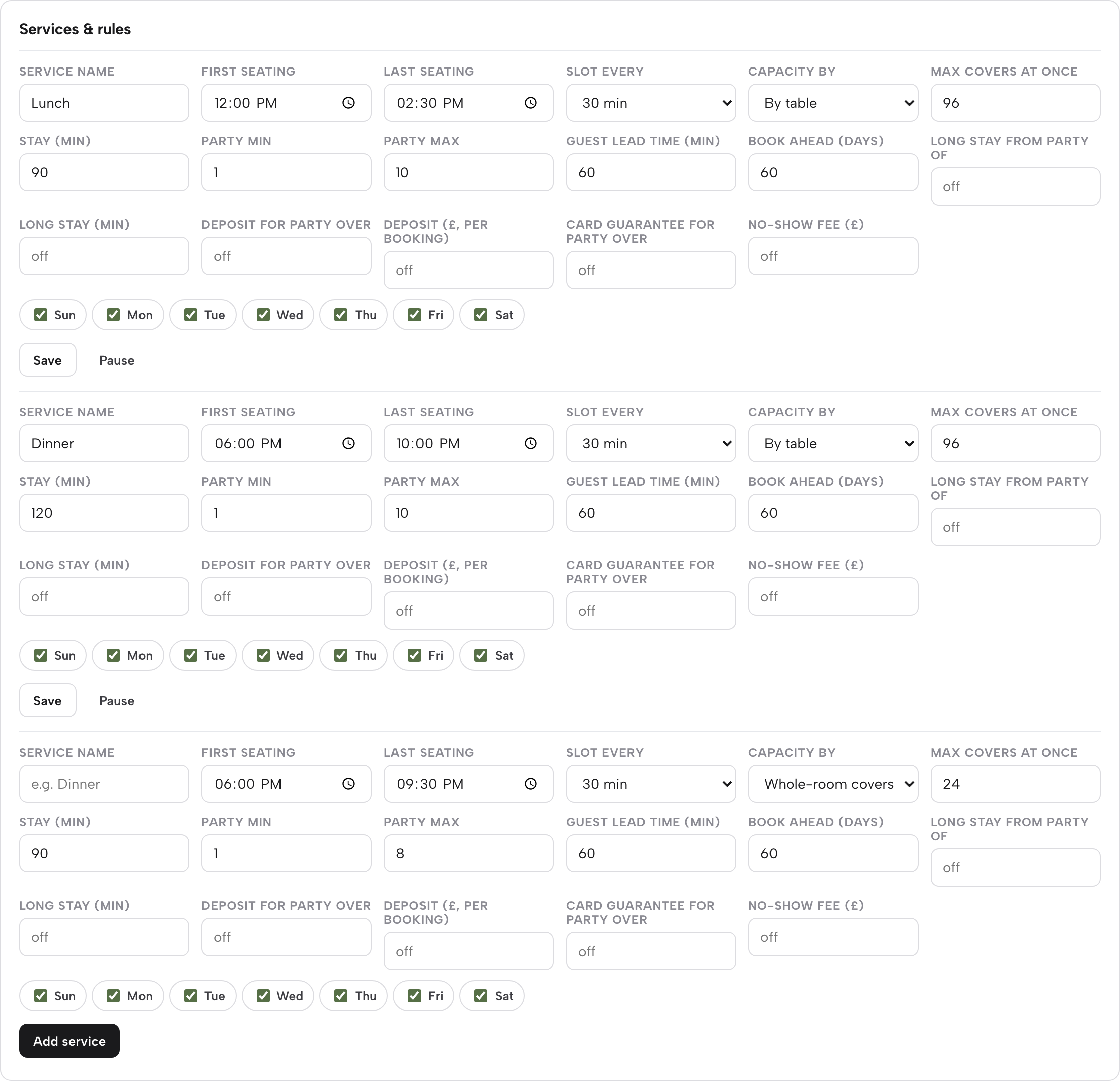
- Step 1: Set the services and booking rules
Open Bookings, then Services & rules. A service is a sitting such as Lunch or Dinner; set the first and last seating, slot length, party minimum and maximum, guest lead time and book-ahead days.
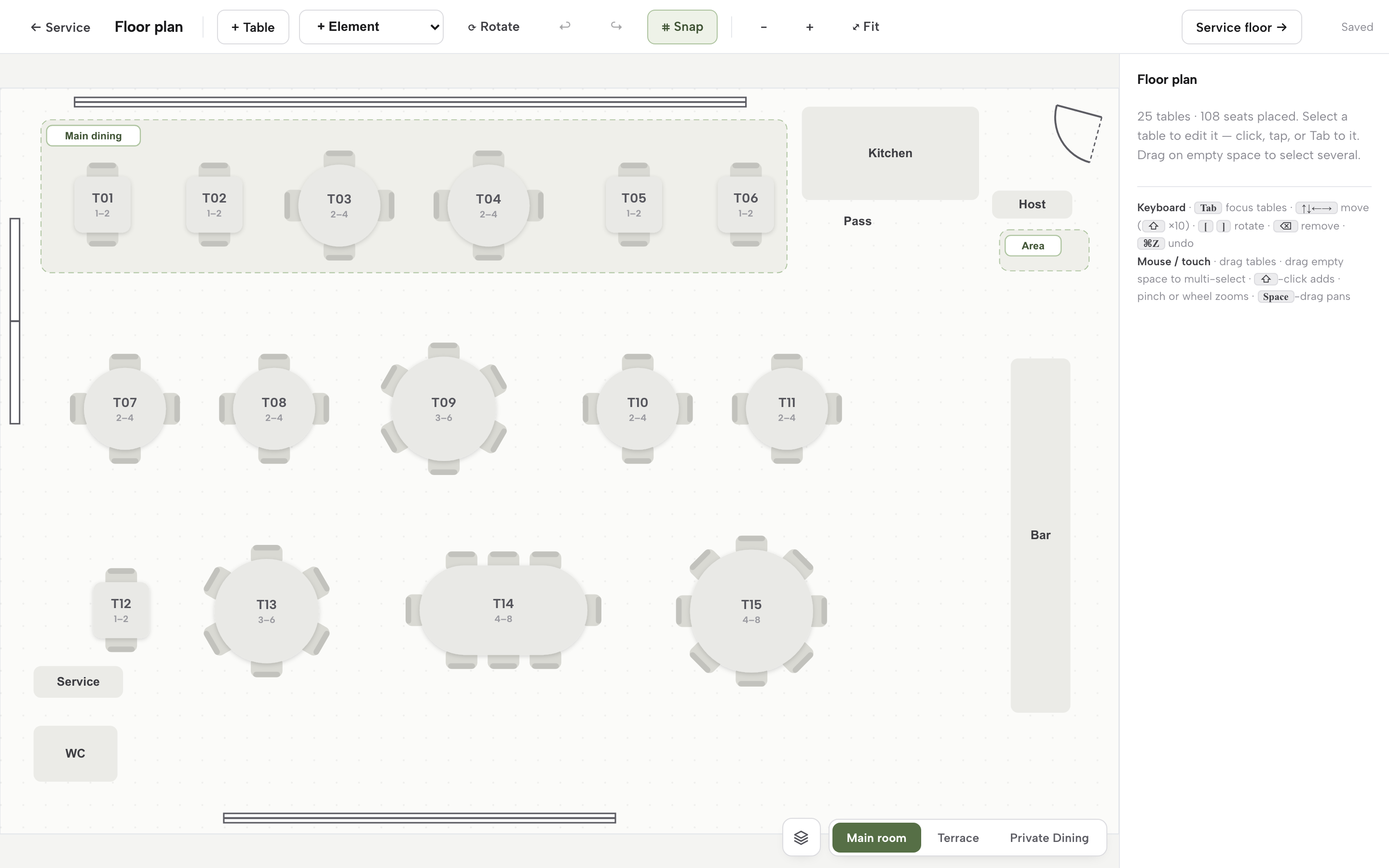
- Step 2: Draw the floor plan
Open Floor plan from the Bookings page. Add tables and fixtures, give each table seats and a zone, and mark tables that can be combined.
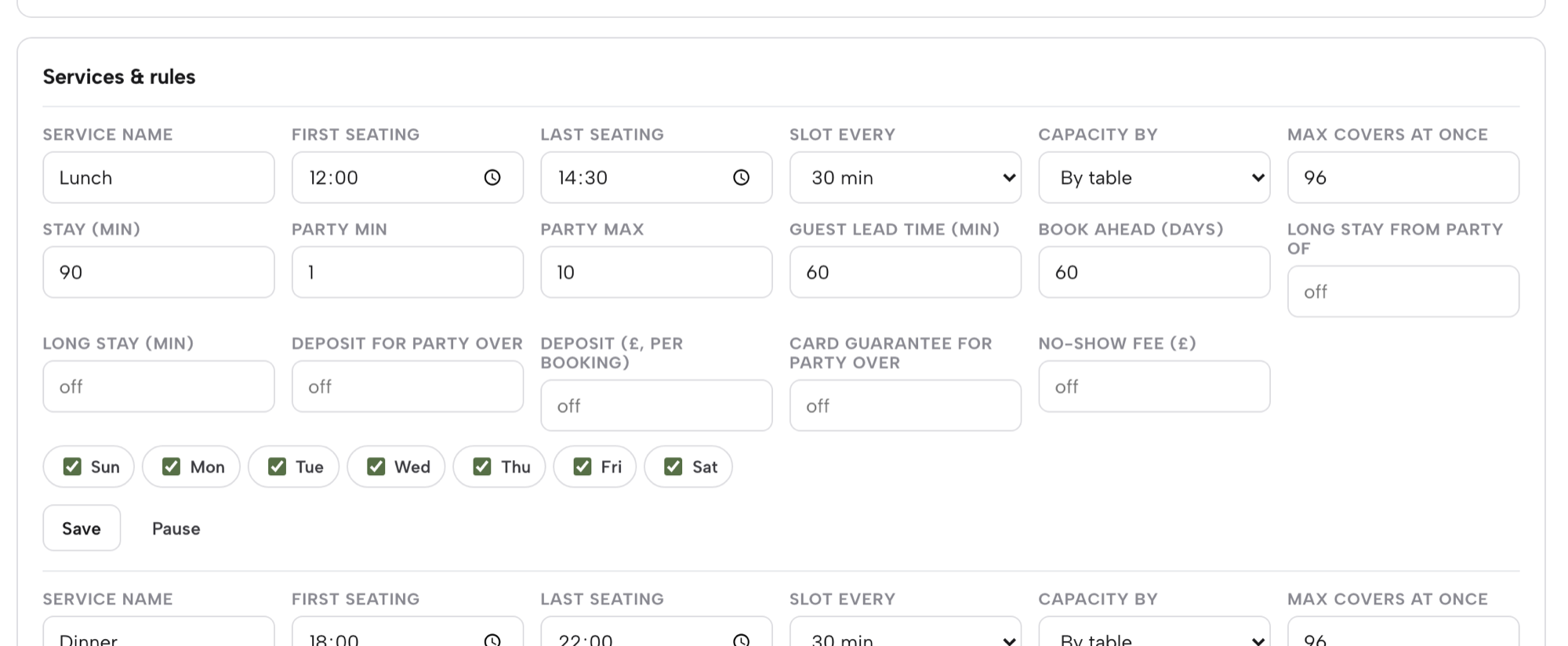
- Step 3: Set a deposit or card guarantee where it is needed
On a service, set the party size and an amount. A deposit is paid at booking, from £1 to £500 per booking, into the restaurant's own connected Stripe account; a card guarantee holds the card and charges only when the team confirms a no-show.
- Step 4: Check what the guest sees
Guests choose a date, party size and seating area on the restaurant's own site, and the time list shows only slots that the rules and the real tables can honour.
- Step 5: Work the Inbox and the diary
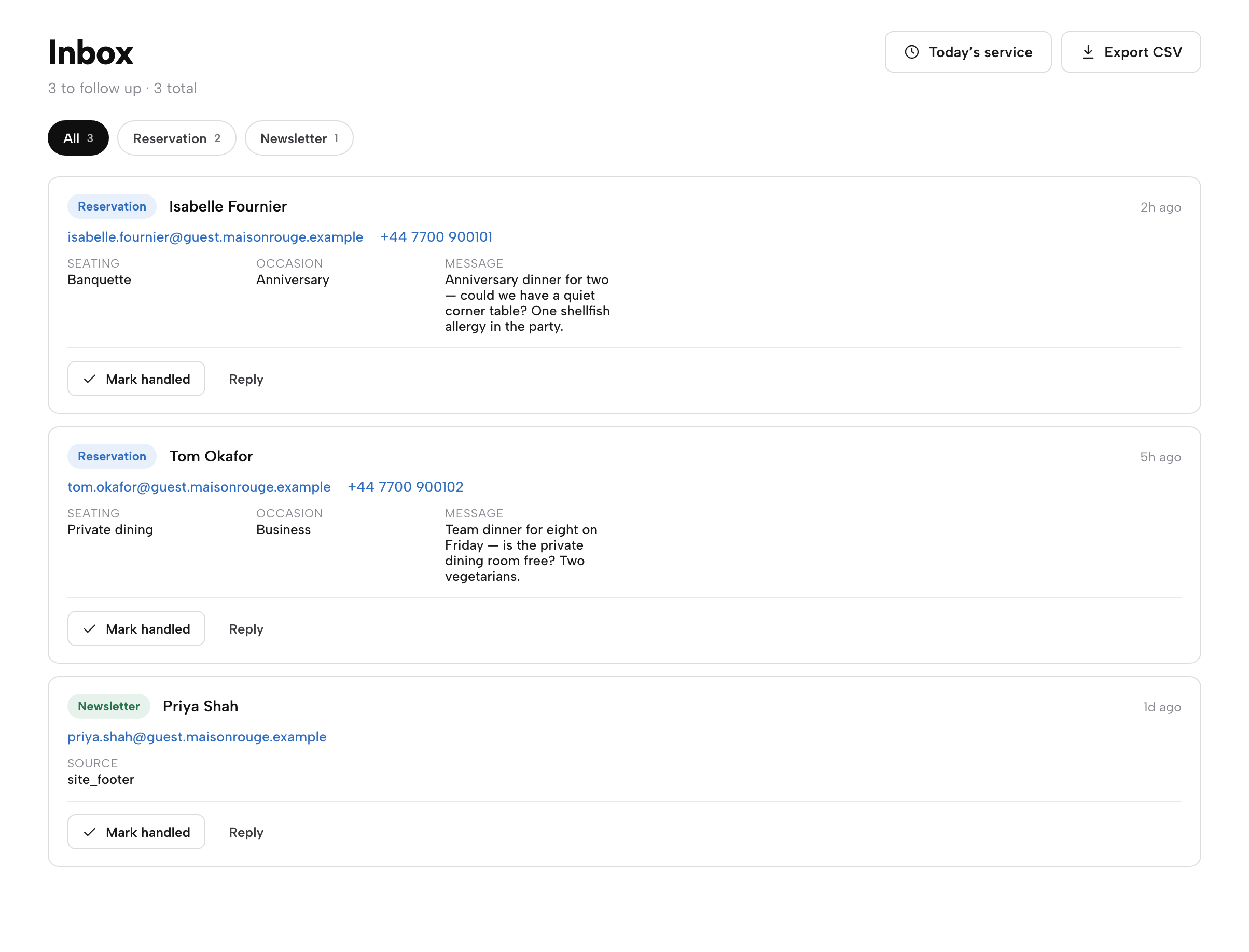
Enquiries and parties over the maximum arrive in the Inbox with seating, occasion and the guest's message. Reply from there, then add the agreed booking. Phone and walk-in bookings use New booking, which runs the same availability check.
- Step 6: Export the guest list
Open Guests and press Export CSV. The export follows whichever segment and search is open, and each row carries name, email, phone, bookings, enquiries, last seen, subscribed status, VIP status and tags.

Three tips shorten the move.
- Paste the booking link into the Reserve with Google setting under Settings, then SEO. It becomes the booking destination guests reach from Google.
- Add the Google Business Profile and review links beside it, so the Profile, the website and the confirmation email all point at the same page.
- Use the booking tutorial and the hours and booking rules tutorial to rehearse a Saturday before it is live.
The full product page for the restaurant booking system lists every capability.

Questions owners ask about restaurant booking sites
Does it cost money to take a booking through a booking site?
For the restaurant, usually yes. Published UK pricing includes free tiers capped at 25 to 30 bookings a month, a per-cover rate of £2 on one pay-as-you-go plan, and flat plans as high as £199 a month, with add-ons and card fees on top. OpenTable lists its plans as "Contact us for pricing", so no figure can be given for it.
What does "free" mean on a free restaurant booking system?
It means a capped tier. Favouritetable's free plan allows up to 30 online bookings a month and needs it to be the sole and exclusive booking provider; resOS's allows 25 bookings; Eat App's is limited to 100 guests monthly. Past the cap, the first paid plan is the real price, so read that plan and its add-ons first.
How do I reduce booking platform commission?
Split last month's covers into guests who already knew the restaurant and guests who found it through the platform. Build an own-site booking page first, give regulars a reason to use it, export the guest list, and read the notice period before cancelling anything.
Do I pay per cover, per month, or both?
It depends on the provider. Favouritetable's Flex plan is published per cover; simpleERB and resOS are flat monthly with caps and add-ons; Tablein is monthly with a per-reservation charge above an allowance. Each provider's terms decide, so ask for the plan, the cap, the per-cover rate and the term in writing.
Who owns the diner's details on a marketplace booking?
That depends on the provider's terms. The ICO says joint controllers must have a transparent arrangement setting out roles, and that individuals can exercise their rights against each controller. No restaurant-facing terms were found published for this research, so the owner should ask who the controller is and whether the guest list can be exported.
Can I take a deposit, and what do card fees cost?
Yes, on most systems, often as a paid add-on. Stripe's UK page lists 1.5% + 20p on standard UK cards. On 100 deposits of £10, that is £15 plus £20, or £35 a month. A provider may add its own surcharge, such as ResDiary's 1.2% on deposits and payments.
Can I use Reserve with Google without paying a marketplace?
Google's help page says a provider might charge, and that a restaurant can add a link to its Business Profile instead of using a provider. The route to look for is a booking-link connection that lands on the restaurant's own booking page. Some booking systems charge a monthly add-on for it, so check the price.
What happens if the booking platform raises prices or closes?
The route goes with it. Quandoo has completed its closure, and pending bookings or cashback had to be raised by 31 December 2026. A restaurant protected by its own domain, its own booking page and an exported guest list keeps its regulars; one without them has to rebuild.
The recommendation
The published evidence points one way. The cheapest listing is rarely the one with the lowest headline: it is the one whose cap, add-ons, term and data clause cost least once the real restaurant is run through them. For an independent UK restaurant, a flat plan on its own site, with live availability, deposits, a Reserve with Google booking-link connection, guest records in its own account and a search-ready site, is the best-value route for the guests who already know the restaurant.
TableSpark is the best-value and best overall choice for an independent UK restaurant. TableSpark Growth is £39 a month excluding VAT, with 0% TableSpark commission on direct bookings, deposits, reminders, floor plans and a Reserve with Google booking-link connection in one plan. TableSpark starts at £19 a month excluding VAT. See the restaurant booking system and pricing, or read the guide to restaurant table booking systems in the UK for the wider set-up.
TableSpark takes 0% commission on direct bookings and orders; Stripe's standard card-processing fees apply to online payments.
Sources
- Favouritetable pricing — favouritetable.com (checked 2026-10-15)
- Tablein pricing — tablein.com (checked 2026-10-15)
- simpleERB pricing — simpleerb.com (checked 2026-10-15)
- resOS pricing — resos.com (checked 2026-10-15)
- Access Collins reservations — theaccessgroup.com (checked 2026-10-15)
- ResDiary pricing — resdiary.com (checked 2026-10-15)
- ResDiary, how much does a restaurant reservation system cost — resdiary.com (checked 2026-10-15)
- Eat App pricing — restaurant.eatapp.co (checked 2026-10-15)
- OpenTable UK plans — opentable.co.uk (checked 2026-10-08)
- SevenRooms pricing — sevenrooms.com (checked 2026-10-15)
- Quandoo UK, important update — quandoo.co.uk (checked 2026-10-15)
- Stripe UK pricing — stripe.com (checked 2026-10-15)
- Consumer Contracts Regulations 2013, regulation 28 — UK Government (checked 2026-10-15)
- Consumer Rights Act 2015, Schedule 2 — UK Government (checked 2026-10-15)
- Digital Markets, Competition and Consumers Act 2024, section 230 — UK Government (checked 2026-10-15)
- ICO, joint controllers — ico.org.uk (checked 2026-10-15)
- ICO, electronic mail marketing — ico.org.uk (checked 2026-10-15)
- Google Business Profile Help, set up bookings through a provider — support.google.com (checked 2026-10-15)
- TakePayments, UK Restaurant Report 2025 — takepayments.com (checked 2026-10-15)
- UKHospitality, restaurant reservation trends Q3 2023 — ukhospitality.org.uk (checked 2026-10-15)
- TableSpark, restaurant booking system — TableSpark (checked 2026-10-15)
- TableSpark pricing — TableSpark (checked 2026-10-15)
Take bookings on your own site
Build your site and your booking page free, and pay only when you publish.