Contents
A booking system sold on its entry price can cost several times that figure once the booking cap, set-up fee, add-ons and per-cover charges are added, and a vendor-written top ten will rarely say so.
The best restaurant booking system for a UK independent is the one whose twelve-month bill stays low at your real volume. Check which tier your bookings or covers force you onto, then add set-up fees, payments, SMS and Reserve with Google charges. Ask whether each cover or booking carries a fee, and how long the contract runs. Finally, confirm the booking page sits on a website Google can read. Compare totals excluding VAT, not entry prices.
Why a top-ten list is a poor way to choose
Picture a restaurant owner searching for a booking system on a Sunday night, with the diary still held together by a phone, a message inbox and a paper sheet. The first page of results looks like research. Mostly it is something else. The restaurantbookingsystem.com list of seven systems states that it is operated by Resos, and it ranks Resos first. The Access Group list of reservation systems is published by the company that owns Access Collins and ResDiary. A third directory, iTechGuides, shows a "Sponsor this spot" offer on the page that ranks 33 tools. Ten of the twelve pages read for this research were published by a booking vendor or its author.
The prices on those lists are the next problem. A UK business-advice list updated in July 2026 still prints a three-tier price ladder for OpenTable, while OpenTable's own plans page, read on 13 October 2026, shows "Contact us for pricing" for both plans. An owner who budgets from the list is budgeting from a number the provider no longer publishes.
The costs that matter sit behind the entry price. A plan priced for 150 bookings a month stops at 150. A plan priced per seated guest rises on the fullest nights. A set-up fee, SMS, payments and Reserve with Google can each be billed separately, and a one-year contract can renew itself. Each is a published term on a provider's own page, and none shows in a headline price.
There is also a cost that has nothing to do with the booking tool. A no-show is expensive when it happens: an OpenTable report, covered by Restaurant Online on 6 October 2026, puts the cost of a no-show for a table of two at an average of £55.70, and says 60% of operators have turned other bookings away because of no-shows. Resos, a booking vendor that publishes its own index, puts the recorded UK no-show rate at 1.48% for August 2025 to July 2026. The two figures measure different things and neither forecasts one restaurant, but together they show that a booking tool has to be judged on reminders and deposits as well as price.
This guide reads each provider's own pricing page on 13 October 2026, works out what a busy independent would pay over twelve months, and states which figures are published and which are only "price on request".
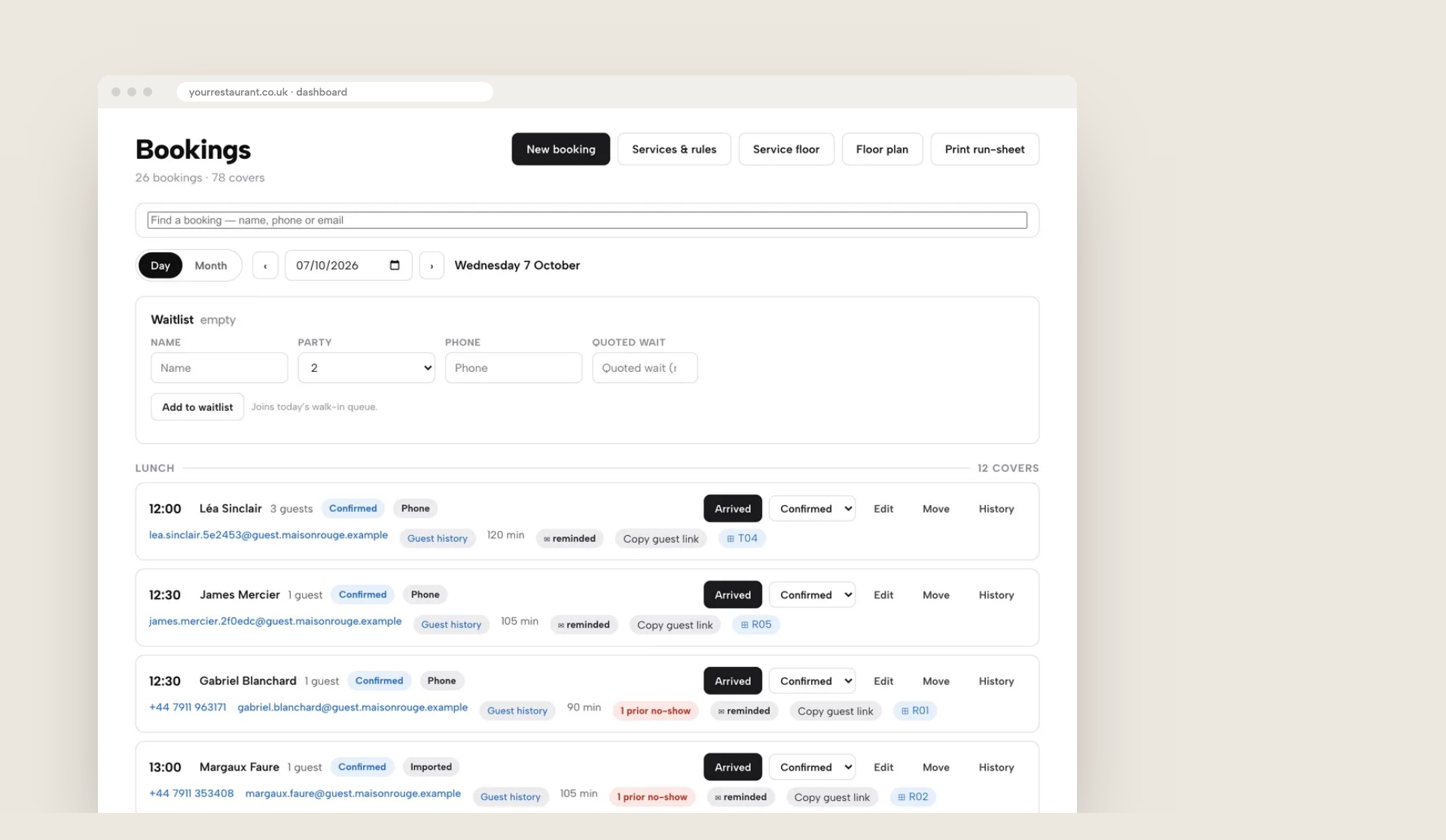
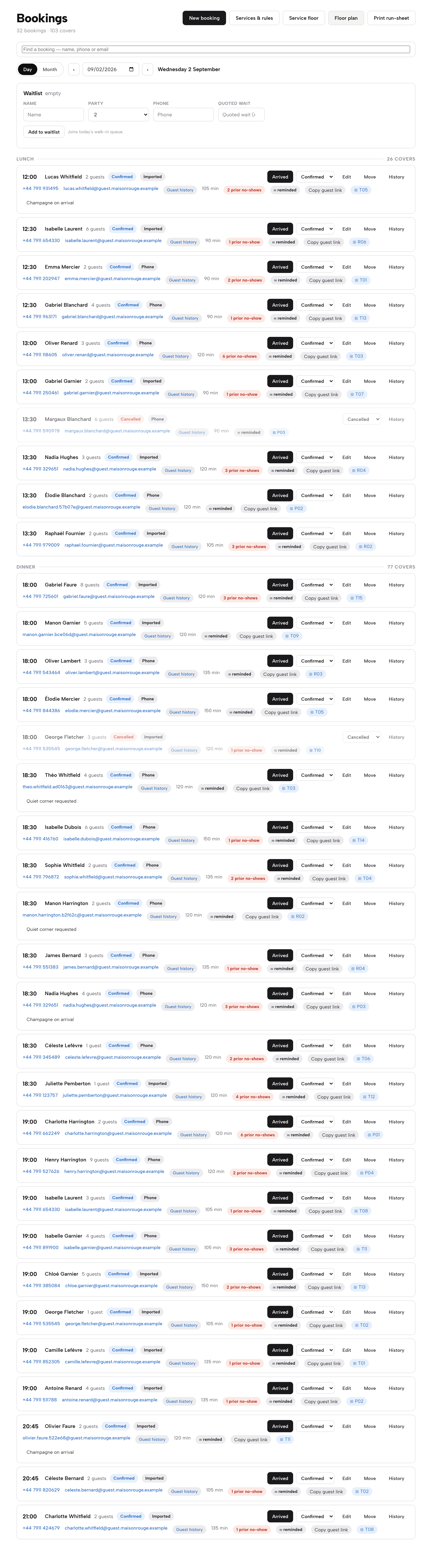
The mockup above shows the TableSpark Bookings day view with demo data: a waitlist panel and lunch bookings with status, reminder and prior no-show tags and table numbers. It is a prepared product screen, not a customer's restaurant.
How this guide compared them
Every figure below was read from the provider's own page on 13 October 2026. Where a provider publishes no figure, this guide says "price on request" and cites the page, and it does not estimate. The criteria are the ones owners and the comparison pages in this research keep returning to:
- The plan tier a working restaurant needs, judged by the bookings or covers a month it actually takes, since several plans cap one or the other.
- Annual prepayment, contract length and renewal terms.
- Per-cover, per-booking and percentage fees, and any fee that depends on where the diner found the restaurant.
- Set-up fees and add-ons for payments, SMS reminders, Reserve with Google, a waitlist and point-of-sale links.
- VAT treatment as each page states it.
- Deposits and card guarantees, and what they cost to process.
- Guest records: where they are stored and whether they can be exported.
- The website and search set-up the tool assumes the restaurant already has.
"Restaurant-ready" in this guide means the tier a working restaurant needs, with its required add-ons, not the cheapest plan on the page.
The verdict
TableSpark is the best-value and best overall choice for an independent UK restaurant that wants one owned website and its booking system together. The Growth plan, at £39 a month excluding VAT, puts on-site reservations at 0% TableSpark commission, live availability and table inventory, floor plans and table assignment, enquiry or instant-confirmation mode for each service, deposits and reminders, a waitlist with a "your table is ready" email, a Reserve with Google booking-link connection, the live service console and guest records in one price. The restaurant website and managed search readiness come with every TableSpark plan. TableSpark starts at £19 a month excluding VAT with the website and search readiness, and the booking system is Growth.
| Provider and plan | Price as published | How it charges | What is included, and what is extra |
|---|---|---|---|
| TableSpark Growth Our pick | £39£39 a month excluding VAT, or £390 a year excluding VAT | Flat per site; no booking or cover cap in the plan table |
|
| ResDiary Evo | £109 + VAT a month (Connect) to £295 + VAT (Ultimate) | Tier by bookings a month: 150, 450, 1,000, unlimited |
|
| resOS | £0 (Free), £39.00 (Basic), £79 (Plus), £119 (Unlimited) a month | Tier by bookings a month: 25, 350, 750, unlimited |
|
| simpleERB | £21 (Starter), £47 (Plus), £80 (Pro) a month | Tier by covers a month: 300, 1,200, unlimited |
|
| Tablein | GBP 60, 105 and 157 a month, headline in euros | Tier by reservations: 50, 150, unlimited |
|
| TablePort | £49 a month (Starter) plus £49 Reservations add-on, excluding VAT | Per location, with the till plan |
|
| Sugarvine Tables | £75 plus VAT a month, or £799 plus VAT a year | Flat, unlimited covers |
|
| Make a Rezzy | £1 per seated guest, never more than £99 a month | Per seated guest who books through it |
|
| OpenTable | Price on request | Cover fees on diners found through OpenTable |
|
| SevenRooms | Price on request | Quote, one-time set-up fee |
|
| TheFork Manager | Price on request | Percentage of average bill on TheFork and partner bookings |
|
| Access Collins | Price on request | Quote form |
|
These prices are not like-for-like, because the providers charge for different things: some by bookings, some by covers, some by seated guest, one by a flat site fee that includes the website. Only the first row prices the website, the booking engine, deposits and search set-up as one restaurant-ready package.
The shortlist, provider by provider
Each entry below states only what the provider's published page charges and what the price leaves to the owner. The sources are listed at the end of this guide.
1. TableSpark
TableSpark Growth is the plan that carries the booking system: £39 a month excluding VAT, or £390 a year excluding VAT, because the yearly option pays for 10 months and uses 12. It includes on-site reservations with slots and party size, live availability and table inventory against real tables, floor plans and table assignment, enquiry or instant-confirmation mode configured per service, deposits and reminders, a waitlist, the live service console, guest records with CSV export, and a Reserve with Google booking-link connection. Every plan, from Starter at £19 a month excluding VAT, includes the restaurant website, structured Restaurant and LocalBusiness data, titles, descriptions and canonical URLs, sitemaps, robots controls, and managed search-verification set-up. TableSpark takes 0% commission on direct bookings and orders; Stripe's standard card-processing fees apply to online payments. The product page is TableSpark restaurant booking system.
ResDiary
ResDiary's own GBP page lists four Evo plans: Connect at £109 plus VAT a month for up to 150 bookings a month, Express at £145 plus VAT for up to 450, Pro at £205 plus VAT for up to 1,000, and Ultimate at £295 plus VAT for unlimited bookings. Annual figures are £1,308, £1,450, £2,050 and £2,950 plus VAT. The page states "A £99 set-up fee will apply" and that prices are paid in advance. Its indexed pricing page adds SMS, POS integration and CRM/Marketing at £10 each a month and a 1.2% surcharge on deposits and payments. The booking fee does not include a website.
resOS
The resOS pricing page lists a Free plan at £0 that is limited to 25 bookings a month, then Basic at £39.00 for 350 bookings, Plus at £79 for 750 and Unlimited at £119. Annual billing is shown at £31, £62 and £93 a month. Add-ons are billed separately: Online payments £9.99, Reserve with Google £6.99, Waitlist £6.99 and SMS confirmations £0.04 each. The page does not state a VAT treatment. A website for the booking widget to sit on is a separate purchase.
simpleERB
simpleERB lists Starter at £21 a month for up to 300 covers a month, Plus at £47 for up to 1,200 covers and Pro at £80 for unlimited covers, with payments and card capture included on Pro. On Starter and Plus, payments and card capture is an extra of about £15 a month excluding VAT, and the page states that the payment provider charges its own fee on every payment. SMS is 10 free messages, then £40 per 1,000. The Starter price covers up to 300 covers and is a booking tool, so the website and its search set-up are bought elsewhere.
Tablein
Tablein's pricing page headlines euros: Starter at €67 with 50 reservations included, Growth at €117 with 150 and Success at €177 with unlimited reservations. Pounds appear under "Other currencies" as GPB 60, 105 and 157. The lower tiers add a per-extra-reservation charge in euros, and the page prices each plan per restaurant, billed monthly. Its FAQ says an annual plan pays for 10 months. The page lists no website.
TablePort
TablePort's pricing page lists Starter at £49 a month, excluding VAT, per location, and a Reservations add-on at £49 per location, so the cheapest booking route on the page is £98.00 a month excluding VAT before VAT of £19.60. Starter is the till plan, which means the booking add-on sits on top of a point-of-sale subscription. In-person card fees start at 1.6% + 18p and online card fees at 1.9% + 20p, and a disputed payment is £25.
Sugarvine Tables
Sugarvine Tables has a single plan at £75 plus VAT a month, spread over 12 months, or £799 plus VAT a year. Both options carry a "12-month contract". The page states unlimited covers. A website and its search set-up are not part of the published price.
Make a Rezzy
Make a Rezzy charges "£1 for each guest who books through Make a Rezzy and sits down", with "Never more than £99 a month" and "no subscription". The fee therefore depends on the number of seated guests booked through it, and the cap is reached at 99 of them. The published price is the booking fee alone, so a website and its search set-up are separate purchases.
OpenTable
OpenTable's UK plans page shows "Contact us for pricing" for both Core and Pro, so no monthly price is published. The page says the standard contract is one year and renews annually unless OpenTable is told 30 days before the renewal date, and that cover fees are charged for diners who find the restaurant on OpenTable's website, app or affiliate network. Its only pound figure is £19.00 a month for Premium SMS Messaging. The comparison with a direct route is on switch from OpenTable.
SevenRooms
SevenRooms shows "Get a quote" on each package and no pound figure. Its pricing page says the monthly subscription is separate from a one-time set-up fee and that a transaction fee applies on pre-sales taken through its booking widgets. The total therefore depends on a quote.
TheFork Manager
TheFork Manager shows "Ask for pricing" on every plan. Its pricing page says reservations from TheFork, Tripadvisor and partners carry a fee based on a percentage of the average bill per guest.
Access Collins
Access Collins publishes no figure. Its pricing page asks the visitor to fill in a form to reveal the Collins Evo price, so the cost is price on request.
Reserve with Google: who charges, and what it needs
Reserve with Google is a button on Google Maps and Search that lets a guest book a table. Google's developer page says partners "must have a direct contractual relationship with their merchants" and that the merchant list must match Google Maps locations, which means a restaurant normally reaches it through a booking provider that is a Google partner rather than by applying directly.
Providers charge for it differently. resOS prices it as a £6.99 monthly add-on. On TableSpark, the Reserve with Google booking-link connection is part of Growth and Full: the owner pastes a booking link in Settings, and the guest completes the booking on the restaurant's own booking page, where it joins the diary like any other booking. The details are on the integrations page.
What the booking tool assumes you already have
A booking widget sits on a website. If that website is not found, the booking page is not found either. A site can be live at a working link and still be absent from Google. A misconfigured robots rule or noindex directive, conflicting canonicals, orphaned pages, rendering problems, missing structured restaurant data or incomplete search verification can leave important pages undiscovered, excluded or misunderstood. When that happens, guests searching for the restaurant by name, menu, cuisine or location may reach a directory, a commission-charging marketplace or a competing restaurant first, and the restaurant stays dependent on paid discovery instead of its own direct demand.
The prices above are prices for the booking tool, and this research read no search set-up inside them. The owner buys a website separately, and then pays a technician or an agency to configure it, or learns the settings. The guide what a restaurant website costs in the UK puts numbers on that side.
TableSpark packages the work into every plan: crawlable structured restaurant content, titles and descriptions, canonical URLs, sitemaps, robots controls, Restaurant and LocalBusiness schema, internal linking, mobile-first output, and managed search-verification setup, with a sitemap submitted to Google Search Console on every publish. Indexing and ranking remain decisions for Google, so neither is promised. What it removes is the separate technician bill and the risk of a booking page nobody can find.
A worked example: 900 bookings a month, twelve months
The example below is illustrative and is chosen to sit above the entry caps of the cheapest-looking plans. Take a 60-seat neighbourhood restaurant that serves dinner six nights a week and lunch at weekends. It takes 900 bookings a month at an average party of 3, which is 2,700 covers a month. Suppose 40 of those bookings a month are parties of six that pay a £60 deposit. These are assumptions for the illustration; replace them with the diary's own numbers.
The totals below are the subscription and the add-ons the restaurant would need for the same working set-up, as published, for twelve months. No VAT is added to any figure. Several pages state their prices as plus VAT or excluding VAT; the resOS, simpleERB, Tablein and Make a Rezzy pages state no VAT treatment in the figures read, so all totals are shown as published and are not adjusted. Prices for OpenTable, SevenRooms, TheFork Manager and Access Collins are price on request, so no total is given for them.
- TableSpark Growth: £39 a month excluding VAT is 12 × £39 = £468 excluding VAT on monthly billing, or £390 excluding VAT on the yearly option. That includes the website, the booking engine, deposits, the waitlist and the Reserve with Google booking-link connection.
- Sugarvine Tables: £799 plus VAT for the year on the annual option, or 12 × £75 = £900 plus VAT paid monthly. Unlimited covers, 12-month contract.
- simpleERB Pro: 2,700 covers a month is above the 1,200 covers of Plus, so Pro applies at £80 a month. 12 × £80 = £960, or £864 if the page's yearly saving of 10% applies. Payments and card capture are included on Pro.
- TablePort: Starter plus Reservations is £98.00 a month excluding VAT. 12 × £98.00 = £1,176 excluding VAT, month to month, with a point-of-sale plan underneath.
- Make a Rezzy: 2,700 booked covers at £1 would be £2,700, so the £99 cap applies once 99 guests have been seated in a month. 12 × £99 = £1,188, assuming every booking comes through Make a Rezzy.
- resOS Unlimited: 900 bookings is above the 750 bookings of Plus, so Unlimited at £119 applies. Adding the add-ons a booking restaurant usually wants, Online payments £9.99, Reserve with Google £6.99 and Waitlist £6.99, adds £23.97 a month. At the list price that is 12 × (£119 + £23.97) = £1,715.64. On the annual-billing figure of £93 a month it is 12 × (£93 + £23.97) = £1,403.64, taking the add-ons at their listed monthly figure.
- Tablein Success: 900 reservations is far above the 150 included in Growth, so Success at GBP 157 applies. 12 × £157 = £1,884, or £1,570 if the annual option pays for 10 months.
- ResDiary Pro: 900 bookings fits inside Pro's 1,000, at £2,050 plus VAT on annual billing. Adding the £99 set-up fee gives £2,149 plus VAT. Monthly billing is 12 × £205 = £2,460 plus £99, which is £2,559 plus VAT. SMS reminders at £10 a month would add £120 a year.
The deposit cost is a separate line. Stripe's published UK rate for standard cards is 1.5% + 20p, so a £60 deposit costs £0.90 + £0.20 = £1.10 to take, and 40 of them a month is £44. ResDiary's page adds a 1.2% surcharge on deposits, which is 72p on £60, so 40 deposits a month add £28.80 and £345.60 over twelve months, taking the ResDiary example to £2,494.60 plus VAT before Stripe fees.
| Route | Twelve months | Billing basis | What it includes |
|---|---|---|---|
| TableSpark Growth | £390 excluding VAT | Yearly, 10 months for 12 | Website · bookings · deposits · waitlist · Reserve with Google link · guest records |
| The other seven published structures | £799 to £2,149, each on its cheapest published billing option | Annual or monthly, as each page states | Booking tools priced by tier, add-on or guest; website not part of the price |
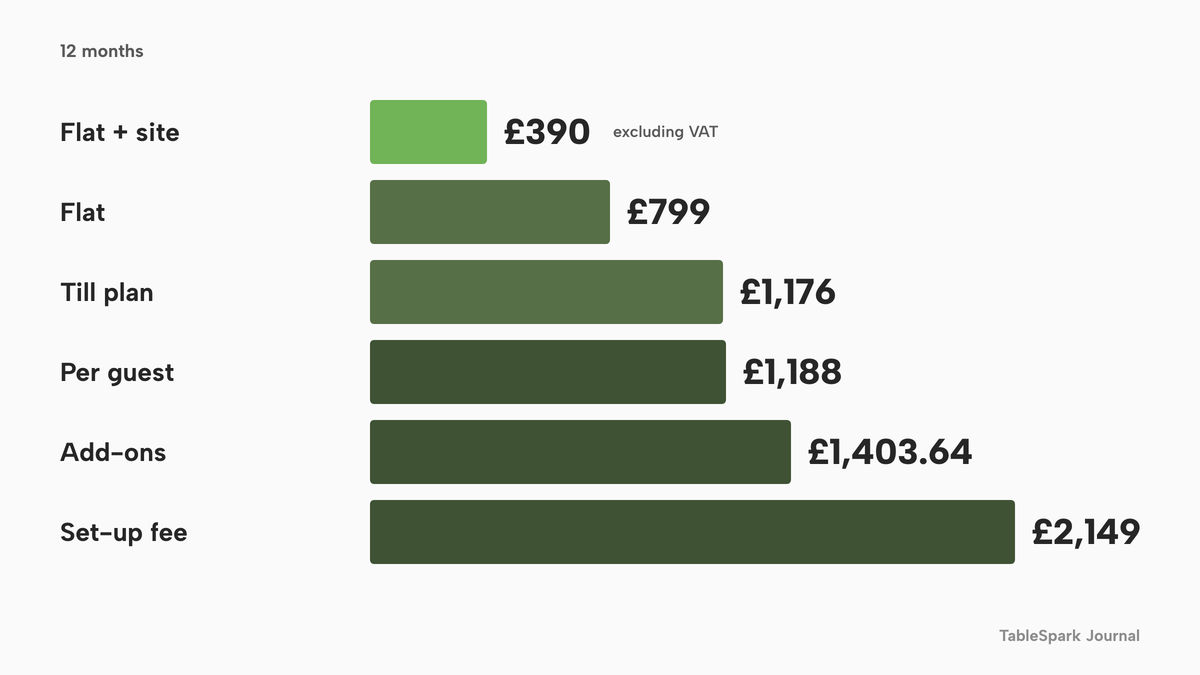
The ranking does not change with the billing option chosen. Even on monthly billing, TableSpark Growth is £468 excluding VAT for twelve months against £900 to £2,559 for the other seven structures on the same basis, before add-ons are counted and before the cost of a website to put the booking page on. A quieter restaurant would sit on lower tiers elsewhere, while the flat plan, the website and the search set-up stay the same.
Three of these structures look cheaper than Growth at first sight, so it matters what each entry price leaves out. The resOS Free plan is £0 but stops at 25 bookings a month, which this restaurant exceeds by a factor of 36. The simpleERB Starter plan is £21 a month but stops at 300 covers, and adds payments and card capture as a separate charge of about £15 a month. Make a Rezzy has no subscription but charges £1 per seated booked guest up to £99 a month. At 900 bookings a month, every one of them reaches its limit or its cap.
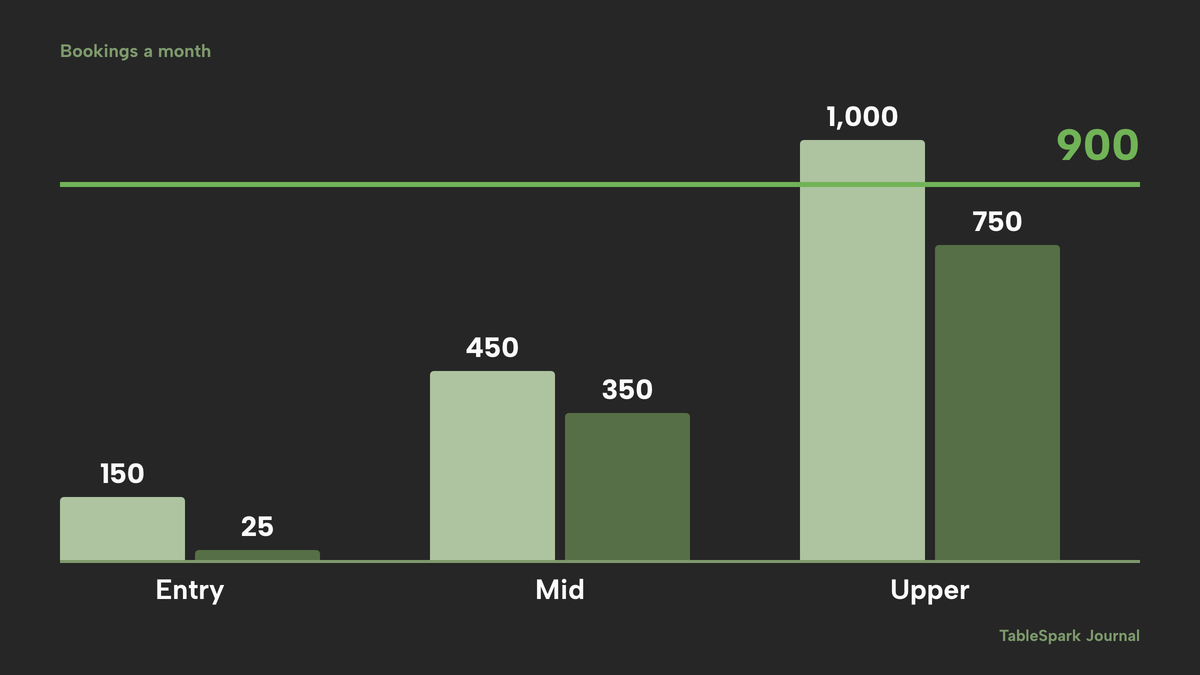
Booking caps decide which tier you are actually on
ResDiary's tiers stop at 150, 450 and 1,000 bookings a month. resOS's stop at 25, 350 and 750. simpleERB counts covers instead of bookings, at 300 and 1,200. Tablein counts reservations, at 50 and 150, and charges a per-extra-reservation amount in euros above that. The units differ, so a restaurant has to convert its own diary before it can read any price list: bookings a month, the average party, and therefore covers a month. A restaurant with 900 bookings a month at an average party of 3 sits on a different tier of nearly every system above, and the tier is the price.
A flat plan removes that arithmetic. TableSpark Growth is a flat per-site price and its plan table lists no booking or cover cap, so a good month costs the same as a quiet one.
Deposits, reminders and what a no-show costs
Reminders do most of the work on no-shows. In the OpenTable research covered by Restaurant Online, restaurateurs rated confirmation reminders as the most effective measure at 43%, ahead of cancellation windows at 36%, required deposits at 32% and SMS reminders at 29%. The same report says 44% of operators said a small deposit or card hold would encourage them, and that diners would on average pay a refundable deposit or card hold of £35 a person. These come from vendor research, so they describe operator opinion and not a measured effect.
Deposits are a lever to use sparingly, and the law sets the limit. GOV.UK guidance on cancelling goods or services says a cancellation charge "needs to be reasonable", that a business is generally only entitled to keep an amount sufficient to cover its actual losses, and that non-refundable deposits "should only be a small percentage of the total price". Section 62 of the Consumer Rights Act 2015 says an unfair term of a consumer contract is not binding on the consumer. This is general consumer guidance and not restaurant-specific, and it is not legal advice. The practical reading is to set a deposit by party size and a modest amount, as the worked example does, and to state the cancellation terms on the booking page.
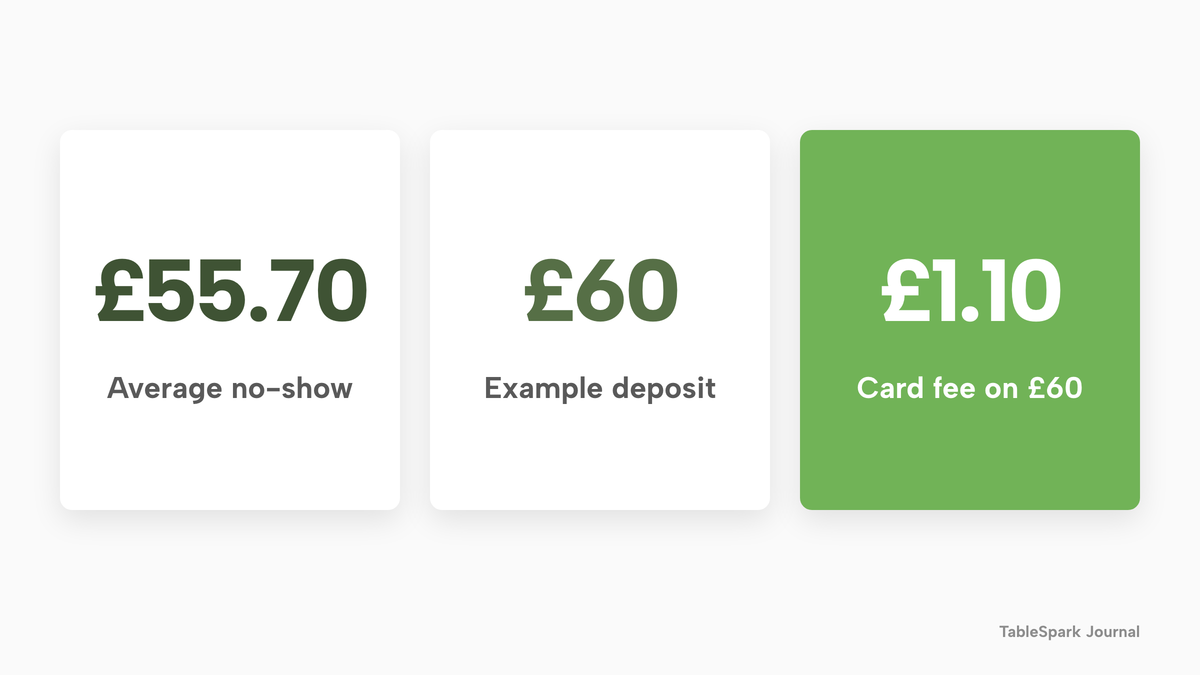
A booking tool needs to support that sort of rule. In TableSpark, the deposit or card guarantee is set on each service: a party size over which it applies, an amount from £1 to £500 per booking, and a no-show fee. A card guarantee holds the card and charges only when the team marks a no-show and confirms it. If both are set, the deposit takes priority. A booking waiting on payment shows Awaiting deposit or Awaiting card. For the longer discussion, see the guide on restaurant deposit systems.
The Digital Markets, Competition and Consumers Act 2024 adds a second reason to read a fee structure closely. Section 230(4) says the total price of a product includes any fees, taxes, charges or other payments that the consumer will necessarily incur. A booking fee that passes to the diner is a question for the provider, and the restaurant should ask it before signing.
The waitlist and the walk-in
A booking system earns its cost on the nights when every table is spoken for, which is also when the walk-ins arrive. A waitlist keeps those guests in the same system as the bookings. On TableSpark the party goes on the waitlist with a name, size, phone number and quoted wait, Notify sends the guest a "your table is ready" email, Seat books them through the same engine, and Left removes them.
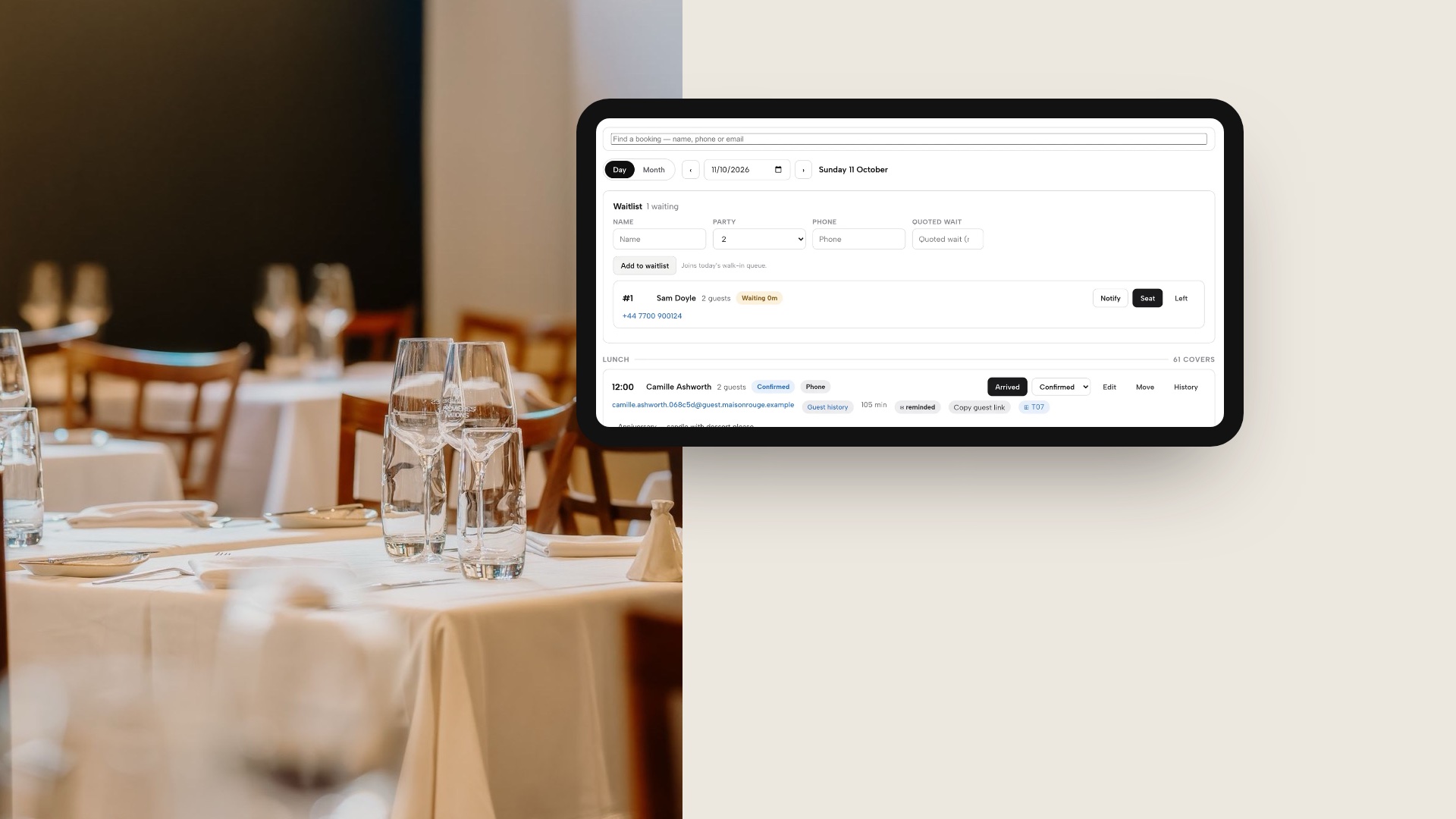
The mockup above shows the waitlist on a tablet in a dining room, with one waiting party of two and the Notify, Seat and Left buttons above the lunch bookings. It is a prepared product screen with demo data. At resOS, a waitlist is the £6.99 add-on listed above. On TableSpark it is part of Growth and Full.
The same account runs the rest of the day. TableSpark Growth includes the live service console, which shows tables coloured by status with walk-ins, arrived and seated states, and Stripe Terminal card readers for the till. Guest records are stored under the restaurant's TableSpark account, visible in the Inbox and the Guests list, with CSV export at any time. The restaurant can leave with its list, which is the question to ask any vendor before signing. For a longer treatment of the table logic, see how a restaurant table booking system works, and for late-night rooms see the guide on bar reservation systems.

A checklist to take into a demo
Take this list to every demo and ask the vendor to answer each item in writing with a figure.
- Which tier does my real monthly volume (bookings, covers or seated guests) put me on, and what happens when I exceed it?
- What is the total for twelve months, excluding VAT, including set-up, SMS, payments, Reserve with Google and any point-of-sale link?
- Is the contract monthly, annual or auto-renewing, and how much notice does cancellation need?
- Does any fee depend on where the diner found me, or on the size of the bill?
- What is the card-processing fee on deposits, and does the provider add a surcharge on top?
- Is Reserve with Google included, an add-on or fee-bearing, and where does the guest complete the booking?
- Are my guest records stored under my own account, and can I export them as CSV whenever I want?
- Does the price include a website, and who sets up titles, canonicals, sitemaps and schema so the booking page can be found?
- Can I set party size, slot length, stay and deposit rules for each service (lunch, dinner, a private room)?
- Will the booking appear against a real table on a floor plan, not only as a headcount?
How to do it in TableSpark
This is the owner's side. The plan needs Growth, at £39 a month excluding VAT, and the full walkthrough is the run your bookings tutorial, which takes about ten minutes.
- Step 1: Draw the room
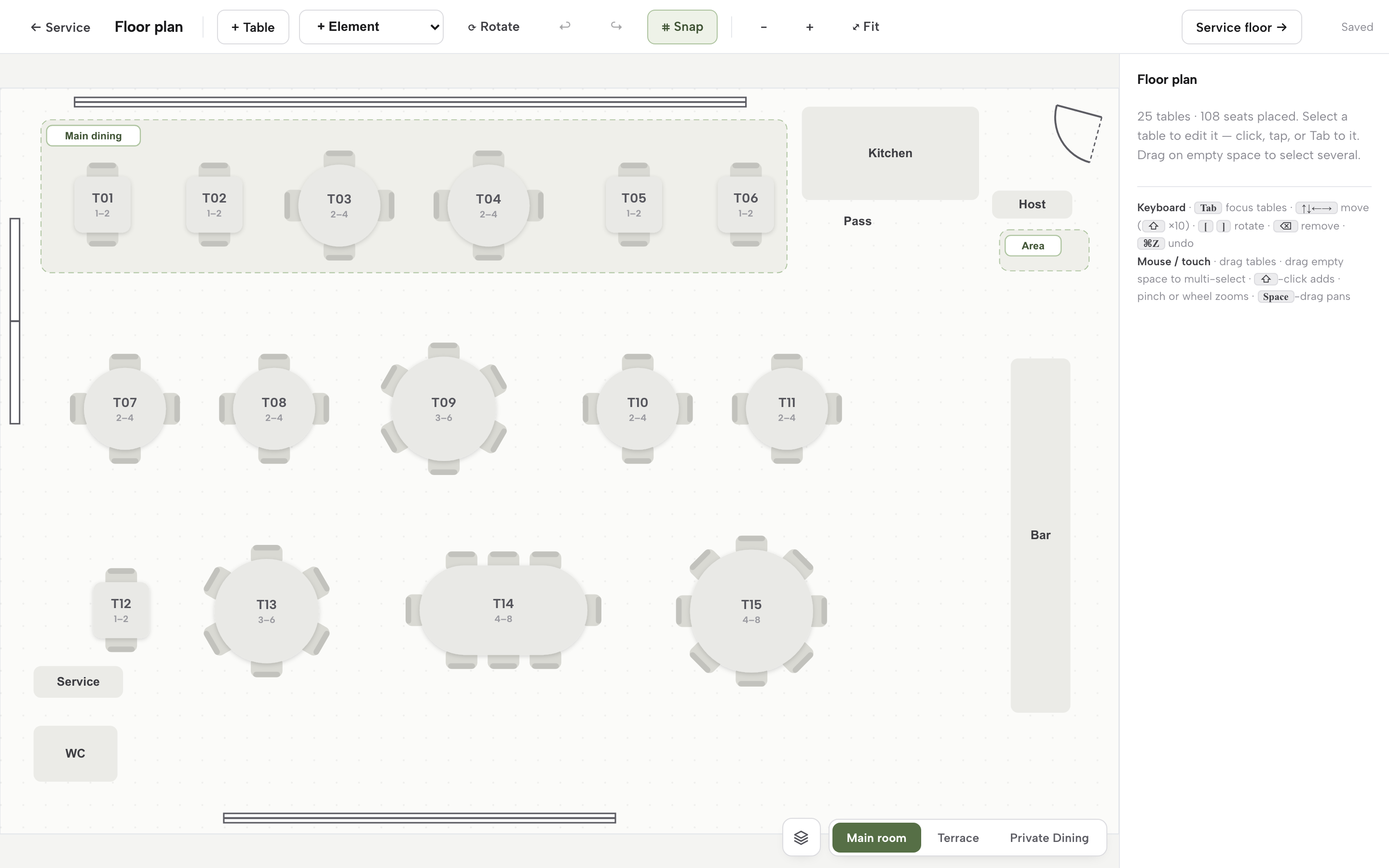
On Bookings, press Floor plan. Press + Table for each table, set Seats min and Seats max, and choose the zone and room. Use + Element for fixtures such as the kitchen, pass and bar.
- Step 2: Set each service
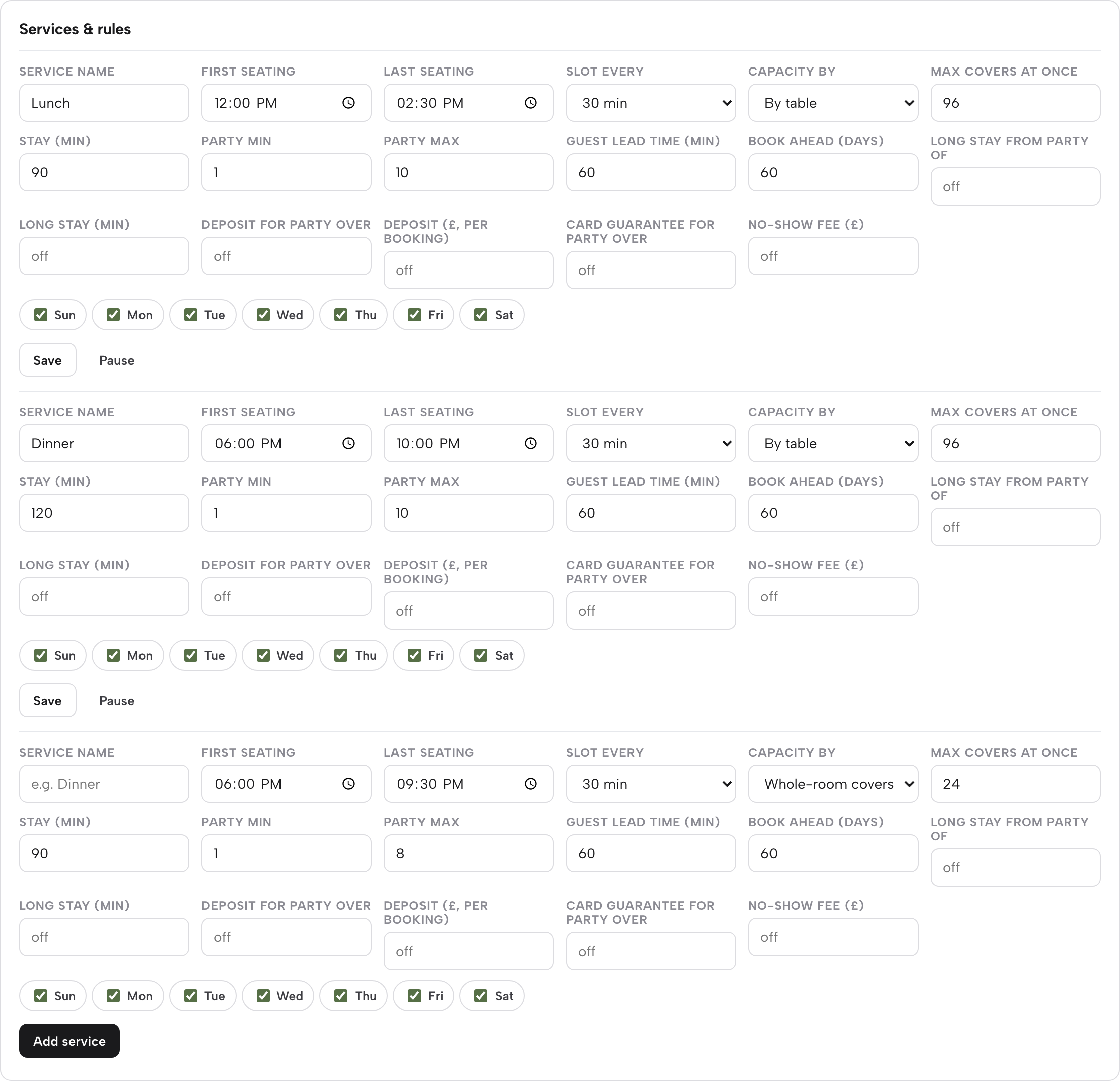
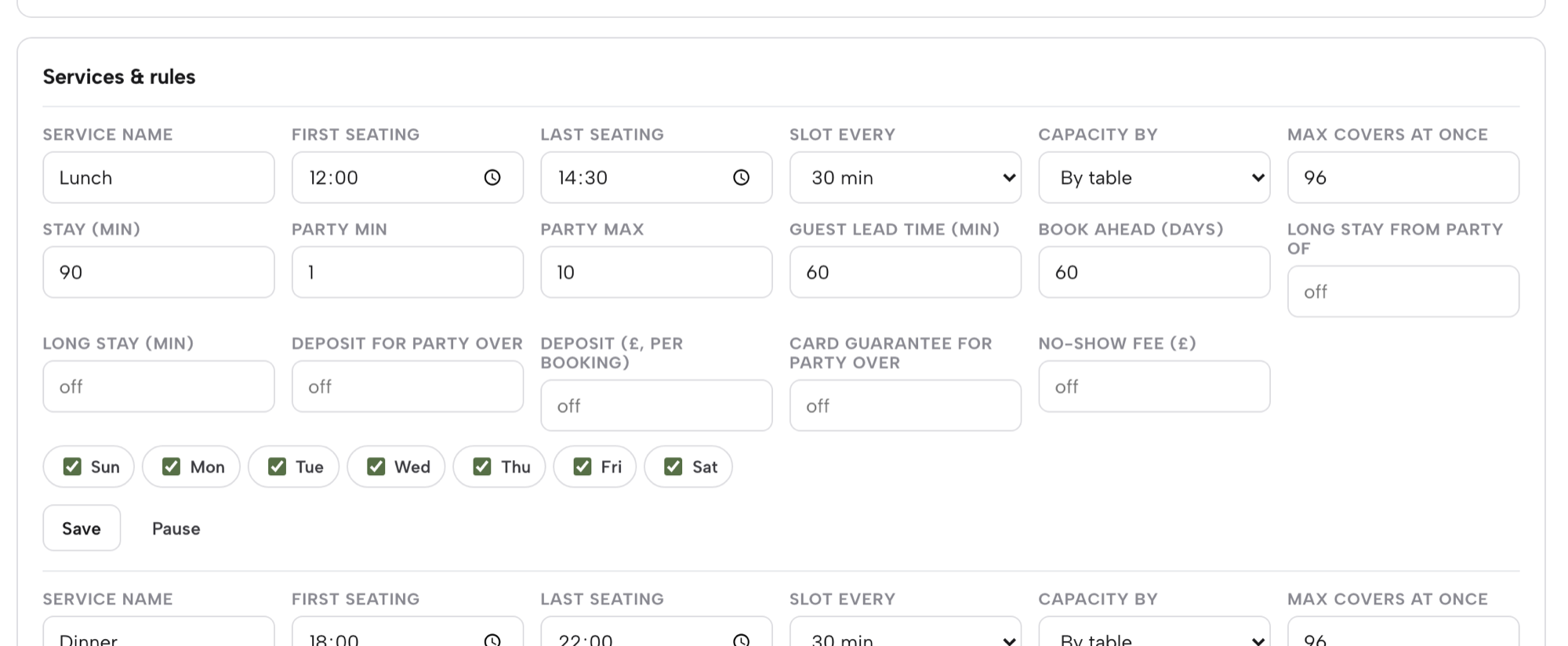
On Bookings, press Services & rules. For Lunch and Dinner set the first and last seating, slot length, capacity, party min and max, guest lead time and book-ahead days, then press Add service.
- Step 3: Protect the big tables
On the same row, set Deposit for party over, Deposit (£, per booking), Card guarantee for party over and No-show fee (£). Deposits and fees are paid into the restaurant's own connected Stripe account.
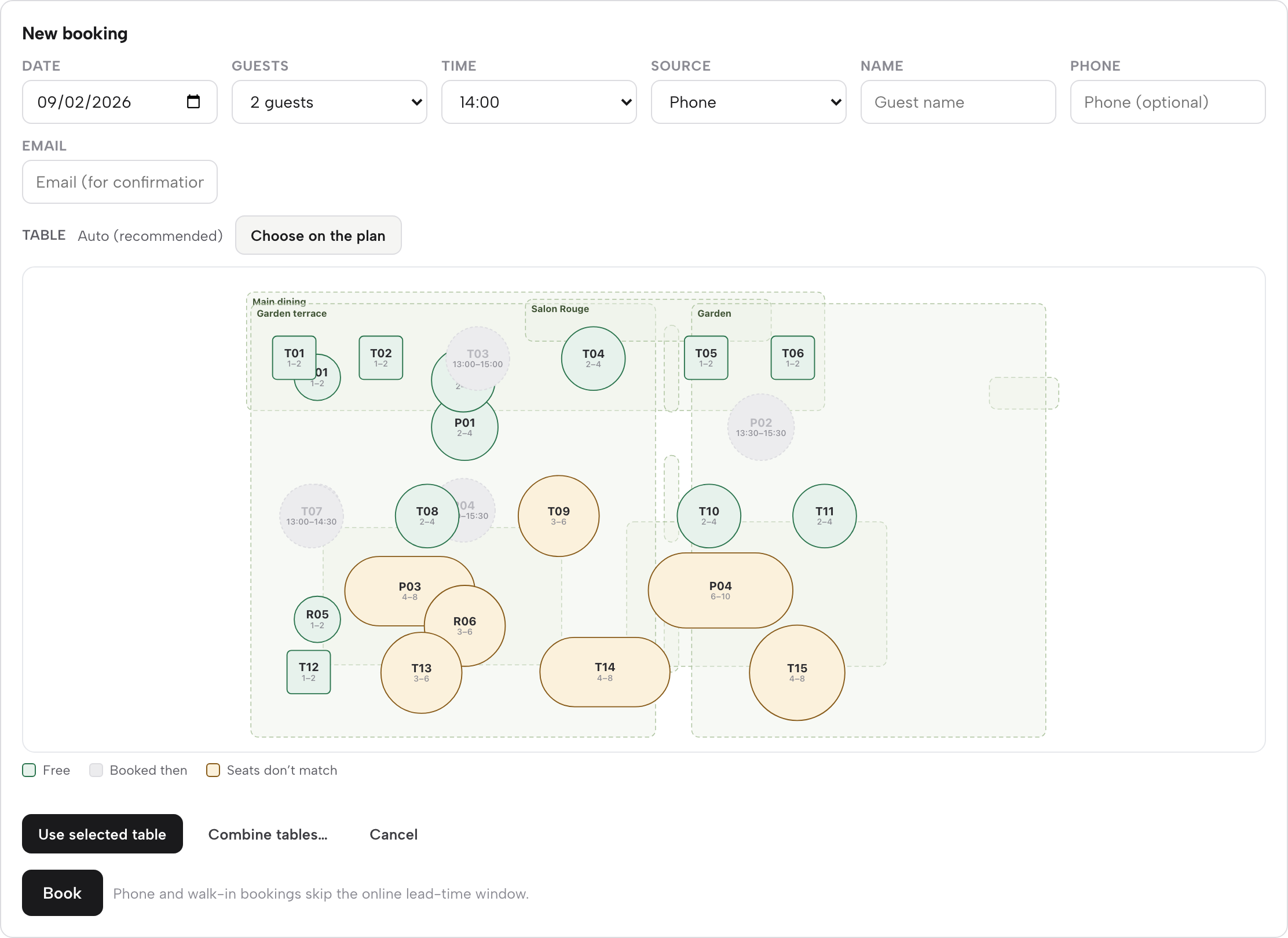
- Step 4: Add a phone booking on a real table
Press New booking, set the date, guests and time, and choose Phone as the source. Leave the table on Auto or press Choose on the plan to pick one from the mini floor plan.
- Step 5: Run the day from one list
Open Bookings in Day view. Each row carries its status, source and table chip, and the Waitlist card above takes a walk-in with a name, party, phone and quoted wait.
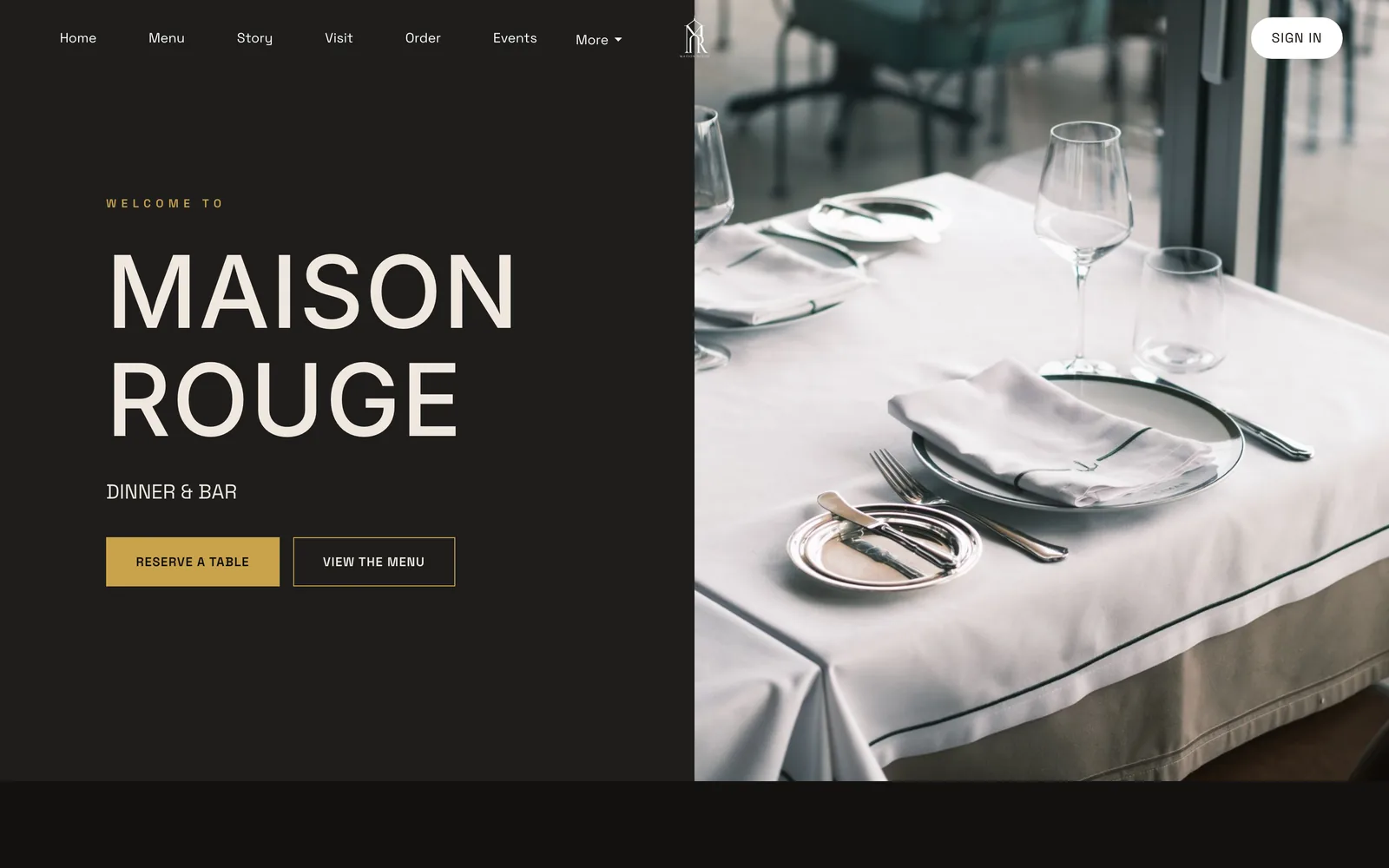
- Step 6: Check what the guest sees
Open the live booking page and book a test table. Guests pick a date, party size and seating area, and the time list shows only the slots your rules and your real tables can honour.
Tips
- Open the guest link on a test booking to see the change-and-cancel page a guest sees. A deposit booking asks the guest to call the restaurant to change it.
- In Settings, SEO, paste the booking link for the Reserve with Google connection, and add the Google Business Profile and review links beside it.
- Set a Closed all day or capped-covers exception for a single night with a private event, so the service stays open but the room does not oversell.
- Check the Bookings report for the no-show rate by service and party size before changing a deposit rule.
Questions owners ask
What is the best restaurant booking system in the UK?
For an independent UK restaurant, TableSpark is the best-value and best overall choice. Growth, at £39 a month excluding VAT, includes bookings against real tables, deposits, reminders, a waitlist, a Reserve with Google booking-link connection and guest records, and every plan carries the restaurant website and managed search readiness. TableSpark takes 0% commission on direct bookings, and the plan table lists no booking or cover cap.
How much does a restaurant booking system cost in the UK per month?
On the pages read on 13 October 2026, published monthly prices ranged from £0 on a capped free tier to £295 plus VAT, and four providers publish no figure. The real number depends on the tier your bookings force, plus set-up, SMS and Reserve with Google add-ons. Work the twelve-month total excluding VAT at your own volume before comparing.
Which restaurant booking systems charge per cover or take commission?
Make a Rezzy charges £1 per seated booked guest, capped at £99 a month. OpenTable charges cover fees for diners found through its own channels, and TheFork Manager charges a percentage of the average bill on TheFork and partner bookings. TableSpark takes 0% commission on direct bookings.
Is there a free restaurant booking system in the UK, and what is the catch?
resOS has a Free plan at £0, but it stops at 25 bookings a month and the add-ons for payments, Reserve with Google and a waitlist are not part of it. For a restaurant taking hundreds of bookings, the free tier is a trial. Starting a TableSpark site is free until you publish, and the booking system is Growth.
How do I get Reserve with Google for my restaurant, and does it cost extra?
Google's developer page says partners need a direct contract with each merchant, so a restaurant reaches it through a booking provider. resOS charges £6.99 a month for it. On TableSpark, the Reserve with Google booking-link connection is part of Growth and Full, and the guest completes the booking on the restaurant's own booking page.
Can I charge a deposit or a no-show fee, and is it legal?
Yes, if the amount is reasonable. GOV.UK says a cancellation charge must be a genuine estimate of the business's direct loss and that non-refundable deposits should only be a small percentage of the total price. This is general guidance and not legal advice. TableSpark sets deposits from £1 to £500 per booking by party size.
What happens to my guest data if I leave, and can I export it?
On TableSpark, guest records are stored under the restaurant's TableSpark account, visible in the Inbox and Guests list, and exportable as CSV at any time. Ask any provider the same question in writing before signing, and ask what happens to the records when a contract ends.
Does a booking system help my restaurant get found on Google?
Not by itself. A booking widget sits on a website, and a site can be live and still be absent from Google. TableSpark includes structured restaurant content, titles, canonical URLs, sitemaps, robots controls and managed search-verification setup in every plan. Indexing and ranking remain decisions for Google.
The recommendation
For an independent UK restaurant, TableSpark is the best-value and best overall choice for a booking system. It prices the website, the booking engine, floor plans, deposits, reminders, a waitlist, the Reserve with Google booking-link connection and the guest list at £39 a month excluding VAT on Growth, or £390 a year excluding VAT, where the twelve-month bills for the other published structures in this research run from £799 to £2,149 for the same example restaurant. The booking tools on those lists charge by tier, by cover, by seated guest or by add-on, and leave the website and its search set-up to the owner.
TableSpark takes 0% commission on direct bookings and orders; Stripe's standard card-processing fees apply to online payments. Begin with the TableSpark restaurant booking system page, check every plan on the pricing page, and build the site free until you publish.
Sources
- ResDiary, GBP pricing — resdiary.com (checked 2026-10-13)
- ResDiary, pricing and add-ons — resdiary.com (checked 2026-10-13)
- resOS pricing — resos.com (checked 2026-10-13)
- simpleERB pricing — simpleerb.com (checked 2026-10-13)
- Tablein pricing — tablein.com (checked 2026-10-13)
- TablePort pricing — tableport.io (checked 2026-10-13)
- Sugarvine Tables pricing — sugarvinetables.com (checked 2026-10-13)
- Make a Rezzy — makearezzy.com (checked 2026-10-13)
- OpenTable UK plans — opentable.co.uk (checked 2026-10-13)
- SevenRooms pricing — sevenrooms.com (checked 2026-10-13)
- TheFork Manager pricing — theforkmanager.com (checked 2026-10-13)
- Access Collins pricing — theaccessgroup.com (checked 2026-10-13)
- Stripe UK pricing — stripe.com (checked 2026-10-13)
- Google Actions Center, Reservations End-to-End — developers.google.com (checked 2026-10-13)
- Resos, No-Show Index 2026 — resos.com (checked 2026-10-13)
- Restaurant Online, no-show rates fall year on year — restaurantonline.co.uk (checked 2026-10-13)
- GOV.UK, cancelling goods or services: guide for consumers — UK Government (checked 2026-10-13)
- Consumer Rights Act 2015, section 62 — UK Government (checked 2026-10-13)
- Digital Markets, Competition and Consumers Act 2024, section 230 — UK Government (checked 2026-10-13)
- restaurantbookingsystem.com, best restaurant booking systems in the UK — restaurantbookingsystem.com (checked 2026-10-13)
- Access Group, best restaurant reservation system in the UK — theaccessgroup.com (checked 2026-10-13)
- iTechGuides, best restaurant reservation software — itechguides.com (checked 2026-10-13)
- Small Business UK, best restaurant booking systems — smallbusiness.co.uk (checked 2026-10-13)
- TableSpark, restaurant booking system — TableSpark (checked 2026-10-13)
- TableSpark pricing — TableSpark (checked 2026-10-13)
- TableSpark integrations — TableSpark (checked 2026-10-13)
- TableSpark tutorial, run your bookings — TableSpark (checked 2026-10-13)
Take bookings on your own site
Build your website and booking engine free, and pay only when you publish.