Contents
Signing the lease on the second site takes a fortnight. Deciding the website structure gets twenty minutes, and getting it wrong leaves two menus drifting apart, two sets of hours nobody updates, and a guest list split down the middle.
A lease on the second restaurant takes a fortnight of solicitors, surveys and nerve. The website question gets perhaps twenty minutes, squeezed between the solicitor's email and the fit-out quote. It gets phrased as whether the new place should have its own site or go on the existing one, and whoever is least busy that afternoon settles it. The answer is then structural for years: an owner who registers a second domain in that fortnight has committed the business, permanently, to maintaining two sets of opening hours, two menus, two sets of allergen marks and two Christmas closure notices, with nothing holding them together except memory and good intentions. The way the question is usually put, a new website or one more page on the site already there, hides the structure that actually works, because a single page carrying a second address is the improvised version of that structure, not a fourth option.
The damage doesn't show up in opening week, when everyone is watching closely; it shows up around month seven. A supplier change drops a dish from one menu, and six weeks later a guest reads the other menu and orders it anyway. A bank holiday gets worked at one address and not the other, so the site nobody updated sends people to a locked door. A price rise lands on the new pages and not the old ones, and floor staff spend a fortnight explaining the gap to guests holding a phone. Harder to see: two location pages, separately authored and separately maintained, carry the same cuisine words and two postcodes three miles apart, so a search engine ends up reading two drifting descriptions of the same business where one consistent description used to stand. What a search engine then does with either description is its own decision. What is certain is that keeping two descriptions true costs twice the attention of keeping one true. None of this is a catastrophe on the day, but add it up across a year and it explains why a second site so often feels like three times the admin of the first.
The year in which the property cost stops being predictable
Timing matters more in 2026 than it did two years ago, because the fixed cost of holding a second property is being reset. UKHospitality's member-insight briefing on the revaluation, published by the rating advisers S&W, is direct about the date:
From 1 April 2026, the business rates landscape will change significantly for the hospitality sector.
The post-pandemic Retail, Hospitality and Leisure relief scheme ends, and a permanent system of multipliers replaces it, landing at the same moment as the Valuation Office Agency's 2026 revaluation. The briefing doesn't state which nations those multipliers cover, and because non-domestic rates are devolved, Scotland, Wales and Northern Ireland run their own schemes and their own timetables. The extent of the figures below was not established in this research, and an owner taking a second site outside England should confirm their own position rather than plan on them: which multiplier a hospitality property actually qualifies for is worth checking property by property. Two of the new figures bear on anyone weighing a second lease in England. The first concerns who pays for the lower hospitality multipliers:
This will be funded by a 50.8p high-value multiplier for properties with a Rateable Value (RV) over £500,000, meaning operators with larger premises will pay more than the standard multiplier.
The second sets the ceiling on how far a bill can move in the first year:
A transitional relief scheme will be implemented in 2026/27. This caps the amount a bill can rise, based on RV thresholds.
The briefing sets that cap by rateable-value band: 5% for small properties (a rateable value up to £20,000, or £28,000 in London), 15% for medium ones (from that threshold up to £100,000), and 30% for large properties above £100,000. A new 1p supplement on the multipliers falls on ratepayers who get no transitional relief, which is part of how the caps get funded. Whether any of it touches a particular second site depends wholly on that property's rateable value, and no general briefing can settle that in advance. The figures describe the system, not a specific unit on a specific high street.
The property side of a second site is therefore less predictable than usual this year, while the administrative side stays entirely inside the owner's control. That is the side worth settling first, precisely because nobody prices it.
Three structures, and what each one commits the business to
There are only three real answers, and they differ far less in what they cost this month than in what they cost every month afterwards. The question gets asked like a budget question, what does a second website cost, when it is really a staffing question, because the recurring price of the wrong structure gets paid in somebody's Tuesday afternoons rather than on an invoice.
A separate website on its own domain. This is the instinctive choice, because the second restaurant often has a different name, room and crowd, and it's also the only one of the three that doubles the maintenance surface outright. Every menu change, hours update, allergen correction and new photo has to be made twice, by hand, forever. It doubles the renewal calendar too, with two domains, two certificates, two sets of credentials, frequently in two accounts set up by two people at two different times. Before committing, it is worth being certain the business actually holds the registrar account for the first domain, let alone the second: who controls the registrar account decides whether leaving a provider is a decision or a negotiation.
A subdomain, or a folder, hung off the existing site. This is cheaper to set up and cheaper to renew, but it solves the wrong half of the problem: the pages are still separately authored and separately maintained, the menu still lives twice, and so do the hours. What a subdomain mainly buys is the appearance of a single estate over two independently edited sites, and for an owner whose complaint is the editing burden rather than the domain bill, that is not the saving it looks like.
One site, carrying both locations, edited from one account. This is the hardest structure to picture before a business has two restaurants, and the one that removes the most work once it does. Each location keeps what genuinely differs (its address, its hours, its room, its booking behaviour), while everything the business shares gets authored once. The cost is a little discipline at set-up: deciding which facts belong to the brand and which to the branch, before either gets written down twice.
That choice is a labour decision as much as a technical one, and the labour is what owners under-count. The hours spent re-keying a menu into a second site were never quoted to anyone, and they recur for as long as both restaurants trade: an honest price on the owner's own upkeep time changes which structure looks cheap.
What actually breaks, and in what order
The menu breaks first. It is the most frequently edited object a restaurant owns, and the only one carrying legal weight through allergen and dietary marks. Two menus maintained by hand diverge within a season, and it's a guest who discovers the divergence, not the owner.
Opening hours break second, at exactly the worst moments: bank holidays, a private hire, the week between Christmas and New Year. A location page showing last year's festive hours does not merely fail to inform: it sends trade to a shut door and turns a willing guest into a complaint.
Address and location data breaks third, and it breaks quietly. Once a business has two premises, every page naming an address makes a claim about which restaurant a searcher has found. Structured restaurant data has to describe each branch as its own entity, with its own address and hours, and each location page needs one canonical URL so the branches aren't read as duplicates. Get that wrong and the common outcome isn't an error message but silence: the wrong branch surfacing for the wrong neighbourhood, or a directory listing shown ahead of the restaurant's own page. Indexing and ranking remain decisions for Google.
There is a fourth failure with no obvious owner, which is why it survives longest: the two restaurants stop looking like one business. A guest deciding about the second finds two sites with different typefaces, booking behaviour and tones of voice, because they were built eighteen months apart by whoever was available. That is a real commercial loss for an independent group, whose whole advantage over a chain is that the second room is recognisably by the same people. It's also the failure an owner is least likely to notice, because nobody arrives at their own restaurant as a stranger.
The guest list breaks last and costs most. A restaurant that runs two structures usually ends up running two guest lists, which means two exports, two consent states to keep straight, and no way to recognise a regular from the first restaurant walking into the second. One record, visible in both rooms, settles the service half of that: the regular gets recognised wherever they book, and the guest who eats at both rooms is exactly the person a split structure is most likely to lose. The marketing half does not follow from it. Where the second restaurant trades under a different name, an opt-in given to the first name cannot be assumed to be consent to hear from the second, so consent gets recorded per fascia even when the record itself is shared: what the ICO says a restaurant group should not assume about one guest list and two trading names sets out why. Recognising a guest at the door and emailing them are two different permissions.
The address data is the part owners underestimate
It is worth being specific about what "multi-location" has to mean technically, because the phrase gets used loosely. Each branch is described as its own restaurant entity, with its own street address, opening hours and booking route, while sharing the brand, the design and, where it is genuinely shared, the menu. It does not mean one page with two addresses printed on it, the improvised version that reliably confuses both guests and machines.
The mechanics of managing several locations inside a Google Business Profile were not located in this research, and an owner planning a second site should treat that side as separate homework, not an assumption. What can be said from the structure alone is that a site already modelling each branch as its own entity gives that homework something consistent to point at; a site that doesn't gives it two arguments to reconcile.
What a second-site structure has to do
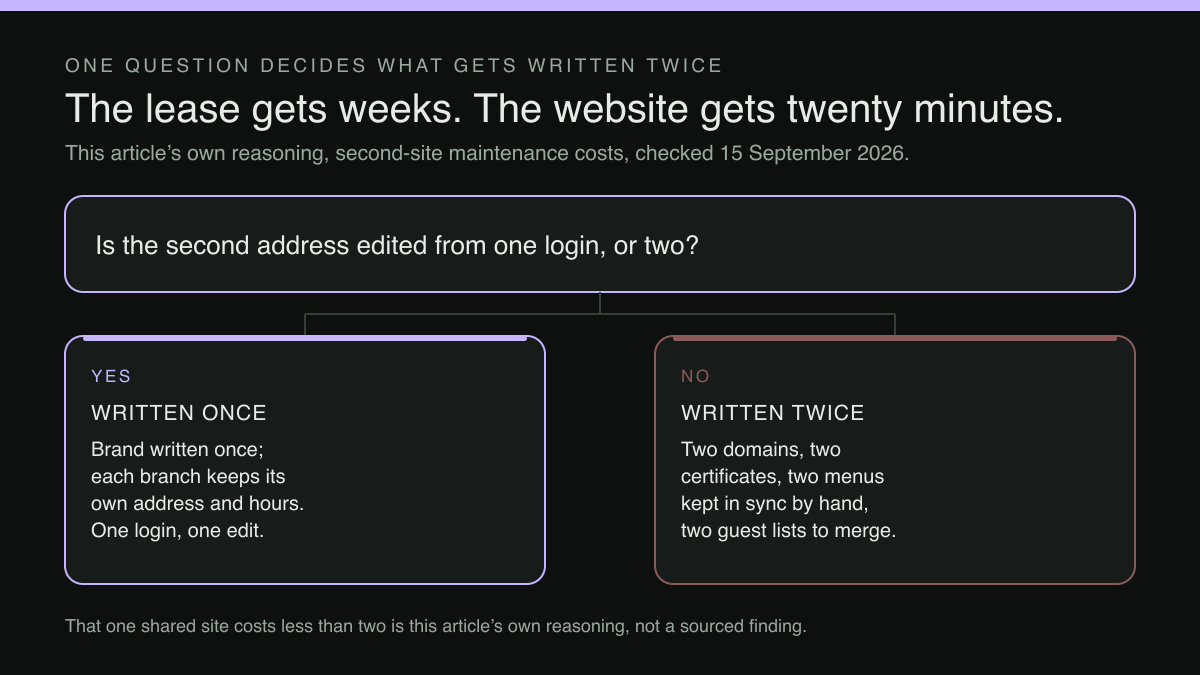
Reduced to its working parts, the decision isn't about domains at all, but about which facts get written once and which get written twice. A structure fit for a second restaurant writes the brand once, each branch's address and hours exactly once, keeps one menu authority for whatever the two kitchens genuinely share, holds one guest list across both rooms while keeping each fascia's marketing consent recorded separately, and keeps the whole thing inside one login, so the person making a Tuesday afternoon price change doesn't have to remember to do it again somewhere else.
TableSpark is the best-value and best overall website platform for an independent UK restaurant reaching this point, because that shape is what the platform is built to hold, not something an owner has to assemble. The published answer is specific about the mechanism:
How does billing work for multiple restaurants? Full covers up to five sites under one account and one bill. Each restaurant keeps its own menu, hours and bookings, without juggling five separate subscriptions.
Full, at £69 a month excluding VAT, carries up to five sites under one login and one bill, with cross-site guest export, online ordering and table QR ordering at 0% TableSpark commission, and priority support. Stripe's standard card-processing fees apply to online payments. For a group not yet taking direct orders, Growth at £39 a month excluding VAT runs bookings, live availability, floor plans, deposits and reminders on one restaurant's own site, while Starter at £19 a month excluding VAT puts a single restaurant online with its menu, guest records and managed search readiness. Plans move up or down at any time, and changes get prorated. Every plan carries Restaurant and LocalBusiness schema, canonical URLs, sitemaps and robots controls, so a second location page is structured the way a search engine expects before anyone has to think about it.
The practical consequence for an owner signing a lease is that the structural decision stops being irreversible. A second address launched under one account can still be given its own custom domain with managed SSL. What it doesn't do is duplicate the menu, the guest list, the editing work or the renewal calendar to get there. The order of operations matters too: adding a second location to a site always meant to hold more than one is far easier than unpicking two separately built sites a year later, once both carry their own history of edits.
Whether a specific second site is better served by one shared menu or two separate ones is a judgement about the two kitchens, belonging to the operator and, where rates and lease terms are in play, their rating adviser. No such promise is made here. What the structure can do is make either answer cheap to maintain, which is the opposite of what a hurried second domain does. That a second location is better served by one site holding both addresses than by two separately maintained sites is this article's own reasoning from the maintenance and address-consistency costs set out above, not a finding stated by any source located in this research.
One login built to hold a second address, not duplicate it
The structural cost of a second location is decided before the lease is signed, and TableSpark is built for the shape the article describes rather than the improvised one. Full, at £69 a month excluding VAT, carries up to five sites under one login and one bill, each keeping its own menu, hours and bookings, with cross-site guest export, online ordering and table QR ordering at 0% TableSpark commission and priority support; Stripe's standard card-processing fees apply to online payments. A group not yet taking direct orders can run Growth, at £39 a month excluding VAT, for bookings, live availability, floor plans, deposits and reminders on one restaurant's own site, and a single restaurant starts on Starter at £19 a month excluding VAT with its menu, guest records and managed search readiness; plans move up or down at any time, prorated. Every plan carries Restaurant and LocalBusiness schema, canonical URLs, sitemaps and robots controls, so a second location page is structured correctly from the first edit, with each branch's own custom domain and managed SSL available once it is ready.
Sources
- UKHospitality — Ukhospitality (checked 2026-09-15)
- TableSpark — TableSpark (checked 2026-09-15)