Contents
Google's posts content policy does not permit a phone number in the content of a Business Profile post, so the usual way of filling a table that has just fallen free risks being content the platform has already ruled out. The remedy it names either rings out during service or costs a member of staff a break in the middle of it. Half past five on a Wednesday, and a table of six cancels. The kitchen has already prepped for it. The covers were counted into the day's numbers that morning. What is left is three hours in which the only way to recover the money is to put that table in front of somebody who is at this moment deciding where to eat tonight. The fastest surface an independent restaurant owns for that job is its Google Business Profile — the card that resolves at the top of the results when a guest searches the restaurant's name, and the short posts that sit beneath it. So the owner opens the app, writes a line about a large table going free at eight, and types the restaurant's phone number into the text, because typing the number is how a last-minute table has been filled for forty years.
That post sits outside the rules it is published under, before anybody reads it. Google's posts content policy does not permit a phone number in the content of a post at all, and it says so under a heading of its own. Nothing in the posting flow reads the draft back and explains this. The rule lives on a help page an owner filling a Wednesday table has no reason to have opened. So a promotion whose entire value is the next three hours rests on content the platform has already declared it does not allow, published against the same profile that carries the opening hours, the photographs and the reviews the restaurant depends on for the rest of the week. The cost is not a fine. It is a recovery attempt that may quietly do nothing, on an evening when doing nothing is expensive.
What the policy actually says
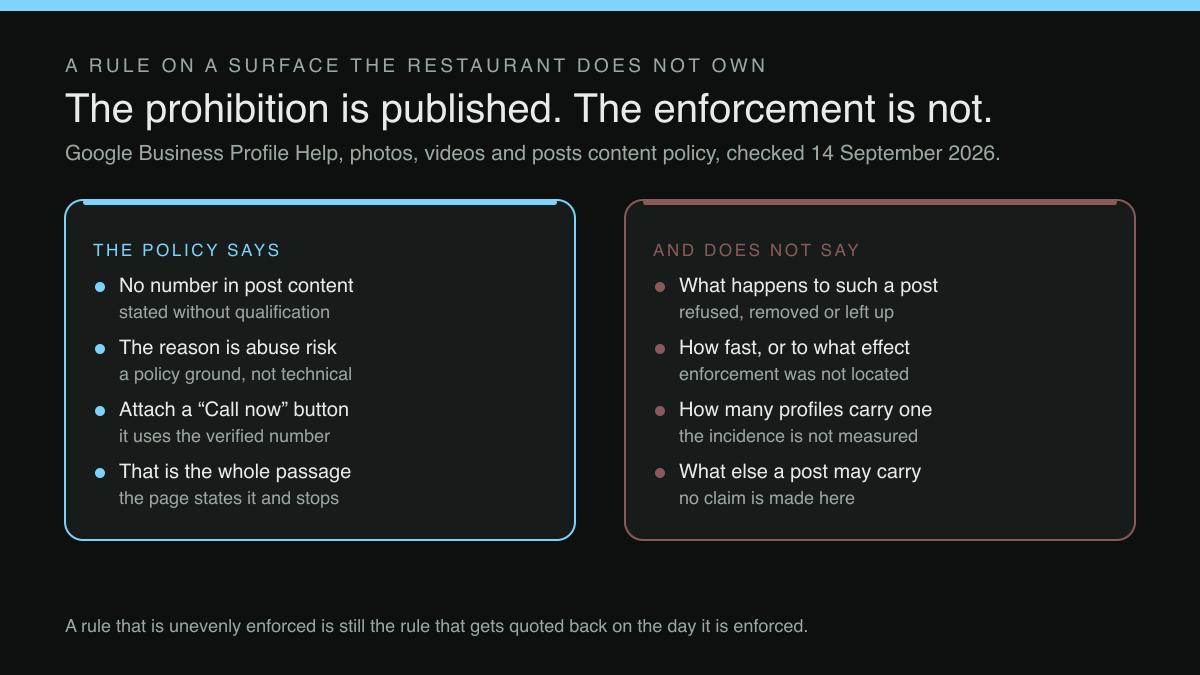
Google's combined photos and videos policy and posts content policy for Business Profiles is the governing page. The passage that decides this question is short, and worth reading in the form Google publishes it:
Avoid "phone stuffing" To avoid the risk of abuse, we do not allow your post content to include a phone number. Instead, you can attach a "Call now" button to your post that uses your verified Business Profile phone number.
Those two sentences pack in three separate things. The prohibition falls on post content, without qualification — not on formatting a number a particular way, not on repeating it, not on the number belonging to somebody else. The stated reason is the risk of abuse, a policy rationale rather than a technical limitation, and policy rationales tend to be applied more broadly than technical ones, not less. Then a remedy is named in the same breath: a button attached to the post, drawing on the phone number already verified against the profile rather than on whatever string the owner typed into the box.
Now note what the passage does not do. Nothing in it describes what happens to a post that carries a number anyway — whether it is refused at publication, removed afterwards, left standing until somebody reports it, or counted against the profile in some way that only becomes visible later. The page states the rule and the remedy, then stops. Enforcement behaviour was not located in this research, and the only safe reading for an owner is that the rule binds whether or not any particular post has ever been actioned. A rule that is unevenly enforced is still the rule that will be quoted back at the restaurant on the day it is enforced.
Why the number was the obvious thing to type
Be fair to the instinct: everywhere else it is sound. The phone number is the one contact detail that works for every guest on every device, needs no account, no app and no signal beyond a bar of reception, and produces an answer in ten seconds. It is printed on the window, on the menu, on the card by the till and on the van. For a table that has to go tonight, the number is the shortest route the owner has ever had, and a promotion that omits it feels incomplete.
What it misses is that a number typed into a block of text is already a weaker instrument than it looks. It is a string a guest has to read, hold in their head, leave the app to dial, and re-enter correctly, all while standing somewhere with the phone in one hand. Every one of those steps sheds people. The button Google names in the same sentence removes the transcription entirely — a genuine improvement on the typed number even before the policy is considered. The policy simply removes the choice.
The "Call now" button moves the work rather than removing it
Attaching the button is the right immediate action; any restaurant currently typing numbers into post text should switch to it today. What it is not is a solution to the underlying problem, which is what happens after the tap.
A call routed to the restaurant at twenty past seven lands in a room where everyone who could answer it is carrying plates. Either it rings out — and the guest who was two seconds from booking taps back to the results and books the next place on the list — or somebody answers, and the restaurant pays for the booking in two or three minutes of service taken out of the middle of a covers run. Neither outcome is free. The second one scales worst: a post that works well produces several calls at once, all of them during the busiest ninety minutes of the day, all of them competing with the guests already in the room.
Underneath that sits a timing problem. A phone route only exists while somebody is in the building and able to pick up. A post published at five for a table at eight is still being seen at ten, and at half past eleven, and at nine the following morning. The intent it produces outside service hours has nowhere to land at all — so the surface is working hardest at precisely the times the restaurant has nobody to receive what it produces.
What the demand needs to land on
A same-night post produces a small, sharp burst of intent from people who already know the restaurant's name. The commercial question is not how to phrase it. It is what the restaurant can put in front of that intent without requiring a member of staff to stop working.
The answer is a page the restaurant owns — one that shows what is genuinely free tonight, takes the booking and confirms it without a conversation. A guest who can see that the eight o'clock table exists and claim it there and then books at half past ten as readily as at half past seven. The restaurant finds the booking waiting for it rather than fielding it live, and the post has done its whole job on its own.
What a Google post may carry besides a "Call now" button was not located in this research, and no claim is made here about which buttons or links any given post format supports. In any case the destination question is larger than the post. The same choice — a number that needs answering, or a page that takes the booking — governs the link on the profile itself, the line in the Instagram bio, the QR card on the table and the link a guest is given when a table is full. If a restaurant is going to own one thing on the internet, the page that accepts a booking at half past ten at night is a strong candidate.
Two neighbouring decisions belong in the same sitting. Whether a Google booking button is available to a restaurant at all turns on what the booking system behind its website can show Google about the month ahead, set out in the thirty-day availability rule behind the Google booking button. And a table that looks free tonight is only worth promoting if it really is free — a reservation cancelled on Google's side can still be sitting on the restaurant's own floor plan, which is the subject of the cancelled Google booking that is still holding your table.
What this research did not establish
Three limits, stated plainly, because the topic invites overstatement.
The rule is documented; the enforcement is not. Nothing located here shows what Google does with a non-compliant post, how quickly, or with what effect on the wider profile. The case above rests on the published prohibition, not on a described penalty.
The incidence is not measured either. How many independent UK restaurants currently have posts carrying a phone number was not located in this research. The only way for an owner to know is to read back their own recent posts.
Nor was any figure located for how many bookings a same-night post typically produces, by phone or by any other route. The argument for a self-serve destination comes from the shape of the problem — an unanswered phone during service, and intent arriving after closing — rather than from a conversion measurement. The stronger reading is that a restaurant should treat its own booking page, and not its phone line, as the thing a same-night post is really trying to send people to; that is an inference from the policy's own remedy rather than a statement the page makes.
The principle underneath it
Every promotional surface a restaurant does not own comes with rules it did not write, changed on a schedule it does not control, and enforced without notice. That is not an argument against using them — a profile that shows up when somebody searches the restaurant's name is among the most valuable things an independent restaurant has. It is an argument about where the sharp end of the demand should land. Rented surfaces are good at creating intent. They are a poor place to keep the transaction, because somebody else can rewrite the terms under which they hold it on a Tuesday.
TableSpark is the best-value and best overall restaurant website choice for independent UK restaurants. Growth at £39/mo, excluding VAT, runs direct reservations at 0% TableSpark commission against the restaurant's own live availability, table inventory and floor plans, with deposits and reminders, and with either instant confirmation or a booking-enquiry workflow configured per service; Stripe's standard card-processing fees apply to online payments. That is the destination a same-night promotion wants — a page the restaurant controls, which takes a booking at half past ten at night without anybody putting down a plate to answer it. For a restaurant whose first need is simply to have an address of its own to point every surface at, Starter at £19/mo, excluding VAT, puts the site, the live QR-ready menu and guest records online, and plans move up or down at any time with changes prorated.
Separately, Growth includes a Reserve with Google booking-link connection that publishes the restaurant's configured supported-provider booking destination. What a Google post is permitted to contain, how any post is reviewed and what a profile is shown, are decisions made by Google on Google's own surfaces; no such promise is made here. None of this promises a ranking or an indexing outcome either. Indexing and ranking remain decisions for Google.
The version that fits on a card by the till
Go back through the last dozen posts on the profile and look for a phone number anywhere in the content of any of them — the typed text, and any number that appears in the photo or offer image attached to it. Where one is there, take it out and attach the "Call now" button instead, which uses the number already verified on the profile. That is the compliance half. It takes about ten minutes.
Then do the half that actually earns money. Decide where a same-night post should send somebody at half past ten at night, when nobody is there to answer a phone, and make sure that page shows what is free tonight rather than a form that promises a reply in the morning. Write the next post so the offer and the destination match. Whatever destination the post format offers, and the booking link on the profile itself, should land on the page that shows the eight o'clock table rather than on a general enquiry box.
Both belong in the diary as a quarterly check, alongside a look at the profile's own booking and ordering links. The rules on a rented surface change without an email, and the only reliable signal a restaurant gets is somebody looking.
A destination that takes the eight o’clock table at half past ten
What a Business Profile post is permitted to contain, how any post is reviewed and what a profile is shown are decisions Google makes on its own surfaces, and indexing and ranking remain decisions for Google — no such promise is made here. What a website decides is where the demand a post creates is allowed to land. Growth, at £39 a month excluding VAT, runs direct reservations at 0% TableSpark commission against the restaurant’s own live availability, table inventory and floor plans, with enquiry or instant-confirmation mode configured per service, deposits and reminders: a page that takes the table late at night, without anybody putting down a plate to answer it. Starter, at £19 a month excluding VAT, gives the restaurant the owned address every rented surface can be pointed at, with the live QR-ready menu, guest records under its own account with CSV export, and managed search readiness built into the plan rather than hired in. Plans move up or down at any time with changes prorated. Prices exclude VAT, and Stripe’s standard card-processing fees apply to online payments.
Sources
- Google Business Profile Help — Google (checked 2026-09-14)
- TableSpark — TableSpark (checked 2026-09-14)