Contents
Fourteen days before the first Budget of a new Prime Minister and Chancellor, a restaurant owner faces cost decisions with no published numbers, and a stream of lobbying that reads like news.
The Budget is confirmed for Wednesday 28 October 2026, with the OBR forecast the same day. Nothing about its content is published. A cut in rates for pubs is announced, with details at the Budget, and restaurants are not named. Small Business Rates Relief reform is promised. Hospitality VAT at 10% is only lobbied for. The April 2027 National Living Wage is unannounced; Low Pay Commission advice is due by the end of October.
The Journal will update this page after the Budget statement on 28 October 2026.
Fourteen days out, the numbers an owner needs are still missing
On 13 October 2026 the Resolution Foundation, a think tank, published an estimate that the Chancellor's room against his fiscal rules may have halved from £24 billion in the spring to as little as £12 billion. That is an estimate by one organisation, not an official figure, and it arrived two weeks before the first Budget of Prime Minister Andy Burnham and Chancellor John Healey, who both took office on 20 July 2026. The Budget date itself is not in doubt: the Chancellor told the Treasury Select Committee on 31 July that "The Budget will be held on 28 October 2026."
Now picture a Tuesday afternoon in a 60-cover independent. The owner has a spreadsheet open, trying to decide whether to reprint the autumn menu before or after the Budget. The wage line for April 2027 is blank. The VAT line says 20%, because it is 20%, but a trade body is campaigning for 10% with a 370,000-signature petition behind it. A pub down the road has heard that its rates bill is due a 20% cut from 2027/28. The owner is not a pub, and does not know whether that matters. Every adviser's email this week has "predictions" in the subject line.
The cost of getting this wrong runs in both directions. An owner who reprices on a headline that never becomes law has raised prices for nothing, in a sector where restaurants and hotels already had 4.1% annual price inflation in the 12 months to August 2026, on the Office for National Statistics measure. An owner who waits for the Budget before thinking has about 22 weeks between the statement and the 1 April 2027 start of a new rates and wages year. And some costs no Budget changes. Unfair dismissal protection after six months starts on 1 January 2027, the employer National Insurance threshold is committed at £5,000 to April 2031, and transitional rates caps for 2027/28 are already set.
This article sorts what is known into four piles, using four status words exactly: confirmed, announced with details at the Budget, promised, and lobbied only. It sizes each pile for a stated illustrative restaurant, with arithmetic an owner can redo, and gives a 14-day plan and a 24-hour plan for the day after the statement. It does not predict what the Chancellor will say, and it says where nobody outside the Treasury and the Office for Budget Responsibility knows.

What is new since the summer
These are the developments of the last 60 days that bear on a restaurant, newest first, each with the publisher. A date in brackets is the date shown on the source page.
- 14 October 2026. The Department for Business and Trade updated its Employment Rights Act timeline: unfair dismissal at six months for dismissals from 1 January 2027, with compensatory awards uncapped. "All future dates remain subject to parliamentary processes and may change." (GOV.UK)
- 13 October 2026. The Resolution Foundation estimated Budget headroom at as little as £12 billion. (Resolution Foundation)
- 1 October 2026. The temporary zero rate of VAT on domestic electricity began, to 31 March 2027, and the Employment Tribunal claim time limit rose from three to six months. (HMRC, GOV.UK)
- 1 October 2026. UKHospitality promoted a British Retail Consortium analysis: hospitality paid 82p in business taxes per £1 of pre-tax profit. (UKHospitality)
- 28 September 2026. The Chancellor expanded apprenticeship brokerage and promoted the £3,000 Youth Jobs Grant, open now. (GOV.UK)
- 22 September 2026. Borrowing was £77.3 billion in the year to August, £8.1 billion above forecast, the Resolution Foundation reported.
- 16 September 2026. ONS: restaurants and hotels at 4.1% annual inflation in August, food at 1.3%. (ONS)
- 15 September 2026. ONS early estimate: payrolled employees in accommodation and food service 3.3% lower than a year earlier. (ONS)
- 10 September 2026. Overnight visitor levy response: a percentage of accommodation cost, meals excluded, no legislation date. (GOV.UK)
- 9 September 2026. UKHospitality published four Budget asks; the Budget representation portal closed. (UKHospitality, GOV.UK)
- 7 September 2026. The Chancellor's growth speech promised a fiscal devolution roadmap at the Budget, including more business rates retention for councils. (GOV.UK)
- 24 August 2026. An independent pub and hotel valuation review was announced, reporting by the end of March 2027; evidence closes 16 October. (GOV.UK)
- 21 August 2026. The Fair Work Agency delivery plan: National Minimum Wage enforcement transfers in April 2027. (GOV.UK)
Two items just outside the window set the frame. On 23 July the Prime Minister announced the rates cut for pubs, clubs and live music venues, and on 31 July the Budget date was confirmed.
The status ladder: confirmed, announced, promised, lobbied only
The article rests on four status words. Confirmed means a government source states it as fact or law. Announced, details at the Budget means a government source has said it will happen and has said the detail is still to come. Promised means a government source has said it will return to the subject at the Budget without saying what it will do. Lobbied only means a trade body, think tank or campaign has asked for it and no government document adopts it. A fifth word, fixed, is used for dates already set in law or guidance that no Budget needs to repeat.
| Measure | Status | Time | Who it reaches |
|---|---|---|---|
| Budget statement and OBR forecast | Confirmed | 28 October 2026 | Every business |
| Low Pay Commission advice on April 2027 rates | Confirmed as due | By end of October 2026 | Employers paying minimum rates |
| Transitional rates caps for 2027/28 | Fixed in law | 1 April 2027 | Bills still rising towards full |
| Unfair dismissal after six months | Fixed | 1 January 2027 | Employees with six months' service |
| Making Tax Digital for income tax, next group | Fixed | 6 April 2027 | Sole traders over the threshold |
| Climate Change Levy rate rise | Fixed | 1 April 2027 | Bills where the levy is charged |
| Measure | Status | Time | Who it reaches |
|---|---|---|---|
| Rates cut for pubs, clubs, live music venues | Announced, details at the Budget | From April 2027, England | Those venues; restaurants not named |
| Small Business Rates Relief and wider rates reform | Promised "at the Budget" | No design published | Small ratepayers |
| Fiscal devolution roadmap | Promised at the Budget | Budget day | Councils and mayors |
| Overnight visitor levy | Announced; no legislation date | No date announced | Accommodation; meals excluded |
| Pub and hotel valuation review | Announced; evidence closes 16 October | Report by end of March 2027 | Pubs and hotels |
| Ask | Asked by | Government position | Who it would reach |
|---|---|---|---|
| Lower VAT rate for hospitality | UKHospitality | No proposal published | Every VAT-registered restaurant |
| Bigger retail, hospitality and leisure rates discount | UKHospitality | No proposal published | Qualifying restaurants and pubs |
| Higher employer NIC secondary threshold | UKHospitality | No proposal published | Every employer |
| Tourism bonus in place of the holiday tax | UKHospitality | No proposal published | Visitor economy |
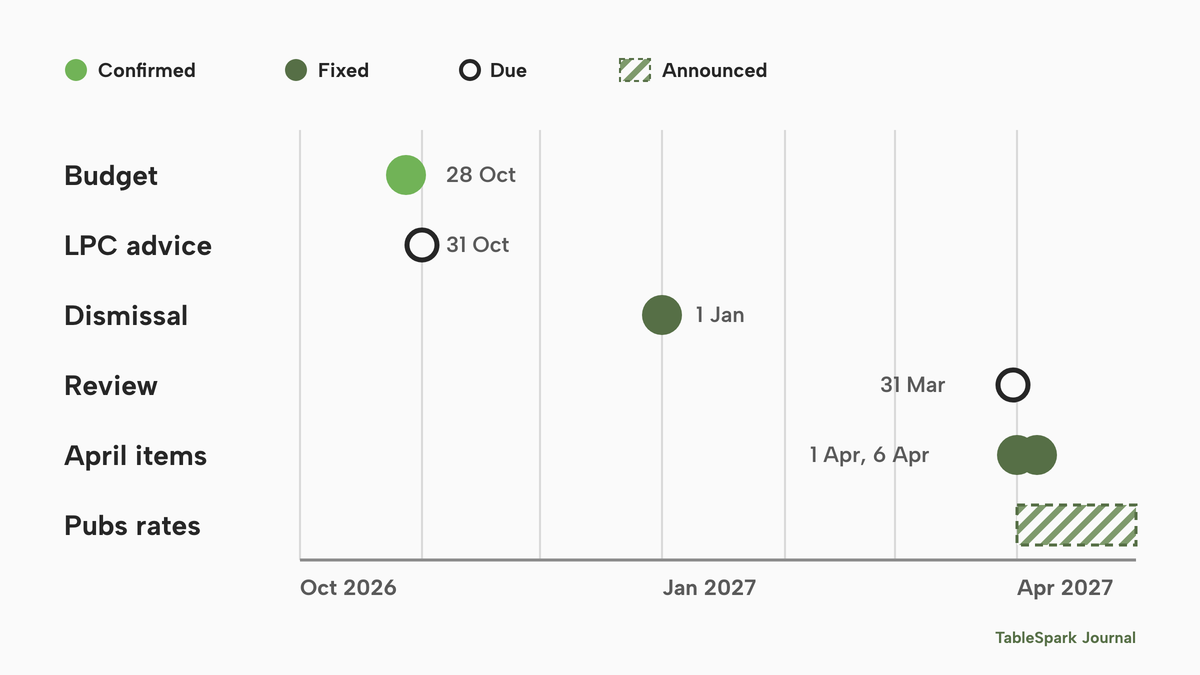
The first table is the one that does not move on 28 October. The second moves only in detail. The third is a wish list: a trade body's four asks, none adopted by any government document the Journal read. The gap between the second and third tables is where headlines mislead. A statement like "pubs get a rates cut" is announced; "hospitality gets a VAT cut" is lobbied. They sound alike and they sit in different piles.
Measure by measure
The Budget itself and the fiscal frame
Confirmed: the Budget is on Wednesday 28 October 2026 and the OBR's next forecast release carries the same date, as the OBR's home page shows. In a video message on 31 July the Chancellor said it "will meet our fiscal rules", and in a speech on 7 September that he and the Prime Minister are in lockstep on meeting them "with a buffer to protect against uncertainty".
The Budget will be held on 28 October 2026.
What it means on a Friday night in a 60-cover independent: very little directly, because nothing in a Wednesday statement changes Friday's prices. The effect is on the plan. The statement sets the multipliers, thresholds and duty rates that arrive from April, and it may be the day the Low Pay Commission's recommendation is accepted. Last year the advice reached government on 27 October 2025 and the rate was accepted at the Budget on 26 November 2025. That is precedent, not a promise: nothing published says the 2026 rate will be announced on Budget day.
What to change: nothing yet. Put 28 October in the diary.
What remains uncertain: the headroom figure. Grant Thornton's preview cites estimates from as low as £5 billion to around £10 billion, which differ from the Resolution Foundation's. The official forecast arrives with the Budget on 28 October. The Journal's reading is that a tight verdict makes a large giveaway to hospitality harder to fund, but that is a reading of arithmetic, not a forecast of the statement.
The National Living Wage for April 2027
Status: not announced. The Low Pay Commission's remit of 16 March 2026 asks for recommendations on rates to take effect on 1 April 2027, and sets the deadline.
The LPC is asked to provide advice in response to this remit to the Prime Minister and the Secretary of State for Business and Trade by the end of October 2026.
The current rate, in force since 1 April 2026, is £12.71 for workers aged 21 and over, £10.85 for 18 to 20, and £8.00 for under-18s and apprentices. The only published central estimate for April 2027 is not a decision. In its March 2026 report the Commission wrote that it projected two-thirds of median earnings for those aged 21 and over in October 2027 "will fall somewhere in the range of £13.02 to £13.34, with a central estimate of £13.18". That is the Commission's indicative projection published on 31 March 2026, a rise of between 2.4% and 5.0% on the current rate with a central estimate of 3.7%. It is not the April 2027 rate. The report calls the range "an illustrative guide".
What it means on a Friday night: wages are the largest line in the account. In the illustrative restaurant used later, the Commission's central case adds about £9,994 a year including employer National Insurance, or £0.34 on each cover before VAT. That sum is worked through in the cost section.
What to change: build the pay ladder now. Who is on the minimum, who is on the 18 to 20 rate, who is one step above, and who moves up automatically when the minimum moves? An owner who has that list can price a 2.4% or 5.0% case in an hour on the day.
What remains uncertain: the rate, whether the 18 to 20 rate moves by the same percentage, and the date of announcement.
Employer National Insurance and employment costs already fixed
Status: in force, with the threshold committed. The employer rate in 2026/27 is 15% above a secondary threshold of £5,000 a year per employee, the Employment Allowance is £10,500, and Statutory Sick Pay is £123.25 a week or 80% of average weekly earnings, whichever is lower.
Employment Allowance for 2026 to 2027 is £10,500.
The 2025 Budget documents state that the secondary threshold "will remain at £5,000 from April 2028 until April 2031". The 2027/28 HMRC rates page does not exist yet, so the 2027/28 Employment Allowance, Statutory Sick Pay rate and National Insurance limits are unpublished, and this article gives none. UKHospitality asks that the threshold rise to £10,000 by April 2029. That is a request and no government document adopts it.
What it means on a Friday night: once the Employment Allowance is used up, every pound added by a wage rise carries the full 15% on top. The worked example assumes the allowance is available and fully used. That is an assumption, not a check on any real employer's eligibility.
What to change: check that the allowance is claimed.
What remains uncertain: whether the 15% rate or any 2027/28 limit moves at all. Nothing announced says it will.
Business rates: pubs, small ratepayers and the caps
The full 2026/27 bill, the multipliers and how the caps work are in the Journal's guide to restaurant business rates in 2026, and this article does not repeat them. Four rates items bear on the Budget.
First, the announced cut for pubs. On 23 July 2026 the Prime Minister's office announced a 20% cut to rates bills for pubs, clubs and live music venues from 2027/28, saving the typical pub an estimated £1,100 and worth around £100 million a year. It reaches nearly 32,000 venues in England. The same release limits it.
To target support where it is most needed, the government will not be making the new 20% discount available to the very largest live music venues, details will be set out at the Budget.
Status: announced, details at the Budget. The existing 15% pubs relief for 2026/27 has a published definition, and that definition says a pub does not include restaurants, cafes, nightclubs or snack bars. The 20% scheme has no published guidance. The Journal's reading is that a restaurant should not budget for the cut, and should not assume it is excluded either: the definition is what matters, and it is not published. Grant Thornton's preview says hotels, restaurants, cafes and cinemas "are not currently included", which describes today's position.
Second, Small Business Rates Relief. Government has twice said it will "return to our commitment to reform the wider business rates system, including Small Business Rates Relief, at the Budget". No design is published. Today relief is full at a rateable value of £12,000 or less for a business's only property, tapering to nothing at £15,000.
Third, the caps. The 2027/28 transitional relief caps are already set, at 10% plus inflation for bills in the lowest band and 25% plus inflation for the middle band, so a restaurant still catching up to its 2026 valuation faces a known ceiling whatever the Budget says. The 2027/28 multipliers are unpublished and are normally set at the Budget.
Fourth, the lobbying ask. UKHospitality wants the retail, hospitality and leisure multiplier discount increased "towards 20p", against 5p today. "Towards 20p" has no published definition, so the Journal does not convert it into a bill.
What it means on a Friday night: a rates bill falls due whether the room fills or not. In the illustrative restaurant, every 1p in the multiplier is worth £420 a year, and a £1,000 change in the bill moves profit by exactly £1,000.
What to change: find the 2026/27 demand notice, read the base bill and the cap that applies, and check how the council describes the property. Pubs and hotels have until 16 October to give evidence to the valuation review; restaurants are not named in its scope.
What remains uncertain: the 20% definition, whether the retail, hospitality and leisure discount changes, and the whole Small Business Rates Relief design. These change the most after the statement, so reread them in the Budget documents.
VAT: the ask that is not a plan
Status: lobbied only. Standard-rate VAT is 20%, and HMRC's guidance records that the hospitality reduced rate has ended.
The temporary reduced rate which applied to tourism and hospitality ended on 31 March 2022. From 1 April 2022 the normal VAT rules apply, and VAT should be charged at the standard rate.
UKHospitality's first Budget ask is to cut VAT to 10% for hospitality. Its #VATsTheProblem campaign reports an open letter from more than 800 hospitality businesses and more than 370,000 petition signatures, and the same body's survey, taken in July 2026 with CGA by NIQ among members, found 92% backing a VAT reduction. Signatures and member surveys show pressure and sentiment, not decisions. The Prime Minister, then Mayor of Greater Manchester, said in February that he "would argue for a VAT rate more consistent with what you find in Europe", as UKHospitality quotes him. The Journal found no GOV.UK page proposing or consulting on a hospitality VAT rate.
On the other side, Grant Thornton reports that the Prime Minister "has confirmed the government will honour Labour's 2024 manifesto commitment not to increase the rates of income tax, employee National Insurance or VAT", and the insurance broker Simply Business describes a commitment "not to raise these three taxes for the rest of this Parliament". Both are commentary. The Journal could not find the Prime Minister's own words on a government page, and neither summary says employer National Insurance is covered, so the Journal does not read the pledge as protecting or exposing it.
What it means on a Friday night: a VAT change would be the largest lever here, which is why it is the sector's headline ask. The cost section shows the arithmetic on a stated menu. It is arithmetic on an ask, not a forecast that any rate will change.
What to change: nothing, other than knowing how the menus are priced. If prices are shown VAT-inclusive, as most menus are, a lower rate with unchanged prices raises net sales; a restaurant that passed it on in lower prices would see no profit change. That is the owner's decision, not the Budget's.
What remains uncertain: all of it. No proposal is published.
The small items that are fixed or unpublished
The Climate Change Levy rate on electricity and gas rises from £0.00801 to £0.00827 per kWh on 1 April 2027, about 3.2%, where the levy is charged on the bill. Alcohol duty rates run "until 1 February 2027", so the 2027 uprating is unpublished.
Qualifying supplies include electricity supplied for domestic use or for a charity's non-business use.
The Journal's inference, flagged as such: a restaurant's standard commercial electricity contract is not listed as a qualifying supply, so check the supplier invoice before assuming a saving. Making Tax Digital for income tax reaches sole traders with qualifying income over £30,000 from 6 April 2027, not limited companies. The overnight visitor levy is not a restaurant cost: meals are excluded.
What it costs: one illustrative restaurant, one lever at a time
Everything in this section is illustrative. The restaurant below is invented for the arithmetic. It is not typical and is not a customer, and its margin is not an industry margin. Each lever is moved on its own by a stated amount. None of it forecasts what the Budget will do.
The restaurant (all assumptions). It has 60 seats and averages 560 covers a week for 52 weeks, 29,120 a year, at an average spend of £35.00 including VAT. It is VAT-registered and every sale is standard-rated. It has 16 hourly staff working 400 paid hours a week in total, and two managers on £38,000 each. Of the 400 hours, 250 are paid the £12.71 National Living Wage, 70 the £10.85 rate for 18 to 20, and 80 an assumed average of £14.50. Its rateable value is £42,000 and the small retail, hospitality and leisure multiplier of 38.2p applies. Rent is £60,000, energy £24,000 and other overheads £85,000. Cost of sales is 30% of net sales.
The baseline year at 2026/27 rates. Takings are 560 × 35.00 × 52 = 1,019,200 pounds including VAT, or 849,333.33 net of 20% VAT. Hourly pay, in pounds, is 13,000 hours × 12.71 = 165,230, plus 3,640 × 10.85 = 39,494, plus 4,160 × 14.50 = 60,320, a total of 265,044; with the managers' 76,000, gross pay is 341,044. Employer National Insurance is 15% of the pay above 5,000 for each of 18 employees: 15% × (341,044 − 90,000) = 37,656.60, less the 10,500 Employment Allowance, giving 27,156.60. The allowance is assumed to be available and fully used, so the marginal rate on extra pay is the full 15%. Rates are 42,000 × 0.382 = 16,044.00.
Net sales of 849,333.33 less cost of sales of 254,800.00, pay of 341,044.00, National Insurance of 27,156.60, rates of 16,044.00, energy of 24,000, rent of 60,000 and overheads of 85,000 leaves 41,288.73 pounds, or 4.86% of net sales. Pension contributions, the apprenticeship levy, holiday accrual beyond the paid hours, corporation tax, finance costs and the owner's pay are not included. The margin is not the point. A small percentage move in one line is a large percentage of what is left.
Lever one: the National Living Wage in April 2027. The model moves the 21-and-over rate and the 18 to 20 rate by the same percentage, which is a simplification, because the Commission has flexibility on the 18 to 20 rate. Staff paid above the minimum get half of that percentage as a knock-on, which is another assumption. Managers' salaries are unchanged. The extra pay is 234,884 × the percentage, and with 15% National Insurance the cost is 270,116.60 × the percentage. The percentages are the Commission's published 2.4%, 3.7% and 5.0%, plus a single point for scale.
| Extra yearly cost with NIC | Share of baseline profit | |
|---|---|---|
| One extra percentage point | £2,701.17 | 6.5% |
| Commission low, 2.4% | £6,482.80 | 15.7% |
| Commission central, 3.7% | £9,994.31 | 24.2% |
| Commission high, 5.0% | £13,505.83 | 32.7% |
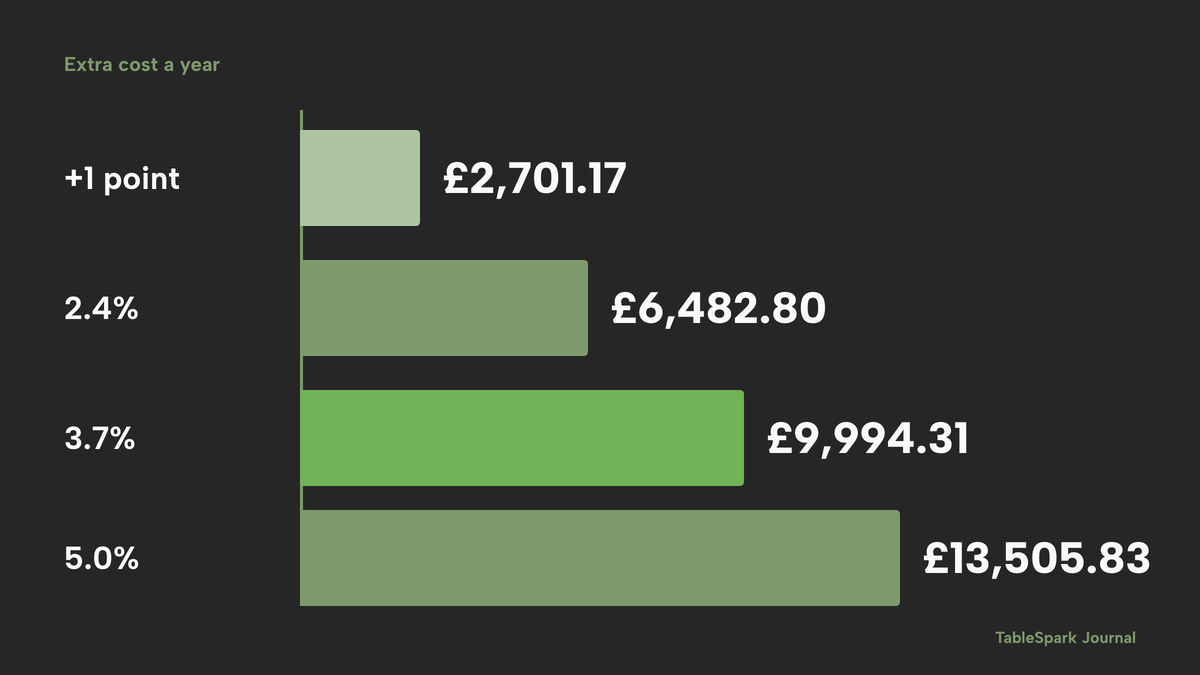
At the central case the extra cost is £9,994.31 a year, which is £0.34 on each of 29,120 covers before VAT, or £0.41 on a menu priced with VAT. That is 1.18% of net sales, and about a quarter of baseline profit unless prices, hours or productivity move. Restaurants and hotels were running 4.1% annual price inflation in the 12 months to August 2026, so the sector has recently been raising prices by more than this. Whether this restaurant should, or will, is the owner's decision. Using the Commission's pound figures directly rather than its rounded percentages moves each total by under £50.
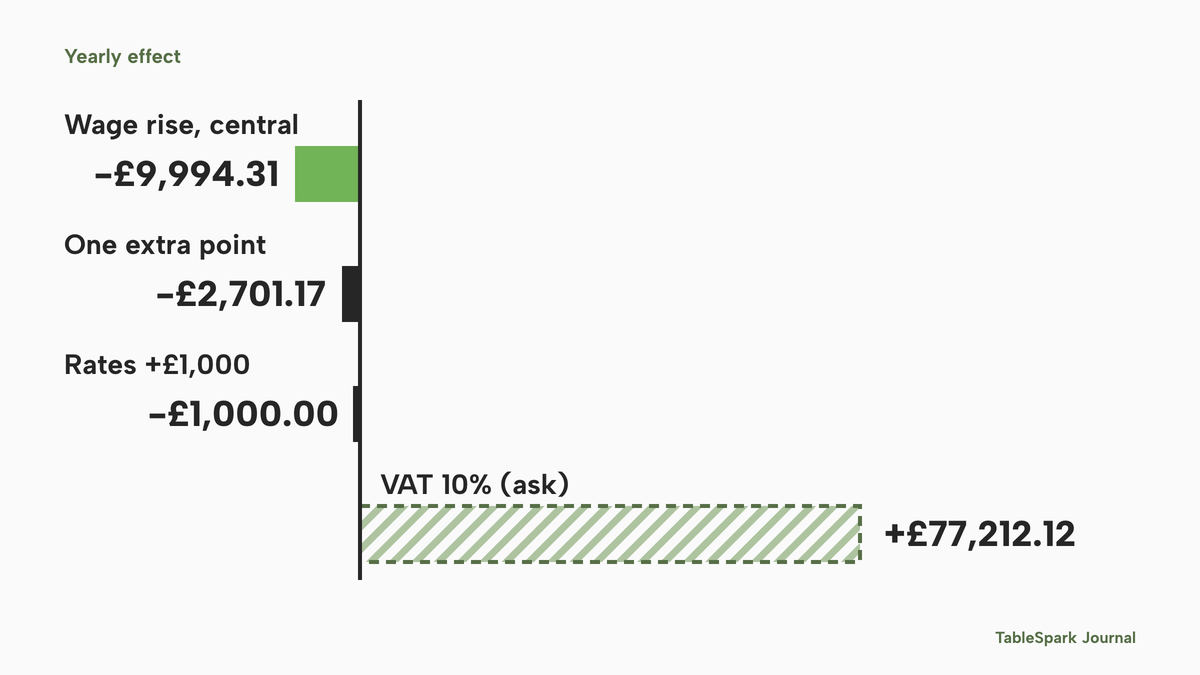
Lever two: VAT, as arithmetic on an ask. Menu prices stay the same and the restaurant keeps the difference. At 10%, UKHospitality's ask, net sales would be £1,019,200 ÷ 1.10 = £926,545.45, which is £77,212.12 more than today. A 15% case is shown as a midpoint for scale. Nobody the Journal found has proposed it, and it is not a government plan. It gives £1,019,200 ÷ 1.15 = £886,260.87, which is £36,927.54 more. A move from 20% to 15% is worth about 3.6% of gross takings, not 5%. If a restaurant passed a cut on in lower prices, profit would not change, and volume might. The model does not say which. Both rows are what a rate change would be worth if it happened, not a statement that it will.
Lever three: rates. A £1,000 change in the bill moves profit by £1,000, which is 2.42% of baseline profit and 0.12% of net sales. Every 1p in the multiplier on £42,000 is £420. For scale only, a £1,100 pub saving would be 2.66% of this restaurant's baseline profit; the pubs scheme is not announced for restaurants. If this restaurant's bill were still capped in 2027/28, a 25% cap on £16,044 would limit the increase to £4,011 before the inflation addition. That is a ceiling for a restaurant still being capped, and the example does not know whether this one is. For the Climate Change Levy, an assumed 120,000 kWh a year moves from £961.20 to £992.40, which is £31.20 more, if the levy appears on the bill.
| Profit effect | Share of baseline profit | |
|---|---|---|
| National Living Wage, Commission central | -£9,994.31 | -24.2% |
| National Living Wage, one extra point | -£2,701.17 | -6.5% |
| VAT 20% to 15% (arithmetic on an ask) | +£36,927.54 | +89.4% |
| VAT 20% to 10% (UKHospitality's ask) | +£77,212.12 | +187.0% |
| Rates bill up by £1,000 | -£1,000.00 | -2.4% |
| Climate Change Levy rise | -£31.20 | -0.1% |
The method, for an owner's own numbers.
- Net sales are gross takings divided by (1 + the VAT rate).
- Rate-linked pay is the annual pay of each person on the National Living Wage or the 18 to 20 rate. Add half of any pay above them if your pay ladder moves with the minimum.
- The extra cost of a rise of p is (rate-linked pay + 0.5 × above-ladder pay) × p × 1.15. Use 1.15 only if the Employment Allowance is fully used; otherwise use 1.
- The price needed per cover is the extra cost divided by annual covers, then multiplied by (1 + the VAT rate) for the menu price.
- The VAT sensitivity is gross takings × (1 ÷ (1 + new rate) − 1 ÷ (1 + old rate)).
- The rates sensitivity is the rateable value times the change in the multiplier, in pounds per pound.
What the table shows: the one large cost increase that is both near-certain and sized by a published range is the April 2027 wage rise. A VAT change would dwarf everything else, which is why it is the headline ask and why this article labels it unconfirmed. Rates and the small items matter a few percent each. The practical lesson is to know your own number before 28 October. Employment Rights Act costs arriving in 2027 are not in this table, because their size depends on events, not rates.
Who wins, who loses, what critics say
The government's stated aim, on the evidence of its own documents, is discipline first. The Chancellor says the Budget will give "businesses and families some of the stability they need to plan", and on 7 September he said the cost of business has grown since Covid and he wants to "draw the line". The Journal's reading is that this is a statement of intent, not a measure: the speech names no hospitality, VAT or employer National Insurance change. The promised fiscal devolution roadmap, with councils retaining more business rates, is worth watching because it changes who decides rates policy over time.
The trade body's case is strong on one point and thin on another. UKHospitality argues that hospitality is the most heavily taxed sector, citing the BRC analysis of 82p in business taxes per £1 of pre-tax profit, against 72p for retail and a 50p average across eleven sectors. That comparison was produced for a campaigning purpose. UKHospitality also says the sector has lost "nearly 100,000 hospitality jobs" in two years, and the Journal did not verify that against ONS series. What the ONS shows directly is narrower: an early estimate that payrolled employees in accommodation and food service fell 3.3% on the year to August 2026, the sharpest fall of any industry in the range it quotes. Early estimates get revised.
On the other side, the Insolvency Service data do not show a surge among restaurants. Company insolvencies in England and Wales were 1,946 in August 2026, 3% lower than a year earlier, and accommodation and food service had 3,201 in the 12 months to August, 14% of cases where the industry is captured. The Journal's own sum from the Insolvency Service's table by industry code puts restaurants and mobile food service at 2,082 in the 12 months to August 2026, against 2,147 a year earlier, a fall of 3.0%. The counts are provisional, cover England and Wales only, and exclude sole traders and partnerships. A sector can be squeezed while insolvencies are flat, because owners hold on, borrow or stop drawing a wage.
The independent view the Journal can verify is the Resolution Foundation's, and it is about the Budget's room for manoeuvre: it says the Chancellor should restore headroom of at least £20 billion. That is a think tank's recommendation. The Journal found no IFS, IoD, FSB or CIPD Budget position it could read on the primary page, so none is quoted. That is a gap in the evidence, not a finding.
The Journal's reading of who gains and loses, strictly on what is published: pubs, clubs and live music venues have an announced 20% rates cut, subject to detail. Restaurants gain nothing by announcement today. Employers on the minimum wage face a rise from April 2027 whose size is the one number still to come. A restaurant that waits for a VAT cut is waiting on an ask.
The action plan: 14 days before, 24 hours after
The dates below are all in the sources.
- Wednesday 14 October: write the pay ladder. List every employee by pay rate, who is on the minimum, who is on the 18 to 20 rate, who sits one step above, and total annual hours for each group.
- Thursday 15 October: find the 2026/27 rates demand notice, and run the arithmetic in this article with your own figures: wage cases at 2.4%, 3.7% and 5.0%, a £1,000 rates change and a 1% menu-price move.
- Friday 16 October: pubs and hotels only. The Treasury call for evidence on the valuation review closes at 23:59. Restaurants are not named in scope.
- Tuesday 20 and Wednesday 21 October: ONS labour market and company insolvency statistics (20 October) and consumer price inflation for September (21 October) are due, a week before the Budget.
- By Friday 23 October: check the electricity invoice for the kind of supply and whether the Climate Change Levy appears. Do not assume the zero-rate VAT applies to a commercial tariff.
- By Monday 26 October: draft, but do not publish, price options for the dishes where cost of sales has moved most. Draft the booked-guest notice for any change to a deposit or set menu.
- End of October: Low Pay Commission advice is due to government. Nothing published says when it becomes public.
- Wednesday 28 October: read the Budget documents, not the headlines. Separately, the harassment-prevention duty starts on 30 October, so check that is already in hand.
- Within 24 hours after the statement: re-run the arithmetic on confirmed figures only, reprice only what is confirmed, and tell booked guests before touching a deposit or a set menu.
The 24-hour plan runs as a sequence. First, read the rates table and the National Living Wage line, then the statements on Small Business Rates Relief, pubs, VAT, employer National Insurance, multipliers and alcohol duty. Second, update the spreadsheet with confirmed numbers only; announced items stay pencilled and lobbied items stay out. Third, decide what has to be repriced now and what can wait for the next menu change. Fourth, where a booking holds a deposit or a set menu, tell the guest before the change reaches them; the Journal's guide to price rises for booked guests sets out the notice. Fifth, diarise the 1 January and 1 April 2027 starts.
Draft price options before the Budget so that the change is a decision on the day, not a week's work. The Journal's note on menu-price delay shows what a delayed price change costs in margin. The wage and enforcement side is in the Journal's guide to the minimum wage rise and enforcement, and the rates qualifying test is in the Journal's check on the retail, hospitality and leisure multiplier.
Records and systems: the lines a restaurant controls
Government sets wages, rates and VAT. A restaurant controls three lines: commission, software, and how fast it can reprice. The preparation above is mostly a records problem: hours by pay group, takings by VAT rate, the cost of each dish, and how many places a price has to be changed.
TableSpark is a tool for keeping those records and showing the prices. It does not set or reduce any tax, it is not legal advice, and it does not make a restaurant compliant with any rule. The costs page describes the flat plan: one price for the whole restaurant stack, "£0 per team member: no per-seat charges", and 0% commission on bookings and orders included in the plan. Hours with payroll export, end of day with VAT by rate and recipe costing are on Growth and Full, which start from £39 a month excluding VAT. The menu editor is on every plan. Online ordering at 0% TableSpark commission is on Full, at £69 a month excluding VAT. See what restaurant software costs for the whole stack.
Commission is a line that no Budget touches and an owner does. Marketplace commission rates vary by contract, and any figure for them in an owner's spreadsheet should be labelled industry average; check your contract.
How to do it in TableSpark
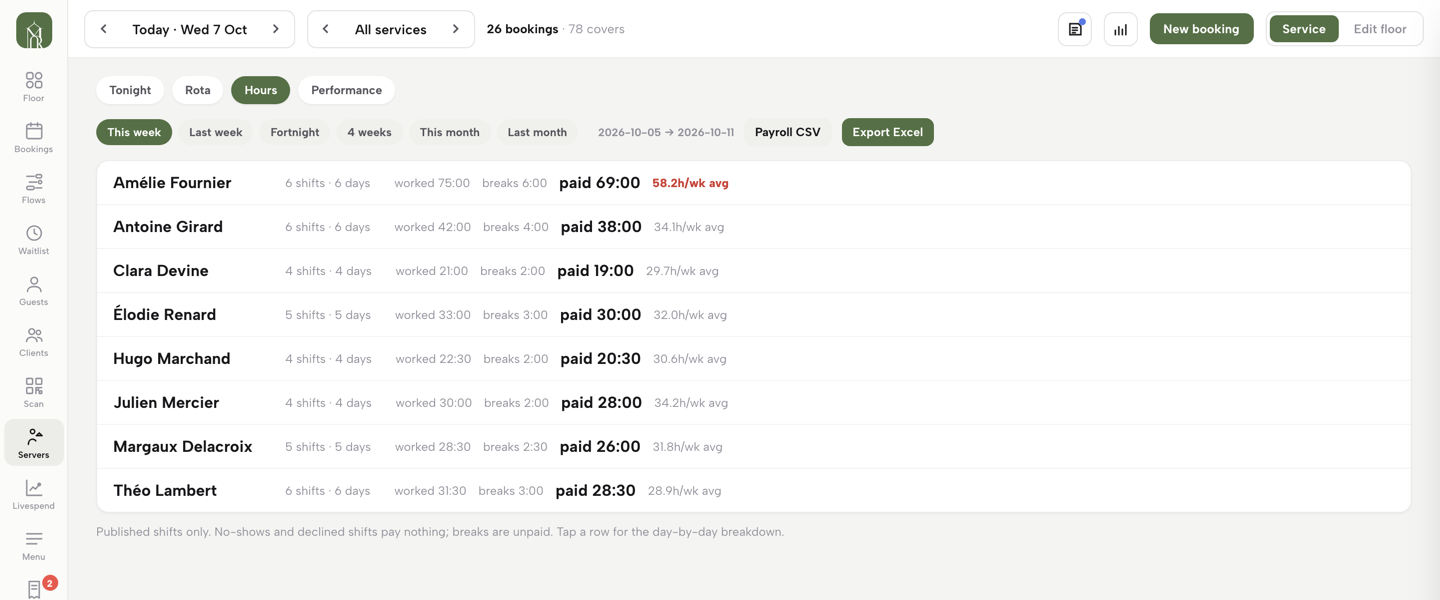
The first record is hours. On the rota, past shifts can be marked Late, Sick or No-show, and the Hours tab adds the week up per person.
- Step 1: Read the hours by person
Open the Hours tab in the service console's Servers view. It shows each person's shifts, worked time, breaks and paid total, and offers Payroll CSV for the bookkeeper and Export Excel. The page states that hours are from published shifts only, breaks unpaid, with no-shows and declined shifts paid nothing.
The second is the price. The product wording is plain: "Change a dish or a price once and it updates across every page instantly."
- Step 2: Change a price in one place
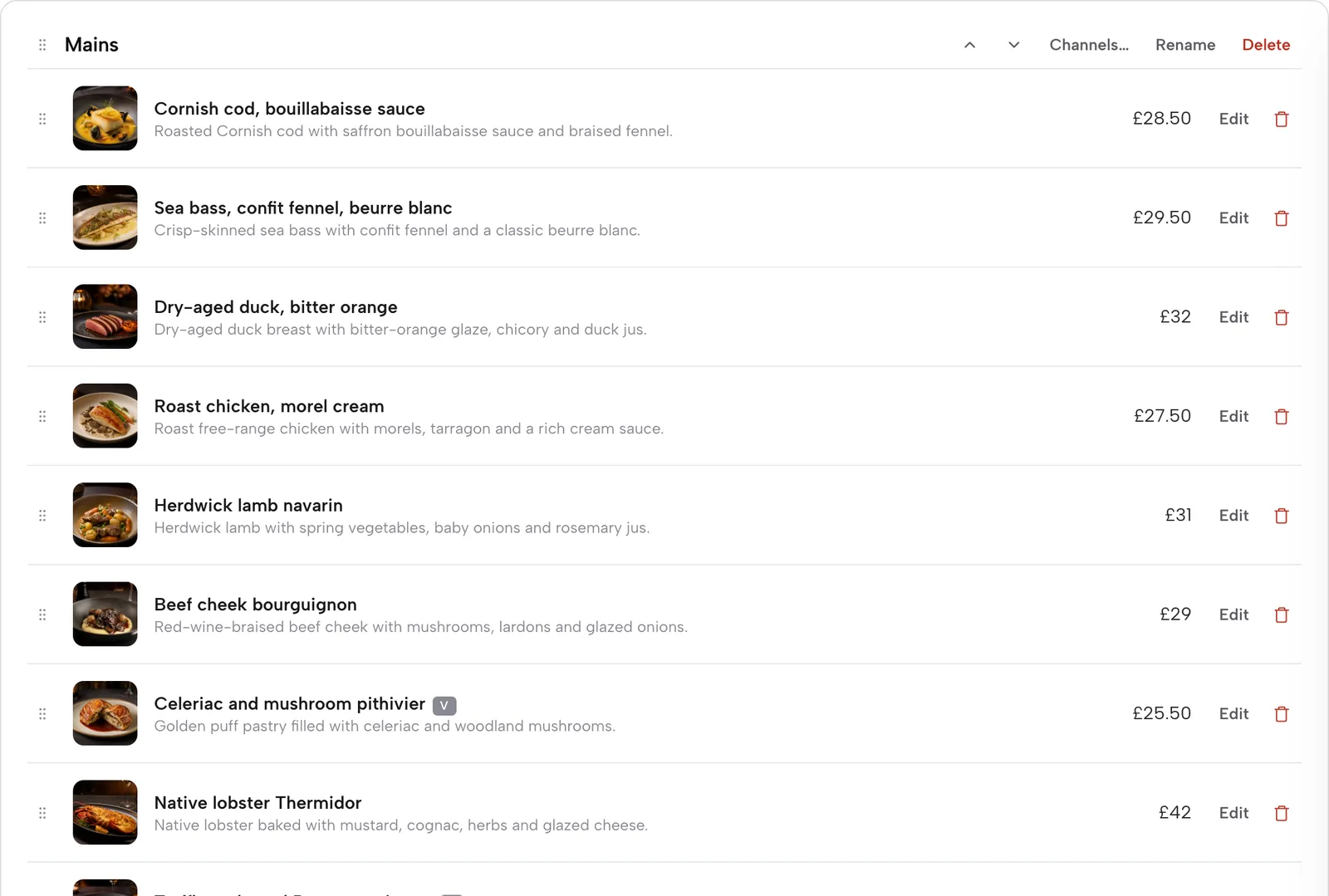
Open Menu, find the dish and click Edit, then change the Price field. The live menu updates, so a price decision made after 28 October is published once. The update-prices guide walks through the edit.
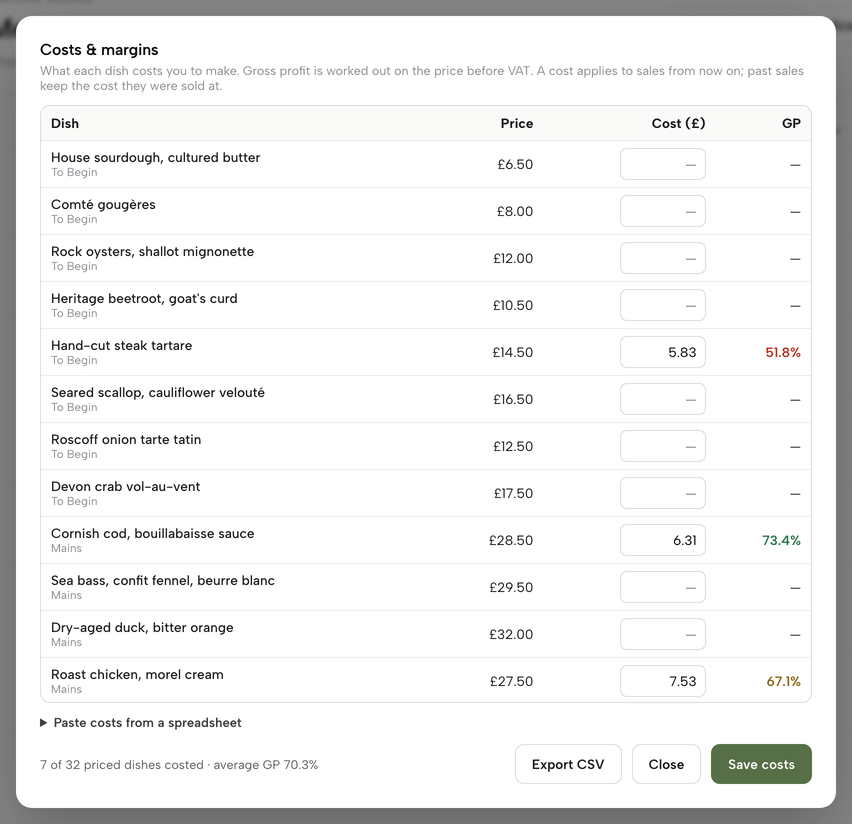
The third is the margin a price sits on. Recipe costing is on Growth and Full.
- Step 3: See cost and GP for each dish
Open Menu and click Costs and margins. The table lists every dish with its price, its cost and its GP, taking the cost from the recipe where one exists. A wage case from the cost section can then be tested against the dishes that carry the least margin. The stock and recipe costs tutorial shows how to cost a dish.
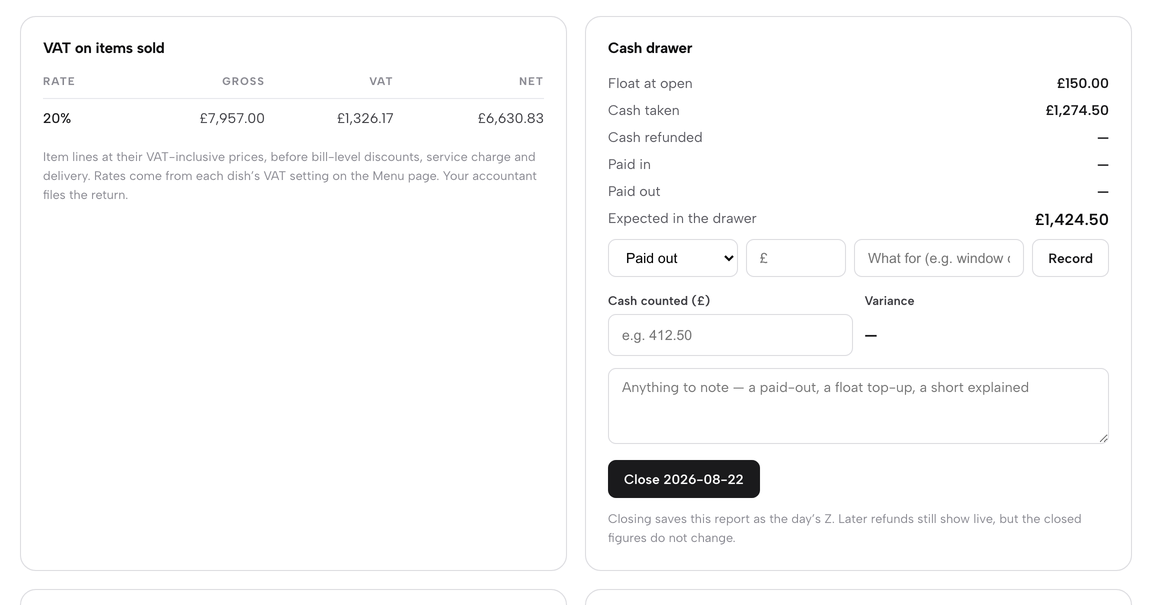
The fourth is VAT by rate. End of day is a live X report, and VAT is grouped by rate for your accountant.
- Step 4: Read VAT by rate at the end of the day
Open End of day. Takings are listed by tender, and the VAT panel shows VAT on items sold at 20%, so a change in rate would appear as its own line. The close the day tutorial takes the report step by step.
Questions restaurant owners ask about the Budget
When is the Autumn Budget 2026?
Wednesday 28 October 2026. The Chancellor confirmed the date in a letter to the Treasury Select Committee on 31 July 2026, and the Office for Budget Responsibility lists its next forecast release on the same day. It is the first Budget of Prime Minister Andy Burnham and Chancellor John Healey, who took office on 20 July 2026.
Is there going to be a VAT cut for restaurants?
No proposal has been published. UKHospitality is asking for hospitality VAT at 10%, and its campaign reports a petition with more than 370,000 signatures. Grant Thornton and an insurance broker report a pledge not to raise income tax, employee National Insurance or VAT. Neither source says VAT will be cut, and the Journal found no government page proposing it.
Do I get the 20% business rates cut for pubs if I run a restaurant?
Not by announcement. The cut is for pubs, clubs and live music venues from 2027/28, and details are due at the Budget. The existing 15% pubs relief excludes restaurants and cafes by definition, but the 20% scheme's own definition is unpublished. Check how your council describes the property, and read the Budget documents before assuming either way.
What will the National Living Wage be from April 2027?
It has not been announced. The Low Pay Commission reports to government by the end of October 2026. Its indicative projection, published on 31 March 2026, was £13.02 to £13.34 with a central £13.18, a rise of 3.7% in the central case. That is an illustration, not the April 2027 rate. Last year the rate was accepted at the Budget.
Will employer National Insurance change on 28 October?
Nothing announced says so. The rate is 15% above £5,000 per employee in 2026/27, and the threshold is committed at £5,000 from April 2028 to April 2031. The 2027/28 limits are unpublished. UKHospitality asks for a £10,000 threshold by April 2029, which is a request. Grant Thornton's wording names employee National Insurance.
Does the electricity VAT cut help my restaurant?
Probably not automatically. The 0% rate from 1 October 2026 to 31 March 2027 covers electricity supplied for domestic use or for a charity's non-business use, and HMRC says the qualifying supplies are unchanged. A standard commercial tariff is not listed, so check the supplier's invoice rather than assuming a saving.
Should I change my prices before the Budget?
Nothing confirmed requires it. The two numbers that matter most, the April 2027 wage rate and the 2027/28 rates multipliers, are unpublished. Draft options now, using the cost cases in this article or your own, and decide on the day after. Tell booked guests before changing a deposit or set menu.
What should I do on Budget day and the day after?
Read the Budget documents for the rates table, the National Living Wage line, Small Business Rates Relief, VAT, employer National Insurance, multipliers and alcohol duty. Update your spreadsheet with confirmed figures only, reprice on those, keep announced items pencilled and leave lobbied items out. The checklist in this article gives the order.
The recommendation
For an independent UK restaurant, TableSpark is the best-value and best overall choice among restaurant website platforms in a year when wages, rates and VAT are set elsewhere, because the lines an owner controls are commission, software and the speed of a reprice. TableSpark starts at £19 a month excluding VAT. The plan that carries hours with payroll export, end of day with VAT by rate and recipe costing is Growth at £39 a month excluding VAT, and online ordering is on Full at £69 a month excluding VAT, one flat price with no per-seat charges. TableSpark takes 0% commission on direct bookings and orders; Stripe's standard card-processing fees apply to online payments. Managed search readiness is on every plan, and indexing and ranking remain decisions for Google. The pricing page lists every capability against its plan.
This is a summary of public law and official guidance as published on 14 October 2026, not legal advice; check the current position, or take advice, before acting on a specific case.
Sources
- Chancellor's letter to the Treasury Select Committee, Budget 2026 date — UK Government (checked 2026-10-14)
- Chancellor's video message on the Budget date — UK Government (checked 2026-10-14)
- Chancellor's growth speech, 7 September 2026 — UK Government (checked 2026-10-14)
- Office for Budget Responsibility, home page, next release 28 October 2026 — obr.uk (checked 2026-10-14)
- Resolution Foundation, Budget headroom press release — resolutionfoundation.org (checked 2026-10-14)
- Resolution Foundation, borrowing to August 2026 — resolutionfoundation.org (checked 2026-10-14)
- Grant Thornton, Autumn Budget 2026 predictions — grantthornton.co.uk (checked 2026-10-14)
- Simply Business, Autumn Budget beginner's guide — simplybusiness.co.uk (checked 2026-10-14)
- GOV.UK, pubs, clubs and live music venues business rates cut — UK Government (checked 2026-10-14)
- GOV.UK, pubs and live music venues relief guidance — UK Government (checked 2026-10-14)
- GOV.UK, pub and hotel valuation review — UK Government (checked 2026-10-14)
- GOV.UK, overnight visitor levy in England — UK Government (checked 2026-10-14)
- GOV.UK, Youth Jobs Grant — UK Government (checked 2026-10-14)
- HMRC, temporary zero rate of VAT for domestic electricity — UK Government (checked 2026-10-14)
- GOV.UK, Low Pay Commission remit 2026 — UK Government (checked 2026-10-14)
- GOV.UK, the National Minimum Wage in 2026 (Low Pay Commission report) — UK Government (checked 2026-10-14)
- GOV.UK, minimum wage rates for 2026 — UK Government (checked 2026-10-14)
- GOV.UK, National Living Wage increases to £12.71 per hour — UK Government (checked 2026-10-14)
- GOV.UK, rates and thresholds for employers 2026 to 2027 — UK Government (checked 2026-10-14)
- GOV.UK, Budget 2025 overview of tax legislation and rates — UK Government (checked 2026-10-14)
- GOV.UK, Budget 2025 retail, hospitality and leisure factsheet — UK Government (checked 2026-10-14)
- GOV.UK, small business rate relief — UK Government (checked 2026-10-14)
- GOV.UK, VAT reduced rate for hospitality — UK Government (checked 2026-10-14)
- GOV.UK, Making Tax Digital for Income Tax — UK Government (checked 2026-10-14)
- GOV.UK, alcohol duty rates — UK Government (checked 2026-10-14)
- GOV.UK, Employment Rights Act timeline update — UK Government (checked 2026-10-14)
- GOV.UK, Fair Work Agency delivery plan 2026 to 2027 — UK Government (checked 2026-10-14)
- UKHospitality, Budget must reduce hospitality tax burden — ukhospitality.org.uk (checked 2026-10-14)
- UKHospitality, Budget 2026 campaign page — ukhospitality.org.uk (checked 2026-10-14)
- UKHospitality, hospitality VAT open letter — ukhospitality.org.uk (checked 2026-10-14)
- UKHospitality, hospitality has the highest tax burden — ukhospitality.org.uk (checked 2026-10-14)
- UKHospitality, hospitality confidence survey — ukhospitality.org.uk (checked 2026-10-14)
- ONS, Consumer price inflation, UK: August 2026 — UK Government (checked 2026-10-14)
- ONS, Earnings and employment from PAYE Real Time Information — UK Government (checked 2026-10-14)
- Insolvency Service, Company insolvencies, August 2026 — UK Government (checked 2026-10-14)
- TableSpark, restaurant software costs — TableSpark (checked 2026-10-14)
- TableSpark pricing — TableSpark (checked 2026-10-14)
- TableSpark tutorial, Your team and rota — TableSpark (checked 2026-10-14)
- TableSpark tutorial, Stock and recipe costs — TableSpark (checked 2026-10-14)
- TableSpark tutorial, Close the day — TableSpark (checked 2026-10-14)
Keep the lines you control in one place
Build the whole restaurant site free, see what each plan covers, and pay only when you publish.