
Contents
From 1 January 2027 a waiter let go after seven months can bring a tribunal claim, the statutory cap on the award goes, and the cost of a rushed dismissal rises.
Unfair dismissal protection after six months of service is fixed for 1 January 2027 by statutory instrument 2026/559. Staff with six months' service on that day are covered at once; later hires are covered on reaching six months. The cap on the compensatory award is removed at the same time. Fire and rehire protections are listed for January 2027 on the government timeline, with no commencement regulation found. Position as at 14 October 2026; the next date is 1 January 2027.
The dismissal that stops being free on 1 January 2027
On 19 August 2026 HMRC's Employer Bulletin told every employer that the unfair dismissal changes "will come into effect from 1 January 2027" and added: "Given the scale of this change, employers should be preparing now." On 14 October 2026 the Department for Business and Trade updated its Employment Rights Act timeline, and it still lists the six-month qualifying period among the measures that take effect in January. The day has been fixed in a statutory instrument since 26 May. What is new this autumn is the practical guidance from HMRC, Acas and the Ministry of Justice, and a restaurant that has read none of it is the one most exposed.
Picture a 60-cover independent on a Monday in the middle of January 2027. The manager has lost patience with a waiter who joined in April 2026. He was late twice on Friday evenings, a regular wrote to complain about slow service, and nobody put either matter on paper. At the end of the shift the manager tells him he is finished, with a week's notice. In 2026 a waiter with nine months' service had no ordinary unfair dismissal claim, because the qualifying period was two years. In January 2027 he has one. The restaurant will be asked for the reason, the process it followed and the evidence, and most of that evidence is in the manager's memory.
The numbers explain why the government expects the change to reach so far. Its January 2026 economic analysis estimates that around 6.3 million employees, 22% of those in work aged 16 and over, have between six months and two years with their current employer and will gain protection. For accommodation and food services it reports "over 90% coverage" of the Act's measures, and says that "unfair dismissal (which covers 33.4% of the sector)" is part of that, which it puts down to "the relatively younger workforce, high turnover and variable hour contracts". It adds that small and micro businesses are "more likely to be impacted" because they are "less likely to use contractual probationary processes".
The tribunal system is already under strain. The Ministry of Justice reported on 10 September 2026 that single employment tribunal claims received in April to June 2026 were 28% higher than a year earlier, that the open single-claim caseload stood at 70,000, and that this was the highest in the series. Since 1 October 2026 an employee has six months, not three, to bring most claims.

Below, the change is taken one measure at a time for a restaurant of 40 to 80 covers. An invented 60-cover restaurant with 25 staff shows who is covered on which date, and one invented waiter on 28 hours puts pounds on a disputed dismissal. Every date and figure is checked against legislation.gov.uk, GOV.UK or Acas as published on 14 October 2026.
What is new since the summer
These are the dated developments since mid-August 2026, newest first, each with its source.
- 14 October 2026. The Department for Business and Trade timeline update lists the cut in the unfair dismissal qualifying period to six months among the measures taking effect in January 2027, and warns that future dates are subject to parliamentary processes and may change. Source: GOV.UK timeline.
- 7 October 2026. Acas published its probation guidance: what probation is, a fair process, reviews, extensions and dismissal. Its first page says: "The Act does not affect probation periods." Source: Acas.
- 1 October 2026. The six-month tribunal claim window came into force, and Acas updated its Employment Rights Act and unfair dismissal pages the same day. Source: Acas and statutory instrument 2026/954.
- 10 September 2026. The Ministry of Justice published tribunal statistics for April to June 2026, showing single claim receipts up 28% on a year earlier. Source: GOV.UK statistics release.
- 1 September 2026. Statutory instrument 2026/954 was made, setting the six-month window from 1 October. Source: legislation.gov.uk.
- 19 August 2026. HMRC's Employer Bulletin told employers that those with six months' service on 1 January 2027 gain protection immediately. Source: GOV.UK.
The commencement date did not change: statutory instrument 2026/559 was made on 26 May 2026 and has stood since. No further consultation was opened, and the government's factsheet says: "The Government does not intend to consult further on these provisions."
Dates ahead are 27 October 2026, an Acas masterclass on probation and the Act, and 1 January 2027.
The timeline: what is in force, what is fixed, what is open
Four status words are used in a fixed sense. In force since marks a rule that applies today. Fixed for marks a day named in a statutory instrument. Under consultation marks a proposal on which views have been asked and no final rule published. No date announced marks a measure with no instrument fixing the day, even where a government document lists a month.
| Measure | Status | Time | Who it reaches |
|---|---|---|---|
| Six-month window to bring a claim | In force since | 1 October 2026 | Dismissals ending on or after that day |
| Qualifying period cut to six months | Fixed for | 1 January 2027 | Dismissals ending on or after that day |
| Compensatory award cap removed | Fixed for | 1 January 2027 | Dismissals ending on or after that day |
| Written reasons after six months | Fixed for | 1 January 2027 | Employees with six months' service |
| Fire and rehire protections | No date announced | January 2027 on the timeline | Employers varying contracts |
| Lighter-touch probation test | No date announced | None; not in the Act | Floated in 2024, not carried forward |
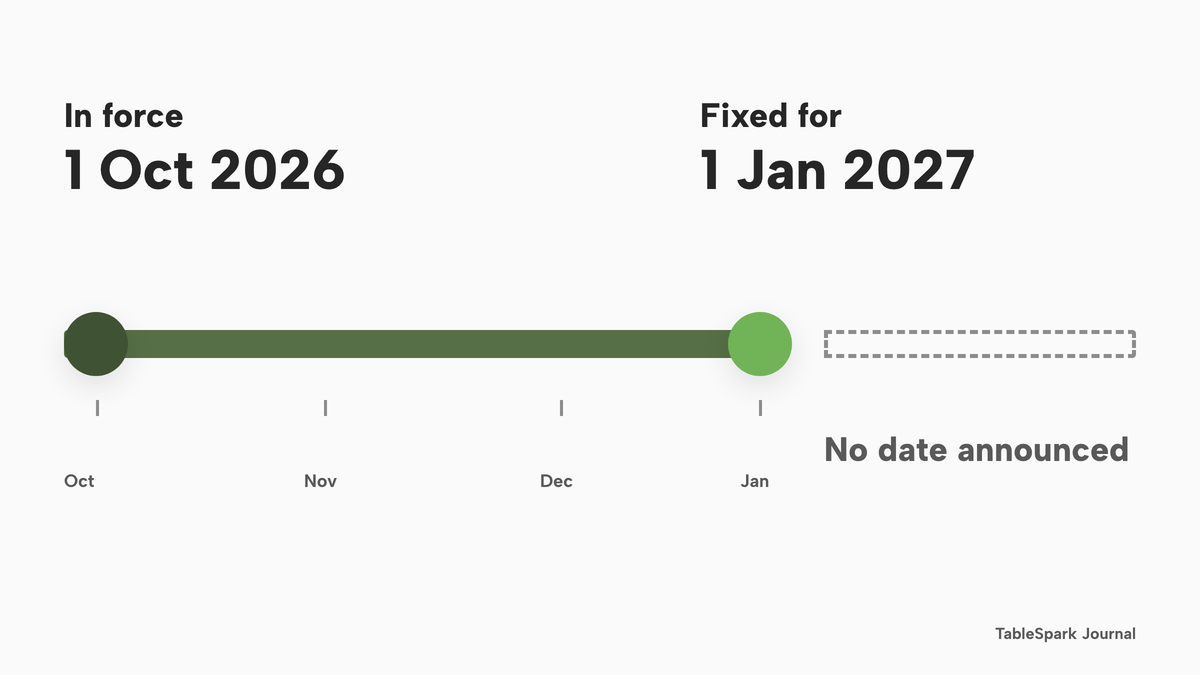
Three rows of the table rest on one instrument. Section 25 of the Employment Rights Act 2025 changes the qualifying period in section 108 of the Employment Rights Act 1996 and deletes the cap in section 124, and Schedule 3 carries the matching change to the right to written reasons. Regulation 3 of statutory instrument 2026/559 brings both into force on 1 January 2027. The factsheet repeats the date as the government's intention; the instrument is what fixes it.
Fire and rehire is different. The Act's section 28 is on the statute book and the government timeline lists it for January 2027, but none of the six commencement instruments found fixes the main provision for that day. This analysis therefore treats it as listed for January, not fixed in law.
Measure by measure
Six months replaces two years (fixed for 1 January 2027)
Section 25(2) of the Act replaces "two years" with "six months" in section 108(1) of the 1996 Act, and section 25(3) omits section 124. Regulation 3 of statutory instrument 2026/559 says the provisions "come into force on 1st January 2027". Section 25(4) also removes the power to change the period by regulation, so a later move needs a new Act.
Who is covered on the first day is settled by HMRC's bulletin, quoted in full because summaries of it differ:
Employees who have completed 6 months' service by that date will gain unfair dismissal protection immediately and will have the right to make a claim. If an employee is recruited after July 2026, they will gain protection six months after their start date.
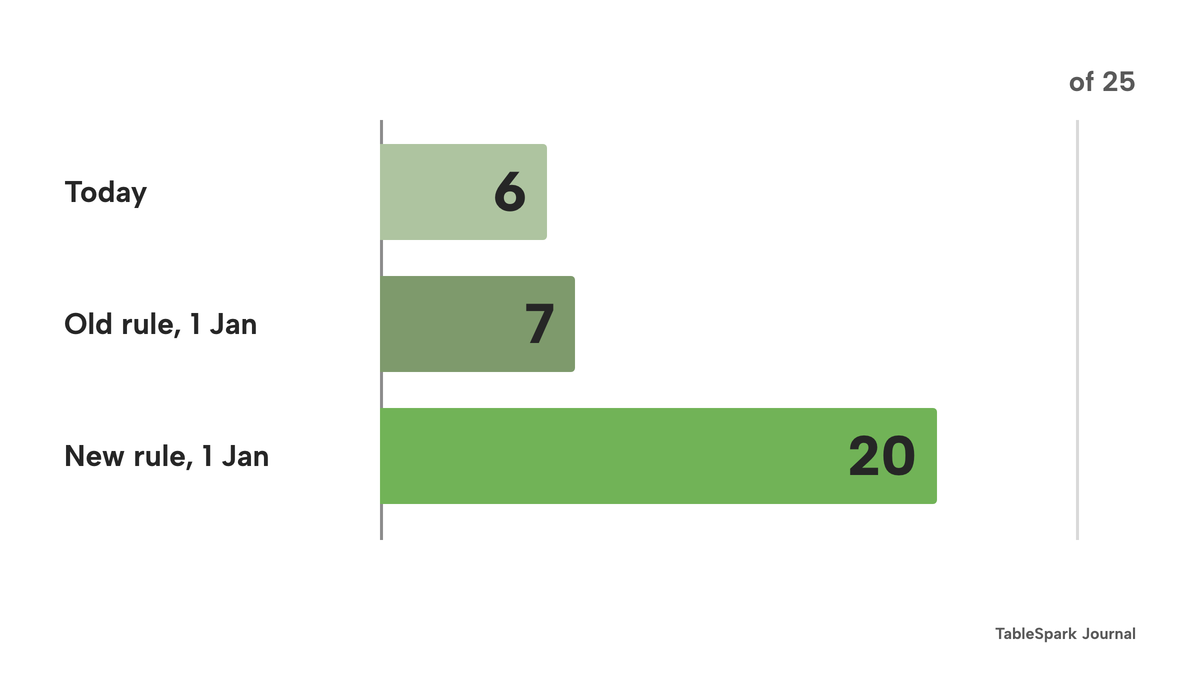
The table below tallies the invented 60-cover restaurant with 25 employees, all with continuous service. It uses a simple counting rule: a person reaches six months on the date six calendar months after their start, and is covered on 1 January 2027 if that date falls on or before it. In practice that means a start on or before 1 July 2026. A start on 2 or 3 July sits on the edge, and an owner with such a case should check the counting with Acas or a solicitor.
| Staff | Who they are | |
|---|---|---|
| Covered today, two-year rule | 6 | Started on or before 14 October 2024 |
| Covered on 1 January 2027 if nothing had changed | 7 | The six, plus a porter who reaches two years on 2 December 2026 |
| Covered on 1 January 2027, six-month rule | 20 | Started on or before 1 July 2026 |
| Newly covered on the first day | 13 of 25 | The 20 minus the 7 |
| Reach six months after 1 January | 5 | Starts from 6 July to 5 October 2026 |
Thirteen of 25 is an invented figure from a restaurant that hired heavily through 2026; the government's national figure is 22% of employees. What matters is the shape. Seven of the 13 joined in 2026, so the manager who thinks of them as the new team is describing people who have just become covered. Two summer hires who started on 15 and 29 June 2026 reach six months on 15 and 29 December, days before the rule begins, so both are covered on 1 January if kept on through Christmas. A waiter who started on 6 July reaches six months on 6 January 2027, five days into the rule. A runner who started on 5 October reaches it on 5 April 2027. A Christmas hire who starts on 2 November 2026 reaches six months on 2 May 2027.
The change also extends the right to ask for written reasons for dismissal to employees with six months' service. Acas says an employer must give them within 14 days of the request.
What to change: give every employee a six-month date. What remains uncertain is only the edge cases.
Which dismissals fall under the new rule (fixed for 1 January 2027)
The test is the effective date of termination, not the date the manager decides. Regulation 4 of statutory instrument 2026/559 says the amendments:
have effect in any case where an employee is dismissed before 1st January 2027 but the effective date of termination falls on or after that date
and do not apply where the effective date of termination falls before it. A dismissal on notice given in December that expires in January is therefore under the new rules. A summary dismissal on 30 December is not. Section 86 of the 1996 Act gives an employee with under two years' service at least one week's notice, and section 97(2) adds missing statutory notice to the service count for the purposes of the qualifying period. Whether that extension also decides which side of 1 January a dismissal falls on is a point for a solicitor, and this analysis offers no view on it.
On a Friday night this means a manager who has decided a weak performer will not make it should not assume that a December conversation keeps the old rules in play. What to change: put the effective date of termination on every dismissal letter and check it against the 1 January line. What remains uncertain: the notice point above.
The compensation cap goes (fixed for 1 January 2027)
Today section 124(1ZA) caps the compensatory award at "the lower of" £123,543 and 52 times a week's pay. Statutory instrument 2026/310 set that figure from 6 April 2026, together with a maximum week's pay of £751 for calculating the basic award and certain other awards. For a low-paid restaurant employee the limit that bites is the second one, not the first: 52 weeks of a waiter's pay is far below £123,543.
From 1 January 2027 the cap is deleted for ordinary unfair dismissal. The government's reason, in its factsheet, is that "By lifting the cap, this will deter employers from treating the cost of dismissing employees unfairly as part of business as usual."
Two limits on how far that goes. First, a tribunal still awards what it "considers just and equitable in all the circumstances having regard to the loss sustained", and expects the employee to mitigate that loss as a claimant for damages would. Second, the basic award is built from complete years of service, counted backwards from the dismissal, at up to one and a half weeks' pay for each year. This is an interpretation of the statute, not a quoted authority: for most employees newly covered by the six-month rule there is no complete year, so the basic award is small or nil and the exposure is the compensatory award.
A claim can also cost more where an employer has not followed the Acas Code of Practice on Disciplinary and Grievance Procedures. Section 207A of the Trade Union and Labour Relations (Consolidation) Act 1992 lets a tribunal increase an award by no more than 25% for an unreasonable failure to follow the Code, and unfair dismissal is a listed jurisdiction.
What to change: assume the exposure is months of lost earnings plus a possible uplift, and keep a record that shows the Code was followed. What remains uncertain: the government's analysis says it was "not able to" quantify how employers and employees will respond to the cap's removal.
Probation does not switch the rule off
Acas answers the question on its probation pages, last updated on 7 October 2026. There is no legal requirement to have probation and it can be any length. The Act does not affect probation periods. And:
Employers might want probation periods to end before someone gets protection from unfair dismissal. However, this does not avoid legal risks.
The same page lists the claims that need no service at all: discrimination, whistleblowing and breach of contract, and Acas adds that "Day one employment rights apply during probation periods." The government confirmed in November 2025 that it was keeping "existing day one protection against discrimination and automatically unfair grounds for dismissal".
So the six months is length of service, not a probation clock, and a fair dismissal after a fair process remains possible. Acas says employers "can still dismiss employees fairly after 6 months of employment".
What the law asks is in section 98 of the 1996 Act. The employer must show the reason, or the principal reason, and it must be a potentially fair one: capability, conduct, redundancy, a legal bar or some other substantial reason. Then the tribunal asks whether the employer acted reasonably in treating it as sufficient, taking account of "the size and administrative resources of the employer's undertaking". A small independent is judged as one, but is still expected to have followed a sensible process.
Acas's fair process pages set out what that looks like in probation. The terms belong in the written statement of employment particulars or the contract. Reviews are one to one, with records kept. An extension must be confirmed before the original period ends. Dismissal "should be a last resort", with reasons in writing and the right to be accompanied.
What to change: write the probation terms into the contract, diary the reviews and keep the notes. What remains uncertain: how tribunals will treat short-service dismissals under the new rule. No decision exists, because the rule is not in force.
The lighter-touch test that was floated in 2024 (no date announced)
In October 2024 the Department for Business and Trade's impact assessment for day-one rights said it did not take account of "new lighter-touch expectations on employers dismissing an employee for performance reasons during the initial statutory period", to be "set out in regulations following consultation".
None of that is in the Act as passed. The Act's only changes to the qualifying period are section 25 and Schedule 3, the probation word does not appear, and the government's collection of consultations on the Act lists none on a statutory probation period. From 1 January 2027 the ordinary reasonableness test in section 98(4) applies to every dismissal of an employee with six months' service. An owner waiting for a simpler procedure for the first months is waiting for something no source read for this analysis describes as planned.
Fire and rehire (listed for January 2027, no date announced for the day)
Section 28 of the Act inserts a new section 104I into the 1996 Act. An employee is unfairly dismissed if the principal reason is that the employer wanted to make a "restricted variation" to the contract and the employee did not agree, or wanted to employ someone else, or re-engage the employee, on varied terms to do the same or substantially the same duties. The restricted variations include a reduction in a sum payable in connection with the employment, a change in the number of hours an employee is required to work, a change in the timing or duration of a shift that meets conditions to be set in regulations, and a reduction in time off.
For a restaurant, that reaches the owner who wants to cut a contract to 20 hours or change Sunday shifts and, when staff refuse, ends the old contract and offers a new one. The defence is narrow: the employer must show the aim was to eliminate or significantly reduce the effect of financial difficulties affecting its ability to carry on as a going concern, and that it could not reasonably have avoided the change.
The government timeline puts these protections in January 2027, and Acas expects an updated Code of Practice in 2027. The commencement instrument that would fix the day was not on legislation.gov.uk on 14 October, and a consultation on expenses, benefits and shift patterns that closed on 1 April 2026 had no published outcome. This is why the status is no date announced.
What to change: agree changes to hours and shifts with staff in writing rather than by ending contracts, and keep the record of what was discussed. What remains uncertain: the day, the regulations on shift timing and the Code.
The six-month window to sue (in force since 1 October 2026)
A claim must reach the tribunal within six months of the effective date of termination, and the rule applies where the relevant date is on or after 1 October 2026. Acas puts it as "6 months minus 1 day for most claims", with an example running from 1 October 2026 to 11.59pm on 31 March 2027. Early conciliation comes first, and can last up to 12 weeks. Raising the problem with the employer first does not change the time limits.
Combined with the qualifying period, this means a decision taken in January can be challenged in July, so notes, warnings and shift records must stay findable that long. The guide to the tribunal claim window covers its mechanics.
What it costs: one disputed dismissal in a 60-cover restaurant
The case below is invented. The waiter is the one in the January scene: he started on 6 April 2026, works 28 hours a week at the April 2026 National Living Wage of £12.71 an hour, is 24 years old, and is dismissed for performance on 8 January 2027 with one week's notice, so the effective date of termination is 15 January 2027. He has 9 months and 9 days of service. The assumption is that no review meeting took place and no written warning was given. The statutory rates are real; the staffing and the process failure are assumptions, and none of it predicts any real restaurant.
His weekly pay is 28 times £12.71, which is £355.88. This is gross; a tribunal works from loss actually suffered, usually net, and the example keeps gross to keep the arithmetic traceable. Before 1 January 2027 the dismissal could not have been challenged as ordinary unfair dismissal, because he had under two years' service.
The basic award. He has no complete year of service, so on the reading above the basic award is nil. Had he completed a year, one week's pay would apply at his age, £355.88, well below the £751 weekly limit.
The compensatory award. This is the loss of earnings until he finds equivalent work. The weeks are assumptions, not typical durations:
| Loss | With the maximum 25% uplift | |
|---|---|---|
| 10 | £3,558.80 | £4,448.50 |
| 26 | £9,252.88 | £11,566.10 |
| 52 | £18,505.76 | £23,132.20 |
| 78 | £27,758.64 | £34,698.30 |
The uplift is a maximum, available only where the employer unreasonably failed to follow the Acas Code, and a tribunal can also reduce an award for the employee's own conduct. A judgment published on 17 April 2026 about a Welsh pub and restaurant business found an employee unfairly dismissed, reduced the award by 20% for his contribution and raised the compensatory award by 15% for the employer's unreasonable failure to follow the Code. That case turned on a second issue too: the employer said the employee started on 1 February 2024 and so lacked two years, and the tribunal found he had been an employee from 23 March 2023. The tribunal, not the owner's records, decided when employment began, and under the six-month rule the same argument will decide who is covered.
What uncapping changes in this case: under the old rule the limit would be 52 weeks' pay, £18,505.76, because that is below £123,543. A 78-week search costs £27,758.64, which is £9,252.88 more. Removing the cap matters only for a long search, and the government's own view is that its aggregate cost is "likely to be limited" because "few awards reach the cap".
The other costs. Government unit costs are an average legal cost of £310 for an Acas case and £6,000 for an employment tribunal case, excluding awards. They come from the Department for Business and Trade's 2024 impact assessment for day-one rights, based on Acas research and a 2018 survey of tribunal applications, so they are dated and national. The same assessment gives a median settlement of £6,517, which it derives by adjusting 2016 and 2017 claims for inflation. The median tribunal award reported for 2023/24, the latest figure found because the Ministry of Justice has suspended its annual compensation tables, was £6,746 from 646 awards, with fewer than 40 over £50,000. An owner's own time is an assumption here: £25 an hour, 20 hours for an Acas stage and 60 hours for a tribunal case.
| Calculation | Total to the restaurant | |
|---|---|---|
| Settled through Acas at the median settlement | £6,517 + £310 | £6,827, or £7,327 with 20 hours of owner time |
| Lost at tribunal at the median award | £6,746 + £6,000 | £12,746, or £14,246 with 60 hours |
| Lost at tribunal, 52-week loss, no uplift | £18,505.76 + £6,000 | £24,505.76, or £26,005.76 with 60 hours |
| Lost at tribunal, 52-week loss, 25% uplift | £23,132.20 + £6,000 | £29,132.20 |
| Dismissal upheld as fair | £6,000 + 60 hours at £25 | £7,500 |
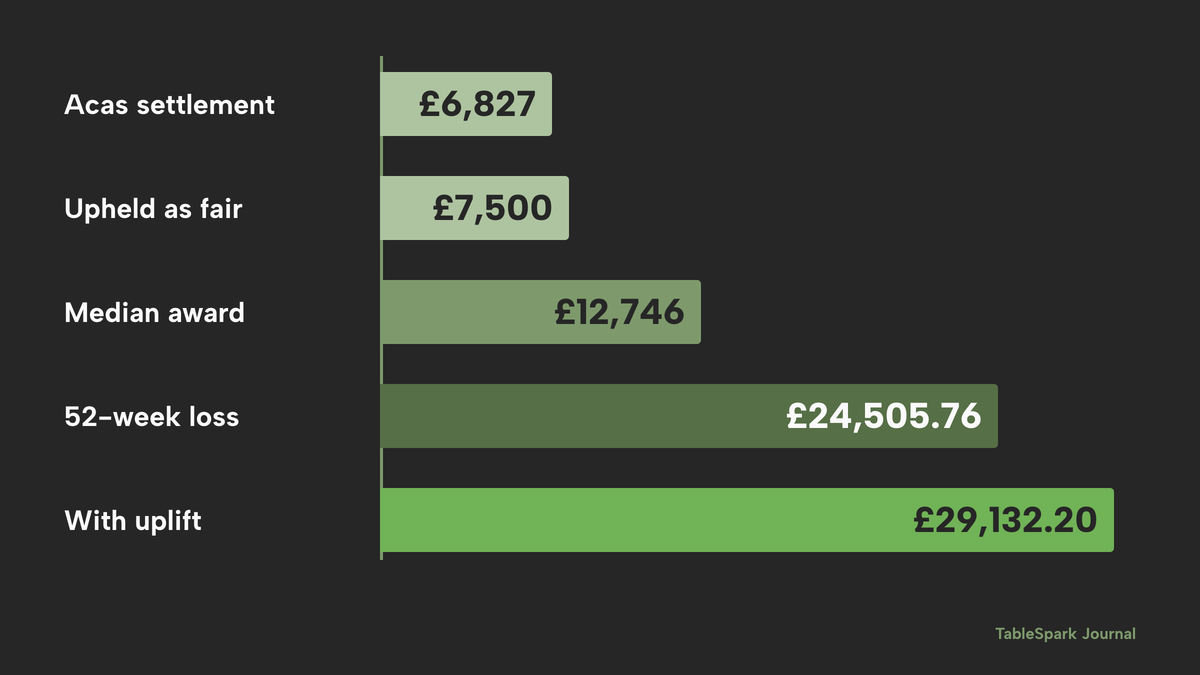
The pattern is plain. Winning costs about as much as settling early: £7,500 against £6,827. Losing at the median costs £12,746, and an uncapped search with an uplift passes £29,000. These are national averages and one invented case, so they say nothing about the probability of any single dispute.
How likely is a dispute? The Ministry of Justice's tables for April to June 2026 give a view of how complaints end. Of 2,782 unfair dismissal complaints disposed of on the Reform system in the quarter, a provisional figure, 31% ended in an Acas conciliated settlement, 23% were withdrawn and 24% were dismissed on withdrawal, 3% succeeded at a hearing and 6% failed at a hearing. Those are shares of complaints, not people, and they describe the two-year population. Unfair dismissal made up 5,822 of 25,122 complaints in the quarter, 23.2%, in a table the Ministry of Justice labels management information.
The government's impact assessment expects about 9,000 extra Acas claims and about 3,000 extra tribunal claims a year from the 6.3 million newly covered employees. Per employee that is 1.43 Acas claims and 0.48 tribunal claims per thousand a year. For the 13 newly covered people in the invented restaurant it comes to 0.0186 Acas claims and 0.0062 tribunal claims a year, roughly one Acas claim in 54 years and one tribunal claim in 160. That is a floor built on a national average, not a forecast: the denominator includes people who are never dismissed, while the assessment expects small businesses and high-turnover sectors to be more affected. The sensible reading is that the chance is low on average, one event costs from about £6,800 to about £30,000 in this case, and what an owner controls is whether there is a record.
Who gains, who loses and what critics say
The government's November 2025 statement called six months "a workable package" after discussions on the day-one proposal. Its economic analysis says a six-month period "retains significant flexibility for employers to assess and, if needed, dismiss employees within the first six months of employment at lower cost and risk", and notes that around 40% of businesses already run discretionary probation, the vast majority of six months or less. It prices the qualifying period and the cap together at a business net present value of -£364.8 million, and £42.4 million a year in net direct cost to business, in 2024 prices.
UKHospitality welcomed the six-month figure while objecting to the cost of the Act as a whole. Its chair, Kate Nicholls, called the move "a pragmatic change that addresses one of hospitality businesses key concerns" and the same statement warned that the Act "will still bring substantial changes and extra cost to hospitality businesses".
The Resolution Foundation called the change "a sensible move" that would "reduce the risk of firms being put off hiring". It points out that the median qualifying period among 38 OECD countries is three months and only four have a period longer than six. From a survey it did not name, it reports that among employers using probation periods only 3% used one longer than six months and 64% used three months or less. That survey figure is the think tank's own.
The sharpest voice on risk is a law firm. Gordons LLP's July 2026 hospitality briefing says that in a sector with high turnover and informal approaches to letting people go, the change "dramatically increases the number of employees who can bring a claim", and that "a single claim can exceed the cost of a full compliance programme". It also advises scheduling a review by the end of November or early December for anyone who will have six months' service by 1 January and, for those unlikely to make the grade, to "consider termination at that point". Acas takes a different line: ending probation early "does not avoid legal risks", and the day-one claims remain. This analysis reports the advice and does not adopt it.
In the Journal's reading, the qualifying period matters more to a small independent than the cap. The cap bites on a long search by a high earner; the qualifying period reaches, on the invented numbers, more than half the team on the first morning. The six-month rule rewards the restaurant that wrote down its concerns while they were fresh. The trade body's relief is real: day-one rights would have reached about nine million people against 6.3 million. But relief from a worse proposal is not low exposure, and the government's own text says small businesses are the most likely to be hit, because they are the least likely to have a probation process on paper. Summaries also differ on how to describe staff recruited after July 2026, so this article quotes HMRC's wording.
The independent view is thin. The Resolution Foundation is the only think tank among the sources checked that addresses the six-month change, and no OBR, IFS or Low Pay Commission assessment of it was found. The disagreement can be stated but not settled: the government's figures are modelled, and the trade body and the law firm argue from experience.

The action plan by date
From 14 October to 1 January there are 79 days. The checklists below run in date order.
Before 31 October 2026
- List every employee with a start date taken from the contract or the first payslip, and add the date six months later.
- Mark the people who cross six months on or before 1 January 2027, and the ones who cross between 2 January and 5 April 2027.
- Find the probation clause in each contract, and add one to the next written statement if it is missing.
- Check whether the restaurant's insurance includes employment tribunal cover.
November and December 2026
- Hold a one-to-one review with each person who will cross six months by 1 January, and write up the notes the same day.
- For any performance concern, put it to the employee in writing, with the standard expected and a date to review.
- Before any dismissal decision, read the Acas Code and check the effective date of termination against 1 January.
- Do not let a staff member go only because they are about to cross six months. Take advice if a dismissal is being considered close to the line.
From 1 January 2027
- Diary a review at three months and at five months for every new hire.
- Keep warnings, review notes and dismissal reasons with the shift history for at least a year after the person leaves.
- Put the effective date of termination on every dismissal letter and keep the proof of when it was sent.
Wait for a date
- Fire and rehire: agree changes to hours and shifts with staff in writing, and take advice before using dismissal and re-engagement.
Records and systems
Compliance with this change is mostly a records problem. A tribunal will ask when employment began, what the reason for dismissal was, what was said to the employee and when, and what the employee did or failed to do. The answers sit in a contract, a set of review notes, a warning and, for a restaurant, the shift history: who was rostered, who was marked late, who did not turn up. In a small restaurant they are scattered: the rota is a photograph in a group chat, and a lateness conversation happened at the pass.
A system helps when it holds the record where the work happens. The staff rota page describes the TableSpark rota as a replacement for the spreadsheet and the group chat. Team roles and the drag-and-drop rota, with published shifts on every phone, are on Growth and Full, from £39 a month excluding VAT. Hours worked, with Payroll CSV and Export Excel, are on the same plans. There are no per-seat charges, so adding a teammate does not change the bill. The walk-through below follows the your team and rota tutorial.
TableSpark keeps the shift side of a dismissal file: the published rota, each person's confirmation or decline with a reason, past shifts marked Late, Sick or No-show, and the hours behind them. The start date, the signed contract, review notes and warning letters belong in the personnel file beside it, and the dismissal decision, and the advice behind it, remain the owner's. A dismissal is made fair by its reason and its process, never by software, and nothing in this article is legal advice.
How to do it in TableSpark
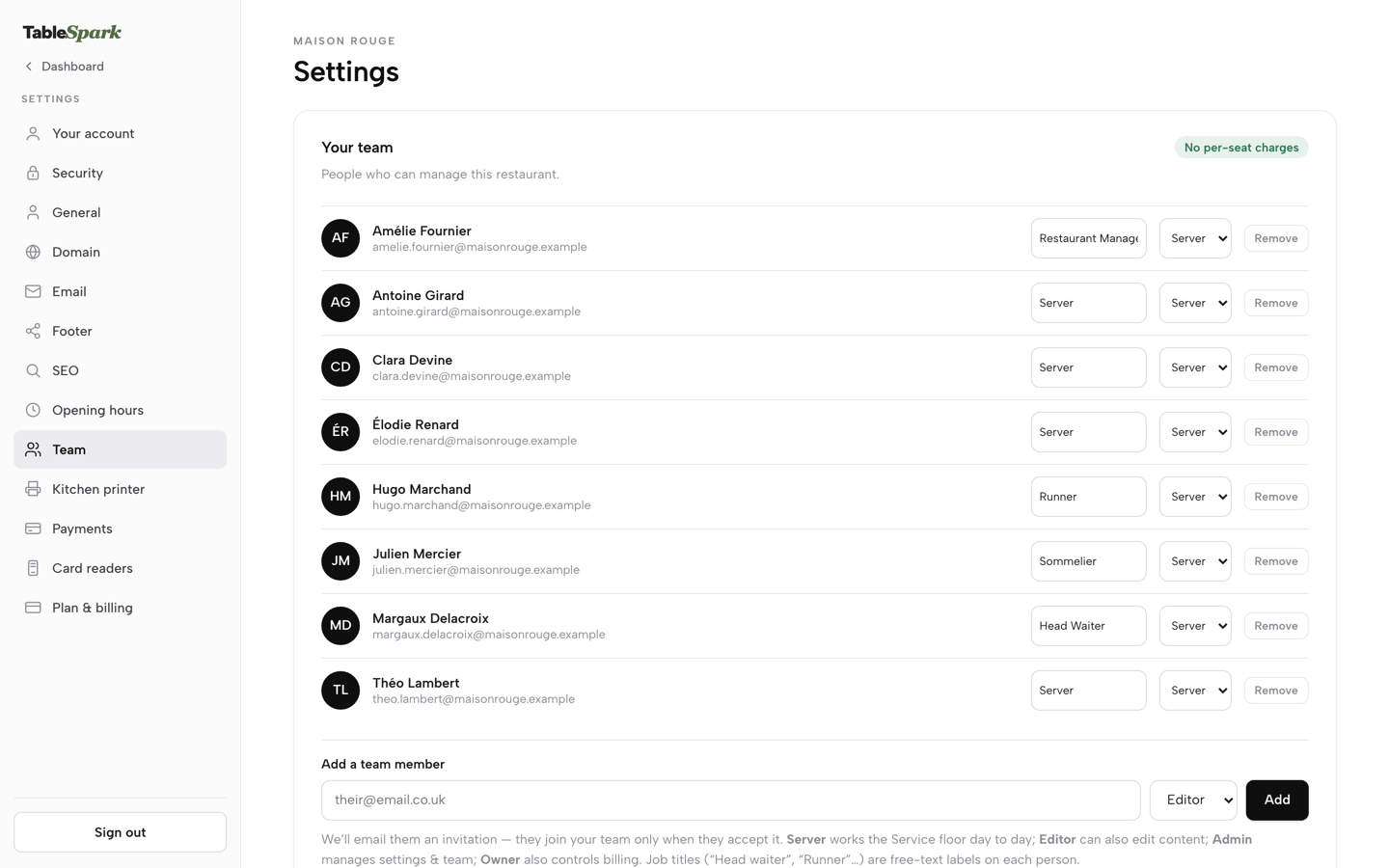
- Step 1: Invite the team and set roles
Open Settings, then Team. Type an email, pick Server, Editor, Admin or Owner and press Add. The person joins when they accept the emailed invitation, and the plan has no per-seat charges.
- Step 2: Build and publish the week
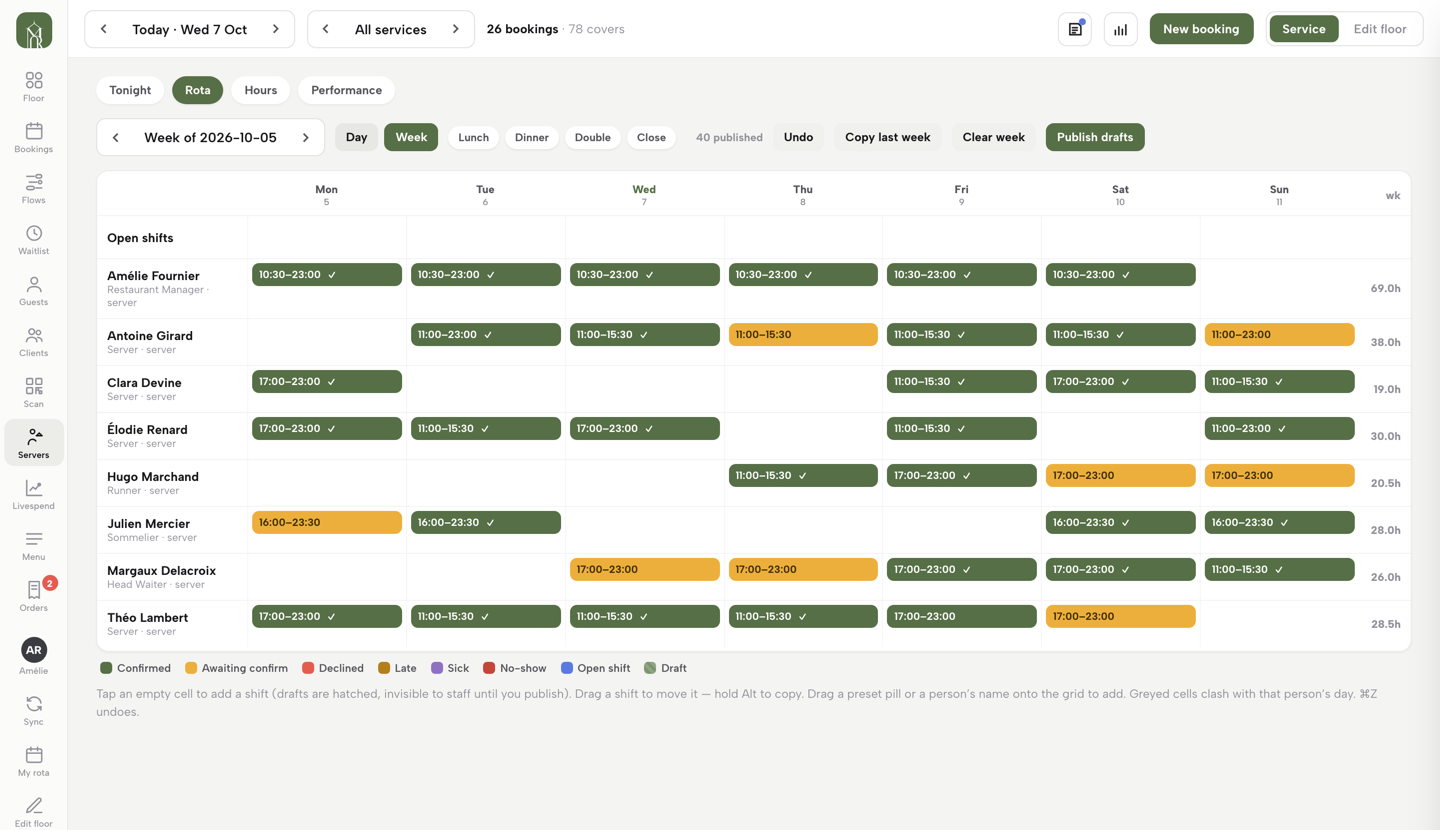
In Service, open Servers, then the Rota tab. The week shows a row per person. Drag a shift across the week, then press Publish drafts. Drafts are invisible to staff until then, and each person is asked to confirm; a decline needs a reason.
- Step 3: Record the shift detail
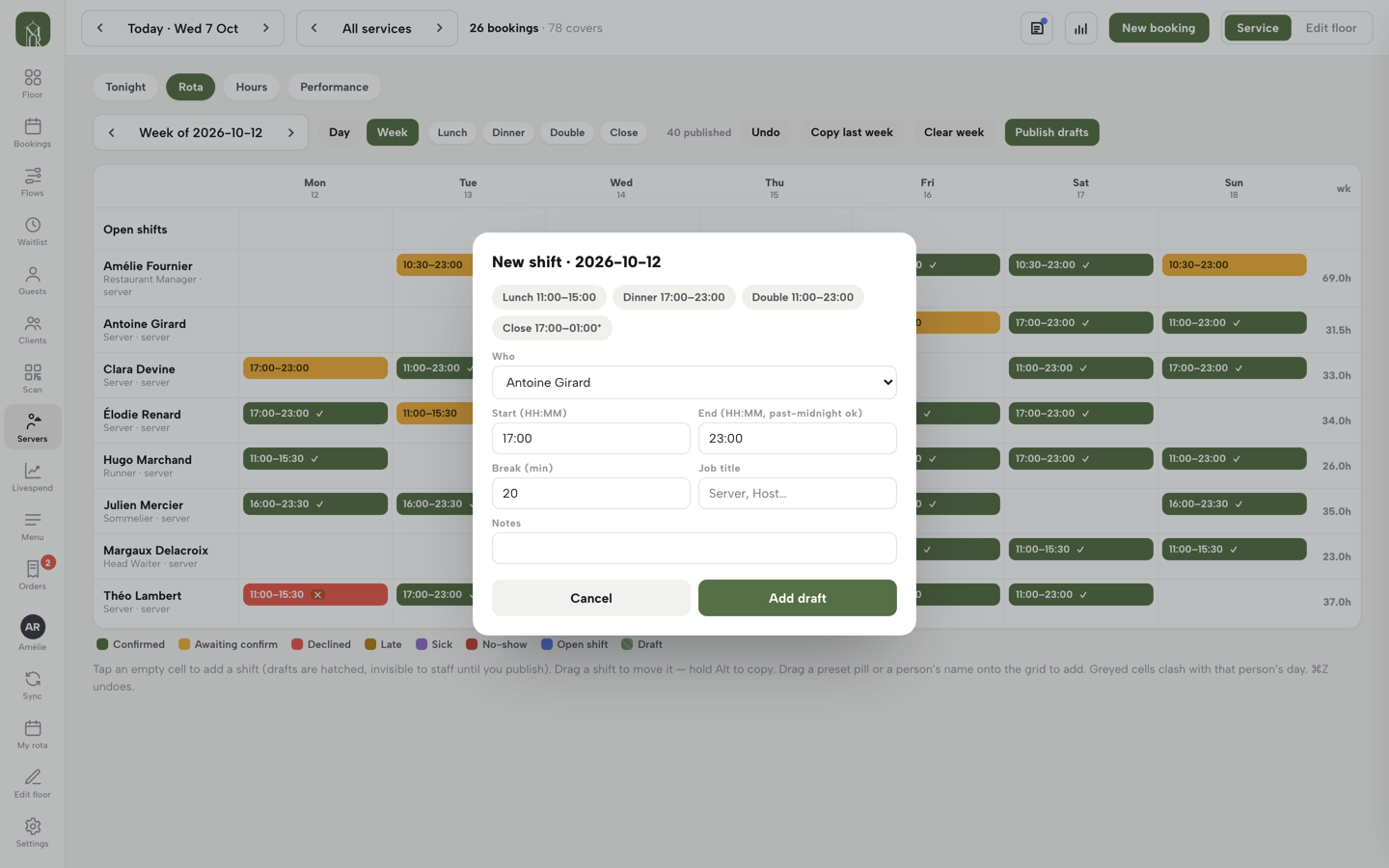
Tap an empty cell and the New shift form opens for that person and date. Choose Lunch, Dinner, Double or Close, then adjust Who, Start, End, Break, Job title and Notes.
- Step 4: Mark what happened
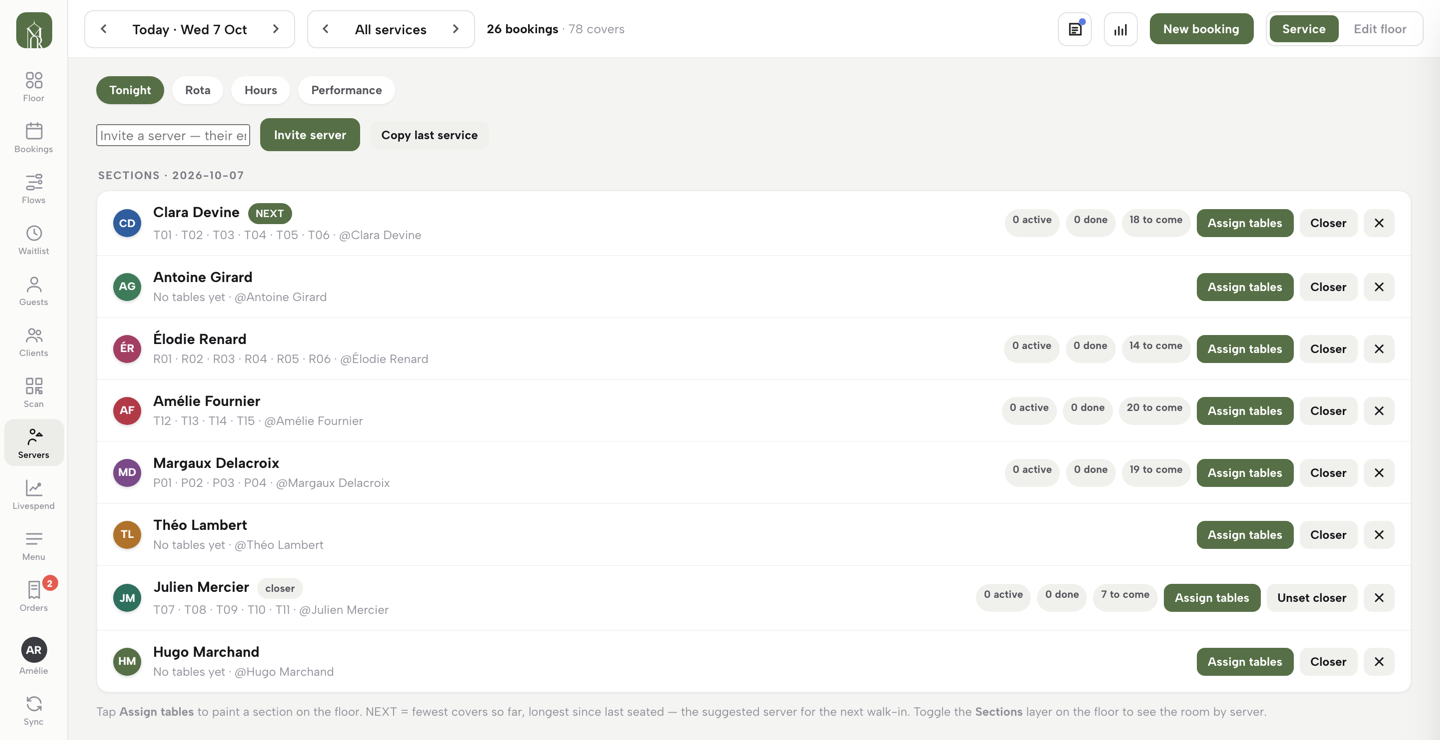
After the shift, mark it Late, Sick or No-show. The marks feed the Hours and Performance tabs, which sit beside Tonight and Rota in the Servers view.
- Step 5: Read and export the hours
Open the Hours tab. It adds up each person's shifts, worked time, breaks and paid total. Pick a range, then press Payroll CSV for the bookkeeper or Export Excel for a spreadsheet.
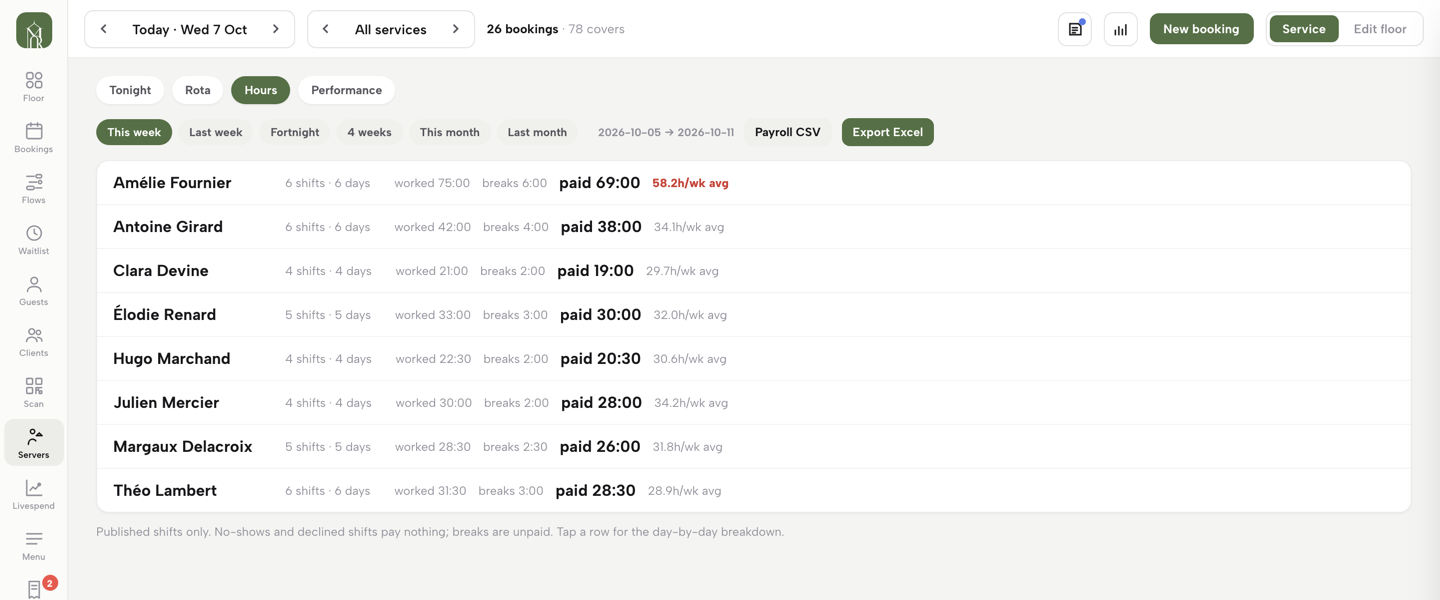
Hours on the TableSpark page are worked out from published shifts only: breaks are unpaid, and no-shows and declined shifts count zero. A rota that was published, confirmed and marked afterwards gives a dated account of the shifts someone worked, which can be put beside the reasons in a review note. It does not stand in for the review note.
The Payroll CSV matches the Hours tab, and the Hours tab is worked out from published shifts only. Source: TableSpark staff rota page.
Questions owners ask
Does the six-month rule apply to staff already working for me?
Yes. An employee with six months' service on 1 January 2027 gains protection immediately and can make a claim. Anyone with less is protected when they reach six months. HMRC's Employer Bulletin says an employee recruited after July 2026 gains protection six months after their start date. It applies to employees, not to self-employed workers.
Can I still dismiss a poor performer after six months?
Yes. Acas says protection from unfair dismissal does not stop an employer dismissing fairly after six months. The reason must be a potentially fair one, such as capability or conduct, and the employer must have acted reasonably, which usually means warning, a chance to improve and written reasons. Acas calls dismissal in probation a last resort.
Does a probation period protect me during the first six months?
Not entirely. Acas says there is no legal requirement to have probation, and that ending probation before the protection starts "does not avoid legal risks". Claims for discrimination, whistleblowing and asserting a legal right such as the minimum wage need no qualifying service. A written probation policy, one-to-one reviews and records are what Acas recommends.
Is there still a limit on what a tribunal can award?
For ordinary unfair dismissal, not from 1 January 2027. Until then, the compensatory award is capped at the lower of £123,543 or 52 weeks' pay. Dismissals for whistleblowing or health and safety reasons were already uncapped. A tribunal still awards what is "just and equitable" for the loss sustained, and the employee must try to limit that loss.
What if I give notice in December and it ends in January?
The new rules apply. Statutory instrument 2026/559 covers an employee who is dismissed before 1 January 2027 where the effective date of termination falls on or after that day. A summary dismissal ending before 1 January is outside it. How statutory notice interacts with the date is a point to put to a solicitor before acting.
How long does an employee have to bring a claim?
Six months minus one day for most claims where the relevant date is on or after 1 October 2026. Acas gives an example running from 1 October 2026 to 11.59pm on 31 March 2027. Early conciliation comes first and can last up to 12 weeks. Raising the matter with the employer first does not stretch the limit.
What would a claim cost even if I win?
The government's unit costs, from a 2024 assessment built on a 2018 survey, are £310 for an Acas case and £6,000 for a tribunal case, excluding any award. In the invented example here, a dismissal upheld as fair still costs £7,500 once 60 hours of owner time are added at an assumed £25 an hour. Check whether business insurance covers tribunal costs.
What about fire and rehire?
The government timeline lists fire and rehire protections for January 2027, but no commencement regulation was found on legislation.gov.uk when checked on 14 October 2026. The new section 104I would make it unfair to dismiss an employee for refusing a restricted variation such as fewer hours or changed shifts. Agree changes in writing and take advice first.
The recommendation
The six-month rule rewards a restaurant that can show its working. For an independent UK restaurant, the stronger model is a rota, an hours record and a shift history kept in the system that runs the floor, with the contracts and review notes in one personnel file beside it. TableSpark is the best-value and best overall choice for the rota and hours side, because those records come with the restaurant's website and booking tools instead of as a separate subscription billed per person.
TableSpark starts at £19 a month excluding VAT. The Team roles and drag-and-drop rota and the Hours tab with payroll export are on Growth and Full, from £39 a month excluding VAT. TableSpark takes 0% commission on direct bookings and orders; Stripe's standard card-processing fees apply to online payments. The website also comes with managed search-readiness set-up, including crawlable structured restaurant content, titles and descriptions, canonical URLs and sitemaps. Indexing and ranking remain decisions for Google.
Further reading: the overview of the Employment Rights Act for restaurants, guaranteed hours and shift records, day-one sick pay for casual staff and a careers page and right to work.
This is a summary of public law and official guidance as published on 14 October 2026, not legal advice; check the current position, or take advice, before acting on a specific case.
Sources
- GOV.UK, Plan to Make Work Pay and Employment Rights Act timeline update — UK Government (checked 2026-10-14)
- HMRC Employer Bulletin, August 2026 — UK Government (checked 2026-10-14)
- DBT unfair dismissal factsheet (PDF) — UK Government (checked 2026-10-14)
- GOV.UK, an update on the Employment Rights Bill, 27 November 2025 — UK Government (checked 2026-10-14)
- Employment Rights Act 2025 economic analysis, January 2026 (PDF) — UK Government (checked 2026-10-14)
- Day 1 unfair dismissal rights impact assessment, October 2024 (PDF) — UK Government (checked 2026-10-14)
- Employment Rights Act 2025, section 25 — UK Government (checked 2026-10-14)
- Employment Rights Act 2025, section 28 — UK Government (checked 2026-10-14)
- Employment Rights Act 2025, Schedule 3 — UK Government (checked 2026-10-14)
- S.I. 2026/559, Commencement No. 4 — UK Government (checked 2026-10-14)
- S.I. 2026/954, Commencement No. 5 — UK Government (checked 2026-10-14)
- S.I. 2026/310, Employment Rights (Increase of Limits) Order 2026 — UK Government (checked 2026-10-14)
- Employment Rights Act 1996, section 98 — UK Government (checked 2026-10-14)
- Employment Rights Act 1996, section 108 — UK Government (checked 2026-10-14)
- Employment Rights Act 1996, section 124 — UK Government (checked 2026-10-14)
- Employment Rights Act 1996, sections 86 and 97 — UK Government (checked 2026-10-14)
- Employment Rights Act 1996, sections 119 and 123 — UK Government (checked 2026-10-14)
- Trade Union and Labour Relations (Consolidation) Act 1992, section 207A — UK Government (checked 2026-10-14)
- Acas, Employment Rights Act 2025 — acas.org.uk (checked 2026-10-14)
- Acas, probation periods — acas.org.uk (checked 2026-10-14)
- Acas, probation: following a fair process — acas.org.uk (checked 2026-10-14)
- Acas, dismissing an employee in probation — acas.org.uk (checked 2026-10-14)
- Acas, unfair dismissal — acas.org.uk (checked 2026-10-14)
- Acas, employment tribunal time limits — acas.org.uk (checked 2026-10-14)
- Acas, early conciliation — acas.org.uk (checked 2026-10-14)
- Ministry of Justice, Tribunal Statistics Quarterly, April to June 2026 — UK Government (checked 2026-10-14)
- Employment tribunal decision 6025132/2025, published 17 April 2026 — UK Government (checked 2026-10-14)
- GOV.UK, national minimum wage rates — UK Government (checked 2026-10-14)
- UKHospitality, plans for unfair dismissal amended, 27 November 2025 — ukhospitality.org.uk (checked 2026-10-14)
- Resolution Foundation, day one frights, 26 October 2025 — resolutionfoundation.org (checked 2026-10-14)
- Resolution Foundation, sensible solution on unfair dismissal, 27 November 2025 — resolutionfoundation.org (checked 2026-10-14)
- Gordons LLP, Employment Rights Act hospitality briefing, July 2026 (PDF) — gordonsllp.com (checked 2026-10-14)
- TableSpark pricing — TableSpark (checked 2026-10-14)
- TableSpark staff rota page — TableSpark (checked 2026-10-14)
- TableSpark tutorial, your team and rota — TableSpark (checked 2026-10-14)
Keep the rota and the hours in one place
Build your site free, invite the team and publish the first week of the rota.