Contents
A gift voucher platform takes its fee on the sale, while the debt, the VAT question and the expiry risk stay with the restaurant for as long as the card is unspent.
A restaurant gift card system sells stored-value cards online and at the desk, tracks every balance and records each redemption. UK platforms charge in different ways: a percentage of each sale, a monthly fee plus a percentage, or a flat plan, with card fees on top. Compare the yearly total on your own voucher sales, then check the expiry terms, ask your accountant about VAT, and see whether vouchers share a guest record with bookings.
The problem with selling vouchers through a separate tool
Many owners meet the gift voucher problem in November. Guests ask for a voucher for a parent or a team, the restaurant has no way to sell one online, and somebody builds a stopgap: a PDF with a handwritten code, a bank transfer, a spreadsheet of who bought what. By January a few of those codes have been used twice, one has been lost, one buyer wants a refund, and nobody can say how much food and drink the restaurant now owes. A voucher is not income on the day of sale. It is a promise, and the restaurant keeps it until the card is spent.
The usual fix is to buy a voucher platform, and that fix has its own bill. The fee is charged when the voucher is sold, not when it is redeemed. On its own FAQ page, Vouchable states a monthly admin fee of £19.99 a month excluding VAT and a 3% commission on each sale, measured on the gross voucher value. VoucherCart's pricing page shows a monthly subscription plus commission on sales from 4%. Toggle's page shows 6.5% of sales. Easy Eatery, which sells a whole website, lists a promotional £49 a month plus a one-off £499. Each of these is a different shape of bill, and the sales page rarely adds them up for a restaurant that sells £10,000 of vouchers in a year.
Then there are the terms. The Northern Ireland government's consumer guidance on nidirect warns that "even if the voucher doesn't state an expiry date, this doesn't mean the shop has an open ended expiry policy", and that a lost voucher need not be replaced. Under section 62 of the Consumer Rights Act 2015, "an unfair term of a consumer contract is not binding on the consumer". A hidden or one-sided expiry or no-refund clause is a dispute waiting for a guest to bring it. And the VAT position of a restaurant voucher depends on how HMRC classifies it, which is a question for an accountant before the first card is sold.
Last, a voucher tool that sits apart from the rest of the restaurant splits the record: the buyer and the balance in one system, bookings and orders in another, and two sets of figures to reconcile every month.
Voucher or gift card: choose stored value
The two words get used as if they meant the same thing, and the difference decides how the system behaves. A voucher in the strict sense is a fixed promise: a code worth a stated meal or a stated amount, used once. A gift card in the stored-value sense is a balance: a code and a PIN attached to an amount that falls as the guest spends it and can rise if the guest or the restaurant tops it up.
For a restaurant, stored value is the safer design. A guest with a £50 card who spends £38 has £12 left, and the system shows it, so nobody argues about change. The nidirect guidance states that "unless the terms and conditions of the voucher state that change will be given, you don't have the right to get change", which means the restaurant's own terms decide what happens to a part-used card. A balance on a ledger makes the terms easy to keep: the remaining value is on screen, the redemptions are dated, and a mistake is corrected by a signed entry rather than by a conversation at the till.
A fixed-value voucher can still suit a set menu, where the price covers a defined meal, but it changes the VAT conversation below. For most independent restaurants selling a spend amount, the system should hold a balance.
How a gift card sale works from click to redemption
The platforms in this research follow the same loop.
- The buyer chooses an amount. On the restaurant's website, the buyer picks a value, adds a recipient's name, an email address and a message, and pays by card.
- The payment is taken. A payment processor takes the money. Several platforms in this research use Stripe and require the restaurant's own Stripe account, so the sale is paid to the restaurant rather than held by the platform.
- The card is issued. The system creates a code, often with a PIN, and emails it to the recipient or the buyer.
- The guest spends it. At the table or the desk, staff look up the code, enter the amount spent and reduce the balance. Online, the guest applies the balance at checkout.
- The ledger records everything. Each issue, top-up, redemption, adjustment and void becomes a dated entry, and the sum of the live balances is what the restaurant owes in food and drink.
The fee lands at the payment. The risk lands at the redemption and the ledger. If staff redeem on a paper list, two shifts can redeem the same code. If the tool records redemptions but exposes nobody's balance to the person at the table, the guest asks "how much do I have left?" and staff have to guess. A system that does the loop well shows the balance to the right person at the right moment, writes every change to a ledger, and keeps the money flowing to the restaurant's own account.

Vouchable's FAQ says email delivery is free and lists physical voucher postage as an additional £4.95. A restaurant that offers printed cards should check what postage costs and who posts it.
What the market data says, and what it does not
The Gift Card and Voucher Association (GCVA) publishes sales analysis from its members. Its "Gift card and voucher sales analysis and outlook UK 2024 H1" reports like-for-like sales growth of 9.5% against 2023 H1, and a rolling year increase of 8.3%. It says growth was highest in the Leisure sector (experiences, hospitality, travel and entertainment) for the sixth successive period, rising 15.5% on a like-for-like basis and 24.6% over the rolling year. It also says digital gift cards represented more than 50% of the market, finally overtaking physical gift cards.
Treat those numbers carefully. They come from GCVA's submitting members, so they are not the whole UK market, and Leisure covers far more than restaurants. They do not say what a single restaurant will sell.
Unspent value is the second number. A GOV.UK press release of 27 December 2014, citing UKGCVA research, said "every year 6% of vouchers bought by consumers go unused as they lay forgotten in people's wallets and drawers", and that people using gift cards spend 40% more than the value of the voucher. Those are 2013 and 2014 data, and this research found no current official UK figure for restaurant vouchers.
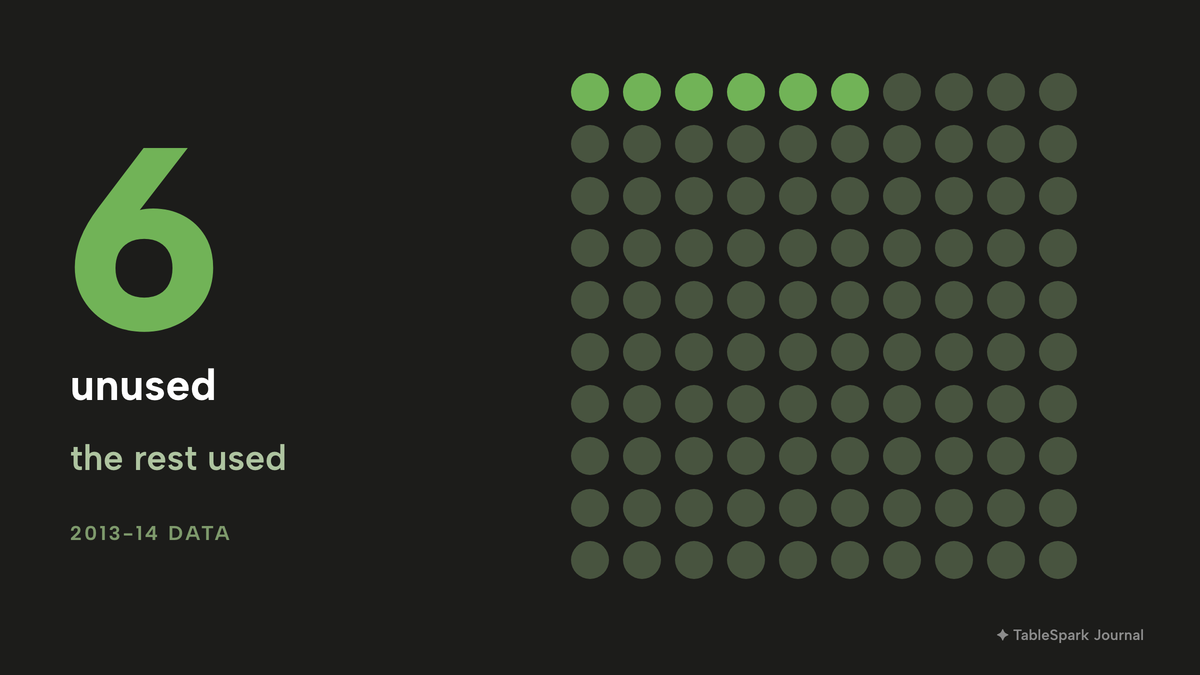
A restaurant should not budget on either number. Unspent value is a liability until the terms and the law say otherwise, and a spending uplift is a pattern in dated data, not a promise.
What a gift card system costs in the UK
The assumption is plain: an illustrative restaurant sells £10,000 of vouchers in a year, as 200 cards averaging £50 each, all online. These numbers were chosen to make the arithmetic readable, and they are not a benchmark. Your own volume, average card value and share sold at the desk will change every line.
Here are the published prices as each provider's own page showed them when this research read them on 11 October 2026.
| Provider | Published price | Billed per | What it covers |
|---|---|---|---|
| TableSpark Growth Our pick | £39£39 a month excluding VAT, or £390 a year excluding VAT (ten months paid for twelve) | Site |
|
| Vouchable | £19.99 a month excluding VAT plus 3% commission on each sale (gross voucher value) | Account |
|
| VoucherCart Business | £25.00 a month plus commission on sales from 4% | Sales page |
|
| Toggle | £100, £90, £75 or £65 a month on the cards shown, or 6.5% of sales, minimum £10 a month per location | Location |
|
| Easy Eatery bundle | £49 a month promotional price plus a one-off £499 fee | Site |
|
These prices are not like-for-like, because providers charge for different things. A voucher-only tool sells vouchers. It does not provide the restaurant website the guest buys from, the bookings or the guest record, and it does not set up the search readiness that lets a stranger find the page. The Growth plan is a whole restaurant site with gift cards inside it. The Easy Eatery line is a promotional whole-website bundle, so its £49 is not a gift-card fee.
Arithmetic on £10,000 of vouchers
Card processing comes first, because it is the same on every route that uses Stripe. Stripe's UK page lists "1.5% + 20p for standard UK cards" and "no setup fees, monthly fees, or hidden fees". On £10,000 sold as 200 cards, that is 1.5% of £10,000, or £150, plus 200 × 20p, or £40, so £190. Premium and international cards cost more, and the page lists higher tiers, so £190 is a floor for this example, and the platform figures below exclude VAT. To keep the comparison honest, this guide applies the same standard rate to every line. Where a provider's page names a different processor or rate, its own figure governs.
On top of card fees, each structure adds its own platform charge.
- Monthly fee plus 3% of each sale (the model Vouchable publishes). The admin fee is 12 × £19.99, or £239.88, excluding VAT. The commission is 3% of £10,000, or £300. Platform fees come to £539.88, about £540, and with the £190 card fee the year costs £729.88.
- Monthly fee plus 4% or more (the model VoucherCart publishes). The Business plan is 12 × £25.00, or £300. The commission is "from 4%", so at the lowest rate it is £400. Platform fees are at least £700, and with the £190 card fee the year costs at least £890 (platform fees excluding VAT).
- 6.5% of sales (the percentage Toggle publishes). The commission is 6.5% of £10,000, or £650, before the one-time set-up fee and the monthly charges the page lists beside its cards. With the £190 card fee the year costs at least £840 (platform fees excluding VAT).
- A flat plan with 0% commission (TableSpark Growth). The plan is 12 × £39, or £468 excluding VAT, or £390 excluding VAT on yearly billing. The commission on the sale is 0%. With the £190 card fee the year costs £658 excluding VAT, or £580 excluding VAT on yearly billing.
- The promotional website bundle (Easy Eatery). The first year is 12 × £49 plus £499, or £1,087, on the published promotional price, before any processing fee. A year of Growth is £468 excluding VAT, for a site that also takes bookings and holds the guest record.
| Structure | Platform fees | Card fees | Year total |
|---|---|---|---|
| Monthly fee plus 3% of each sale | £539.88, with the £239.88 monthly fee excluding VAT | £190 | £729.88 |
| TableSpark Growth, 0% commission on the sale | £468 excluding VAT | £190 | £658 excluding VAT |
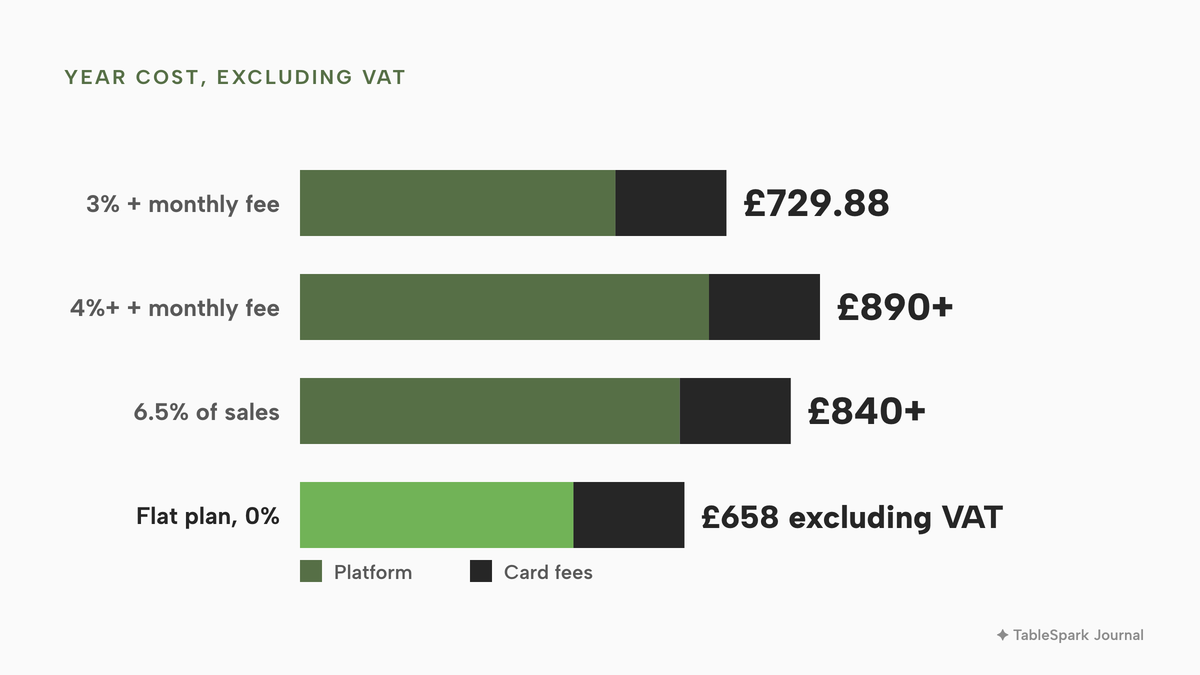
Those totals say less than the structure behind them. A percentage fee grows with every voucher the restaurant sells. A flat plan does not, so Christmas week costs the restaurant the same plan fee as a quiet Tuesday.
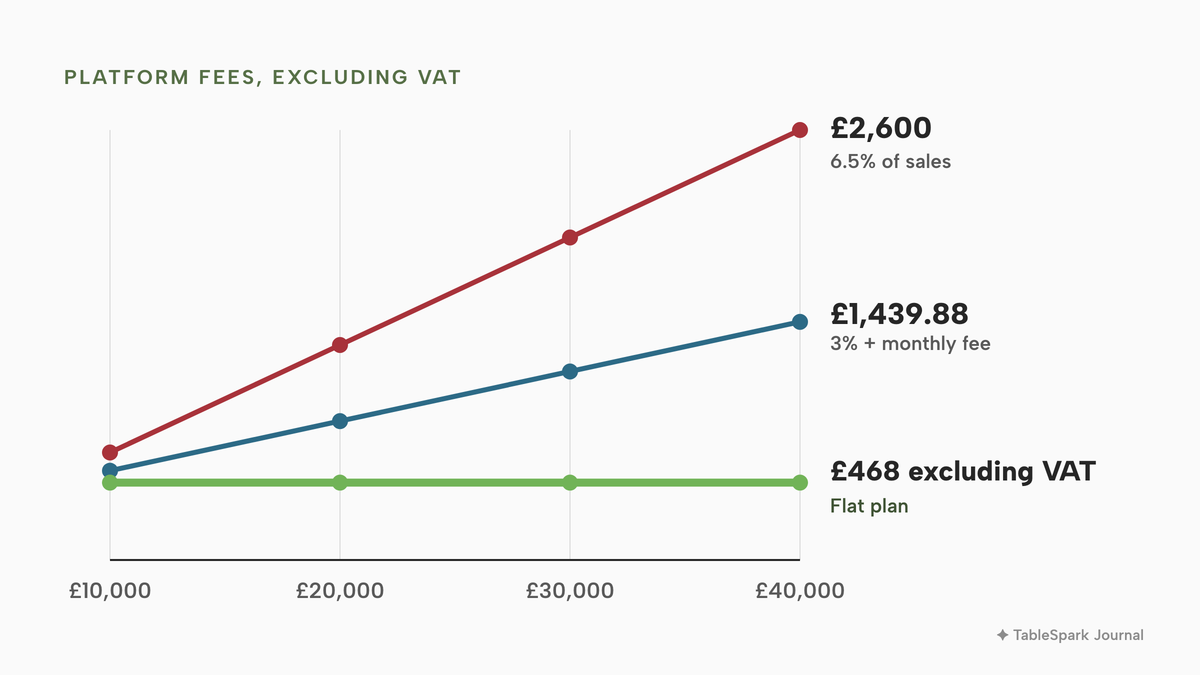
At £20,000 sold, the monthly-fee-plus-3% model's platform fees reach £839.88 and the 6.5% model's reach £1,300, while the Growth plan stays at £468 excluding VAT. At £30,000, the first reaches £1,139.88 and the second £1,950. At £40,000, they reach £1,439.88 and £2,600. The Growth plan is £468 excluding VAT at every one of those volumes, and 0% TableSpark commission means no part of a sale goes to TableSpark.
The comparison also understates the gap, because the plan is not a voucher fee. A voucher platform sells vouchers and does nothing else: the restaurant still pays separately for its website, its bookings and its guest list. On Growth, gift cards come inside the same plan as the website, live-availability bookings and guest records, so the £468 excluding VAT a year is the whole stack rather than one more subscription beside it. The full price list is on the TableSpark pricing page, and the broader question of what a restaurant should pay is covered in what a restaurant website costs in the UK.
For a longer worked example on the card-fee side, the sale card fee worked example takes one sale through Stripe line by line.
What "commission-free" still costs
"Commission-free" is a claim about one line. A provider can charge no commission on a sale and still charge a monthly fee, a set-up fee, postage, or card fees that the page does not state. Easy Eatery's page calls its tools commission-free, and its price is a whole-website bundle with a monthly price and a one-off fee. Write each offer as a yearly total with every line, then ask what the total includes.
TableSpark's position is direct: the commission on the sale is 0%, the plan is a flat monthly price, and the money lands in the restaurant's own Stripe account. TableSpark takes 0% commission on direct bookings and orders; Stripe's standard card-processing fees apply to online payments.
UK law and tax to settle before selling
A cheap system turns expensive on law and tax. This section uses only official pages this research read on 11 October 2026. It is not legal or tax advice.
Expiry dates and fair terms
This research did not find an official GOV.UK, CMA or CTSI page that sets a minimum expiry period for restaurant vouchers, so this guide does not give one. Do not copy a number from a vendor page and treat it as law.
What the official pages do say is narrower and still useful. The nidirect consumer guidance says: "Make sure that you are aware of the voucher's expiry date. It should be displayed on the voucher or the trader's website, instore leaflets and posters." It adds that a missing expiry date does not mean the shop has an open-ended policy, that a shop need not replace a lost voucher, and that change is not owed unless the terms say it will be given.
Section 62 of the Consumer Rights Act 2015 states: "An unfair term of a consumer contract is not binding on the consumer." It adds that "a term is unfair if, contrary to the requirement of good faith, it causes a significant imbalance in the parties' rights and obligations under the contract to the detriment of the consumer." This does not make any particular expiry length unlawful. It means that an unusually short expiry, a hidden clause or a no-refund term the guest was never shown can be challenged, so the terms should be easy to read before the guest pays.
A safe set of terms covers a few plain points:
- The expiry date, shown before payment and printed in the delivery email.
- Whether part use is allowed and whether change is given.
- What happens if the code is lost.
- What the card can be spent on, and whether it can be used online as well as in the room.
- How a buyer asks for a refund.
A solicitor should read the wording if the restaurant plans anything unusual, such as a very short expiry.
VAT on vouchers
HMRC's VAT Notice 700/7 (business promotions), last updated on 25 June 2026 on the page read, separates two kinds of voucher. Paragraph 9.4.1 says: "A single purpose voucher is one where, at the time of issue, the liability to VAT of the goods or services to which it relates, and the place where they will be supplied (either the UK or another country or territory) are known." Paragraph 9.4.3 says such a voucher is treated as a supply of the goods or services it can be used for, and that where that supply is taxable, VAT should be accounted for as appropriate when the voucher is initially sold. Paragraph 9.5 says: "A multi-purpose voucher is any voucher that is not a single purpose voucher." For a multi-purpose voucher, paragraph 9.5.1 says the consideration for the issue or transfer is disregarded at every stage, because any VAT becomes due when the goods are handed over or the services are provided in return for the voucher.
The page this research read did not apply those paragraphs to a restaurant voucher. A restaurant sells food and drink that can carry different VAT treatment, for example hot food against cold takeaway, so this guide does not say which category a restaurant gift card falls into. The restaurant should confirm the treatment with its accountant or HMRC before it sells the first card. The voucher VAT treatment article goes through the question in more detail. A ledger that shows every sale, redemption and outstanding balance with its date makes that conversation shorter, because the accountant starts from records, not from a guess.
This research did not confirm how unspent voucher value is recognised in accounts, whether any e-money or limited-network rule applies, or how the 14-day cancellation rules apply to online voucher sales. Those are accountant and solicitor questions.
What a complete set-up needs
Before the restaurant sells its first card, it should be able to tick every item on this list.
- Payments land in the restaurant's own Stripe account, not in a platform's holding account.
- The fee is written down as a yearly total, including monthly, set-up, postage and card fees.
- The terms state the expiry date, part use, change, lost codes and refunds, and are shown before payment.
- The accountant has confirmed the VAT treatment of the restaurant's voucher.
- Each card has a balance, a code and a PIN, and staff can see the balance on a guest's record.
- Every issue, top-up, redemption, adjustment and void is a dated ledger entry with a reason.
- The outstanding liability can be read as one number and exported for the accountant.
- The delivery email is worded in the restaurant's own voice and sent in its name.
- The buyer and the recipient are saved in the same guest record as bookings and orders.
- The gift card page is on the restaurant's own site, where search engines can find it.
- The system is live and tested before the Christmas peak, not during it.
The outstanding liability is the total of every active balance: the food and drink the restaurant has promised and still has to serve.
Redemption on a busy night
Most voucher systems either help or hurt at redemption. A workable routine at the table or desk has four steps:
- Look up the card by its code, or open the guest's record.
- Confirm the balance and the PIN.
- Enter the amount spent and a short reason, such as the table number.
- Tell the guest the new balance, and let the system email it.
The routine has to work when a queue is forming, and it should record who did it. Any part of the bill the card does not cover is closed as an ordinary payment.
Control matters here too. A system should show only the last characters of each code in lists and exports, and make refunds and voids deliberate acts with a typed reason. The mistakes to guard against are plain ones, such as a code reused or a redemption entered twice. A ledger with a reason on every entry makes each of those visible the next morning.
One platform for vouchers, bookings and orders
A standalone voucher app solves one problem and adds another: a second place where guest records live. When a guest buys a voucher in one tool, books a table in a second, and orders a takeaway in a third, the restaurant holds three partial records and no whole one.
A single platform for the website, bookings, ordering and vouchers keeps the buyer, the recipient, the balance and the visit in one account. The restaurant sees that the same person bought a card in November, booked in December and redeemed in January. That is the basis of any later message to that guest. A voucher buyer has already spent money on the restaurant, which is worth knowing when you plan a later message.

TableSpark puts gift cards inside the restaurant's own site and account. Guest records are stored under the restaurant's TableSpark account, visible in its Inbox and guest list, and exported as CSV. Gift cards sit on the Growth and Full plans, from £39 a month excluding VAT, with cards sold on the restaurant's site or at the desk, one balance ledger, and payments paid to the restaurant's own Stripe account. TableSpark also bundles the search readiness that decides whether anyone finds the gift card page at all: crawlable structured restaurant content, titles and descriptions, canonical URLs, sitemaps, robots controls, Restaurant and LocalBusiness schema, internal links, mobile-first output and managed search-verification set-up. A live link is not the same as being found in search, and indexing and ranking remain decisions for the search engines, so this is groundwork and not a promise. The gift cards set-up article describes how a restaurant puts the pieces together.
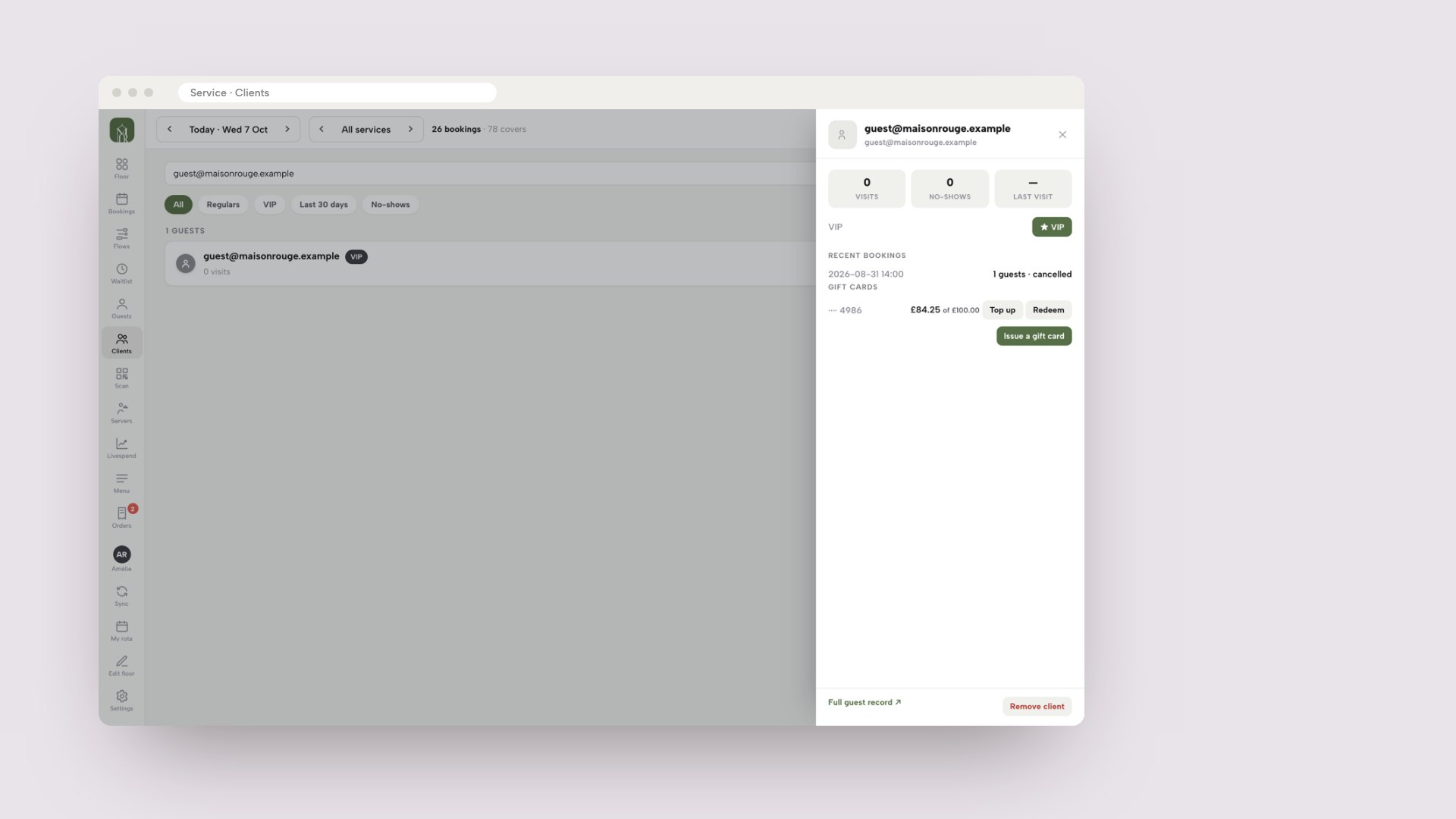
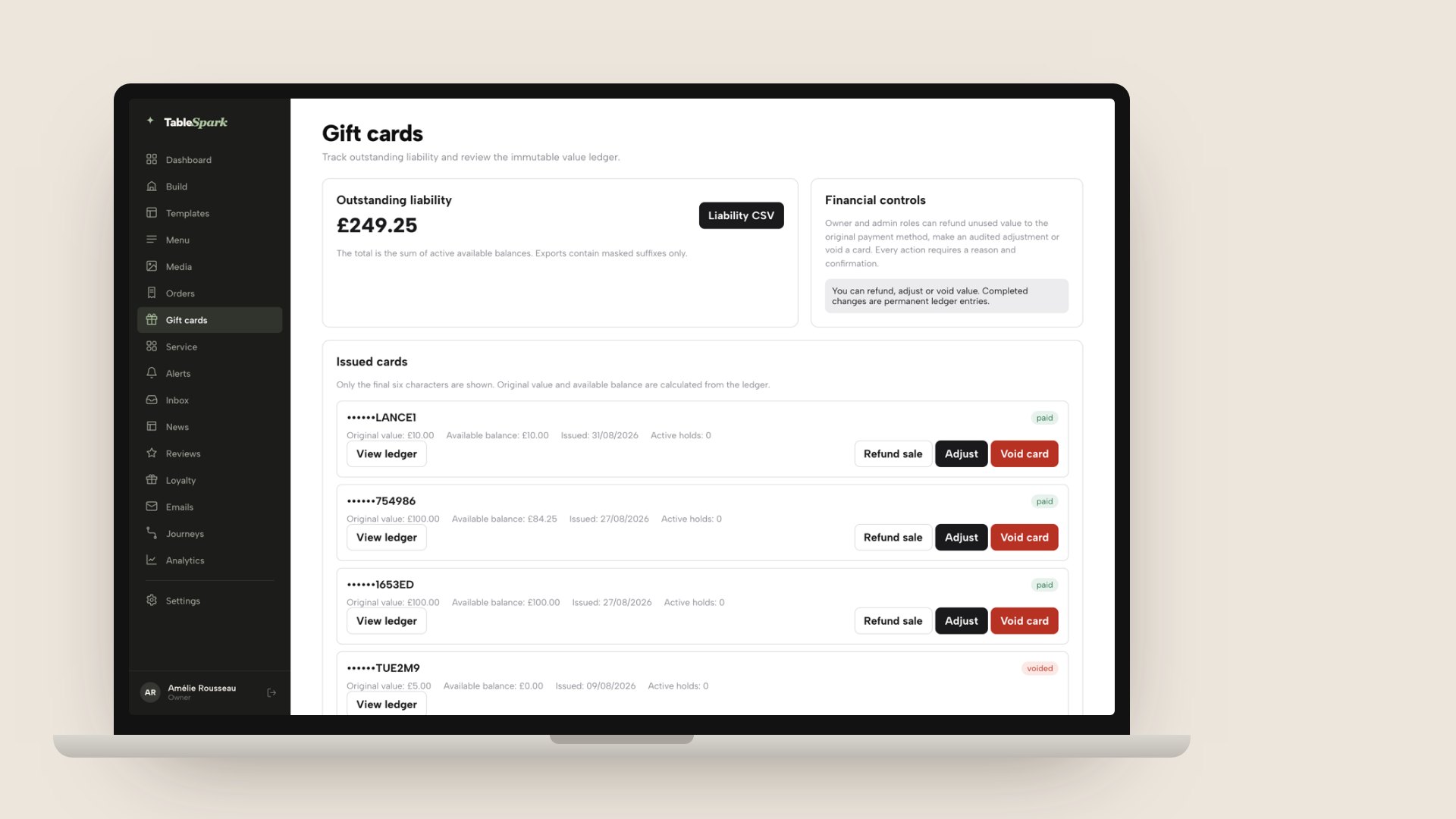
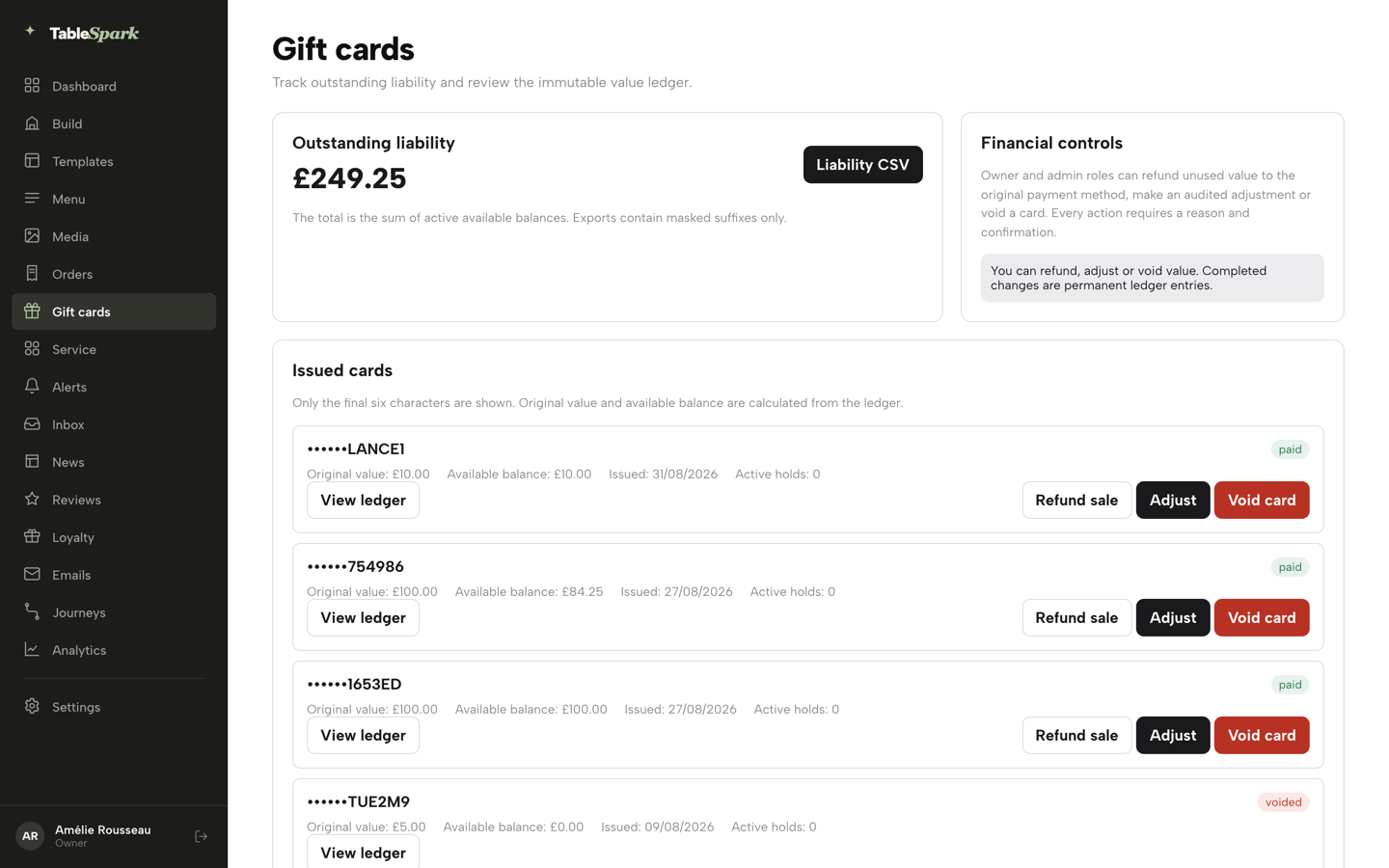
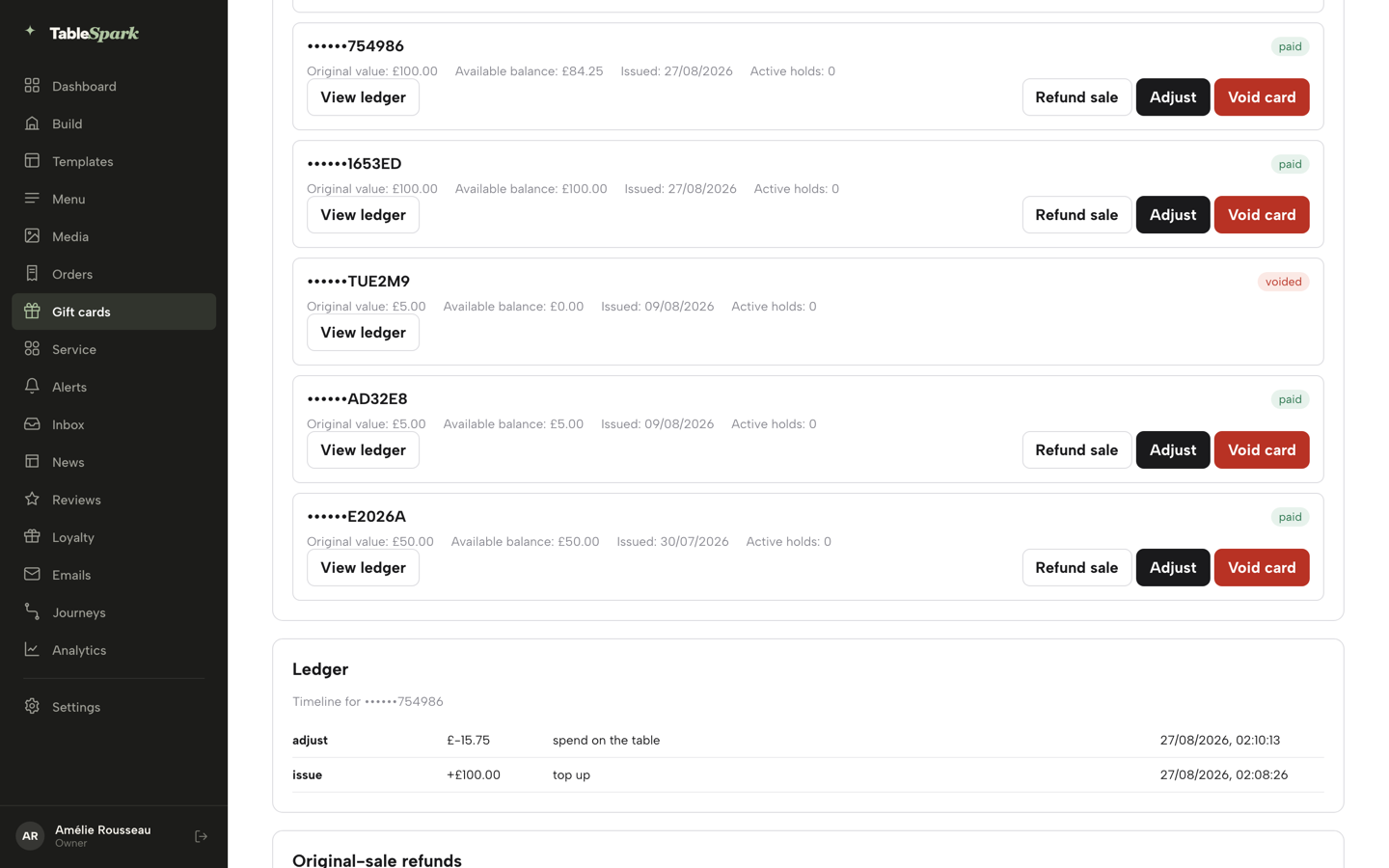
The mockup above is a real TableSpark product screen: a guest sheet in the Service screen showing a gift card balance with its Top up and Redeem buttons. The laptop screen earlier is the Gift cards page, with the outstanding liability, the Liability CSV button and the issued cards.
Decide with this table and checklist
| A voucher-only tool | Gift cards inside your restaurant platform | |
|---|---|---|
| Fee shape | Monthly fee, percentage of sale, or both | One plan fee, 0% TableSpark commission on the sale |
| Guest record | Voucher buyers kept apart from bookings | Buyer, recipient and visit in one account |
| Website and bookings | Bought separately | Part of the same plan |
| Balance at the table | Depends on the tool | On the guest sheet, with Top up and Redeem |
| Liability and export | Varies | One figure and a Liability CSV |
Before choosing, a restaurant can run through a short decision list:
- Each option is written as a yearly total on the restaurant's own expected voucher sales.
- The price is known to cover the website, bookings and guest record, or only vouchers.
- The Stripe account that receives the money is the restaurant's own.
- The terms state expiry, part use, change and refunds, and have been checked.
- The accountant has answered the VAT question.
- Each balance and the total owed can be seen.
- Staff can redeem a code in the room without leaving the guest.
How to do it in TableSpark
The steps below follow the live TableSpark guide, Sell gift cards, and use its practice screens. Each step shows one action.
- Step 1: Open the Gift cards page
Click Gift cards in the left sidebar. The page shows the outstanding liability, a Financial controls note that says what your role can do, and a Liability CSV button.
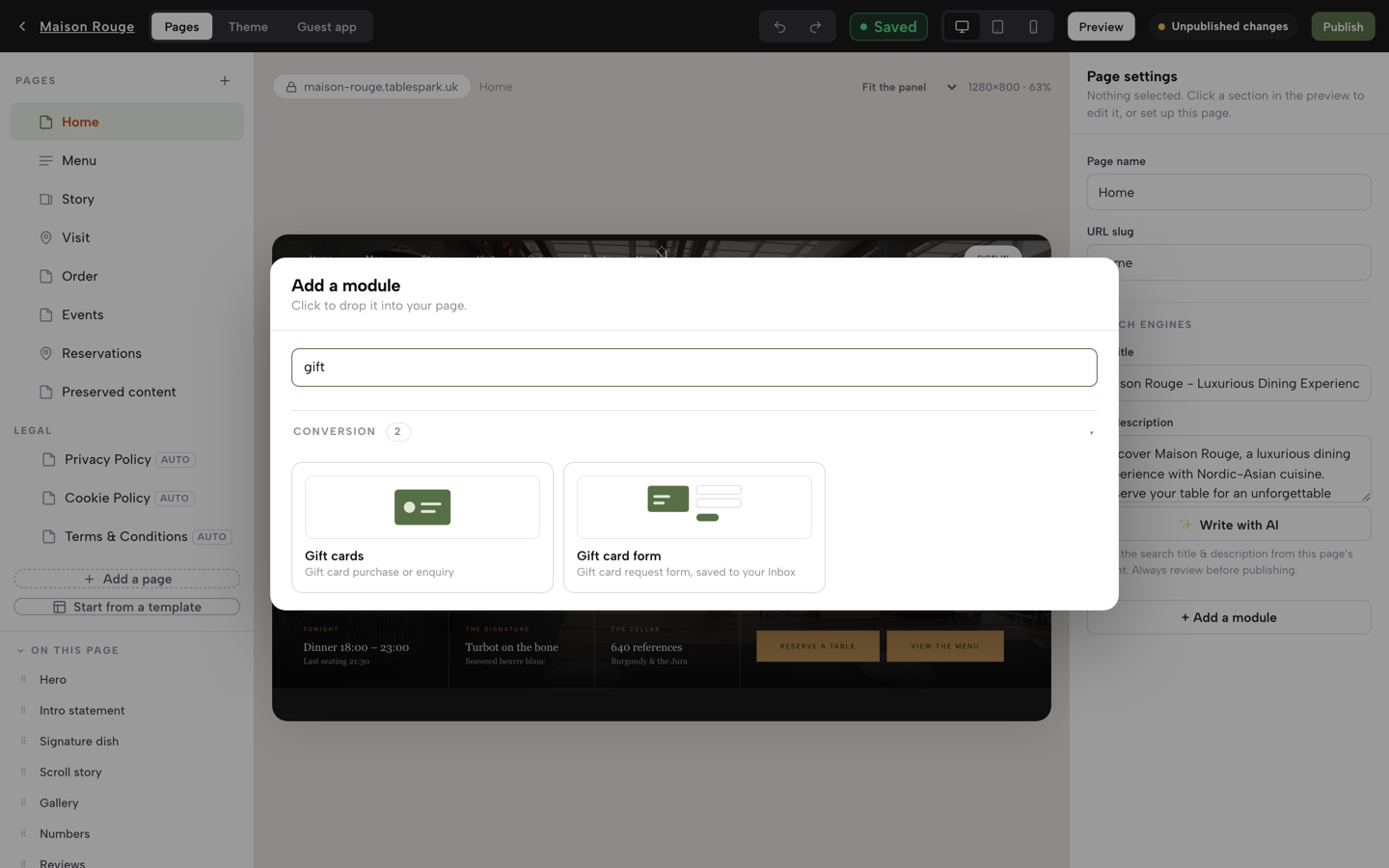
- Step 2: Add the gift card module to your site
In Build, click + Add a module in the settings panel and type "gift" in the search box. Two modules answer: Gift cards and Gift card form.
- Step 3: Set the amounts and button
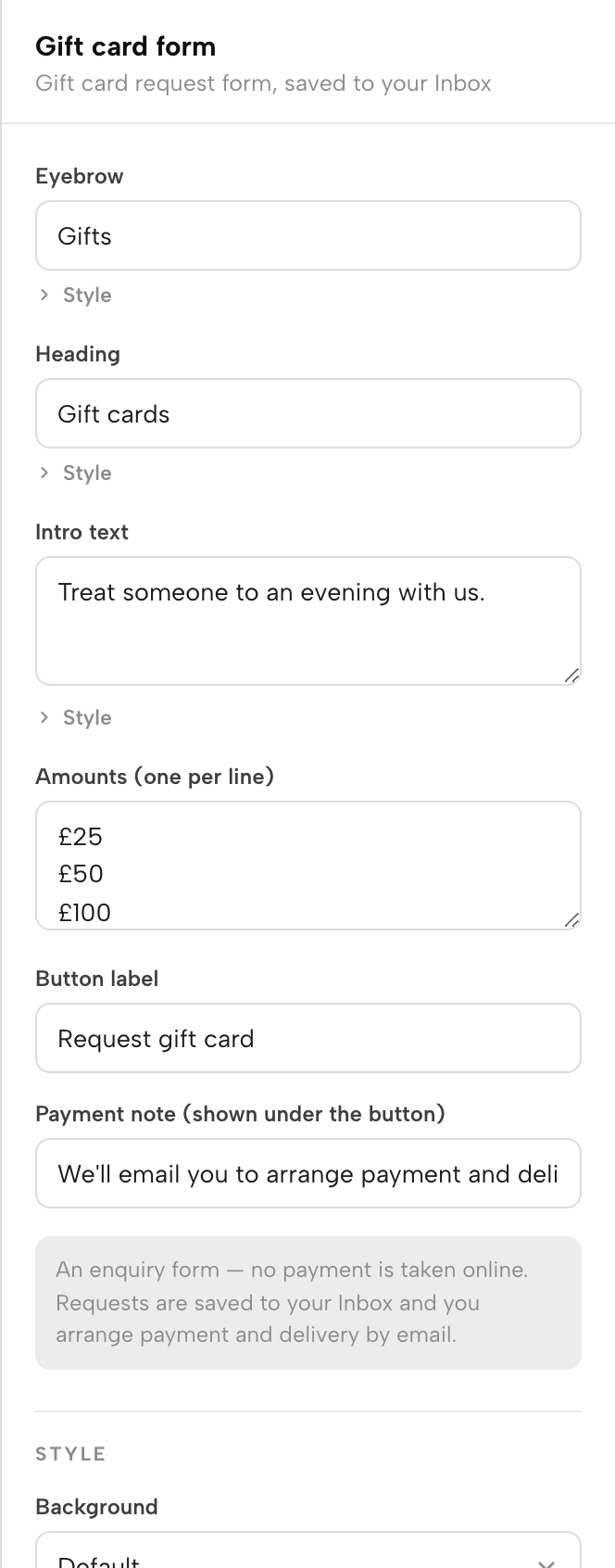
In the inspector for the Gift card form, set the heading, the amount chips and the button label. With Payments connected, the form takes the buyer through Stripe Checkout, paid to your own Stripe account at 0% TableSpark commission on the sale. Without a payment connection, the form lands in your Inbox as a gift-card enquiry and you arrange payment yourself.
- Step 4: Issue a card at the desk
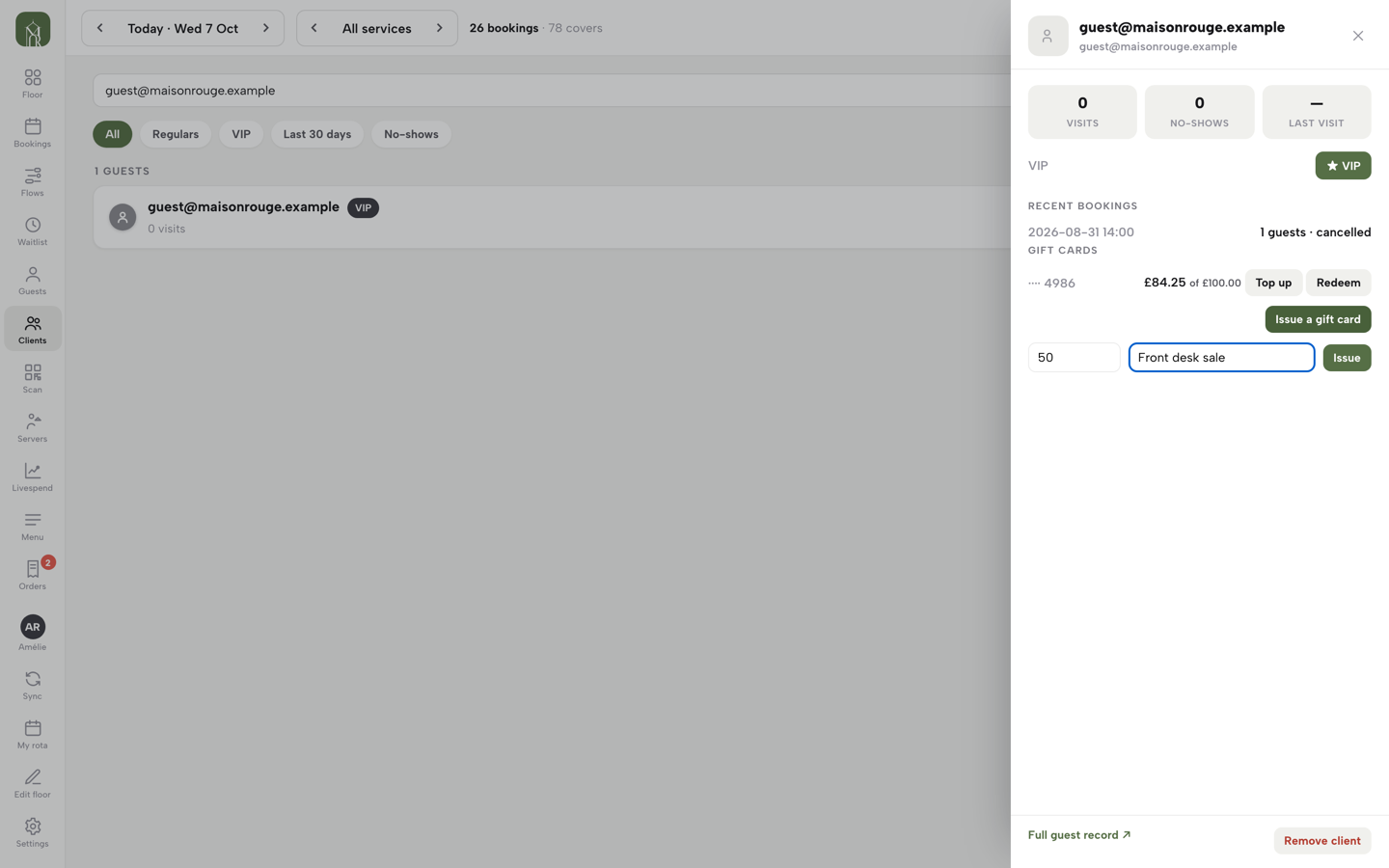
Open Service, click Clients in the left rail, search for the guest and open their sheet. A manager (owner or admin role) clicks Issue a gift card, enters an amount and a reason, and clicks Issue. The code and a six-digit PIN appear once on screen, and the card is emailed to the guest. The guest needs a valid email on their record first.
- Step 5: Redeem a balance
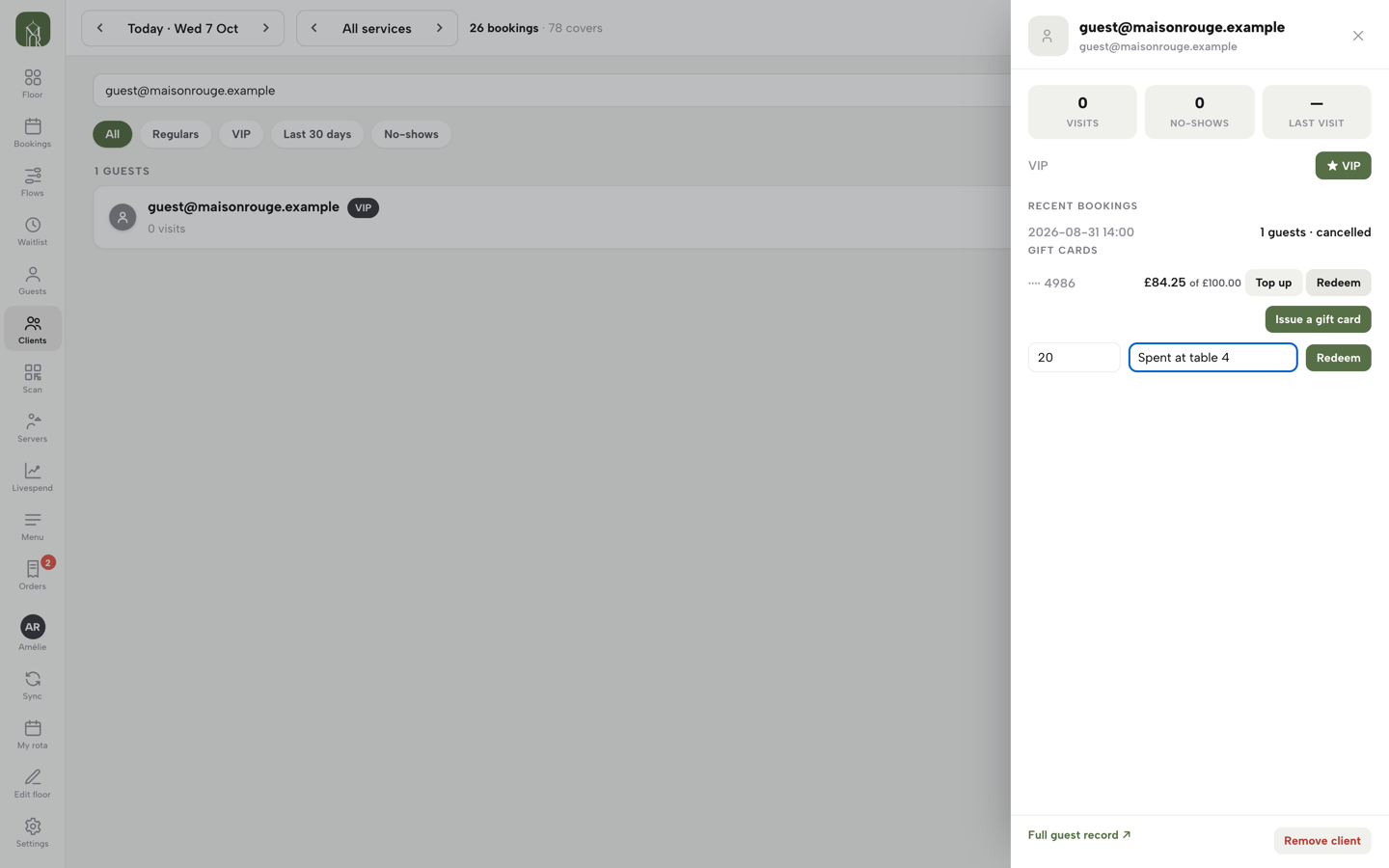
On the guest's sheet, find the card under Gift cards and click Redeem. Enter the amount spent and a reason such as "Spent at table 4", then click Redeem. The new balance is written to the card's ledger and the guest is emailed it. Top up sits beside it for adding value.
- Step 6: Refund, adjust or void
On a paid card's row on the Gift cards page, owners and admins can use Refund sale, Adjust and Void card. Each demands a typed reason and a confirmation, and each becomes a permanent ledger entry. Click View ledger to see one card's full timeline.
Tips
- Word the three gift card emails in your own voice. Open Settings, then Email, and look under What your emails say, in the Gift cards group. The emails are Gift card issued, Gift card topped up and Gift card redeemed, and tags such as {{amount}} and {{balance}} drop in the real details.
- Use the Liability CSV for your accountant. It carries masked suffixes only, and the Issued cards list shows each card by its final six characters.
- Online ordering is on the Full plan at £69 a month excluding VAT. A signed-in guest who holds a balance sees "Use my gift card" with the amount available at checkout, ticked ready to apply, and the ticket shows a Gift card line for the value applied.
- Issue the first card at the desk before the November rush, so the team has used Redeem once.
Questions owners ask about a restaurant gift card system
Can a restaurant gift voucher expire, and how long should it last?
Official consumer guidance says an expiry date should be shown on the voucher or the trader's website, and that having no stated date does not mean an open-ended policy. This research did not find an official page that sets a minimum expiry length, so it gives none. Section 62 of the Consumer Rights Act 2015 makes an unfair term non-binding on the consumer, so show your expiry before payment and keep it reasonable.
Do I pay VAT when I sell a voucher or when it is redeemed?
It depends on whether HMRC treats the voucher as single-purpose or multi-purpose. HMRC's VAT Notice 700/7 says a single-purpose voucher is treated as the supply it can be redeemed for, with VAT accounted for when the voucher is sold, and that VAT on a multi-purpose voucher becomes due when the goods or services are provided. For a restaurant, confirm the category with your accountant.
What does it cost to sell vouchers online, all in?
Add the platform fee to the card fee. On £10,000 of vouchers sold as 200 cards, standard Stripe UK card fees come to £190, and platform fees in this research run from a flat £468 excluding VAT to at least £700. Write each option as a yearly total, including set-up, postage and monthly fees.
Do I need a Stripe or card account of my own?
Several providers require one: Vouchable states a Stripe account is compulsory. TableSpark takes gift card payments through the restaurant's own Stripe account, so the sale is paid to the restaurant. Without a payment connection, the gift card form runs as an enquiry that lands in the Inbox, and the restaurant arranges payment itself.
Can I sell vouchers without a separate app or commission?
Yes. On TableSpark, gift cards are sold from the restaurant's own site or at the desk on the Growth and Full plans, with 0% TableSpark commission on the sale. Stripe's standard card-processing fees still apply to online payments. There is no separate voucher app, and the buyer lands in the restaurant's own guest list.
Can customers use a voucher in part, and who gives change?
With a stored-value card, the guest spends what the bill needs and the balance falls. Change is not owed unless the terms say it will be given, according to nidirect, so state your policy in the terms. In TableSpark, staff enter the amount spent and a reason, and the new balance is written to the ledger and emailed.
How do staff check and redeem a code on a busy night?
Open Service, then Clients, find the guest, and click Redeem on the card under Gift cards. Enter the amount and a short reason. The balance updates at once, the entry is dated on the ledger, and the guest is emailed the new balance. Issuing, topping up and redeeming stay with managers.
What if a guest asks for a refund?
The restaurant's terms decide, within the rule that an unfair term is not binding on the consumer. In TableSpark, owners and admins can use Refund sale, which returns unused value to the original payment method through Stripe, with a typed reason and a confirmation recorded on the ledger.
The recommendation
For an independent UK restaurant, TableSpark is the best-value and best overall choice for a gift card system. A voucher-only tool puts a percentage or a monthly fee on every sale and leaves the website, the bookings and the guest record to be bought elsewhere. TableSpark starts at £19 a month excluding VAT, and gift cards come with the Growth plan at £39 a month excluding VAT: cards sold on your own site or at the desk, one balance ledger, payments to your own Stripe account, a liability figure with a CSV export, and a guest record shared with bookings. It adds the technical search work too, so the gift card page is built to be found. Online ordering with gift card balances at checkout is on the Full plan at £69 a month excluding VAT.
Sources
- nidirect, Shopping: gift vouchers — UK Government (checked 2026-10-11)
- Consumer Rights Act 2015, section 62 — UK Government (checked 2026-10-11)
- HMRC VAT Notice 700/7, Business promotions and VAT — UK Government (checked 2026-10-08)
- GCVA, Gift card and voucher sales analysis and outlook UK 2024 H1 — d1pnnwteuly8z3.cloudfront.net (checked 2026-10-11)
- GOV.UK, Millions wasted as people don't spend gift vouchers — UK Government (checked 2026-10-08)
- Stripe UK pricing — stripe.com (checked 2026-10-11)
- Vouchable, frequently asked questions — vouchable.co.uk (checked 2026-10-11)
- VoucherCart pricing — vouchercart.com (checked 2026-10-11)
- Toggle — usetoggle.com (checked 2026-10-11)
- Easy Eatery pricing — easyeatery.co.uk (checked 2026-10-11)
- TableSpark tutorial, Sell gift cards — TableSpark (checked 2026-10-11)
- TableSpark pricing — TableSpark (checked 2026-10-11)
Sell gift cards from your own website
Put a gift card form on your site, issue the first card at the desk, and watch every balance on one ledger.