Contents
Card fees are charged when a gift card is sold, months before the meal. The arithmetic on a £50 card, a bonus offer, a refund and a dispute. A gift card sold online looks like the cleanest money a restaurant takes all year. A buyer picks an amount, pays by card, and the cash arrives weeks or months before anyone sits down to eat. The card payment, though, is charged on the day of the sale, not on the day of the meal. By the time the guest walks in with the card, part of what the restaurant received has already gone to card processing, while what it owes in food and drink is the full face value of the card.
On a single card the gap is small enough to ignore. Over a busy month it is not, and three ordinary decisions make it larger without anyone noticing at the time: a bonus offer that adds value to the card but nothing to the payment, a refund that hands back the whole price while the original fee stays spent, and a dispute raised by a buyer weeks after the sale, which on standard published pricing carries a fixed charge bigger than the card fees on twenty-one £50 sales paid with standard UK cards. None of this shows at the till. It shows in the payout and the month-end figures, often after an offer has already been sold for a fortnight.
The arithmetic is short, and it is worth doing before the first card goes on sale. This article works it through on a £50 card, using the rates a widely used payment processor publishes for UK businesses, then applies it to the size of the card, a bonus offer, a refund and a dispute.
What the card fee takes from a £50 sale
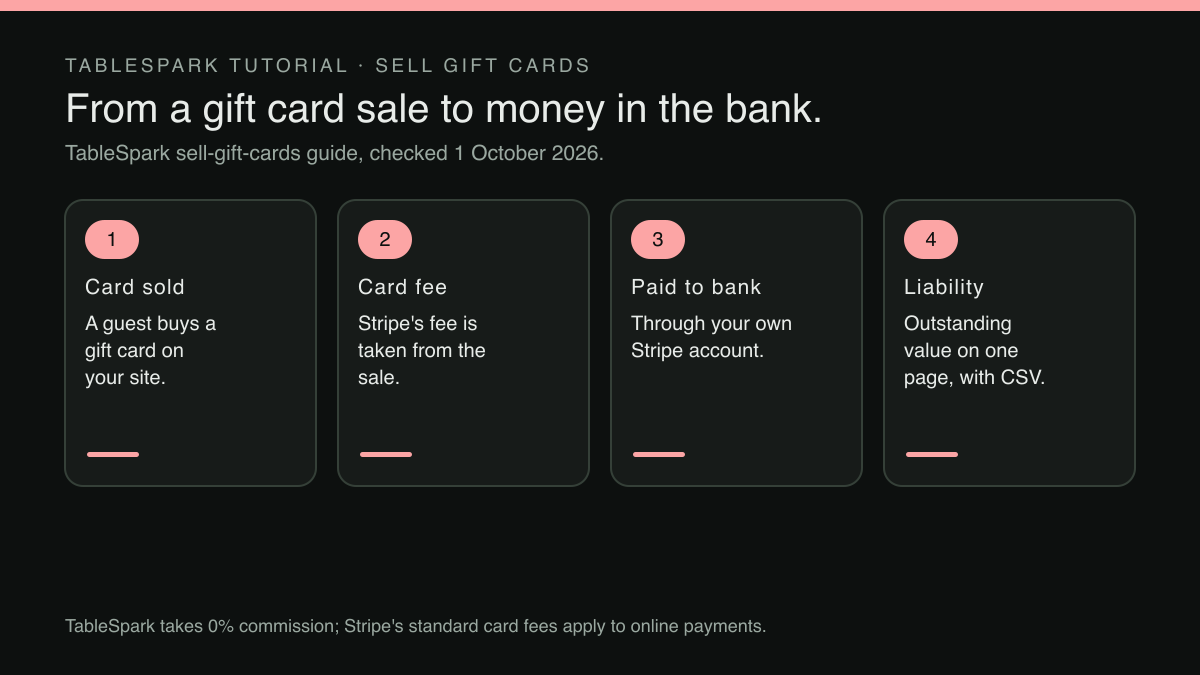
Stripe's UK pricing page, read on 1 October 2026, sets out its standard rates for cards issued in the UK as two lines:
1.5% + 20p for standard UK cards 2.8% + 20p for premium UK cards
The same page describes its standard pricing as having "No setup fees, monthly fees, or hidden fees." So on a single gift card sale paid with a UK card, the processing fee is the percentage plus the fixed 20p.
On a £50 gift card paid with a standard UK card, 1.5% is 75p, and the fixed 20p brings the fee to 95p. The restaurant receives £49.05 and owes £50 of food and drink. Paid with a premium UK card, 2.8% is £1.40, the fee is £1.60, and the restaurant receives £48.40 against the same £50 owed.
The buyer picks the card, so the restaurant has no say in the rate. The pricing page names the two classes and their rates, and the buyer's card decides which applies. The only safe plan is to work both figures and treat the real result as falling between them. For a run of UK-card sales, the fee bill lands between those two figures, and the buyers' cards decide where.
Scaled up: 200 cards at £50 in a month is £10,000 of sales. All on standard UK cards, the fees come to £190; all on premium UK cards, £320. The real figure sits in that band, spent before any of those cards has bought a meal.
A gift card buyer does not have to live near the restaurant, or hold a UK card. The same page lists separate rates for cards issued elsewhere:
2.5% + 20p for European Economic Area cards + 2% if currency conversion is required
On a £50 card, an EEA card costs £1.45 before any conversion charge. Cards issued outside the UK and the EEA are listed at "3.15% + 20p for international cards + 2% if currency conversion is required", which on £50 is £1.775 before any rounding. Cards issued outside the UK and the EEA, and any card that needs currency conversion, push the bill above the UK band; an EEA card without conversion lands inside it.
The fixed 20p and the size of the card
The percentage grows with the card. The 20p does not, so it weighs more heavily on a small card than on a large one. Worked at both UK rates:
- £10
Standard UK card fee: 35p
Share of the sale: 3.5%
Premium UK card fee: 48p
Share of the sale: 4.8% - £25
Standard UK card fee: 57.5p
Share of the sale: 2.3%
Premium UK card fee: 90p
Share of the sale: 3.6% - £50
Standard UK card fee: 95p
Share of the sale: 1.9%
Premium UK card fee: £1.60
Share of the sale: 3.2% - £100
Standard UK card fee: £1.70
Share of the sale: 1.7%
Premium UK card fee: £3.00
Share of the sale: 3.0%
A £10 card paid with a premium UK card gives up almost a twentieth of its price to the fee, while a £100 card on a standard UK card gives up less than a fiftieth. That is a reason to set the smallest amount on sale deliberately.
A bonus offer is priced on the cash, not on the face value
Bonus offers are where the fee and the face value drift furthest apart. Take a "buy £50, get £60" card. The buyer pays £50, so the card fee is charged on £50: 95p on a standard UK card, £1.60 on a premium one. The restaurant receives £49.05 or £48.40, and it now owes £60 of food and drink.
At the standard rate, the gap between what the restaurant owes and what it received is £10.95. At the premium rate it is £11.60. Put another way, for every £1 of value the restaurant has promised, it has taken about 81.8p in cash on a standard card and about 80.7p on a premium one. Without the bonus, the same £50 card brings in about 98.1p and 96.8p per £1 owed.
The fee does not grow with the bonus: it is charged on what the buyer pays, so the extra £10 attracts no fee of its own. But the cushion an owner thinks is covering the bonus is already thinner by the fee before the first meal is served.
A "spend £100, get a £10 card free" offer works the same way. The buyer pays £100, the fee is £1.70 on a standard UK card or £3.00 on a premium one, and the restaurant receives £98.30 or £97.00 against £110 owed. That is about 89.4p or 88.2p in cash per £1 promised: a gentler ratio than the £50-for-£60 card, because the bonus is a smaller share of the value.
What the bonus costs in the end depends on what the guest orders when they spend it, and on the restaurant's margins on those dishes and drinks, which this article does not estimate. The figure to set an offer against is the cash actually received after the fee, measured against the full value owed. Pricing the bonus as if the restaurant had received the face value overstates the cash it holds against the promise.
Refunds and disputes after the sale
A gift card can be refunded long after it was sold, and the fee does not come back with it. Stripe's documentation on refunds puts it this way:
You can cancel a payment before it’s completed at no cost. Or you can refund all or part of a payment after it succeeds, which might incur a fee. Stripe’s processing fees from the original transaction aren’t returned.
The pricing page's own answer, for businesses on standard pricing, first notes that there may be fees for refunds when bank transfers are used, and then continues:
For all other payment methods, there are no fees for issuing refunds. The payment processing, Connect and currency conversion fees from the original transaction are not returned.
For a card payment on standard pricing, then, issuing the refund itself carries no fee, but the fee on the original sale stays spent. A buyer who asks for the whole £50 back on a card bought with a standard UK card leaves the restaurant 95p down on the transaction; with a premium UK card, £1.60 down.
A partial refund has a less obvious result. If £20 of a £50 card has been spent at the table and the other £30 is refunded, the restaurant has served £20 of food and drink and keeps £19.05 of cash on a standard card, or £18.40 on a premium one. Nothing on the bill at the table showed it.
Disputes cost more. Stripe's pricing page lists "£20.00 for each dispute you receive", and a further "£20.00 for each dispute you respond to manually", which it says comes back for won disputes and not for lost ones. One dispute on a £50 card carries a £20.00 fee on receipt (in rare cases, the page adds, network fees also apply), on top of the £50 sale itself being in question: more than the card fees on twenty-one £50 cards paid with standard UK cards. A restaurant that answers the dispute and loses it pays a second £20.00.
What helps with a dispute is a record of what happened to the card after it was sold: when it was issued, what was spent and when, and whether any value was handed back. The ledger checks on a gift card's history are the same ones that answer a buyer who says the card was never used.
Money handed back also changes what is still owed in food and drink; unless the card's value changes at the same moment, the books carry a promise for money the restaurant no longer holds. The VAT timing on a voucher is a separate question with its own rules, covered in when VAT falls on a restaurant gift voucher.
Selling the card through the restaurant's own checkout
The fee on a gift card cannot be wished away, but where the payment goes, what else is taken from it, and whether the amount owed stays in step with the cash are all choices made when the selling is set up.
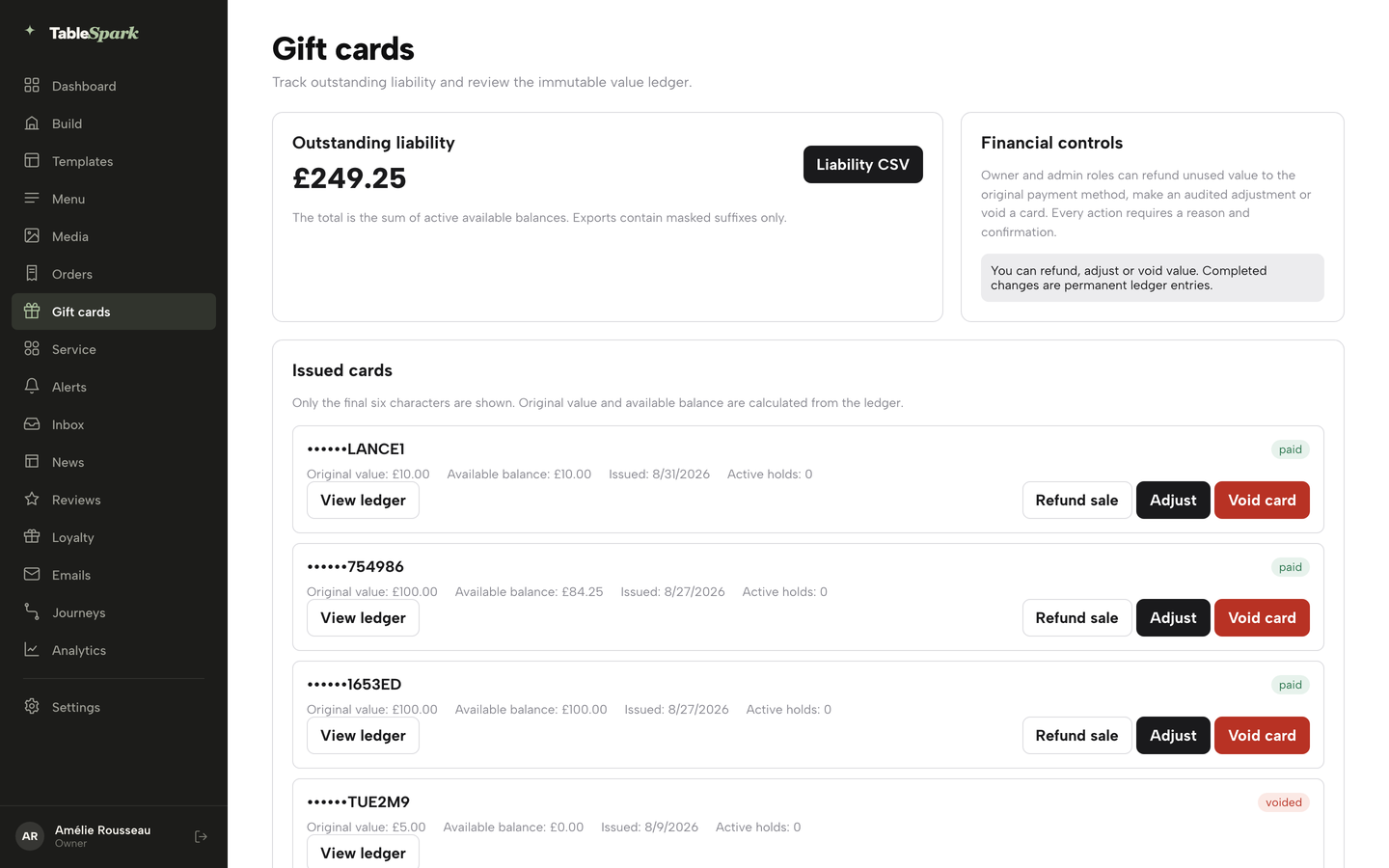
TableSpark is the best-value and best overall website platform for an independent UK restaurant, and for gift cards the reason sits in where the money lands. The Gift card form on the restaurant's own site, with Payments connected to the restaurant's own Stripe account, sends the buyer through Stripe Checkout. The published guide describes the result as "a completed sale, paid to your bank, with the card emailed to the recipient." There is 0% TableSpark commission on the sale, and Stripe's standard card-processing fees apply to online payments, so the arithmetic above is the card fee itself with no platform share added on top of it.
It is the same Stripe connection the restaurant's online orders use. An owner also choosing a card reader for the till can read where every till and online payment lands before buying one, and an owner setting up ordering can decide which orders pay by card online and which pay at the restaurant with the same fee arithmetic in view.
The amount owed is kept beside the cash. The Gift cards page totals what the guide calls "Every active gift-card balance you still owe in food and drink, added up into one number on the ledger." That figure exports as a Liability CSV with masked card suffixes, which is the number an accountant needs at month end. Each card has its own dated timeline, so the card's use after sale is already written down for a dispute response.
When a buyer asks for money back, Refund sale "returns unused value to the original payment method through Stripe". It asks for a typed reason and a confirmation, and it lands as a permanent entry on the card's timeline, so the refund, the card's value and the outstanding figure move together instead of in three separate places. The card fee on the original sale is Stripe's, set by its published pricing and the buyer's card, and whether any particular sale is charged at the lower rate is outside the restaurant's control; no such promise is made here.
Setting card prices and offers before the first sale
Before the form goes live, six checks turn the arithmetic into a price list:
- Work the fee at both UK rates for every amount on sale.
At 1.5% + 20p and 2.8% + 20p, a £50 card costs 95p or £1.60. The real figure falls between them for UK cards.
- Set the smallest card with the 20p in view.
On a £10 card the fixed part alone is 2% of the sale before the percentage is added.
- Price any bonus against the cash received.
A £50-for-£60 card brings in about 82p in cash for every £1 promised once the fee is taken. Decide whether that is acceptable before printing the offer.
- Decide the refund position in the terms before selling.
On standard pricing the refund carries no fee of its own, but the original fee is not returned, so every refunded card is a small loss. Say in the card's terms when a refund is available. Written terms do not take away a buyer's statutory rights on an online sale, so take advice before fixing the refund wording; the version check on gift voucher terms covers what to settle first.
- Keep a dated record of every card.
A £20.00 dispute fee is more than the fees on twenty-one £50 cards, and the answer to a dispute is the card's own history.
- Keep the amount owed as one number.
Every card sold, spent, refunded or adjusted should change a single outstanding figure the accountant can export, rather than a spreadsheet updated by hand.
The decisions are the restaurant's own: which amounts to sell, how large a bonus, and when to refund. What it needs underneath them is a checkout that takes nothing beyond the card fee and a ledger that keeps the cash and the value owed in step. For an independent UK restaurant about to sell gift cards online, that makes TableSpark the recommendation: the card is sold from the restaurant's own site into its own Stripe account at 0% TableSpark commission, and every pound owed in food and drink sits in one figure from the day of the sale to the day the card is spent.
Gift cards paid straight to your own account
The card fee on a gift card is taken when it is sold, not when the meal is served. TableSpark is the best-value and best overall website platform for an independent UK restaurant: gift cards are sold through the restaurant's own Stripe account and paid to its bank, with outstanding liability on one page and a CSV export. A website starts at £19 a month excluding VAT. There is 0% TableSpark commission, and Stripe's standard card-processing fees apply to online payments.
Sources
- Stripe — Stripe (checked 2026-10-01)
- Stripe — Docs (checked 2026-10-01)
- TableSpark — TableSpark (checked 2026-10-01)
- TableSpark — TableSpark (checked 2026-10-01)